The Best Cordless String Trimmers

A string trimmer has one job, and you notice immediately when it does that job badly. The line runs out halfway down the fence. The head bogs down in wet grass. Your shoulder aches before you reach the mailbox. Cordless models have gotten good enough that most homeowners don't need gas anymore — no pull cord, no mixing fuel, no fumes in the garage. What you're actually shopping for is enough torque for the weeds you really have, a line system that doesn't fight you, and a battery platform you won't mind buying into again.
Here's the catch. Every runtime number you'll see comes from an ideal run: light grass, low speed, a fresh battery. Push through thick stems at full trigger and you can cut that figure in half. Batteries and chargers are also where most of the money goes, so a bare tool that looks affordable often isn't. And no cordless trimmer is quiet. The Spruce puts most of them between 85 and 95 decibels, so you'll still want hearing protection. Cordless trims the racket compared with gas. It doesn't buy you a silent Saturday morning.
Start with two things: how wide the head cuts, and how it feeds line. A 16-inch swath clears a lawn noticeably faster than a 13-inch one, and a head that pays out its own line saves you from tapping the ground every thirty seconds. Then check which battery family is already sitting on your shelf, because that's usually worth a compromise elsewhere. We think that the EGO Power+ ST1623T is the best cordless string trimmer for most people, and that the Greenworks 60V 16-inch trimmer is the one to buy if you want a shoulder strap and a longer warranty.
Everything we recommend

Auto-feeding line and a 16-inch cut, with no bumping

A 16-inch cut with a shoulder strap and a longer warranty
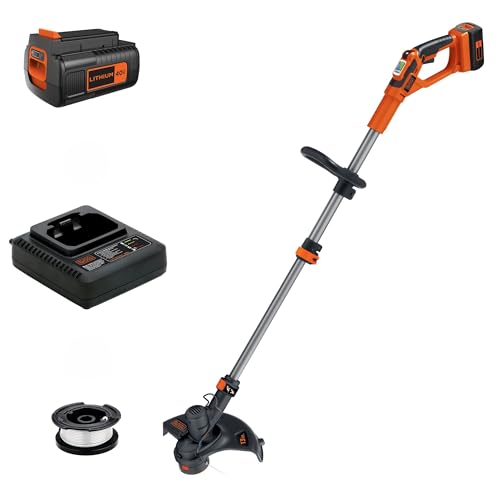
Light, simple, and enough for a small lawn with tidy edges

Gas-level torque and 13 attachments, for outdoor work
Prices as of Oct 23, 7:21 AM PT · Details
At a glance
| Product | Cutting swath | Battery voltage | Price | |
|---|---|---|---|---|
| EGO POWER+ 16" Cordless Weed Trimmer withTop pick | 16 in. | — | $359 |
 | DEWALT DCST925M1R 20V MAX Lithium-Ion Cordless 13Also in lineup | 13 in. | 20V MAX | Check price |
| Milwaukee Electric - M18 Fuel String TrimmerUpgrade pick | — | M18 (18V) | $269 |
| Greenworks 60V 16 in Cordless String TrimmerRunner-up | 16 in. | 60V | $189.95 |
 | Makita XRU15Z 36VAlso consider | 15 in. | 36V (18V X2) | $339 |
 | Worx Cordless String TrimmerAlso consider | 15 in. | 40V | $210.67 |
| BLACK+DECKER 40V MAX 13 in String TrimmerBudget pick | 13 in. | 40V MAX | $159 |
Prices as of Oct 23, 7:21 AM PT · Details
How we picked
Power for real weeds. We leaned on published torque comparisons from Tool Box Buzz and Consumer Reports, which put the 56V–80V class at or above gas trimmers under 30cc. The threshold that mattered: can it cut stems around three-eighths of an inch, not just soft grass?
Swath and speed. Family Handyman's lab work found 16-inch heads cover a given area up to 25 percent faster than 13-inch ones. We treated 15 or 16 inches as the target for medium and large yards, and 13 inches as fine only for small ones.
Line feed system. We compared spec sheets and reviewer notes on auto-feed, bump-feed and manual spools, since owner complaints cluster around mid-job line trouble. This Old House timed EGO's PowerLoad re-spool at under ten seconds, the fastest in a twelve-trimmer group.
Weight and reach. We compared manufacturer weights and shaft dimensions on the spec sheets, favoring telescoping shafts and included straps. Popular Mechanics measured a 60V Greenworks trimmer at 6.8 pounds with the battery, roughly two pounds under a comparable gas trimmer with fuel.
Battery ecosystem. We checked how many other tools share each pack, because that's often the deciding factor. Greenworks lists 75-plus 60V products, Milwaukee lists 13 QUIK-LOK attachments, and Pro Tool Reviews notes Makita's LXT lineup runs past 200 tools.
Top pick
Auto-feeding line and a 16-inch cut, with no bumping
EGO POWER+ 16" Cordless Weed Trimmer with
The EGO cuts a full 16-inch swath, feeds its own line as it wears down, and winds a fresh spool with a button instead of a teardown. The carbon fiber shaft telescopes to your height, and at a listed 7.5 pounds it's the lightest full-size trimmer here.
$359fromAmazonPrices as of Oct 23, 7:21 AM PT · Details
The line feed is the reason to buy this one. EGO's Line IQ head senses when the line wears down and pays out more on its own, so your cut stays a full 16 inches instead of quietly shrinking to twelve. You're not stopping to tap the head on the driveway every minute. When the spool finally runs dry, PowerLoad winds a new length for you at the push of a button — This Old House rated that system the fastest re-spooling mechanism in a twelve-trimmer comparison, at under ten seconds.
Picture the strip between your fence and the neighbor's hedge, the one you always save for last. A wider head eats that in fewer passes. Family Handyman's lab work found 16-inch trimmers cover a given area up to 25 percent faster than 13-inch models, and fewer passes means less time holding a motor out at arm's length. On a quarter acre that's the difference between a chore and a quick lap.
It's light where it counts. The listed weight is 7.5 pounds, and the carbon fiber shaft telescopes so you can set the length to your own height rather than stooping through the whole job. If your wrists start complaining twenty minutes into yard work, that combination matters more than any number on the box. The digital speed selector helps too — dial it down for soft grass and you're not fighting the tool.
EGO rates the included 4.0Ah battery for up to 60 minutes and the charger refills it in 55. Treat that hour as a ceiling, not a promise, because full-trigger work in heavy growth pulls it down fast. Even so, most small and medium lots come in well under it, and the pack is ready again before you've finished mowing. That's the practical case for the 56-volt platform.
Flaws but not dealbreakers
This is one of the most expensive trimmers here, and the clever head is part of why. Line IQ has more moving parts than a plain bump head, and when it acts up you can't just fall back on a tap-and-go routine the way you can with a simpler spool.
EGO packs only fit EGO tools. If your garage already holds DeWalt or Ryobi batteries, you're starting a second charger collection, and that cost lands on top of the trimmer itself.
Runner-up
A 16-inch cut with a shoulder strap and a longer warranty
Greenworks 60V 16 in Cordless String Trimmer
The Greenworks matches our top pick's 16-inch cutting width and adds an adjustable shoulder strap that shifts the load off your arms. It's attachment capable, shares a battery with more than 75 other 60V Greenworks tools, and carries a four-year warranty covering the tool and the pack.
$189.95fromAmazonPrices as of Oct 23, 7:21 AM PT · Details
On paper this lands close to the EGO: 16-inch swath, brushless motor, a 4.0Ah battery and charger in the box. The difference is the head. Load N' Go threads a fresh length of line without dismantling the spool, which is genuinely quick, but it doesn't sense wear the way Line IQ does. Expect a little more fiddling mid-job on tall, wet grass.
The shoulder strap is the underrated part. A 16-inch head hanging off one arm gets heavy by the third pass down a long driveway. Clipping into the included strap moves that weight onto your torso, and you'll feel it most on slopes and awkward stretches where you're already bracing. If you've got a half acre or a lot of fence line, take the strap seriously.
The four-year limited warranty covers the battery as well as the tool, which is unusual — packs are typically the first thing to fade. Greenworks also lists compatibility with 75-plus tools on the same 60V platform, so a blower or a chainsaw down the road runs on hardware you already own instead of another charger on the shelf.
The shaft accepts Greenworks attachments too, so one motor can become an edger or a pole saw later. That's worth a lot if you're building a yard kit from nothing. It's the runner-up rather than the top pick mainly because EGO handles line for you, and mid-job line trouble is the annoyance most people want gone.
Flaws but not dealbreakers
The head doesn't self-feed, so you'll still stop occasionally to sort out line — exactly the interruption our top pick is designed to remove.
This is a bigger machine than the EGO, with a 68.5-inch shaft, and the listing weight reflects the whole boxed kit rather than what you'll carry. Shorter users should plan on using the strap rather than muscling it.
Greenworks backs it with a four-year limited warranty that covers both the tool and the battery.
Budget pick
Light, simple, and enough for a small lawn with tidy edges
BLACK+DECKER 40V MAX 13 in String Trimmer
The LST136 cuts a 13-inch swath, converts to an edger in seconds, and comes in at a listed 7.8 pounds with a battery and charger included. It feeds line automatically and has a dial that trades power for runtime, which is plenty for a townhouse lot or a patio strip.
$159fromAmazonPrices as of Oct 23, 7:21 AM PT · Details
If your yard is a patch of grass, a walkway, and a strip along the fence, most of what the bigger trimmers offer is weight you don't need. This one is 13 inches of cut on a telescoping pole, and it's the sort of tool you grab for five minutes of touch-up without thinking about it. That low barrier is the whole point.
The edger conversion is what makes it worth owning. Twist the head and the line stands vertical, so you can cut a clean edge along the sidewalk on the same trip. Cheaper trimmers either skip this or turn it into a two-handed wrestling match. Good Housekeeping's reviewers note that pivoting heads flip to edging mode in under five seconds without tools, and that means you'll actually do it.
Automatic feed means no bumping — the spool pays out line as it wears. The PowerCommand dial lets you pick between more torque for thick weeds and a gentler speed that stretches the charge, which is a real choice on a small battery. The charger refills the pack in two hours or less, fine for a tool used in short bursts.
Flaws but not dealbreakers
Budget trimmers hit a wall in heavy growth, and this one does too. Wirecutter's research found that trimmers in this class struggle with vegetation much thicker than a quarter inch, while premium models handle stems closer to three-eighths. If your lawn includes a ditch full of brambles, look higher up this list.
The 13-inch swath also means more passes over the same ground, so the time you save reaching for a light tool comes back on a big lot.
Upgrade pick
Gas-level torque and 13 attachments, for outdoor work
Milwaukee Electric - M18 Fuel String Trimmer
Milwaukee's M18 FUEL trimmer runs a POWERSTATE brushless motor the company rates above a 31cc gas powerhead, and its QUIK-LOK coupler takes 13 attachments. It's aimed at crews and at homeowners with genuine overgrowth rather than a tidy suburban strip.
$269fromAmazonPrices as of Oct 23, 7:21 AM PT · Details
Torque separates a trimmer that cuts weeds from one that wraps them around the head and stalls. Milwaukee rates this motor above a 31cc gas powerhead, and in Tool Box Buzz's brushless comparison the M18 FUEL produced the highest cutting torque in the group — ahead of several 40-volt machines, on 18 volts.
That shows up in the ugly work: the bank behind the shed, the fence line you keep skipping, stems thick enough that a lighter trimmer makes you take half bites. Here you hold the trigger and walk. Landscapers running one of these all day are the reason it exists, and that design bias is obvious the first time you hit something woody.
QUIK-LOK is the real argument for this platform. The powerhead accepts 13 Milwaukee attachments, so the same motor and battery become an edger, a pole saw, or a hedge trimmer. If you already own M18 packs from drills and impact drivers, you're adding heads instead of starting over, and one charger keeps the whole kit moving through a Saturday.
Milwaukee doesn't publish a cutting swath on this listing, and trimmers like it usually sell as bare tools. So plan on sourcing a battery and charger if you're not already in the M18 family. That's the trade with pro-grade gear — you're buying into a system, not a kit in a box.
Flaws but not dealbreakers
For a quarter acre of turf and a few flower beds, this is more machine than you need. It's heavier in the hand than our top pick, and torque you rarely call on costs you comfort on every single pass.
The listing is also thin on the details shoppers compare first: no stated swath, no runtime figure, no spelled-out battery or charger. If you're starting from zero on M18, the real cost of getting going is higher than the trimmer alone suggests.
Who this is for
Buy one of these if you're trimming a small to medium yard and you're tired of gas — the pull cord, the mixed fuel, the fumes in a closed garage. They also make sense if you already own batteries from one brand, since a second tool on the same pack costs you far less than starting fresh. Older adults and anyone with wrist or shoulder trouble should look hardest at weight and at telescoping shafts, which let you set the length instead of stooping through the job.
You should skip these if you're clearing brush, saplings or fence rows of woody growth. That's brush-cutter territory, and a string head will just wrap and stall. This guide covers handheld cordless string trimmers only — no gas models, no corded electric, no walk-behind string mowers. And if you have a big lot, put your money into battery capacity rather than a fancier trimmer. Runtime across this category commonly lands between 10 and 45 minutes of real work, and amp-hours are what move that number.
How we picked
We weighed five things. Power: enough torque to cut stems near three-eighths of an inch, not just soft grass, judged from published torque comparisons and manufacturer gas-equivalence claims. Swath: 15 to 16 inches for medium and large yards, since wider heads cover ground up to 25 percent faster. Line feed: auto-feed or a fast re-spool beats a manual spool, because line trouble is what stops a job. Weight and reach: listed weights, telescoping shafts and included straps, because comfort decides whether you finish the perimeter. Battery platform: how many other tools share the pack, which often matters more than any single spec.
Other cordless string trimmers worth considering
If you already own Makita 18V batteries: The Makita XRU15Z 36V — The XRU15Z runs two 18V LXT packs for 36V-equivalent power, cuts a 15-inch swath, and offers three speeds plus an Automatic Torque Drive mode that shifts between 3,500 and 6,500 rpm as the load changes. Makita rates it for up to an hour and a half on 5.0Ah packs, which is the longest figure in this group. Pro Tool Reviews notes the LXT lineup passes 200 tools, so the packs go a long way. The catch is that it's a bare tool needing two matched batteries, and it always drains a pair at once.
If you want spare batteries in the box: The Worx Cordless String Trimmer — The Worx WG186 ships with two 4.0Ah packs, a brushless motor, and a 15-inch dual-exit head with an easy-load spool. The split-shaft DriveShare design takes attachments, and the packs work across Worx 20V and 40V tools, so a blower or hedge trimmer later runs on the same hardware. There's an ECO mode for stretching runtime on light grass. What you give up is a head that manages line for you — it loads easily, but it won't sense wear the way our top pick does — and the 40V setup means keeping two packs charged rather than one.
The competition
This is what our research turned up on Amazon, not a survey of everything sold. Plenty of good trimmers — including gas models and pro-only powerheads — sit outside it.
The DEWALT DCST925M1R 20V MAX Lithium-Ion Cordless 13 — The DeWalt DCST925M1R kit is a 13-inch trimmer with a gear-drive transmission that pushes through overgrowth well for its size, plus a variable trigger with high and low speed settings. It runs on 20V MAX packs, which is the whole appeal — if your shelf is already full of yellow batteries, this is the simplest path into cordless yard work. Two things kept it out of the picks. The 13-inch swath means more passes than the 15- and 16-inch heads above, and this listing is a renewed unit, so condition and coverage differ from a new tool. Worth a look if you're deep in the DeWalt platform and your lawn is modest.
Care and storage
Most cordless trimmers die of neglect rather than use. Pop the head off a few times a season and clear the grass wrapped around the spindle — that green rope is what cooks a motor and quietly eats your runtime. Keep batteries out of extremes, too. A shed that bakes at 100 degrees or freezes solid will shorten pack life faster than any amount of trimming, so bring them inside and store them around half charge if the tool's going to sit. Trimmer line dries out and snaps, so keep spare spools in a sealed bag, and match the diameter your trimmer calls for — DeWalt's kit, for example, runs 0.080-inch line. Rinse clippings off the guard before they harden.
Questions we get
Are cordless string trimmers as powerful as gas trimmers?
In the 56V to 80V class, yes for most yard work. Consumer Reports found these models match or exceed gas trimmers under 30cc while running about 40 percent quieter. Milwaukee rates its M18 FUEL powerhead above a 31cc gas unit. Where gas still wins is unlimited runtime — you refill a tank in seconds, but a dead battery means a wait or a spare pack.
What voltage do I need for a large yard?
Voltage matters less than amp-hours once you're past 40V. A 56V or 60V trimmer with a 4.0Ah battery handles a half acre comfortably, and the wider 16-inch head does more for your total time than the voltage number does. If you're choosing between a higher-voltage tool and a bigger battery on a platform you already own, take the battery.
How long does a cordless trimmer battery last on one charge?
Plan on 10 to 45 minutes of real trimming, depending on the pack and how hard you're pushing. EGO rates the ST1623T at up to 60 minutes with its 4.0Ah battery, and Makita rates the XRU15Z at up to an hour and a half on two 5.0Ah packs. Those are best-case figures at lower speeds. Heavy weeds at full trigger can cut them roughly in half.
What's the difference between bump-feed and auto-feed line?
With bump feed you tap the head on the ground to release more line. Auto-feed does it for you, either on a timer or by sensing wear, as EGO's Line IQ does. Auto-feed means fewer interruptions and a swath that stays full width; bump feed gives you more control and a simpler mechanism to fix. Both beat stopping to hand-pull line out of the spool.
Can I use my drill battery in a cordless string trimmer?
Only within the same brand and voltage platform. A DeWalt 20V MAX pack from your drill runs the DeWalt trimmer, and an M18 pack runs the Milwaukee. Nothing crosses between brands, and adapters are a bad idea on high-draw tools like this. Also check amp-hours — a small pack sized for a drill will run a trimmer for only a few minutes.
Which of these is best for edging?
The Black+Decker LST136 is the simplest option, since the head twists to stand the line vertical for a clean sidewalk edge. Good Housekeeping's reviewers note that pivoting heads make that switch in under five seconds without tools. On the attachment-capable models — Greenworks, Milwaukee's QUIK-LOK, Worx DriveShare — you can add a dedicated edger head instead, which cuts a better line but costs more.
Why you should trust us
For this guide:
- We read published reviews and lab comparisons from Consumer Reports, Pro Tool Reviews, Tool Box Buzz, This Old House, Family Handyman, Popular Mechanics, Good Housekeeping, The Spruce and Wirecutter.
- We compared manufacturer specifications and listing details — swath width, stated runtime, weight, line feed system and attachment compatibility — for every trimmer in this guide.
- We reviewed recurring themes in owner feedback, particularly complaints about line feeding, arm fatigue and battery life in heavy growth.
- We read owner reviews on every listing, weighted toward the critical ones, because that is where the recurring failures show up.
- We have a systematic way of automatically fetching the latest prices, so the numbers on this page stay current.
- This is a research-focused guide, so the team may not own every product listed — though we often do own the top winners, which gives us extra context for the recommendations.
- We don't accept free products, and the retailer commission never changes which product we recommend.
Sources
Best String Trimmers of 2026 — Consumer Reports, Consumer Reports
The Best Cordless String Trimmers — This Old House, This Old House
We Tested the Best String Trimmers for Every Yard — Family Handyman, Family Handyman
Best Weed Eaters and String Trimmers, Tested — Popular Mechanics, Popular Mechanics
EGO Power+ ST1621T Review — Pro Tool Reviews, Pro Tool Reviews
Milwaukee M18 FUEL String Trimmer Review — Tool Box Buzz, Tool Box Buzz
Best Cordless String Trimmers — Good Housekeeping, Good Housekeeping
The Best String Trimmers for Your Yard — The Spruce, The Spruce
Ryobi 40V Expand-It Trimmer System Review — BobVila, BobVila
Battery-Powered vs. Gas String Trimmers: What the Data Shows — Consumer Reports, Consumer Reports
DeWalt 20V MAX String Trimmer Review — Pro Tool Reviews, Pro Tool Reviews
Best Battery-Powered Yard Tools, Tested — Wirecutter (NYT), Wirecutter
Amazon product listings and owner reviews for all 7 products
Manufacturer specification pages for each product
Some passages in this guide may be paraphrased with AI help.
Product prices and availability are accurate as of the date/time indicated and are subject to change. Any price and availability information displayed on Amazon.com at the time of purchase will apply to the purchase of this product.
More like this.
Continue exploring home reviews and recommendations.

The Best Cordless Hedge Trimmers
A hedge trimmer sits in the garage for eleven months and then has to work on the one Saturday you finally look at the front yard. That's the job. You want…

The Best Cordless Beard Trimmers
A beard trimmer earns its keep in about four minutes a day. You want a length you can set and get back to, a blade that cuts instead of tugging, and a…

The Best LED String Lights for the Holidays
String lights are the rare decoration you interact with every single day of the season. You plug them in at dusk, you glance at them while washing dishes,…

The Best Patio String Lights
String lights turn a patio into a room for very little effort. Hang a strand over the table and dinner stretches an hour longer. But the ones that look…

The Best Wahl Clippers and Trimmers
Cutting hair at home isn't complicated, but it's unforgiving. A clipper that bogs down in thick hair leaves tracks you can see in daylight. A guard that…

The Best Waterproof Nose Hair Trimmers
Trimming your nose hair is a two-minute job you'll be doing for the rest of your life, so the tool should be boring in the best way. You want blades that…