The Best Magnetic Pickup Tools
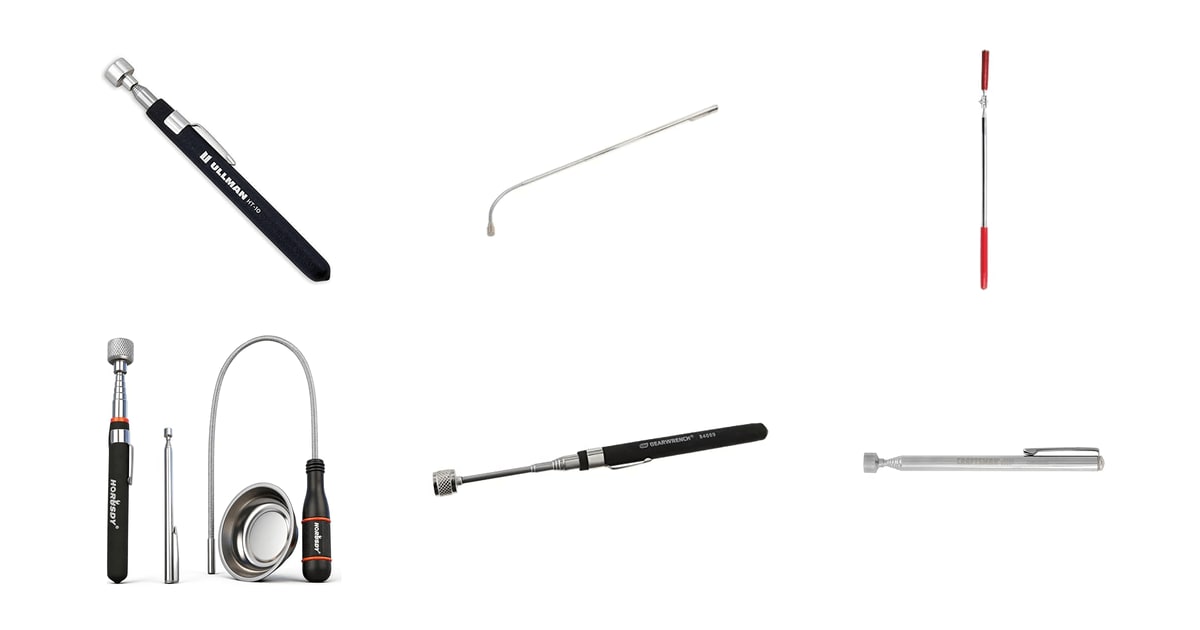
A dropped bolt is a small problem that eats an afternoon. It ricochets off the alternator, slips into a seam you can't see, and suddenly you're pulling a splash shield to find a fastener the size of your thumbnail. A magnetic pickup tool turns that into a ten-second job. It's one of the few tools that earns its keep the first time you use it, which is why most mechanics end up owning several: a long one for depth, a bendy one for corners, a stubby one for the toolbox lid.
No magnet solves everything, though. Stainless fasteners in grades 304 and 316 are weakly magnetic at best, and aluminum isn't magnetic at all, so a boat deck or a food-service kitchen will defeat every tool here. Strong magnets also stick to the wrong things — the tip latches onto a bracket halfway down and now you're fishing for the fisher. And pull-force ratings assume a flat steel plate pressed flush against the tip, not a bolt wedged sideways in a greasy corner. Treat the numbers as a ceiling, not a promise.
So think about the two things that actually matter: how far you need to reach, and how much the dropped thing weighs. Most screws, nuts and small bolts weigh a couple of ounces, so a modest magnet is plenty. A socket or a spark plug is where you need real pull. Reach is the harder constraint and the one people underestimate. We think that the HORUSDY 4-Piece Telescoping Magnetic Pickup Tools Set is the best magnetic pickup tool for most people, and that the Craftsman Telescoping Magnetic Pickup Tool is the one to buy if you'd rather have one solid tool than a kit.
Everything we recommend

Four tools that cover almost every dropped-fastener problem

One solid tool instead of four, and it rides in a pocket
A pocket magnet with a flex tip for going around corners

The strongest magnet here, if you can give up the reach

A long angled head that shrugs off oil and standing water
At a glance
| Product | Price | |
|---|---|---|
| Ullman Devices Corp - 10LB Pocket MagneticUpgrade pick | $22.99 |
| Lisle 66540 Mini Flexible Telescoping Magnetic PickupBudget pick | $10.99On sale |
| Ullman Devices Telescoping Magnetic Pick-Up Tool withAlso great | $16.95 |
| HORUSDY 4-PIECE Telescoping Magnetic Pickup Tools SetTop pick | $8.99On sale |
 | GEARWRENCH 33-1/4" Telescoping Magnetic Pickup Tool 5Also consider | $17.87On sale |
| CRAFTSMAN Telescoping Magnetic Pickup ToolRunner-up | $7.98 |
 | Performance Tool W83192 Flexible Micro Long NeckAlso in lineup | $17.84 |
How we picked
Pull force. We compared each manufacturer's rated capacity against the weight of what people actually drop. Anything under 2 pounds handles screws and small bolts; sockets and spark plugs need a rating in the double digits.
Reach and collapsed size. We looked at both extended and closed lengths from the spec sheets. Published testing puts 24 inches as the point where a tool can reach the base of a V8 block from above, and Family Handyman uses 8 inches closed as its portability line.
Magnet material. We favored neodymium tips, which K&J Magnetics measures at roughly ten times the energy density of ceramic. Alnico earned an exception where heat and liquid exposure matter more than raw pull.
Handle and shaft build. Machined metal and knurled grips beat plastic sleeves in published oil-exposure testing, and owner feedback tracks the same split — the complaints cluster around flexy telescoping sections and handles that go slick.
Reported failures. We read owner feedback for patterns rather than one-offs, watching for magnets that fade, sections that bind, and tools that arrive smaller than the listing photos imply.
Top pickOn sale
Four tools that cover almost every dropped-fastener problem
HORUSDY 4-PIECE Telescoping Magnetic Pickup Tools Set
This set pairs a 15-pound telescoping wand that stretches past 30 inches with a lighter second telescoper, a bendable 20-inch retriever and three flat magnets. Between them you can go deep, go around a corner, and corral spilled screws on a workbench without buying three separate tools.
$8.99fromAmazonList priceMost people don't need one magnet — they need three. The long wand runs from 7 inches to just over 30 and is rated at 15 pounds. The second telescoper is lighter and thinner for narrow gaps. The 20-inch flexible stick bends. Three flat magnets stick anywhere you want to park hardware. That covers the 10mm in the engine bay, the screw behind the dishwasher and the bolt you set down and lost.
The long wand is the piece you'll reach for most. The Drive's automotive team reports that a rigid telescoping tool with 24 inches of extension can get to the base of a typical V8 block from above the bay without pulling parts, and this one goes six inches past that. Owners keep describing the same kind of rescue: a pin down an HVAC duct, a screw inside a UTV frame, a socket in a boat bilge.
The bendable retriever earns its place in the set. Rigid shafts stop at the first corner. This one doesn't — you can curl it past a strut tower or down a vent and still come back with the screw. Its magnet only handles about a pound and a half, so think of it as the corner-turning specialist. Let the telescoping wand do the heavy lifting and use this when geometry, not weight, is the problem.
The flat magnets look like filler and turn out to be the pieces you use daily. Stick one to a fender while you work and your bolts stay where you can see them. Stick another to the bench edge for drill bits. It's not clever engineering. It's just the thing you'd otherwise improvise with a fridge magnet, and having three of them is genuinely convenient.
Flaws but not dealbreakers
The magnets are strong enough to become their own problem. Owners run into this constantly in an engine bay: the tip clamps onto a bracket or a bolt head on the way down, and you spend a minute peeling it off metal you never wanted. That's the price of a magnet that works, but it takes some practice to steer around fixed steel.
You're buying a set, so the quality isn't even across the four pieces. The long telescoper is the star; the small flexible stick and the flat magnets are simpler, lighter things that feel closer to what they are. If you want one machined tool that will outlive you, buy one machined tool instead.
Runner-up
One solid tool instead of four, and it rides in a pocket
CRAFTSMAN Telescoping Magnetic Pickup Tool
Craftsman's telescoping wand is a single well-made piece of metal that goes from 5 inches to 25 and disappears into a shirt pocket. The 2-pound tip handles the screws, nuts and small bolts you actually drop, and there's very little on it to break.
$7.98fromAmazonPull it out, extend it, grab the bolt, collapse it, put it back. That's the whole experience, and it's why this one gets carried instead of left in a drawer. Family Handyman treats a collapsed length under 8 inches as its portability benchmark and found that only a minority of the tools in its round-up cleared it. At 5 inches closed, this clears it easily.
Metal construction is the reason to pick this over a gas-station telescoper. Cheap wands use plastic-sheathed sections that flex, bind and eventually crack where the shaft meets the handle. Pro Tool Reviews found that plastic-handled budget tools showed measurable surface degradation after repeated oil exposure, while machined-metal handles held up. Owners here report smooth telescoping action that stays smooth, which is the failure point that matters.
The 2-pound tip is the honest limit, and for most people it's the right one. A dropped machine screw weighs a fraction of an ounce. A 10mm bolt isn't close to two pounds. What you can't do is haul up a 3/8-inch drive socket wedged at an angle or a small wrench — that's a job for a 15-pound tip. Buy this knowing where the line sits.
Flaws but not dealbreakers
There's no light and no flex. In an electrical panel or under a dash you'll be holding a flashlight in your other hand, and if the fastener sits behind a bracket rather than below it, a rigid shaft can't get there.
It's small enough to lose, and owners do lose it. A pocket clip helps, but a slim silver wand vanishes on a cluttered bench. Several people mention buying a second one just to keep in the car, which is a reasonable habit rather than a real complaint.
Budget pickOn sale
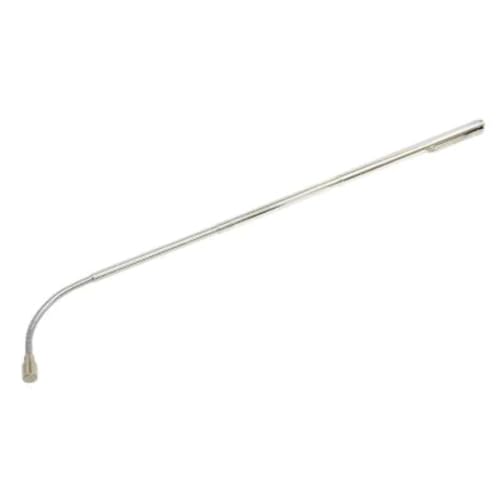
A pocket magnet with a flex tip for going around corners
Lisle 66540 Mini Flexible Telescoping Magnetic Pickup
Lisle's mini telescoper is barely bigger than a fat pen, but the last two and a half inches bend, so it can hook around a rack-and-pinion or a wiring loom. A neodymium tip rated to 2 pounds does the grabbing, and the shaft extends to 13 inches.
$10.99fromAmazonList priceThe flexible segment is the entire reason to buy this one. A straight telescoping wand goes down and only down. When the bolt has skipped sideways under a hose or behind a steering component, you need the last couple of inches to turn. Lisle gives you 2.5 inches of bend on the end of a shaft that extends from 4.5 to 13 inches, and that small hinge solves problems no rigid tool can touch.
The magnet is neodymium, which matters more than the 2-pound number suggests. Per K&J Magnetics, rare-earth magnets run 33 to 52 MGOe against roughly 4 for ceramic, so you get three to five times the practical pull at the same physical size. That's how a tip this narrow still snaps onto a nut with authority, and it's why it fits into gaps a bigger ceramic head can't enter.
Think of it as a complement, not a replacement. Thirteen inches doesn't reach the bottom of an engine bay, and the flexible neck gives up pull force in exchange for its bend. But it lives in a shirt pocket permanently, which means it's the one that's actually with you when something disappears. That availability beats a stronger tool sitting in the garage.
Flaws but not dealbreakers
Reach is the obvious limit. More than one owner has wished for another six inches, and if your usual job is deep in a transmission tunnel this isn't the tool.
The flexible cable can snag as you collapse the shaft fully, so the last inch of retraction sometimes needs a wiggle. A few owners have also found a rough edge on the rivet holding the pocket clip — worth checking with a thumb before you slide it into a shirt.
Upgrade pick
The strongest magnet here, if you can give up the reach
Ullman Devices Corp - 10LB Pocket Magnetic
This is a fixed 5.75-inch aluminum wand with a 10-pound magnet and a swinging hook. It doesn't extend at all, so it's the tool you grab when what you dropped is heavy and reachable, rather than light and buried.
$22.99fromAmazonOwners keep hauling up things you wouldn't trust to a magnet this size: a hefty flashlight out of a storm drain, big nuts and bolts from inside a motorcycle frame. A 10-pound rating in a tool under 6 inches long is an unusual combination, and it's what separates this from the pen magnets it resembles. When the object is awkward and heavy, raw pull is the only spec that counts.
The build is the other half of the story. It's an aluminum handle rather than a plastic sleeve, and owner feedback on it skews toward the language people use for tools they expect to keep for decades. Pro Tool Reviews found knurled-aluminum handles kept their grip after 50-plus oil-contamination cycles, while plastic-handled tools degraded in under half that. This is the category where that difference shows up.
Buy this as your second magnet, not your only one. It doesn't telescope, it doesn't bend and it doesn't light anything. What it does is sit in a chest pocket and pull hard from close range. Pair it with one of the telescoping picks and you've covered both ends of the problem — depth from the long wand, brute force from this.
Flaws but not dealbreakers
No extension is a real limitation, not a quirk. Five and three-quarter inches gets you into a fuse box or a cluttered bench drawer, and nowhere near the bottom of an engine bay. If you only buy one magnetic pickup tool, this shouldn't be it.
It also costs more than telescoping tools that reach five times as far, which feels backwards until you use it. And at this size it's easy to misplace — the swinging hook helps you clip it somewhere deliberate, so use it.
Also great
A long angled head that shrugs off oil and standing water
Ullman Devices Telescoping Magnetic Pick-Up Tool with
Ullman's angled pick-up runs from about 17 inches to nearly 27 and puts an alnico magnet behind a nylon head. It lifts 3 pounds and it's meant for the greasy, wet corners — under oil, in standing water — where lighter tools stop being useful.
$16.95fromAmazonIf your dropped fastener has landed somewhere wet, this is the tool. The nylon head is rated for use submerged in oil and water, which covers drain pans, flooded bilges, coolant catch trays and the puddle under a water heater. Most pickup tools treat liquid as an edge case. This one treats it as the job, and owners buy it specifically to replace flimsier tools that didn't survive that duty.
The angled head changes what you can grab. A straight tip approaches everything from directly above. This one comes in at a bend, which lets you slide under a shelf or reach the side of an object your line of sight can't clear. Combined with nearly 27 inches of extension, it gets to the awkward geometry that costs you the most time.
The magnet is alnico V rather than neodymium, which is a deliberate trade rather than a cost cut. Alnico handles heat and rough treatment better; per-cubic-inch it's weaker, which is why the rating is 3 pounds and not 15. For loose nuts, bolts and small parts in hostile conditions, 3 pounds is enough, and owners consistently describe the pull as stronger than they expected.
Flaws but not dealbreakers
It collapses to about 16.75 inches, so it is not going in a pocket or a tool-belt pouch. This lives in a toolbox or hangs on a pegboard, and you go get it.
Some owners find it chunkier in hand than the photos suggest, and a strong magnet on a long shaft has the usual habit of finding a bracket before it finds your bolt. In a tight engine bay you'll fight it a little on the way down.
Who this is for
Buy one if you work on cars, wiring, plumbing or anything assembled with small steel fasteners — which is to say almost everyone with a toolbox. Mechanics and DIYers who lose hardware into engine bays should start with a long telescoping tool. Electricians and HVAC techs working in panels and duct chases get more out of a short flexible tool, because the obstacle there is geometry and darkness rather than depth. If you assemble furniture twice a year, a pocket telescoper is all you'll ever need.
Skip these if your fasteners are stainless or aluminum. Grades 304 and 316 are weakly paramagnetic or non-magnetic, so a magnet won't reliably retrieve them and you want a claw grabber instead. This guide covers handheld pickup tools only — not rolling floor sweepers, not inspection cameras, not grabber claws, and not work lights, even the ones with magnetic bases. None of the tools here include a light, so if you work in the dark, plan on carrying one separately.
How we picked
We started from specifications and published reviews rather than marketing copy. Pull force: we matched rated capacity to real dropped objects, since a screw needs ounces and a socket needs pounds. Reach: we took 24 inches extended as the threshold for serious automotive work and 8 inches collapsed as the threshold for carrying one on you. Magnet type: neodymium wins on pull per cubic inch by a wide margin, and alnico only makes sense where heat and liquid are the real enemy. Build: metal shafts and knurled or aluminum handles survive oily hands; plastic sleeves don't. Owner feedback: we looked for repeated complaints — binding sections, fading magnets, tools smaller than advertised — not isolated bad luck.
Other magnetic pickup tools worth considering
If you want the longest reach in the group: The GEARWRENCH 33-1/4" Telescoping Magnetic Pickup Tool 5 ($17.87) — GearWrench's telescoper extends to 33.25 inches, further than anything else here, and it collapses to under 10 with a pocket clip. That extra depth is genuinely useful over a tall truck fender or down a transmission tunnel. Two things hold it back. The listing contradicts itself on capacity — the title claims 5 pounds while the bullets say 1.5 — and the bullets are the more conservative read. And owners are split on the telescoping sections, with some describing the shaft as flimsy for the brand and the sliding locking collar as fussy to work one-handed. Worth it if reach is your only real constraint.
The competition
This is what our research surfaced, not a survey of everything for sale. Magnetic pickup tools are a crowded, lightly differentiated category, and there are competent options from brands we didn't look at. Here's the one we considered and passed over, and who might still want it.
The Performance Tool W83192 Flexible Micro Long Neck ($17.84) — The Performance Tool W83192 is a micro flexible pickup with a 300mm bendable shaft, a soft grip and a 4mm magnetic head rated to 1.5 pounds. That head is the whole story: it's thin enough to go down a sink drain, into a defroster vent, or into a hole you just drilled to pull out shavings, which is a trick none of our picks can do. But owner feedback is the least consistent of the group, with a recurring theme that the tool is smaller than the listing photos suggest and the magnet weaker than the rating implies. It lost to the Lisle, which bends nearly as usefully and pulls harder. Still a reasonable buy if your access hole is a quarter inch wide and nothing else will fit.
Care and storage
Keep the tip away from your phone, your wallet and anything with a magnetic stripe — a rare-earth magnet will scramble a hotel key card without touching it. Don't let it snap onto steel from an inch away over and over, either. Neodymium is brittle, and repeated impacts chip the plating and take pull force with them. Heat does the same damage more quietly, so a magnet parked on a hot exhaust manifold is a magnet you're slowly ruining. Wipe oil off the shaft before you collapse a telescoping tool, or grit rides down into the joints and the sections start to bind. Bob Vila's panel flagged fading magnets after about a year of daily shop use as the main way budget ceramic tools die, which is one more argument for rare-earth tips.
Questions we get
How many pounds of pull force do I actually need?
For dropped screws, nuts and small bolts, anything from 1 to 3 pounds is plenty — those parts weigh ounces. Step up to 15 pounds or more if you regularly need to retrieve sockets, spark plug sockets or brake hardware. Popular Mechanics' lab simulation had a 30-pound tool pull a 3/8-inch drive socket from 28 inches down a simulated transmission tunnel, so a high rating buys you margin, not just capacity. Remember that ratings assume a flat plate against the tip, so real-world pull is always lower.
Flexible gooseneck or rigid telescoping — which should I buy first?
Buy rigid telescoping first. It reaches further, pulls harder and handles the common case, which is something falling straight down. A flexible tool trades pull force for the ability to turn a corner, and that's exactly what you want when the fastener has landed behind a bracket or inside a curved cavity. Most people who work on cars end up owning both, which is part of why we made a multi-tool set our top pick.
Are neodymium magnets worth paying more for than ceramic?
Yes, and it isn't close. K&J Magnetics puts neodymium at 33 to 52 MGOe against roughly 3.5 to 4 for ceramic, which works out to three to five times the practical pull at the same physical size. That means a slimmer tip that still holds, and a slim tip fits into gaps a fat ceramic head can't enter. Neodymium also holds its strength longer — fading magnets are the main failure mode reviewers report in budget ceramic tools.
Do these work on stainless steel or aluminum fasteners?
Mostly no. Aluminum isn't magnetic at all, and the two most common stainless fastener alloys, 304 and 316, are weakly paramagnetic or effectively non-magnetic, according to standard alloy references. Some hardware-store stainless is magnetic enough to grab weakly, but you can't count on it. If you're working on a boat, an outdoor kitchen or anything built with marine-grade hardware, get a mechanical grabber claw instead.
Can a magnetic pickup tool damage my car's ECU or sensors?
Under normal use, no. K&J Magnetics' field-strength reference shows that a 30-pound-rated magnet drops below 10 gauss about 2 inches from the tip, which is under the level documented to affect automotive ECUs, ABS sensors and TPMS units. Fishing for a bolt near a control module is fine. Just don't park a strong magnet directly on a module for an extended stretch, and keep it away from credit cards and mechanical hard drives.
What should I use in a dark electrical panel or duct chase?
A short flexible tool is more practical there than a long rigid one, because the problem is turning corners in a confined box rather than reaching depth. None of the picks here include a light, so you'll want a separate work light or headlamp — ideally one you can set down or clip, since both hands will be busy. The Lisle mini is the closest fit in this group: it's pocketable and the tip bends.
Why you should trust us
For this guide:
- We read manufacturer specifications for every tool here and compared rated pull force, extended and collapsed lengths, magnet material and handle construction.
- We reviewed published testing and round-ups from Pro Tool Reviews, Bob Vila, Family Handyman, Popular Mechanics and The Drive for what separates a durable pickup tool from a disposable one.
- We read owner feedback across these listings for recurring themes rather than one-off complaints — magnets that grab the wrong metal, telescoping sections that bind, and tools that arrive smaller than the photos suggest.
- We read owner reviews on every listing, weighted toward the critical ones, because that is where the recurring failures show up.
- We have a systematic way of automatically fetching the latest prices, so the numbers on this page stay current.
- This is a research-focused guide, so the team may not own every product listed — though we often do own the top winners, which gives us extra context for the recommendations.
- We don't accept free products, and the retailer commission never changes which product we recommend.
Sources
Best Magnetic Pickup Tools — Pro Tool Reviews, Pro Tool Reviews
Best Magnetic Pickup Tools for Mechanics — Bob Vila, Bob Vila
Best Magnetic Pickup Tools — Family Handyman, Family Handyman
Best Magnetic Pickup Tools — The Drive, The Drive
Best Magnetic Pickup Tools — Popular Mechanics, Popular Mechanics
Best Magnetic Pickup Tools — This Old House, This Old House
Ullman Devices HM-1 — Manufacturer Specifications, Ullman Devices (Manufacturer)
Lisle 65270 Telescoping Magnetic Pickup — Lisle Corporation Product Page, Lisle Corporation (Manufacturer)
Klein Tools MAG2 — Product Page and Specifications, Klein Tools (Manufacturer)
GearWrench Retrieval Tools — Product Line Overview, GearWrench (Manufacturer)
Snap-on Hand Tool Warranty Terms, Snap-on (Manufacturer)
Neodymium vs. Ceramic Magnet Comparison — K&J Magnetics, K&J Magnetics
Amazon product listings and owner reviews for all 7 products
Manufacturer specification pages for each product
Some passages in this guide may be paraphrased with AI help. Prices are refreshed automatically.
More like this.
Continue exploring electronics reviews and recommendations.

The Best Magnetic Car Phone Mounts
A phone mount is one of those small purchases you either forget about or curse daily. You reach for it a dozen times a drive - snapping the phone up for…

The Best Magnetic Parts Trays
Anyone who's dropped a caliper bolt into gravel knows the appeal of a magnetic parts tray. You stick it to a fender, a tool cart rail, or the side of an…

The Best Magnetic Resistance Rowing Machines
A rowing machine is one of the few pieces of home cardio gear that works your legs, back, core and arms in the same motion. Rowing engages up to 86% of…

The Best Truck Bed Tool Boxes
A truck bed is a rough place to keep tools. Everything slides around, gets rained on, and sits in plain view at every red light. A crossbed tool box fixes…

The Best Mechanic Tool Sets for Your Home Garage
The first time a socket doesn't fit, you learn what a tool set is really for. Most home garage work is unglamorous - an oil change, a set of brake pads, a…

The Best Rolling Tool Chests
A rolling tool chest earns its keep in the boring moments. You reach for a 10 mm socket with greasy hands, pull the drawer, and it either glides or it…