The Best Airtight Pantry Storage Containers
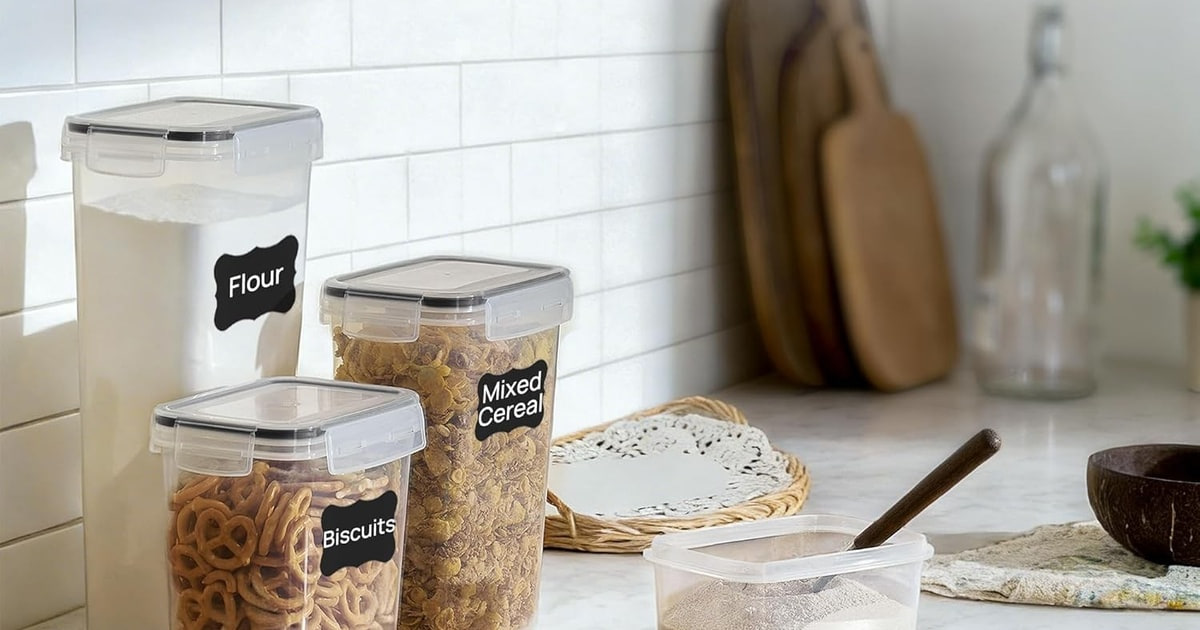
A bag of flour rolled shut with a chip clip isn't sealed. Air gets in, and so does everything else. Cereal goes soft, brown sugar turns into a brick, and a torn rice bag spills across the shelf every time you reach past it. Good airtight containers fix all of that at once. They keep moisture out, they stack into a flat readable wall of food, and you can tell at a glance that you're down to your last cup of oats.
No container does everything well. Gasket lids seal best, but the gasket is one more part to pull out, wash, and dry, and skipping that step is how a container starts to smell musty. Glass resists stains and curry smells, but it's heavy overhead and it breaks. Plastic is light and easy to replace, though it can cloud or scratch after years of dishwasher cycles. Big matching sets look wonderful in photos, but they rarely include the exact sizes your shelves actually need.
Most people don't need a 24-piece system on day one. Start with the three or four staples you reach for daily, buy containers sized to the bags you already bring home, and add from there. Square shapes waste less shelf than round ones, and one lid style across a set means less rummaging. We think that the OXO Good Grips POP Container set is the best airtight pantry storage container for most people, and that the Rubbermaid Brilliance Pantry set is the one to buy if you want a full range of sizes in one box.
Everything we recommend

The most reliable seal, if you can live with two sizes

More sizes and a dishwasher-safe lid, with a stiffer latch

Enough matching containers for a whole pantry, in four sizes

Baking-specific canisters, if you skip the matching grid
Prices as of Oct 25, 6:48 AM PT · Details
At a glance
| Product | Set size | Material | Price | |
|---|---|---|---|---|
| OXO Good Grips 2-Piece Prelabeled POP ContainerTop pick | 2 containers | — | $39.99 |
| Rubbermaid Brilliance Pantry 10 Piece SetRunner-up | 10 containers | Tritan plastic | $59.99 |
 | Ankou Airtight Food Storage Container Sets withAlso in lineup | 6 containers | — | $35.99 |
| Progressive ProKeeper Baker's Airtight Kitchen Storage CanisterAlso great | 6 pieces | Plastic | $57.99 |
 | ClearSpace Pantry Storage Bins with Lids forAlso in lineup | 8 bins | — | Check price |
 | Snapware Glass Total SolutionsAlso consider | 24 pieces | Glass | Check price |
 | Ikea Plastic 365+ Dry Food Jar WithAlso consider | 4 jars | Plastic | Check price |
| Vtopmart Airtight Food Storage Containers with LidsBudget pick | 24 containers | — | $35.99 |
Prices as of Oct 25, 6:48 AM PT · Details
How we picked
Seal design. We favored lids that press a silicone gasket down evenly around the whole rim, whether by latch or push-button. Consumer Reports treats an all-around locking mechanism, rather than a single front clip, as the better indicator of a real airtight seal, and that standard shaped our picks.
Shape and stacking. Square and rectangular containers fit more product per linear foot of shelf than round canisters of the same volume, a point organizing coverage from Better Homes & Gardens makes repeatedly. We gave weight to sets with matching footprints and lids that stack without shifting.
Sizes that fit bags. We checked stated capacities against the packages people actually buy, especially five-pound flour and sugar bags. A container that leaves a half-empty bag on the shelf hasn't solved anything.
Cleaning the lid. We read spec sheets for dishwasher safety and looked for lids that come apart so the gasket channel can be cleaned. Recurring owner complaints about musty smells almost always trace back to a gasket that never got washed or dried.
Material and clarity. We compared BPA-free plastics, Tritan, and glass on stain and odor resistance and on how clearly you can read a fill level. The Kitchn has flagged glass as the better long-term choice after storing tomato sauces or curry powders, and we weighed that against weight and breakage.
Top pick
The most reliable seal, if you can live with two sizes
OXO Good Grips 2-Piece Prelabeled POP Container
A push-button lid presses a silicone gasket onto the rim, so one thumb gets you into your flour. This two-container set holds a five-pound bag each of flour and sugar, arrives prelabeled, and hides a half-cup scoop under the lid where you can find it.
$39.99fromAmazonPrices as of Oct 25, 6:48 AM PT · Details
The button is the whole point. Press it and the lid seals. Press it again and it pops up into a handle you can lift with the same hand. You'll use it with a dough-covered palm, with a kid on your hip, with a measuring cup already in the other hand. Snap lids and screw lids both want two hands. This one doesn't, and that's why it actually gets used instead of left propped open.
Wirecutter has named this POP line its top pick for airtight food storage across several update cycles, citing how consistently the silicone gasket seals in repeated testing. That's a long run for a kitchen product. The seal is also the part most likely to fail on cheaper containers, and it's the one thing you can't judge from a listing photo. A track record is the next best evidence you'll get.
The two containers here hold 4.4 quarts each, sized to a standard five-pound bag of flour or sugar. That matters more than it sounds. Buy a canister that's a little too small and you're left with a half-empty bag flopping on the shelf, which is the exact mess you were trying to end. The half-cup scoop clips under the lid, so it isn't buried at the bottom of the sugar.
Starting with two containers is a strategy, not a limitation. The POP line is modular, and lids and footprints line up across the rest of it. Live with flour and sugar for a month, then add the sizes your pantry actually calls for. That beats guessing at a ten-piece assortment and discovering that three of the pieces never get filled and just take up a shelf.
Flaws but not dealbreakers
Two containers is a small start, and building a pantry this way costs more per container than a bundled set does. You're paying for the mechanism, and you'll pay for it again with every jar you add.
The button has more moving parts than a plain snap lid, and the lid comes apart for a proper wash. The listing doesn't call it dishwasher safe, so plan on washing it by hand and drying the gasket channel before you reassemble it. Prelabeled also means what it says. If you want the flour container to hold pasta, the label doesn't change.
Runner-up
More sizes and a dishwasher-safe lid, with a stiffer latch
Rubbermaid Brilliance Pantry 10 Piece Set
You get ten containers in seven sizes, from a 16-cup bin for cereal down to half-cup jars for baking powder. The latching lids pull down evenly all the way around, the Tritan plastic is shatter-resistant, and the whole set goes in the dishwasher when it gets sticky.
$59.99fromAmazonPrices as of Oct 25, 6:48 AM PT · Details
This is the set to buy if you want to do the entire pantry in one afternoon. Ten containers covers cereal, flour, rice, pasta, snacks, and the small stuff like baking powder that otherwise lives in a torn paper box. The sizes step down sensibly, so you're not putting a cup of lentils in a giant bin and calling it organized. A half-cup scoop comes along too.
The latch is the reason it seals. Four tabs pull the lid down evenly around the rim instead of leaning on one clip at the front. Consumer Reports points to exactly that, an all-around locking mechanism rather than a single clip, as the more reliable sign of a genuinely airtight seal. You can feel the difference when you close one, and you can hear it when you pop one open.
Tritan plastic is the quiet advantage here. It stays clear rather than fogging, so you can read the fill level from across the kitchen, and it doesn't shatter when a full container slides off a high shelf. Rubbermaid calls it odor- and stain-resistant, which matters if chili powder, turmeric, or coffee is in your rotation. It's dishwasher safe, which is more than most gasket lids can claim.
It's the runner-up rather than the top pick for one reason: opening it. The latches want two hands and a bit of force, and if your fingers are wet or floury you'll notice every time. That's a fair trade for a tight seal at a lower cost per container. But it's a daily annoyance, not a one-time one, and daily annoyances decide whether a system sticks.
Flaws but not dealbreakers
The latches are stiff when new, and on any latching lid the tabs are the part most likely to give out after years of hard use. The gasket also sits in a groove that traps water, so lids need to go upside down on the dishwasher rack or get a towel afterward.
The 16-cup bin is tall. It won't slide under a low fixed shelf, and a full one is awkward to lift down with one hand. Measure your shelf height before you order, because a container you can't reach comfortably ends up on the counter.
Budget pick
Enough matching containers for a whole pantry, in four sizes
Vtopmart Airtight Food Storage Containers with Lids
Twenty-four containers in four sizes, all sharing one lid, with reusable labels in the box. The side-locking lids press a silicone gasket onto the rim, and the top flips open on its own, so you can scoop oats without setting the whole lid down somewhere.
$35.99fromAmazonPrices as of Oct 25, 6:48 AM PT · Details
If your pantry is currently a shelf of half-open bags, this is the box that fixes it in one go. You get six each of four sizes, from a 0.7-quart snack container up to a 2.5-quart tall one that swallows pasta or cereal. Owners describe the same before-and-after over and over: bulky packaging out, a flat readable row in. The included labels are reusable, so a container can change jobs.
One lid for the whole set is a bigger deal than it sounds. Every container takes the same lid, so a lid sitting on the counter always belongs to whatever's open. Nothing gets orphaned at the back of a cabinet. You can wash lids in one batch instead of matching them like socks, and replacing a warped one doesn't mean tracking down a specific size.
The top flips open while the sides stay latched, which is easier on stiff hands than prying four tabs. Owner feedback runs unusually consistent for a set this widely bought, and the recurring themes are that the seals hold and the containers survive being stacked full. Food52 has pointed to bundled starter sets like this one, labels included, as a sensible entry point for a first pantry overhaul.
The catch is that four sizes have to cover everything you own. Nothing here takes a five-pound bag of flour in one pour, so a full bag won't go in whole. If you bake most weekends, you'll end up buying a dedicated canister anyway. For snacks, grains, pasta, rice, and dry pet food, though, the range is genuinely fine, and there's enough of it to finish the job.
Flaws but not dealbreakers
The gasket sits in a channel on the underside of the lid, and cleaning it by hand is fiddly. Owners who wash by hand mention it takes extra attention, especially after anything oily. It's doable, just not quick.
Buying this many containers means each one is fairly light-duty. They're fine on a pantry shelf and fine stacked full, but they're not what you want to sling into a bag for a picnic. The black lids also hide the fill line at the very top, so a full container looks the same as a nearly full one until you lift it.
Also great
Baking-specific canisters, if you skip the matching grid
Progressive ProKeeper Baker's Airtight Kitchen Storage Canister
Six canisters shaped around what bakers actually store: a 4-quart flour keeper with a leveling bar, a 2.5-quart sugar keeper with a flip-out pour spout, and a brown sugar keeper with a terra cotta disk. If you bake weekly, these details earn their shelf space.
$57.99fromAmazonPrices as of Oct 25, 6:48 AM PT · Details
These are the only containers here designed around a recipe rather than a shelf. The flour keeper has a detachable leveling bar, so you sweep a measuring cup flat without hunting for a knife. The sugar keeper flips open into a pour spout. The brown sugar keeper takes a soaked terra cotta disk, which is the standard fix for brown sugar that's gone rock hard in the back of the cabinet.
Sizes are matched to bags, not to round numbers. The flour keeper holds a five-pound bag, the sugar keeper holds four pounds, the brown sugar keeper holds two. You pour a bag in and the bag goes straight in the recycling, which is the entire point of buying canisters and the thing cheaper sets get wrong by an inch.
The lids snap on rather than latching down onto a gasket, so they're faster to open one-handed but not as tightly sealed as the OXO or Rubbermaid lids. For flour and sugar you turn over every couple of weeks, that's fine. For a bag of specialty grain you'll open twice a year, put it in something with a gasket and leave it alone.
Measurement marks run up the side, so you can see you're down to two cups of flour before you start a recipe instead of halfway through it. The set is dishwasher safe, which matters because flour paste dries like cement. The mouths are wide enough that a standard measuring cup goes in and comes out without scraping powder down the rim.
Flaws but not dealbreakers
The shapes aren't modular. Each canister is sized to its job, so they don't line up into the tidy grid you get from the OXO or Vtopmart containers, and stacking is mostly out. The lids are color-coded rather than uniformly clear, which reads as charming or cluttered depending on your pantry.
Six pieces of baking-specific storage is a lot of shelf if you bake three times a year. The powdered sugar and brown sugar keepers in particular sit unused in most kitchens.
Who this is for
Buy these if you keep dry goods around long enough for them to go stale, or if you've ever found something moving in the flour. USDA food storage guidance recommends transferring opened flour, cereal, rice, and pasta into airtight containers, and notes it meaningfully extends how long those foods stay usable compared with the original packaging. You'll also stop losing track of what you have, which is the quiet reason most people end up with three open bags of brown rice.
This guide covers containers for shelf-stable dry goods: flour, sugar, grains, pasta, cereal, snacks, coffee, pet food. It isn't a guide to leftovers containers, freezer meal prep, or bulk five-gallon buckets for long-term food storage. If your pantry is a single narrow cabinet, skip the big matched sets and buy four containers sized to what you actually cook. And if you rent and expect to move soon, glass is heavy and breakable in a box truck, so lean toward plastic.
How we picked
We looked at published testing and buying guidance from Wirecutter, Good Housekeeping, Consumer Reports, The Kitchn, Food52, and Real Simple, then compared it against each manufacturer's own specifications and the themes that keep coming up in owner feedback. Seal: a silicone gasket pulled down evenly around the rim, by latch or button, rather than a single front clip or a press-on lid. Shape: square or rectangular footprints that stack and line up, since round canisters waste shelf. Sizes: capacities matched to the bags you already buy, especially five-pound flour and sugar. Cleaning: lids that come apart so the gasket channel can be washed and dried. Material: clear enough to read a fill level from a step back, and either stain-resistant plastic or glass depending on what you store.
Other airtight pantry storage containers worth considering
If you want glass: The Snapware Glass Total Solutions — Glass wins on the things plastic slowly loses. It doesn't hold onto curry powder or tomato smells, it doesn't cloud, and The Kitchn's container coverage has repeatedly flagged Snapware's locking-lid glass line for exactly that long-term odor and stain resistance. This 24-piece set uses four locking tabs and a gasket, and the containers are top-rack dishwasher, freezer, and microwave safe, so a container of leftover rice goes straight from shelf to reheat. What you give up is pantry sizing. The pieces here run from 1 cup to 4 cups, which suits leftovers and meal prep more than a five-pound bag of flour. Glass is also heavy, and a full 4-cup container on a high shelf is a genuine hazard.
If you want to add jars one at a time: The Ikea Plastic 365+ Dry Food Jar With — IKEA sells the 365+ dry food jar as open stock, and Real Simple has pointed out that buying jar by jar is a low-cost way to build a pantry gradually instead of committing to a fixed multi-piece set. This listing bundles four of the 2.3-liter jars. They're tall and narrow, about a foot high and three inches wide, which is either perfect for a deep shelf or completely wrong for a shallow one. The lid comes off entirely for filling, and half of it opens for pouring, which is a nice touch when you're tipping rice into a pot. The trade-off is a simpler seal than the gasket-and-latch sets, and the narrow mouth makes scooping awkward.
The competition
Here's what the research turned up alongside the picks, not a survey of everything sold. These two are worth knowing about because one is a close copy of an editorial favorite and the other gets bought for pantry duty even though it isn't really built for it.
The Ankou Airtight Food Storage Container Sets with — The Ankou set borrows the push-button lid that makes the OXO containers so easy to open one-handed, and it puts six containers in the box across three sizes. The clear PET is described as impact-resistant and BPA-free, and the lids come apart for cleaning. It loses to the OXO pick on range: the largest container is 1.8 quarts, so nothing here takes a five-pound bag, and the sizes come in pairs whether you need two of each or not. If you want the button mechanism for snacks, coffee, and nuts rather than baking staples, it's a reasonable way to get it.
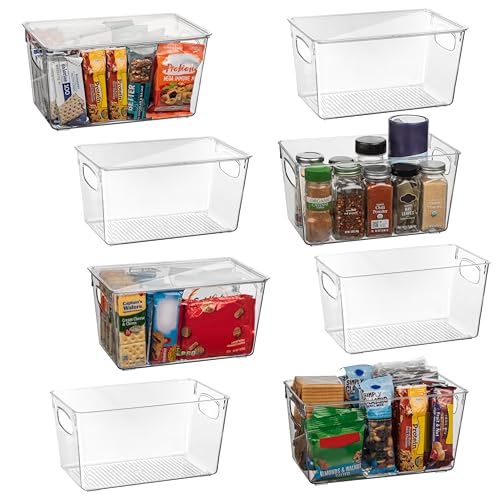
The ClearSpace Pantry Storage Bins with Lids for — The ClearSpace bins are organizers, not sealed containers. Each one is a clear shatter-resistant tub, 10 by 6 by 5 inches, with grip handles on the sides, a lid, and feet that keep a stack from sliding. That makes them genuinely useful for corralling snack packets, produce in the fridge, or the loose chaos on a deep shelf, and the handles mean you can pull the whole group down at once. But there's no gasket and no locking mechanism, so they won't keep flour fresh or moths out. Buy them to tidy a shelf, not to seal anything.
Care and cleaning
Take the lid apart. Almost every airtight lid here hides a silicone gasket in a channel, and that channel collects flour dust, oil, and water. Pop the gasket out every few washes, clean both parts, and let them dry completely before you snap the lid back together. A gasket sealed up damp is how a container starts smelling musty. Wipe the inside dry before refilling, and resist topping off old flour with new, since the oldest layer at the bottom is what goes rancid first. If you've ever had pantry moths, wash the empty container in hot soapy water and pay attention to the rim and the threads, because eggs hide in exactly those seams. On push-button lids, check now and then that the button still springs back.
Questions we get
Are airtight pantry containers actually worth it?
Yes, if you buy dry goods in bags and don't finish them in a week. USDA food storage guidance recommends moving opened flour, cereal, rice, and pasta into airtight containers, and notes it extends how long they stay usable. The second payoff is visibility. You stop buying a fourth bag of lentils because you can see the three you already have.
Glass or plastic for pantry storage?
Plastic for most pantry shelves, glass for anything that stains or smells. The Kitchn's testing has found glass holds up better against tomato-based and heavily spiced foods over years, with no clouding or lingering odor. But glass is heavy, it breaks, and a full container on a high shelf is a real risk. Tritan and other BPA-free plastics are lighter, cheaper to replace, and fine for flour, sugar, grains, and cereal.
How do airtight containers stop pantry pests?
Weevils and pantry moths usually arrive inside packaged goods you already brought home, not through your window. A sealed container keeps whatever hatches trapped in one place instead of spreading to every open bag on the shelf. The National Pest Management Association has found that roughly one in three Americans has discovered a pantry pest infestation, often traced to unsealed dry goods. A gasket lid is the single most effective thing you can do about it.
Do square or round containers save more space?
Square and rectangular, clearly. Round canisters leave wedges of dead air between them, while square ones sit flush against each other and against the wall. Organizing coverage from Better Homes & Gardens makes this point repeatedly: modular rectangles fit more product per foot of shelving than round canisters of the same volume. Uniform footprints also stack safely, which round ones often don't.
Can airtight containers go in the dishwasher?
It depends on the lid, and the lid is usually the problem. The Rubbermaid Brilliance and Progressive ProKeeper sets are both listed as dishwasher safe, and Snapware's glass containers are top-rack safe. Gasket lids trap water in the channel, so put them upside down and check them before you put them away. When a listing doesn't say dishwasher safe, wash the lid by hand.
How many containers do I need for a normal pantry?
Start with four to six, not twenty. Cover the things you open weekly: flour, sugar, rice or pasta, cereal, coffee, and whatever snack disappears fastest. Live with that for a month and you'll know exactly which sizes you're missing. Buying a big matched set first is how people end up with three empty containers and a bag of quinoa still in the bag.
Why you should trust us
For this guide:
- We read published testing and buying guidance from Wirecutter, Good Housekeeping, Consumer Reports, The Kitchn, Food52, Real Simple, and Better Homes & Gardens on seal performance, materials, and shelf efficiency.
- We compared each manufacturer's stated specifications for capacity, seal type, material, and dishwasher, freezer, and microwave safety across every set here.
- We looked for recurring themes in owner feedback, especially complaints about cleaning gaskets, lids that stop sealing, and sizes that don't match a standard bag.
- We read owner reviews on every listing, weighted toward the critical ones, because that is where the recurring failures show up.
- We have a systematic way of automatically fetching the latest prices, so the numbers on this page stay current.
- This is a research-focused guide, so the team may not own every product listed — though we often do own the top winners, which gives us extra context for the recommendations.
- We don't accept free products, and the retailer commission never changes which product we recommend.
Sources
The Best Food Storage Containers - Wirecutter, Wirecutter
Good Housekeeping Institute: Best Food Storage Containers, Tested, Good Housekeeping
The Spruce Eats: The 9 Best Food Storage Containers, The Spruce Eats
Consumer Reports: Food Storage Container Buying Guide, Consumer Reports
Real Simple: The Best Pantry Organization Containers, Real Simple
Better Homes & Gardens: How to Organize a Pantry, Better Homes & Gardens
The Kitchn: Best Pantry Storage Containers We've Tested, The Kitchn
National Pest Management Association: Pantry Pest Prevention Tips, National Pest Management Association (NPMA)
USDA FoodKeeper App and Food Storage Guidelines, USDA / FoodSafety.gov
U.S. FDA: Bisphenol A (BPA) Use in Food Contact Applications, U.S. Food & Drug Administration
Martha Stewart: The Best Pantry Organizers for Every Budget, Martha Stewart
Food52: We Tested the Most Popular Airtight Containers, Food52
Amazon product listings and owner reviews for all 8 products
Manufacturer specification pages for each product
Some passages in this guide may be paraphrased with AI help.
Product prices and availability are accurate as of the date/time indicated and are subject to change. Any price and availability information displayed on Amazon.com at the time of purchase will apply to the purchase of this product.
More like this.
Continue exploring home reviews and recommendations.

The Best Under-Bed Storage Containers
The space under your bed is the biggest empty room in your apartment, and it costs nothing to use. A few flat boxes there can absorb the winter coats, the…

The Best Pantry Organization Bin Sets
A pantry bin set does two jobs at once. It keeps flour and cereal from going stale, and it lets you see what you already own so you stop buying a fourth…

The Best Garage Storage Cabinets
A garage cabinet does one job better than any shelf or pegboard: it hides the mess and locks the dangerous stuff away. Open shelving turns into a dust…

The Best Garage Wall Storage Systems
A garage fills up fast. Bikes lean against the car, bags of potting soil slump in a corner, and the snow shovel ends up wherever you dropped it in April.…

The Best Storage Ottomans
A storage ottoman earns its spot by doing two jobs at once. It's a footrest when you're on the couch, a seat when a friend drops by, and a place to stuff…

The Best Garage Ceiling Storage Racks
Garage floors fill up in a way that sneaks up on you. A cooler here, a bin of holiday lights there, and one day the second car doesn't fit. Ceiling…