The Best Torque Wrenches
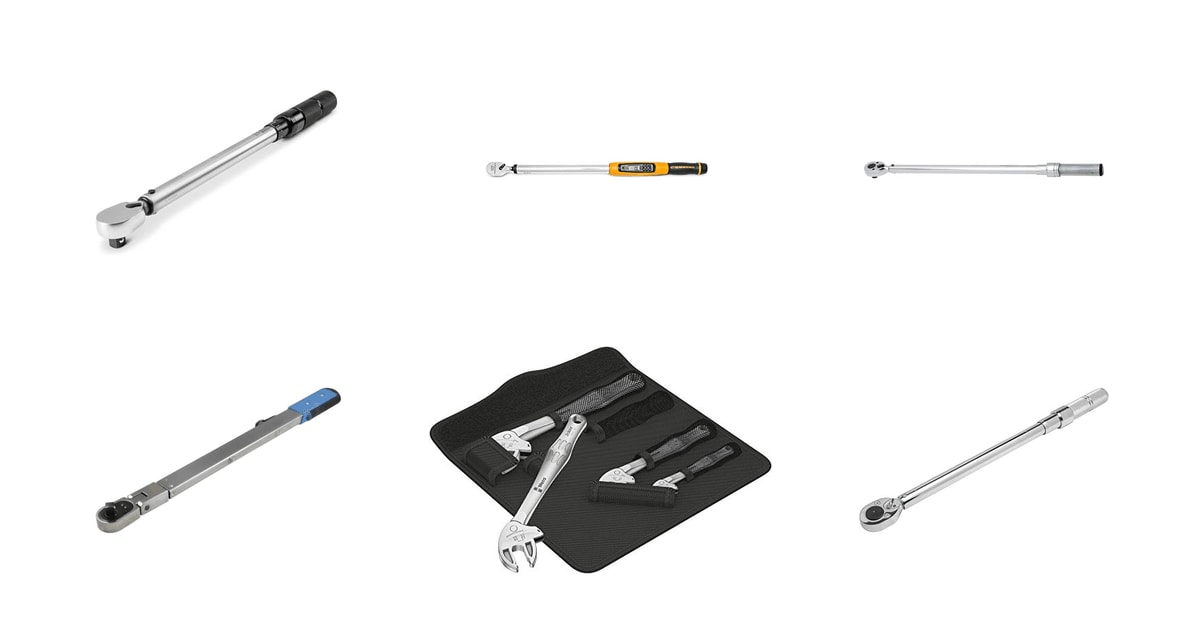
A torque wrench is the tool that stands between a properly seated fastener and a very bad afternoon. Lug nuts, brake caliper bolts, cylinder head studs, suspension hardware — every one of them has a number the manufacturer picked for a reason. Guess with a ratchet and you'll either strip threads and snap bolts or leave something loose enough to work its way off. You don't need a torque wrench often. But when you need one, nothing else does the job.
Here's the honest part: no torque wrench stays accurate on its own. Every one of these is a precision instrument with a spring or a sensor inside, and both drift. Store a click wrench cranked to 150 ft-lb and the spring takes a set, so it clicks early and you under-torque everything for months without knowing. Drop one on concrete and it can shift instantly. Certification standards call for recalibration every 5,000 cycles or twelve months, and that's a cost nobody mentions at checkout.
We also can't measure accuracy ourselves, so we leaned on published specs, certification standards, and what owners report after months of real use. Wide torque ranges, real serialized calibration paperwork, and a click you can't mistake mattered most. We think that the TEKTON TRQ52402 is the best torque wrench for most people, and that the CDI 2503MFRMH is the one to buy if you're turning wrenches for a living and want one tool to cover every fastener on the car.
Everything we recommend
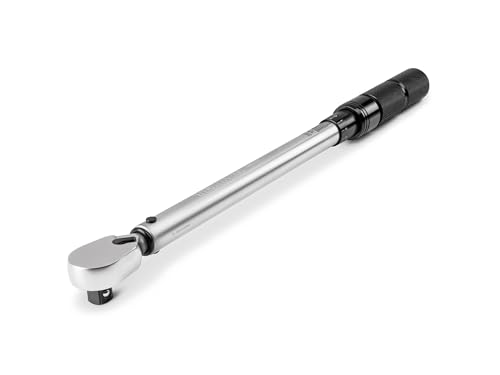
Real calibration paperwork without the professional markup

One wrench that covers every fastener on the car
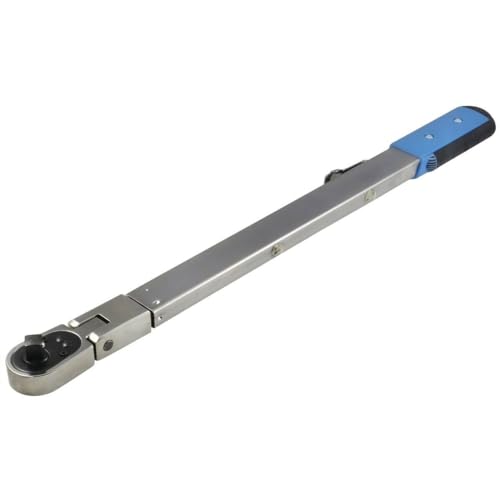
A flex head and no spring to wear out over time

A ratcheting head, for when you're doing this all day
At a glance
| Product | Torque Range | Drive Size | Price | |
|---|---|---|---|---|
| TEKTON 1/2 Inch Drive Micrometer Torque WrenchTop pick | 40-200 Ft-lb | 1/2 in. | $125 |
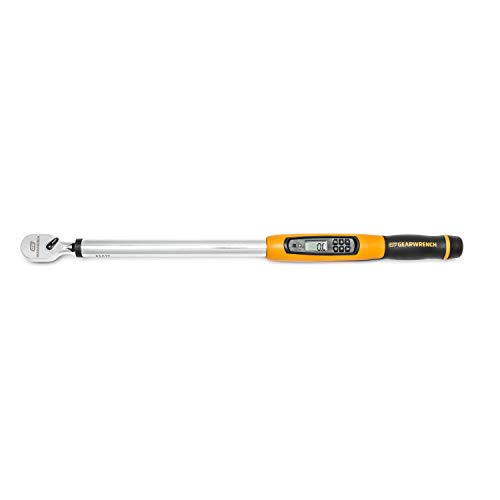 | GEARWRENCH 1/2 Drive Electronic Torque WrenchAlso consider | 30-340 Nm | 1/2 in. | $239 |
| CDI 1/2 Inch Drive Adjustable Click TorqueUpgrade pick | 30-250 Ft-lb | 1/2 in. | $187.88 |
| Precision Instruments PREC3FR250F Silver 1/2" Drive SplitAlso great | — | 1/2 in. | $251.47 |
 | Wera 6004 Joker 4 Set 1 Self-settingAlso in lineup | — | — | $149 |
| Stanley Proto J6016C 1/2" Ratcheting Head MicrometerRunner-up | 30-150 Ft-lb | 1/2 in. | $259.98 |
How we picked
Documented accuracy. We looked for a stated accuracy spec of 3% or better clockwise, and no worse than 4% for anything doing safety-critical work. A compliance sticker isn't enough — we wanted certificates that list the wrench's actual test results.
Certification and traceability. We favored wrenches certified to ISO 6789 or ASME B107.300 with serialized, traceable calibration paperwork. That's the baseline for anything holding a wheel or a brake caliper on.
Range that fits the job. Accuracy degrades in the top and bottom 10% of any wrench's range, so we checked that common specs like lug nuts land near the middle. Wider ranges scored higher because they replace a second tool.
Click and head quality. From owner feedback we weighted how distinct the click feels and sounds, since a soft one invites over-torquing. Higher ratchet tooth counts and shorter swing arcs mattered for tight engine bays.
Recalibration support. Every one of these needs recalibration eventually, so we checked whether the brand runs a factory service that restores traceability. Brands without one push that problem onto you.
Top pick
Real calibration paperwork without the professional markup
TEKTON 1/2 Inch Drive Micrometer Torque Wrench
The TEKTON TRQ52402 is a 1/2-inch click wrench certified accurate within 3% in both directions, and it ships with a serialized certificate showing your specific wrench's test results. For lug nuts, brakes and suspension work, it's all the wrench most people need.
$125fromAmazonThe certificate is the whole point. Plenty of wrenches come with a card that says "calibrated." This one comes with a document listing your wrench's serial number, the actual numbers it produced on the test bench, and the equipment used to get them. TEKTON's floor is 3% in both clockwise and counterclockwise directions, and because it's calibrated to the ISO standard, it clears the ASME standard too. That's the paperwork professional shops run on.
The click is the other thing that matters, and it's easy to underrate until you've used a bad one. On a mushy wrench you're never sure whether you felt it or imagined it, so you push a little further — and that's how threads get stripped. The TEKTON's click arrives in your hand and your ear at the same instant. Owners who replaced budget wrenches with this one consistently mention the difference in that feedback.
The head is a 90-tooth fixed ratchet with a 4-degree swing arc. In plain terms, you barely have to move the handle to catch the next tooth, which matters when a control arm bolt sits three inches from the frame rail. Nine teeth stay engaged at all times, so it won't skip under load. Most wrenches near this price use 36 or 45 teeth and a much longer swing.
Its 40–200 ft-lb range fits the work most people actually do. Lug nuts land between 80 and 120 ft-lb on nearly every passenger car, comfortably in the middle of the range where accuracy is best. Brake caliper brackets, strut bolts and axle hardware sit in there too. Just don't work at the very bottom of the scale — accuracy falls off in the last 10% of any wrench's range, and this one's floor is higher than some.
Flaws but not dealbreakers
There's no electronic alert, so you're relying entirely on the mechanical click. In a quiet garage that's fine. Next to a running compressor with hearing protection on, you're depending on feel alone, and that's a real limitation.
The head is fixed. When a fastener sits under an intake manifold or behind a crossmember at an awkward angle, you'll be reaching for a wobble extension and hoping the geometry works out. A flex head solves that, and this wrench doesn't have one.
It's not the least expensive way to buy a click wrench. Discount-store wrenches cost far less. They also skip the serialized certificate, which is exactly the thing you're paying for here.
TEKTON backs the TRQ52402 with a lifetime warranty.
Upgrade pick
One wrench that covers every fastener on the car
CDI 1/2 Inch Drive Adjustable Click Torque
The CDI 2503MFRMH covers 30 to 250 ft-lb, so a single tool handles exhaust manifold bolts and truck axle nuts alike. It comes from Snap-on's industrial arm, includes traceable serialized calibration, and it's built for daily shop abuse.
$187.88fromAmazonThe range is what you're buying. Most micrometer click wrenches stop around 150 ft-lb, which means a second, larger tool for heavy hardware. The CDI runs from 30 all the way to 250 ft-lb on dual English and metric scales. Exhaust manifold bolts at the low end, lug nuts in the middle, truck axle nuts up top — one wrench, one certificate, one recalibration bill.
CDI is Snap-on's industrial subsidiary, and it shows in details you notice on the twentieth job rather than the first. The scales are laser-marked instead of engraved, so shop grime doesn't pack into them and hide the numbers. The spring-loaded lock ring pulls down and stays put, which means the impact gun running on the next lift can't vibrate your setting off target. The quick-release button makes socket swaps quick when you're doing the same job on four corners.
Owners who've bought several wrenches over the years tend to describe this one as the point where they stopped buying wrenches. The mechanism has very little slop, the length gives you leverage that makes a 217 ft-lb axle nut almost pleasant, and it's made in California with a blow-molded case in the box.
There's also a practical argument that has nothing to do with the wrench itself. CDI runs a factory recalibration service that restores traceability and resets your compliance clock. If you have to document that your tools were in spec — dealership service, fleet work, anything audited — that infrastructure is worth as much as the accuracy spec.
Flaws but not dealbreakers
The accuracy spec is 4% clockwise and 6% counterclockwise, wider than the TEKTON's 3% and considerably wider than the GEARWRENCH. For lug nuts and suspension bolts that's still well inside what matters. For torque-to-yield head bolts, you'd want tighter.
It's long and it's heavy, and both are the price of that 250 ft-lb range. Owners like the leverage but note that tight spaces are genuinely harder with a 16-inch wrench in your hands. A few also find the markings hard to read in poor light despite the laser etching.
There's no ratcheting mechanism for continuous pulls, so on high-cycle work you're lifting and repositioning more than you would with a ratcheting head.
CDI covers the 2503MFRMH under its manufacturer warranty.
Also great
A flex head and no spring to wear out over time
Precision Instruments PREC3FR250F Silver 1/2" Drive Split
The Precision Instruments PREC3FR250F pairs a flex head with a split beam mechanism, so it reaches fasteners a fixed head can't and doesn't rely on a coil spring that fatigues. It's the wrench for buried bolts and for people who don't trust click mechanisms.
$251.47fromAmazonSplit beam wrenches don't have a spring to go soft. That's the pitch, and it's a real one. Every click wrench uses a compressed coil spring, and that spring is why you're told to dial back to minimum after every use. Skip that habit for a year and the spring takes a set, then clicks early, and you under-torque everything. The split beam design sidesteps the whole failure mode. Precision Instruments has supplied these to automotive and aerospace shops for decades.
The flex head is the other half. Modern engine bays bury fasteners under intake manifolds and behind subframes at angles a straight wrench simply can't reach. The head articulates to meet them. It's a longer wrench than most, too, which helps you get to deep-set hardware without stacking extensions and introducing flex you can't account for.
Here's a detail worth knowing: Precision Instruments builds the dual beam wrenches that Snap-on sells. Owners who've compared them side by side describe this as nearly the same tool without the tool-truck price. One owner who owns a torque comparator and checks his wrenches routinely reports this one holding its numbers — the kind of feedback that's hard to come by.
If you've ever stripped a thread because a tired click wrench gave you a premature click, this is the wrench that answers that specific fear. You give up the ratcheting head and you pay a premium for a wrench with no electronics. What you get back is a mechanism that doesn't degrade the way spring-loaded ones do.
Flaws but not dealbreakers
Split beam actuation feels different. There's no sharp click — you feel the beam break over instead. If you've spent years listening for that click, you'll need a few jobs to trust the new signal, and some people never fully warm to it.
The flex head adds bulk at the business end. In a spot that's tight in every direction rather than just awkwardly angled, a compact fixed head can actually fit better.
At 4.5 pounds it's the heaviest wrench here, and you'll feel it overhead or under a dash.
Runner-up
A ratcheting head, for when you're doing this all day
Stanley Proto J6016C 1/2" Ratcheting Head Micrometer
The Stanley Proto J6016C is a 30–150 ft-lb click wrench with a ratcheting head, built and certified for industrial use. If you torque the same fasteners hundreds of times a shift, not repositioning the wrench on every pull adds up fast.
$259.98fromAmazonThe ratcheting head is the reason to pick this one. On a fixed-head wrench, every partial turn means lifting the wrench off, repositioning, and setting it back down. Do that on four lug nuts and it's nothing. Do it across a shift of heavy equipment work and you've lost real time. The Proto ratchets back and keeps pulling.
It's certified to ASME B107.300, and it's built for plant work. Stanley Proto is the industrial arm of Stanley Black & Decker, and this wrench is specified onto manufacturing and OEM tooling approval lists rather than sold as a garage tool. Owners consistently report it arriving with a hand-signed test certificate, and at least one had it independently recalibrated to a lab standard and found it needed no adjustment.
The build quality is the other thing owners keep coming back to. Several describe replacing cheaper wrenches that never clicked properly at all, and the recurring note is how tight the tolerances feel and how positively the lock holds a setting. It's made in the USA and it comes in a case, which matters more than it sounds — a hard case protects the spring mechanism through transport.
Where it falls short of the CDI is range. The 30–150 ft-lb span covers passenger car lug nuts and most structural hardware, but it stops well short of the truck axle nuts and heavy fasteners the CDI reaches. If your work stays inside that window, the ratcheting head is worth the trade.
Flaws but not dealbreakers
The accuracy spec is the same 4% clockwise and 6% counterclockwise as the CDI, but this wrench costs more. You're paying that premium purely for the ratcheting head and the industrial build, not for tighter numbers.
The 30–150 ft-lb ceiling is genuinely limiting if you work on trucks. Heavy axle and hub hardware lives above it, and you'd need a second wrench.
It's specified for industrial environments, and it's more wrench than a weekend garage needs. For occasional brake jobs and tire rotations you're paying for high-cycle durability you'll never approach.
Who this is for
Buy one of these if you work on cars, trucks or anything with fasteners that have a published spec — wheels, brakes, suspension, engine internals. If you've been doing lug nuts by feel with a breaker bar, this is the upgrade that actually prevents damage rather than just making the job nicer. A wrench like the TEKTON pays for itself the first time it stops you from stretching a wheel stud.
This guide covers 1/2-inch drive wrenches, which is the right size for lug nuts, large suspension bolts and structural hardware. It's the wrong size for bicycles and carbon fiber parts, which usually spec between 4 and 10 Nm — far below where any of these can measure. For that work you want a 1/4-inch drive wrench topping out around 25 Nm. Skip all of these if you only ever change a tire on the roadside; the spare goes back on at the shop anyway, and a torque wrench you use twice a decade will be out of calibration when you finally need it.
How we picked
Accuracy: we wanted 3% or better clockwise where possible, and a certificate showing the actual test result rather than a generic sticker. Certification: ISO 6789 or ASME B107.300, with serialized traceable paperwork, because that's the baseline for lug nuts and brake calipers. Range: the torque you use most should land in the middle of the scale, since accuracy falls off at both extremes. Feedback: a click you can't mistake, or an electronic alert you can't miss in a loud bay. Head design: higher tooth counts and shorter swing arcs for tight spaces, and a flex head when fasteners sit at awkward angles. Service: factory recalibration that restores traceability, because every one of these will need it.
Other torque wrenches worth considering
If you work in a loud shop or a cramped engine bay: The GEARWRENCH 1/2 Drive Electronic Torque Wrench ($239) — The GEARWRENCH 85077 is electronic, and it tells you three ways at once — the handle vibrates, a buzzer sounds, an LED lights up. In a bay with a compressor cycling and an impact gun running, you cannot miss it. It also pre-warns as you approach target so you don't blow past it, reads out in five units, and its 2% clockwise accuracy is the tightest number here. The 72-tooth head with a 5-degree swing arc helps in spaces where you can barely move the handle. The tradeoffs are real, though. It needs batteries, and owner reports on the exact type conflict with the listing, which is a frustrating thing to discover in a driveway. It's fussier to set than turning a dial. And while most owners are happy, the ratings spread is noticeably wider than the mechanical wrenches here, with a handful reporting ratchet mechanism failure inside the first year. That's the risk you take on any tool with more moving parts.
The competition
This is what our research surfaced in the 1/2-inch drive category, not a census of everything on the market. Torque wrenches are a deep field, and plenty of good tools from Snap-on, Icon and others sell through channels we didn't cover here. The product below is the one that came up in the same searches but doesn't do the same job.
The Wera 6004 Joker 4 Set 1 Self-setting ($149) — The Wera 6004 Joker 4 Set 1 is excellent, and it isn't a torque wrench. It's four self-adjusting spanners in a folding pouch covering 7–19 mm and 1/4 to 3/4 inch, and the self-setting jaws grip a hex head without you sizing anything. Owners rave about it — the grip prevents rounding, the ratchet function works without lifting off, and one describes using it underwater on a dock build. If you ride a bike or a motorcycle and want a real toolkit that fits in a pocket, it earns the shelf space. But it has no torque measurement, no calibration certificate, and no accuracy specification of any kind. For anything with a published torque spec — a lug nut, a caliper bolt, a carbon seatpost clamp — reach for one of the picks instead.
Care and calibration
Two habits keep a click wrench honest. First, dial it back to its lowest setting before you put it away, every single time. The mechanism runs on a compressed coil spring, and leaving it wound tight lets the spring take a permanent set — it starts clicking early, and you quietly under-torque everything you touch. Second, never use a torque wrench to break loose a seized fastener. It's a measuring instrument, not a breaker bar, and the shock load of cracking a rusted bolt can shear internal parts or shift calibration on the spot. Break it free with a breaker bar or impact gun, then switch over for the final pull. Beyond that, keep it in its case, and send it in for recalibration at twelve months or 5,000 cycles, whichever lands first.
Questions we get
How often should I recalibrate a torque wrench?
The ISO 6789 standard calls for recalibration every 5,000 cycles or twelve months, whichever comes first. If you're a home mechanic doing brakes and seasonal tire swaps, you'll hit the twelve-month mark long before the cycle count. A busy shop torquing lug nuts all day can burn through 5,000 cycles in a matter of weeks. TEKTON, CDI and Stanley Proto all offer factory recalibration that restores traceability.
Can I use a torque wrench to loosen bolts?
No. A torque wrench is a calibrated measuring instrument, and using it as a breaker bar applies shock loads far past what the mechanism is designed for. You can shear internal components or shift the calibration without any outward sign that anything happened. Break fasteners loose with a breaker bar, standard ratchet or impact gun, then switch to the torque wrench for tightening.
Why should I store it at the lowest setting?
Click wrenches work by compressing a coil spring, and springs left compressed for months develop a permanent set. When that happens the wrench clicks at a lower torque than the dial reads, so every fastener ends up looser than you think. Dialing back to minimum after each use takes three seconds and is the single most effective thing you can do to hold accuracy between recalibrations.
What drive size do I need for lug nuts?
Use a 1/2-inch drive. Passenger car lug nuts typically spec between 80 and 120 ft-lb, with larger trucks running 140 to 165, and a 3/8-inch drive isn't rated for that load. Push a 3/8 wrench up there and you risk damaging the drive mechanism. Every wrench in our picks is 1/2-inch drive.
Click or electronic — which should I get?
A click wrench uses a spring that releases with an audible snap and a jolt you feel in your hand. No batteries, no display, nothing to fail electronically. An electronic wrench uses sensors, shows real-time readings, and can alert you through sound, vibration and light — which matters in a loud shop. Electronic units usually spec tighter accuracy, but they add batteries and more failure points. For most car maintenance, a good click wrench is plenty.
Is a 3% accuracy spec good enough for cylinder head bolts?
For most head bolt work, yes, provided the wrench comes with a serialized certificate showing its real measured accuracy. Incorrect torque on a head bolt means a blown gasket or a warped head, so documentation matters more than brand name here. Torque-to-yield fasteners with very tight windows are where you'd want a wrench specced tighter than 3%. A wrench with no real certificate isn't acceptable for this job at any price.
Why you should trust us
For this guide:
- We compared published accuracy specifications, certification standards and calibration documentation across every 1/2-inch drive wrench in this lineup.
- We read manufacturer spec sheets alongside owner feedback, paying attention to recurring reports of click quality, ratchet durability and how well each wrench holds a setting over time.
- We did not calibrate, load or otherwise operate any of these wrenches ourselves — our conclusions rest on documentation and reported experience.
- We read owner reviews on every listing, weighted toward the critical ones, because that is where the recurring failures show up.
- We have a systematic way of automatically fetching the latest prices, so the numbers on this page stay current.
- This is a research-focused guide, so the team may not own every product listed — though we often do own the top winners, which gives us extra context for the recommendations.
- We don't accept free products, and the retailer commission never changes which product we recommend.
Sources
Best Torque Wrenches of 2026 — Popular Mechanics, Popular Mechanics
Best Torque Wrenches Tested and Reviewed — This Old House, This Old House
Best Torque Wrenches — Bob Vila, Bob Vila
Best Torque Wrench for the Money — Pro Tool Reviews, Pro Tool Reviews
Best Torque Wrenches — Family Handyman, Family Handyman
Amazon product listings and owner reviews for all 6 products
Manufacturer specification pages for each product
Some passages in this guide may be paraphrased with AI help. Prices are refreshed automatically.
More like this.
Continue exploring undefined reviews and recommendations.

The Best Oil Filter Wrenches
Changing your own oil is one of the easiest ways to save money on a car. But it falls apart at one step: getting the old filter off. A filter that a shop…

The Best Ratcheting Wrench Sets
A ratcheting wrench earns its keep in the spots where a regular wrench can't move. You slip the box end over a bolt and swing the handle back without…