The Best Ratcheting Wrench Sets
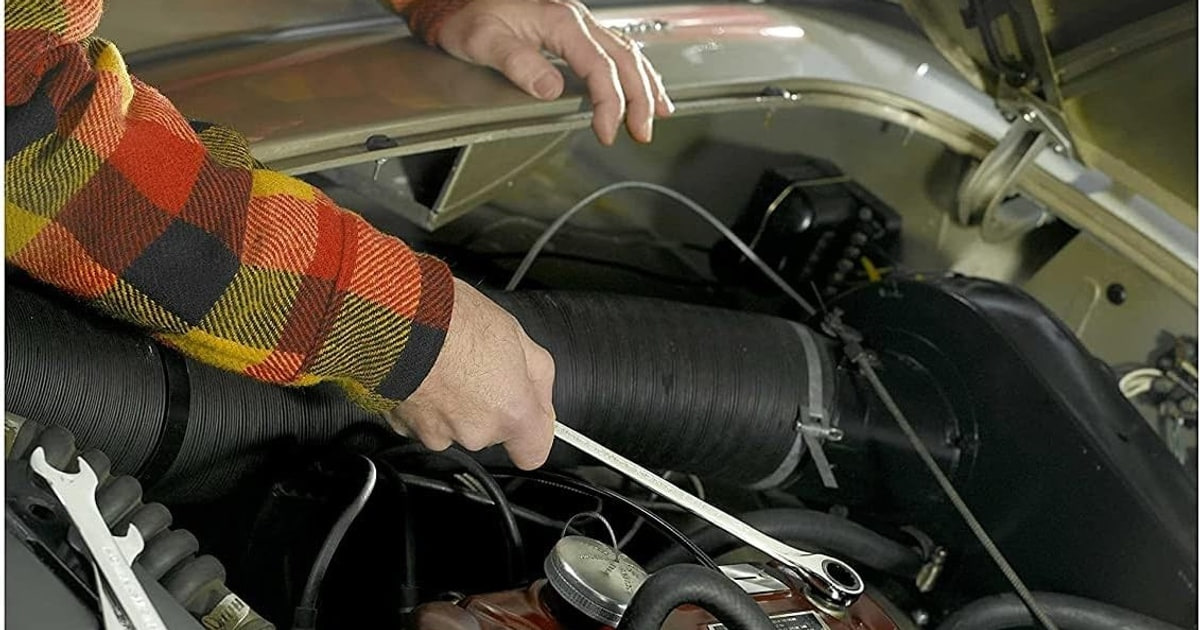
A ratcheting wrench earns its keep in the spots where a regular wrench can't move. You slip the box end over a bolt and swing the handle back without lifting off. On a bracket bolt tucked behind an alternator, that's the difference between a two-minute job and a twenty-minute one. The number that decides whether it works at all is arc swing — how far the handle has to travel to catch the next tooth. A 72-tooth head needs about five degrees. A 144-position head needs 2.5.
No set does everything. The ratchet lives inside the box end as a set of small moving parts, and small moving parts break, so you shouldn't lean on one for lug nuts, rusted suspension bolts or final torque. Use a breaker bar for those. Every set also forces a choice: SAE, metric, or both at a higher piece count and a bigger footprint in your drawer. And the thin heads that reach into tight corners are, by definition, less beefy than solid ones.
Almost everything you'll touch on a modern car is metric, American brands included, so an SAE-only set is a supplement rather than a starter kit. Think about where your hands actually go. If you're mostly on accessible bolts — oil pans, battery terminals, caliper brackets — a fixed head is fine. If you're reaching past hoses and harnesses, you want a flex head. We think that the GEARWRENCH 30-Piece Ratcheting Combination Wrench Set is the best ratcheting wrench set for most people, and that the TEKTON Flex Head 25-Piece Set is the one to buy if you spend your time working around obstructions.
Everything we recommend

Both size standards, thin heads, and a grip that spares bolts
A flex head on every wrench, in both size standards
Honest specs and a reversing lever, in a roll-up pouch

Geometry that grips the flats, for bolts already chewed up

The tightest swing here, if metric is all you need
At a glance
| Product | Pieces | Size Range | Price | |
|---|---|---|---|---|
| GEARWRENCH 30 Piece 12 Point Ratcheting CombinationTop pick | 30 Piece | 1/4-1 in., 8-24 mm | $188.16On sale |
| Milwaukee 15 Piece Metric Flex Head WrenchAlso great | 15 Piece | — | $241.99 |
 | Craftsman 20 pc Combination Ratcheting Wrench SetAlso consider | 20 pc | — | $101 |
| Snap-On 10 pc 12-Point Metric Flank DriveUpgrade pick | 10 pc | — | $636.50 |
| TEKTON Flex Head 12-Point Ratcheting Combination WrenchRunner-up | 25-Piece | 1/4-3/4 in., 6-19 mm | $290 |
 | Husky BITE SAE Combination Wrench SetAlso in lineup | 10-Piece | — | $39.96 |
| DURATECH Reversible Ratcheting Combination Wrench SetBudget pick | 9-Piece | 1/4 to 3/4 in | $39.99On sale |
 | Stanley Proto JSCV-11SA 11-piece Full Polish CombinationAlso in lineup | 11-piece | — | $371.47 |
How we picked
Arc swing. We treated tooth count as the headline spec, because 360 divided by it gives you the arc swing that decides whether a wrench works in a tight bay. Seventy-two teeth and five degrees was our floor; anything tighter counted as a real advantage.
Head type. We looked at whether heads are fixed or flexing, and for flex heads, whether they sweep freely or lock into a few preset angles. Continuous articulation reaches bolts that detented heads can't.
Size coverage. We compared the actual size lists in each spec sheet rather than trusting piece counts, since a big number can hide duplicated sizes. Sets covering roughly 8 to 19 mm and 1/4 to 3/4 inch handle the large majority of automotive work.
Steel and finish. We noted which sets disclose their alloy and heat treatment, and treated chrome molybdenum as the stronger choice for sustained high-torque use. A listing that won't say what the steel is told us something too.
Storage and support. We favored sets that ship with racks, organizers or a roll pouch, because a set you can't sort costs you more time than a slightly better wrench saves. We also weighed how straightforward each brand's replacement process is.
Top pickOn sale
Both size standards, thin heads, and a grip that spares bolts
GEARWRENCH 30 Piece 12 Point Ratcheting Combination
Thirty wrenches cover 1/4 to 1 inch and 8 to 24 mm, so one box handles nearly every fastener on a car, a truck or a mower. The box ends push on the flat faces of a bolt instead of the corners, which is what keeps a tired fastener from rounding off.
$188.16fromAmazonList priceOne box covers nearly every bolt you'll meet. The range runs 1/4 inch to 1 inch in SAE and 8 mm to 24 mm in metric, which is the working span for cars, light trucks and small engines. That matters more than it sounds. Buying metric now and SAE later means two purchases, two storage solutions, and a gap you tend to discover halfway through a job with the car on stands.
The box ends are shaped to spare chewed-up fasteners. Off-corner loading puts pressure on the flats of a hex head rather than the corners, and the corners are exactly where a bolt rounds off. If you've ever fought a fastener that a previous owner already mangled, you know why that geometry is worth caring about. It won't rescue every ruined bolt, but it buys you a real margin.
Thin heads reach where fatter wrenches stop. GEARWRENCH keeps both the head and the beam slim, so you can slide a wrench between a bracket and a coolant hose instead of unbolting the bracket first. Owners who work on packed engine bays keep coming back to that. It's the reason this set gets used daily instead of living in the bottom of a drawer.
The small stuff is done right. Sizes are stamped on both ends of the beam, so you can read one without flipping it over in a dark wheel well. The racks in the box keep everything in order, which sounds trivial until you've dumped thirty loose wrenches in a drawer. The alloy steel handles the torque you can actually apply by hand.
Flaws but not dealbreakers
Nothing in this set flexes. Every head is fixed. So when a bolt sits deep in a valve cover or behind a chassis rail and you can only come at it from one awkward angle, you're reaching for a socket and an extension anyway. That's a real slice of engine work. Plan on pairing this set with a flex-head option if that's your usual Saturday.
It's heavy, and it wants room. Thirty wrenches running up to 1 inch and 24 mm come to nearly fourteen pounds, and the racks need most of a drawer. If you're storing tools in an apartment closet or a truck box, that's worth thinking about before you commit.
Runner-up
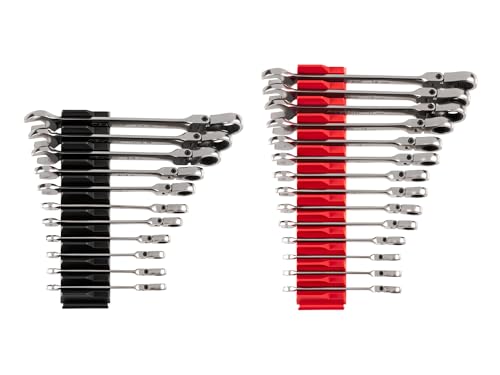
A flex head on every wrench, in both size standards
TEKTON Flex Head 12-Point Ratcheting Combination Wrench
Twenty-five wrenches cover 1/4 to 3/4 inch and 6 to 19 mm, and every one of them has a head that pivots through a full 180 degrees. If your bolts hide behind hoses and brackets, this is the set that gets to them without an extension.
$290fromAmazonEvery head flexes, and it flexes the whole way. TEKTON's pivot sweeps through 180 degrees with no preset detents, so you can park the head at whatever odd angle the bolt demands. Flex heads that snap into three or four fixed positions leave you fighting for the angle in between. This one just holds where you put it, which is the difference between reaching a bolt and giving up on it.
You get both size standards without a second purchase. Eleven SAE wrenches run 1/4 to 3/4 inch and fourteen metric wrenches run up to 19 mm. That's the automotive sweet spot on both sides. If you own a modern import and something older and domestic, you're not swapping between two sets in the middle of a job.
The organizers are better than a pouch for drawer storage. The set comes with modular three-tab holders with labeled slots, so each wrench has a home and you can see at a glance which one is missing. Sorting takes seconds instead of a minute of shuffling. Over a long job that's more time back than most of the fancier features here.
The markings and finish are done properly. Sizes are stamped into both sides of each wrench rather than printed, so they don't wear off with grease and solvent. The satin chrome is abrasive-blasted and plated, which gives you a bit more grip with oily hands than a mirror polish does.
Flaws but not dealbreakers
A pivot is a joint, and joints can loosen. Flex heads trade a little rigidity for access, and the hinge is the part most likely to develop play after years of hard use. A fixed-head wrench has nothing to wear there. If you're mostly working on accessible bolts, that trade isn't worth making.
The box ends are conventional 12-point. There's no special flank geometry protecting rusty fasteners here, so on a bolt that's already rounded you're relying on luck and a firm grip. That's fine for maintained vehicles. It's less fine in a rust belt driveway.
The top sizes stop earlier than you might want. Coverage tops out at 3/4 inch and 19 mm, which leaves out some of the larger suspension and axle hardware. You'll still be reaching for a socket on those.
Budget pickOn sale
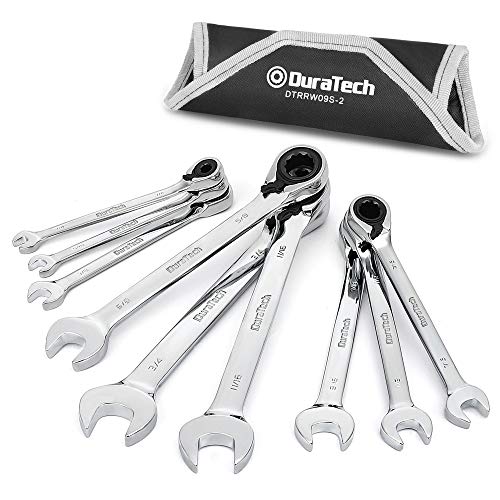
Honest specs and a reversing lever, in a roll-up pouch
DURATECH Reversible Ratcheting Combination Wrench Set
Nine SAE wrenches from 1/4 to 3/4 inch, with a published 72-tooth ratchet, a five-degree swing and heat-treated chrome vanadium steel. It's the budget set that tells you exactly what you're getting instead of hiding behind vague marketing.
$39.99fromAmazonList priceDURATECH publishes the numbers other budget brands leave out. You get the tooth count, the arc swing, the steel and the finish treatment right there in the listing. That sounds like a small thing. It isn't — when a cheap set stays quiet about tooth count, it's usually because the answer isn't flattering, and you can't compare what nobody will tell you.
The reversing lever is the feature you'll use most. It sits flush in the head, so you flip direction with a thumb without pulling the wrench off the bolt. On a long run of bolts you'll do that dozens of times. Plenty of sets at this level make you flip the whole wrench over instead, which costs you your position every single time.
The sizes are the ones you actually reach for. Nine wrenches from 1/4 to 3/4 inch cover the SAE hardware on older American vehicles, trailers, mowers and shop equipment. There's no filler here padding the piece count. The 12-point box end has a 15-degree offset, so it catches the bolt quickly when you're working blind.
It travels well. The roll-up pouch keeps the set flat and quiet, with a flap that stops wrenches sliding out when you toss it in a trunk or a gear bag. Heat-treated chrome vanadium with a high polish wipes clean easily, which matters more than it should when everything you touch is coated in gear oil.
Flaws but not dealbreakers
SAE only. There's no metric here at all, and metric is what you'll find under the hood of anything built in recent decades, American brands included. Treat this as a second set or a set for older iron. As your only wrenches, it'll leave you stranded on the first 10 mm bolt you meet.
Chrome vanadium has a ceiling. It's plenty for home use and light professional work, but it doesn't hold up to sustained high-torque cycles the way chrome molybdenum does. If you're leaning on wrenches all day, every day, you'll feel that difference eventually in flex and in mechanism wear.
Upgrade pick
Geometry that grips the flats, for bolts already chewed up
Snap-On 10 pc 12-Point Metric Flank Drive
Ten 12-point metric wrenches with Snap-on's Flank Drive Plus box ends, which spread torque across the flat faces of a fastener. If you make your living removing corroded and previously rounded bolts, this is what the trade buys.
$636.50fromAmazonThe box-end geometry is the whole reason to buy this set. Flank Drive Plus contacts the flats of a hex head well away from the points, so the load spreads across a wide surface instead of concentrating where the metal is weakest. On a bolt that's already lost its corners to rust or an over-torqued impact gun, that's often the difference between backing it out and drilling it out.
It's built for people who hold wrenches all day. Snap-on tools are made to survive a working life rather than a weekend, and the fit and finish reflect that. On a clean bolt you won't see much daylight between this and a good mid-tier set. You'll notice it in year five, when the mechanism still feels the same as the day it arrived.
Ten metric sizes cover the everyday range. These are the wrenches that come out over and over on modern vehicles — engine covers, brake caliper brackets, suspension hardware. It's a focused set, not a comprehensive one, and that's clearly the intent.
Support is the other half of what you're paying for. Snap-on's replacement process runs through its dealer network rather than a return counter, and it has a long-standing reputation for making failures right without much argument. For a shop where a broken tool is downtime, that's worth something real.
Flaws but not dealbreakers
Metric only, and just ten pieces. There's no SAE coverage, so anyone working on older domestic vehicles needs another set entirely. Ten wrenches also leave gaps at both ends of the range that you'll fill with sockets.
You're paying a lot for an edge you may rarely need. If your vehicles are maintained and your fasteners are clean, the practical gap between this and our top pick narrows to how the wrench feels in your hand. That's a hard case to make for a home garage. It's an easy one for a shop that sees high-mileage, salt-exposed cars every week.
Buying and servicing it isn't as simple as walking into a store. Snap-on's model is built around dealers and route trucks, so there's no counter to visit when something goes wrong. That's fine if you already have a rep. It's friction if you don't.
Also great
The tightest swing here, if metric is all you need
Milwaukee 15 Piece Metric Flex Head Wrench
A 144-position mechanism needs only 2.5 degrees of handle travel to catch the next tooth, and every head flexes. When a hose and a harness leave you three degrees of room, this is the set that still turns the bolt.
$241.99fromAmazonTwo and a half degrees is the tightest swing in this group. The 144-position ratchet advances a fastener in spaces where a 72-tooth wrench simply clicks back and forth without gaining anything. That situation isn't rare on a transverse engine, where brackets and lines box in nearly every bolt on the back side of the block.
The flex head solves the other half of the problem. A tight swing doesn't help if you can't get the head onto the bolt square in the first place. Pivoting the head lets you come in over a hose or around a bracket and still keep full contact on the fastener. The two features together are why this set gets pulled out for engine work specifically.
The handle is made for finding sizes by feel and glance. Milwaukee's I-beam profile gives you something to push against without digging into your palm, and the size labels are ink-filled into the metal rather than printed on top. Under a car with a work light behind you, that legibility is worth more than it sounds.
It's a specialist, and it's honest about that. Fifteen metric wrenches aren't trying to be your whole collection. They're the set you keep near the front of the drawer for the jobs that would otherwise cost you an afternoon of removing things just to reach one bolt.
Flaws but not dealbreakers
No SAE coverage at all. Every wrench here is metric, so older American vehicles, trailers and shop equipment need a separate set. Budget for that from the start rather than discovering it mid-job.
Fifteen pieces is a supplement, not a foundation. As a first and only set, it leaves too many gaps. It makes the most sense alongside a broader fixed-head set, where it handles the awkward ten percent of fasteners the big set can't reach.
Availability comes and goes. Milwaukee hand tools move through professional channels as much as retail, and this set isn't always sitting in stock. Check before you plan a job around it.
Who this is for
This guide is for anyone who turns their own wrenches — oil changes and brake jobs in the driveway, mower and small-engine work in the garage, or full days in a shop. If you're still working with a basic combination set and you've been lifting and repositioning the wrench after every quarter turn, a ratcheting set is one of the few tool upgrades you'll feel immediately. If you already own a deep socket collection and a good ratchet, the case is narrower: ratcheting wrenches earn their spot on bolts where a socket won't fit or won't clear.
We're covering ratcheting combination wrench sets, not individual wrenches, sockets, torque wrenches or impact tools. And these aren't the tool for maximum-torque work. Lug nuts, rusted suspension bolts and final torque settings belong to a breaker bar, an impact wrench or a proper torque wrench, because the ratchet mechanism inside the box end is a failure point that a solid wrench doesn't have. Choose your set around the sizes you'll actually use and the space you'll actually work in, and skip SAE-only sets as a primary kit unless everything you own is old and American.
How we picked
Arc swing: We started with tooth count, since 360 divided by it gives the handle travel a wrench needs to catch the next tooth, and 72 teeth at five degrees was our practical floor. Head type: We separated fixed heads from flexing ones and preferred flex designs that sweep continuously over ones that snap into a few set positions. Size coverage: We read the actual size lists rather than the piece counts, looking for roughly 8 to 19 mm and 1/4 to 3/4 inch. Steel and finish: We rewarded sets that disclose alloy and heat treatment, and counted chrome molybdenum as the stronger option for daily high-torque work. Storage and support: We looked for included racks, organizers or pouches, and for a replacement process you can actually use without mailing tools away.
Other ratcheting wrench sets worth considering
If you want both size standards in a starter set: The Craftsman 20 pc Combination Ratcheting Wrench Set ($101) — The Craftsman 20-piece covers 1/4 to 3/4 inch and 6 to 18 mm, which is enough for oil changes, spark plugs, caliper bolts and most routine maintenance on a passenger car. The finish is fully polished and comfortable in the hand, and the profile is slim enough for reasonable access. What you give up is swing angle: five degrees on most sizes, and six on the smallest ones, where you'd most like it to be tighter. It's a set you'll grow out of if you get serious about engine bay work, but it gets you turning bolts on both standards without a second purchase.
The competition
These are the other sets our research surfaced, not a census of the market. Each one lost to a pick for a specific reason, and in a couple of cases the reason is narrow enough that the set still makes sense for the right person.
The Husky BITE SAE Combination Wrench Set ($39.96) — The Husky BITE SAE 10-piece is the entry point here, backed by a lifetime warranty you can exercise over a Home Depot counter without mailing anything anywhere. That convenience is genuine. The trouble is what the listing doesn't say: no tooth count, no arc swing, no steel alloy, which makes it impossible to compare against sets that publish all three. It's also SAE only, so it's off the table as a primary set for any modern vehicle. If you need wrenches in your hand this afternoon and you're working on older American iron, it'll do. Otherwise our budget pick tells you far more about what you're buying.
The Stanley Proto JSCV-11SA 11-piece Full Polish Combination ($371.47) — The Stanley Proto JSCV-11SA is a genuinely industrial set, made in the United States with a full polish finish that resists chipping and rust and a countersunk box end that drops onto a fastener quickly. But it's spline drive, built for the specialty spline bolts used where head weight and size have to be minimized — aerospace, military maintenance, precision industrial work. Those bolts barely exist on consumer vehicles. The high contact surface away from the fastener points does help on badly rounded hardware, which is a nice side effect. If you maintain aircraft or heavy equipment, this is aimed squarely at you. If you maintain cars, it isn't.
Care and maintenance
Wipe the wrenches down after each job. Oil, grit and metal shavings work their way into the ratchet head, and that's what kills the mechanism long before the steel gives out. Every few months, put a single drop of light machine oil at the pivot and work the head back and forth to spread it. If a wrench starts feeling gritty or skipping teeth under load, spray the mechanism with aerosol contact cleaner, let it dry completely, then re-oil it — contact cleaner flushes debris without leaving residue behind. Don't soak wrenches in solvent, which strips the internal lubricant and leaves the ratchet dry. Store them in the rack or pouch they came with. Loose wrenches rattling in a drawer chip their own finish, and a chipped finish is where rust starts.
Questions we get
What's the difference between a ratcheting wrench and a standard combination wrench?
A ratcheting wrench has a small ratchet built into the box end, so it turns the fastener one way and slips freely on the backswing. A standard wrench has to be lifted off and repositioned after every partial turn. In open space that makes ratcheting wrenches noticeably faster. In a tight spot where you physically can't lift the wrench off, they're the only thing that works.
How many teeth should a ratcheting wrench have?
Seventy-two is the practical floor, which works out to a five-degree swing. A hundred teeth gets you to 3.6 degrees, and a 144-position mechanism gets to 2.5. Divide 360 by the tooth count and you'll have the arc swing yourself. If a manufacturer won't publish the tooth count, assume the number isn't one they're proud of.
Do I need both SAE and metric wrenches?
For anything built in the last few decades, yes. Metric fasteners are used throughout the powertrain, suspension and chassis of every modern vehicle, including Ford, GM and Stellantis products. SAE hardware turns up mostly on older American vehicles, trailers and shop equipment. A dual-coverage set saves you from owning two partial collections.
Can I use a ratcheting wrench on lug nuts?
You shouldn't. The ratchet mechanism is a stack of small parts that a solid wrench doesn't have, and shock loads or heavy leverage will eventually chew it up. Use a breaker bar to break lugs loose and a torque wrench to set them. Save the ratcheting wrenches for the enormous number of moderate-torque bolts everywhere else on the car.
Is chrome molybdenum better than chrome vanadium?
Chrome molybdenum has a higher yield strength, so it handles sustained high torque and shock loading better. That matters if you're working on seized bolts all day. Chrome vanadium is plenty for home use and light professional work, and both are a big step up from plain carbon steel. Most people will never push either alloy to its limit.
Is a flex head worth the extra money?
It depends entirely on where your bolts live. If you're mostly on accessible fasteners, a fixed head is stiffer and simpler with nothing to develop play. If you're routinely reaching past hoses, harnesses and brackets to a bolt you can barely see, a flex head turns impossible jobs into ordinary ones. Plenty of people end up owning both and reaching for whichever the job needs.
Why you should trust us
For this guide:
- We read manufacturer spec sheets and listings for tooth count, arc swing, steel alloy, finish and the actual size list in each set, and we noted which brands leave those numbers out.
- We compared published reviews from tool and automotive outlets against recurring themes in owner feedback, paying particular attention to complaints about ratchets skipping under load and flex heads developing play.
- We checked coverage size by size rather than trusting piece counts, since a higher count often means duplicated or padded sizes rather than a wider range.
- We read owner reviews on every listing, weighted toward the critical ones, because that is where the recurring failures show up.
- We have a systematic way of automatically fetching the latest prices, so the numbers on this page stay current.
- This is a research-focused guide, so the team may not own every product listed — though we often do own the top winners, which gives us extra context for the recommendations.
- We don't accept free products, and the retailer commission never changes which product we recommend.
Sources
Best Ratcheting Wrench Sets Tested — Popular Mechanics, Popular Mechanics
Best Ratcheting Wrenches We've Tested — This Old House, This Old House
Best Ratcheting Wrench Set Reviews — Pro Tool Reviews, Pro Tool Reviews
Best Ratcheting Wrench Set Buying Guide — Tool Craze, Tool Craze
Best Ratcheting Wrenches — The Family Handyman, The Family Handyman
Amazon product listings and owner reviews for all 8 products
Manufacturer specification pages for each product
Some passages in this guide may be paraphrased with AI help. Prices are refreshed automatically.
More like this.
Continue exploring home reviews and recommendations.

The Best Torque Wrenches
A torque wrench is the tool that stands between a properly seated fastener and a very bad afternoon. Lug nuts, brake caliper bolts, cylinder head studs,…

The Best Oil Filter Wrenches
Changing your own oil is one of the easiest ways to save money on a car. But it falls apart at one step: getting the old filter off. A filter that a shop…

The Best Ceramic Cookware Sets
Ceramic nonstick is what most people buy when they want eggs to slide out of the pan without cooking on a coating made with PFAS. It's the pan you grab on…

The Best Cordless Drill Sets for Home Improvement
A cordless drill is the tool you'll reach for more than any other, and most of the time you're not doing anything heroic with it. You're hanging a curtain…

The Best Pantry Organization Bin Sets
A pantry bin set does two jobs at once. It keeps flour and cereal from going stale, and it lets you see what you already own so you stop buying a fourth…

The Best Copper Cookware Sets
Copper cooks differently, and you feel it within a minute. Turn the burner down and a copper saucepan actually cools, instead of coasting for another two…