The Best MERV 13 Furnace Filters
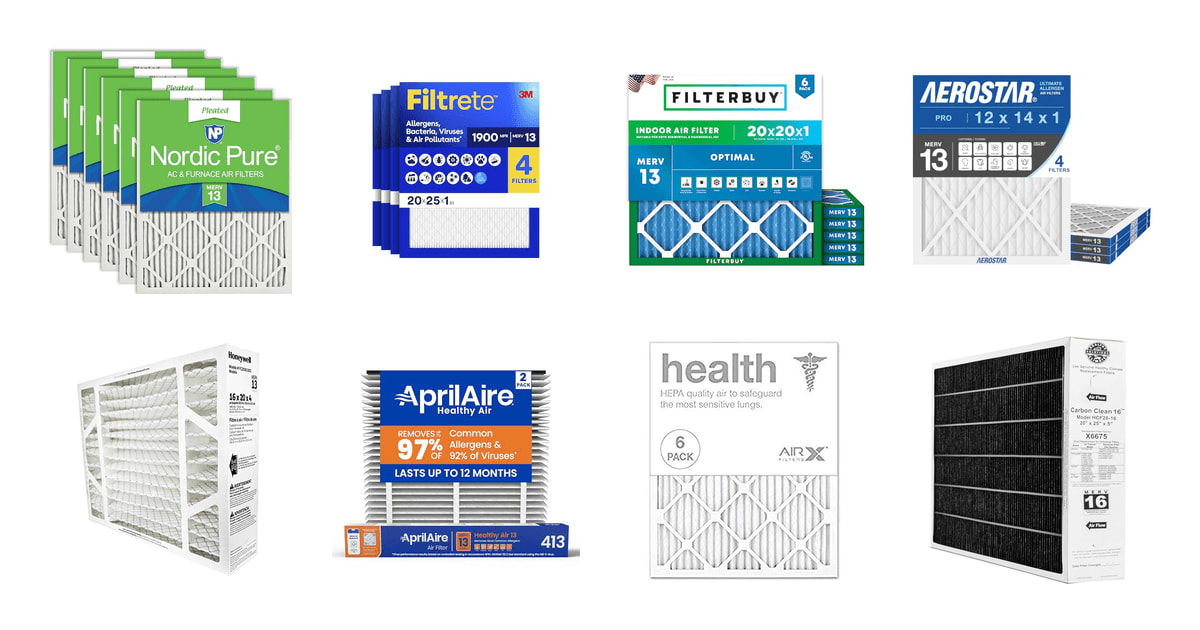
Your furnace filter is the only air cleaner in the house that touches every room. Each time the blower runs, your whole indoor air volume passes through one pleated rectangle about the size of a cookie sheet. Change that rectangle and you change what you breathe in the bedroom, the basement and the nursery all at once. MERV 13 is where that upgrade starts to matter. It catches the fine stuff — smoke, dander, the 1-to-3-micron particles that carry bacteria — and not just the visible lint your old filter grabs.
Here's the honest part: none of this is free. Finer media means more resistance. A 1-inch MERV 13 filter runs a static pressure drop of roughly 0.10 to 0.20 inches of water gauge, about double a MERV 8, and in a system with an undersized blower that can cut airflow by 5 to 15%. None of these filters does much once it's clogged, either. Industry surveys suggest about 40% of homeowners leave a 1-inch filter in for more than six months, which drops capture efficiency 15 to 25%.
So the real question isn't which box has the biggest number on it. It's which filter hits the MERV 13 standard honestly, seals in your slot without letting air sneak around the edges, and is cheap enough that you'll actually swap it on schedule. We leaned on ASHRAE's test standard, EPA and Department of Energy guidance, third-party lab findings and owner feedback themes. We think that the Nordic Pure Pleated MERV 13 is the best MERV 13 furnace filter for most people, and that the Filtrete MPR 1900 is the one to buy if you want something you can grab almost anywhere on short notice.
Everything we recommend

Honest MERV 13 filtration, bought by the box
The easiest one to find, with airflow to spare

Bulk MERV 13 with a frame that won't warp

A year of filtration, if you've got the cabinet for it
At a glance
| Product | Filter Size | MPR Rating | Price | |
|---|---|---|---|---|
| Nordic Pure 14x20x1 Pleated MERV 13 AirTop pick | 14x20x1 | 2200-2400 | $59.99 |
| Filtrete 20x25x1 Air FilterRunner-up | 20x25x1 | 1900 | $61.91 |
| Filterbuy 20x20x1 Air Filter MERV 13 OptimalBudget pick | 20x20x1 | 1900 | $49.98 |
 | Aerostar Air Filter 12x14x1 MERV 13 ACAlso in lineup | 12x14x1 | 1900 | $73.99 |
 | Honeywell Home Media Air Filter 16 xAlso consider | 16x20x4 | — | Check price |
| Genuine AprilAire 413 Replacement Filter for AprilAireUpgrade pick | 16x25x4 | — | $89.99On sale |
 | AIRX WICKED CLEAN AIR. HEALTH 20x25x1 MERVAlso consider | 20x25x1 | 1500-2400 | $59.99 |
 | Lennox Healthy Climate X6675 Healthy Climate HCF20-16Also in lineup | 25x20x5 | — | $121.99 |
How we picked
Verified MERV 13. We treated ASHRAE Standard 52.2 as the bar: at least 50% capture from 0.3 to 1.0 micron, 85% from 1.0 to 3.0, and 90% above 3.0. Because Consumer Reports found MERV 13-labeled products varying by up to 40% in sub-micron capture, we favored brands with third-party or published lab data behind the label.
Airflow you can live with. A 1-inch MERV 13 filter typically adds 0.10 to 0.20 inches of water gauge, about double a MERV 8, which can cost 5 to 15% airflow in systems with weak blowers. We gave weight to high pleat counts, published airflow data and deeper media, all of which cut that penalty.
Frame and fit. Air takes the easy path, so a warped or undersized frame quietly defeats good media. We looked for beverage board or wire-backed frames over plain cardboard, and for listings that state actual dimensions rather than only the nominal size.
Replacement cadence. Owner feedback and HVAC industry data both point the same direction: filters get left in too long, and a loaded filter costs 10 to 15% in energy while losing 15 to 25% of its capture. We preferred multi-packs, subscription options and long-life media that make on-time changes likely.
Top pick
Honest MERV 13 filtration, bought by the box
Nordic Pure 14x20x1 Pleated MERV 13 Air
Nordic Pure's pleated MERV 13 media hits the standard without the name-brand markup, and the six-pack means your next filter is already sitting in the closet. The actual size runs a half-inch under the nominal number, so measure your slot before you order.
$59.99fromAmazonFor most homes, this is all the filter you need. MERV 13 is a defined thing, not a marketing word. Under ASHRAE Standard 52.2, a filter has to capture at least 50% of particles in the 0.3-to-1.0-micron range, 85% from 1.0 to 3.0 microns, and 90% or more from 3.0 to 10.0 microns. Practically, that's 80 to 90% of PM2.5 versus roughly 20 to 35% for the MERV 8 filter you're probably running now.
Nordic Pure rates this media as equivalent to MPR 2200 to 2400 and makes it in the USA. That puts it at the upper end of what a 1-inch pleated filter claims. The listing here is a 14x20x1 six-pack, and the actual panel measures 13.5 by 19.5 by 0.75 inches. If your slot takes a different size, check that number against your old filter rather than trusting the nominal label.
Cheap filters with MERV 13 printed on the frame are common, and they don't all behave the same. Consumer Reports found that premium verified brands outperformed cheap alternatives by as much as 40% in sub-1-micron capture. That gap is invisible in the aisle. Nordic Pure is one of the names that keeps showing up on the verified side of that line, which is most of why it's here instead of a no-name multipack.
The six-pack matters more than it sounds like it does. Replacement timing is the single biggest lever on real-world performance. The Department of Energy pegs a well-maintained MERV 13 at under 3% more HVAC energy than a MERV 8, but a heavily loaded one spikes that penalty to 10 to 15%. When you've got five spares on a shelf, you swap it. When you have to order one, you don't.
Flaws but not dealbreakers
It's a 1-inch filter, and that's the format's core limitation. Expect a pressure drop around 0.10 to 0.20 inches of water gauge, roughly twice a MERV 8. If your house has an older blower motor or ductwork that's already marginal, MERV 13 in a 1-inch slot is the riskiest place to try it. Check your system's static pressure rating first.
Service life is short. Plan on 90 days in a typical house, and closer to 60 to 90 if you have a dog or cat — This Old House found that pet households burn through 1-inch MERV 13 filters faster than the usual baseline. A six-pack sounds like a lot until you realize it's roughly a year and a half of filters at best.
The listing doesn't spell out the frame construction, so if a rigid moisture-resistant frame is a priority for you — a damp basement return, say — you're partly buying on brand reputation here.
Runner-up
The easiest one to find, with airflow to spare
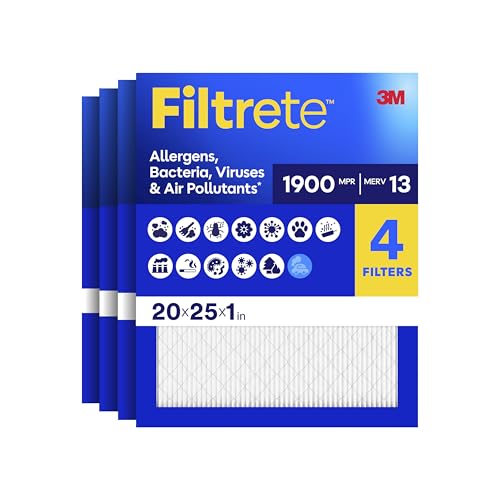
Filtrete 20x25x1 Air Filter
Filtrete's MPR 1900 is a MERV 13 filter sold at basically every hardware store and big-box chain, and 3M's own data puts its airflow ahead of other 1-inch retail MERV 13 filters. It's the one to buy when you need a filter today.
$61.91fromAmazonMPR 1900 and MERV 13 aren't competing ratings — MPR is 3M's in-house scale, and this filter carries both labels. 3M's lab data shows it capturing 95% of particles in the 1-to-3-micron range, the band where smoke, bacteria and virus-carrying aerosols concentrate. The listing puts microparticle capture between 0.3 and 1 micron at 62%, comfortably above the 50% ASHRAE floor for that band.
The airflow claim is the interesting one. 3M states, based on data filed with the California Energy Commission, that MPR 1900 filters move more air than any other brand's residential 1-inch retail MERV 13 filter. If you're upgrading an older system and you're nervous about restriction, that's a meaningful hedge — you're getting MERV 13 capture from the 1-inch filter that gives up the least airflow.
Availability is a real feature, not a consolation prize. Filters get changed when changing them is easy. Filtrete is stocked at essentially every major retailer, which means you can replace it on a Saturday afternoon instead of waiting on a delivery window. This 4-pack is a 20x25x1 with an actual size of 19.62 by 24.62 by 0.78 inches, one of the most common residential slot sizes there is.
For allergy households, the certification is worth something. This filter is certified asthma and allergy friendly, which is a third-party program rather than a marketing badge. Combined with the 1-to-3-micron numbers, it's a sensible pick if someone in your house reacts to pollen, mold spores or cat dander and you want documentation rather than adjectives.
Flaws but not dealbreakers
It's the priciest 1-inch option here per filter, and it comes in a 4-pack rather than a 6-pack, so you'll reorder sooner. If your only goal is verified MERV 13 media in your slot, you're paying a premium for the brand and the shelf presence.
3M rates it for three months, and that's an optimistic ceiling in a house with pets or heavy cooking. Electrostatically charged media also loses some of its edge as it loads, so the last few weeks of a cycle aren't doing what the first few did.
Like every 1-inch filter, it has limited media area to work with. If your ducts run high static pressure already, no 1-inch MERV 13 filter — this one included — fixes that.
Budget pick
Bulk MERV 13 with a frame that won't warp
Filterbuy 20x20x1 Air Filter MERV 13 Optimal
Filterbuy sells MERV 13 synthetic media in six-packs at a lower cost per filter than the big brands, with a beverage-board frame and dual wire backing that hold their shape. It's the one to buy if you're filtering a whole house and need several slots covered.
$49.98fromAmazonThe frame is the part people underrate. Filterbuy uses beverage board with dual wire backing instead of plain cardboard, which resists warping and handles heat and humidity better. That matters more than it sounds: a bowed frame breaks the seal against the slot, and air that goes around your filter isn't filtered at all. In a damp basement or an attic air handler, a rigid frame is doing quiet work.
On paper it's a real MERV 13, not a lookalike. Filterbuy rates this synthetic media as comparable to MPR 1900 and FPR 10, with 16 pleats per foot and 98% dust capture. More pleats mean more surface area, and more surface area means the filter loads slower and restricts less air for a given rating. It's made in the USA, which the company leans on for consistency between batches.
This particular listing is a 20x20x1 six-pack with an actual size of 19.50 by 19.50 by 0.75 inches. Six filters at 90-day intervals is about a year and a half of coverage for one return. If you've got two or three returns, buying in this format is the difference between staying on schedule and running a gray, clogged filter through July.
Filterbuy also runs subscription delivery, which is the single most effective fix for the problem that actually ruins filter performance. Nobody forgets on purpose. They just don't have a spare. Having filters show up on a cadence solves the loading penalty better than any spec on the box does.
Flaws but not dealbreakers
Sixteen pleats per foot is solid but not exceptional, and the media is electrostatically charged — that charge fades as the filter fills, so late-cycle capture drifts below the fresh-filter number. Change it on time and it's a non-issue; stretch it to six months and you've given back most of the upgrade.
Filterbuy doesn't have the same depth of independent verification behind it as Filtrete or Aprilaire. Consumer Reports' finding that MERV 13-labeled products vary widely is the reason we made it the budget pick rather than the top one.
Ninety days is the stated interval, and pets or wildfire season will shorten it.
Upgrade pickOn sale
A year of filtration, if you've got the cabinet for it
Genuine AprilAire 413 Replacement Filter for AprilAire
The AprilAire 413 is a 4-inch media filter that lasts up to 12 months and restricts airflow far less than any 1-inch filter can. It only works in an AprilAire whole-house air cleaner cabinet, so this is an upgrade for your ductwork as much as your filter.
$89.99fromAmazonList priceDepth is the cheat code in filtration. A 4-inch media filter packs roughly four to six times the surface area of a 1-inch filter at the same face size. That geometry buys you 60 to 70% lower static pressure drop and a service life of 6 to 12 months instead of 1 to 3. You get better capture and less strain on your blower at the same time, which no 1-inch filter can offer.
AprilAire's numbers for the 413 are unusually specific. The company states it removes up to 97% of common allergens and 92% of viruses, using MS-2 virus testing under the ASHRAE 52.2 method, and that it captures 15% more particles than the MERV 13 minimum — verified by a third-party lab. If you're filtering for an infant, an elderly parent or someone immunocompromised, that margin above the floor is the point.
The math favors thick media over time. Forbes Home's analysis found 4-inch MERV 13 media filters run 30 to 40% lower total cost of ownership over five years than buying 1-inch filters on repeat, once you account for replacement frequency, energy and wear on the system. This listing is a 16x25x4 two-pack, which at 12-month intervals is a couple of years of not thinking about your filter.
One change a year also removes the failure mode that ruins most filtration upgrades. You don't have to remember a 90-day cadence. You swap it when you change the smoke detector batteries and you're done, and the filter spends its whole life inside its rated performance window rather than limping through month five.
Flaws but not dealbreakers
It needs an AprilAire whole-house air cleaner cabinet installed in your ductwork. If you have a 1-inch slot in the furnace, this filter simply won't fit, and adding a cabinet is a job for an HVAC contractor with sheet metal tools. That's the real cost here, and it's not a weekend project for most people.
A two-pack of 12-month filters is two years of supply sitting in a closet, which is a lot to commit to up front for a filter you haven't lived with yet.
Deep media lowers restriction but doesn't rescue a badly matched system. If your ductwork is undersized or your return is starved, you still need someone to look at static pressure before blaming the filter.
Who this is for
Buy MERV 13 if someone in your house has allergies or asthma, if you have pets, if you live where wildfire smoke shows up, or if there's an infant, an elderly parent or an immunocompromised person under your roof. The gain over MERV 8 is real: roughly 80 to 90% PM2.5 capture versus 20 to 35%, and the EPA points to MERV 13 or better during smoke events, where homes running it saw about half the indoor PM2.5 of comparable MERV 8 homes. ASHRAE's Epidemic Task Force sets MERV 13 as its recommended minimum for occupied buildings, and CDC and NIOSH cite it as an effective way to cut occupant PM2.5 exposure by 40 to 60% in homes with working central HVAC.
Hold off if your system can't take it. Older blower motors, undersized return ducts and high existing static pressure are all reasons to check with an HVAC tech before jumping from MERV 8 to MERV 13, especially in a 1-inch slot. This guide covers filters for residential central heating and cooling systems only. It doesn't cover portable room air purifiers, window-unit filters, MERV 8 or MERV 11 filters, or washable filters, and it can't tell you your size — measure the filter that's in there now.
How we picked
We started from the standard and worked outward. Verified MERV 13: the filter has to meet ASHRAE 52.2 thresholds in all three particle bands, backed by published or third-party lab data rather than a number printed on the frame. Airflow: we favored high pleat counts, stated airflow performance and deeper media, because a 1-inch MERV 13 can cost 5 to 15% airflow in a weak system. Frame and fit: beverage board and wire backing over bare cardboard, plus listings that publish actual dimensions so the filter seals instead of leaking around the edges. Replacement cadence: multi-packs, subscriptions and long-life media, since an overdue filter gives back more than the rating upgrade gained. Availability: filters you can reorder or grab locally in the size your slot actually takes.
Other merv 13 furnace filters worth considering
If you want thick media and don't have an AprilAire cabinet: The Honeywell Home Media Air Filter 16 x — Honeywell Home's 16x20x4 media filter is the other way into deep-media MERV 13. It's rated under ASHRAE Standard 52.2, with efficiency broken out across the same three particle ranges — 0.3 to 1.0, 1.0 to 3.0 and 3.0 to 10.0 microns — that define the rating. You get the same structural advantage as any 4-inch filter: far more surface area, much less restriction, and a long interval between changes. Two catches. It still needs a media cabinet in your ductwork, and this listing's own dimensions disagree with each other, giving 4 inches in the title and 6 in the spec block. Measure your cabinet and confirm the depth before ordering.
If your filter slot is an awkward size: The AIRX WICKED CLEAN AIR. HEALTH 20x25x1 MERV ($59.99) — AIRx has a reputation among owners for stocking sizes other brands skip, which is the whole ballgame if your return doesn't take a standard rectangle. The media is electrostatically charged synthetic in a moisture-resistant double-wall beverage board frame, rated for continuous service to 180F, and AIRx positions it as a replacement for MPR 1500 through 2400 filters. This particular listing is a 20x25x1 six-pack with an actual size of 19.50 by 24.50 by 0.75 inches. What you give up is the depth of published lab data behind Filtrete and AprilAire — you're trusting the spec sheet more here.
The competition
This is what our research surfaced, not a census of every filter sold. MERV 13 filters exist in hundreds of size and pack combinations, and a filter that's wrong for us may be exactly right if it's the only one that fits your slot. Here's what else we looked at and why it didn't make the picks.
The Aerostar Air Filter 12x14x1 MERV 13 AC ($73.99) — The Aerostar MERV 13 is a perfectly reasonable filter that lost on the margins. It's made in the USA by Filtration Group, uses electrostatically charged synthetic media in a moisture-resistant beverage board frame, and is rated comparable to MPR 1900 and FPR 10 with a 60-to-90-day interval. It also lists compatibility with most major furnace brands. But it does nothing our budget pick doesn't, and this listing is a 4-pack of a fairly uncommon 12x14x1 size rather than a bulk buy. If 12x14x1 is what your system takes, grab it without worrying — it's the same class of product.
The Lennox Healthy Climate X6675 Healthy Climate HCF20-16 ($121.99) — The Lennox X6675 Healthy Climate Carbon Clean is a 5-inch media filter, and it isn't a MERV 13 at all — it's rated MERV 16, a step above what this guide covers, with an activated coconut carbon matrix added for odor removal. That extra efficiency comes with more restriction, and it only drops into a Lennox Healthy Climate HC16 cabinet, though the listing notes it also replaces several Honeywell media filter models. If you already own that cabinet and want odor control on top of fine particle capture, it's the filter your system was built around. For everyone else, it's the wrong shape and the wrong rating.
Fit and replacement
Measure the filter you're replacing, not the slot, and compare that to the actual dimensions in the listing — nominal sizes run about a half-inch large on purpose. A filter that's too small lets air slip around the media, which wastes the entire upgrade. Check the airflow arrow on the frame and point it toward the furnace. Then set a reminder: 90 days for a 1-inch filter, 60 to 90 if you have pets or you're in smoke season, and once a year for 4-inch media. Write the install date on the frame in marker, since that's the only record you'll actually have. If your blower gets noticeably louder or the house heats unevenly after the swap, pull the filter and talk to an HVAC tech about your system's static pressure before going back to MERV 13.
Questions we get
Is MERV 13 too restrictive for a residential HVAC system?
For most modern systems, no. A 1-inch MERV 13 adds roughly 0.10 to 0.20 inches of water gauge, about double a MERV 8, and a well-maintained one costs under 3% in extra energy according to the Department of Energy. The risk is real in homes with older blower motors or undersized returns, where airflow can drop 5 to 15%. Check your system's static pressure rating first, or move to a 4-inch media filter, which restricts far less.
Are MERV 13 and MPR 1900 the same thing?
They're different scales measuring overlapping things. MERV comes from ASHRAE Standard 52.2 and is the industry standard; MPR is 3M's own rating focused on particles from 0.3 to 1 micron. The Filtrete MPR 1900 carries both labels, and several other filters here describe themselves as comparable to MPR 1900. Treat MERV as the number to compare across brands.
How often should I change a MERV 13 filter?
Every 90 days for a 1-inch filter in a typical home, and every 60 to 90 days if you have a dog or cat. Four-inch media filters run 6 to 12 months. This is the part that matters most — a loaded filter loses 15 to 25% of its capture efficiency and pushes your energy penalty from under 3% to 10 or 15%.
Should I use a 1-inch or a 4-inch MERV 13 filter?
Use 4-inch if your ductwork has a media cabinet for it. A 4-inch filter has roughly four to six times the surface area of a 1-inch filter, which means 60 to 70% less pressure drop and a service life measured in months instead of weeks. Forbes Home's analysis puts total cost of ownership 30 to 40% lower over five years. The catch is that adding a cabinet requires an HVAC contractor.
Will a MERV 13 filter catch wildfire smoke?
Yes, and it's the specific thing the EPA recommends for smoke events. MERV 13 captures roughly 80 to 90% of PM2.5, the fine particulate that makes smoke dangerous, versus 20 to 35% for MERV 8. Field studies during active smoke events found homes running MERV 13 had about half the indoor PM2.5 of comparable MERV 8 homes. Run your system's fan continuously during smoke, and expect to change the filter sooner than usual.
Do MERV 13 filters reduce airborne virus risk at home?
They help, and MERV 13 is ASHRAE's recommended minimum for that purpose. Its Epidemic Task Force points to MERV 13 or equivalent in all occupied buildings, because respiratory droplet nuclei concentrate in the 1-to-3-micron band that MERV 13 captures well. AprilAire states its 413 removes 92% of viruses in MS-2 testing under ASHRAE 52.2. Filtration is one layer, not a substitute for ventilation.
Why you should trust us
For this guide:
- We read ASHRAE Standard 52.2 along with EPA, Department of Energy and CDC/NIOSH guidance to set the bar for what a MERV 13 filter has to do in a house.
- We compared manufacturer spec sheets and listing claims for every filter here against published third-party findings, including Consumer Reports' work showing how widely MERV 13-labeled products vary in sub-micron capture.
- We weighed recurring themes in owner feedback about frame durability, size accuracy and how quickly these filters load in homes with pets.
- We read owner reviews on every listing, weighted toward the critical ones, because that is where the recurring failures show up.
- We have a systematic way of automatically fetching the latest prices, so the numbers on this page stay current.
- This is a research-focused guide, so the team may not own every product listed — though we often do own the top winners, which gives us extra context for the recommendations.
- We don't accept free products, and the retailer commission never changes which product we recommend.
Sources
Wildfires and Indoor Air Quality (IAQ) — Using Air Filtration, U.S. EPA
ASHRAE Epidemic Task Force — Core Recommendations for Reducing Airborne Infectious Aerosol Exposure, ASHRAE
Maintaining Your Air Conditioner and Heating Systems — Filter Guidance, U.S. Department of Energy
Best Furnace Filters — Consumer Reports Ratings & Reviews, Consumer Reports
Best Furnace Filters of 2026 — This Old House Reviews, This Old House
Best Furnace Filters — Bob Vila Expert Reviews, Bob Vila
MERV Rating Chart: What MERV Ratings Mean for Your Home, HVAC.com
Best Furnace Filters of 2026 — Forbes Home, Forbes Home
Aprilaire MERV 13 Replacement Media Filter Specifications, Aprilaire
3M Filtrete MPR 1900 Product Data and Filtration Performance, 3M Filtrete
Indoor Air Pollution and Health — Particulate Matter and Filtration, CDC / NIOSH
Amazon product listings and owner reviews for all 8 products
Manufacturer specification pages for each product
Some passages in this guide may be paraphrased with AI help. Prices are refreshed automatically.
More like this.
Continue exploring home reviews and recommendations.

The Best Aquarium Filters for Freshwater Tanks
A freshwater filter is the one piece of equipment in your tank that never gets a break. It runs every hour of every day, pushing water through foam and…

The Best Oil Filter Wrenches
Changing your own oil is one of the easiest ways to save money on a car. But it falls apart at one step: getting the old filter off. A filter that a shop…

The Best Backpacking Water Filters
Clean water is the one thing you can't carry enough of. A liter weighs about two pounds, so on any trip longer than an afternoon you're going to be…

The Best Ceramic Cookware Sets
Ceramic nonstick is what most people buy when they want eggs to slide out of the pan without cooking on a coating made with PFAS. It's the pan you grab on…

The Best Gutter Downspout Extensions
Water that lands on your roof has to go somewhere, and a downspout that dumps it at the base of the wall sends it straight into the soil against your…

The Best LED String Lights for the Holidays
String lights are the rare decoration you interact with every single day of the season. You plug them in at dusk, you glance at them while washing dishes,…