The Best Gutter Downspout Extensions
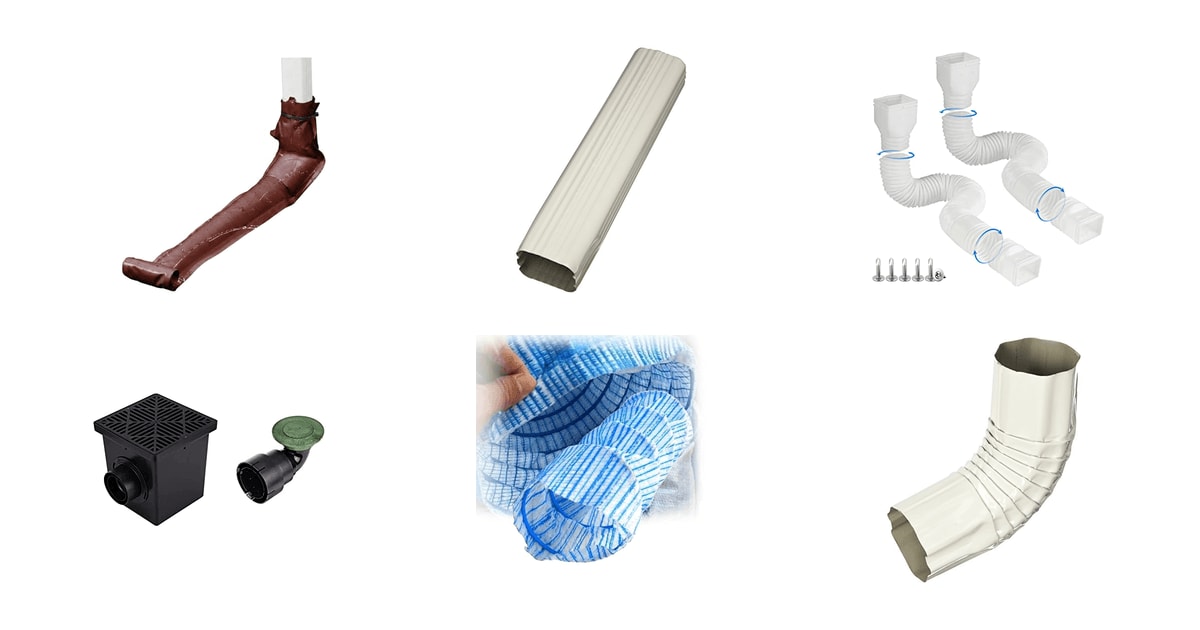
Water that lands on your roof has to go somewhere, and a downspout that dumps it at the base of the wall sends it straight into the soil against your foundation. Saturated soil pushes back on that wall, and over a few years it shows up as a damp basement, hairline cracks, or a musty crawl space. An extension is the easy fix: it moves the discharge point out to where water can soak away harmlessly. Home inspectors generally want that point four to six feet from the house, and farther in heavy clay.
Here's the honest part. No extension fixes ground that slopes toward the house, and none of them last forever. Surface plastic goes brittle in strong sun, sometimes within a season or two in the South. Aluminum holds up far longer, but it sits in your lawn all year, which is exactly why so many extensions come off before the first mow and never go back on. Buried pipe solves both problems and costs you a weekend with a shovel.
So pick by the problem you actually have. If you're routing water around a garden bed or a walkway, you want something that bends. If you're tired of looking at pipe in the grass, you want to dig. If you'd rather use the runoff on your tomatoes, you want a diverter. We think that the plusgutter Rain Gutter Downspout Extensions two-pack is the best gutter downspout extension for most people, and that the NDS 1200BKITRTL1PK catch basin and pop-up emitter kit is the one to buy if you're ready to bury the run.
Everything we recommend

Bends around your landscaping and reaches far enough to matter

Invisible drainage that lasts, if you're willing to dig

Free garden water, if your downspout is the bigger size
At a glance
| Product | Extended Length | Downspout Fit | Price | |
|---|---|---|---|---|
 | VelTherm Automatic Roll-Out Downspout ExtensionAlso consider | 46 in | 2x3 & 3x4 | $16.99On sale |
 | AMERIMAX Home Products 27075 15-Inch Downspout ExtensionAlso consider | 15 in | — | $23.06 |
| plusgutter White-2pack Rain Gutter Downspout Extensions FlexibleTop pick | 21-68 in | 2x3,3x3,3x4 | $27.99 |
| NDS 1200BKITRTL1PK Square Kit with Catch BasinUpgrade pick | — | 3-4 inch pipes | $98.60 |
 | 3 Inch Corrugated Perforated Drain PipesAlso in lineup | 10.m | 3 Inch | $95.33 |
 | AMERIMAX Home Products 473741 3-Inch Round AluminumAlso in lineup | 9 in | 3-Inch | $23.92 |
| EarthMinded Rain Barrel Diverter Kit 3x4 DownspoutsAlso great | 8-31 in | 3x4 | $48 |
How we picked
Discharge distance. Published inspector guidance lands consistently on four to six feet from the foundation as the minimum. We noted which products reach that on their own and which are only one piece of a longer run.
Downspout fit. The two common residential sizes, 2x3 and 3x4, don't interchange, and most products serve one of them. We gave weight to anything that ships adapters instead of forcing you to measure perfectly.
Material and UV life. Home-improvement guides put rigid aluminum well ahead of vinyl and plastic in freeze-thaw climates, and put surface plastic in the five-to-fifteen-year range. Owner feedback about sun damage was the tiebreaker.
Install effort. We separated slip-on parts that take five minutes from projects that need a trench, a level and a saw, and we said plainly which is which.
Reported failures. We looked for problems that repeat across owners — cracking, kinking, mechanisms that don't open, seams that split — rather than isolated complaints or shipping damage.
Top pick
Bends around your landscaping and reaches far enough to matter
plusgutter White-2pack Rain Gutter Downspout Extensions Flexible
A two-pack of flexible extensions that stretch from about two feet to nearly six, with adapters for the three common downspout sizes. You can bend one around a flower bed or a walkway and screw it down so a storm doesn't carry it off.
$27.99fromAmazonThis is the one product here that fits almost any downspout you're likely to have. The kit ships with adapters for 2x3, 3x3 and 3x4 openings, so you don't have to measure, guess, and then return the wrong box. Everything else in this guide is sized for one profile. If your house has a mix of old and newer downspouts, or you're buying for a rental you haven't looked at closely, that flexibility does a lot of work.
Say the downspout at the back corner empties into a hosta bed. A rigid extension gives you one angle and a saw. This one stretches from 21 to 68 inches and bends horizontally, so you can walk the outlet past the bed, around a stepping stone, and point it downhill without cutting a single fitting. At full stretch it clears the four-foot minimum inspectors ask for, with room left over.
The body is a thickened PE that's noticeably stiffer than the flimsy accordion tubes at the hardware store, and the manufacturer rates it to take a ten-pound load without deforming. Owners who've had them through a few storms mostly report the same thing: they stay put, they hold their bend, and they don't collapse when someone steps on one. The included screws matter more than they sound like they would, since an unsecured extension is the kind of thing you find in the neighbor's yard.
Two in a box is why most people should start here. Almost no house has just one problem downspout, and the back corners are usually the worst ones. This is also the product in this guide with by far the deepest pool of owner feedback behind it, which means its weak points are known rather than theoretical. That counts for something when you're bolting plastic to your house and walking away for a year.
Flaws but not dealbreakers
Sun is the enemy. Owners in Florida and other high-UV places report the plastic going brittle and cracking, in some cases after a single summer, and more commonly after a couple of years. Shade helps, and so does buying the two-pack, since you'll likely be replacing these eventually. Treat them as a five-to-eight-year part, not a permanent one.
White is the only color, which looks fine against white gutters and obvious against brown or mill-finish aluminum. And like any flexible extension, it can kink if you fold it at a sharp angle instead of a gentle curve. Support the bend with a brick or a stake and it stays open.
Upgrade pick
Invisible drainage that lasts, if you're willing to dig
NDS 1200BKITRTL1PK Square Kit with Catch Basin
A catch basin, grate, adapters and a pop-up emitter — the two ends of a buried downspout run, in one box. You supply the pipe, the trench and the slope, and in exchange your yard looks like nothing's there.
$98.60fromAmazonEvery surface extension is a negotiation with your lawn. This one ends the argument. The kit pairs a 12-inch square catch basin, which sits at grade below the downspout and takes the water in, with the NDS 430 pop-up emitter, which lets it out somewhere down the slope. In between goes solid pipe you bury. Nothing shows except a grate at one end and a small green lid at the other.
The details are the professional ones. The emitter lid stays shut when it's dry, which keeps mice, wasps and leaf litter from moving into your pipe from the far end, and it lifts under water pressure during a storm. Its flange is wide enough that grass doesn't swallow it. The basin's grate catches leaves before they reach the buried run, and the basin itself is rated for medium-duty traffic, so a wheelbarrow crossing it isn't a problem.
The labor is the real price of admission. You need a trench that drops at least an eighth of an inch per foot, which works out to about an inch and a quarter over a ten-foot run, and you need to hold that grade the whole way with a level. In average soil, a twenty-to-thirty-foot run is a few hours of digging. Rocky or clay-heavy ground is a different afternoon entirely.
It's worth it when your yard fights you. Ground that slopes toward the house, soil that stays soggy days after a storm, a walkway you can't route around — those are the situations where surface extensions keep failing and buried pipe just works. It also fits the standard 3- and 4-inch corrugated, triple-wall and DWV or Sch. 40 pipe you'll find at any home center, so sourcing the rest of the run is easy.
Flaws but not dealbreakers
The box covers the two ends and none of the middle. You'll buy solid, non-perforated corrugated pipe separately, plus gravel for backfill, and the pipe length drives the real cost of the project.
Get the slope wrong and you're worse off than before. A flat or backward-pitched run holds standing water inside the pipe, which freezes, silts up, and eventually pushes water back toward the basin at the house. There's also very little owner feedback on this particular kit to lean on, though NDS parts are the ones landscapers reach for by default.
Also great
Free garden water, if your downspout is the bigger size
EarthMinded Rain Barrel Diverter Kit 3x4 Downspouts
A diverter that cuts into a 3x4 downspout and feeds a rain barrel, then routes the overflow back down the spout once the barrel fills. The kit includes the hole saw and self-tapping screws, so the only thing you still need is the barrel itself.
$48fromAmazonThis replaces your extension rather than adding to it. The diverter body goes into the downspout, a flex pipe runs over to the barrel, and when the barrel is full the excess keeps going down the spout instead of pouring out at your foundation. That last part is what separates a real diverter from a cut-and-pray setup, where a full barrel dumps water exactly where you didn't want it.
Installation is more committing than a slip-on extension but not hard. You mark the 3-inch face of the downspout, cut with the included hole saw, and drive the self-tapping screws. Owners who bought the kit with the drill bits generally describe it as a ten-minute job, though several note the supplied bit struggles on steel downspouts and does its last inch by friction. The flex pipe stretches from 8 to 31 inches, so the barrel can sit off to the side rather than directly under the spout.
Over a growing season a barrel on a decent-sized roof holds enough to matter for beds, containers and a small vegetable patch, and it's water you're not pulling off the municipal system during a dry August stretch. Nearly any sealed plastic container works as the barrel, which keeps the rest of the project loose and improvised.
Flaws but not dealbreakers
It installs only on the 3-inch side of a 3x4 downspout. Plenty of older houses have 2x3 spouts, and this kit won't fit them. Measure before you buy.
Diversion isn't total. Some owners report that a meaningful share of the flow just passes by the diverter and continues down the spout, especially in hard rain, so the barrel fills more slowly than you'd expect. The included spigot has also drawn complaints about a gasket that seeps and can't really be tightened; a replacement spigot is a cheap swap. And the cut you make in the downspout can't be undone without replacing that section, which is worth thinking about if you rent or plan to sell soon.
Who this is for
Buy an extension if your downspouts discharge within a foot or two of the wall, if you see a splash trench or a puddle at the base after storms, or if your basement smells damp after a long rain. This guide covers what a homeowner can add to an existing downspout without touching the gutters: flexible and rigid surface extensions, connectors, the two ends of a buried run, and a rain-barrel diverter.
It won't solve everything. If the ground itself slopes back toward the house, or if the gutters overflow before the water ever reaches the downspout, start with regrading or gutter cleaning instead — an extension just relocates the problem a few feet. Renters should also think twice about anything that requires cutting into a downspout. And if you already have a buried run that backs up, the fix is usually slope or a clog, not a new part at the top.
How we picked
We weighed five things. Discharge distance: does the product get water four to six feet out on its own, or is it one piece of a longer system? Downspout fit: it has to match a 2x3 or 3x4 opening, and adapters that cover both are worth real credit. Material and UV life: aluminum outlasts plastic by a wide margin in cold climates, while surface plastic in strong sun is a consumable. Install effort: slip-on and screw-down parts belong in a different conversation than anything requiring a trench and a level. Reported failures: we cared most about the problems owners hit repeatedly, like brittle plastic, split seams and mechanisms that don't open in ordinary rain.
Other gutter downspout extensions worth considering
If mowing is what makes you pull extensions off: The VelTherm Automatic Roll-Out Downspout Extension ($16.99) — The VelTherm rolls out on its own when water pushes through it, then curls back flat against the house when the rain stops, so there's nothing lying in the grass for the mower to catch. It's 46 inches deployed and 8.5 inches wide, which is the widest outlet here and helps keep a flash downpour from spilling out the sides. Installation is a slip-on collar with zip ties, under five minutes. The catch is that owner feedback on the mechanism is genuinely mixed: several report it only unrolls in a heavy downpour and stays shut during ordinary rain, backing water up at the elbow. That's the whole point of the product, so it's a real risk — but if you know from experience that a fixed extension will end up in your shed, an imperfect one that stays installed still beats a perfect one that doesn't.
If you just need a short rigid piece to reach a splash block: The AMERIMAX Home Products 27075 15-Inch Downspout Extension ($23.06) — The AMERIMAX 27075 is a corrugated white aluminum sleeve that slips over the outlet with no tools and pushes water about 15 inches out. Aluminum is the right material for cold climates, since it doesn't go brittle the way vinyl does after a few freeze-thaw cycles, and the white finish matches most gutters. Understand what it is, though: 15 inches is nowhere near the four-to-six-foot minimum, so it works as a transition into a splash block, a longer flexible run, or a catch basin — not as the whole solution. Owners who've tried to shorten one report the seam pulling apart under a hacksaw, so plan to use it at full length.
The competition
This is what our research surfaced in the downspout aisle, not a survey of everything sold. Plenty of decent extensions never make it to a listing page, and a local hardware store often carries fittings that are awkward to buy online.
The AMERIMAX Home Products 473741 3-Inch Round Aluminum ($23.92) — The AMERIMAX 473741 is a 3-inch round aluminum elbow, meant for the round downspouts you find on older houses rather than the rectangular ones on most newer construction. As a material choice it's the most durable thing in this guide — aluminum, no moving parts, nothing to maintain — but it redirects water a few inches, it doesn't carry it away, so it can't compete with a real extension. One quirk worth knowing: some buyers found both ends crimped male, which means you may have to reshape one end to mate with your spout. If your house has round downspouts and you need a fitting, this is the right part, and the gutter aisle at a big-box store is usually a faster way to get it.
Installation and upkeep
Measure the downspout outlet before you order anything. The two standard sizes, 2x3 and 3x4, don't interchange, and most extensions fit only one of them. Once installed, secure it — screws or zip ties at the collar are what keep an extension from washing into the yard during the storm you bought it for. Then look at it twice a year, once in spring after the pollen and once in fall after the leaves come down. Clear the elbow at the bottom of the downspout, since that's where clogs actually form, not in the extension body. Flex the plastic on surface extensions while you're there; if it feels stiff or shows fine cracks, replace it before winter rather than after. For buried runs, lift the emitter lid and check that it still moves freely.
Questions we get
How far should a downspout extension reach from the house?
Four to six feet from the foundation is the number inspectors and extension services keep repeating. The idea is to get water out past the backfilled soil next to the wall, where it soaks in and pushes against the foundation. In heavy clay or a yard that drains poorly, eight to ten feet is safer. A flexible extension at full stretch clears the minimum comfortably; a short rigid connector does not.
What size do I need, 2x3 or 3x4?
Measure the outlet — they're not interchangeable. Older houses mostly use the 2x3 opening, and newer construction usually uses 3x4. Most extensions and diverters are built for one size only. The plusgutter two-pack is the exception here, since it includes adapters for 2x3, 3x3 and 3x4.
Do retractable roll-out extensions actually work?
The concept is sound: water pressure unrolls the tube, and it collapses flat when the flow stops. In practice it depends on getting enough flow to open the roll, and owners of the model here report that light or steady rain sometimes doesn't do it, which backs water up at the elbow. Keeping the roll clean helps. The other limit is the plastic itself, which stiffens with sun exposure and loses its spring after several years.
Can I connect a downspout to a buried drain pipe?
Yes, and it's the most durable setup. You run a short surface piece from the downspout into a catch basin set at grade, then solid non-perforated corrugated pipe underground to a pop-up emitter downhill. The NDS kit covers the basin and the emitter; the pipe is a separate purchase. The whole run needs at least an eighth of an inch of fall per foot, and too little slope is the usual reason DIY buried systems hold water.
What's a pop-up emitter, and do I need one?
It's the lid at the far end of a buried run. It stays closed when dry, which keeps rodents, insects and leaf litter from crawling into your pipe, and it opens under water pressure when a storm comes through. If you're burying pipe, use one. An open pipe end fills with debris and attracts burrowing animals within a season or two.
How long do plastic extensions last before they crack?
Somewhere between five and fifteen years, and where you live decides which end of that you get. Direct southern sun is brutal on them, and owners in high-UV areas report brittleness and cracking much sooner than that range suggests. Aluminum lasts substantially longer in freeze-thaw climates, and buried HDPE pipe is effectively a lifetime part. Check surface plastic annually and budget for replacement rather than being surprised by it.
Why you should trust us
For this guide:
- We read the manufacturer specifications and listing details for every extension, fitting and kit covered here, including downspout compatibility, materials and what's actually in the box.
- We compared published home-improvement and inspection guidance on discharge distance, trench slope and how aluminum, vinyl and PE hold up over time.
- We read owner feedback for each product and gave weight to failures that repeat — cracking in strong sun, split seams, mechanisms that don't open in ordinary rain — over isolated complaints.
- We read owner reviews on every listing, weighted toward the critical ones, because that is where the recurring failures show up.
- We have a systematic way of automatically fetching the latest prices, so the numbers on this page stay current.
- This is a research-focused guide, so the team may not own every product listed — though we often do own the top winners, which gives us extra context for the recommendations.
- We don't accept free products, and the retailer commission never changes which product we recommend.
Sources
How to Extend a Downspout — This Old House, This Old House
Best Downspout Extensions Tested and Reviewed — Bob Vila, Bob Vila
Best Downspout Extensions — Family Handyman, Family Handyman
Best Downspout Extensions — The Spruce, The Spruce
How to Bury a Downspout Extension — Family Handyman, Family Handyman
Amazon product listings and owner reviews for all 7 products
Manufacturer specification pages for each product
Some passages in this guide may be paraphrased with AI help. Prices are refreshed automatically.
More like this.
Continue exploring home reviews and recommendations.

The Best Heat Cables for Gutters and Roofs
An ice dam starts quietly. Snow melts on the warm part of your roof, runs down to the cold overhang, and freezes into a ridge at the eave. Water then…

The Best Gutter Guards
Cleaning gutters is a lousy job. You haul a ladder around the house, scoop out a season's worth of wet leaves by hand, and then do it again a few months…

The Best Gutter Cleaning Tools
Gutters only matter when they stop working. Then a storm rolls through, water sheets over the front lip, and you end up with a flooded flower bed, a damp…

The Best Dust-Free Drywall Sanders
Sanding drywall is the part of a remodel nobody warns you about. The mudding goes fine, the taping goes fine, and then you spend an afternoon filling your…

The Best Ceiling Fans With Lights
A ceiling fan doesn't cool a room. It cools you, by moving air across your skin, and that difference is bigger than it sounds. The Department of Energy…

The Best French Drain Kits
Standing water in a yard doesn't stay a cosmetic problem for long. Give it a season or two and you'll see dead grass in the low spots, mud tracked across…