The Best Dust-Free Drywall Sanders
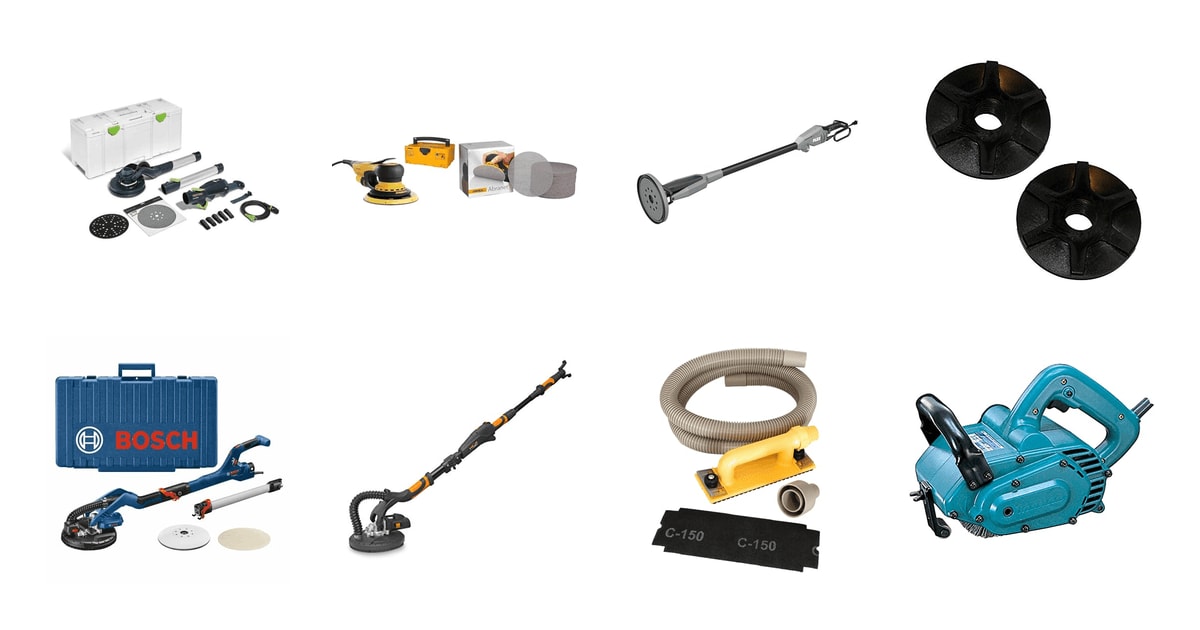
Sanding drywall is the part of a remodel nobody warns you about. The mudding goes fine, the taping goes fine, and then you spend an afternoon filling your house with a fine gray powder that settles on every surface for weeks. A dust-extracting sander changes that. It pulls the dust off the wall as you cut it and pipes it into a vacuum, so you're not breathing it and you're not wiping it off the top of the fridge in October. It also saves your shoulders, because the good ones reach the ceiling for you.
Here's the honest part: not one of these tools is dustless by itself. Every single one is a hose with a sanding head on the end, and the vacuum you connect does at least half the work. A regular shop vac without a HEPA filter grabs the big stuff and blows the fine silica right back into the room, which is the dust that actually matters for your lungs. So budget for a HEPA-rated vacuum before you upgrade the sander. A modest sander on a good vacuum beats an expensive sander on a bad one.
We read through spec sheets, manufacturer documentation, published reviews and owner feedback for eight tools, from a hand sander that clamps a screen over a vacuum port to a professional pole sander that holds itself against your ceiling. We think that the WEN 6369 is the best dust-free drywall sander for most people, and that the Bosch GTR55-85 is the one to buy if you're sanding walls and ceilings often enough that a full day overhead is a normal Tuesday.
Everything we recommend

The long-reach sander that fits most one-room projects
A flexible head and less overhead strain for long days

For people whose job is sanding, not people with a spare weekend

For nail holes and patches in a room you can't tarp off
At a glance
| Product | Weight | Motor Power | Price | |
|---|---|---|---|---|
| Festool 575994 Drywall Sander PLANEX LHS 2Upgrade pick | 22.05 lbs | Brushless EC Motor | $1,599 |
 | Mirka DEROS 650CV 6-Inch Random Orbital SanderAlso consider | 2.4 lbs | 110V Brushless Motor | $674.76 |
 | FLEX 120V Rotary Drywall Sander - FC3731-ZAlso consider | 6.2 lbs | Brushless Motor | $649 |
 | Porter Cable 7800 Drywalll Sander ReplacementAlso in lineup | 0.04 lbs | — | $19.99 |
| Bosch GTR55-85 9 In. Drywall Sander KitRunner-up | 9.04 lbs | — | $575 |
| WEN Drywall SanderTop pick | 9.2 lbs | 5-Amp Motor | $143.19 |
| Hyde Tools 09165 Dust-Free Drywall Vacuum HandAlso great | 0.2 lbs | — | $31.17 |
 | Makita 9741 Wheel SanderAlso in lineup | 9.3 lbs | 7.8 Amp Motor | $819 |
How we picked
Dust capture at the head. We compared how each head is designed to route particles into the hose rather than out the edge of the pad, using manufacturer documentation and published reviews. Anything without a purpose-built extraction head didn't make the picks.
Reach and ceiling height. A standard eight-foot ceiling needs roughly 52 inches of combined tool and arm reach, and a ten-foot ceiling needs more like 63. We checked published lengths and favored tools that reach without a ladder.
Weight overhead. Owner feedback on pole sanders is dominated by fatigue, so we weighted listed tool weight heavily and gave credit for suction assist that offloads some of it onto the wall.
Speed control. Swirl marks come from too much speed on a finish coat. We looked for a usable low end, ideally down around 600 rpm, alongside enough top speed for rough first-coat removal.
Vacuum compatibility. Port sizes vary between European and North American standards, so we checked what each tool connects to out of the box and whether owners report needing adapters.
Top pick
The long-reach sander that fits most one-room projects
WEN Drywall Sander
The WEN 6369 is a telescoping 9-inch pole sander with a 5-amp motor in the head and a 15-foot dust hose. Hook it to a HEPA shop vac and it handles a whole room's walls and ceiling without burying your floors in powder.
$143.19fromAmazonPutting the motor in the sanding head is the reason this one works. Cheaper pole sanders run a motor in the handle and send power down a flexible shaft, and torque leaks out along the way. WEN mounts a 5-amp motor right behind the pad. So when you hit a ridge of dried compound, the disc keeps cutting instead of bogging down and burnishing the surface. That's the difference between one pass and three.
The 15-foot hose is the feature you'll appreciate most and think about least. Plenty of sanders ship with a six-foot hose, which means your vacuum follows you around the room and tips over every time you stretch. With fifteen feet you park the vac in a doorway and sand an entire average bedroom from that one spot. Fewer interruptions means fewer places where you stop mid-wall and leave a visible seam.
Variable speed from 600 to 1,500 rpm covers every coat stage. Run it near the bottom of the range on your final skim coat, where heat and speed are what create swirl marks. Push it to the top for knocking down that first rough coat. WEN also includes a spread of hook-and-loop discs from 60 all the way to 240 grit, so you can work through the whole sequence without a trip to the store.
It telescopes to about five feet, which is enough for a standard ceiling. With a normal eight- or nine-foot ceiling you can stand flat-footed and reach the middle of the room. No ladder shuffle, no scaffold. The hook-and-loop pad swaps discs in a couple of seconds with no tools, which matters more than it sounds like when you change grit three times per wall.
Flaws but not dealbreakers
It spins, and spinning leaves swirls. This is a rotary sander, not a random orbital, so at high speed it can leave a faint circular scratch pattern that shows up under raking light after you paint. Keep it slow on the finish coat and feather your passes and you'll be fine. If you're doing a high-gloss wall or a client's living room, this is the WEN's real limitation.
The build is light-duty next to the professional tools. Owners generally report it holds up well for a room or a house, but this isn't a tool that shrugs off being tossed in a van five days a week, and parts like the pad and hose get complaints over long hard use. It's also about nine pounds, which your arms notice after half an hour of ceiling work.
It's only as dust-free as the vacuum you plug into it. WEN can't sell you the other half of the system. If you connect it to an old shop vac with a standard filter, you'll get the big particles and recirculate the fine silica. Plan on a HEPA vacuum from the start rather than discovering the problem after your first ceiling.
Runner-up
A flexible head and less overhead strain for long days
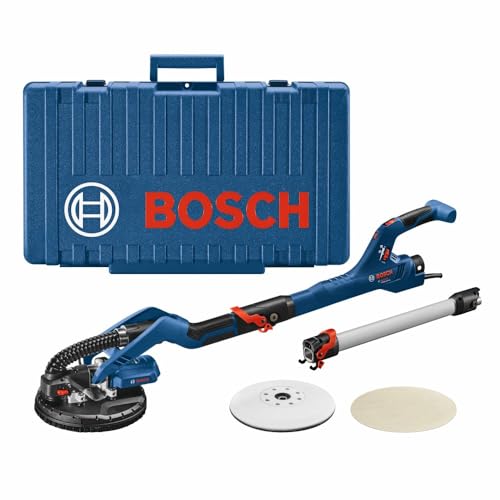
Bosch GTR55-85 9 In. Drywall Sander Kit
The Bosch GTR55-85 is a 9-inch pole sander with an unusually forgiving sanding head and a ceiling-suction mode that helps carry the tool's weight overhead. It's the pick if you sand often and mostly repair existing walls.
$575fromAmazonThe ultra-flexible head is insurance against the mistake that costs you an hour. Sand through the face paper on a high spot and you're not touching up, you're re-patching and waiting for it to dry. The Bosch head compresses and follows small irregularities instead of digging into them. If you're working on old walls that were never flat to begin with, that forgiveness is worth more than raw speed.
Ceiling-suction mode takes some of the tool off your arms. Bosch routes extraction airflow so the head pulls itself toward the ceiling, which means you're steering the sander instead of holding it up. Over an afternoon overhead, that's the difference between finishing the room and calling it a day early. It's the same idea Festool built its flagship around, at a much lower entry point.
A 9-inch pad clears open wall fast. On a long unbroken run, coverage per pass is what sets your pace, and a 9-inch disc covers far more ground than the 6-inch orbitals here. Combine that with a quick-release extension pole and you can pull the extension off for wall work so you're not swinging extra length and weight around at chest height.
The controls sit where your hand already is. Power, rpm and airflow all adjust from the T-handle grip. You can dial airflow down when the head is gripping too hard on a finish pass, or speed down as you move from second coat to skim, without stopping and repositioning the tool. Small thing, but it's the kind of small thing you do fifty times a day.
Flaws but not dealbreakers
It's the heaviest pole sander in this guide. At around nine pounds it's noticeably more tool than the carbon-fiber FLEX, and the suction assist only partly cancels that out. On tall ceilings with the extension fitted, you'll feel every ounce by the end of a wall.
Bosch clearly wants you on a Bosch vacuum. It'll connect to other extractors with the right adapter, but the integrated setup is the one the company designed for, and shops already committed to another vacuum brand should confirm hose and port fit before buying.
A round pad can't get into a corner. Nothing with a 9-inch disc can. You'll still finish inside corners and edges by hand, which is exactly where a vacuum hand sander earns its keep.
Upgrade pick
For people whose job is sanding, not people with a spare weekend
Festool 575994 Drywall Sander PLANEX LHS 2
The Festool PLANEX LHS 2 225 EQI-Plus is a professional pole sander that holds itself against the wall and lights the surface as it cuts. Paired with a Festool HEPA extractor it's the system contractors use where dust control has to be documented.
$1,599fromAmazonThe suction assist is the whole argument for this tool. The head presses itself against the wall or ceiling hard enough that you're guiding it rather than supporting it. On overhead passes that stretch past half an hour, it's the difference between fatigue and just work. Suction is adjustable too, so you can back it off on a delicate finish coat where a gripping pad would drag.
The LED light ring shows you problems before your painter does. A full ring of light around the pad throws raking shadows across the surface as you sand, so ridges and high spots you'd never catch under a ceiling fixture become obvious right away. Fixing them now takes a second pass. Finding them after primer takes a whole return trip.
Working length is variable, so one tool covers the whole house. You can run it short with the T-handle for walls and add up to two extensions for tall ceilings. That flexibility matters on jobs with stairwells or vaulted rooms, where a fixed-length sander leaves you setting up scaffold for a couple of square feet.
The brushless EC motor is built to be ignored. No brushes to replace, no service intervals to schedule, and it's designed for the kind of duty cycle that kills consumer tools. It ships in a Systainer case, which stacks with the rest of the Festool system and keeps the extensions from rattling around a van floor.
Flaws but not dealbreakers
It's by far the most expensive tool here, and that's before the vacuum. The rated dust performance assumes a matching Festool HEPA extractor, so the real entry cost is a system, not a sander. For one bedroom or even one house, that math never works out — a modest pole sander on a good HEPA vac gets you most of the way there for a small fraction of it.
It's heavy and it's a lot of tool. The suction assist offsets the mass on the wall, but you still carry it, set it up and store it. For occasional use, the setup overhead outweighs the ergonomic payoff you'd get from it on day three of a job.
Also great
For nail holes and patches in a room you can't tarp off
Hyde Tools 09165 Dust-Free Drywall Vacuum Hand
The Hyde 09165 is a hand sander with a vacuum port and a screen clamp, and it connects to whatever wet/dry vac you already own. For a patch in a finished room, it's the fastest way to sand without redecorating the place in dust.
$31.17fromAmazonIt solves the small job that a pole sander makes worse. You've got three nail holes and a seam that telegraphed through the paint. Dragging out a powered sander for that is absurd, and sanding it dry means dust on the sofa. The Hyde clamps a screen over a vacuum-fed plate, so the dust goes down the hose at the point where you make it.
It works with the vacuum you already have. The included coupling adapter fits the common wet/dry hose sizes, so there's no proprietary anything and no reason to buy a second machine. If you've got a shop vac in the garage, you're one purchase away from dust-controlled patching.
The EasyClamp swaps screens in seconds without tools. Screens load up fast on fresh compound, and a clamp you can open one-handed means you actually change it instead of pushing harder on a dead one. Pushing harder on a clogged screen is how you end up with a shiny burnished patch that shows through paint.
It's the one tool here that also protects the room. Filling a nail hole in a finished bedroom means the electronics, the rug and the closet are all in the line of fire. Sanding at the vacuum port keeps the mess contained enough that cleanup is a wipe, not a project.
Flaws but not dealbreakers
All the effort is yours. There's no motor. For a patch that's fine, but on anything approaching a full wall you'll be exhausted long before the surface is flat, and hand pressure varies enough that a big area ends up uneven.
The six-foot hose keeps you close to the vacuum. Reach above shoulder height and you'll be moving the vac constantly. It's a spot-repair tool, and treating it like a room tool is how people end up disappointed with it.
Who this is for
Buy one of these if you're about to finish a room's worth of drywall, or if you patch walls often enough that the cleanup has started to annoy you. A powered pole sander turns a two-day dusty ordeal into an afternoon, and it's the practical way to avoid breathing joint-compound dust, which contains crystalline silica and is classified as a Group 1 human carcinogen. If you're working a job site covered by OSHA's construction silica standard, dust-extracting tools aren't a preference, they're the required engineering control.
You don't need one for a single nail hole, and you shouldn't buy one expecting it to work alone. Every tool here is half a system; the HEPA vacuum is the other half, and skimping there wastes the sander. This guide covers dust-extracting drywall sanders you connect to a vacuum, from hand tools to professional pole systems. It doesn't cover vacuums themselves, dry pole sanders with no extraction, or cordless tools, since no battery long-reach sander currently runs long enough for real room work.
How we picked
We built the shortlist from spec sheets, manufacturer documentation, published reviews and themes in owner feedback, then judged every tool on the same five things. Dust capture: the head has to be designed to pull particles into the hose, not just have a port bolted on. Reach: at least 52 inches of combined tool and arm reach for a standard ceiling, more for anything taller. Weight: fatigue is the top complaint owners raise about pole sanders, so lighter wins, and suction assist that carries the tool for you counts too. Speed control: a low end near 600 rpm to keep swirl marks off finish coats, with enough top speed to knock down a rough first coat. Vacuum fit: clear port sizing and no surprise adapters between the tool and a HEPA extractor.
Other dust-free drywall sanders worth considering
If you want swirl-free finish coats: The Mirka DEROS 650CV 6-Inch Random Orbital Sander ($674.76) — The Mirka DEROS 650CV bundle is the finish specialist. Its random orbital action moves the pad in an eccentric path, so it never repeats a scratch pattern the way a rotary sander can, and the included Abranet mesh discs pull dust through effectively the entire abrasive face instead of a handful of punched holes. That means cleaner cutting, longer disc life and better extraction. At 2.4 pounds it's genuinely easy to hold all day. What you give up is reach: it's a 6-inch handheld, so ceilings mean a ladder or scaffold, and it's a lot of money for a tool that only covers what your arm can reach. The 50-disc pack of 180-grit Abranet makes it ready for skim-coat work the day it shows up.
If you want the lightest long-reach sander: The FLEX 120V Rotary Drywall Sander - FC3731-Z ($649) — The FLEX FC3731-Z uses a carbon fiber shaft to hit 6.2 pounds, which is roughly a third less than a typical steel-shaft pole sander. If your days end with sore shoulders, that's not a spec-sheet flourish, it's the reason you'll still be sanding cleanly at four o'clock. The flexible shaft also damps vibration, the head swings through 160 degrees, and the brushless motor asks nothing of you. Two catches: the 56-inch length is fixed, so it's built around standard eight- and nine-foot ceilings and gets awkward above that, and it's rotary rather than orbital, so the same swirl-mark discipline applies on finish coats. Against the Bosch it trades the forgiving head for the lighter frame.
The competition
This is what our research surfaced, not a census of the category. Drywall sanders come and go, brands re-badge the same shaft-drive design under a dozen names, and there are certainly capable tools we didn't look at. Here's the one we considered and passed over, and who might still want it.
The Makita 9741 Wheel Sander ($819) — The Makita 9741 is a wheel sander, not a disc sander, and it exists for one job: chewing through thick dried compound that a finishing sander just polishes. A 7.8-amp motor at 3,500 rpm removes material faster than anything else here, the wheel lets you work flush to a wall using the nose or the side, and it doubles as a rust and paint stripper. But it's far too aggressive for a second coat, let alone a skim coat, so it can't be your only sander. It also costs more than either of our pole sanders while doing less of the work, and the dust shroud you'd need for any real extraction isn't in the box. If you're a pro who wants a dedicated rough-coat tool sitting next to a finish sander, it makes sense. For anyone else, it's the wrong shape of tool.
Dust control and setup
Choose the vacuum first. HEPA filtration captures 99.97% of particles at 0.3 microns, which is the range that reaches deep lung tissue and passes straight through a standard shop vac filter. Check port sizes before you order: 35mm and 1.25-inch are the North American norm, while some European tools use 27mm, and a mismatched hose leaks dust exactly where you're standing. Once you're set up, work the grits in order — around 80 to 100 on the first coat, 120 on the second, 150 to 180 on the skim — and don't go finer than 180, because fine grit loads up on joint compound and a clogged abrasive extracts almost nothing. Change screens and discs sooner than feels necessary. And crack a window.
Questions we get
Will any shop vac work with a dustless drywall sander?
It'll suck, but it won't protect you. A standard shop vac grabs the visible particles and pushes the fine respirable silica back into the room through the filter. You want a vacuum rated HEPA, which captures 99.97% of particles at 0.3 microns, and most of them connect to these sanders through a standard 1.25-inch or 35mm port with a common adapter.
What's the best drywall sander for ceilings?
Look for suction assist, which the Festool PLANEX and the Bosch GTR55-85 both offer. The extraction airflow holds the head against the ceiling so you're not supporting the whole tool with your arms, and that's what determines whether you finish the room. For a standard eight-foot ceiling, any pole sander with 52 inches or more of reach is geometrically enough. Weight is the tiebreaker after that.
What grit should I use for each coat?
Start around 80 to 100 grit on the first coat to knock down ridges and tape edges. Move to 120 for the second coat to smooth and feather. Finish with 150 to 180 on the skim coat, where surface quality decides how much shows through paint. Don't go finer than 180 — it clogs fast on compound and kills your dust extraction without improving the finish.
Random orbital or rotary — does it matter for dust?
Not much for dust; both extract about the same when they're on a HEPA vacuum. It matters for the finish. Rotary sanders cut faster but can leave a repeating circular scratch that shows under raking light after painting, while random orbital motion never repeats the pattern. The disc design affects dust more than the motion does, which is why Abranet mesh outperforms punched-hole paper either way.
Can I add a dust shroud to a regular orbital sander instead?
Sort of. Aftermarket shrouds clamp onto a standard orbital and connect to a vacuum hose, and they'll capture a meaningful share of the dust in good conditions. But they don't match a purpose-built extraction head, which is engineered around the airflow path. It's a fine answer for occasional small repairs and a poor one for a whole room.
Is a cordless drywall sander worth considering?
Not for room work. No cordless long-reach sander currently runs long enough to finish walls and a ceiling on a charge, and the battery tools marketed for drywall are usually standard orbitals adapted to the job. For genuinely cord-free patching, a vacuum hand sander like the Hyde needs no power at all — just the shop vac you already own.
Why you should trust us
For this guide:
- We read manufacturer spec sheets and listing documentation for all eight tools, comparing reach, weight, motor output, speed range and extraction port sizing on the same terms.
- We reviewed published coverage of dust-extracting sanders alongside OSHA's construction silica standard and IARC's classification of crystalline silica to understand what dust control actually requires.
- We looked for recurring themes in owner feedback — overhead fatigue, swirl marks on finish coats, hose length and long-term durability — and let those patterns shape the flaws we call out.
- We read owner reviews on every listing, weighted toward the critical ones, because that is where the recurring failures show up.
- We have a systematic way of automatically fetching the latest prices, so the numbers on this page stay current.
- This is a research-focused guide, so the team may not own every product listed — though we often do own the top winners, which gives us extra context for the recommendations.
- We don't accept free products, and the retailer commission never changes which product we recommend.
Sources
Best Drywall Sanders — This Old House Reviews, This Old House
Best Drywall Sanders Tested in 2026 — Bob Vila, Bob Vila
Best Drywall Sanders — Family Handyman, Family Handyman
Best Drywall Sanders for 2026 — Popular Mechanics, Popular Mechanics
Drywall Sander Head-to-Head Testing — Tool Box Buzz, Tool Box Buzz
OSHA Respirable Crystalline Silica Standard for Construction — 29 CFR 1926.1153, OSHA
IARC Monographs Volume 68 — Silica, Some Silicates, Coal Dust and Para-Aramid Fibrils, IARC / WHO
Mirka Abranet Mesh Abrasives — Technical Product Overview, Mirka
Amazon product listings and owner reviews for all 8 products
Manufacturer specification pages for each product
Some passages in this guide may be paraphrased with AI help. Prices are refreshed automatically.
More like this.
Continue exploring home reviews and recommendations.

The Best Random Orbital Sanders for Woodworking
Sanding is the part of woodworking nobody brags about. It's also the part that decides whether your finish looks like furniture or looks like a school…

The Best Salt-Free Water Softeners
Hard water shows up in small annoyances before it shows up in your wallet. There's the white crust on the showerhead, the film on your drinking glasses,…

The Best Streak-Free Self Tanners
A self-tanner's whole job is to look like something that happened to you outdoors. That means the color has to land evenly on skin that isn't even - your…

The Best Water Filtration Pitchers
Filtered water is one of those upgrades you notice for about a week and then take for granted. The chlorine smell goes away, ice stops tasting like the…

The Best Outdoor Motion Sensor Lights
A good outdoor motion light does three unglamorous jobs. It keeps you from missing a step on a dark walkway, it makes your house a less appealing target…

The Best Can Openers
A can opener is one of those tools you don't think about until it fails you. Then you're standing over a half-open can of tomatoes, working the wheel back…