The Best Random Orbital Sanders for Woodworking
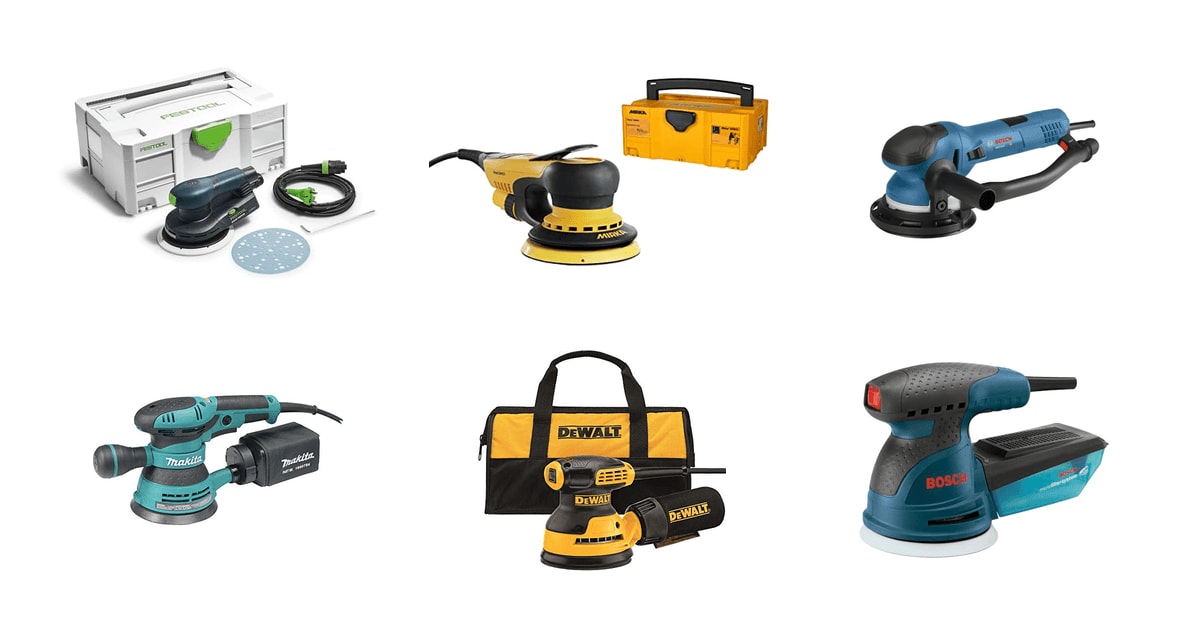
Sanding is the part of woodworking nobody brags about. It's also the part that decides whether your finish looks like furniture or looks like a school project. A random orbital sander spins and wobbles at the same time, so the pad never traces the same path twice. That's what keeps swirl marks out of a walnut tabletop, and it's why you can hand one to a complete beginner and still get a decent surface. Most of what separates a good sander from a bad one is how it feels after twenty minutes, and where the dust goes.
Here's the part nobody puts on the box: no random orbital sander catches all its dust. The bag or canister on the tool grabs the coarse stuff and lets the fine particles float. That matters, because IARC classifies oak and beech dust as a Group 1 carcinogen, and OSHA caps wood dust exposure at 5 mg/m³ over an eight-hour shift. NIOSH warns that sanding MDF in a closed shop can push formaldehyde past safe limits within minutes. So plan on a shop vac and a mask, no matter which of these you buy.
Beyond dust, the decision comes down to three things: orbit size, pad size, and how much vibration reaches your hand. A 3mm orbit finishes finer; a 5mm orbit removes wood faster. A 6-inch pad covers about 44% more area per pass than a 5-inch pad, which helps on a wide tabletop and hurts near a face frame. Vibration is the one you feel at hour three. We think that the Makita BO5041 is the best random orbital sander for woodworking for most people, and that the DeWalt DWE6421K is the one to buy if you want a kit with a three-year warranty behind it.
Everything we recommend

Smooth speed control and a front handle that earns its keep
A tidier kit and a longer warranty, minus the speed dial

The easy first sander, with real speed control and fine filtering

Barely any vibration, and dust collection that actually works
At a glance
| Product | Disc Size | Speed (OPM) | Price | |
|---|---|---|---|---|
| Festool ETS EC150/5 EQ-Plus Random Orbital SanderUpgrade pick | — | — | $1,316.32 |
 | Mirka DEROS 550X CV - 5" HookAlso consider | 125mm | — | $580.35 |
 | BOSCH GET75-6N 6 In. Dual-Mode Random OrbitAlso in lineup | 6 in | 3,300-7,300 OPM | $305On sale |
| Makita BO5041 5" Random Orbit SanderTop pick | — | 4,000-12,000 OPM | $129 |
| DEWALT Orbital Sander KitRunner-up | 5 inch | 12,000 OPM | $64.89On sale |
| BOSCH ROS20VSC 5 In. Palm Random OrbitBudget pick | 5 in | 7,500-12,000 OPM | $99 |
How we picked
Orbit and pad size. Published specifications sort these tools by orbit diameter and pad size, which drive finish quality and sanding speed more than anything else. Smaller orbits earned credit for fine furniture work; 6-inch pads earned credit for wide panels.
Dust extraction. Fine Woodworking's evaluations rank dust port seal quality and vacuum compatibility above motor amps as the real difference between budget and mid-range sanders. We favored tools that take a standard hose and seal well at the port.
Vibration and comfort. We compared published vibration figures where manufacturers report them, and read owner feedback for recurring complaints about hand fatigue. Sub-2.5 m/s² ratings mattered for all-day use; balance and low body height mattered for everyone else.
Speed control. A dial spanning roughly 4,000 to 12,000 OPM lets one sander handle both stock removal and finish passes. We treated a single fixed speed as a real limitation, though not a disqualifying one on an otherwise strong tool.
Paper and parts. Hook-and-loop backing is now the standard, and we checked that each tool takes common disc sizes and hole patterns. Easy access to replacement pads and sandpaper from multiple brands kept a sander in contention.
Top pick
Smooth speed control and a front handle that earns its keep
Makita BO5041 5" Random Orbit Sander
The BO5041 runs from 4,000 to 12,000 OPM on a 3-amp motor, so it handles rough stock and final passes without a second tool. The adjustable front handle and low palm grip make a long session on a tabletop far less punishing than it should be.
$129fromAmazonThis is the sander we'd hand to someone building their first real piece of furniture. The variable speed dial spans 4,000 to 12,000 OPM, which covers everything from knocking mill marks off rough poplar to feathering a coat of shellac. You set it and forget it, and the motor holds speed reasonably well when you lean in. Owners who've run one for years tend to describe it as the tool that stopped them shopping for another.
The adjustable front handle is the part you'll appreciate in a corner. Most palm sanders leave you pressing down with one hand and wrangling the cord with the other. Here you can grip low and forward, tip the pad into an inside corner, and keep pressure even across the disc. On a cabinet face frame or a chair leg, that's the difference between one pass and three.
At roughly 3.1 pounds it's light for a 5-inch corded sander, and the rubberized grip soaks up a fair amount of buzz. It isn't Festool-quiet or Mirka-smooth, and we won't pretend otherwise. But for the one to five hours a week most hobbyists actually spend sanding, your hands won't file a complaint.
The dust port is where this one quietly earns its keep. Fine Woodworking's evaluations put port seal quality and vacuum compatibility ahead of motor amps as the real dividing line between cheap sanders and good ones. The BO5041 takes a standard hose without a fight, and once it's on a shop vac the fine stuff mostly goes where it belongs. You still want a mask. But you won't be wiping a film off every flat surface in the garage.
Flaws but not dealbreakers
The stock dust bag is close to useless for fine work. It fills fast and it leaks the exact particles you most want gone. Budget for a hose and a vacuum from day one, and treat the bag as something for a quick job on the driveway.
It's a 5-inch, 3-amp tool, and it behaves like one. If you're flattening a wide slab or stripping paint off a deck, it'll get there eventually — but eventually is the operative word. A 6-inch machine with a bigger orbit does that work in a fraction of the time.
Runner-upOn sale
A tidier kit and a longer warranty, minus the speed dial
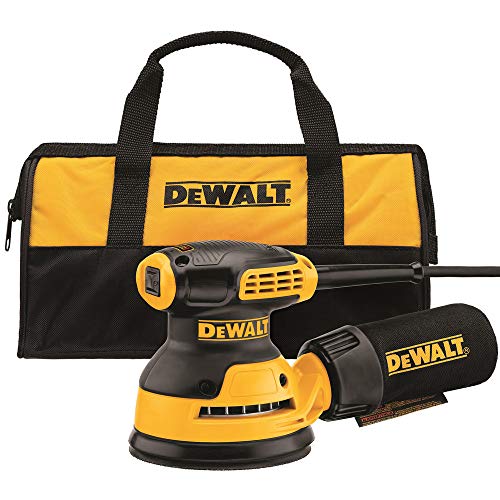
DEWALT Orbital Sander Kit
The DWE6421K arrives as a kit with a one-handed locking dust bag and a soft case, backed by a three-year warranty. It's short in the body, light in the hand, and dead simple: there's one speed, and it's fast.
$64.89fromAmazonList priceDeWalt lists this one at 3.3 pounds, under the roughly 3.8-pound average for 5-inch corded sanders. It's short, too, which sounds like marketing copy until you're leaning over a bench and notice your wrist sits closer to the wood. Less leverage means less rocking. Less rocking means fewer of those crescent scratches that only show up after the first coat of oil.
The dust bag latch is a small thing you'll use a hundred times. It locks on and off with one hand, so you can empty it without setting the sander down or fighting a friction fit. The trigger is dust-sealed as well, and that's the failure point on a lot of cheap sanders — grit works into the switch and the tool starts cutting out mid-pass.
A separate counterweight handles the balance, and it works well enough that owners doing long refinishing jobs — decks, dressers, resin pours — don't complain much about buzz. This isn't a low-vibration tool in the Festool sense. It's a well-balanced one, which for weekend work is most of what you actually need.
The three-year warranty is the quiet argument here. Sanders live hard lives: they eat their own dust, they get dropped off benches, and the pad and switch wear out first. Knowing DeWalt will look at it for three years takes some sting out of buying a tool you fully intend to abuse.
Flaws but not dealbreakers
There's no variable speed. The pad runs at 12,000 OPM and that's the whole menu. For most wood that's fine, but it's too fast for a few things you'll eventually want to do — knocking down raised grain between coats, sanding thin veneer, working acrylic. You'll notice the gap the first time you scorch the edge grain on a piece of pine.
The kit ships in a soft bag rather than a hard case. It'll keep the sander and a stack of discs together on a shelf. It won't survive a week in a truck bed.
DeWalt backs the DWE6421K with a three-year limited warranty.
Budget pick
The easy first sander, with real speed control and fine filtering
BOSCH ROS20VSC 5 In. Palm Random Orbit
The ROS20VSC pairs a 2.5-amp motor with a 7,500 to 12,000 OPM dial and a canister that filters particles down to about half a micron. For a first sander — refinishing furniture, smoothing a shelf, shaping a guitar body — it's more tool than most beginners expect.
$99fromAmazonBuy this one if you're not yet sure how much you'll enjoy sanding. It's the smallest commitment here that still does honest work. The speed control is a real dial rather than a two-position switch, so you can drop it low for delicate passes and open it up when you need to move material. Owners refinishing furniture and building instruments consistently report clean, swirl-free surfaces from it.
The dust canister beats the cloth bags most sanders in this class ship with. Bosch's microfilter catches particles down to roughly half a micron, and the clear body shows you when it's full. It's still no substitute for a vacuum. But if you're sanding in a spare bedroom with a fan in the window, it's meaningfully less awful than a bag.
Bosch's hook-and-loop pad uses a dense field of hooks, and discs stay put through a full paper's worth of work. Sandpaper for 5-inch, 8-hole pads sits on the shelf at every hardware store, in every grit, from every brand. That sounds boring. It's also the most underrated reason to buy a mainstream 5-inch sander instead of something exotic.
Flaws but not dealbreakers
At 2.5 amps it's the weakest motor here, and you'll feel it when you press. Lean on it in hard maple and the pad slows; the fix is patience and coarser grit, not force. Push through anyway and you'll leave a burnished patch that turns up under stain looking like a bruise.
It's a light-to-medium-duty tool, and owners describe it that way — happy on finishing work, less happy on all-day jobs. If sanding is most of what you do, start further up this list.
Upgrade pick
Barely any vibration, and dust collection that actually works
Festool ETS EC150/5 EQ-Plus Random Orbital Sander
Festool's ETS EC 150/5 puts a brushless motor in a body only 116mm tall, with a published vibration value of 2.5 m/s². That's at or below the action threshold in the EU's vibration directive, which is the whole reason this tool exists.
$1,316.32fromAmazonVibration is what you're paying for here, and the number is real. Festool publishes 2.5 m/s² for the ETS EC 150/5, at or below the action value in EU directive 2002/44/EC — the threshold above which employers have to start managing exposure. If you sand for an hour on Saturday, that's an abstraction. If you're a finish carpenter on hour six, it's whether your fingers still work at the end of the day.
The suction detection is either brilliant or infuriating, depending on your habits. The sander simply won't start unless a hose is connected. You can't grab it for one quick pass without setting up extraction, which is exactly the point and exactly what people find annoying. On dust, Festool has decided to be your safety officer whether you asked or not.
A carbide-tipped disc brake keeps the pad from spinning up free, so you can bring the sander to the work — or set it down — without scoring a surface you just spent an hour flattening. The 5mm orbit on a 6-inch pad splits the difference well: fast enough to level a glue-up, fine enough that 220 grit leaves something you can finish directly.
The body stands only about 116mm tall and weighs less than you'd guess from how substantial it feels. Pair that with the vibration control, which eases the motor back when the sander starts chattering, and it's the least tiring tool on this list. It's also a doorway into an ecosystem: Festool hoses, Festool abrasives, Festool cases. Once you're in, you're in.
Flaws but not dealbreakers
It costs several times what a very good hobbyist sander costs, and that math only works if you sand for hours a day, most days. For a weekend woodworker, the Makita gets you most of the finish quality and none of the sting.
The hose requirement is a genuine constraint, not a quirk. No vacuum, no sanding — not even for a thirty-second knockdown of raised grain. And Festool's fittings don't mate with a standard shop vac hose without an adapter, so plan on buying into their extraction system or hunting down a coupler.
Who this is for
This guide is for anyone who works wood at home or for a living and wants a smooth, swirl-free surface without learning to drive a belt sander. That covers a first-time furniture builder, a hobbyist who sands a few hours a week, and a cabinet maker who sands all day and needs the tool to stop hurting. If you're refinishing a deck, stripping paint, or flattening a big slab, a random orbital will do it — just more slowly than a tool built for the job.
It doesn't cover pneumatic sanders, detail and corner sanders, drum or belt sanders, or floor machines. If your project is a whole house of hardwood floors, rent a proper floor sander and use one of these for edges and closets. And if you already own a sander you're happy with, the honest advice is to spend the money on a better shop vac and a box of quality discs instead.
How we picked
We weighed each sander against five things. Orbit and pad size: smaller orbits give finer finishes, and a 6-inch pad covers about 44% more area per pass than a 5-inch pad, so the right choice depends on whether you sand tabletops or face frames. Dust extraction: a sealed port that takes a shop vac hose matters more than motor amps, which is exactly how Fine Woodworking ranks it. Vibration and comfort: published figures under 2.5 m/s² separate professional tools from everything else, and body height and balance separate the rest. Speed control: a 4,000 to 12,000 OPM range lets one tool do rough work and final passes. Paper and parts: universal hook-and-loop backing and common disc patterns keep a sander usable for years.
Other random orbital sanders for woodworking worth considering
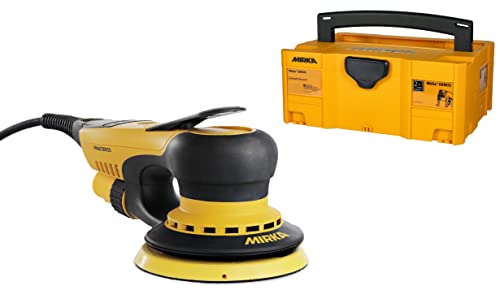
If you want the quietest sander in the shop: The Mirka DEROS 550X CV - 5" Hook ($580.35) — The Mirka DEROS 550CV runs at 73 dB(A), roughly 10 to 13 decibels below the 82–86 dB(A) typical of corded random orbitals. Decibels are logarithmic, so that works out to something like four to eight times less acoustic energy — quiet enough that owners report sanding on low settings without hearing protection. It's also the lightest tool we looked at, at 2.2 pounds, with a 3.9-inch body and a 5mm orbit that balances stock removal against fine finishing. Woodworkers with wrist trouble talk about it the way people talk about a good mattress. The catch is service: a thread of owner feedback describes units failing inside the first year and warranty support going badly, and a Mirka isn't something the local hardware store can fix. Buy from a dealer who'll stand behind it.
The competition
This is what our research surfaced, not a survey of everything on the market. Plenty of capable sanders sit outside this lineup — pneumatic models that need a real compressor, cordless kits tied to a battery platform you may not own, and the big dual-action machines aimed at auto body shops.
The BOSCH GET75-6N 6 In. Dual-Mode Random Orbit ($305) — The Bosch GET75-6N is the muscle option: a 7.5-amp motor, a 6-inch pad, and a turbo mode that switches to direct-drive rotation for several times the stock removal of normal random-orbit sanding. On a wide slab or a cured epoxy pour it does work a 5-inch sander can't touch, and that bigger pad covers about 44% more area per stroke. It lost on livability. At 5.7 pounds it's the heaviest tool here by a wide margin, owners describe it as loud, and turbo mode is aggressive enough to dish a panel if your attention wanders. It also has no onboard dust collection at all — it's vacuum or nothing, though Bosch includes a hose adapter. If your projects are big flat surfaces and you already own a shop vac, it's a legitimate alternative to a belt sander.
Dust collection and upkeep
Connect a vacuum, always. The bag or canister on any of these sanders is a courtesy, not a dust collection system, and the hardwood and MDF dust you can't see is the part that hurts you. Work up through grits without skipping — 80 to 120 to 180 to 220, advancing no more than about 50% per step. Jumping straight from 80 to 220 leaves scratches that stay invisible until the finish goes on and then never leave. Check the hook-and-loop pad every few projects: once the hooks mat down, discs slip and spin, which burns paper and scars wood. Replacement pads are cheap and take a minute to swap. And keep the sander moving. Parking it in one spot is how you get a dish you'll spend an evening flattening.
Questions we get
What's the difference between a random orbital sander and a regular orbital sander?
A regular orbital sander vibrates the pad in a fixed small circle, so it repeats the same path over and over and can leave a visible pattern. A random orbital spins the pad while also orbiting it, so the abrasive never retraces its own scratches. That's why it produces swirl-free surfaces with almost no technique required. It also removes material faster than a sheet sander of the same size.
What orbit size is best for fine furniture — 3mm, 5mm, or 8mm?
For fine furniture, a 3mm orbit gives the finest surface with the least risk of swirl. A 5mm orbit is the versatile middle ground and what most quality sanders use, including the Festool and the Mirka here. An 8mm orbit removes stock quickly but leaves scratches you'll need to sand out afterward, so it suits rough work and slab flattening rather than finish passes.
Is a 5-inch or 6-inch random orbital sander better for woodworking?
A 6-inch pad has about 28.3 square inches of contact area versus 19.6 for a 5-inch pad — roughly 44% more per pass — which cuts real time off wide tabletops and panels. A 5-inch pad is more maneuverable near edges, inside face frames, and on smaller parts. For most home woodworkers building furniture and cabinets, 5 inches is the more useful default. Go 6-inch if you regularly work big flat surfaces.
Is the sander's built-in dust bag good enough, or do I need a vacuum?
You need a vacuum. Onboard bags catch the coarse chips and let the fine particles escape, and fine particles are the health concern — IARC classifies oak and beech dust as a Group 1 carcinogen, and OSHA limits wood dust exposure to 5 mg/m³ over an eight-hour shift. NIOSH also warns that sanding MDF in a closed shop can push formaldehyde past safe limits quickly. Connect a shop vac and wear a mask.
How do I avoid swirl marks?
Most swirl marks come from three habits: pressing too hard, skipping grits, and letting dust build up under the disc. Let the sander's weight do the work and move it slowly across the surface. Advance no more than about 50% per grit step, so 80 to 120 to 180 to 220. Keep the vacuum running, because trapped grit under the pad is what carves the deeper scratches you find after staining.
Is a Festool worth it for a weekend hobbyist?
Probably not. What you're buying is the vibration figure — 2.5 m/s² on the ETS EC 150/5, at or below the EU occupational action threshold — plus dust extraction that genuinely works. Both pay off across a six-hour day, several days a week. If you sand a few hours a month, the Makita or the Bosch gets you a comparable finish, and the difference is better spent on a good vacuum and quality abrasives.
Why you should trust us
For this guide:
- We read manufacturer specification sheets for every sander here, comparing orbit diameter, pad size, motor draw, speed range, and published vibration and noise values.
- We compared published reviews and tool evaluations from woodworking publications, including how Fine Woodworking and Wood Magazine rank dust extraction, pad size, and grit progression.
- We read through owner feedback for each model, looking for repeated themes around vibration, dust leakage, pad wear, and long-term reliability rather than isolated complaints.
- We read owner reviews on every listing, weighted toward the critical ones, because that is where the recurring failures show up.
- We have a systematic way of automatically fetching the latest prices, so the numbers on this page stay current.
- This is a research-focused guide, so the team may not own every product listed — though we often do own the top winners, which gives us extra context for the recommendations.
- We don't accept free products, and the retailer commission never changes which product we recommend.
Sources
Best Random Orbital Sanders — Wirecutter (NYT), Wirecutter
Random Orbital Sanders Tool Review — Fine Woodworking, Fine Woodworking
Best Random Orbital Sanders — Popular Mechanics, Popular Mechanics
Best Random Orbital Sanders — Bob Vila, Bob Vila
Best Random Orbital Sanders — Family Handyman, Family Handyman
Best Random Orbital Sanders — This Old House, This Old House
Wood Dust — Occupational Safety and Health Administration (OSHA), OSHA
Wood Dust Health Hazards — NIOSH, NIOSH / CDC
Festool ETS EC 150/5 EQ Technical Specifications, Festool USA
Mirka DEROS 5650CV Product Specifications, Mirka
Amazon product listings and owner reviews for all 6 products
Manufacturer specification pages for each product
Some passages in this guide may be paraphrased with AI help. Prices are refreshed automatically.
More like this.
Continue exploring home reviews and recommendations.

The Best Dust-Free Drywall Sanders
Sanding drywall is the part of a remodel nobody warns you about. The mudding goes fine, the taping goes fine, and then you spend an afternoon filling your…

The Best Miter Saws for Woodworking and Home Shops
A miter saw is the tool that decides whether your trim looks sharp or looks like it was cut with a butter knife. It crosscuts boards to length and slices…

The Best Benchtop Drill Presses for Woodworking
A handheld drill wanders. Even with a steady hand you'll drift a couple of degrees, and that shows up later as a shelf that rocks or a dowel joint that…

The Best Car Polishers And Orbital Buffers
Swirl marks show up in direct sun as a spiderweb of fine scratches across your hood and doors. They come from washing, drying, and automatic car washes,…

The Best Soldering Stations
A soldering station is what decides whether your joints come out shiny and solid or gray and cracked. Temperature control is the whole game. A cheap…

The Best Door Threshold Seals and Weatherstripping
You can feel a bad door seal before you can see it. Stand near the front door on a cold morning and there's a cool ribbon of air across your ankles. In…