The Best Whole House Water Softeners
Hard water doesn't announce itself. It shows up as a film on the shower glass you can't scrub off, spots on glasses that came out of a dishwasher you just ran, laundry that feels stiff, and a water heater that quietly gets less efficient every year as scale builds on the element. A whole house softener sits where the water line enters your home and pulls the calcium and magnesium out before any of that happens. Get the size right and you mostly forget it exists, except for hauling salt bags a couple times a month.
Here's the honest part: no softener here is a set-and-forget appliance. All of them need a drain line, a nearby outlet, and roughly half a Saturday of plumbing. All of them consume salt forever. And all of them dump salty backwash water down the drain, which some regions restrict. Sizing is on you, too — buy one rated too close to your actual demand and it'll regenerate constantly, burning salt and shortening resin life. The manufacturer's grain number is a ceiling, not a target.
You also need to know your water before you order. Iron above a few parts per million will foul standard resin, and a salt-free conditioner won't soften anything at all no matter how it's marketed. We think that the Fleck 5600SXT 48,000 Grain is the best whole house water softener for most people, and that the AFWFilters Iron Pro 2 is the one to buy if you're on a well with iron staining your fixtures.
Everything we recommend

Repairable, metered, and boring in the best way

For well water where iron stains everything orange

Metered softening plus a pre-filter, for less
Leak alerts on your phone, if that's worth the premium
At a glance
| Product | Grain Capacity | Flow Rate | Price | |
|---|---|---|---|---|
| Fleck 5600SXT 48Top pick | 48,000 Grain | 12 GPM | $809 |
 | PRO+AQUA PRO-E-S80E Elite Whole House Water FiltrationAlso consider | 80,000 Grain | 20 GPM | $1,211.44On sale |
| Aquasure Harmony Series 40Budget pick | 40,000 Grain | — | $579.99 |
| GE Smart Water SoftenerUpgrade pick | 35,000 Grain | — | $699 |
 | Aquasana Rhino Salt-Free Conditioner Replacement Tank -Also in lineup | — | — | $774 |
 | iSpring WCSTB45KG Whole House Water Softener SystemAlso consider | 45,000 Grain | — | $529.40 |
| AFWFilters Iron Pro 2 Combination Water SoftenerAlso great | 64,000 Grain | — | $909 |
 | Aquasure Harmony Series Grains Whole House WaterAlso consider | 64,000 Grain | — | $749.99 |
How we picked
Regeneration control. We only considered systems with demand-initiated metered valves, which regenerate based on gallons used rather than a timer. Published industry figures put the salt savings around 30 to 50 percent versus timed control.
Grain capacity and sizing. We compared rated capacity against the standard sizing formula — occupants times 75 gallons times hardness in grains per gallon times seven days — and looked for headroom above that number rather than a tight fit.
Parts and repairability. We weighted control valves with broad third-party parts availability heavily, since the valve is what usually fails first. Fleck-based systems have a decades-deep supply network that newer brands can't match.
Iron and pre-treatment. We checked stated iron and manganese tolerances against what well owners actually deal with, and noted which systems include sediment or carbon pre-filtration rather than requiring a separate stage.
Owner-reported install experience. We read owner feedback for recurring patterns in documentation quality, shipping completeness, and support responsiveness — the failure modes that turn a weekend project into a two-week ordeal.
Top pick
Repairable, metered, and boring in the best way
Fleck 5600SXT 48
A 48,000-grain metered softener built around the Fleck 5600SXT valve, the control head independent plumbing suppliers have stocked parts for over decades. It handles up to six people at moderate-to-very-hard water, and it's the one you can still fix in year fifteen.
$809fromAmazonThe valve is the whole argument. The 5600SXT is the most widely serviced residential softener control head in North America, and that matters more than any feature on a spec sheet. Seals, pistons, and meter assemblies are stocked by dozens of independent suppliers, so a failure fifteen years in is a part swap rather than a new system. Most softeners are outlived by their control valve. This one isn't.
It regenerates on demand, not on a clock. A paddle wheel meter counts the water you actually use and triggers a cycle when the resin bed is genuinely spent. If you travel for a week, it sits idle. Timer-based softeners regenerate on schedule whether you're home or not, and industry estimates put the salt savings from metered control in the range of 30 to 50 percent a year.
At 48,000 grains with a 1-inch yoke, this handles a household of four to six at hardness up to about 20 grains per gallon. The 1-inch connection matters more than people expect. Undersized plumbing at the softener is where pressure drops show up, and you'll notice it when someone starts a shower while the dishwasher is filling.
Owners describe the install as approachable if you've cut pipe before, and plenty report hiring a plumber and finding the bill smaller than expected. The kit ships with hardness test strips, sanitizer, and silicone lubricant, which is a small thing that saves a second trip to the hardware store.
Flaws but not dealbreakers
There's no app, no WiFi, no phone alerts, and no leak detection. If you want your softener to text you when the salt is low, this isn't it. You'll be lifting the brine tank lid once a month like everyone did before smart home appliances existed.
It also has no pre-filter. On municipal water that's usually fine, but if your supply carries sediment or you're on a well, you'll want a sediment filter upstream to keep grit out of the resin bed. That's another fitting, another housing, and another thing to service.
A handful of owners have reported the system arriving as split shipments, with the valve traveling separately from the tanks. If you've scheduled a plumber, confirm every box is on site before anyone shows up with a pipe cutter.
Warranty terms for this system aren't stated in the listing.
Also great
For well water where iron stains everything orange
AFWFilters Iron Pro 2 Combination Water Softener
A 64,000-grain softener on the same Fleck 5600SXT valve, but with fine mesh resin that tolerates far more iron. If your toilet tanks and tub have rust rings, a standard softener will foul and this one won't.
$909fromAmazonStandard softening resin gives up on iron long before you do. Most resin handles roughly 1 to 3 ppm before iron coats the beads and capacity collapses. The Iron Pro 2's fine mesh resin is rated for up to 6 ppm iron and manganese, which covers a large share of problem wells without a separate iron filter stage upstream. That's one less tank, one less connection, one less thing to maintain.
You get the same 5600SXT control head as our top pick, so demand-initiated regeneration and the deep parts ecosystem carry over. The valve comes with a five-year warranty. At 64,000 grains, it also has enough headroom to run a large household on genuinely hard well water without cycling every other night.
Owners on wells consistently describe the change as immediate and dramatic — the rotten-egg smell gone, rust staining stopped, faucet aerators staying clear. Several report replacing failed multi-stage setups with this single unit. It's the most reviewed system in this guide by a wide margin, and the pattern in that feedback is unusually consistent.
Test your water first. This isn't optional. Iron above the rated ceiling, or pH above about 7.5, means you'll need oxidizing pre-treatment ahead of the softener no matter which unit you buy, and finding that out after installation is an expensive lesson.
Flaws but not dealbreakers
Fine mesh resin uses somewhat more salt per regeneration than standard resin. On city water with no iron, you'd be paying for capability you never use and feeding it extra salt for the privilege. Get the Fleck 5600SXT instead.
The unit ships with resin pre-loaded, which makes the tank genuinely heavy. Owners recommend a dolly and a second set of hands. Instructions are workable but thin — a few people with real trade experience still found themselves puzzling over details.
The Fleck 5600SXT valve on this system carries a five-year warranty.
Budget pick
Metered softening plus a pre-filter, for less
Aquasure Harmony Series 40
A 40,000-grain metered softener that includes a triple sediment, carbon, and zinc pre-filter — a component most competitors make you buy separately. It's sized for a three- to four-bathroom home at moderate hardness.
$579.99fromAmazonThe included pre-filter is the reason to look here. It catches chlorine, sediment, rust, and VOCs before water hits the resin, which protects the resin bed and improves what comes out of every tap. Chlorine slowly degrades softening resin, so on municipal water this isn't just a taste upgrade — it extends the life of the expensive part.
Owner feedback on this one is the strongest in the lineup. People describe the installation directions as unusually clear, the digital programming as straightforward, and the customer support as responsive when something goes sideways. That's a meaningful signal on a product where the difference between a good weekend and a bad one is documentation.
The digital metered control head works the same way as the Fleck's: it counts gallons and regenerates when the resin is actually depleted. Multiple owners replacing older units mention noticeably lower salt consumption, which is what you'd expect moving from a timer to a meter.
Aquasure includes a 30-day money-back window and offers extended manufacturer coverage. That's worth something on a category where a dead-on-arrival control valve means your water goes back to being hard while you sort out returns.
Flaws but not dealbreakers
Forty thousand grains isn't enough for a big house on hard water. At five or more people above roughly 15 to 18 grains per gallon, you'll be regenerating too often, wasting salt and wearing the resin. Do the math before you order: people times 75 gallons times your hardness times 7 gives your weekly grain load, and you want real headroom above it.
No WiFi, no app, no leak alerts. And Aquasure doesn't have the decades of parts availability that Fleck does — if a valve fails outside the warranty window, you're dealing with the manufacturer rather than any plumbing supply house in town.
A few owners needed to re-pipe to fit it. At 55 inches tall in a nine-inch footprint, it's narrow but tall, so measure your utility space including clearance above the tank.
Upgrade pick
Leak alerts on your phone, if that's worth the premium
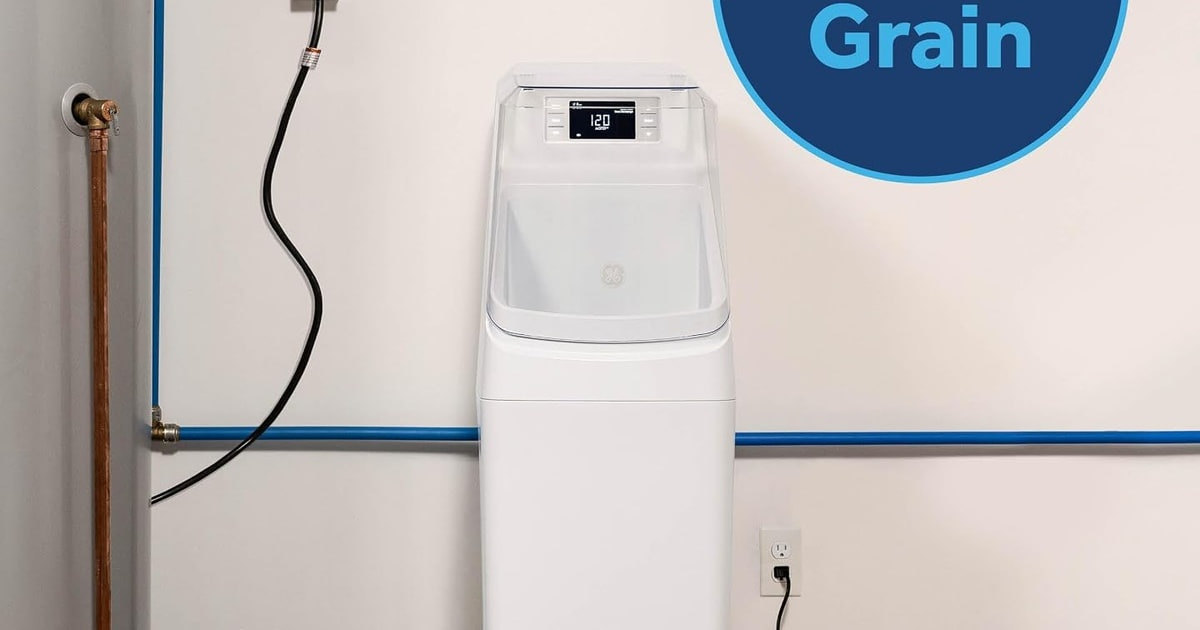
GE Smart Water Softener
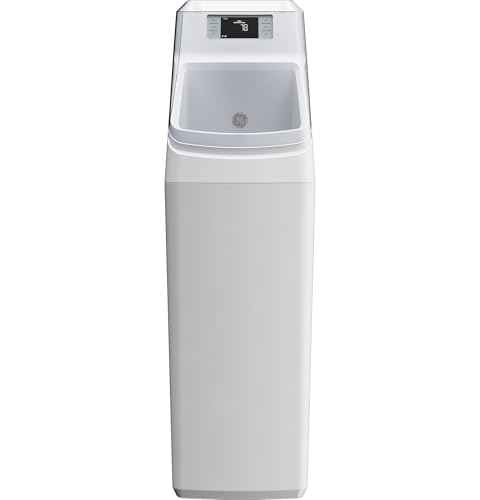
The only softener here with built-in WiFi. It pushes alerts when it sees continuous water flow, which catches a running toilet or a slow leak early, and it pairs with an optional valve that shuts the house off remotely.
$699fromAmazonThe flow alerts are the actual feature, not the softening. The SmartHQ app notifies you when it detects sustained low, medium, or high flow — the signature of a running toilet, a dripping supply line, or a burst pipe while you're away. Water damage claims are among the most common and expensive homeowner losses. Getting a phone notification on day one instead of finding a flooded basement on day nine is the value here.
Pair it with GE's separate RMVALVESFT shutoff and you can kill water to the whole house from anywhere. Vacation Mode pauses regeneration while you're gone, so it isn't dumping brine and using salt on an empty house. Low-salt reminders arrive on your phone rather than requiring you to remember to check.
It's also the most space-efficient design in this guide. The tank and brine cabinet share one enclosure at 46 inches tall, and owners squeezing it into tight mechanical closets say it fit where a two-tank system wouldn't. The 1-inch connections adapt down to 3/4-inch or up to 1-1/4-inch, and a blending valve lets you dial back how soft the water actually gets if you find full softening too slick.
GE's national service network and retail presence are real advantages over the smaller brands here. If something fails, there's an established warranty process rather than an email address.
Flaws but not dealbreakers
Thirty-five thousand grains is the smallest capacity in this guide. For a family of five on 15-plus grain water, that's undersized, and you'll pay for it in regeneration frequency. This is a softener for small-to-midsize households on typical municipal supply.
Setup frustrates some owners. Reports of unlabeled valves, thin instructions, and WiFi pairing that wouldn't complete come up more than once, and a few units have thrown error codes on the first regeneration cycle. If you're not comfortable troubleshooting a connected appliance, the mechanical simplicity of the Fleck is a feature.
The remote shutoff valve is sold separately, so the leak-protection story isn't complete out of the box. And it's built for city water — iron-bearing well supply will foul it.
Who this is for
Buy a whole house softener if you've confirmed hard water with a test strip and you're seeing the consequences: scale on fixtures, cloudy dishes, soap that won't lather, a water heater that's aging fast. The benefits show up quickly — most people notice the difference in the shower within a week. If you're renting, or if your hardness tests below about 7 grains per gallon, the payback probably isn't there.
This guide covers point-of-entry salt-based ion exchange softeners for single-family homes, plus one salt-free conditioner included because it's constantly merchandised alongside them and shouldn't be. We're not covering under-sink filters, reverse osmosis drinking systems, or commercial-scale equipment. If your goal is better-tasting water rather than scale control, you want a filter, not a softener — they solve different problems and many households end up with both.
How we picked
Regeneration control: we required demand-initiated metered valves, since timers regenerate whether you've used water or not and waste salt doing it. Capacity: we sized against the standard formula — occupants times 75 gallons times hardness times seven days — and looked for headroom rather than a system running at its ceiling. Repairability: the control valve fails before the tanks do, so we favored heads with deep third-party parts availability. Iron handling: standard resin fouls above roughly 1 to 3 ppm iron, so we checked stated tolerances and pre-filtration against what well owners actually report. Install experience: we read owner feedback for recurring complaints about documentation, missing parts, and support responsiveness.
Other whole house water softeners worth considering
If you want maximum capacity without iron removal: The Aquasure Harmony Series Grains Whole House Water ($749.99) — The Aquasure Harmony 64,000 Grain is built for four-plus bathroom homes with five to seven people, where simultaneous showers, laundry, and a dishwasher would drive a smaller unit into regeneration multiple times a week. It uses the same digital metered control head as the 40,000-grain model and it's the most reviewed Aquasure here by a large margin, including detailed feedback from someone who works in industrial water treatment. What it gives up is the integrated pre-filter that comes with the smaller Aquasure — add a sediment filter upstream if you're on a well. A minority of owners report control valve trouble and hardness returning, so register it and keep the warranty paperwork.
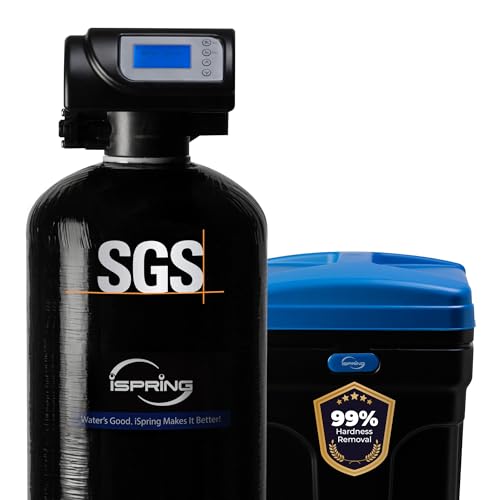
If you want third-party verification and responsive support: The iSpring WCSTB45KG Whole House Water Softener System ($529.40) — The iSpring WCSTB45KG is rated by independent laboratory testing to reduce 99.71 percent of hardness, which is a firmer claim than most brands here make. Its programmable valve adjusts regeneration based on measured water quality and usage, and at 45,000 grains it slots neatly between the 40,000 and 48,000 classes. The standout in owner feedback is support: people repeatedly describe reaching a real person by phone and getting replacement parts shipped within days, which matters because shipping damage to the brine tank comes up more than once. The trade-off is the parts ecosystem — iSpring valve components aren't stocked at plumbing suppliers the way Fleck's are.
If you want softening and multi-stage filtration in one install: The PRO+AQUA PRO-E-S80E Elite Whole House Water Filtration ($1,211.44) — The PRO+AQUA PRO-E-S80E combines an 80,000-grain softener with filtration for chlorine, iron, VOCs, rust, and sediment, all in one point-of-entry package rated to 20 GPM. For a large home on well water with several problems at once, consolidating into one install saves space and plumbing complexity. It's also the heaviest and most demanding installation here at over 200 pounds, and it's far more system than a four-person household on municipal water needs. The bigger hesitation is service: owner feedback includes shipping delays and unresolved support disputes, which is a real risk on a system this expensive and this hard to return.
The competition
This is what our research surfaced across widely sold whole house systems — not a survey of everything on the market. Several capable softeners sold through plumbing wholesalers and installers never appear in retail listings at all, and pricing on this category shifts constantly. The products below either lost to a pick on capacity, support, or parts availability, or they solve a different problem than the guide's title suggests.
The Aquasana Rhino Salt-Free Conditioner Replacement Tank - ($774) — The Aquasana Rhino Salt-Free Conditioner Replacement Tank isn't a water softener, and it isn't a complete system. It's a replacement media tank for Aquasana's existing Rhino and OptimH2O setups — WH-1000, EQ-1000, EQ-600, EQ-OPTM — so it does nothing on its own. The Scale Control Media inside uses template-assisted crystallization to convert dissolved calcium and magnesium into microscopic crystals that won't bond to pipe walls, which genuinely prevents new scale without salt, sodium, electricity, or a drain line. But the hardness minerals stay in your water. You won't get the slippery feel, you won't get better soap lathering, and it won't touch existing scale. It's rated for water below 15 grains per gallon with iron under 0.3 ppm, and the media lasts about a million gallons. Choose it if you already own a Rhino system, or if sodium is medically off the table or brine discharge is restricted where you live.
Installation and upkeep
Plan on two to four hours if you've cut and joined copper or PEX before. You'll tee into the main line after the meter and before the water heater, install the included bypass valve, connect inlet and outlet, run a drain line to a floor drain or standpipe with an air gap, and find a 120V outlet. Sanitize the resin bed on startup — most kits include a packet — and run a manual regeneration before you trust the water. After that, check the brine tank monthly and refill when it drops to about a third. Solar salt crystals or evaporated pellets dissolve cleanly; skip rock salt, which leaves sediment that eventually bridges into a crust over empty space. Break up any bridging you find with a broom handle. Resin typically lasts 10 to 15 years.
Questions we get
What size water softener do I need for a family of four?
Multiply four people by 75 gallons a day, by your hardness in grains per gallon, by seven days. At 10 GPG that's 21,000 grains a week; at 15 GPG it's 31,500; at 20 GPG it's 42,000. Buy the next tier up from that number — running a softener near its rated ceiling forces frequent regeneration that wastes salt and ages the resin. Square footage and bedroom count don't matter here, only occupants and hardness.
Are salt-free conditioners as good as salt-based softeners?
No, and they're not trying to be. Salt-based ion exchange physically removes calcium and magnesium, which is what produces the slippery feel and full soap lathering people associate with soft water. Salt-free TAC systems convert those minerals into crystals that won't stick to pipes — scale prevention happens, but hardness stays in the water. Choose salt-free only when sodium is medically contraindicated or your municipality restricts brine discharge.
How do I know if I actually have hard water?
The signs are white crust on faucets and showerheads, soap scum on shower glass, spots on dishes that came out of the dishwasher clean, stiff towels, and skin that feels dry after a shower. The USGS classifies 7 to 10.5 grains per gallon as hard and anything above that as very hard. A cheap test strip kit settles it in a minute, and you need the number anyway to size a system.
Is softened water safe to drink every day?
For most people, yes. Ion exchange trades hardness minerals for sodium, and at 10 GPG that works out to roughly 40 to 50 mg of sodium per liter — small next to the 2,300 mg daily limit the American Heart Association suggests. If you're on a medically prescribed low-sodium diet, talk to your doctor. Many households add a reverse osmosis tap at the kitchen sink and soften everything else.
Can I install one myself?
Every salt-based system here is designed for DIY installation, and most owners who try it succeed. You need to cut and rejoin copper or PEX, mount the bypass valve, run a drain line for brine discharge, and reach a standard outlet. Budget two to four hours, more if the main line needs rerouting. Hire a plumber if your supply lines are galvanized or in an awkward spot — that's where projects go long.
How long will a softener last?
A quality metered system runs 15 to 25 years with routine salt and occasional cleaning. The control valve usually fails first, which is why the parts ecosystem behind it matters so much — Fleck-based units can be repaired decades after purchase. Softening resin degrades gradually and typically needs replacement somewhere around the 10-to-15-year mark, sooner if chlorinated water hits it without a carbon pre-filter.
Why you should trust us
For this guide:
- We compared manufacturer specifications across all eight listings, focusing on rated grain capacity, service flow rate, valve type, and stated iron and manganese tolerances.
- We read published guidance on softener sizing, metered versus timed regeneration efficiency, and NSF/ANSI 44 certification to set our thresholds.
- We reviewed owner feedback for each system, looking for recurring patterns in installation documentation, shipping completeness, control valve reliability, and manufacturer support rather than isolated complaints.
- We read owner reviews on every listing, weighted toward the critical ones, because that is where the recurring failures show up.
- We have a systematic way of automatically fetching the latest prices, so the numbers on this page stay current.
- This is a research-focused guide, so the team may not own every product listed — though we often do own the top winners, which gives us extra context for the recommendations.
- We don't accept free products, and the retailer commission never changes which product we recommend.
Sources
Best Water Softeners of 2026 — Wirecutter (New York Times), Wirecutter
Water Softener Ratings & Reviews 2026 — Consumer Reports, Consumer Reports
Best Water Softeners for Hard Water 2026 — CNET, CNET
Best Water Softeners 2026: Expert Reviews — Bob Vila, Bob Vila
Hardness of Water — USGS Water Science School, U.S. Geological Survey (USGS)
Amazon product listings and owner reviews for all 8 products
Manufacturer specification pages for each product
Some passages in this guide may be paraphrased with AI help. Prices are refreshed automatically.
More like this.
Continue exploring home reviews and recommendations.

The Best Whole-House Surge Protectors
Most people picture a lightning bolt when they think about surge protection. The real threat is quieter. Every time your air conditioner's compressor…

The Best Whole-House Humidifiers
Winter air inside a heated house gets dry fast. Once it's below about 20°F outside, indoor humidity can slide into the teens, and you feel it everywhere:…

The Best Salt-Free Water Softeners
Hard water shows up in small annoyances before it shows up in your wallet. There's the white crust on the showerhead, the film on your drinking glasses,…

The Best Water Heater Insulation Blankets
Your water heater sits there all day keeping 40 or 50 gallons hot, whether you're home or not. If the tank is old, a lot of that heat leaks straight into…

The Best Smart Water Leak Detectors
A burst washing machine hose can put hundreds of gallons on your floor before you get home from work. That's the whole problem with water damage - it's…

The Best Automatic Water Shutoff Valves
A burst supply line doesn't wait for you to get home. Water runs at whatever pressure your main delivers, and it keeps running until somebody turns it off…