The Best Whole-House Surge Protectors
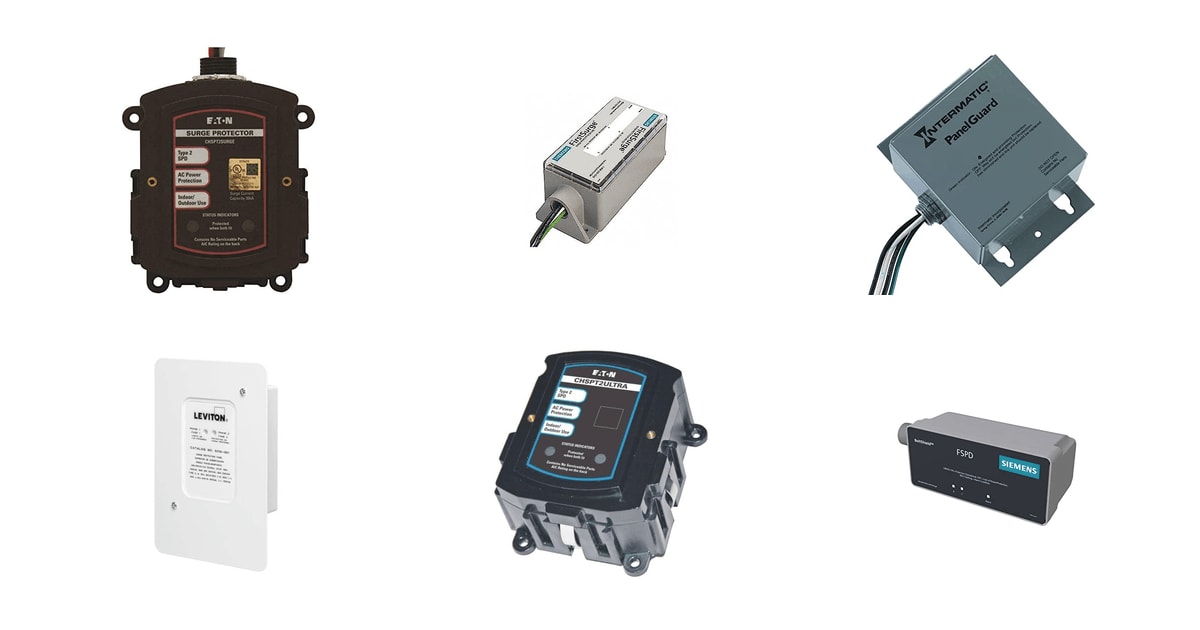
Most of the damage a power surge does to your house isn't dramatic. A dishwasher control board quits. The garage door opener gets flaky. Your router needs a reboot every other day. Those small hits add up, and they usually come in from the utility side — a line fault down the street, a transformer switching, a lightning strike a mile away. A whole house surge protector sits at your main panel and clamps that incoming spike before it fans out to every circuit in the house.
Here's the part nobody advertises. None of these units protects against a direct lightning strike to your house — the energy in that is far beyond what a panel-mounted device can absorb. They also do nothing about surges that start inside your walls, like the spike your air conditioner compressor throws every time it cycles. And they wear out. Every one of them is a sacrificial part that degrades with each hit it takes, which is why you'll still want strips on the gear you actually care about.
We read spec sheets, UL's own explanation of the 1449 standard, and owner feedback across six panel-mounted units to sort out which ones give you a real UL 1449 listing, a status indicator you'll actually notice, and a surge current rating high enough to survive more than one bad storm season. We think that the Eaton CHSPT2SURGE is the best whole house surge protector for most people, and that the Siemens FS140 is the one to buy if you want a higher surge current rating and a written connected-equipment warranty.
Everything we recommend

Easy to wire into any panel, with less headroom than the big units

More capacity and a real warranty, in a much bigger box

More headroom than the basic module, with the same thin spec sheet

Audible failure warning, with a bit less surge capacity
At a glance
| Product | Surge current | Mounting | Price | |
|---|---|---|---|---|
| Eaton CHSPT2SURGE SPD Type 2 Chsp WholeTop pick | — | — | $56.72 |
| Siemens FS140 Whole House Surge Protection DeviceRunner-up | 140,000 A per phase | Indoor or outdoor | $569 |
 | Intermatic IG3240RC3 120/240 VAC Surge Protective DeviceAlso consider | — | — | $283On sale |
 | Leviton Type 2 Residential Whole House SurgeAlso in lineup | 26,000 A per mode | Outdoor NEMA 4X | $61.03 |
| Eaton CHSPT2ULTRA Ultimate Surge Protection 3rd EditionUpgrade pick | — | — | $121.39 |
| Siemens Boltshield FSPD100 Level 2 Whole HouseAlso great | 100,000 A | — | $197.11 |
How we picked
UL 1449 listing. We treated a UL or cUL 1449 listing as the floor, and we noted each product's Type classification, because Type 1 and Type 2 describe where in your electrical system a device may be installed. Joule ratings, common on power strips, aren't meaningful here.
Surge current rating. We pulled kA figures from spec sheets and listings, and we favored a published number over silence. A higher rating generally buys a longer service life rather than better clamping.
Let-through voltage. VPR is UL's measure of how much voltage reaches your gear during standardized testing, and lower is better. Where a listing didn't state it, we said so instead of guessing.
Status and alarms. We looked for indicator lights per phase and, better, an audible alarm, since a silently dead protector is the main way homeowners end up unprotected. Owner feedback about dim or hard-to-see LEDs counted too.
Install and warranty. We compared enclosure ratings, size, lead length and panel compatibility against what a licensed electrician actually has to do. We also read manufacturer warranty pages for stated product and connected-equipment terms.
Top pick
Easy to wire into any panel, with less headroom than the big units
Eaton CHSPT2SURGE SPD Type 2 Chsp Whole
The CHSPT2SURGE is a Type 2 device that mounts to the side of almost any breaker box and ties into a spare two-pole breaker. Indicator lights show that both legs are still protected, and Eaton's quick-connect design keeps the electrician's visit short — which is most of why we'd start here.
$56.72fromAmazonThis is the unit to buy if you want the decision over with. Eaton's listing says it connects to any manufacturer's load center, so you're not hunting for a panel-specific part number, and the quick-connect leads mean your electrician isn't fishing stiff wire through a crowded gutter. Shorter leads also matter electrically — the longer the run between the device and the bus, the more let-through voltage your gear sees.
It's a Type 2 device, which is the right class for most houses. Type 2 means it installs on the load side of your service disconnect — in other words, at the breaker panel, where almost everyone wants it. Type 1 units can go ahead of the disconnect, on the utility side, and you need that only if your electrician tells you so or your meter base is the mounting point.
Owner feedback on this one skews strongly positive and, more usefully, it reads as uneventful. People note the indicator lights, note that an electrician had it in quickly, and then have nothing else to say. For a part whose whole job is sitting there doing nothing visible, that's the signal you want. What we don't see is a pattern of units dying young, which isn't true of everything in this guide.
The enclosure is rated NEMA 4, so a damp basement wall or a sheltered exterior spot is fine. At under a pound and about five by seven inches, it tucks beside most panels without a fight. If your panel is already packed and the only free space is to the right of the door trim, measure first — there's not much slack in the leads.
Flaws but not dealbreakers
Eaton doesn't publish a surge current rating on this listing, and that's a real gap. The Siemens FS140 puts 140,000 amps per phase right in the product name; here you're taking the UL listing on faith and guessing at headroom. If you live somewhere with frequent lightning, that guess matters.
The listing also cites UL 1449 3rd edition. The standard has been revised since, so a current-edition listing is what you'd rather see on the label — ask your supplier, or check the carton when it arrives. There's no stated connected-equipment warranty here either, unlike the Siemens unit.
Runner-up
More capacity and a real warranty, in a much bigger box
Siemens FS140 Whole House Surge Protection Device
The FS140 carries 140,000 amps of surge current per phase, the highest rating in this group, and backs it with a 10-year product and connected-equipment warranty. It fits any brand of load center and can mount indoors, outdoors, or inside the panel itself.
$569fromAmazonSiemens prints the number on the box: 140,000 amps of surge current capacity per phase. Leviton's panel, by comparison, claims 26,000 amps per mode. Those aren't the same measurement, so don't do the division — but the gap is wide enough to matter. Higher capacity doesn't improve clamping. It generally means more hits before the unit uses itself up, which is really a question of how often you'll be buying another one.
The warranty is the other reason to pick this one. Siemens states 10 years of product and connected-equipment coverage, which is the only coverage term anybody in this group puts in writing. Read the fine print before you count on it — these policies tend to require proof of correct installation and a licensed electrician's paperwork — but having a stated term beats having none, and it's a meaningful difference from the Eaton units.
The enclosure is a commercial-grade NEMA 4X box, rated for outdoor use, and Siemens says you can also install the guts inside the load center if you'd rather not hang anything on the wall. That flexibility is useful in a tight utility closet or on an exterior meter wall that's already crowded with a disconnect and a conduit run.
It's Type 2 and UL/cUL 1449 listed, and it works with any brand of load center and breakers. If your panel is a Siemens, this is the natural pairing. If it's a Square D or a GE, it still fits — you're just mounting a gray Siemens box next to a different-colored panel, which nobody who isn't an electrician will ever notice.
Flaws but not dealbreakers
It's the bulkiest unit here — about ten inches long and nearly three pounds. Next to the Eaton, which weighs under a pound, that's a real difference when your panel sits in a finished laundry room and you'd rather not look at it.
Siemens doesn't publish a VPR figure on the listing, so you can't compare let-through voltage against the Eaton Ultra without pulling both datasheets. And a 10-year warranty doesn't mean the device survives 10 years. It means Siemens will talk to you if it doesn't.
Siemens states a 10-year product and connected-equipment warranty for the FS140.
Upgrade pick
More headroom than the basic module, with the same thin spec sheet
Eaton CHSPT2ULTRA Ultimate Surge Protection 3rd Edition
The CHSPT2ULTRA is Eaton's step-up module, sold on more surge-current capacity and lower let-through voltage than the CHSPT2SURGE. It mounts the same way, to any manufacturer's load center, so stepping up doesn't complicate the install or take more panel space.
$121.39fromAmazonBuy this one if the house has expensive gear plugged into it. A projector, a NAS full of photos, a heat pump with a variable-speed board, a Level 2 EV charger — those are the loads where a few hundred volts of let-through is the difference between a shrug and a service call. Eaton positions the Ultra as the lower-clamping, higher-capacity version of the same basic device, and it installs identically.
Lower VPR is the spec that actually protects your electronics. VPR is UL's measure of how much voltage gets past the device during a standardized test, and less is better — it's the voltage your dishwasher board sees, not the voltage the protector stops. kA ratings tell you about lifespan; VPR tells you about protection. If you compare only one number across datasheets, make it this one.
It's also the lightest and flattest unit in this guide. Half a pound, and under two and a half inches deep. That sounds trivial until you're standing in front of a panel mounted in a stud bay with drywall returns on both sides, trying to find somewhere a box can actually sit. The Ultra goes where the Siemens FS140 won't.
Owner feedback on the Ultra is deep and consistently positive. The themes are the ones you'd hope for: an electrician had it in without drama, the lights came on, nothing has happened since. That isn't proof of protection — nobody can prove a surge that didn't do damage — but a large body of uneventful ownership is about the best evidence this category offers.
Flaws but not dealbreakers
Eaton's listing for the Ultra is close to useless. The bullets say little more than easy to use and high quality product, twice each, and there's no kA figure, no VPR, no warranty term and no enclosure rating. Everything we can say about why it beats the CHSPT2SURGE comes from Eaton's broader product literature rather than this page, so pull the datasheet before you commit.
Because it mounts externally like the standard model, you still need a spare two-pole slot and a short lead run. If your panel is full, plan on a tandem breaker or a subpanel conversation with your electrician before you order.
Also great
Audible failure warning, with a bit less surge capacity
Siemens Boltshield FSPD100 Level 2 Whole House
The Boltshield FSPD100 is rated for 100,000 amps of surge current and adds something the others skip: an audible alarm plus a red flag indicator when protection is gone. It mounts outside the panel or inside the load center, in a Type 4 outdoor enclosure.
$197.11fromAmazonIndicator lights only work if you look at them. That's the quiet failure mode of every unit in this guide — the LED goes out, you don't notice for two years, and you're unprotected the whole time. The FSPD100 is the only one here that makes noise about it, pairing the usual lights with an audible alarm and a red flag you can see across the garage.
100,000 amps of surge current is plenty for a house. It's below the FS140's 140,000, but both numbers are far past what a typical nearby strike or utility fault puts on your service. Siemens also says the MOVs are thermally protected, which is the mechanism that's supposed to disconnect a failing varistor instead of letting it cook. On a device that lives inside or beside your panel, that's worth having.
Owners mostly mention how easy it was to get in. The leads are long enough to reach from a spot above the panel, and the unit is small enough to go inside the load center if you'd rather. The common gripe is that the status lights aren't very bright, which matters more than it sounds — the alarm covers you, but you'll still want to glance at it.
Flaws but not dealbreakers
Siemens doesn't publish dimensions or a weight on this listing, which makes planning the mount harder than it should be. You're measuring the wall before you know what has to fit on it.
The owner feedback pool is thin compared with the FS140, so there's less accumulated evidence about how it holds up over years in a hot garage. No warranty term appears on the listing either, which is odd given that Siemens states one for the FS140.
Who this is for
Buy one of these if you own the house and have gear worth protecting: a home office, a home theater, a heat pump or variable-speed air conditioner, solar, a battery, an EV charger. Modern appliances run on control boards that don't like voltage spikes, and those boards are the expensive part of the appliance. If you live where storms knock the power out and bring it back with a thump, you're the clearest case of all. Recent editions of the National Electrical Code also require surge protection at the service for new dwelling-unit installations, so if you're building or swapping a panel, this may not be optional — check what your local jurisdiction has adopted.
Hold off if you rent, if your panel is already due for replacement, or if you aren't prepared to hire an electrician, since the labor is the bigger half of the job for most people. This guide covers panel-level, hardwired surge protective devices for single-phase 120/240-volt residential service. It doesn't cover plug-in strips, UPS units, generator transfer equipment or whole-house voltage regulators, all of which solve different problems, and it doesn't cover three-phase or commercial gear.
How we picked
Listing: we required a UL or cUL 1449 listing and noted Type 1 versus Type 2, since that determines where the device can go. Capacity: we compared published surge-current ratings in kA and treated a missing number as a real gap. Let-through voltage: we looked for VPR, UL's measure of how much voltage gets past the device, wherever manufacturers published it. Alarms: per-phase indicator lights were the minimum, and an audible alarm counted for a lot. Install and warranty: we weighed enclosure rating, size, lead length and panel compatibility against the work an electrician has to do, and we read the stated product and connected-equipment terms.
Other whole-house surge protectors worth considering
If you need a Type 1 unit ahead of the service disconnect: The Intermatic IG3240RC3 120/240 VAC Surge Protective Device ($283) — The IG3240RC3 is the flexible one here. Intermatic lists it for both Type 1 and Type 2 applications, which means it can go on the line side, outdoors, at the meter — somewhere a Type 2 device can't. That's exactly what some utilities and some older services require, and none of our picks can do it. It's CSA listed to ANSI/UL 1449 3rd edition and approved for residential and light commercial service, in a box a little under eight inches tall. The catch is the owner feedback, which is noticeably more mixed than anything else in this guide: there are recurring reports of units failing inside the coverage period, of replacements failing too, and of warranty claims going nowhere. We'd still choose it if your electrician says you need Type 1. We'd think twice otherwise.
The competition
This is what our research surfaced, not a census of the market. Panel-level surge protection is a slow-moving, crowded category, and plenty of competent units from other brands — along with the meter-socket protectors some utilities will rent you — never came up in the datasheets and reviews we worked from. Here's the remaining unit we looked at and why it lost to a pick.
The Leviton Type 2 Residential Whole House Surge ($61.03) — Leviton's 51110-SRG is a Type 2 panel in an outdoor NEMA 4X enclosure, with LEDs showing power and protection status for each phase. The build is fine and it's brand-agnostic, so it'll hang next to any load center. The problem is capacity: 26,000 amps per mode is the lowest figure anyone here publishes, and in a lightning-prone area that translates to a short service life. It's also the widest box in the group, at nearly ten inches across. For a detached garage subpanel or a shop where the connected load is a compressor and some lights, it's a sensible, honest device. For the main panel of a house full of electronics, the Siemens FS140 gives you far more headroom in a smaller box.
Installation notes
Hire a licensed electrician unless you genuinely know your way around a live panel — the main lugs stay energized with the breaker off, and that's the hazard that hurts people. Two details are worth saying out loud to whoever does the work. Keep the leads as short as the device allows, because extra wire length adds inductance and raises the voltage your equipment actually sees. And mount the unit where you'll walk past it, not behind a door or above a water heater, so the indicator sits in your line of sight. After that, the job is checking the lights every few months and after any storm that takes your power out. A unit that has taken a big hit needs replacing, even if the house seems fine.
Questions we get
Are whole house surge protectors worth it?
For most homeowners, yes. Modern appliances and HVAC equipment run on control boards that a voltage spike can kill, and replacing one means a service call plus a part. A panel-level device covers every circuit at once, which point-of-use strips can't do. It isn't insurance against a direct strike, though — treat it as improving your odds on the common stuff.
Can I install a whole house surge protector myself?
Only if you're already comfortable working in an energized panel. The main lugs stay live after you switch off the main breaker, and these devices wire into a two-pole breaker right next to them. Most people should hire a licensed electrician, and some manufacturers' connected-equipment warranties require proof that one did the work.
What's the difference between Type 1 and Type 2 surge protective devices?
Type 1 devices can be installed on the line side of your service disconnect — ahead of the main breaker, often at the meter or outdoors. Type 2 devices go on the load side, at the panel, which is where most homes want one. UL 1449 defines both classifications. If you're unsure which applies, your electrician or your utility will tell you.
What VPR should I look for?
Lower is better, and you compare it across datasheets for the same voltage system rather than against a fixed target. VPR is UL's measure of how much voltage gets past the device during a standardized test, so it's the number closest to what your electronics experience. Plenty of listings in this category don't publish it, which is why we go to manufacturer datasheets before committing.
Do I still need surge strips if I have one of these?
Yes. A panel-level device handles the big stuff arriving from outside. It does nothing about surges your own motors and compressors generate inside the house, and it can't clamp down to the level a sensitive device wants. Use both, and put strips on computers, networking gear, TVs and anything with a microprocessor you'd miss.
How long does one last, and how do I know it has failed?
There's no fixed lifespan. These are sacrificial parts that degrade with every surge they absorb, so a house that takes frequent hits burns through them faster. Watch the status indicator: when the protection light goes out or a red flag appears, the unit is done. The Siemens Boltshield also sounds an alarm, which is the only way you'll find out without looking.
Why you should trust us
For this guide:
- We read UL Solutions' explanation of the 1449 standard and its Type 1 and Type 2 classifications, along with the NFPA's dwelling-unit service requirement, to set the baseline for this guide.
- We compared manufacturer spec sheets and listing facts for every unit here, and we flagged the ones that don't publish a surge-current rating or a VPR figure.
- We read owner feedback for recurring themes — dim indicators, early failures, warranty friction — and used those patterns to shape the flaws and caveats.
- We read owner reviews on every listing, weighted toward the critical ones, because that is where the recurring failures show up.
- We have a systematic way of automatically fetching the latest prices, so the numbers on this page stay current.
- This is a research-focused guide, so the team may not own every product listed — though we often do own the top winners, which gives us extra context for the recommendations.
- We don't accept free products, and the retailer commission never changes which product we recommend.
Sources
UL 1449 Surge Protective Devices standard overview, UL Solutions
NFPA 70 (National Electrical Code), surge protection requirements for dwelling units, NFPA
Surge Protection resources, Electrical Safety Foundation International
Eaton CHSPT2SURGE product specifications, Eaton
Square D SDSA1175 product specifications, Schneider Electric
Siemens FS140 product specifications, Siemens
Intermatic IG3240RC3 product specifications, Intermatic
Leviton 51120-1 product specifications, Leviton
Lightning safety and home damage statistics, NOAA / National Weather Service
Amazon product listings and owner reviews for all 6 products
Manufacturer specification pages for each product
Some passages in this guide may be paraphrased with AI help. Prices are refreshed automatically.
More like this.
Continue exploring home reviews and recommendations.

The Best Whole House Water Softeners
Hard water doesn't announce itself. It shows up as a film on the shower glass you can't scrub off, spots on glasses that came out of a dishwasher you just…

The Best Whole-House Humidifiers
Winter air inside a heated house gets dry fast. Once it's below about 20°F outside, indoor humidity can slide into the teens, and you feel it everywhere:…

The Best RV Surge Protectors
Shore power at a campground isn't the same thing as power at home. A pedestal sits outside for years, gets plugged and unplugged thousands of times, and…

The Best Waterproof Mattress Protectors
A mattress protector is about the least expensive insurance you'll ever buy for a big purchase. One spilled glass of wine, one sick kid, one dog who…

The Best Outlet Covers and Plug Protectors
A crawling baby finds the outlet behind the couch faster than you'd think. Electrical outlets and cords sit near the top of the home hazard list for kids…

The Best iPhone 17 Cases and Screen Protectors
A case is the accessory you touch more than any other. It decides how your phone feels in your hand, whether it slides off the arm of the couch, and…