The Best Soccer Rebounders for Backyard Training
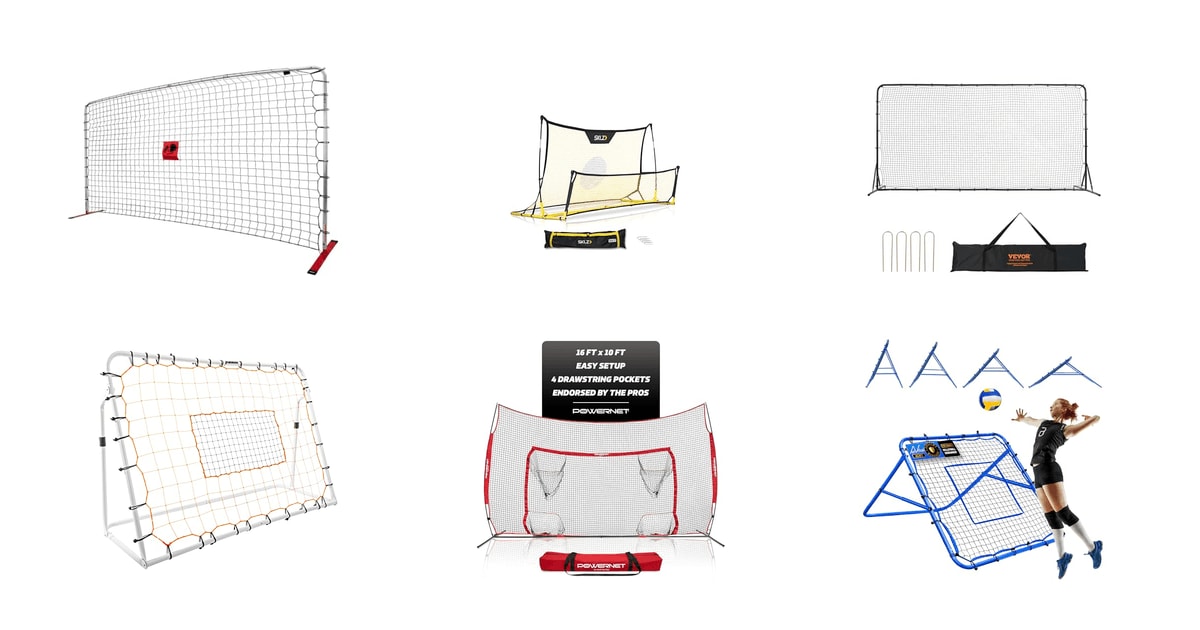
A rebounder turns a lonely backyard into a practice partner. Your kid kicks, the ball comes back, and the touch-after-touch repetition that builds a first touch finally happens without you standing out there shagging balls. That's the whole pitch. A good one returns the ball with enough pace to feel like a real pass, sits at an angle you can change for ground balls or volleys, and goes up fast enough that nobody talks themselves out of a session.
Here's the honest part: almost every rebounder in this price range is a steel or aluminum frame with a net stretched across it, and nets wear out. Owners across nearly every brand describe the same arc — a great first season, then a sagging net, a frayed corner, or rust creeping up the tubing after a winter outside. None of these are buy-it-for-life purchases unless you store them and can get a replacement net. Treat the net as the consumable part and you'll be much happier.
Angle adjustment is also less universal than the marketing suggests. Some of the biggest nets here don't tilt at all, which makes them fine backstops and mediocre volley trainers. Small frames tilt beautifully but only cover a narrow band of the ball's path. We think that the Kwik Goal AFR-1 Rebounder is the best soccer rebounder for most people, and that the SKLZ Quickster Soccer Trainer is the one to buy if you want a dual-sided net that packs into a bag.
Everything we recommend

Club-grade frame and a wide face, if you have the room

Two rebound surfaces in one bag, with a lighter frame

Real angle adjustment on a frame a kid can move

Six angle settings in a 4-foot square you can fold flat
At a glance
| Product | Net size | Angle adjustment | Price | |
|---|---|---|---|---|
| Kwik Goal AFR-1 RebounderTop pick | 7' H x 14' W | Moveable target | $665 |
| SKLZ Quickster Soccer Trainer - Dual-Sided RebounderRunner-up | 6 x 4 ft + 6' x 20" | Adjustable frame | $129.99 |
 | VEVOR Soccer Rebounder NetAlso consider | 12 x 6 ft | — | $76.99On sale |
| Franklin Sports Adjustable Soccer Rebounder - 6'Budget pick | 6' x 4' | — | $99.99 |
 | PowerNet Soccer GoalAlso consider | 16 x 10 ft | — | $214.99 |
| 4x4FT Volleyball Lacrosse Rebounder Pro Multi-Sport PracticeAlso great | 4 ft x 4 ft | 6 increments | $54.99 |
 | Kwik Goal AFR-1 Rebounder Replacement NetAlso in lineup | 7' H x 14' W | — | $125 |
How we picked
Rebound consistency. We compared net construction and frame rigidity across spec sheets, favoring tensioned nets on stiff tubing over loose netting on flexible poles. Owner feedback about dead or unpredictable rebounds was treated as disqualifying for a pick.
Angle adjustment. A rebounder that only returns one kind of ball covers one drill. We prioritized frames whose published specs confirm multiple tilt positions for ground passes, chest traps and volleys.
Size and portability. We read listed dimensions and shipping weights against the reality of a normal backyard, and weighted carry bags and fold-flat designs heavily. Owner comments about kids moving the frame themselves told us which ones get used.
Frame and net durability. We looked for aluminum or powder-coated steel tubing and weather-resistant netting, then checked owner feedback for the common failure points: sagging frames, rust after one winter, and nets tearing early.
Net replaceability. Nets are the consumable part, so we checked whether a replacement is sold at all. Repeated owner reports of out-of-stock or nonexistent replacement nets counted against a product.
Top pick
Club-grade frame and a wide face, if you have the room
Kwik Goal AFR-1 Rebounder
The AFR-1 is a 7-by-14-foot aluminum rebounder with a moveable target, steel ground shoes and a tight 3mm net. It's the one that holds up to a full team's worth of shooting and still works as a backyard goal when you disconnect the sides.
$665fromAmazonThis is the rebounder coaches actually buy. At 7 feet tall and 14 feet wide, the AFR-1 gives you a face big enough that a missed strike still comes back instead of rolling down the driveway. Owners running youth teams describe using it for direct shooting drills, then unhooking the side connectors so it doubles as a goal. For a family with a flat stretch of yard, that flexibility is worth more than any single feature.
The frame is 1.75-inch aluminum tubing, and that's the difference you feel years in. Owners who've had theirs for three seasons report no sagging, which is the usual failure mode on cheaper pop-up frames. The bungee cords and ground spikes get specific praise too — the spikes are coated, so they don't rust into orange stubs after a wet spring.
Setup needs no tools, and at 50 pounds it's a two-person carry rather than a one-arm grab. That's the trade. You won't fold this into a bag and toss it in the trunk, so plan on it living in the yard or the garage. Most owners describe assembly as genuinely easy once the net tension is sorted, which is not something you hear about large steel frames.
The moveable target is the part kids use most. Instead of just blasting the ball, your player aims for a quadrant, and suddenly a solo session has a score. Owners with U13 squads note that players naturally start picking corners. Combined with the 3mm HTPP net, which returns the ball with real pace rather than a dead flop, you get a rebound that feels like a pass back from a teammate.
Flaws but not dealbreakers
It's the biggest and heaviest thing here, and the price reflects that. If your yard is a patio and a strip of grass, this is the wrong buy — a 14-foot frame needs real space and a flat spot to sit square.
The net arrives tight, and getting it stretched onto the frame the first time frustrates people. Owners describe wrestling with it before it settles in, and a couple of coaches mention the net stretching further over time. The fix is re-tensioning, which is annoying but not a defect.
At least one parent bought this for a 6-year-old and regretted it. The scale is built for players who can strike a ball with some force; a small kid will rattle it around a huge net and get bored. Match it to a player who's past the mini-goal stage.
Runner-up
Two rebound surfaces in one bag, with a lighter frame
SKLZ Quickster Soccer Trainer - Dual-Sided Rebounder
The Quickster has a 6-by-4-foot upright net for trapping with your chest and thighs, plus a separate 6-foot-by-20-inch low net for ground passing. It weighs about 13 pounds, comes with stakes and a carry bag, and the bottom bar-free design lets balls roll true.
$129.99fromAmazonTwo rebound surfaces is the smartest idea in this category. The large net handles the balls you want to chest down or trap with a thigh. The low net is a tight horizontal strip that fires ground passes straight back at your feet, which is exactly the drill a player needs a thousand reps of. One purchase covers both halves of first-touch work.
That bottom bar-free design matters more than it sounds. On most rebounders a crossbar sits along the ground, and every low ball that catches it skips sideways. Here the net runs clean to the turf, so a ground pass comes back along a predictable line. If you're working on receiving with the inside of the foot, predictability is the whole point.
It's the easiest pick here to live with. Thirteen pounds, a carry bag, telescoping poles that lock, and quick-connect clips for the net. Owners consistently describe assembling it in one sitting with no drama and then hauling it to practice. Parents of 8- to 10-year-olds note their kids carry it to the garage themselves, which is the real test of whether a rebounder gets used.
The netting is UV- and weather-resistant, and owners who leave it out through a season report it holding up. A coach of ten years' standing recommends it on the simple grounds that it generates quality touches in volume. That's the right reason to buy a rebounder.
Flaws but not dealbreakers
Replacement nets are the weak link. The most pointed owner complaint is a worn net followed by a replacement that was out of stock, which turns a repairable product into a disposable one. Buy it knowing you may not be able to re-net it.
The tension setup confuses people on the first build. The poles need to be extended and locked just so, and the printed instructions are small. Nothing breaks, but expect a few minutes of second-guessing before the net sits taut.
Its 6-by-4-foot face is small compared with the Kwik Goal and VEVOR. A mis-hit sails past it, so you'll chase more balls — fine in a fenced yard, tedious in an open one.
Budget pick
Real angle adjustment on a frame a kid can move
Franklin Sports Adjustable Soccer Rebounder - 6'
Franklin's 6-by-4-foot rebounder tilts to practice ground, knee, chest and head traps, assembles with push pins, and weighs under 18 pounds. It's the simplest way to get a genuinely adjustable rebounder into a small backyard.
$99.99fromAmazonThe tilt is the reason to buy this one. You set it flat for ground passes, crank it back for balls that arrive at chest height, and steepen it again for heading. Owners describe the adjustment as easy enough that a 10-year-old changes it mid-session without help. On a frame this cheap, that's a lot of training variety.
It's springier than the big frames, in a good way for younger players. Owners report the net has real pop when struck, so a kid who can't yet hit a hard shot still gets a ball that comes back with pace. The powder-coated steel tubing and locking pins hold it square, and at under 18 pounds it moves to the park and back.
Assembly runs 25 to 30 minutes from the box with basic instructions, which several owners mention before saying they figured it out fine. Push pins snap into place and the kit includes spare fasteners. If you can build flat-pack furniture, you can build this.
It's also the right scale for the whole family. One owner describes a 5-year-old and a 3-year-old using it for shooting and goalie games while adults take turns without sprinting after every ball. A 6-by-4 face is big enough for that and small enough to tuck beside a fence.
Flaws but not dealbreakers
Longevity is the recurring knock. Owners report nets wearing out and steel starting to break down after a year or two of hard use, with no replacement net sold. One parent's second unit lasted about two months.
The all-weather net survives being left outside, but not forever. Owners who store it indoors get years; owners who leave it in the sprinkler zone get a season or two.
Customer service draws complaints when something fails. If the frame goes, plan on replacing the whole rebounder rather than getting a part.
Also great
Six angle settings in a 4-foot square you can fold flat
4x4FT Volleyball Lacrosse Rebounder Pro Multi-Sport Practice
This Winthai 4-by-4-foot rebounder has a two-setting connector with six incremental angle adjustments and an adjustable center target. It folds flat for storage, weighs about 13 pounds, and works for volleyball and baseball reps too.
$54.99fromAmazonIf your yard is small, this is the one that fits. Four feet square is roughly the footprint of a patio chair, and it folds flat when you're done. For a townhouse, a side yard, or a garage session in winter, the big frames here simply don't work and this one does.
Six angle increments across two connector settings is the finest adjustment in this lineup. You can dial in a shallow tilt for rolling ground passes, then slide it to a steep angle for volleys and headers in a few seconds. The slider is smooth enough that changing drills doesn't break your rhythm.
The adjustable center target gives a solo session structure. Instead of kicking at a square of net, your player aims at a spot that you can move higher or lower as they improve. The steel frame and high-elasticity net return the ball consistently, and setup takes about 15 minutes with no tools.
It's genuinely multi-sport. Volleyball players use it for serve and pass reps, baseball players for throwing and fielding. If your household has one soccer kid and one who plays something else, that versatility is worth real money.
Flaws but not dealbreakers
A 4-foot square is small. Anything struck with power and even slightly off-line misses entirely, so this suits controlled touch work far more than shooting practice.
At 13 pounds on a compact base, it needs staking or weighting on grass. A hard strike into a steep angle can walk it backward.
The branding leads with volleyball and lacrosse, and the net is tuned for that general elasticity rather than specifically for a size 5 soccer ball. It works well for passing reps; it won't feel like the tight 3mm net on the Kwik Goal.
Who this is for
Buy a rebounder if you have a player who wants more touches than team practice provides and a patch of flat ground to put one on. It's the single best piece of home equipment for first touch, because it removes the one thing that stops solo practice: somebody has to pass the ball back. Parents of 6- to 12-year-olds, teens working on receiving under pace, adult rec players, and goalkeepers drilling reaction saves all get real use out of one. Match the frame to the player — a small kid in front of a 14-foot net mostly misses.
Skip it if your yard is uneven, if you have no way to anchor a frame in wind, or if you'd rather kick against a garage wall and don't mind the sound. A flat concrete wall returns the ball faster and more consistently than any net here, for free. This guide covers free-standing backyard rebounders and the nets that double as goals or backstops; it doesn't cover rigid rebound boards, wall-mounted panels, or full-size match goals.
How we picked
We built this guide from manufacturer spec sheets, published reviews and recurring themes in owner feedback, weighing five things. Rebound consistency: a tensioned net on a rigid frame returns the ball with pace and repeatability, so we favored stiff aluminum or powder-coated steel tubing over flexible poles. Angle adjustment: we prioritized frames with confirmed multiple tilt positions, since one fixed angle covers one drill. Size and portability: listed dimensions and weights matter more than marketing, and a rebounder that's a hassle to move goes unused. Durability: we looked for weather-resistant netting and checked owner reports for sagging, rust and early tears. Net replaceability: nets wear out, so we checked whether you can actually buy a new one.
Other soccer rebounders for backyard training worth considering
If you want the biggest net for the money: The VEVOR Soccer Rebounder Net ($76.99) — VEVOR's 12-by-6-foot iron-framed net is enormous, packs into a carry bag, and includes four U-shaped ground nails. Owners use it as a backstop behind a small goal, for pickup games, and even as a makeshift volleyball net. But it's a backstop first and a rebounder second — the rebound is slow even off a hard strike, and there's no angle adjustment, so volley and heading work is out. Durability reports are mixed: one owner had the net tear within a few shots, and another found a hole and visible rust after a single summer. Buy it for coverage, not for pace.
If you mostly want shooting accuracy and fewer chased balls: The PowerNet Soccer Goal ($214.99) — PowerNet's 16-by-10-foot combo puts a pop-up goal in front of a 160-square-foot barrier screen, with four drawstring pocket targets for picking corners. For a player working on finishing, the pockets turn every session into a scoring game and the barrier means you're not jogging into the neighbor's hedge. It's described as a soft rebounder rather than a true one, though — balls die in the net instead of coming back, so it does nothing for first touch. Owner feedback is thin and more mixed than anything else here.
The competition
This is what our research surfaced among widely available backyard rebounders, not a survey of everything on the market. Several well-known training nets we hoped to compare weren't confirmed as currently available, and the category turns over fast. What follows is the one remaining lineup item and where it fits.
The Kwik Goal AFR-1 Rebounder Replacement Net ($125) — The Kwik Goal AFR-1 Replacement Net is the official 7-by-14-foot net for our top pick, and it's worth knowing it exists — being able to re-net a frame is exactly what separates the AFR-1 from rebounders you throw away. It weighs under 3 pounds and attaches to the existing frame without tools. It's a part, not a rebounder, so it's not something to compare against the picks; buy it when your AFR-1 net finally gives out.
Setup and anchoring notes
Anchor the frame before the first kick. Every rebounder here ships with stakes or ground nails, and on grass they're not optional — a tensioned net catches wind like a sail, and a 13-pound frame will walk or tip. Drive the stakes at an angle away from the net so tension pulls them deeper. Pick the flattest spot you have, because a frame sitting on a slope returns the ball off-line and racks the joints. New nets arrive tight and often need stretching onto the frame; work around the perimeter in stages rather than forcing one corner. Re-check tension every few weeks, since a sagging net is what kills rebound pace. Store it indoors over winter if you can, and rinse mud off the tubing — rust at the joints is the most common complaint across brands.
Questions we get
Are soccer rebounders worth it for improving first touch?
Yes, and it's the clearest case for buying one. First touch improves through volume, and a rebounder removes the need for a partner to pass the ball back. A player can get hundreds of controlled receptions in a half-hour session. Just make sure the net has some angle adjustment, or you'll only ever receive one kind of ball.
What size rebounder do I need for a 10-year-old?
A 6-by-4-foot face is the sweet spot. It's big enough that mis-hits still come back and small enough that the player stays close to the net, which is where the touch work happens. Our Franklin and SKLZ picks are both in that range. A 4-foot square works for controlled passing but punishes any stray strike.
Can you use a soccer rebounder on grass?
Grass is the normal surface for all of these, and each one ships with stakes or ground nails for it. Find the flattest spot you have and drive the stakes at an angle so net tension pulls them in rather than out. On hard-baked summer ground you may need to water the spot first or use sandbags on the base instead.
Rebounder net versus a wall: which is better for passing practice?
A flat concrete wall returns the ball faster and more consistently, and it costs nothing. A rebounder wins on angle — you can tilt it to send balls up to your chest or head, which a wall can't do — and on noise, since a net is much quieter than a ball slamming into masonry. If you have a good wall and tolerant neighbors, use it for ground passing and buy a rebounder for everything above the ankle.
Can a soccer rebounder be left outside year-round?
You can, but it shortens the life considerably. The nets on these are UV- and weather-resistant, and some owners report leaving a frame out for years with no problem. Others describe rust showing after a single wet summer and nets failing in one season. Storing it in a garage over winter is the single biggest thing you can do to make it last.
How long does a rebounder net last, and can it be replaced?
Expect one to three seasons depending on how hard it's struck and whether it lives outside. Replaceability varies wildly and is worth checking before you buy: Kwik Goal sells an official AFR-1 replacement net, while owners of other brands report replacements being out of stock or never offered. If a net can't be replaced, the whole rebounder is effectively disposable.
Why you should trust us
For this guide:
- We read manufacturer spec sheets for every rebounder in this guide, comparing frame material, tubing diameter, net construction, listed dimensions and shipping weight.
- We reviewed published coverage of backyard training nets and worked through owner feedback for each product, looking for recurring themes around rebound pace, assembly, net tearing and rust.
- We weighed replacement-net availability heavily, because owner reports made clear that the net is the part most likely to fail first.
- We read owner reviews on every listing, weighted toward the critical ones, because that is where the recurring failures show up.
- We have a systematic way of automatically fetching the latest prices, so the numbers on this page stay current.
- This is a research-focused guide, so the team may not own every product listed — though we often do own the top winners, which gives us extra context for the recommendations.
- We don't accept free products, and the retailer commission never changes which product we recommend.
Sources
Soccer rebounder buying guidance, RTINGS (unverified: confirm they cover this category before citing)
Wirecutter sports equipment coverage, Wirecutter (unverified: confirm a rebounder guide exists)
Manufacturer spec pages for each product, Kwik Goal (manufacturer)
US Youth Soccer player development resources, US Youth Soccer
U.S. Soccer Learning Center, U.S. Soccer Federation
Amazon product listings and owner reviews for all 7 products
Manufacturer specification pages for each product
Some passages in this guide may be paraphrased with AI help. Prices are refreshed automatically.
More like this.
Continue exploring health reviews and recommendations.

The Best Mini Trampolines and Rebounders
A mini trampoline is the rare piece of cardio gear that doesn't punish you for using it. You can bounce for ten minutes in socks while a podcast plays,…

The Best Gifts for Soccer Players
Soccer players accumulate gear fast, and most of it wears out on a schedule. Cleats get shredded by a season on turf. Balls lose their shape. Shin guards…

The Best Portable Backyard Volleyball Nets
A backyard volleyball net earns its keep by staying put. You want to stake it, pull the lines tight, and then forget it exists for three hours while…

The Best Backyard Batting Cages
A backyard cage changes how often your kid swings. Instead of waiting for the next team practice, they take 60 cuts before dinner. That's the whole point.…

The Best Pickleball Sets for Your Backyard
A pickleball set lives or dies on how fast you can get it out of the closet. If the net takes twenty minutes to assemble, you'll play twice all summer. If…
The Best Agility Ladders, Cones, and Speed Training Gear
Footwork gear is cheap, portable, and easy to overthink. A ladder, a stack of cones, and a few low hurdles cover almost everything a youth coach, a high…