The Best Portable Backyard Volleyball Nets
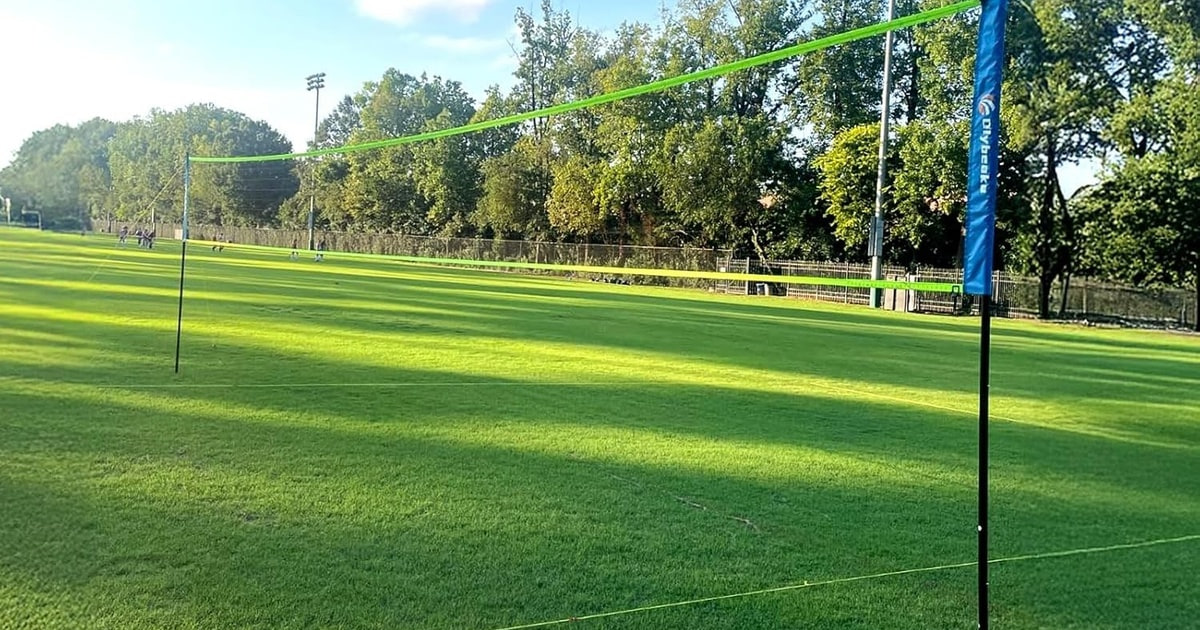
A backyard volleyball net earns its keep by staying put. You want to stake it, pull the lines tight, and then forget it exists for three hours while people dive around in the grass. The ones that fail do it in predictable ways. Poles bow after a hard swing. The top wire sags a little more each game until the ball drops dead on the tape. Stakes creep out of the soil under cable tension. Pole diameter, net width and the anchors in the bag tell you most of what you need to know.
Here's the honest part. No portable system plays like a permanent net sunk in concrete, and none of these comes close. Every one of them leans on guy lines and stakes, so a sloped yard or soft ground will cost you tension no matter which you buy. Sand is worse. The flat spikes that ship with almost every set pull free under load, and you'll want screw-in auger anchors instead. And if your only flat space is a driveway, a staked system simply won't stand up on it.
So match the system to how you actually play. If volleyball is a weekly habit in your house and somebody swings hard, stiff poles and a sleeved net are worth the money. If the net comes out twice a summer for cookouts, a complete kit with a ball and boundary lines already in the bag will make you happier. We think that the Park & Sun Sports Spectrum Classic is the best portable backyard volleyball net for most people, and that the Park & Sun Sports Tournament Flex 1000 is the one to buy if you want the same net on slightly lighter poles.
Everything we recommend

The stiffest poles here, if you spike like you mean it

Nearly the same net and feel, for meaningfully less

A full-width net and every accessory, at the budget end

Everything a family court needs, in one bag
At a glance
| Product | Net Size | Weight | Price | |
|---|---|---|---|---|
| Park & Sun Sports Spectrum Classic: AdjustableTop pick | 32' L x 3' H | — | $299.99 |
| Park & Sun Sports Tournament Flex 1000:Runner-up | 32' L x 3' H | 8 lbs | $189.04 |
 | Champion Sports Adjustable Racquet Sport Net: PortableAlso consider | 14'W x 63"H | 1 lb | $138.99 |
| Portable Outdoor Volleyball Net Set for BackyardBudget pick | 32ft | 8.6 lbs | $59.99 |
| Baden Champions Volleyball Net SetAlso great | 32' x 3' | 19 lbs | $89.99 |
 | Mikasa VBN-2 Competition Volleyball NetAlso consider | 32' x 3' | — | $42.42On sale |
 | 4-Way Volleyball and Badminton Net Combo GameAlso consider | 20FT x 20FT | 18.3 lbs | $109.99 |
How we picked
Net width and depth. We treated the regulation 32-by-3-foot standard as the line between a real game and a bounce-around, and we checked every listing's stated net dimensions against it. Sets that ship a 20-foot net can't support standard play no matter how good the poles are.
Pole diameter and material. Specs and published reviews line up here: 2-inch aluminum is the stability benchmark, 1.75-inch aluminum is close behind, and 1.5-inch steel flexes under hard hitting. We weighted this heavily for anyone whose games involve strong adult players.
Anchoring hardware. We compared stake length, material and style, since owner feedback across the category keeps returning to bent stakes and nets that go slack. Forged steel and 10-inch stakes earned credit; thin flat spikes did not.
What's in the box. A ball, pump, boundary lines and a carry bag decide whether a set is playable the day it arrives. We noted exactly which systems include them, because the premium nets mostly don't.
Setup without tools. We favored push-button and snap-on designs over rope ties and twist clamps, based on how consistently reviews describe them as faster and more repeatable. Solo setup viability mattered too.
Top pick
The stiffest poles here, if you spike like you mean it
Park & Sun Sports Spectrum Classic: Adjustable
The Spectrum Classic pairs a regulation 32-by-3-foot sleeved net with 2-inch aircraft-aluminum poles, plus guylines, forged steel stakes and a premeasured boundary. It's the one to buy if the people in your yard actually swing hard, and you don't mind sourcing a ball yourself.
$299.99fromAmazonThe poles are the reason to buy this one. They're 2-inch aircraft aluminum, and that step up over the 1.5-inch steel in most family sets is exactly what you feel when someone swings hard. Steel poles shiver after contact and the net moves with them. Aluminum at this diameter mostly doesn't, so the ball comes off the tape the same way every time and nobody argues the point.
The sleeved net holds its tension instead of drooping by the third game. The slip-on design wraps the net over the cable rather than clipping to it, with 3-inch binding top and bottom, reinforced corners and 6-inch side sleeves. Sag is the complaint owners raise most often across this whole category, and it's the failure this construction is built to resist. You get the full regulation 32 by 3 feet, so a real game fits.
Changing heights takes seconds and no tools. Push-button locks step the poles between men's 8 feet, co-ed 7 feet 8 inches and women's 7 feet 4 inches. That matters more than it sounds if your yard hosts adults and teenagers in the same afternoon. You press the button, slide the pole, and it clicks. There's no rope to retie and no clamp to over-tighten.
The court comes with it, even though the ball doesn't. You get 5/16-inch guylines with pull-down handles, four 12-inch forged steel stakes, and a premeasured 60-by-30-foot boundary that lives on a cord winder so it doesn't become a knot in the bag. The bag is 1800-denier polyester with carry handles. Small things, but they decide whether you spend the first ten minutes playing or untangling.
Flaws but not dealbreakers
You're buying poles and netting, and that's about it. No volleyball, no pump. If you don't already own a decent outdoor ball, plan on buying one — a slightly odd omission on the most expensive system here. At least the boundary and the stakes are in the box, so you're not shopping for those too.
Setup is slower than the snap-together sets, and it goes better with help. Sliding a sleeved net onto the cable while holding a pole upright is a two-hand job. Plan on roughly fifteen minutes the first time and about half that once you've done it twice. One person can manage it alone. You'll just mutter a bit.
It's more net than a few-times-a-summer household needs. If nobody's hitting with real force, the flex in a steel-pole set won't bother you, and you'll have paid for stiffness you can't feel. Buy this because volleyball is a habit in your house, not because the spec sheet is impressive.
Runner-up
Nearly the same net and feel, for meaningfully less
Park & Sun Sports Tournament Flex 1000:
The Tournament Flex 1000 uses the same regulation Spectrum net as our top pick, on 1.75-inch aluminum poles instead of 2-inch. For most backyards that quarter inch is invisible, and you keep the guylines, the boundary and a system light enough to throw in a trunk.
$189.04fromAmazonThe net doesn't step down at all. You get the same regulation 32-by-3-foot Spectrum net, with 2-inch tapes top and bottom, reinforced corners and side sleeves that spread tension evenly across the span. Net construction is where cheap systems cut corners first, and this is where the Flex 1000 refuses to. Whatever you save comes out of the poles, not the part the ball hits.
The double guyline with tension rings is the thing to care about. Backyards aren't level, and a net that's taut when you stake it often isn't twenty minutes later. The quarter-inch double guyline lets you pull the rings and retune tautness in seconds without pulling stakes or starting over. If your lawn slopes even slightly, you'll use this more than you expect.
Push-button locking covers all three official heights. Men's 8 feet, co-ed 7 feet 8 inches, women's 7 feet 4 inches, no tools and no guesswork. The telescopic two-piece poles collapse for storage, so the whole thing fits a closet shelf rather than a garage corner. It's the same mechanism as the top pick and it's just as quick.
It's light enough that you'll actually take it places. The system weighs about eight pounds, which is a fraction of what the loaded family kits weigh, and it still includes the premeasured 60-by-30-foot boundary with corner anchors. A compact hand pump with two needles comes along too. Beach trip, campground, a friend's yard — carrying it isn't the reason you leave it home.
Flaws but not dealbreakers
The quarter inch of pole diameter is real, even if it's small. At 1.75 inches, the poles flex and ring a little more than the 2-inch version when a strong adult hits repeatedly. Most people playing recreationally will never notice. If your weekly game includes somebody who genuinely swings, that's the reason to step up.
There's a pump in the box but no ball to put air in. You'll need to buy an outdoor volleyball separately, which stings a bit given the pump made the cut. Boundary lines are included, so at least the court itself is covered.
Budget pick
A full-width net and every accessory, at the budget end
Portable Outdoor Volleyball Net Set for Backyard
The Olybeaka set is the unusual inexpensive system that ships a full 32-foot regulation net, along with snap-on poles, a soft PU volleyball, a pump, boundary line and a carry bag. Assembly takes about five minutes, and four heights cover young kids through adults.
$59.99fromAmazonIt's the rare budget set with a full 32-foot net. Most inexpensive systems quietly ship a 20-foot net, which is a foot shy of two-thirds regulation width and turns a game into a bounce-around. Olybeaka gives you the real span, so rotations, angles and a proper court all work. If you want to play by the actual rules without spending much, this is the short list.
Five minutes, no tools, picture instructions. The poles snap together rather than threading or clamping, and the manual is drawings instead of paragraphs. That sounds trivial until it's a hot afternoon and six people are waiting on you. Teardown is just as fast, which matters if you're the household that puts everything away after every game.
Four heights make it the pick for mixed ages. Alongside men's 8 feet, co-ed 7 feet 8 inches and women's 7 feet 4 inches, there's a lower kid setting so a seven-year-old can get the ball over. There's also a sliding scoring clamp on the bottom of the net, which is a small gimmick that ends more arguments than you'd think.
Olybeaka thickened the stakes that owners kept snapping. The current plastic ground stakes use an anti-aging material meant to resist bending underfoot and cracking in sun and rain — a direct response to complaints about the thin stakes on earlier budget systems. The poles are rust-proof steel, so leaving the set out overnight after a cookout isn't a disaster.
Flaws but not dealbreakers
Steel poles mean flex, and a bit of weight. At around eight and a half pounds the system is easy to carry, but the poles bow visibly when an adult hits hard, and the net moves with them. For family games it's a non-issue. For a driveway pickup game with real hitters, you'll want aluminum.
The stakes are flat spikes, so sand is the weak spot. In firm grass they hold fine at a 45-degree angle. In loose sand or dry soil they pull under cable tension, and the net goes slack mid-rally. If you're taking this to a beach, plan on auger-style screw anchors as an aftermarket swap.
Olybeaka lists a one-year replacement guarantee covering broken stakes, torn netting and missing parts.
Also great
Everything a family court needs, in one bag
Baden Champions Volleyball Net Set
The Baden Champions set puts a whole court in a single carry bag: a regulation 32-by-3-foot net, adjustable steel poles, weather-resistant boundary lines, a Match Point volleyball and a pump. It's the easy answer for a family that wants to unzip a bag and start playing.
$89.99fromAmazonOne bag holds an entire court. You get the regulation net, two adjustable steel poles, 10-inch stakes, boundary lines, a Match Point volleyball and a pump with a needle. Nothing to order separately, nothing to discover missing on a Saturday. If you're buying this so the kids and their friends have something to do all summer, that completeness is the whole pitch.
The net is regulation width, which matters more than you'd guess. At 32 by 3 feet, this is a court you can actually run a six-a-side game on, with room to set and swing. That separates it from most all-in-one kits at the family end of the market, which shrink the net and hope you don't check. Here the accessories are the bonus, not the compromise.
The 10-inch stakes and powder-coated poles hold up outdoors. The stakes are long enough to bite properly in firm lawn, and driving them at an angle away from each pole keeps the guy tension from levering them out. Powder coating on the steel keeps rust off the poles through a season of dew and sprinklers. Owners tend to describe this set as the one that's still standing years later.
Setup is straightforward and forgiving. Poles telescope to your chosen height, the net clips on, stakes go in, boundary lines roll out. Expect fifteen to twenty minutes the first time because laying the court lines is what eats the clock. After that you'll be quicker, and you can skip the boundary entirely for a casual game.
Flaws but not dealbreakers
The 1.5-inch steel poles flex when adults hit hard. They won't come down, but you'll see the bow and feel the net soften on contact. For mixed-age family games that's fine and nobody will care. If your regulars are strong adult players, the aluminum systems are a real upgrade in feel.
It's one of the heaviest sets here to lug around. At roughly nineteen pounds packed, it's a fine backyard system and a mediocre travel one. Getting it from the car to a spot on the sand is a genuine haul. Buy it for a lawn you own, not for a picnic you're walking to.
Who this is for
This guide is for anyone who wants a full-size volleyball net they can put up in a lawn, take down after the game, and store in a garage. If you play a handful of times each summer with a mix of kids and adults, an all-in-one kit with a ball and boundary lines will serve you better than a premium bare net. If you host a standing weekly game, or somebody in it hits hard enough to make the poles sing, spend the extra on aluminum and a sleeved net.
It's not for permanent installations. If you want posts sunk in sleeves in the ground, that's a different purchase entirely, and none of these systems compete with one. It's also not for pavement: staked systems don't work on concrete or asphalt, and the one free-standing option here isn't a regulation volleyball net. And if you already own good poles, you may only need netting, not another whole kit.
How we picked
Net size: we started by checking stated dimensions against the regulation 32-by-3-foot outdoor standard, since a 20-foot net changes the game you get to play. Poles: 2-inch aluminum sets the bar for stiffness, 1.75-inch aluminum sits just under it, and 1.5-inch steel flexes under strong adults — fine for family play, limiting for anything harder. Anchoring: we looked at stake length, material and style, because slack nets and bent stakes are the complaints owners raise most. Accessories: a ball, pump, boundary lines and a bag decide whether you can play the day the box lands. Setup: push-button heights and snap-on poles beat ropes and twist clamps, especially if you're assembling alone.
Other portable backyard volleyball nets worth considering
If your only flat space is a driveway: The Champion Sports Adjustable Racquet Sport Net: Portable ($138.99) — The Champion Sports Adjustable Racquet Sport Net stands on its own powder-coated steel frame, so it needs no stakes and works on concrete, asphalt or a gym floor. It sets to 63 inches raised and 33 inches low, which covers pickleball, tennis and badminton properly, and it packs into a 35-inch travel bag. What it gives up is volleyball itself: at 14 feet across, it's less than half regulation width, so full-court play is off the table. Think of it as a multi-sport net for hard surfaces that happens to have a volleyball setting.
If you already own poles and just need better netting: The Mikasa VBN-2 Competition Volleyball Net ($42.42) — The Mikasa VBN-2 is competition-quality polyester at the full 32-by-3-foot regulation size, with an aircraft steel cable running the top edge. That cable is the point: progressive top-wire sag is the most common way a portable net dies after a couple of outdoor seasons, and steel cable resists it far better than galvanized wire. It fits existing Park & Sun and Baden pole systems well. But it's netting only — no poles, no stakes, no guylines — so it solves nothing on its own if you're starting from scratch.
If you want badminton out of the same box: The 4-Way Volleyball and Badminton Net Combo Game ($109.99) — The Zdgao 4-Way Combo runs a 20-by-20-foot cross-shaped net that turns the yard into a four-square volleyball court, which is genuinely fun with a big group and different from anything else here. Press-lock buttons swap between volleyball at 7 feet and badminton at 5 feet 1 inch in seconds, the mesh is knotless PE with reinforcement at the cross joint, and a ball, pump, boundary line, rubber hammer and bag are included. The trade is regulation: 20 feet is short of the 32-foot standard, and the 7-foot-4 ceiling matches women's height, not men's.
The competition
Here's what our research turned up beyond the picks — not a survey of everything sold, just the widely recommended systems we compared alongside them. One of them is worth buying for a specific household, and it's worth being clear about which one that is.
Setup and anchoring
Anchor for your surface, not for the photo on the box. In firm grass, drive stakes at a 45-degree angle away from each pole rather than straight down — the angle spreads the sideways pull from the cable instead of levering the stake up and out. Re-check tension after the first fifteen minutes, since the soil compresses under load and the net goes soft. In sand, flat spikes lose the argument every time; auger-style screw anchors thread in like a corkscrew and hold far better, and they're a common aftermarket add-on to any of these sets. On concrete, don't try. And bring the netting in when you're done. Stored in its bag, it outlasts one left staked out all summer by a wide margin.
Questions we get
What height should I set the net for adults?
Men's regulation is 8 feet, women's is 7 feet 4 inches, and co-ed recreational play usually runs 7 feet 8 inches. Both Park & Sun systems, the Baden Champions set and the Olybeaka set adjust to all three with push-button locks. If a system tops out below 8 feet, it can't host a men's regulation game.
What size net do I actually need?
Standard outdoor and beach volleyball calls for a net at least 32 feet wide and 3 feet deep. Plenty of popular sets ship 20-foot nets, which is 12 feet short and noticeably changes the game. The Olybeaka, Baden, both Park & Sun systems and the Mikasa net all hit the full 32-by-3-foot standard. Check the stated dimensions before you buy, since the listing photo won't tell you.
Can I set one up on concrete or pavement?
Not with a staked system, and don't try — the stakes have nothing to bite and the net will come down mid-rally. The Champion Sports free-standing frame is the only option here that works on a hard surface, and it isn't a regulation volleyball net. For pavement you'd need weighted bases or a different product entirely.
How do I keep the net from blowing over?
Stake angle, guyline tension and pole stiffness all matter. Drive stakes at 45 degrees away from the poles, and if your system has adjustable guylines like the Tournament Flex 1000's tension rings, re-tighten after the first twenty minutes as the ground settles. Auger anchors hold much better than flat spikes in wind. Take the whole thing down before a storm rather than hoping.
What's best for kids under 10?
Adjustable height is the spec that matters. The Olybeaka set includes a kid-friendly setting below women's regulation, which is what lets a small child actually get the ball over. The Zdgao combo also drops to lower heights. Avoid anything locked at 8 feet — most kids under 12 can't play a meaningful game at that height.
How long will one last outside?
Material and sun exposure decide it. UV-stabilized netting, like the polyester on the Mikasa and the Park & Sun nets, holds its strength far longer than untreated nylon under direct sun. Budget nylon nets left out permanently often show visible fraying and sag within a season or two. Packing the net into its bag between games, and bringing everything indoors for winter, does more for lifespan than anything else you can do.
Why you should trust us
For this guide:
- We read manufacturer spec sheets and published reviews for every system here, then compared net dimensions, pole diameter and material, and included hardware line by line.
- We leaned on recurring themes in owner feedback — sagging top wires, bending stakes, poles that flex under hard hitting — to decide which flaws were worth flagging and which were noise.
- We read owner reviews on every listing, weighted toward the critical ones, because that is where the recurring failures show up.
- We have a systematic way of automatically fetching the latest prices, so the numbers on this page stay current.
- This is a research-focused guide, so the team may not own every product listed — though we often do own the top winners, which gives us extra context for the recommendations.
- We don't accept free products, and the retailer commission never changes which product we recommend.
Sources
Best Volleyball Nets — Wirecutter / New York Times, Wirecutter
Best Volleyball Nets of 2025 — Sports Illustrated Showcase, Sports Illustrated
Best Backyard Volleyball Nets — BobVila.com, BobVila
Best Volleyball Nets Reviewed — The Spruce, The Spruce
Best Volleyball Nets — Popular Mechanics, Popular Mechanics
Amazon product listings and owner reviews for all 7 products
Manufacturer specification pages for each product
Some passages in this guide may be paraphrased with AI help. Prices are refreshed automatically.
More like this.
Continue exploring health reviews and recommendations.

The Best Golf Practice Nets
A practice net does one useful thing: it lets you hit real golf balls without leaving your driveway. That's a bigger deal than it sounds. Twenty swings…

The Best Truck Bed Cargo Nets
A cargo net is the difference between a load that arrives and a load that scatters across two lanes of highway. Most of what you haul in a pickup bed - …

The Best Mosquito Net Gazebos for Patios
A patio you can't sit on after sundown isn't much of a patio. Mosquitoes show up right when the evening gets good - dinner outside, a drink, the kids…

The Best Soccer Rebounders for Backyard Training
A rebounder turns a lonely backyard into a practice partner. Your kid kicks, the ball comes back, and the touch-after-touch repetition that builds a first…

The Best Backyard Batting Cages
A backyard cage changes how often your kid swings. Instead of waiting for the next team practice, they take 60 cuts before dinner. That's the whole point.…

The Best Pickleball Sets for Your Backyard
A pickleball set lives or dies on how fast you can get it out of the closet. If the net takes twenty minutes to assemble, you'll play twice all summer. If…