The Best Golf Practice Nets
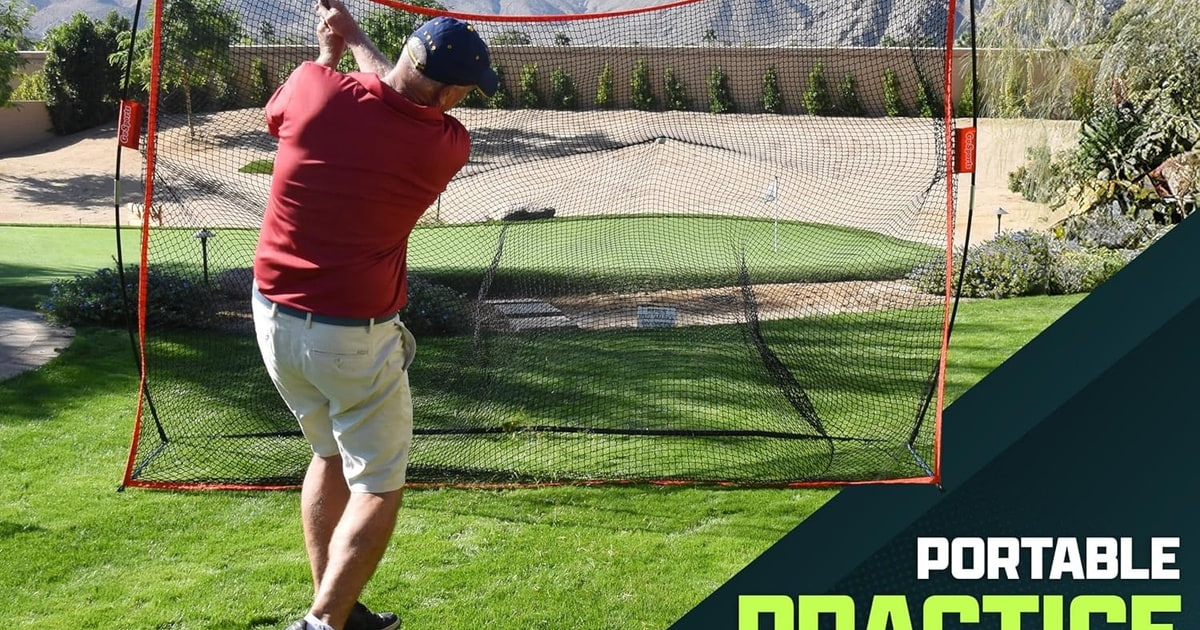
A practice net does one useful thing: it lets you hit real golf balls without leaving your driveway. That's a bigger deal than it sounds. Twenty swings before dinner beats a range trip you keep postponing, and you'll groove a change faster hitting a few balls most days than a bucket once a month. A good net catches the ball quietly, drops it somewhere near your feet, and holds still when you catch one thin off the toe.
No net can tell you where the ball went. You'll see the first ten feet of flight and then a thud, which is fine for tempo and contact but useless for judging a fade or a pull. Nets also wear out. The mesh frays where you hit it most, frames loosen, and cheap fiberglass poles crack in a cold garage. Plan on replacing something eventually, and check that the maker actually sells parts before you buy.
Space decides most of this. You want roughly ten feet of ceiling and ten to twelve feet of depth for full iron swings, and more room behind you for driver. Measure before you shop, because a net that's too shallow puts your clubhead near a wall. We think that the Net Return Pro Series is the best golf practice net for most people, and that the Spornia SPG-7 is the one to buy if you want a covered cage with a big target sheet.
Everything we recommend

The safest catch in a tight garage, and the sturdiest frame here
A full cage with a roof and a target sheet, for daily driver work
A wide catch area on a light frame, if you skip the extras

The same catch-and-drop design, sized for a one-car garage
Prices as of Oct 25, 6:48 AM PT · Details
At a glance
| Product | Hitting area | Ball return | Price | |
|---|---|---|---|---|
| Net Return Pro Series Golf Training NetTop pick | 8 ft x 7.5 ft | Auto ball return | $795 |
| GoSports Golf Practice Hitting Net - ChooseBudget pick | 10 ft x 7 ft | Ball return | $89.99 |
 | SKLZ Quickster Chipping Golf NetAlso in lineup | — | — | $39.99 |
 | Gagalileo Golf Net for Backyard Driving RealAlso consider | 10x7FT | — | $86.99 |
| Spornia SPG-7 Golf Practice Net - AutomaticRunner-up | 108 in H x 96 in W | Automatic ball return | $349.99 |
 | KLAODOT Golf Net with Practice MatAlso in lineup | 10x7FT | — | $56.98On sale |
| Net Return Home Series Golf Training NetAlso great | 7 ft x 7 ft | Auto ball return | $695 |
Prices as of Oct 25, 6:48 AM PT · Details
How we picked
Catch behavior. We favored nets whose manufacturer specs describe catching the ball and dropping or returning it rather than letting it rebound. In a garage, ricochet is the safety issue that matters most.
Frame and netting. We compared frame materials, netting weight and stated swing-speed limits from spec sheets. A net rated only for irons and wedges didn't qualify as a full-swing pick.
Space and setup. We looked at footprint and stated setup times against the roughly ten feet of height and ten to twelve feet of depth that manufacturer guidance and MyGolfSpy recommend for full iron swings.
What's included. Bundled mats and target sheets change what a net costs you overall. Golf Monthly's testers make the case for a mat, and Golfweek's editors credit scoring zones with turning a net into real practice.
Top pick
The safest catch in a tight garage, and the sturdiest frame here
Net Return Pro Series Golf Training Net
The Pro Series uses a curved barrier net that catches the ball and rolls it back toward your stance instead of firing it at your shins. It's the one net here we'd feel fine setting up eight feet from a garage wall.
$795fromAmazonPrices as of Oct 25, 6:48 AM PT · Details
The catch-and-drop design is the whole reason to buy this net. Net Return's barrier weave is built to absorb the ball and feed it into a return chute rather than bounce it back at you. In a two-car garage with a water heater behind you, that matters more than any spec on the box. Balls come back along the ground at walking speed, so you can hit twenty in a row using one ball.
The frame is aircraft-grade aluminum with push-button connectors, and Net Return puts a full build or breakdown at about five minutes with no tools. It weighs 28 pounds, so one person can move it, though you won't want to carry it up stairs every night. Most people leave it standing in a garage bay and park around it, which is really what it's designed for.
It's rated for the swings that break other nets. Net Return lists ball speeds above 240 mph and backs the net with a 250,000-shot guarantee, which covers years of daily driver work for the rest of us. Lighter pop-up frames usually hedge with iron-and-wedge language instead. If you swing hard, or your teenager does, this is the one that won't need a replacement panel within a year.
If you're building a home simulator, this is the net most launch monitors end up pointed at. Net Return designs it to work alongside monitors, sim software and projectors, and the 8-by-7.5-foot opening leaves room for a screen or a target sheet later. You can start with the net alone and add pieces as your budget allows, which is how most people end up with a simulator anyway.
Flaws but not dealbreakers
It's the most expensive net in this guide by a wide margin, and you're paying for the frame and the return system, not for extras. There's no hitting mat, no target sheet and no balls in the box. Budget for a mat you actually like, because hitting off concrete will wreck your wrists and the soles of your wedges.
The 28-pound frame isn't a grab-and-go net either. Breakdown is genuinely quick, but you're still handling poles and a folded net, so it's a poor match for someone who wants to toss a net in a trunk for a weekend.
Net Return lists a three-year warranty and a 250,000-shot guarantee on the Pro Series.
Runner-up
A full cage with a roof and a target sheet, for daily driver work
Spornia SPG-7 Golf Practice Net - Automatic
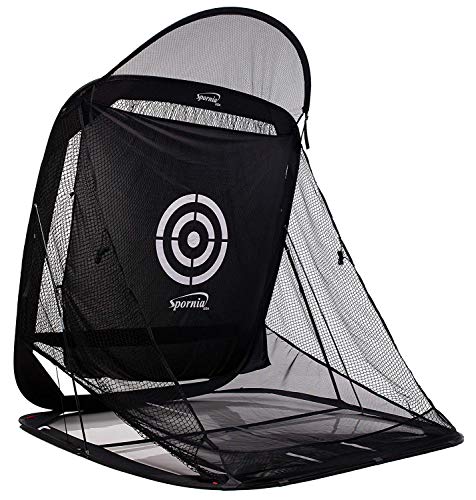
The SPG-7 is a full cage with two side barriers and a roof, so a shot you catch sideways stays inside it. An automatic return rolls the ball back to you, and the oversized target sheet gives you something to actually aim at.
$349.99fromAmazonPrices as of Oct 25, 6:48 AM PT · Details
Picture the shot you shank sideways. Into an open-fronted net, that ball is in your neighbor's fence. In the SPG-7 it hits a side panel and drops. The cage has two barriers and a roof, which is why it turns up so often in backyards with a window in the wrong place. For wayward contact, it's the most forgiving setup in this guide.
Spornia rates the frame for daily use at driver swing speeds, a step up from lighter nets that mostly talk about irons and wedges. Setup runs under a minute once you've done it twice, and the company puts breakdown in the same range. That's the difference between a net you put away between sessions and one that quietly becomes furniture.
The target sheet is the part you'll use most. It's a 60-by-60-inch panel that soaks up impact, quiets the strike and helps hold the net steady. Golfweek's gear editors point to marked scoring zones as the thing that turns a net into structured practice instead of a place to dump balls. Pick a zone for your wedge, another for a 7-iron, and keep score.
The return system needs only one ball, and the stopper holds a couple hundred if you'd rather feed them in bulk. Balls roll down after impact without bouncing off the floor, which keeps things quiet enough for a basement. Clip on the chipping baskets at any of three heights and you've got short-game work too, so a rainy weekend isn't wasted.
Flaws but not dealbreakers
The cage eats more floor space than a flat net, and the roof means you need real ceiling height. Measure a low basement carefully before you order.
Owner feedback points at the netting rather than the frame as the first thing to go under heavy driver use. That's a pattern across cage nets generally, not a Spornia-specific defect, but confirm replacement netting is available before you commit.
Budget pick
A wide catch area on a light frame, if you skip the extras
GoSports Golf Practice Hitting Net - Choose
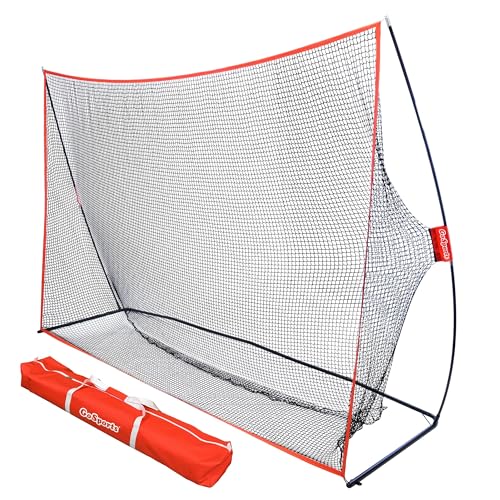
The GoSports net gives you a 10-by-7-foot catch area on a light frame, and it folds into an included carry case. You give up the engineered ball return and every accessory, but you're hitting real balls into something big and forgiving.
$89.99fromAmazonPrices as of Oct 25, 6:48 AM PT · Details
Ten feet of width forgives a lot of bad contact. Most inexpensive nets are narrow, so a pull hook sails past the edge and into your garage door. This one comes in a 10-by-7-foot version and a smaller 7-by-7, and the wide one is what you want if the room allows. The frame is light enough that one person can stand it up in a few minutes.
The netting is reinforced nylon with a ball-return feature, so shots tend to trickle back toward you rather than stopping dead in a pocket. It isn't the engineered chute you get from Net Return. Expect the ball to end up a few feet away instead of at your stance, which is a fair trade at this end of the market.
Nothing else comes in the box. No mat, no balls, no target sheet. If you're starting from zero, add a decent tri-turf mat to the order, because hitting off a driveway is how you ruin a wedge. For a beginner working on contact in a backyard, though, this is the shortest path to swinging at real balls at home.
Flaws but not dealbreakers
At 20 pounds it's the lightest full-size frame here, and light frames tip. GOLF.com's guidance is to stake or weight the legs for any outdoor setup, since unanchored nets start walking in gusts past roughly 15 mph. Do that on day one rather than after you chase it across the lawn.
Longevity is the other question. Golf Digest's gear testers note that quick-deploy nets generally have a shorter net lifespan under regular driver use than fixed-frame cage designs. Hit irons and wedges here most of the time and it'll hold up. Feed it driver every day and you'll be shopping again.
Also great
The same catch-and-drop design, sized for a one-car garage
Net Return Home Series Golf Training Net
The Home Series is a 7-by-7-foot version of the Pro, with the same barrier netting and the same push-button aluminum frame. If your garage bay is tight or your ceiling is low, this is the Net Return that actually fits.
$695fromAmazonPrices as of Oct 25, 6:48 AM PT · Details
Stand in a single-car garage with a bike on one wall and shelving on the other. A 7-by-7-foot opening still leaves you room to swing. A 10-foot net doesn't go in at all. The Home Series is a foot narrower and a foot shorter than the Pro Series, and that's often the difference between a net that lives in the garage and one that lives in its box.
You're not giving up the part that matters. It uses the same barrier weave and the same S-shaped return system, so balls get caught and dropped rather than fired back. Net Return quotes the same ball-speed handling and the same 250,000-shot guarantee across the line. What you lose is catch area, and that's a real loss if your misses run wild.
So the trade-off is margin for error. A smaller opening punishes a heel strike that the Pro Series would have swallowed, which makes this a better fit for a player with reasonably repeatable contact than for a raw beginner. It's still Net Return money, too. If space isn't your constraint, buy the bigger one.
Flaws but not dealbreakers
The tighter aiming window means you'll want to set up carefully every session, and a thin shot off the toe can find the edge of the frame. You're also buying a bare net again, so a mat, a target sheet and balls are all separate purchases on top of an already steep price.
Net Return lists the same three-year warranty and 250,000-shot guarantee on the Home Series.
Who this is for
Buy one of these if you have somewhere to put it and you'd practice more often with a net than without. That's most people in cold climates, anyone with a garage bay to spare over the winter, parents setting up a junior golfer, and players who want to hit balls at seven in the morning without driving anywhere. If you already own a launch monitor, a net turns it into a usable indoor setup instead of a range toy.
Skip it if your ceiling is under about nine feet, if you only ever want to work on chipping, or if your practice problem is ball flight rather than contact. A net won't show you shot shape. This guide covers full-swing nets you set up at home, indoors or in a yard. It doesn't cover permanent backyard cages, projector screens, hitting mats sold on their own, or launch monitors.
How we picked
We built the shortlist around a handful of things that decide whether a net gets used or resented. Catch behavior: does the ball drop and return, or does it come back at you? Durability: frame material, netting weight and the manufacturer's stated swing-speed limit, since a net rated for wedges isn't a driver net. Space: footprint and height against the roughly ten-by-ten-foot minimum most manufacturers and MyGolfSpy recommend for full iron swings. Setup: how long it takes to stand up and put away, because a twenty-minute build kills a twenty-minute practice window. Extras: whether a mat, target sheet or stakes come in the box, and whether the maker sells replacement netting when the middle finally frays.
Other golf practice nets worth considering
If you want the whole setup in one box: The Gagalileo Golf Net for Backyard Driving Real — The Gagalileo bundle ships with the 10-by-7-foot net, a tri-turf hitting mat, six real balls, a rubber tee and ground stakes. That's most of what you'd otherwise buy piecemeal, and the stakes matter more than they sound if the net lives outside. Gagalileo specs a 300-gram high-density net behind 600D Oxford cloth, plus a velvet target panel meant to quiet the strike for indoor and simulator use. What it gives up is the engineered ball return of our picks and the heavy cage frame of the Spornia, so treat it as a good iron-and-wedge net with strong accessories rather than a daily driver rig. Golf Monthly's testers make the general case for bundled mats: a consistent lie beats hitting off patchy grass, and your turf survives.
The competition
This is what our research surfaced, not a census of everything for sale. Each of these is a real product with real buyers. Each also lost to a pick on something we think you'd notice within a month.
The KLAODOT Golf Net with Practice Mat — The KLAODOT is another 10-by-7-foot bundle, with a center target, four corner pockets, a three-in-one turf mat, five balls and a tee. On paper it reads a lot like the Gagalileo. The netting is lighter, at 250 grams against 300, and the poles are 0.45-inch fiberglass rather than metal, which is the part that gives us pause for driver work. Fiberglass in a cold garage is a known weak point, and owner feedback here runs more mixed than on our picks. It's a budget bundle and it plays like one, but for a beginner who wants targets to aim at and a mat included, it's a reasonable place to start.
The SKLZ Quickster Chipping Golf Net — The SKLZ Quickster Chipping Net isn't a full-swing net at all. It's a small target with three holes for accuracy work, it folds into a nylon carry bag, and SKLZ puts setup and breakdown at about thirty seconds. Take a driver at it and you'll destroy it, and probably something behind it. But if you already own a big net, or you just want something to lob wedges at across the yard on a summer evening, it's light, packable and genuinely fun. Think of it as short-game equipment that happens to be sold next to the real nets.
Setup and upkeep
Anchor the thing. GOLF.com's guidance is to stake or weight the legs of any outdoor net, because unanchored frames start tipping in gusts past roughly 15 mph, and a net that falls forward mid-swing is how frames bend. Indoors, give yourself about ten feet of ceiling and ten to twelve feet of depth for full iron swings, and more for driver. Hit off a mat rather than concrete or bare dirt, both to save your wrists and to keep the lie consistent. Move your aim point around every few sessions so you're not fraying one square foot of netting. And find out whether replacement panels exist for your net before the first one wears through, because the mesh almost always fails long before the frame does.
Questions we get
What's the best golf practice net for a garage?
Look for a net that catches and drops the ball instead of rebounding it, since a garage puts walls, cars and a water heater right behind you. The Net Return Pro Series is built around exactly that, and the Home Series does the same thing in a smaller footprint. Measure your ceiling first. Under about nine feet, you're limited to wedges and half swings no matter what you buy.
How much space do I need for a golf practice net?
Most manufacturer guidance, and MyGolfSpy's coverage, lands on roughly ten feet of ceiling clearance and ten to twelve feet of depth for safe full-swing iron practice. Driver needs more depth, mainly so your clubhead isn't near a wall on the takeaway. Width matters too. Stand where you'd hit and swing a club slowly through the whole arc before you commit.
Can you hit a driver into a golf practice net?
Only if the maker says so. A net rated for full swings with irons and wedges isn't automatically rated for driver speeds, and that distinction is buried in the spec sheet more often than not. Net Return lists ball speeds above 240 mph on its nets, and Spornia rates the SPG-7 frame for daily driver-speed use. Lighter pop-up nets usually don't make that claim.
What's the best golf net for a launch monitor setup?
Any net deep enough and wide enough for a full swing will work, but the ones designed for simulator use save you fiddling. Net Return builds its nets to sit alongside launch monitors, sim software and projectors, and the Pro Series opening leaves room to add a screen. Give the monitor the distance from the ball its manual asks for, since that's usually the constraint, not the net.
How do you stop a golf net from moving when you hit it?
Stake it or weight it. GOLF.com recommends anchoring the legs of any outdoor net, because light frames tip in gusts above roughly 15 mph and shift a little with every strike. Sandbags or gym plates on the feet work indoors. A large target sheet helps too, since it absorbs the hit and steadies the netting behind it.
How long does a golf practice net last?
The netting almost always wears out before the frame, and it fails where you hit it most. Golf Digest's gear testers note that quick-deploy pop-up nets generally have a shorter net lifespan under regular driver use than fixed-frame cage designs. You'll stretch it by hitting irons more than driver and moving your aim point around. Before you buy, confirm you can order a replacement panel.
Why you should trust us
For this guide:
- We read the manufacturer specifications for every net here, including frame materials, netting weight, stated dimensions and swing-speed limits.
- We compared published gear coverage from Golf Digest, Golf Monthly, Golfweek, GOLF.com and MyGolfSpy on net durability, setup time and space requirements.
- We looked for recurring themes in owner feedback, particularly complaints about frame stability in wind and netting wear under driver use.
- We read owner reviews on every listing, weighted toward the critical ones, because that is where the recurring failures show up.
- We have a systematic way of automatically fetching the latest prices, so the numbers on this page stay current.
- This is a research-focused guide, so the team may not own every product listed — though we often do own the top winners, which gives us extra context for the recommendations.
- We don't accept free products, and the retailer commission never changes which product we recommend.
Sources
The Net Return Pro Series Review, The Net Return (manufacturer specs)
Best Golf Practice Nets, Tested, Golf Digest
Golf Practice Net Buying Guide, GOLF.com
Best Home Golf Simulators and Practice Nets, Golf Monthly
SKLZ Quickster Golf Net Product Specs, SKLZ (manufacturer specs)
Rukket Sports Haack Golf Net Specs, Rukket Sports (manufacturer specs)
Spornia SPG-7 Golf Practice Net, Spornia (manufacturer specs)
Cimarron Nets Golf Vertus Specs, Cimarron Sports (manufacturer specs)
Rapsodo R-Motion Launch Monitor Review, Rapsodo (manufacturer specs)
Best Golf Gear Tested by Editors, Golfweek
How Much Space Do You Need for a Home Golf Net?, MyGolfSpy
Golf Net Safety and Setup Guidelines, USGA
Amazon product listings and owner reviews for all 7 products
Manufacturer specification pages for each product
Some passages in this guide may be paraphrased with AI help.
Product prices and availability are accurate as of the date/time indicated and are subject to change. Any price and availability information displayed on Amazon.com at the time of purchase will apply to the purchase of this product.
More like this.
Continue exploring health reviews and recommendations.

The Best Portable Backyard Volleyball Nets
A backyard volleyball net earns its keep by staying put. You want to stake it, pull the lines tight, and then forget it exists for three hours while…

The Best Mosquito Net Gazebos for Patios
A patio you can't sit on after sundown isn't much of a patio. Mosquitoes show up right when the evening gets good - dinner outside, a drink, the kids…

The Best Truck Bed Cargo Nets
A cargo net is the difference between a load that arrives and a load that scatters across two lanes of highway. Most of what you haul in a pickup bed - …

The Best Golf Drivers
Your driver is the club you hit when the tee shot matters most, and it's the one that decides whether the next shot comes from short grass or from…

The Best Golf Push Carts
Walking a golf course means a few miles on foot with a heavy bag hanging off one shoulder. A push cart takes that weight off you, and most golfers notice…

The Best Golf Putters
You use your putter more than any other club in the bag. On a typical round you'll pull it out on all 18 greens, often two or three times each, and every…