The Best Manual Tile Cutters
If you're tiling a bathroom floor or a kitchen backsplash, most of your cuts are straight lines. A manual tile cutter handles those with a scoring wheel and a breaker bar — no water, no cord, no dust. You score once, press down, and the tile snaps. That means you can work in the room you're tiling instead of hauling every tile out to a wet saw in the driveway. For a weekend project, that convenience is most of the value.
No snap cutter cuts curves. If you need an L-shaped notch around a toilet flange or a hole for an outlet box, you'll still want a wet saw or a grinder for those few tiles. Natural stone is another gap: travertine, marble and slate fracture along their own planes, and even the most capable cutter here won't give you a break you can count on. Scoring wheels wear out, too, and a dull wheel starts chipping edges long before it stops cutting.
So the real question is how big your tiles are and how many cuts you're making. A 17-inch rail covers subway tile and 12x12 squares; it won't touch a 24-inch field cut. Dense porcelain needs more leverage than soft ceramic does. And a scoring wheel you can't replace puts a ceiling on how long the tool lasts. We think that the Montolit Masterpiuma P3 is the best manual tile cutter for most people, and that the QEP 10630 is the one to buy if you're working with 12x24 tile or anything larger.
Everything we recommend

The cleanest snap edge here, if 17 inches is enough

More reach and a replaceable wheel, with some rail flex

A hand tool for small ceramic jobs, not a bench cutter

The one that snaps thick, large-format porcelain cleanly
At a glance
| Product | Price | |
|---|---|---|
| RUBIUpgrade pick | $889.98 |
| Montolit 17" Masterpiuma P3 Tile CutterTop pick | $491.78 |
 | SIGMA LASER LIGHT KIT FOR SERIES 4Also in lineup | $149.99 |
 | BELLOTA 8251Also in lineup | $32.90 |
| QEP 10630 24-Inch Manual Tile Cutter withRunner-up | $129.99 |
| Vitrex 10 1500 Pro Series Heavy-Duty TileBudget pick | $73.35 |
How we picked
Cutting capacity. We compared stated straight and diagonal lengths against the tile sizes people actually buy, from 3x6 subway up to 24x24. We treated the diagonal spec as the real limit, since it's always shorter than the headline number and it's where most buyers get caught out.
Material and thickness. Spec sheets list a maximum thickness and the materials a cutter is engineered for, and those limits are not marketing. We favored cutters whose stated ratings cover dense porcelain rather than ceramic alone.
Scoring wheel quality. Tungsten carbide wheels score far more tile than plain steel before they start chipping edges. We gave extra weight to wheels that are replaceable, because that's what turns a one-project tool into a multi-project one.
Frame and rail rigidity. Published reviews and owner feedback point at the same failure: a rail that flexes lets the wheel drift, and the tile breaks off-angle. We preferred rigid, well-braced frames, especially on cutters rated past 18 inches.
Breaker design. Breakers that spread force across the tile chip less than ones that press on a single center point, which matters most on glass and thin porcelain. We looked for that in both the specs and in what owners report about edge quality.
Top pick
The cleanest snap edge here, if 17 inches is enough
Montolit 17" Masterpiuma P3 Tile Cutter
This is a 17-inch snap cutter built around a push handle that turns modest hand pressure into a deep, even score. It cuts ceramic, porcelain and even glass mosaic cleanly, and the frame folds flat without tools when you're done.
$491.78fromAmazonThe push handle is the reason to buy this cutter. Montolit's scribe handle pushes forward instead of levering down, so more of your effort ends up in the wheel. On dense full-body porcelain, that means a deeper groove from one pass — and one pass is what keeps the edge from chipping. If you've ever fought a cheap cutter that needs two or three strokes to leave a mark, you'll notice the difference on the first tile.
A stiff beam keeps a long score on the line. Flex is what ruins cuts. When a rail bends under pressure, the wheel wanders a hair off your mark, and the tile breaks at an angle you never drew. This frame is built to resist that, and published reviews and working tile setters keep coming back to snap-edge quality as the reason they buy Montolit over cheaper alternatives.
Glass mosaic is where it separates from everything else here. Glass shatters under a center-point breaker, which is how most budget cutters snap a tile. Montolit lists glass and delicate glass mosaic among the materials this cutter is engineered for, and the way it spreads breaking pressure is why. If your backsplash mixes a porcelain field with a glass accent strip, this is the one tool in this guide that handles both.
The folding frame means you'll actually use it where you're working. The patented frame opens without tools and closes without dismantling, so it lives in a closet instead of taking over the garage. It also comes ready to go, with no assembly. That sounds minor until you're on your knees in a half-tiled bathroom, and the difference is carrying the cutter to the tile rather than the tile to the cutter.
Flaws but not dealbreakers
Seventeen inches is a hard ceiling. If your floor is 18x18 or 24x24 porcelain, this cutter can't make the field cuts at all. Diagonal work eats into the usable length further, so even some 12x24 layouts get awkward. Plenty of tile setters own a Montolit for border and detail cuts and something longer for big field tile. That's a two-tool answer, and it's worth knowing before you commit.
It's a serious commitment for a one-weekend job. This is one of the most expensive cutters here, and the money buys edge quality rather than capacity. If you're tiling one small bathroom in standard ceramic and never touching tile again, you won't get that back. There's also no adjustable angle fence, so anything other than a straight or 45-degree cut means marking carefully and working to a separate guide.
Runner-up
More reach and a replaceable wheel, with some rail flex
QEP 10630 24-Inch Manual Tile Cutter with
A 24-inch snap cutter with a replaceable titanium-coated carbide wheel and fold-out arms that hold big tiles level while you score. It covers the formats most bathrooms and backsplashes actually use, and it'll survive more than one project.
$129.99fromAmazonTwenty-four inches covers the tile most homes actually use. Subway tile, 12x12 squares, 12x24 planks — all of it fits with room to spare. Diagonal capacity is 17.5 inches, which handles a 12-inch tile turned on point but not much beyond that. Thickness tops out at half an inch, and that covers standard floor and wall tile. Measure your tile's thickness against that number before you buy, not after.
A replaceable scoring wheel changes the math. Wheels dull. On most budget cutters that's the end of the tool, because the wheel isn't a part you can swap. This one takes a 7/8-inch titanium-coated tungsten carbide wheel that comes off and goes back on, so chipping becomes a small repair instead of a replacement purchase. If you're doing a bathroom now and a kitchen later, that's the feature that matters.
The side arms are more useful than they look. An 18-inch tile hanging off the end of the bed tips as you press, and a tipping tile breaks off-axis. The fold-out extensions hold the far edge level through both the score and the snap. Working alone, that support is the difference between needing a second pair of hands and just getting on with it.
A smooth slide makes a single-pass score easier. The carriage rides on ball bearings, so the wheel travels at a steady speed instead of catching and skipping. That's not a luxury. A stutter mid-stroke leaves a shallow spot in the groove, and the tile breaks wherever the groove is weakest. Even pressure, one pass, edge to edge — the hardware here makes that easy to repeat.
Flaws but not dealbreakers
Dense porcelain past about 10mm is where it struggles. The half-inch rating is a ceiling, not a comfort zone. Thick full-body porcelain asks for more leverage than this cutter has, and the usual result is a break that wanders off your score line. If your tile is heavy in the hand and rings when you tap it, plan on the RUBI or a wet saw for those pieces.
The single-bar rail flexes on the longest cuts. Push toward the full 24 inches and you may see a little wander and a slightly angled break. It isn't a dealbreaker for a backsplash, and it's the trade-off you accept at this size. Keep your longest cuts as square as you can, score with steady pressure rather than force, and check the alignment against the breaker bar before you press down.
Budget pick
A hand tool for small ceramic jobs, not a bench cutter
Vitrex 10 1500 Pro Series Heavy-Duty Tile
This is a hand-held score-and-snap tool rather than a cutter with a rail. For a short list of straight cuts in standard ceramic, it's the least tool you can get away with, and drop-forged steel means it won't develop play halfway through.
$73.35fromAmazonDrop-forged steel is the reason to pick this over a bargain-bin scorer. Forged steel holds its shape under repeated pressure. Pressed steel develops play, and play means your score line drifts. For something that weighs under a pound, you're getting a tool that stays true well past the point where the throwaway versions start wandering. Vitrex rates it for all tile types, which realistically means standard ceramic and thin porcelain.
There's no technique to learn. You mark the tile, run the wheel along a clamped straight edge in one pass, then snap. That's the whole method. A first-time tiler gets clean cuts on ceramic almost immediately, which isn't true of every cutter here. The cushioned grip and contoured handles matter more than they sound when you're forty cuts into an afternoon and your hand is tired.
It stores anywhere and travels with you. The tool is about eleven inches long and weighs less than a pound. It goes in a bag, not a truck bed. If your job is the backsplash behind a stove and you're working off the countertop, a full bench cutter is more machine than you want to shuffle around a small kitchen.
Flaws but not dealbreakers
You supply the accuracy. There's no rail, no fence and no breaker bed. A straight cut depends on a straight edge you clamp down and on your own steady hand, and any wobble in the stroke shows up as a ragged edge. If you want repeatable results without thinking about setup for every tile, this isn't the tool for you.
The wheel isn't a serviceable part, and it wears. Expect performance to fall off after a couple hundred cuts in ceramic, and much sooner in porcelain. Once the groove gets shallow and edges start chipping, you're buying another tool rather than another wheel. For one bathroom, that's fine. For a house you're working through room by room, step up to the QEP.
Upgrade pick
The one that snaps thick, large-format porcelain cleanly
RUBI
A professional bench cutter with a 33 7/16-inch rail, a breaking system rated to 3,307 pounds and a folding chassis on wheels. If your floor is large-format porcelain stoneware, this is the manual cutter that won't flinch at it.
$889.98fromAmazonThe capacity is in a different class. You get 33 7/16 inches straight, 24x24 on the diagonal, and up to 7/8 inch of thickness. Read that diagonal number twice, because it's the one that decides whether you can lay 24-inch tile on point. Cutters advertising a 24-inch straight capacity usually give you 17 or 18 inches diagonally, and that's not enough for a real 24x24 field cut.
Breaking force is what dense stoneware demands. RUBI rates the breaking system to 3,307 pounds, operated with one hand. Extruded and full-body porcelain stoneware doesn't snap politely. It either separates cleanly along a deep score or it fractures somewhere you didn't want it to. On thick tile, leverage is the whole margin between those two outcomes, and this cutter has more of it than anything else here.
It arrives set up for the whole job. Two scoring wheels come in the box, an 8mm silver and a 22mm extreme, and wheels are interchangeable across that range — so you match the wheel to the tile instead of fighting the wrong one. There's a swivel square with a central pivot for angle work, plus a reinforced textile bag for hauling and storing it.
The chassis folds and rolls. This is a 54-pound machine, and RUBI put rubber wheels with bearings and a handle on it. The structure folds, so moving it between rooms or into a truck doesn't require a favor from a neighbor. Rigidity during the cut and portability afterward usually trade against each other, and this is one of the few designs that mostly gets both.
Flaws but not dealbreakers
It's overkill for a normal bathroom. If you're cutting 12x12 ceramic, you're paying for 21mm thickness capacity and a breaker you'll never call on. This is the most expensive cutter here by a wide margin, and the math only works if you cut large-format tile again and again — a contractor, or a homeowner with several rooms still ahead of them.
It takes up real space. Nearly four feet long and better than fifty pounds, folded or not. Storage is a genuine consideration in a garage that already has a mower and a workbench in it. One person can move it, thanks to the wheels, but nobody enjoys carrying it up a flight of stairs.
Who this is for
This guide is for anyone doing straight cuts in ceramic or porcelain tile: a bathroom floor, a kitchen backsplash, a laundry room, a mudroom. If your layout is field tile plus border cuts and you can count your notched pieces on one hand, a manual cutter does 90 percent or more of the work, and it does it faster than a wet saw because there's no setup and nothing to clean up afterward. Buy for your largest tile and your hardest tile, not your average one.
Skip all of this if your project is natural stone, a mosaic sheet you need to trim around a curve, or a floor full of cutouts for pipes and floor vents. Rent a wet saw for a day and be done. This guide also doesn't cover wet saws, angle grinders, tile nippers or hole saws — only score-and-snap tools. And if your tile is thicker than the cutter's rating, no amount of technique fixes it; the tile simply won't break where you want it to.
How we picked
We built the shortlist from spec sheets, published reviews and the themes that come up repeatedly in owner feedback, then weighed each cutter on five things. Capacity: the straight length has to clear your biggest tile, and the diagonal rating — always the smaller number — has to clear it turned on point. Material and thickness: we checked stated limits for porcelain, glass and thick stoneware rather than trusting a general claim of suitability. Scoring wheel: tungsten carbide over steel, and replaceable over sealed, because a dull wheel is the most common cause of chipped edges. Rigidity: a frame that doesn't flex is what keeps a long score on the line. Breaker design: pressure spread across the tile chips less than a single center point, and that shows up first on glass and thin tile.
The competition
This is what the research turned up in this category, not a survey of everything on the market. Manual tile cutters are sold under dozens of house brands, and plenty of them are the same casting with a different sticker. The listing below covers a real tool that just doesn't do the job this guide is about.
The BELLOTA 8251 ($32.90) — Bellota's 8251 is a Spanish-made hand tool in chrome vanadium steel, with different heat treatments across the head, tip and housing and a polished, lacquered tip. It's built to a genuinely high standard, and Bellota has been making hand tools for well over a century. But the listing describes a hand tool, not a cutting system: there's no guide rail, no bed and no breaker bar, so every straight line depends on a straight edge you clamp yourself. That's why it loses to all four picks here. If you already own a snap cutter and want something durable for border scoring and detail work in tight corners, it's a reasonable companion — just don't expect it to replace the cutter.
Cutting technique and care
Score once. That's the single rule that separates clean edges from chipped ones. Run the wheel from one edge of the tile to the other in one uninterrupted pass at steady pressure, and never go back over the same line — a second pass widens the groove and gives the break somewhere to wander. If the first pass doesn't leave a visible groove, the wheel is worn or you're pressing too lightly, so fix that instead of re-scoring. Line the groove up squarely with the breaker before you press down; a misaligned snap breaks off-angle even with a perfect score. Between sessions, wipe the rail and the slide so grit doesn't drag, keep the wheel clean, and replace it when edges start chipping on tile that used to cut cleanly.
Questions we get
Can a manual snap cutter handle 24x24-inch tile?
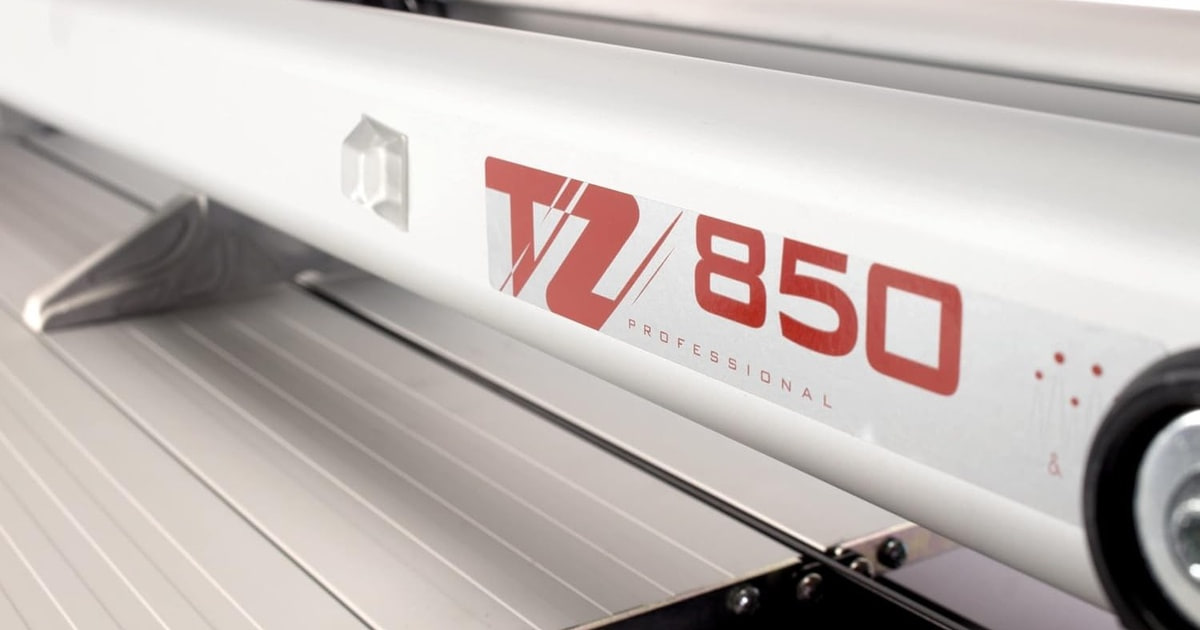
Only if the cutter is explicitly rated for it on the diagonal. The RUBI TZ-850 lists a 24x24-inch diagonal capacity alongside its 33 7/16-inch straight length, which is what large-format work actually requires. Most cutters advertised at 24 inches straight give you only 17 or 18 inches diagonally. Check the diagonal spec, not the headline number.
What's the difference between a manual cutter and a wet saw?
A manual cutter scores the glaze and snaps the tile along that line, with no water, no power and almost no dust. A wet saw grinds all the way through with a diamond blade cooled by water, so it can cut curves, notches and hard stone. Snap cutters handle the large majority of straight residential cuts. Wet saws are for cutouts around pipes and outlets, natural stone, and anything that isn't a straight line.
Can a snap cutter cut glass mosaic tile?
Some can, but most shouldn't be trusted with it. Glass shatters unpredictably under a center-point breaker, which is how most cutters snap a tile. The Montolit Masterpiuma P3 lists glass and delicate glass mosaic among its intended materials, and it's the one cutter in this guide we'd point at for that work. For anything else, use a wet saw with a glass blade.
Why do my tiles keep breaking off-angle?
It's almost always one of four things: a dull scoring wheel, more than one pass over the same line, a score that isn't lined up with the breaker, or a rail that flexes under pressure. Start with the wheel, since that's the quickest thing to rule out. If the breaks only go wrong on your longest cuts, the frame is flexing and you need a more rigid cutter.
How long does a scoring wheel last?
A good titanium-coated tungsten carbide wheel will run for hundreds of clean cuts in standard ceramic, and considerably fewer in dense porcelain, which is far harder on the edge. Plain steel wheels wear out much faster. The tells are a shallower groove, chipping along the score line, and a grating sound during the stroke. Replace the wheel at that point rather than pressing harder.
Do I need a wet saw for a kitchen backsplash?
Usually not. Standard subway tile and field tile up to 12x24 are well within what the QEP 10630 or a good hand cutter can do, and a snap cutter is faster and far cleaner in a finished kitchen. The exceptions are the cutouts around outlets and switch plates, natural stone, and glass mosaic without a cutter rated for it. Many people do the straight cuts themselves and rent a saw for one day to knock out the notches.
Why you should trust us
For this guide:
- We read manufacturer spec sheets for every cutter here, paying particular attention to diagonal capacity and maximum tile thickness, since those are the limits buyers most often miss.
- We compared published reviews and recurring themes in owner feedback to identify the failures people actually run into: rail flex on long cuts, chipping from worn wheels, and tiles that refuse to snap when they're thicker than the rating.
- We cross-checked each product's listing against the category to make sure a laser accessory sold without a cutter wasn't recommended as one.
- We read owner reviews on every listing, weighted toward the critical ones, because that is where the recurring failures show up.
- We have a systematic way of automatically fetching the latest prices, so the numbers on this page stay current.
- This is a research-focused guide, so the team may not own every product listed — though we often do own the top winners, which gives us extra context for the recommendations.
- We don't accept free products, and the retailer commission never changes which product we recommend.
Sources
Best Tile Cutters 2026 — This Old House Reviews, This Old House
Best Manual Tile Cutters Tested — Family Handyman, Family Handyman
Best Tile Cutters Tested by Bob Vila's Team — Bob Vila, Bob Vila
Best Tile Cutters Reviewed — The Spruce, The Spruce
Manual Tile Cutter Roundup — Pro Tool Reviews, Pro Tool Reviews
Amazon product listings and owner reviews for all 6 products
Manufacturer specification pages for each product
Some passages in this guide may be paraphrased with AI help. Prices are refreshed automatically.
More like this.
Continue exploring home reviews and recommendations.

The Best Steam Mops for Hardwood and Tile Floors
Mopping with a bucket mostly moves dirty water around. A steam mop skips that entirely: you fill the tank with plain water, wait half a minute, and push a…

The Best Wet Tile Saws
Cutting tile is the part of a tile job that decides how the finished wall looks. Every outlet, every doorway, every corner needs a cut piece, and a…

The Best Cutting Boards
A cutting board is the one tool you touch every single time you cook. It takes the beating your knives would otherwise give your countertop, and it…

The Best Wood Cutting Boards
A wood cutting board is the one tool on your counter that touches almost every meal. The good ones are heavy enough to stay put when you rock a knife…

The Best Cutting Boards
The cutting board is the surface you touch most in a kitchen, and it's usually the one you think about least. It sits under every onion, every chicken…

The Best Metal Lathes for Hobbyist Machinists
A metal lathe is the machine that lets you make a part instead of ordering one. You chuck up a piece of steel or brass, and a few minutes later it's a…