The Best Pickleball Ball Machines
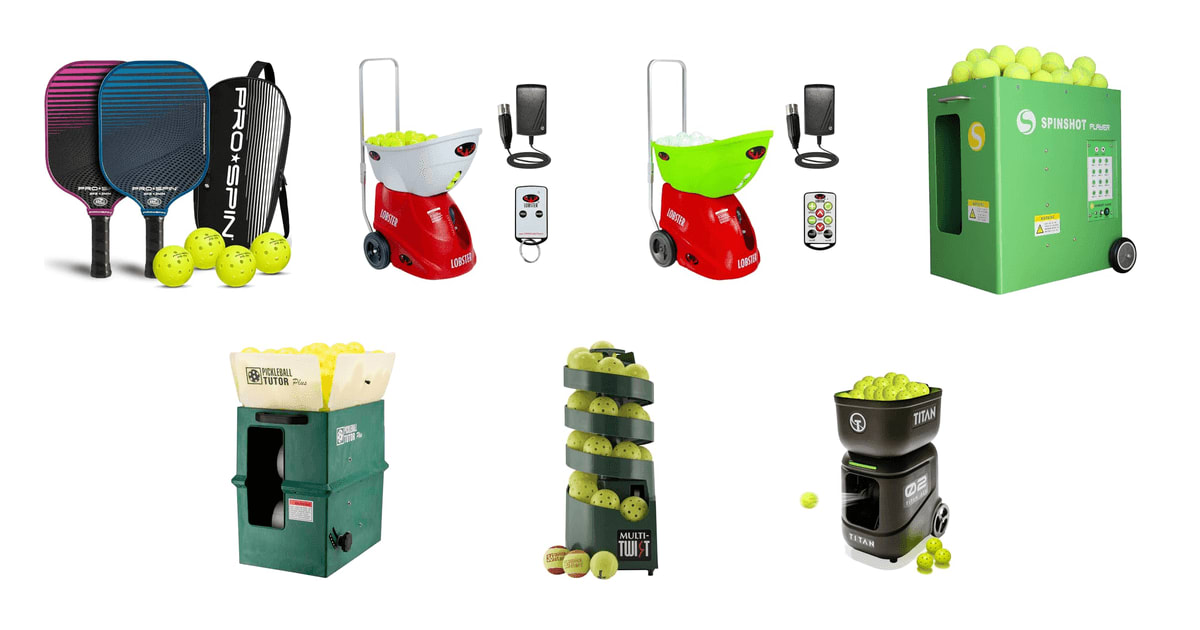
A ball machine is the only practice partner that never gets tired, never checks its phone, and never wants to just play games instead of drilling. That's the real appeal. If you want to hit 300 dinks in a row at 6 a.m. on an empty court, no human is going to volunteer for that. The machines that matter here feed balls at a steady pace, let you dial in speed and spin, and move the ball around the court so you have to actually run. Everything else is packaging.
Here's the honest part: none of these machines will fix your technique. They give you repetitions, and repetitions of a bad stroke just make the bad stroke permanent. A machine also can't read your positioning or tell you why your third shot keeps floating. Reload pauses interrupt your rhythm too, since even the biggest hoppers here run dry in roughly ten minutes at a normal feed rate. And every one of them is a heavy, awkward object you have to load into a car and wheel across a parking lot.
So think about how often you'll really practice before you spend. A player who drills twice a month doesn't need programmable shot sequences, and a 4.5 competitor grinding four days a week will outgrow a fixed feeder fast. We think that the Titan ACE is the best pickleball ball machine for most people, and that the Pickleball Tutor Plus is the one to buy if you'd rather turn a knob than open an app.
Everything we recommend

App-programmed drills in a frame you can fold into a trunk
Knobs instead of an app, and coaches keep picking it
The biggest hopper and a remote, built for group sessions
A simple feeder for brand-new players, and nothing more
At a glance
| Product | Price | |
|---|---|---|
| Titan ACE Pickleball Machine with Invertible HopperTop pick | $2,099 |
| LOBSTER Sports Pickle Two Pickleball MachineAlso great | $1,599 |
 | SPINSHOT PLAYER Tennis Ball MachineAlso consider | $1,749 |
| Pickleball Tutor Plus. Ball Machine. Variable TOPSPINRunner-up | $1,319 |
 | LOBSTER SportsAlso consider | $1,179 |
| Sports Tutor Pickleball Twist Ball Machine -Budget pick | $359 |
 | PRO-SPIN Carbon Fiber Pickleball Paddles Set ofAlso in lineup | $79.99 |
How we picked
Ball capacity. We compared listed hopper sizes against typical feed rates to see how long each machine runs before a reload. Anything under about 80 balls breaks the rhythm of a real drill set.
Oscillation and spin. We read spec sheets and published reviews for whether a machine moves the ball unpredictably and adjusts both topspin and backspin. Fixed-position feeders without spin were treated as beginner tools only.
Speed range. We checked that the low end reaches dink pace around 10 to 15 mph and the top end covers competitive drives in the 45 to 65 mph band. Machines that only cover one end of that range lose a lot of drill variety.
Control method. We weighed onboard knobs against wireless remotes and phone apps, since walking back to the machine between sets is the most common complaint owners raise. App control earned extra credit only when it enabled real drill sequencing.
Portability and power. We looked at listed weight, wheel size, folding design, and battery runtime, because most public courts have no outlet. Machines in the 35 to 42 pound range with real wheels are the ones one person can move alone.
Top pick
App-programmed drills in a frame you can fold into a trunk
Titan ACE Pickleball Machine with Invertible Hopper
The Titan ACE lets you build a drill on your phone — dinks, volleys, drives — and then run it on a loop while its internal oscillation spreads shots across the court. It folds down small enough for a car trunk, so you can actually get it to the court alone.
$2,099fromAmazonThe app is what you're really paying for. You set speed, spin, height, and angle for each shot in a sequence, then let it run for the whole hopper. That means you can build a third-shot-drop drill on Monday and rerun it exactly on Thursday. There's a drill library too, so you can pull sequences from coaches or other players by scanning a code instead of thumbing in settings from scratch.
Internal oscillation moves the ball, not the machine. The launch head shifts inside the chassis rather than the whole unit rolling on the court surface. You get smooth sideline-to-sideline coverage without the machine creeping out of position mid-drill. For rally simulation, that matters — you're forced to read and move rather than camp in one spot waiting for the next ball.
It's genuinely portable for a full-featured machine. The frame collapses, and one person can load it, wheel it out, and set it up without a second pair of hands. If your home court is a municipal park with a long walk from the lot, this is the difference between practicing and not practicing. Most machines with this feature set are bulkier propositions.
You have more than one way to control it. The phone app does the heavy lifting for designing and editing drills, but there's an onboard panel for quick changes and Apple Watch support for tweaks mid-session. A physical remote is sold separately if you want one-touch adjustments. So you're not stranded if your phone dies halfway through a session.
It's calibrated for official ball flight. Titan is the official machine partner of the UPA, which means the feed is tuned to how sanctioned match balls actually travel. Pickleballs are light and wind-sensitive, and a machine tuned for a different ball throws differently. If you're prepping for league or tournament play, that consistency is worth something.
Flaws but not dealbreakers
The hopper runs dry sooner than you'd like. The 110-ball capacity gives you roughly ten to twelve minutes at a normal feed rate before you're picking up balls. That's fine for focused sets, but it breaks up longer conditioning drills where the whole point is not stopping. The Pickle Two holds more.
It's the most expensive machine here, and the app is the reason. If you're going to set a single oscillation pattern and grind, you're paying a premium for software you won't open. Be honest about whether you'll actually build drill sequences. Players who practice once a week rarely do.
Stock has been thin. Availability tends to run in small batches, so delivery timing is worth confirming before you commit. Not a dealbreaker, but plan around it if you have a court reserved.
Runner-up
Knobs instead of an app, and coaches keep picking it
Pickleball Tutor Plus. Ball Machine. Variable TOPSPIN
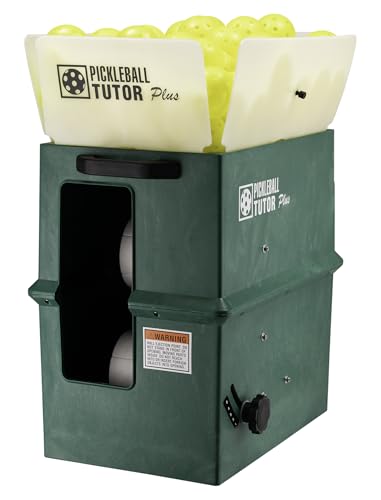
The Pickleball Tutor Plus covers every shot type through simple dials — one knob sweeps from heavy topspin to heavy backspin, another sets speed from dink pace to hard drive. There's no pairing, no updates, and no app to open before you can hit.
$1,319fromAmazonYou can be hitting balls in under a minute. Turn two knobs and go. No Bluetooth handshake, no firmware update the one morning you have court time. For a lot of players that's the whole argument, and it's why this machine shows up so often in coach recommendations. Technology that works reliably beats technology that does more.
The spin dial does the full range on one control. A single knob moves you from heavy topspin through flat to heavy backspin. You can set a topspin drive pattern, then drop to backspin for slice returns without menu-diving. Published reviews and coach feedback both point to the spin delivery being consistent shot to shot, which is what makes it useful for grooving a stroke.
The speed band covers everything you'll actually face. It runs from 10 to 65 mph, so soft dinks and hard third-shot drives both live inside the range. Feed interval adjusts from a ball and a half seconds for reaction volleys out to ten seconds if you want time to reset between reps. That range covers beginner drills and 4.5-level pressure work with the same hardware.
Random oscillation forces you to move. Shots land across the court unpredictably rather than in a fixed left-center-right pattern, so you have to read and run instead of pre-positioning. It's the feature that separates real rally simulation from a ball feeder. The built-in rechargeable battery runs up to four hours and comes with a charger that shuts itself off overnight.
Flaws but not dealbreakers
No app and no wireless remote means walking. Every adjustment sends you back to the machine, which breaks rhythm if you like to change speed between every set. Coaches running a drill from the baseline won't mind. Solo players who tinker constantly will.
Simplicity has a ceiling. You can't program a sequence where shot one is a lob and shot two is a low drive. If you want to replicate a specific opponent's shot pattern, this machine can't do it and the Titan ACE can. Availability has also been limited in small batches.
Also great
The biggest hopper and a remote, built for group sessions
LOBSTER Sports Pickle Two Pickleball Machine
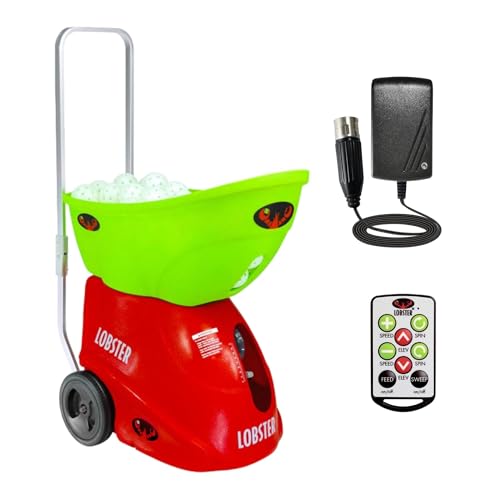
The Pickle Two holds 125 balls — more than anything else here — and its 10-function wireless remote lets you change speed, spin, and oscillation from wherever you're standing. The 2-Line mode alternates between two court spots, which is what makes it work for clinics.
$1,599fromAmazonThe hopper is the reason coaches buy it. At 125 balls you get roughly twelve to thirteen minutes per load, the longest window in this guide. If you're rotating four players through a drill, that's the difference between one reload and three. The inverting hopper doubles as the storage container, so there's no separate transfer step.
The remote covers ten functions from the court. Speed, spin, oscillation mode, and feed rate all adjust without walking back. During a clinic that means you can correct a player's footwork and bump the speed in the same breath. It's the practical minimum for anyone above 3.0 who drills seriously.
2-Line mode is built for doubles work. It alternates delivery between two preset court positions, which is exactly what you need for poaching drills and position-switch rotations. Random oscillation is there too when you want unpredictability instead. Few machines at this level give you both patterns.
Elevation and speed both go where you need them. Electronic elevation control reaches 50 degrees, so overhead smashes and high defensive lobs are on the menu alongside net dinks. Speed tops out at 60 mph for attacking drives. Battery life is rated at four to six hours, the longest run time here, and the charger is included.
Flaws but not dealbreakers
It's a bigger object to move. At 42 pounds with a larger chassis, it's a heavier haul than the Titan ACE's collapsible frame. The 8-inch all-terrain wheels help over grass and curbs, but you'll feel it lifting the thing into a trunk. Solo players who mostly want dink repetition will find lighter machines more practical.
Fixed oscillation positions limit the drill design. You get left, right, center, random, and two-line — good patterns, but you can't define an arbitrary angle the way app-driven machines can. Owners also note that lead times can stretch, so order ahead of a season.
Budget pick
A simple feeder for brand-new players, and nothing more
Sports Tutor Pickleball Twist Ball Machine -
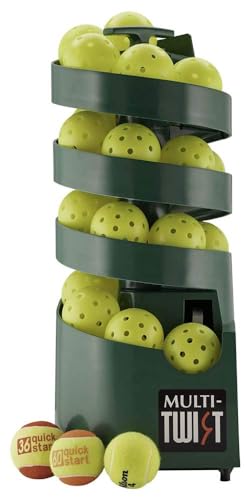
The Pickleball Twist tosses a ball every five seconds at an adjustable distance between 12 and 20 feet. There's no app, no remote, and no settings menu — you drop in batteries, flip it on, and start swinging.
$359fromAmazonSetup is close to nothing. Six D batteries and a switch. No charging cycle to plan around, no pairing, no learning curve. For a nervous first-timer or a retirement community court where several people share the machine, that simplicity is the feature. It runs eight to ten hours on a fresh set of batteries.
The five-second rhythm is easier on beginners than it sounds. A predictable interval gives you time to reset your feet and paddle between reps, which is exactly what someone still building a stroke needs. Faster or variable machines tend to overwhelm new players. Here you get a steady metronome to hit against.
It works for more than pickleball. It throws tennis balls too, and it doubles as a soft-toss batting feeder for kids using pickleballs instead of baseballs. If you've got a mixed-sport household, one machine covers a few bases. Sports Tutor builds it in the USA with US-based support behind it.
The toss range covers where beginners actually rally. Twelve to twenty feet lands you in net-play and mid-court territory, which is where most early points are decided anyway. You're not going to groove a deep baseline drive, but that's not the shot you're working on yet.
Flaws but not dealbreakers
The 28-ball capacity means constant reloading. At a ball every five seconds you're out in a couple of minutes. Expect to spend a good chunk of every session picking balls up. If flow matters to you, this isn't the machine.
You'll outgrow it, probably fast. No spin, no oscillation, and a fixed feed interval mean every session is identical. Once you've had a few lessons the ceiling arrives quickly. Plan on it as a starter feeder, not a training system.
Who this is for
This guide is for players who want high-volume repetitions and can't get them from a practice partner — solo drillers, coaches running clinics, and households where two people want court time on different schedules. If you're a 3.0 grooving a dink or a 4.5 drilling cross-court attacks, there's a machine here for you. If you've never picked up a paddle, take a couple of lessons first. A machine will happily reinforce a bad grip 300 times an hour.
We're covering battery-powered machines that feed pickleballs, including one tennis-first machine that handles both sports. We're not covering AC-only club machines, since most outdoor public courts have no outlet, and we're not covering paddles, nets, or court equipment. If you practice less than twice a month, be honest with yourself: the money is probably better spent on coaching.
How we picked
Capacity: We compared hopper sizes against real feed rates, since anything under roughly 80 balls means you spend more time collecting than hitting. Oscillation and spin: We looked for machines that move the ball unpredictably and sweep from topspin through backspin, which is the minimum for realistic rally work above beginner level. Speed: The range has to start near dink pace and reach the 45 to 65 mph band where competitive drives live. Control: Wireless remotes and phone apps keep you on the court instead of walking back between sets, and owner feedback consistently flags that walk as the main annoyance. Portability and power: Battery operation isn't optional for outdoor courts, and a folding frame with real wheels decides whether the machine gets used or stays in the garage.
Other pickleball ball machines worth considering
If you want per-shot control over every variable: The SPINSHOT PLAYER Tennis Ball Machine ($1,749) — The Spinshot Player lets you program speed, spin, height, angle, and feed rate for each individual shot in a sequence, not just for the session. Shot one can be a high lob, shot two a flat cross-court drive, shot three a soft dink — then it loops. You can build any oscillation pattern you want rather than picking from presets, and it's the only machine here whose body isn't plastic. Two catches: the battery is sold separately, so the real cost is higher than the sticker suggests, and it's marketed as a tennis machine, so pickleball calibration is your job. If you'd rather turn a knob than build a drill library, skip it.
If you play tennis and pickleball both: The LOBSTER Sports ($1,179) — The Lobster Elite Liberty is a tennis machine that handles pickleball fine once you dial the speed down. It spans 10 to 70 mph, sweeps from heavy topspin to heavy backspin, runs two to four hours on a charge with the charger included, and rolls on 8-inch all-terrain wheels. A two-year warranty backs it, which is unusually good for the category. What you give up: it's horizontal oscillation only, with no random or two-line patterns, no remote, and no pickleball-specific calibration. If you only play pickleball, you're paying for a top speed you'll never use.
The competition
This is what our research surfaced in the pickleball ball machine category, not a census of everything for sale. Machines come and go quickly here, and a few well-regarded club models are sold direct rather than through the retailers we looked at. What follows is the one remaining product from our lineup and where it fits.
The PRO-SPIN Carbon Fiber Pickleball Paddles Set of ($79.99) — The Pro-Spin carbon fiber paddle set isn't a ball machine, but it comes up often enough alongside one that it's worth a word. You get two USAPA-approved graphite paddles with a 13mm honeycomb core, indoor and outdoor balls, a cover, and a carry bag, all backed by a one-year warranty. The cushioned non-slip grip is the relevant part for machine work: a 200-shot session exposes grip fatigue in a way casual rallying never does. If two people in your house will share the machine, this is a sensible companion buy. Players coming from a soft composite face may find the carbon surface stiff.
Setup and court notes
Confirm there's no outlet at your home court before you shop, because most public parks don't have one — every machine here runs on battery for that reason. Charge fully the night before a session, and expect the low end of any rated runtime if you're drilling at high speed and heavy spin. Set the machine at the baseline or just behind it, and check the elevation before you load a full hopper. A miscalibrated angle wastes a hundred balls fast. Keep the hopper clean, since grit on the feed wheels is the most common cause of erratic tosses owners report. Store it out of direct sun and rain, and pull the batteries if you're shelving it for a season.
Questions we get
What's the best ball machine for a total beginner?
The Sports Tutor Pickleball Twist. It needs no app or remote, feeds a ball every five seconds, and runs on D batteries so you can use it anywhere. The tradeoff is a 28-ball hopper and no spin or oscillation, so you'll be picking up balls often and you'll outgrow it once your mechanics settle.
Can you use a tennis ball machine for pickleball?
Yes, with caveats. The Lobster Elite Liberty is sold as a tennis machine but works for pickleball drills once you dial the speed into pickleball ranges. Purpose-built machines are calibrated to a pickleball's size, weight, and bounce, so they simulate real shots more accurately. If you play both sports, a dual-sport machine is good value; if you only play pickleball, buy a pickleball machine.
How long does the battery last?
Most premium machines run two to four hours per charge, and the Pickle Two is rated at four to six. A typical solo session at about ten balls per minute runs 45 to 60 minutes, so one charge usually covers two to four sessions. Expect the low end of any rating if you're drilling at maximum speed and spin, since both draw more power.
Do I need a remote or an app?
Above the 3.0 level, some form of remote control is worth having. Walking back to the machine after every set kills your rhythm and eats into court time. A wireless remote like the Pickle Two's is the practical minimum; app control on the Titan ACE or Spinshot Player adds full drill sequencing on top. Beginners can start without one.
How many balls should the hopper hold?
For solo practice, aim for 100 or more. At roughly ten balls a minute, 100 balls gives you a ten-minute drill window, which is enough for a focused set without stopping. The Pickle Two's 125-ball hopper stretches that to twelve or thirteen minutes, which matters most during footwork drills where a reload break drops your heart rate.
Is a machine worth it compared to hiring a coach?
For pure repetition volume, a machine wins on cost over a year of regular use. But a machine can't tell you why your paddle face is opening or how to read an opponent's setup. The best approach is both: use the machine for reps and save coaching hours for technique correction and strategy.
Why you should trust us
For this guide:
- We read manufacturer spec sheets for every machine here and compared hopper capacity, speed range, spin control, oscillation type, weight, and battery runtime side by side.
- We reviewed published coverage of pickleball and tennis ball machines along with owner feedback themes, paying particular attention to reload frequency, transport hassle, and feed consistency complaints.
- We did not use, install, or operate any of these machines.
- We read owner reviews on every listing, weighted toward the critical ones, because that is where the recurring failures show up.
- We have a systematic way of automatically fetching the latest prices, so the numbers on this page stay current.
- This is a research-focused guide, so the team may not own every product listed — though we often do own the top winners, which gives us extra context for the recommendations.
- We don't accept free products, and the retailer commission never changes which product we recommend.
Sources
Ball Machines — Pickleball Central Product Catalog and Reviews, Pickleball Central
USA Pickleball — Player Growth Statistics and Sport Overview 2025, USA Pickleball (Official Governing Body)
Best Pickleball Ball Machines — Buyer's Guide and Rankings, Pickleheads
Pickleball Ball Machine Reviews and Head-to-Head Testing, The Pickleball Guide
Spinshot Pro vs. Lobster Elite Liberty — In-Depth Comparison, Clever Pickleball
Amazon product listings and owner reviews for all 7 products
Manufacturer specification pages for each product
Some passages in this guide may be paraphrased with AI help. Prices are refreshed automatically.
More like this.
Continue exploring health reviews and recommendations.

The Best Tennis Ball Machines
A ball machine is the only practice partner that never cancels on you. It'll feed the same wide slice to your backhand 200 times while you figure out your…

The Best Pickleball Gear for Beginners
Pickleball is easy to start and hard to shop for. You show up at a public court, borrow somebody's spare paddle, have a great time, and then discover…

The Best Pickleball Sets for Your Backyard
A pickleball set lives or dies on how fast you can get it out of the closet. If the net takes twenty minutes to assemble, you'll play twice all summer. If…

The Best Pickleball Shoes for Court Support
Pickleball looks gentle until you're three steps into a crosscourt dink rally and your foot slides out from under you. The sport is mostly short, sharp…

The Best Compact Rowing Machines
Rowing is the rare cardio machine that doesn't punish you for using it. One stroke pulls in your legs, back, core and arms at once, and your knees never…

The Best Magnetic Resistance Rowing Machines
A rowing machine only helps if you actually get on it, and the thing that most often stops people is noise. Air rowers roar. Water rowers slosh. A…