The Best Cutting Boards
Your cutting board is the surface you touch most in the kitchen, and it quietly decides how long your knives stay sharp. Every chop lands on it. A hard surface like glass or a heavily scored plastic slab dulls edges fast and hides bacteria in the grooves. A good board does the opposite: it grips the counter, absorbs the impact, and cleans up without a fight. It also has to fit your actual life — your sink, your storage, and how much patience you have for upkeep.
Here's the honest part: no board does everything. The surfaces that treat your knives best are wood, and wood means hand-washing, oiling, and never letting it soak. The boards you can throw in the dishwasher are plastic or composite, and those are harder on your edges — plastic especially, since it eventually needs replacing once the knife scoring gets deep. Bamboo splits the difference but leans hard. You're picking which compromise you can live with, not finding a board without one.
Most people are best served by matching the board to their knives and their cleanup habits, then buying one size bigger than they think they need. We think that the John Boos CCB Series maple block is the best cutting board for most people, and that the Epicurean Kitchen Series is the one to buy if you want to run your board through the dishwasher.
Everything we recommend
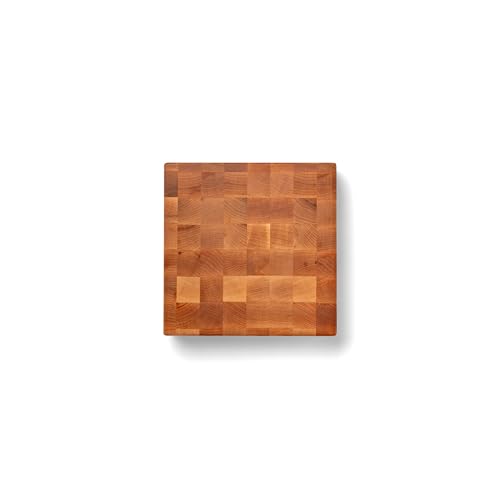
The gentlest surface for good knives, if you'll oil it

Dishwasher-safe and still decent to knives

A grippy everyday board you'll replace in a few years

A big end-grain surface with a groove that catches everything

Color-coded boards that make cross-contamination harder
At a glance
| Product | Board Size | Material | Price | |
|---|---|---|---|---|
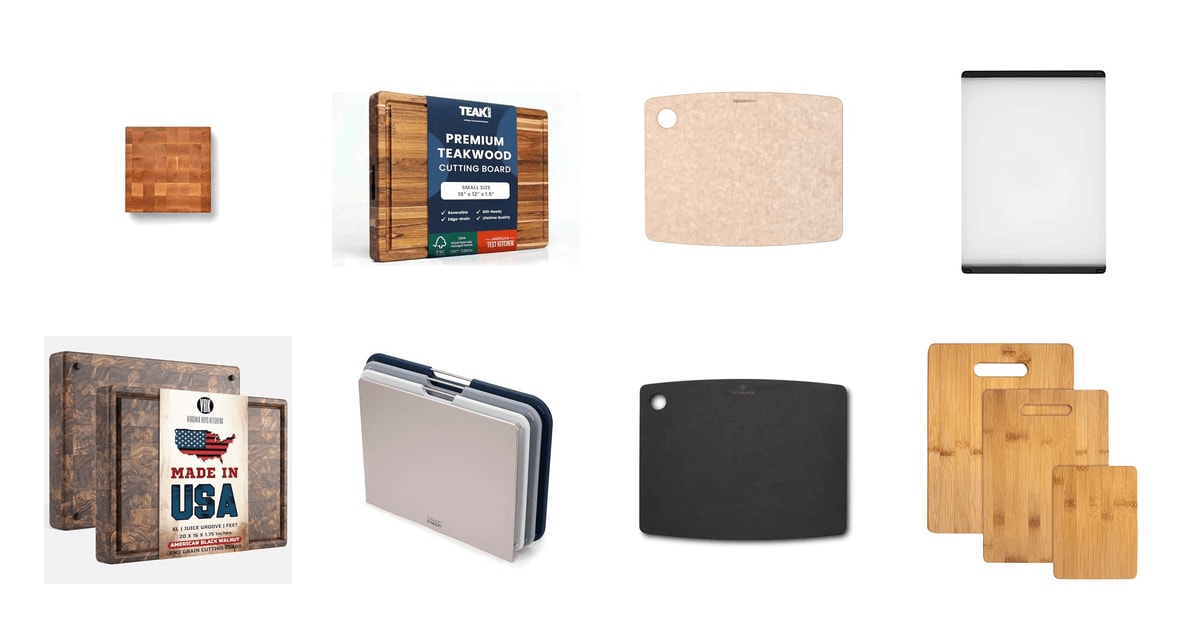
| John Boos CCB Series Square Wooden MapleTop pick | 12"L x 12"W | Maple | $211.95 |
 | Teakhaus Cutting Board - SmallAlso consider | 16x12x1.5 in | Teak | $59.99 |
| Epicurean Kitchen Series Cutting BoardRunner-up | 14.5"L x 11.3"W | Richlite | $33.99 |
| OXO Good Grips Plastic Utility Cutting BoardBudget pick | 14.8"L x 10.4"W | Plastic | $20On sale |
| Virginia Boys Kitchens - Made in USAUpgrade pick | 20"L x 16"W | Walnut Wood | $249 |
| Joseph Joseph Nest Large 3-Piece Color codedAlso great | 14" x 10.2" | — | $54.99 |
 | Victorinox Kitchen Series 7.4122.3 Cutting BoardAlso in lineup | 14.5"L x 11.2"W | Wood Fiber | $107.32 |
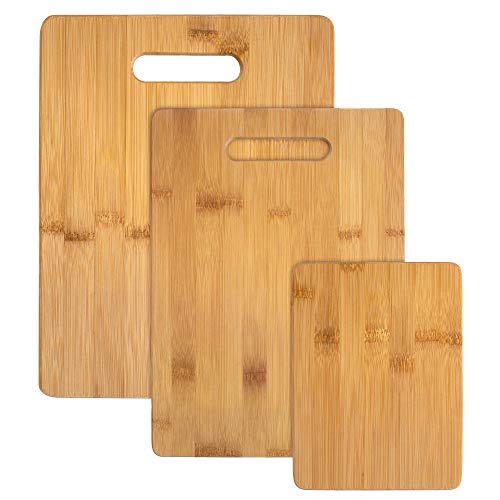 | Totally Bamboo 3-Piece Cutting Board SetAlso consider | 3 Assorted Sizes | Bamboo Wood | $19.99 |
How we picked
Knife-edge impact. We compared material hardness and grain construction across the lineup, leaning on published guidance about how end-grain, edge-grain, composite, plastic and bamboo surfaces affect blade geometry. Boards that would visibly accelerate edge wear on decent knives couldn't be top picks.
Cleanability and safety. We read spec sheets for dishwasher compatibility, non-porosity and NSF certification, and weighed them against published food-safety guidance on scored plastic. A board that can't be cleaned back to safe after heavy use had to be treated as a consumable.
Stability. We looked for non-slip feet, meaningful weight, or a grip perimeter in the listing details, since a board that slides during chopping is a genuine hazard. Owner feedback about warping and rocking counted against thin boards.
Usable size. We prioritized boards with at least 14 inches on the long edge, since anything smaller forces you to crowd ingredients. Compact boards had to earn their place another way, usually through thickness or knife care.
Upkeep honesty. We compared stated care requirements — oiling frequency, hand-wash restrictions, moisture resistance — against how people actually clean. A board that only performs when perfectly maintained gets a caveat, not a pass.
Top pick
The gentlest surface for good knives, if you'll oil it
John Boos CCB Series Square Wooden Maple
A 3-inch-thick end-grain maple block that treats knife edges better than anything else here. It's heavy, it needs regular oiling, and it's small for its weight — but it's the board most likely to outlive your kitchen.
$211.95fromAmazonEnd-grain construction is the reason this board protects your knives. The wood fibers run vertically, so the blade slips between them and the grain closes back up behind it. Think of cutting into the end of a log rather than across it. That's what keeps your edge from micro-chipping the way it does on plastic or bamboo. If you own knives you actually care about, this is the surface that repays you.
It's built like a piece of restaurant equipment, because that's what John Boos makes. The company has been turning out American butcher blocks since 1887, and the CCB carries the same 3-inch thickness and flat, quiet cutting face you'd find in a professional kitchen. There's no flex, no bounce, no hollow sound. It just sits there and takes the hit.
The reversible faces effectively double how long you can use it before resurfacing. Once one side gets visibly scored, flip it and start over. That matters more than it sounds, because a board this thick can also be sanded flat again years down the line. Most boards get thrown out; this one gets refinished.
Recessed finger grips turn a heavy block into something you can safely move. Nearly nine pounds of maple is awkward to lift off a counter with wet hands. The grooves cut into the sides give you a real hold, so carrying it to the sink or setting it out for cheese and bread isn't a two-handed gamble. It also arrives with an oil finish already applied, so you can use it the day it shows up.
Flaws but not dealbreakers
The 12-by-12-inch footprint is small, and that's the real trade-off. You get thickness instead of surface area. For dicing an onion or breaking down a pepper, it's fine. For a full meal prep session with three vegetables and a protein going at once, you'll run out of room and start pushing scraps off the edge. If that's your normal weeknight, plan on a second, larger board for the bulk work.
Neglect will crack it, and that's on you. End-grain maple needs food-grade mineral oil roughly once a month, hand-washing only, and no soaking. Skip that for a season or two and the block dries out and splits along the seams. Owners who let wood boards go tend to report exactly this. It's not difficult maintenance, but it is maintenance you have to actually remember.
There's no juice groove. Carve a chicken or slice a ripe tomato on this and the liquid runs straight onto your counter. For a board this expensive, some cooks find that surprising. Cutting on a rimmed sheet pan or keeping a towel underneath works, but it's a workaround.
John Boos doesn't state a warranty term in the listing, so treat the care guide as the operative document.
Runner-up
Dishwasher-safe and still decent to knives
Epicurean Kitchen Series Cutting Board
A thin Richlite composite board that's non-porous, NSF certified, and genuinely dishwasher safe. It's the only board here that survives a machine wash without punishing your knife edges the way plastic does.
$33.99fromAmazonThis is the board for people who won't hand-wash anything. Be honest about your habits. If a wood board means you'll leave it sitting in the sink overnight, you're better off with something you can load into the dishwasher and forget. The Epicurean handles that cycle by design, which is unusual for a surface that's also reasonably kind to blades.
Richlite is non-porous, so knife grooves don't become bacteria condos. It's a paper composite, the same stuff used for professional kitchen countertops, and it doesn't absorb moisture. That's the practical hygiene argument against heavily scored plastic: on plastic, the grooves hold onto things that washing won't reach. Here, the surface stays sealed.
The NSF certification means it clears commercial kitchen food-safety standards. That's a rare credential on a home cutting board. If you prep a lot of raw chicken, or someone in your house is immunocompromised, it's a meaningful line of defense — more concrete than a marketing claim about being antibacterial.
The thin profile makes it easy to live with. At about a quarter-inch thick and well under two pounds, you can slide it into a cabinet gap, hold it up to scrape vegetables into a pot, and carry it one-handed. There's a thumb hole for hanging. It's also heat resistant to 350°F, so it doubles as a trivet when your counter's full.
Flaws but not dealbreakers
It feels thin, and some cooks never get past that. There's no heft, no thunk. On a slick counter it can slide if you're chopping hard, so put a damp towel underneath. Compared to a maple block, it reads more like a tool than a piece of the kitchen.
The surface shows wear. Cut on it for a year and you'll see fuzzing and lightened knife tracks, especially on the natural finish. It's cosmetic rather than a safety issue, since the material stays non-porous, but it won't look new for long. There's also no juice groove at this size.
The Epicurean Kitchen Series carries a limited lifetime warranty.
Budget pickOn sale
A grippy everyday board you'll replace in a few years
OXO Good Grips Plastic Utility Cutting Board
A large, double-sided plastic board with non-slip feet and a drip catcher. It costs a fraction of the wood picks and goes in the dishwasher — just accept that deep knife scoring means it's time to buy another.
$20fromAmazonList priceThe non-slip feet are the feature that actually matters. Cheap plastic boards skate across the counter when you're rocking a knife through carrots, and that's how people cut themselves. This one stays put. It's a small thing that budget boards routinely skip, and it's the main reason we'd point you here rather than to a generic slab.
It's genuinely large for the money, at nearly 15 inches on the long edge. That's enough room to break down a couple of vegetables without ingredients tumbling off. The integrated drip catcher and pour corners keep tomato juice and chicken liquid off your counter, which the maple pick can't do.
Double-sided use makes raw-and-cooked separation easy without owning four boards. Chicken on one face, salad on the other, then the whole thing goes in the dishwasher. Tapered soft edges give you something to grab when you're carrying it, wet, to the sink.
Think of it as a workhorse second board rather than a forever purchase. Even if you own a nice wood block, having a cheap plastic board for raw meat and beet stains keeps the good surface clean. That's a genuinely good reason to own one regardless of budget.
Flaws but not dealbreakers
Plastic scores, and scored plastic can't be cleaned back to safe. The FDA Food Code acknowledges that deep knife grooves in plastic hold bacteria that ordinary household washing doesn't remove. Once the scoring is deep enough to catch a fingernail, replace the board. Most people don't, which is the real hygiene problem with plastic — not the material itself.
It's harder on knife edges than the wood or composite picks. You'll be sharpening more often. For a decent stainless chef's knife, that's a non-issue. For a thin Japanese blade, it's the wrong surface.
It flexes. A thin plastic board bends slightly under heavy pressure, and owners of thinner boards commonly mention warping over time, especially after repeated hot dishwasher cycles. A warped board rocks, and a rocking board is unsafe.
Upgrade pick
A big end-grain surface with a groove that catches everything
Virginia Boys Kitchens - Made in USA
A 20-by-16-inch American black walnut block with a juice groove and raised feet. It's the board to buy if you carve roasts, break down whole chickens, or want something that goes straight from prep to the dinner table.
$249fromAmazonThe size is the point. At 20 by 16 inches, this is the only board here that comfortably handles a whole chicken breakdown or a large roast without you playing Tetris with the pieces. If you've ever chased a rolling potato off a too-small board, you know the frustration. This gives you room to stage prepped ingredients on one side while you keep cutting on the other.
The juice groove does real work with meat. Carve a roast and the drippings pool in the channel instead of running under your knife block. Same with a watermelon or a stack of ripe tomatoes. This is the feature our top pick lacks, and it's the single best argument for spending more.
It's end grain, so it protects knives the same way the maple block does. Blades part the fibers rather than scraping across them. Walnut is a bit softer than maple, which means it's forgiving on edges — though it also means it'll show cuts a little sooner.
Raised feet keep air moving underneath. A flat wood board trapped against a wet counter dries unevenly and can cup. The feet lift it, which helps it dry flat and gives you a gap to slide your fingers under when lifting sixteen pounds of walnut. It's also handsome enough to put a cheese spread on and set down in front of guests.
Flaws but not dealbreakers
It's the most expensive board here by a wide margin, and it's heavy. Sixteen pounds is a lot to move to a sink, and it's too big for most drawers or cabinets. You need dedicated counter or shelf space, permanently. If your kitchen is small, this board will dominate it.
It demands the same monthly oiling as any hardwood. Walnut dries, cracks, and splits when neglected, and on a board this large a split is expensive. The listing information is also thin — there's little detail beyond the American-made walnut construction, so buy it for the size, the grain, and the groove rather than for a documented feature set.
Also great
Color-coded boards that make cross-contamination harder
Joseph Joseph Nest Large 3-Piece Color coded
Three color-coded plastic boards in a stand that keeps them separated and air-drying. If you've ever second-guessed which board just had raw chicken on it, this set solves that problem with a glance.
$54.99fromAmazonColor coding turns food safety into a habit instead of a decision. The FDA Food Code recommends separate surfaces for raw meat, produce, and ready-to-eat food. Most of us know that and then use one board anyway because the alternative is thinking about it mid-cook. Assign a color and the thinking disappears. That's the whole value here.
The stand is smarter than it looks. It holds the boards apart so air circulates and each one dries evenly, rather than stacking them damp in a cabinet. It also keeps three boards in the footprint of one, which matters if your storage is already full.
The textured surfaces grip food better than slick plastic. Onion halves and chicken breasts slide less while you're cutting. Stainless steel handles on each board make it easy to pull the one you want out of the stand without touching the others.
This is the pick for households with kids or shared cooking. If more than one person cooks in your kitchen, a visual system beats a verbal rule. It's also the easiest way to keep garlic and onion smells off the board you use for fruit.
Flaws but not dealbreakers
It only works if everyone follows it. One person grabbing whichever board is on top defeats the entire system. Color coding is a reminder, not a lock.
These are plastic boards, with all that implies. They'll score, and scored boards need replacing — which means eventually rebuying the set rather than a single board. They're also less gentle on knife edges than wood or the Epicurean composite.
Each board is on the small side. At roughly 14 by 10 inches, they're fine for one ingredient at a time but tight for a full prep session. The system is designed around separation, not surface area.
Who this is for
Buy now if your current board is warped, deeply scored, or made of glass. Those aren't fixable problems, and a scored plastic board is the one kitchen item where replacing it is a food-safety decision rather than an upgrade. This guide covers boards for everyday home prep across five materials: end-grain and edge-grain hardwood, teak, paper composite, plastic and bamboo. It's aimed at people who own knives they'd rather not dull and who want one board to handle most of what they cook.
Skip it if your board is in good shape and you're only shopping because a nicer one caught your eye — a sound board doesn't need replacing. We don't cover glass, marble, or ceramic boards, which wreck knife edges and don't belong on a prep counter. We also don't cover over-the-sink boards, folding silicone mats, or built-in countertop blocks. If you carve whole roasts weekly, go straight to the large walnut board and stop reading.
How we picked
We built the picks around five things. Knife care: grain direction and material hardness decide how fast your edges dull, and end-grain hardwood sits at the gentle end while bamboo and plastic sit at the harsh end. Cleanability: dishwasher compatibility, non-porous surfaces and NSF certification separate boards you can sanitize from boards you eventually have to throw out. Stability: feet, grip perimeters or real weight, because a board that slides while you chop is the most common way home cooks get hurt. Size: at least 14 inches on the long edge for real meal prep, since a cramped board pushes food onto your counter. Upkeep: how often it needs oil, whether it can go in the machine, and whether the care routine matches how you actually clean.
Other cutting boards worth considering
If you want wood without the oiling routine: The Teakhaus Cutting Board - Small ($59.99) — Teak has natural oils and silica in the grain, so it shrugs off moisture far better than maple or walnut and needs conditioning much less often. This Teakhaus board is FSC-certified teak, reversible, edge grain, and it has a juice groove — the feature our maple top pick is missing. It's also the prettiest board here and ships gift-ready, which makes it a standing answer for weddings and housewarmings. What you give up is knife care: edge grain is harder on blades than end grain, though still far gentler than plastic. And check the dimensions before you buy, because "Small" undersells it slightly at 16 by 12 inches but it's still not a carving board.
If you want three boards for the price of one: The Totally Bamboo 3-Piece Cutting Board Set ($19.99) — This Totally Bamboo set gives you small, medium and large boards, with built-in handles on the two bigger ones and a slim 3/8-inch profile that stacks flat in a drawer. For a first kitchen or an apartment, that coverage is hard to argue with — garnish work, vegetable prep and meat all get their own surface. Flat-grain Moso bamboo is also kinder to knives than plastic. The catch is that bamboo is harder than maple or walnut, so it causes more cumulative micro-chipping over years, and the thin boards don't feel planted under forceful chopping. If your knives are standard Western stainless, that hardness difference barely registers.
The competition
This is what our research surfaced across the common cutting board materials, not a survey of everything on the market. The remaining board is a reasonable product that lost to a pick for specific reasons.
The Victorinox Kitchen Series 7.4122.3 Cutting Board ($107.32) — The Victorinox Kitchen Series is a commercial-minded board from the company behind the Fibrox Pro knives, made in the USA from a wood-fiber composite that's dishwasher safe and heat resistant to 175°C. That heat tolerance is genuinely useful — you can set a hot pan on it. But it costs meaningfully more than the OXO while covering a similar 14.5-by-11.2-inch footprint, and it has no juice groove. The black finish also makes knife scoring hard to see, which matters on a board you're supposed to retire once it's deeply cut. Choose it if you want a compact, dark board that handles hot cookware and matches a modern kitchen; otherwise the OXO does the daily work for less and the Epicurean does it with better credentials.
Care and maintenance
Wood boards fail from neglect, not use. Oil yours with food-grade mineral oil monthly for the first year, then every four to six weeks — pour a thin layer over every surface including the sides and bottom, spread it, let it soak overnight, and wipe off what's left. Never use olive or vegetable oil; it goes rancid inside the wood and the smell transfers to food. Wash wood by hand with hot soapy water right after use, then stand it upright to air dry rather than laying it flat. Don't soak it, and never put it in the dishwasher. For plastic and composite boards, the dishwasher is fine, but watch the scoring: once the knife grooves are deep enough to catch a fingernail, replace the board.
Questions we get
What's the best cutting board material?
End-grain hardwood like maple or walnut is best for knife care, because the blade parts the fibers instead of cutting across them. Composite like Epicurean's Richlite is the best combination of dishwasher safety and knife friendliness. Plastic is fine when new but has to be replaced once it's deeply scored. Avoid glass, ceramic and stone entirely — they destroy edges fast.
Are wooden boards safe for raw chicken?
Yes, with normal care. Research from UC Davis found bacteria on wood surfaces, including in fresh knife grooves, died off on their own over time, while bacteria in plastic grooves survived repeated washing. Wash the board promptly with hot soapy water after raw meat contact and let it air dry standing upright. Don't let juices sit pooled on any board.
Can I put a wooden cutting board in the dishwasher?
No. The heat and prolonged water exposure warp, crack and split wood — that includes maple, walnut, teak and bamboo. Hand wash with hot soapy water, rinse, and dry it standing on edge. The only boards here that are genuinely dishwasher safe are the Epicurean composite, the OXO plastic, the Victorinox and the Joseph Joseph set.
What size board do I actually need?
Aim for at least 14 inches on the long edge for everyday prep, and closer to 18 if you regularly carve meat. Most mass-market boards are 10 by 14 inches or smaller, which works for a quick onion but gets cramped fast. The Virginia Boys walnut board at 20 by 16 inches is the large-format option here. For a one- or two-person kitchen, the Epicurean covers daily work without eating your counter.
How often should I oil a wood board?
Monthly through the first year, then every four to six weeks. Teak needs it less often than maple or walnut because its natural oil content already resists moisture. Use food-grade mineral oil on every surface, let it soak overnight, and wipe off the excess. Never use cooking oils — they turn rancid in the wood.
Is bamboo harder on knives than wood?
Yes, modestly. Bamboo ranks harder than maple or walnut on the Janka scale, so it causes more cumulative micro-chipping over years of use. For everyday stainless knives that difference is small enough to ignore. If you own thin-edged Japanese blades, go with end-grain hardwood instead. Bamboo is still far better for your edges than plastic, glass or ceramic.
Why you should trust us
For this guide:
- We read the manufacturer specifications and listing details for all eight boards, comparing material, grain construction, dimensions, weight, care requirements and certifications side by side.
- We reviewed published food-safety guidance on scored plastic surfaces and wood board sanitation, along with how established review outlets rank these materials for knife care.
- We weighed common owner feedback themes — warping, cracking from missed oiling, surface wear and boards sliding on the counter — when deciding which flaws to flag.
- We read owner reviews on every listing, weighted toward the critical ones, because that is where the recurring failures show up.
- We have a systematic way of automatically fetching the latest prices, so the numbers on this page stay current.
- This is a research-focused guide, so the team may not own every product listed — though we often do own the top winners, which gives us extra context for the recommendations.
- We don't accept free products, and the retailer commission never changes which product we recommend.
Sources
The Best Cutting Boards — Wirecutter, Wirecutter
Best Cutting Boards Tested by Good Housekeeping Institute, Good Housekeeping
The Best Cutting Boards for Home Cooks — Serious Eats, Serious Eats
Best Cutting Boards — America's Test Kitchen, America's Test Kitchen
Best Cutting Boards of 2026 — Food and Wine, Food and Wine
Amazon product listings and owner reviews for all 8 products
Manufacturer specification pages for each product
Some passages in this guide may be paraphrased with AI help. Prices are refreshed automatically.
More like this.
Continue exploring home reviews and recommendations.

The Best Wood Cutting Boards
A cutting board is the one tool you touch every single time you cook. A good wood board changes how that feels. Knives land with a soft thud instead of a…

The Best Cutting Boards
The cutting board is the surface you touch most in a kitchen, and it's usually the one you think about least. It sits under every onion, every chicken…

The Best Reusable Kitchen Swaps for Cutting Plastic Waste
Kitchen plastic doesn't leave your house in one big pile. It leaves a sandwich bag at a time, a sheet of cling film at a time, a produce bag at a time.…

The Best Manual Tile Cutters
If you're tiling a bathroom floor or a kitchen backsplash, most of your cuts are straight lines. A manual tile cutter handles those with a scoring wheel…

The Best Ironing Boards
An ironing board is one of those things you don't think about until you're fighting one. The legs skate on tile. The cover slides as you push into a…

The Best Charcuterie Boards and Serving Sets
A charcuterie board earns its keep on the nights you don't want to cook. You put out some cheese, a few slices of salami, olives, a handful of grapes, and…