The Best Wood Cutting Boards
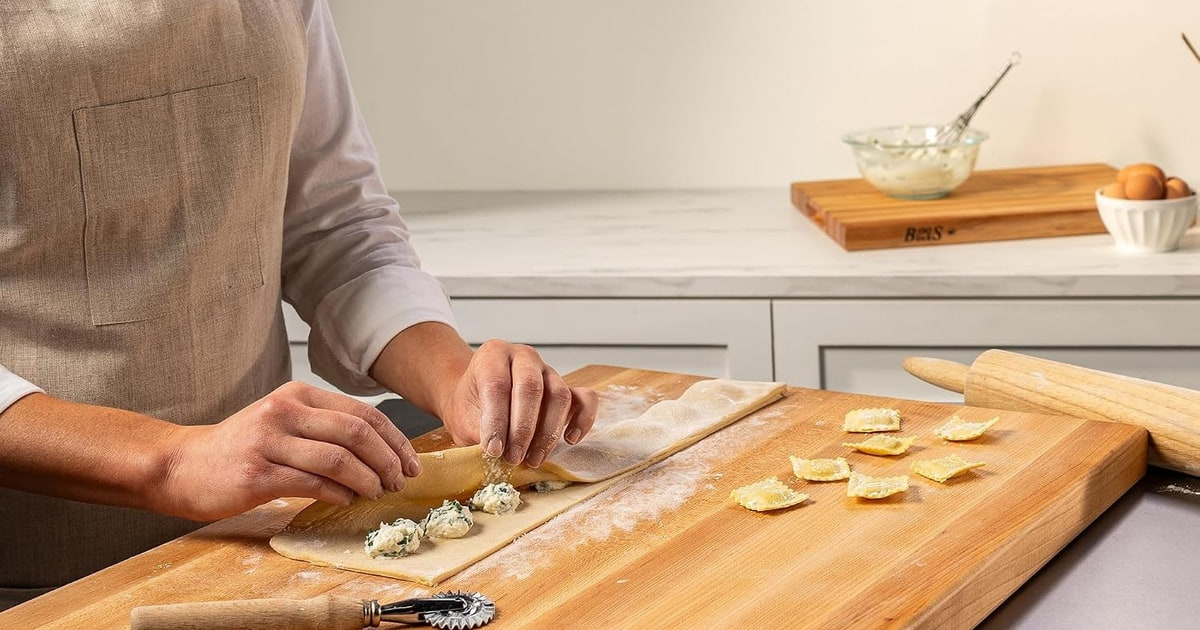
A cutting board is the one tool you touch every single time you cook. A good wood board changes how that feels. Knives land with a soft thud instead of a hard click. Onions don't skate around. A big flat surface means you can break down a chicken without pushing scraps onto the counter. Wood also holds up in a way plastic doesn't. Instead of collecting permanent knife grooves, hardwood absorbs the cut and keeps a smooth working surface for years.
But no wood board is low-effort. Every one of them is hand-wash only, and a single dishwasher cycle can warp or crack a board badly enough that makers void the warranty over it. You'll need to rub in food-grade mineral oil monthly, and more often when the board is new. They're heavy. They eat counter space. They cost more than plastic. If none of that sounds appealing, buy a plastic board and replace it often.
So the real question isn't which board is best. It's which trade-offs you want to live with: hardness against knife friendliness, end grain against edge grain, size against the weight you're willing to lift into a sink. We dug through the species data, construction differences and warping research to sort that out. We think that the John Boos R-Board is the best wood cutting board for most people, and that the Sonder Los Angeles Alfred is the one to buy if you own thin Japanese knives or carve a lot of meat.
Everything we recommend

The maple workhorse that fits almost every kitchen

End grain in a softer wood, with a real juice groove

End grain on a budget, if acacia's hardness is okay

Two inches of end-grain maple for heavy daily prep

A deep perimeter groove for roasts and juicy fruit
At a glance
| Product | Board Size | Grain Type | Price | |
|---|---|---|---|---|
| John Boos R-Board Series Rectangular Wooden MapleTop pick | 24x18 in | Edge Grain | $154.95 |
 | Teakhaus Teak Cutting Board - Rectangle EdgeAlso consider | 16x12 in | Edge Grain | $43 |
 | Virginia Boys Kitchens Walnut Wood Cutting BoardsAlso in lineup | 17x11,8x12,20x15 | — | $283.16On sale |
| Ironwood Gourmet Large End Grain Prep StationBudget pick | 20x14 in | End Grain | $78.99 |
| The Boardsmith Maple End Grain Cutting BoardUpgrade pick | 18x12 in | End Grain | $269.99 |
| All-Clad End-Grain Acacia Wood Cutting Board withAlso great | 19x14 in | End Grain | $79.70 |
| Sonder Los Angeles Alfred Cutting BoardRunner-up | 17x13 in | End Grain | $179.99 |
How we picked
Wood species and hardness. We leaned on Janka hardness figures from The Wood Database and treated 900 to 1,500 lbf as the target range. Anything softer scars too easily, and anything harder — acacia, and especially bamboo — starts costing you knife edges.
Grain construction. We looked at whether a board is end grain, edge grain or face grain, and what that means for how long it stays smooth. End grain self-heals and lasts longer, but it costs two to three times as much, so we made sure each construction type earned its spot.
Size and thickness. America's Test Kitchen's year-long comparison pointed to 12 by 18 inches as the practical minimum surface and 1.5 inches as the thickness where warping stops being a problem. We checked every board's listed dimensions against both numbers and flagged the ones that fall short.
Grooves, feet and grip. We checked specs for juice channels deep enough to hold a roast's drippings, non-slip feet, and finger grips or handles. On a board that can weigh ten pounds, being able to pick it up safely is not a small thing.
Sourcing and finish. We favored boards with FSC certification, domestically harvested hardwood or plantation-grown teak, and we ruled out anything finished with varnish or lacquer. Food-safe glue and a plain mineral-oil-and-beeswax finish are what you want on a surface you cut food on.
Top pick
The maple workhorse that fits almost every kitchen
John Boos R-Board Series Rectangular Wooden Maple
This is the reversible maple board that turns up in cooking schools and restaurant prep lines. It's big enough for a whole chicken, thick enough to stay flat, and soft enough that your knives keep their edge for months between sharpenings.
$154.95fromAmazonHard maple hits the sweet spot for knife edges. The Wood Database puts hard maple at 1,450 lbf on the Janka scale, right near the top of the 900-to-1,500 range that board makers treat as ideal. That's hard enough to shrug off years of chopping, and soft enough that your blade bites into the surface instead of skidding across it. Harder woods like acacia and bamboo look tougher, but they wear edges down faster.
An inch and a half of thickness keeps it flat. America's Test Kitchen ran boards for a full year and found that anything at least 1.5 inches thick resisted warping far better than thinner models. This one hits that mark. At 24 by 18 inches, it's well past the 12-by-18 minimum they call the practical floor for everyday prep. You get room to pile trimmings on one side while you keep working on the other.
Edge grain is the sensible choice for most cooks. End grain self-heals better, but it runs two to three times the cost of an equivalent edge-grain board because of the labor involved. Edge-grain maple this thick still lasts decades with basic care. Unless you're breaking down proteins every day, you're paying for durability you'll never use up. Put the difference toward a better knife instead.
Both faces work, and there are grips cut into the sides. You can keep one side for raw meat and the other for produce, then flip the board when a face gets scarred up. Recessed finger grips make a big slab of maple manageable when you haul it to the sink. It arrives with an oil finish, so it's ready to use the day you unbox it.
Flaws but not dealbreakers
It's heavy, and it's awkward to wash. A 24-by-18 maple board doesn't fit in most sinks, so cleaning means a soapy sponge, a rinse and a towel while the board sits on the counter. Then it has to dry standing on edge so air reaches both faces. If your counter space is tight or lifting is hard on you, size down within the R-Board line.
There's no juice groove. Both faces are flat, which is exactly what makes the board reversible, but it also means a resting steak or a spatchcocked chicken will drip onto your counter. If carving is a regular part of your cooking, you'll want a second board with a channel, or you'll end up sliding this one onto a sheet pan.
Maple is thirsty. Plan on conditioning with food-grade mineral oil five to seven times in the first month, then monthly after that. Skip a season and the board dries out, starts holding onto garlic and onion smells, and eventually checks along the grain. Teak owners get away with far less. Maple owners don't.
Runner-up
End grain in a softer wood, with a real juice groove
Sonder Los Angeles Alfred Cutting Board
The Alfred is end-grain black walnut with a deep channel around the perimeter and three shallow wells for sorting prep. Walnut is the gentlest of the common board woods on thin, hard blades, which makes this the one to buy if your knives are Japanese.
$179.99fromAmazonWalnut is the kindest hardwood to a delicate edge. The Wood Database rates black walnut at 1,010 lbf, the softest of the popular cutting board hardwoods. If you own high-carbon Japanese knives with thin, brittle edges, that softness matters. Those blades chip on hard surfaces. Walnut gives a little instead of fighting back, and it's still firmly inside the range that holds up to years of daily chopping.
End grain means your cuts close back up. As Serious Eats explains it, a knife entering end grain slips between the wood fibers rather than slicing across them, so the fibers spring back together afterward. The board keeps a smooth face long after an edge-grain board of the same wood would look chewed up. On a soft wood like walnut, that self-healing does a lot of work.
The groove and the wells earn their space. The perimeter channel holds about 3.5 fluid ounces, which is enough for a rested roast or a pile of just-cut peaches. Three built-in wells let you park diced onion and garlic without hunting for prep bowls. Removable non-slip feet keep the board planted when you're chopping hard, and you can pull them off when you want to serve on it.
It's American walnut, made in the USA. Sonder sources sustainably and builds these here, and the maker's own guidance is hand-wash only with oil every two to three weeks. That's a slightly heavier schedule than maple's monthly routine, but it's a small board and the whole job takes about five minutes.
Flaws but not dealbreakers
It's smaller than the top pick, noticeably. At 17 by 13 inches, it clears the 12-inch width threshold but comes up just short of the 18-inch length America's Test Kitchen recommends. Add the juice groove and the sorting wells, and the usable chopping area shrinks further. It's plenty for weeknight cooking. It's tight for a Thanksgiving turkey.
Walnut shows its scars. A softer wood picks up marks faster, and pale knife lines stand out against dark walnut in a way they don't on maple. The end grain closes most of them up over time, and a fresh coat of oil hides the rest. But this board won't look factory-new for long.
The groove makes it effectively one-sided. You get one working face, not two. The feet come off, which helps, but you can't flip this board to give a beat-up surface a rest the way you can with the reversible Boos.
Budget pick
End grain on a budget, if acacia's hardness is okay
Ironwood Gourmet Large End Grain Prep Station
This is the least demanding way to get genuine end-grain construction and a large working surface. Acacia isn't as friendly to knife edges as maple or walnut, but the board is big, handsome enough to serve from, and easy to keep up with.
$78.99fromAmazonYou get true end-grain construction without the usual outlay. End-grain boards normally cost two to three times what a comparable edge-grain board does, because orienting and gluing all those blocks is slow work. This one lands far below that premium. If you want the self-healing surface that Serious Eats describes and can't stomach the jump to a boutique maple block, this is the practical entry.
Twenty by fourteen inches is genuinely roomy. That clears the 12-by-18 minimum that America's Test Kitchen calls the threshold for comfortable meal prep, with margin to spare. You can butterfly a pork loin, or dice a full mise en place for a stir-fry, without shoving vegetables off the edge. It also looks good enough to leave out on the counter, which is where a board this size ends up living anyway.
Acacia asks less of you than maple does. The care routine is simple: hand-wash in warm soapy water, dry it right away, don't soak it, and oil it now and then to keep it from cracking. Skip a month and you won't pay for it the way you would with a maple block. For a first real wood board, that forgiveness counts for something.
Flaws but not dealbreakers
Acacia is harder than your knives would prefer. The Wood Database puts it around 1,700 lbf, well above maple's 1,450 and outside the 900-to-1,500 range that board makers aim for. End grain softens the blow, since the blade still enters between fibers. But over years of daily use, you'll be sharpening a bit more often than a maple owner would.
At 1.25 inches, it's just under the warp-resistant threshold. America's Test Kitchen drew the line at 1.5 inches. This board sits below it, so keeping it dry matters more here than it does with a thicker block. Dry it upright, don't leave it in a puddle, and don't store it somewhere humid.
The listing doesn't mention non-slip feet or a juice groove. Treat it as a flat prep surface. That means a damp towel underneath when you're chopping hard, and a rimmed sheet pan under it when you're carving anything that runs.
Upgrade pick
Two inches of end-grain maple for heavy daily prep
The Boardsmith Maple End Grain Cutting Board
The Boardsmith is a small-batch, end-grain maple block built two inches thick with shock-absorbing wooden feet. If you cook something serious most nights and you want one board to outlive the kitchen it sits in, this is the one worth stretching for.
$269.99fromAmazonTwo inches of end-grain maple is about as durable as boards get. Thickness is the single best predictor of whether a board stays flat, and this one has a half inch on the 1.5-inch threshold America's Test Kitchen settled on. Combine that with end-grain construction, where cuts open between the fibers and close again, and you have a surface that shrugs off decades of chopping.
Maple gives you hardness and knife friendliness in the same board. At 1,450 lbf, hard maple is durable enough to take a cleaver and soft enough to spare your edges, which is why it's the standard in professional kitchens. Walnut is gentler and acacia is tougher. Maple is the one that doesn't force you to choose, and end grain is the best way to use it.
The build details are where the money goes. The maple is sanded smooth, soaked in food-grade mineral oil, then buffed with mineral oil and natural beeswax, so it arrives conditioned rather than raw. Edges and corners are beveled, which makes a heavy block easier to grab. The joinery uses a waterproof, food-safe glue, and there's no varnish or lacquer anywhere on the cutting surface.
Wooden feet lift it off the counter. Those shock-absorbing feet do two things you'll notice. They keep the board from sliding while you work, and they let air circulate underneath so the bottom face dries instead of trapping moisture. On a board this heavy, that airflow is the difference between a block that stays flat and one that cups.
Flaws but not dealbreakers
It's the most expensive board here, by a wide margin. You're paying for small-batch artisan work, careful wood selection and hand-finished edges. That's real craft, but it's craft you're buying on faith. Plenty of cooks will be perfectly happy with the top pick and never feel like they compromised.
Twelve by eighteen inches is the floor, not a luxury. At that size, this upgrade board is actually smaller than both our top pick and our budget pick. It's exactly the practical minimum for comfortable prep, so if your bottleneck is surface area rather than longevity, spending more here won't solve your problem.
At eight to nine pounds and two inches thick, it lives on the counter. You won't be tucking this into a cabinet between uses, and hauling it to the sink is a two-handed job. Factor in the counter real estate before you commit.
Also great
A deep perimeter groove for roasts and juicy fruit
All-Clad End-Grain Acacia Wood Cutting Board with
This end-grain acacia board is built around carving. A channel runs the full perimeter to catch drippings, rubber feet hold it steady, and cutouts on the sides give you somewhere to grip. It's the board to reach for when something is going to leak.
$79.70fromAmazonThe juice groove runs the entire perimeter, and it's deep. That's the whole point of this board. A brisket off the smoker, a spatchcocked chicken straight out of the oven, a watermelon in July — all of them run, and all of that liquid stays in the channel instead of on your counter. If you carve regularly, a groove this generous stops being a nice-to-have.
Rubber feet and built-in handles make it easier to live with. The feet keep the board from wandering while you're working through a roast, which matters more when you're pulling a knife toward you. The integrated handles on the sides let you lift a ten-pound board without fumbling for an edge, and they mean you can carry it straight to the table and serve off it.
End grain softens what acacia does to your knives. Acacia is a hard wood, and edge-grain acacia is rough on blades. Orienting the fibers vertically helps: the knife slides between fibers rather than scraping across them, and the surface closes back up afterward. It's not as gentle as walnut or maple, but it's a meaningfully better surface than the acacia boards you usually see.
Flaws but not dealbreakers
Acacia still dulls knives faster than maple or walnut. Around 1,700 lbf on the Janka scale, it sits above the range board makers target. For carving cooked meat with a long slicing knife, that's fine. For daily chopping with a thin-edged chef's knife, you'd be better served by one of our maple or walnut picks.
The listing contradicts itself on thickness. The specs list the board at an inch and a half, while the description says one inch. That's a meaningful gap, since 1.5 inches is the threshold where boards start reliably resisting warp. Either way, dry it immediately and store it upright rather than flat.
It's designed in Pennsylvania and made in China. That's not a knock on the construction, but if buying American-made is part of why you want a wood board, the Boos, Boardsmith and Sonder picks are the ones that actually deliver it.
All-Clad backs this board with a limited lifetime warranty.
Who this is for
This guide is for you if you're moving up from plastic or bamboo and want a board you'll keep. It's also for gift buyers — a good hardwood block is one of the few kitchen gifts that reads as generous and still gets used daily. And it's for anyone who owns nice knives and has noticed they're going dull faster than they should. If you cook a few times a week and you're tired of a board that's more groove than surface, one of these will change your prep.
It's not for you if hand-washing is a dealbreaker. Every board here is dishwasher-forbidden, and every one needs oil on a schedule. If you want to toss a board in the machine after handling raw chicken, buy plastic and replace it when it gets chewed up. We've also stuck to boards, not blocks — no built-in butcher block tables, no over-the-sink cutting systems, no bamboo, and no plastic beyond noting where it makes more sense than wood.
How we picked
Hardness: We leaned on Janka ratings from The Wood Database and targeted 900 to 1,500 lbf, the band that's tough enough to last and soft enough to spare your knives. Construction: We compared end grain, which opens between the fibers and closes back up, against edge grain, which costs a fraction as much and still lasts decades. Size and thickness: We held every board to the 12-by-18-inch surface and 1.5-inch thickness that America's Test Kitchen's year-long comparison pointed to. Handling: We looked for deep juice grooves, non-slip feet and real grips, because a ten-pound board that slides is a hazard. Sourcing and finish: We favored FSC certification and domestic hardwood, and we skipped anything sealed with varnish or lacquer.
Other wood cutting boards worth considering
If you want the least maintenance: The Teakhaus Teak Cutting Board - Rectangle Edge ($43) — Teak is the low-effort wood. Its natural oil and rubber content makes it water- and stain-resistant on its own, so it needs far less conditioning than maple or walnut — a few drops of oil now and then keeps it looking right. This one is FSC certified from responsibly managed forests, with no coatings or finishes at all, and it has a juice canal plus a corner hole for hanging. What you give up is substantial, though. At 16 by 12 inches and half an inch thick, it's under both the size and thickness thresholds, so it's a serving-and-light-prep board rather than a workhorse. And teak's silica content, the same thing that makes it shrug off water, wears knife edges faster than maple does.
The competition
Here's what else turned up in the research. This isn't every wood board on the market — it's the group that came up often enough in reviews, spec sheets and owner discussion to be worth weighing against the picks.
The Virginia Boys Kitchens Walnut Wood Cutting Boards ($283.16) — The Virginia Boys Kitchens walnut listing is a three-board bundle — roughly 8 by 12, 17 by 11 and 20 by 15 inches — made in Virginia from American-grown sustainable walnut, with a tree planted for every unit sold. Walnut's 1,010 lbf hardness is the gentlest surface here for thin Japanese blades, and the sourcing story is genuinely good. It lost to our picks on specifics: the listing doesn't state thickness, construction or whether there's a juice groove, and thickness is the number that decides whether a board stays flat. It's also a set rather than one great board, which spreads the money across three surfaces instead of concentrating it in one. Still worth a look if you want a graduated set of walnut boards, or a sustainability angle you can feel good about gifting.
Care and maintenance
Never put a wood board in the dishwasher. One high-heat cycle can warp it or split it along the grain, and every major maker — Boos and TeakHaus included — voids the warranty over it. Wash by hand with warm soapy water, rinse, and towel it dry right away. Then stand it on edge so both faces get air; leaving it flat traps moisture underneath and cups the board. Condition a new board with food-grade USP mineral oil five to seven times over the first month, then once a month after that. For garlic smells or a stain, scrub with coarse salt and a cut lemon, rinse, dry, and re-oil. When knife grooves get deep enough that you can't clean them, the USDA says it's time to replace the board.
Questions we get
What's the best wood for a cutting board — maple, walnut, teak, or acacia?
Hard maple is the default answer, at 1,450 lbf on the Janka scale, right inside the 900-to-1,500 range that's durable without being hard on knives. Walnut, at 1,010 lbf, is the softest of the common board woods and the best pick if you own thin Japanese blades. Teak needs the least upkeep thanks to its natural oils, but its silica content wears edges. Acacia is around 1,700 lbf, which makes it tough and scratch-resistant but rougher on knives than the others.
Is end grain or edge grain better?
End grain is better, and it costs two to three times more. When you cut into end grain, the blade slips between the wood fibers instead of slicing across them, and the fibers close back up afterward, so the surface stays smooth for much longer. Edge grain is still excellent — a thick edge-grain maple board will serve you for decades. Unless you're cooking at volume every day, edge grain is the smarter buy and you can put the savings toward a knife.
Are wood boards actually safe for raw meat and poultry?
Yes, and they may be safer than the plastic they replaced. Dr. Dean Cliver's work at UC Davis found that Salmonella and Listeria rubbed into wood surfaces couldn't be recovered after a few minutes and eventually died off. The same bacteria survived and multiplied in the knife grooves of used plastic boards. Wash with hot soapy water and dry immediately, and replace any board once the cuts get too deep to clean.
Can you put a wood cutting board in the dishwasher?
No. Not once, not on a gentle cycle. The combination of prolonged water exposure and high heat causes irreversible warping and checking, which is cracking along the grain. Every major manufacturer voids the warranty for dishwasher use, so a single cycle can cost you both the board and any recourse.
What size board do I actually need?
Aim for at least 12 by 18 inches of surface. That's the threshold America's Test Kitchen landed on for comfortable everyday prep, and below it you'll spend your time pushing scraps around instead of cooking. Go bigger if you break down whole chickens or carve roasts. Just remember that a bigger board is a heavier board, and it probably won't fit in your sink.
How thick should a board be to avoid warping?
At least 1.5 inches. In a year-long comparison, America's Test Kitchen found boards at that thickness resisted warping far better than thinner ones. Thinner boards can still work if you're disciplined about drying them upright and never letting them sit in water. But thickness buys you forgiveness, which is worth having in a real kitchen.
Why you should trust us
For this guide:
- We read published reviews and testing writeups from America's Test Kitchen and Serious Eats on board thickness, warping and end-grain construction, and we pulled Janka hardness figures for every wood here from The Wood Database.
- We compared each manufacturer's listed specs, care instructions and warranty terms side by side, including the dishwasher exclusions that Boos and TeakHaus both publish.
- We reviewed owner feedback themes around warping, cracking, odor retention and knife dulling, and those patterns shaped the flaws and caveats in this guide.
- We read owner reviews on every listing, weighted toward the critical ones, because that is where the recurring failures show up.
- We have a systematic way of automatically fetching the latest prices, so the numbers on this page stay current.
- This is a research-focused guide, so the team may not own every product listed — though we often do own the top winners, which gives us extra context for the recommendations.
- We don't accept free products, and the retailer commission never changes which product we recommend.
Sources
The Best Cutting Boards — Wirecutter (NY Times), Wirecutter
The Best Cutting Boards for Every Kitchen — Serious Eats, Serious Eats
Best Cutting Boards Tested by the GHI — Good Housekeeping, Good Housekeeping Institute
Cutting Board Reviews & Ratings — Consumer Reports, Consumer Reports
Best Cutting Boards Equipment Review — America's Test Kitchen, America's Test Kitchen
Wood Cutting Board Safety Research — UC Davis Food Safety Laboratory, UC Davis / Journal of Food Protection
Cutting Boards and Food Safety — USDA Food Safety and Inspection Service, USDA FSIS
Janka Hardness Ratings by Wood Species — The Wood Database, The Wood Database
How to Care for a Wooden Cutting Board — Food52, Food52
John Boos & Co. — History and Manufacturing, John Boos & Co.
Why Teak? — TeakHaus by Proteak, TeakHaus
Amazon product listings and owner reviews for all 7 products
Manufacturer specification pages for each product
Some passages in this guide may be paraphrased with AI help. Prices are refreshed automatically.
More like this.
Continue exploring home reviews and recommendations.

The Best Cutting Boards
Your cutting board is the surface you touch most in the kitchen, and it quietly decides how long your knives stay sharp. Every chop lands on it. A hard…

The Best Cutting Boards
The cutting board is the surface you touch most in a kitchen, and it's usually the one you think about least. It sits under every onion, every chicken…

The Best Wood Routers
A router is the tool that makes furniture look finished. It cuts the round-over on a tabletop edge, the dado that carries a shelf, the groove for a drawer…

The Best Wood Chippers and Shredders
A wood chipper earns its keep on one specific afternoon: the one where you'd otherwise be dragging a brush pile to the curb or paying someone to haul it.…

The Best Reusable Kitchen Swaps for Cutting Plastic Waste
Kitchen plastic doesn't leave your house in one big pile. It leaves a sandwich bag at a time, a sheet of cling film at a time, a produce bag at a time.…

The Best Manual Tile Cutters
If you're tiling a bathroom floor or a kitchen backsplash, most of your cuts are straight lines. A manual tile cutter handles those with a scoring wheel…