The Best Wet Tile Saws
Cutting tile is the part of a tile job that decides how the finished wall looks. Every outlet, every doorway, every corner needs a cut piece, and a chipped edge shows up forever once the grout is in. A wet saw runs a diamond blade through a stream of water, which cools the blade, holds down the dust and leaves a cleaner edge than any dry method. It also matters for your lungs. Cutting porcelain dry throws off respirable silica, and wet cutting knocks most of that out of the air.
Here's the honest part: no wet tile saw is pleasant to use indoors. They all splash. They all leave a gray slurry that you'll be chasing across the floor with a shop vac. Cheaper saws share a second problem — the fence drifts, so a setting that was square in the morning isn't square by afternoon, and you find out only after you've cut a tile short. And the biggest, most capable saws are heavy enough that moving one up a flight of stairs by yourself is genuinely a two-person job you're doing alone.
So the right saw depends on your tile, not your ambition. Standard ceramic in one bathroom needs far less machine than 24-inch porcelain across a whole floor. We think that the DEWALT D24000S is the best wet tile saw for most people, and that the QEP 22700Q 700XT is the one to buy if you're doing a single room in ordinary ceramic and don't want to spend more than the tile costs.
Everything we recommend
Cuts anything a house needs, if you have room for it

Enough saw for one room, and it cuts more than ceramic

The only one here that swallows a 24x48 slab whole

A small, simple saw that novices actually finish jobs with
At a glance
| Product | Price | |
|---|---|---|
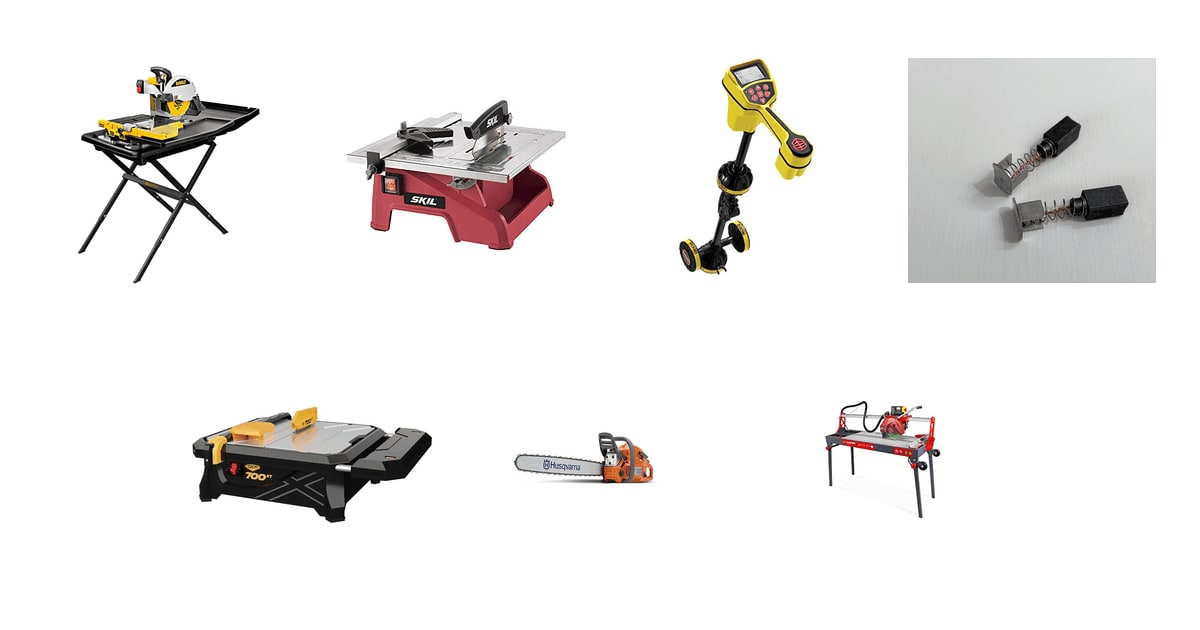
| DEWALT Wet Tile Saw with StandTop pick | $999 |
| SKIL 7-Inch Wet Tile SawAlso great | $129.40 |
 | RIDGID 21893 SeekTech SR-20 Utility Pipeline LocatorAlso in lineup | $3,101.26 |
 | For MK Diamond Tile Saw Carbon MotorAlso in lineup | $28.50 |
| QEP 22700Q 700XT 3/4 HP Wet TileBudget pick | $82.97 |
 | Husqvarna 460 Rancher Gas Powered ChainsawAlso in lineup | $549On sale |
| Rubi Tools DC-250 PYTHON 1200 120V 60HZUpgrade pick | $2,694.03 |
How we picked
Cut capacity. We compared each saw's stated rip, diagonal and depth capacities against the tile sizes people actually buy — 12x12 through 24x48. A saw had to complete a diagonal on your tile in one pass to be a serious pick for that format.
Motor and material range. Manufacturer specs tell you which materials a saw is rated for, and owner feedback tells you where it bogs down. We treated 3/4 horsepower as the floor for ceramic and light porcelain, and looked for more on anything dense.
Fence and repeatability. Published reviews and owner feedback both flag drifting fences as the defining budget-saw failure. We weighted stated accuracy figures and, more heavily, whether owners report having to re-square the fence mid-job.
Water control. Enclosed pump systems with trays and blade guards spray less than open reservoirs, which matters when you're cutting inside a finished house. Owner complaints about mess were a reliable tiebreaker.
What's in the box. A stand, a usable blade and a miter gauge included means you aren't shopping again before your first cut. We noted where owners replaced the included blade anyway.
Top pick
Cuts anything a house needs, if you have room for it
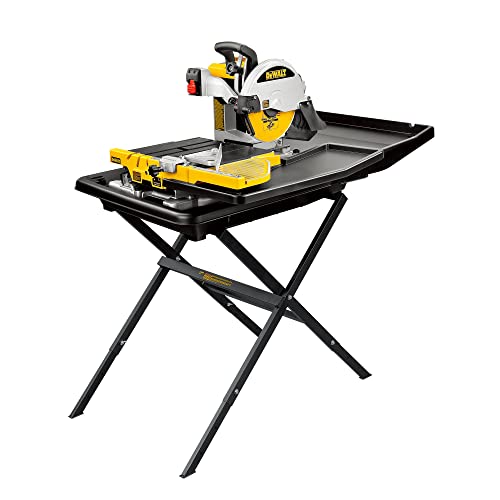
DEWALT Wet Tile Saw with Stand
The D24000S is a full-size 10-inch saw with a sliding cart, a 1.5-horsepower motor and a stand in the box. It handles large-format porcelain and single-pass diagonals that smaller saws simply can't reach, and it arrives ready to cut.
$999fromAmazonThe 10-inch blade is the whole argument. A 7-inch saw tops out around 12 inches of tile before you have to flip the piece and line up a second pass. The D24000S gives you an 18-by-18-inch diagonal in one stroke and up to 28 inches of rip with the plunge. If your floor is 12x24 porcelain — which is most floors now — that difference isn't a luxury. It's the gap between a clean cut and a visible seam.
The sliding cart matters as much as the motor. You set the tile on a rolling table and push the tile into the blade, instead of dragging it across a fixed surface. Owners doing 6x24 planks describe it as noticeably smoother and quieter than the small grinder-motor saws they'd used before. DEWALT rates the cutline accuracy at 1/32 inch over an 18-inch cut, and the stainless rollers are what make that number believable.
Everything you need shows up in one box: the folding stand, an XP4 porcelain blade, the submersible pump, a water pan, side and rear trays, a cart extension, the angle guide and the wrenches. On cheaper saws you're often buying a decent blade separately before the first cut. Here you aren't — though several owners still swapped the included blade after it chipped budget porcelain, so treat it as a starting blade rather than a final one.
It's built for a project, not a task. The 1.5-horsepower motor holds its speed through dense porcelain instead of bogging at the exit edge, which is where chips happen. Owners who bought it specifically to avoid daily rental fees on a long DIY bathroom report it held up across the whole job. If you're tiling more than one room, or expect to tile again in a few years, that endurance is the thing you're actually paying for.
Flaws but not dealbreakers
It's 69 pounds and 36 inches long. Owners who love the saw still call out the weight — carrying it upstairs alone is awkward and genuinely unsafe on a turn. Budget for a helper, or plan to cut in the garage and walk tiles up.
This is far more saw than a small backsplash needs. If you're cutting 4x4 or 6x6 ceramic in one room, the extra capacity does nothing for you and the storage footprint is real. It also needs a dedicated spot to live; you can't tuck it on a shelf.
DEWALT does not state a warranty term in the listing information we have, so check the packaging before you buy.
Budget pick
Enough saw for one room, and it cuts more than ceramic
QEP 22700Q 700XT 3/4 HP Wet Tile
The QEP 700XT is a compact 7-inch saw with a 3/4-horsepower motor, a continuous-rim blade and a table extension. It cuts ceramic, marble, travertine and lighter porcelain, which makes it a safer default than the bare-bones ceramic-only saws it sits alongside.
$82.97fromAmazonIts material range is what earns it the spot. Plenty of entry-level saws are rated for ceramic and little else. The 700XT's 550-watt motor is specified for marble, stone, travertine and porcelain up to 1-1/4 inches thick. If you haven't picked your tile yet, or you're not sure how dense the porcelain you ordered actually is, that flexibility keeps you from buying the wrong tool.
The blade guard is a small thing that you'll appreciate at nine at night in a finished bathroom. It cuts down the spray coming off the blade, which is the difference between wiping the wall and repainting it. The 8-inch table extension mounts on either side and holds up the far end of a tile through the cut, so the piece doesn't drop and chip as it clears the blade.
It's light — under 20 pounds — and about the size of a large toolbox. You can carry it in one hand, set it on a bench or the floor right where you're working, and put it away when you're done. Professional installers doing backsplashes describe keeping a saw like this next to the work precisely to avoid hauling a big one around.
Flaws but not dealbreakers
Quality control is the real concern here. Owner feedback includes saws that quit partway through the first tile or smoked on startup, and at least one buyer had trouble getting a response from the company afterward. Test it thoroughly the day it arrives rather than the morning you plan to tile.
Squaring the fence takes patience, and some owners never got it perfectly true — they ended up eyeballing cuts, which slows everything down. The pull-out extension can also flex enough that you'll want to shim under the tile.
The 3/4-horsepower motor strains on very dense or thick porcelain, and this isn't a saw for cutting all day at pace. It's built for one room, not a whole house.
Upgrade pick
The only one here that swallows a 24x48 slab whole
Rubi Tools DC-250 PYTHON 1200 120V 60HZ
The Rubi DC-250 PYTHON 1200 is a bridge-style saw with a sliding motor on bearings and a cut length of nearly 48 inches. It's the pick when your tile is oversized porcelain slab and every other saw in this guide runs out of table.
$2,694.03fromAmazonLarge-format tile breaks the rules other saws are built around. A 24x48 porcelain slab won't fit on a 10-inch saw's cart, and cutting it in stages invites a visible step in the line. The PYTHON's 47-7/16-inch capacity and 40-by-20-inch working area let the piece lie flat and fully supported while the motor travels over it. That support is what prevents the mid-pass deflection that chips long cuts.
The sliding motor rides on bearings rather than dragging on a rail, and that's the design choice you're paying for. It keeps blade angle and pressure steady from one end of a long pass to the other. The adjustable square goes to 60 degrees, so angular cuts on oversized pieces stay repeatable instead of becoming freehand guesses. Miter cuts on slab-size tile are possible here and nowhere else in this lineup.
Rubi's patented ZERO DUST system, certified by TNO, cuts the breathable dust generated during cutting. That's worth taking seriously with porcelain, where the fine particles are the hazard rather than the visible mess. The 1,200-watt motor is rated for intensive tile and glazed stoneware work, with occasional natural stone.
Owner feedback splits sharply. Several buyers describe it arriving square and cutting well with only minor adjustment out of the box. But at least one experienced buyer found the build quality disappointing for the money — an unusual complaint for a European-made tool, and worth weighing given how few people have reported back on this one.
Flaws but not dealbreakers
It's enormous — over five feet tall and more than five feet long — and it isn't going in a car. This is a tool that lives in a shop or a dedicated garage bay, and freight shipping is part of the deal.
For anything under 18x18 inches, it's pointless. The D24000S handles that work in a fraction of the space. And if you're doing one large-format bathroom, renting a comparable pro saw for a few days is almost certainly the smarter move than owning this.
Also great
A small, simple saw that novices actually finish jobs with
SKIL 7-Inch Wet Tile Saw
The SKIL 3540-02 is a stripped-down 7-inch saw with a stainless top, an adjustable rip fence and a miter gauge. It's for ceramic tile up to 12x12 inches in one room, and within those limits it's a proven, forgiving first saw.
$129.40fromAmazonThe reason to consider this one is the track record. Thousands of owners have used it, and the pattern in their feedback is consistent: first-timers tiling a backsplash or a tub surround finish the job and are happy. One professional tile setter keeps it around specifically for showers and repairs so they don't have to haul a 10-inch overhead saw to a small job. That's a meaningful endorsement of a cheap tool.
The stainless top is the part that survives. Water and a steel table are a bad combination on budget saws, and rust on the surface makes tiles catch and skew. SKIL's top is corrosion-resistant, which is why these saws keep working years after purchase rather than seizing up in a damp garage. The bevel adjusts from 0 to 45 degrees, and the miter gauge handles diagonals within the saw's small capacity.
It weighs 18 pounds. That sounds trivial until you're moving a saw from the garage to a second-floor bathroom several times in a weekend. Owners cutting travertine floor tile report it handled that material fine, so the practical range is a bit wider than the ceramic-only reputation suggests.
Flaws but not dealbreakers
The fence is the weak point, and owners say so plainly — it's fiddly to set square and needs rechecking as you go. The cross-cut capacity is 7.75 inches and the diagonal is 7.25, so the real working limit is well under the 12x12 tile the table supports. Anything larger means cutting freehand, which is exactly when the fence problems bite.
It's messy. Water gets away from an open reservoir design, so tarp generously and expect to wipe down after. And the motor isn't up to dense porcelain — it'll bog and chip rather than cut clean, so step up if that's your tile.
Who this is for
This guide is for homeowners and weekend DIYers cutting tile for their own projects — a backsplash, a bathroom floor, a shower surround, maybe a whole first floor. If that's you, the question isn't which saw is best in the abstract. It's whether your tile is bigger than a 7-inch saw can handle in one pass, and whether you'll use the saw again. Both answers point you at a specific machine.
If you're doing exactly one small room and never plan to tile again, think hard before buying anything. Renting a professional saw for a few days often costs less than a budget saw and gives you a better tool. We've stuck to corded electric wet saws sized for home use here; we don't cover manual score-and-snap cutters, angle grinders, or the truck-mounted saws contractors run all week.
How we picked
We built the picks around five things. Cut capacity: the saw has to finish a diagonal on your tile in one pass, so we matched stated rip and diagonal figures to real tile formats from 12x12 up to 24x48. Motor and material range: 3/4 horsepower is the floor for ceramic and light porcelain, and we looked for more wherever the tile gets dense or thick. Fence accuracy: a fence that drifts costs you tile, so we leaned on owner feedback about re-squaring mid-project. Water control: enclosed trays, pumps and blade guards keep the mess down when you're cutting inside a finished house. What's included: a stand, a decent blade and guides in the box save you a second shopping trip before you can start.
The competition
This is what our research turned up in this lineup, not a survey of every wet tile saw sold. A few listings here matched a tile-saw search without being tile saws at all, and we've set those aside separately below.
Care and maintenance
Change the water when it turns murky — roughly every hour or two of cutting, or every 30 to 50 cuts. The slurry that builds up is abrasive, and it grinds down both your blade and your pump if you leave it in there. If your saw has an enclosed pump, rinse the filter each time you dump the water, or flow drops off and the blade runs hot. Never pour slurry into a storm drain; a utility sink or a hole in the yard is the right answer, and in a lot of places it's the legal one too. Between sessions, dry the table and the fence rails so nothing seizes. And feed tile slowly on the last inch of every cut — most chipping happens right at the exit edge, when the tile drops away unsupported.
Questions we get
Do I need a 10-inch saw or is 7 inches enough?
For 12x12 or 12x24 tile, a 7-inch saw handles the straight and miter cuts you'll need. Once your tile is 18x18 or bigger, or you want 45-degree diagonals in one pass, you need the 10-inch blade. A 7-inch saw can still get there, but you're flipping the tile and lining up a second cut, which costs time and invites a misaligned angle.
Can a wet saw cut porcelain, or do I need a special blade?
It can, but the blade matters more than the saw. Use a continuous-rim diamond blade rated for porcelain rather than a segmented blade meant for stone. Underpowered motors bog down in dense porcelain and let the blade deflect, which chips the edge — 3/4 horsepower is the practical minimum, and 1.5 is better for thick material.
Should I rent instead of buying?
If your project is one room and under about five days of cutting, renting is usually the better deal. You get a pro-grade saw for less than a budget saw costs to own. Buying makes sense when you're tiling multiple rooms, or when you expect to come back to tile work in the next couple of years.
How do I keep water off my floors when cutting indoors?
Pick a saw with an enclosed tray and pump rather than an open reservoir — it throws far less spray. Tarp at least four feet in every direction, aim the blade discharge away from finished walls, and put the saw on something stable so vibration doesn't slosh the tray. Vacuum up slurry with a wet-dry vac before it dries into your grout lines.
Can a tile saw cut curves or L-shaped notches?
Not directly — a wet saw makes straight cuts. For an L-shaped notch around a door jamb, make two intersecting straight cuts from opposite edges and snap the corner out. For curves around a pipe or a toilet flange, use an angle grinder with a diamond cup wheel or a rotary tool with a diamond bit.
How do I stop porcelain from chipping at the edge?
Four things. Use a continuous-rim porcelain blade, get water flowing before the blade touches tile, feed slowly and steadily without forcing it, and support the trailing edge all the way through so the tile doesn't drop as it clears. Most chips happen in the last half-inch of the cut.
Why you should trust us
For this guide:
- We compared manufacturer specifications for every saw in this lineup — blade size, rip and diagonal capacity, motor rating and stated accuracy figures — against the tile formats homeowners commonly install.
- We read published reviews from tool and home-improvement outlets alongside owner feedback, looking for the failure modes that show up repeatedly rather than the one-off complaints.
- We weighted recurring owner themes — fence squaring, water mess, weight, and early motor failures — more heavily than any single specification.
- We read owner reviews on every listing, weighted toward the critical ones, because that is where the recurring failures show up.
- We have a systematic way of automatically fetching the latest prices, so the numbers on this page stay current.
- This is a research-focused guide, so the team may not own every product listed — though we often do own the top winners, which gives us extra context for the recommendations.
- We don't accept free products, and the retailer commission never changes which product we recommend.
Sources
Best Tile Saws — Family Handyman, Family Handyman
Best Wet Tile Saws — Bob Vila, Bob Vila
Best Tile Saws — Popular Mechanics, Popular Mechanics
Best Tile Saws — This Old House, This Old House
Best Wet Tile Saws — Pro Tool Reviews, Pro Tool Reviews
OSHA Respirable Crystalline Silica Standard for Construction, OSHA
NIOSH Silica Dust Exposure and Control in Construction, CDC / NIOSH
Diamond Blade Selection Guide for Tile and Stone, Diamond Blade Warehouse
Amazon product listings and owner reviews for all 7 products
Manufacturer specification pages for each product
Some passages in this guide may be paraphrased with AI help. Prices are refreshed automatically.
More like this.
Continue exploring home reviews and recommendations.

The Best Wet/Dry Shop Vacuums
A shop vacuum is the tool you drag out when a regular vacuum would die trying. Broken tile, wet sawdust, a burst supply line under the sink, the gravel…

The Best Manual Tile Cutters
If you're tiling a bathroom floor or a kitchen backsplash, most of your cuts are straight lines. A manual tile cutter handles those with a scoring wheel…

The Best Miter Saws for Woodworking and Home Shops
A miter saw is the tool that decides whether your trim looks sharp or looks like it was cut with a butter knife. It crosscuts boards to length and slices…

The Best Steam Mops for Hardwood and Tile Floors
Mopping with a bucket mostly moves dirty water around. A steam mop skips that entirely: you fill the tank with plain water, wait half a minute, and push a…

The Best Pole Saws
Pruning overhead branches used to mean a ladder, a chainsaw, and a bad idea. A pole saw fixes that. You keep both feet on the ground, extend the shaft,…

The Best Log Splitters for Home Firewood
Splitting firewood by hand is fine for the first ten rounds. After that your shoulders start voting against it. A powered splitter turns a Saturday of…