The Best Bearded Dragon Terrariums
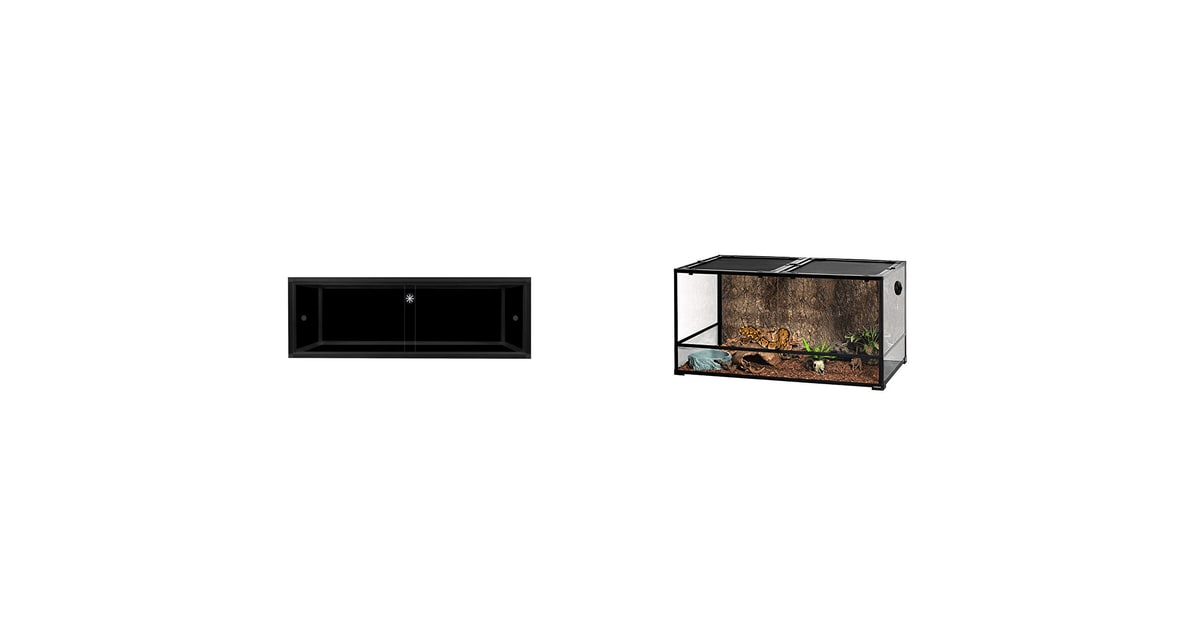
A bearded dragon spends its whole life in one box, so the box matters more than almost anything else you'll buy. It has to hold a real temperature gradient — a basking surface around 100 to 115°F at one end, low 80s at the other — because that's how a dragon digests food and fights off illness. It needs room to walk, not just room to turn around. And you'll be reaching into it several times a day, so the way the doors open shapes how calm your animal stays.
Here's the part the product pages skip: the enclosure is maybe half your setup. None of these arrive with the T5 HO UVB tube, basking fixture, thermostat and thermometers you actually need. Worse, the screen top that makes UVB possible is the same thing letting your heat escape. Research compiled by Frances Baines at UV Guide UK found standard wire mesh can block 30 to 50% of UVB, so bulb height ends up mattering as much as bulb wattage. Every option here is a starting point.
Size is where most people go wrong, and it's an expensive mistake. Josh's Frogs' care team reports stress behaviors like glass surfing and defensive head-bobbing in most juveniles kept under 40 gallons, and Reptile Advisor's buyer analysis finds keepers who start small usually upgrade within six to twelve months anyway. Buy the adult enclosure first. We think that the Zen Habitats 4'x2'x16 Reptile Enclosure is the best bearded dragon terrarium for most people, and that the REPTIZOO Large Reptile Terrarium 120 Gallon is the one to buy if you want a full glass view and more headroom.
Everything we recommend

Better heat retention and calmer, front-door access

Full glass and real headroom, if your room stays warm
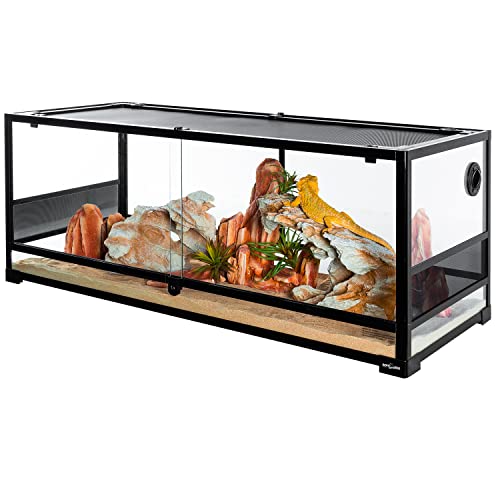
The full four-foot length in a lower, narrower box
At a glance
| Product | Dimensions | Material | Price | |
|---|---|---|---|---|
| Zen Habitats 4'x2'x16 Reptile Enclosure - TheTop pick | 4'x2'x16" | PVC | $349 |
| REPTIZOO Large 120 Gallon Reptile TerrariumRunner-up | 48"x24"x24" | Tempered Glass | $409.99 |
| REPTI ZOO Reptile Tempered Glass Extra-Long TerrariumBudget pick | 48"x18"x18" | Tempered Glass | $262.99 |
How we picked
Size and footprint. We treated a 4x2x2-foot floor plan — the 120-gallon equivalent — as the adult target, following ReptiFiles and general veterinary care guidance. Anything smaller had to justify itself as a growth enclosure, not a permanent one.
Heat retention. We compared panel materials against published heat-retention work, including a Reptile Apartment comparison showing PVC enclosures drawing about 22% less heating wattage than equivalent glass tanks in a 68°F room. Cheaper to buy often means costlier to run.
UVB and ventilation. Frances Baines' research at UV Guide UK shows wire mesh can block 30 to 50% of UVB, so we favored wide-woven or removable screens and noted where bulb distance needs adjusting. Ventilation had to work without gutting the basking temperature.
Door design. Front-opening access won over top-opening. Work published in the Herpetological Journal ties overhead approach to stronger predator-evasion stress responses in diurnal lizards, and every enclosure here opens from the front.
Cleaning and build. We looked for waterproof or raised bases, sealed seams and cable pass-throughs, then read owner feedback for recurring assembly and shipping-damage themes. A tank that arrives cracked or takes three people to build is a real cost.
Top pick
Better heat retention and calmer, front-door access
Zen Habitats 4'x2'x16 Reptile Enclosure - The
A four-by-two-foot PVC enclosure with sliding front doors and panels that hold heat far better than glass. It gives an adult dragon the floor space care guides ask for, keeps your basking bulb from fighting a cold room, and goes together in a few minutes.
$349fromAmazonFloor space is the one spec you can't fudge, and this one has it. The 3.0 gives you a full four-by-two-foot footprint — the 120-gallon equivalent that care guides like ReptiFiles treat as the adult minimum. Your dragon can take real steps, turn around without brushing both walls, and put actual distance between the hot end and the cool end. That last part is what makes a 35-degree gradient possible instead of theoretical.
Heat is the quiet cost of keeping a desert lizard in a house you keep at 68 degrees. PVC handles that better than glass. Zen Habitats rates its finished panels at up to ten times the heat retention of glass, and a Reptile Apartment comparison found PVC enclosures pulled about 22% less heating wattage than glass tanks of the same volume. Your bulbs cycle less and your basking spot holds steadier.
The doors change how your dragon reacts to you. Diurnal lizards read anything coming from above as a bird, and work published in the Herpetological Journal ties overhead access to sharper stress responses than front access. With sliding acrylic doors, your hand arrives from the side instead. Skittish rescues and young dragons tend to settle faster this way, and daily feeding stops feeling like a small ambush.
The finish work is where your money goes. Panels are sealed PVC, so a tipped water dish doesn't creep into a seam and swell it. The interior surfaces are non-reflective, which sounds like marketing until you watch a dragon glass-surf at its own reflection for an hour. Zen rates the panels for sustained interior temperatures up to 120°F, comfortably above a 115°F basking surface, so nothing warps or off-gasses under the lamp.
Flaws but not dealbreakers
The ceiling is 16 inches, and that's the real trade-off. You get the full four-by-two floor, but not much height for a hammock, a tall branch, or a deep substrate layer plus climbing room above it. It also puts your UVB fixture close to the animal, so check your bulb's own distance chart rather than assuming the usual 12-to-18-inch mounting advice applies here.
PVC costs you the view. You're looking through two acrylic front doors instead of glass on every side, and acrylic scratches — from substrate grit, from a scrub brush, from claws. Owner feedback on this version is also thin so far, so there's less long-term durability evidence than you'd get from a glass tank that's been around for years.
Runner-up
Full glass and real headroom, if your room stays warm
REPTIZOO Large 120 Gallon Reptile Terrarium
A 48-by-24-by-24-inch tempered glass terrarium with all-glass sides, front sliding doors and a fully removable screen top. It hits the 120-gallon adult target with more vertical room than most, and the wide-woven screen lets more UVB through than a fine mesh would.
$409.99fromAmazonGlass earns its place when you actually want to watch the animal. The side panels here are glass rather than mesh, so the enclosure reads as a window instead of a cage, and owners keeping dragons and snakes keep coming back to the clarity and the smooth sliding doors. If this thing is living in your living room, that matters more than any spec on the box.
The extra six inches of height buy you more than decorating room. At 24 inches tall you can mount a T5 HO tube above the screen and still land in the distance range ReptiFiles recommends for a basking-surface UVI around 4 to 6. You also get room to stack a basking platform, which is how you build a proper hot spot without parking the bulb right on top of your dragon.
The trade-off is heat. Glass sheds it, a full screen top sheds more, and in a room that sits in the 60s you'll run your basking bulb harder than a PVC owner would. The screen is also the thing making your UVB work — Baines' research puts mesh losses at 30 to 50% — so you can't simply cover it up. Plan on a ceramic heat emitter or a warmer room.
Assembly is the recurring complaint. Owners describe a two-person job that runs long, with threaded rods that don't always line up on the first attempt, and a few report transit damage despite heavy packaging. The raised waterproof base is worth the trouble, though. It gives you clearance for an under-tank heater and keeps spills off your furniture.
Flaws but not dealbreakers
It's heavy, and once it's built you're not moving it by yourself. Glass at this size is a two-person lift, and it claims a full four feet of wall whether your room can spare it or not.
Running costs go the other way from the sticker. In a cool room you'll feed more wattage into this enclosure than into PVC of the same volume — roughly a fifth more, by Reptile Apartment's comparison — every day, for years.
Budget pick
The full four-foot length in a lower, narrower box
REPTI ZOO Reptile Tempered Glass Extra-Long Terrarium
This tempered glass terrarium keeps the four-foot length a dragon needs but trims depth and height to 18 inches each. It's the smallest step down from a true 4x2x2 that still gives a growing dragon a long thermal gradient, and it assembles in about 20 minutes.
$262.99fromAmazonLength is the dimension that builds a gradient, and all four feet of it survive here. Depth and height drop to 18 inches, but your hot end and cool end stay as far apart as they'd be in a full-size enclosure. For a dragon under about 14 inches, that's a genuinely workable home, and it's a real upgrade on the 40-gallon breeder tanks most first-timers start with.
Assembly is the pleasant surprise. Owners describe flat packaging, clear instructions, and a build measured in minutes rather than an afternoon — several managed it alone despite the two-person recommendation. They also tend to describe the tempered glass as tougher than expected during setup, which is reassuring for a panel you'll be sliding a heat lamp over.
Small side vents plus the screen top give you more control over airflow than an all-screen design does. Six cable inlets on the top and side mean your lamp, UVB fixture and thermostat probe cords go somewhere sensible instead of pinching in a door track. The front sliding doors lock too, which matters if there are curious kids in the house.
Flaws but not dealbreakers
Eighteen inches of depth falls short of the 4x2x2 that ReptiFiles and most reptile vets call the adult minimum, and 18 inches of height leaves little air between a basking platform and the screen. A big adult male will outgrow these proportions even though the length holds up. Treat it as a strong first enclosure, not a forever one.
The shallow footprint limits what you can build inside. A full hide, a deep substrate bed, a basking stack and a water dish crowd each other quickly across 18 inches of depth.
REPTI ZOO covers this terrarium with a 12-month quality assurance guarantee.
Who this is for
This guide is for anyone housing a bearded dragon — a first-timer setting up before the animal comes home, or a keeper whose juvenile has outgrown a starter tank. If you're shopping now, skip the small-tank stage entirely. Reptile Advisor's buyer analysis found most people who start with a 20 or 40-gallon setup upgrade within six to twelve months, which means paying twice for the same job. The American Pet Products Association's national pet owners survey puts bearded dragons among the most popular pet lizards in the country, and metabolic bone disease from poor UVB access remains one of the most common preventable illnesses VCA Animal Hospitals sees in them.
We're covering enclosures only — the box, its doors, its ventilation and its base. Lighting, heating, thermostats and substrate are separate purchases, and none of these picks include them. We're also not covering nano or arboreal terrariums built for geckos, frogs and invertebrates, or DIY melamine builds. If you keep your house cold, weight your decision toward PVC. If the enclosure is going in a room you spend time in and you want to see the animal clearly, glass is the honest choice.
How we picked
We started from published care guidance and manufacturer specifications, then weighed each design against five things. Size: a 4x2x2-foot floor plan for adults, with anything smaller framed as a growth enclosure. Heat retention: how much wattage the material costs you in a normally cool room, using published PVC-versus-glass comparisons. UVB and ventilation: screen designs that pass usable UVB, since mesh can block 30 to 50% of it. Access: front-opening doors, because overhead approach reliably stresses diurnal lizards. Maintenance: waterproof bases, sealed seams, cable inlets, and owner feedback on assembly and shipping damage.
The competition
This is what our research surfaced, not a map of the whole market. Purpose-built PVC and ABS enclosures from smaller reptile-specific brands are worth a look if you're willing to shop outside general retail, and several enclosures we read about were ruled out because they're sized for geckos, chameleons or amphibians rather than a full-grown Pogona. Everything that made the cut here is in the picks above.
Setup and maintenance
Set the enclosure up and run it for a few days before the dragon moves in, so you can confirm the gradient with two thermometers — one on the basking surface, one at the cool end. You want roughly 100 to 115°F under the lamp and 80 to 85°F at the other side. Mount a T5 HO UVB tube inside or directly above the screen, following the bulb maker's distance chart rather than a general rule, and replace it on schedule even while it still lights up. Spot-clean droppings daily. Once a week, pull the decor, wipe the base with a reptile-safe disinfectant and check the door tracks for substrate grit, which is what wears sliding doors out.
Questions we get
What size terrarium does a bearded dragon need?
An adult needs at least a 4x2x2-foot enclosure, the 120-gallon equivalent. That's the floor plan care resources like ReptiFiles treat as a minimum, and it's what makes a proper hot-to-cool gradient possible. Juveniles can start smaller, but Josh's Frogs' care team links enclosures under 40 gallons to stress behaviors in most young dragons they observe.
Is PVC or glass better for a bearded dragon enclosure?
PVC holds heat much better, which matters if your house runs cool. A Reptile Apartment comparison found PVC enclosures using about 22% less heating wattage than glass of the same volume, and Zen Habitats rates its panels at up to ten times the heat retention of glass. Glass wins on visibility and scratch resistance. Pick based on your room temperature and how much you want to watch the animal.
Can I use a 40-gallon breeder tank for a bearded dragon?
As a growth enclosure, yes. As a permanent home for an adult, no. A 40-gallon breeder's 36-by-18-inch footprint gives a young dragon usable floor space, but it can't hold the temperature spread an adult needs. Most keepers who start there upgrade within six to twelve months, so buying the adult enclosure first usually costs less overall.
Does a bearded dragon enclosure need a screen top?
You need ventilation and UVB penetration, and a screen top is the usual way to get both. The catch is heat loss, plus the screen itself absorbing UVB — Frances Baines' research puts mesh losses at 30 to 50% depending on gauge and bulb distance. Wide-woven or removable screens lose less. If your room is cold, add a ceramic heat emitter rather than blocking the screen off.
What temperature does a bearded dragon basking spot need to be?
Aim for 100 to 115°F on the basking surface and 80 to 85°F at the cool end. That gradient of at least 35 degrees is what lets a dragon regulate digestion and immune function by moving around. Measure the surface itself with a probe or infrared thermometer, not the air, and always run heat elements through a thermostat.
Why you should trust us
For this guide:
- We read manufacturer specifications and listing documentation for every enclosure here, alongside care guidance from ReptiFiles, VCA Animal Hospitals and Josh's Frogs.
- We compared UVB transmission research from UV Guide UK with published work in the Journal of Zoo and Aquarium Research and the Herpetological Journal to judge what each screen and door design allows.
- We read through owner feedback for recurring themes around assembly difficulty, shipping damage and long-term durability.
- We read owner reviews on every listing, weighted toward the critical ones, because that is where the recurring failures show up.
- We have a systematic way of automatically fetching the latest prices, so the numbers on this page stay current.
- This is a research-focused guide, so the team may not own every product listed — though we often do own the top winners, which gives us extra context for the recommendations.
- We don't accept free products, and the retailer commission never changes which product we recommend.
Sources
Bearded Dragon Care Sheet — ReptiFiles, ReptiFiles
Bearded Dragon Lighting Guide — UV Guide UK / Frances Baines, UV Guide UK (Frances Baines, veterinary researcher)
Reptile Lighting & Vitamin D — Journal of Zoo and Aquarium Research, Journal of Zoo and Aquarium Research
Best Bearded Dragon Enclosures — Reptile Advisor, Reptile Advisor
Zen Habitats Product Specs & Customer Reviews, Zen Habitats
Bearded Dragon Thermoregulation Study — Herpetological Journal, Herpetological Journal (British Herpetological Society)
Metabolic Bone Disease in Reptiles — VCA Animal Hospitals, VCA Animal Hospitals
Exo Terra Terrarium Product Line Specs, Exo Terra
Bearded Dragon Care — Reptile Knowledgebase (Josh's Frogs), Josh's Frogs
REPTI ZOO 120-Gallon Terrarium Customer & Expert Reviews — Amazon / Reptile Communities, Amazon / Community Reviews
Bearded Dragon Population & Ownership Stats — American Pet Products Association (APPA), American Pet Products Association
Heat Retention Comparison: Glass vs. PVC Reptile Enclosures — Reptile Apartment, Reptile Apartment
Amazon product listings and owner reviews for all 3 products
Manufacturer specification pages for each product
Some passages in this guide may be paraphrased with AI help. Prices are refreshed automatically.
More like this.
Continue exploring pet reviews and recommendations.

The Best Dog Food Brands
You buy dog food more often than almost anything else you own a decision about. Twice a day, every day, for ten or fifteen years. That repetition is what…

The Best Automatic Chicken Coop Doors
The riskiest twenty minutes of your chickens' day happen right at dusk. That's the gap between when your hens have settled onto the roost and when you…

The Best Automatic Dog Feeders
Your dog knows when dinner is late. A feeder that runs on a schedule takes that pressure off you - the meeting that runs long, the flight that boards at…

The Best Dog Cooling Vests
Heat sneaks up on dogs. They can't sweat through their skin the way you do, so panting is most of what they've got, and panting stops working well once…

The Best Pet GPS Trackers
A tracker earns its keep in the ten minutes after a door gets left open. That's the whole pitch. You want to open an app and see a dot moving down the…

The Best Calming Treats and Supplements for Anxious Pets
Anxiety in pets rarely looks dramatic. It's the dog who paces by the door for three hours after you leave, or the cat who licks a bald patch into her…