The Best Automatic Chicken Coop Doors
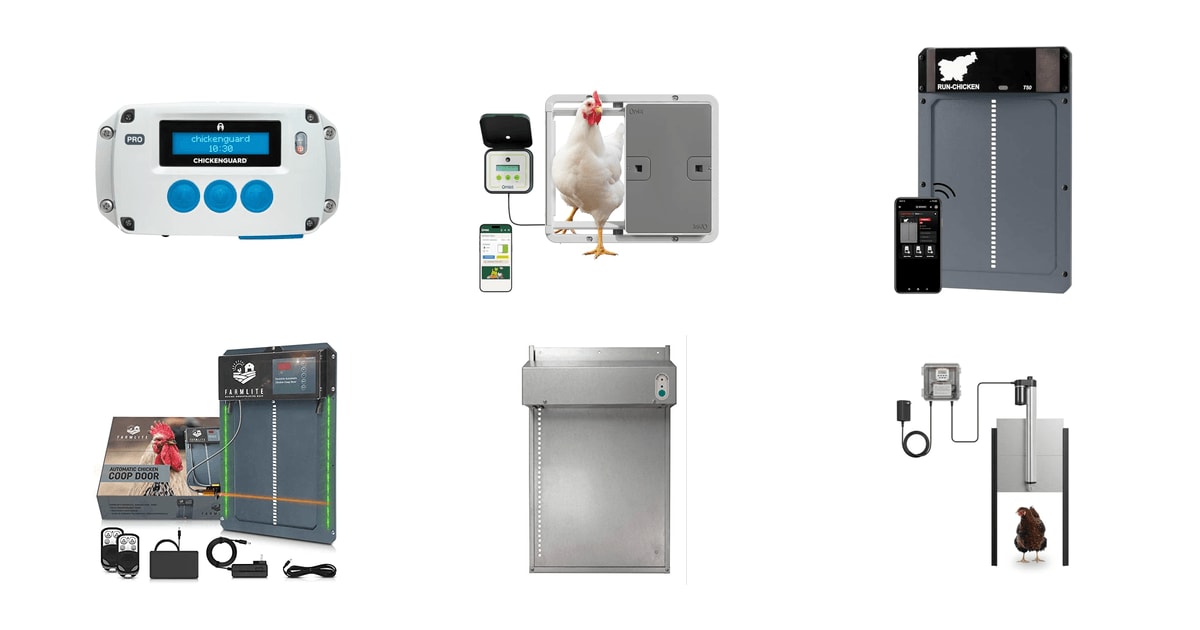
The riskiest twenty minutes of your chickens' day happen right at dusk. That's the gap between when your hens have settled onto the roost and when you finally get out there to slide the latch. A raccoon or fox only needs one of those gaps. An automatic door closes it every single night, whether you're at work, on vacation, or just watching the end of a movie. It also gets your birds out at dawn without you standing in the rain in your pajamas at five in the morning.
Here's the honest part: none of these doors is install-and-forget. Every one of them has owners who report a unit that quit somewhere between six months and three years in, usually after a hard freeze or a wet stretch. Cold is the common thread. Batteries lose capacity, tracks ice up, and motors slow down. You'll still want to glance at the coop most nights, and you'll still want a plan for the morning the door doesn't open. Treat one of these as a very good backup for your routine, not a replacement for it.
We also can't tell you how a door behaves on your particular coop, because we haven't put one on a coop. What follows is built from manufacturer specs, published reviews and a lot of owner feedback about what breaks and when. We think that the ChickenGuard Automatic Chicken Coop Door Opener is the best automatic chicken coop door for most people, and that the Omlet Smart Automatic Chicken Coop Door Opener is the one to buy if you travel often and want a notification on your phone the moment the door shuts.
Everything we recommend

The strongest motor and lock, if you can supply the door

The one to get if you want a phone notification at dusk

Long battery life and easy mounting, with a lighter build

Galvanized steel and a big opening, for heavy birds
Three control modes and real safety features, for less
At a glance
| Product | Power Source | Control Mode | Price | |
|---|---|---|---|---|
| ChickenGuard Automatic Chicken Coop Door OpenerTop pick | Solar/Batteries/Electric | Timer/Light Sensing | $139.98 |
| Omlet Smart Automatic Chicken Coop Door OpenerAlso great | Battery or Plug-in Power | Light Sensor or Timer | $229 |
| RUN-CHICKEN Door T50Runner-up | Battery Powered | App & Timer Control | $129.99 |
 | FarmLite Automatic Chicken Coop Door OpenerAlso consider | Non-Battery Powered | Timer and Light Sensor | $119.99 |
| Automatic Chicken Coop Door Extra Large 13Upgrade pick | 6V Lantern Battery | Sunrise/Sunset | $240 |
 | JVR Automatic Chicken Coop DoorAlso consider | — | Programmable Timer | $154.77 |
| VEVOR Automatic Chicken Coop DoorBudget pick | DC & Battery Powered | — | $49.90 |
How we picked
Anti-pinch safety. We treated obstruction detection as a requirement, not a bonus, and checked every spec sheet for it. Doors that reverse faster or detect a bird before contact scored higher than ones that wait for pressure.
Predator resistance. We looked for a positive mechanical lock in the closed position — self-locking wings, a screw-rod actuator, a direct-drive sprocket — rather than a door held shut by gravity or friction. Owner reports of raccoon and fox pressure informed which mechanisms we trusted.
Cold-weather rating. We compared published minimum operating temperatures and weighed them against owner feedback from northern winters, since cold is where these doors fail most often. Anything without a stated low-temperature spec lost ground.
Build and longevity. We favored aluminum and galvanized steel over plastic-dominant housings, and we read owner feedback specifically for what happens in year two and year three. Warranty length mattered less than the pattern of reported failures.
Power and control. We preferred doors that offer more than one power source and more than one trigger, because a light sensor confused by a yard light needs a timer to fall back on. Placement flexibility was a tiebreaker for remote coops.
Top pick
The strongest motor and lock, if you can supply the door
ChickenGuard Automatic Chicken Coop Door Opener
The ChickenGuard PRO is a motor-and-controller unit that automates the coop door you already have, or pairs with a self-locking panel. It has the most powerful lift in this group, four operating modes, and a track record long enough that owners talk about it in five-year increments.
$139.98fromAmazonThe lift spec is the reason this one wins. ChickenGuard rates the PRO to raise a door weighing up to two kilograms — roughly four pounds. That's a real wooden panel, not a thin sheet of aluminum. If you've already got a heavy door on your coop and you just want to automate it, most of the competition here assumes you'll replace the whole assembly. This one doesn't. The motor is noticeably bigger than what's inside the lighter-weight units, and owners who've owned both say so.
Cold is what kills coop doors, and ChickenGuard rates this one to -20°C. That's the lowest documented operating temperature in this lineup. If you're in Zone 5 or colder, that margin matters more than any app feature. Owners in genuinely cold country report the unit still cycling through deep winter, and one reports simply adding a solar panel and forgetting about it. That said, cold hurts battery capacity on every door here, ChickenGuard included.
You get four ways to run it: a fixed timer, a light sensor that follows sunrise and sunset, a dual-safe mode that closes on whichever comes first, and plain manual buttons. Dual-safe is the one worth knowing about. If a security light near your coop confuses the sensor, the timer still shuts the door. Single-trigger doors don't have that fallback, and it's the difference between a weird night and an open coop.
Power flexibility is the quiet advantage. Solar panel kit, AA alkalines, or a 9–12V DC cable — you pick, and you can switch later. A coop out at the back of a paddock runs on solar. One bolted to the side of the garage runs on the cable. There's also a door-closed light that's visible from a good distance, so you can confirm from the kitchen window instead of walking out in the drizzle.
The version to buy depends on your coop. The motor unit alone automates an existing door. The PRO-plus-door package adds ChickenGuard's aluminum panel with self-locking wings that engage as the door drops, so a raccoon can't lever it back up. Measure your cutout and decide before you order, because guessing wrong here means a return.
Flaws but not dealbreakers
Battery changes are a chore. To swap the AAs you take the whole unit off the coop wall, which is exactly the job you don't want in February. Owners bring this up more than any other complaint, and it's the main argument for choosing the solar or DC option instead.
The interface has a learning curve. Setting the clock and calibrating the door travel trips people up, and some owners end up hunting through video guides to change the time. It's not hard once it clicks, but plan on spending real time with the manual rather than getting it right in ten minutes.
There's no app and no WiFi, so you can't check the door from a hotel room. And warranty service has frustrated some owners — a few report a slow back-and-forth over what proof a claim requires. Keep your receipt and your order confirmation.
Also great
The one to get if you want a phone notification at dusk
Omlet Smart Automatic Chicken Coop Door Opener
The Omlet Smart is the only door here with real WiFi, a proper app, and Alexa and Google Home support. It installs in minutes with no tools or wiring, and it pushes a notification to your phone every time it opens or locks up.
$229fromAmazonIf you travel, the notifications change how the whole system feels. Every other door here asks you to trust it. This one tells you. You get a push when it opens at dawn and another when it locks at dusk, from anywhere. Owners who spend nights away describe that as the whole reason they paid more, and one who cycled through several other doors first says this is the one they stopped worrying about.
Setup really is fast. It clips on without tools or wiring and mounts either way up, so the door can slide open left or right to suit your coop. Owners with an Omlet Eglu report it fits that plastic coop when nothing else would, which is a genuinely useful thing if you own one. Wooden coops are the design target either way.
The casing is rated IPX6 and the door is specified down to -4°F. That's not the deepest cold rating here, but it covers most of the country. Built-in safety sensors stop the door when something's in the way. Power comes from four AAs — Omlet says up to six months, though WiFi use asks more of them — or a wired connection if you have an outlet nearby.
A router outage doesn't strand your birds. The door keeps running its last saved schedule on its own; you just lose the remote view and control until the network is back. That's the right failure mode. But it does mean the premium here is almost entirely about connectivity, so if your coop is visible from your kitchen sink, you're paying for something you won't use.
Flaws but not dealbreakers
This is the most expensive door in the lineup, and the extra money buys connectivity rather than a stronger motor or a better lock. Nothing about the mechanism outclasses the ChickenGuard or the ADOR1.
Owner feedback on longevity is genuinely mixed. Plenty of people are two years in and happy, but a meaningful number report a unit that simply stopped — sometimes within weeks, often after a stretch of early, low-angle winter sunsets. Others report grit and sand collecting in the track and keeping the door from seating at night, which is worth knowing if your run has a sandy floor.
Getting the most out of it means keeping the app on your phone and the coop inside WiFi range. If your coop sits at the far end of a large yard, check your signal there before you buy.
Runner-up
Long battery life and easy mounting, with a lighter build
RUN-CHICKEN Door T50
The RUN-CHICKEN T50 runs off a rechargeable internal battery that the company says lasts a year or more, mounts with six screws and no wiring, and pairs with an app for timer or light-sensor control. It's the low-fuss choice for a standard-breed flock.
$129.99fromAmazonBattery anxiety is the most common complaint about automatic coop doors, and the T50's answer is a rechargeable pack RUN-CHICKEN rates for up to two years in warm climates and a year in cold. Compare that to the three-to-six-month AA cycle on cheaper units. Owners back the general shape of the claim — several report going a year or two between charges — though cold weather pulls those numbers down, as it does on every door here.
Installation is the easiest of any full-kit door in this lineup. Six screws, no wiring, no solar panel to aim. If you're retrofitting an existing coop and you don't want to run a cable across the yard, that's a real advantage over the FarmLite, which wants an outlet or a solar setup you buy separately. The aluminum construction is weatherproof and rated from -15°F to 140°F.
The app handles both timer and light-sensor mode, so you can let it follow the seasons or pin it to exact times. There's an obstruction sensor that stops the door from closing on a bird. Owners in genuinely cold places report it cycling reliably well below zero, which is more than the spec sheet strictly promises.
This is by far the most widely bought door here, which cuts both ways. It means the owner feedback pool is deep and the failure modes are well documented. It also means you're reading complaints from a much larger base than the boutique brands generate.
Flaws but not dealbreakers
Longevity is the real question mark. A recurring owner story is a door that works beautifully and then, somewhere between six months and three years, stops accepting programming or stops opening in the morning. The warranty is one year, so a failure in year two is on you. Some owners who've handled both the T50 and the ChickenGuard describe the T50 as noticeably lighter-built.
Freezing rain can stick the door in its track. Owners in freeze-thaw climates report mornings when it couldn't lift until things warmed up. And the internal battery means recharging rather than swapping in fresh AAs — easier most of the time, worse on the day it dies unexpectedly.
There's no Alexa or Google Home integration, so it won't fold into an existing smart home routine the way the Omlet does.
Upgrade pick
Galvanized steel and a big opening, for heavy birds
Automatic Chicken Coop Door Extra Large 13
The ADOR1 Extra Large has a 13 by 10.5 inch opening and a galvanized steel body, built in the USA. If you keep Brahmas, Jersey Giants, ducks or geese, it's the door that actually fits them — and it's the most durable build here.
$240fromAmazonStandard coop doors are too small for large birds, and most manufacturers ignore that. An 8 to 11 inch opening works fine for Leghorns and Rhode Island Reds. Watch a Brahma or a goose try to get through one and the problem is obvious. The ADOR1's 13 by 10.5 inch opening gives heavy breeds and waterfowl room to walk through without ducking. Nothing else in this lineup comes close on size.
The build is galvanized steel rather than aluminum or ABS, and at nine pounds you can feel where the weight went. AdorStore claims lifetime construction, and owner feedback runs unusually consistent for a product this old — people report six and eight years of daily cycles, including winters in negative-twenty temperatures, with the strong motor and heavy lantern battery doing the work. A direct-drive sprocket holds the door locked closed rather than letting it rest on gravity, so there's nothing for a determined raccoon to work loose over a few nights.
It self-adapts its open and close times to the seasons without you reprogramming anything, and you can offset those times relative to sunrise and sunset if your birds like an early start. A 6-volt lantern battery comes included, with other electric options available. Owners typically report replacing that battery about once a year.
It's the plainest door here, and that's part of the appeal. No app, no WiFi, no LCD menus to navigate. Just a heavy steel door that opens and shuts. If you've been burned by a unit whose controller board died, the simplicity is the feature.
Flaws but not dealbreakers
It's the most expensive door in this group and the least feature-rich. No connectivity, no anti-pinch sensor called out in the specs, no menu of operating modes. You're paying for metal and a motor strong enough to move it.
There's no low-battery warning. Owners report the specific bad morning where the door simply doesn't open and the birds stay shut in — fine on a mild day, not fine in July heat. Put a battery swap on your calendar rather than waiting for a symptom.
Nine pounds of galvanized steel needs solid mounting. Check that your coop wall can carry it, and confirm your cutout can be enlarged to the opening size before you order.
The ADOR1 comes with a one-year manufacturer warranty.
Budget pick
Three control modes and real safety features, for less
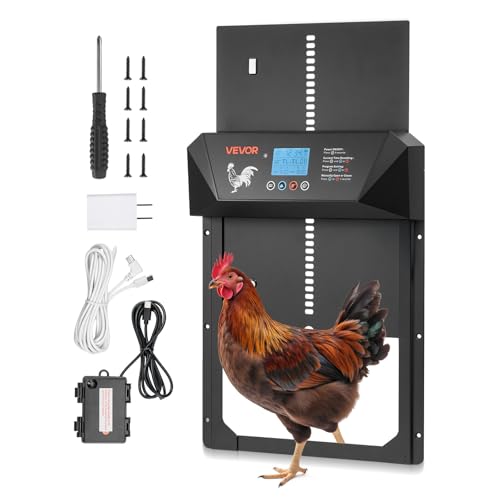
VEVOR Automatic Chicken Coop Door
The VEVOR gets you light-sensor, timer and manual modes, anti-pinch protection, an LCD screen and an aluminum-alloy door for the least money here. It's the sensible way to find out whether automation suits your setup before spending more.
$49.90fromAmazonA few years ago this feature list belonged to premium doors only. Three control modes, an obstruction sensor that reverses the door within three seconds, a readable LCD display, aluminum alloy with an ABS housing that's corrosion- and UV-resistant. You can run it on batteries or DC power. For a first automatic door, that's a lot of the important stuff.
Anti-pinch protection is the line you shouldn't cross below, and the VEVOR stays above it. Plenty of no-name doors at similar money skip obstruction detection entirely, which means the door closes on whatever is in the way. Three seconds isn't fast, but three seconds and a reversal beats no sensor at all. That single feature is why this is the budget pick and a generic listing wouldn't be.
Owners describe straightforward installation and programming, and the ones who are happy are happy in a simple way — it opens at six, it closes at nine, the birds figured it out. If you're automating a secondary door on a protected run, or you want to test the concept on an existing coop before committing, this does the job.
Think of it as a two-to-three year door rather than a decade-long one. The ABS housing components won't age like the ChickenGuard's or the ADOR1's metal, and there's no app, no WiFi and no premium safety hardware. At this price that trade is reasonable. It wouldn't be at twice the money.
Flaws but not dealbreakers
The three-second anti-pinch response is the slowest here. For a healthy hen at normal speed that's fine. For an elderly bird, an injured one, or a bantam that hesitates in the doorway, it's a meaningful gap next to the JVR's half-second reversal.
Owners report the door stopping when a chicken sits in the opening and then refusing to restart on its own, which turns a safety feature into a morning chore. Battery-powered units also want charging about quarterly, so this isn't the set-and-forget option.
Customer support draws the sharpest complaints. Owners with a failed unit describe slow email turnaround and repeated requests for more proof. Buy this expecting the product to work or to be replaced through Amazon, not through the manufacturer.
Who this is for
Buy one of these if you keep backyard chickens and you're the one who opens and shuts the coop every day. That's the whole pitch: you get your mornings back, and your birds get locked in on time even when you're not home. It matters most if you have real predator pressure — raccoons, foxes, possums, anything that patrols at dusk — or if you're gone overnight with any regularity. It also matters if you're physically not up for a walk to the back of the yard in the dark, which is a reason a lot of keepers give and a good one.
You need less of this if your run is fully enclosed with heavy hardware cloth on every surface including the roof, since the run is already your security layer. Skip it entirely if your coop cutout is an odd shape you can't modify, or if nobody in your household can handle a drill and a jigsaw. This guide covers doors and motor units that mount on an existing coop wall. It doesn't cover complete coops, run enclosures, feeders, or the accessory kits and spare parts that turn up in the same searches.
How we picked
We ranked these on the things that decide whether you're happy a year later. Safety: an anti-pinch or infrared sensor is non-negotiable, and faster reversal beats slower. Predator resistance: the door has to lock positively closed, not just rest there — self-locking wings, a screw-rod actuator or a direct-drive sprocket. Cold weather: we compared stated minimum operating temperatures against what owners in northern winters report, because that's where motors seize and batteries fade. Build: aluminum and galvanized steel age better than ABS, and we read owner feedback for what breaks in year two. Control and power: dual triggers and more than one power source give you a fallback when a yard light fools the sensor or an outlet isn't close. Fit: the opening has to suit your birds, which is a different question for a Leghorn than for a goose.
Other automatic chicken coop doors worth considering
If you want proactive safety and US-based support: The FarmLite Automatic Chicken Coop Door Opener ($119.99) — The FarmLite uses an infrared motion sensor that holds the door open while a bird is still in the doorway, rather than waiting for the door to touch her. If you've ever had a slow or elderly hen caught at closing time, that difference is worth something. It runs on AC with a battery backup, or on a 12V solar setup you buy separately, so you skip the battery cycle entirely. Owners consistently single out the customer support, and the build — aluminum panel, metal gears, a rain guard, two remotes — reads as more considered than the price suggests. The trade-offs: the AC requirement ties you to an outlet or a solar purchase, there's no app, and owners in daily freeze-thaw climates report the door sticking on icy mornings.
If your main worry is raccoons and slow hens: The JVR Automatic Chicken Coop Door ($154.77) — The JVR pairs the fastest obstruction response here — a half-second auto-reverse on a pressure sensor that monitors every close cycle — with an industrial screw-rod actuator that drives the door into a locked position like a deadbolt. There's no string for a clever raccoon to work at. The 11 by 12 inch anodized aluminum door suits most standard breeds, and owners with turkeys and geese report it working for larger birds too. A memory chip saves your settings through a blackout. What you give up is the light sensor: it's timer-only, programmable to the minute, which means you adjust it yourself as daylight shifts. Owners also report the controller being fragile and replacement parts taking weeks.
The competition
This is what our research surfaced in the current crop of automatic coop doors, not a census of everything for sale. Small brands appear and vanish in this category constantly, and a lot of the budget listings are the same unbranded mechanism under different names. Every product we looked at is covered above — the picks, the two worth considering, and nothing left over.
Installation and sizing notes
Measure your existing coop cutout before you order anything. Listed door dimensions describe the opening your birds walk through, not the overall unit, and those two numbers can differ by inches. Standard breeds — Leghorns, Rhode Island Reds, Australorps, Plymouth Rocks — do fine with an 8 to 11 inch opening. Brahmas, Jersey Giants, Cochins, ducks and geese want twelve inches minimum. Most of these mount to the exterior wall in 30 to 90 minutes with a drill, a jigsaw and a screwdriver. Motor-only units like the ChickenGuard adapt your existing panel, so confirm the weight and travel first. Once it's up, watch a few close cycles with your birds present, and sweep the track clear if your run has sand or fine grit.
Questions we get
What happens if a hen is standing in the doorway when the door closes?
Every door we recommend has some form of obstruction detection, but they're not equal. The JVR reverses within half a second on pressure, and FarmLite's infrared sensor holds the door open before it ever touches a bird. The VEVOR takes about three seconds, which is fine for a healthy hen and slower than you'd want for an elderly one. Confirm anti-pinch protection is listed before you buy anything, because plenty of cheap no-name doors skip it entirely.
Which door handles hard winters best?
The ChickenGuard PRO is rated to -20°C, the lowest stated operating temperature in this lineup. The RUN-CHICKEN T50 is specified to -15°F and the Omlet to -4°F. Owners of the ADOR1 also report it cycling in negative-twenty conditions, which its heavy motor and lantern battery help explain. Whatever you pick, expect battery runtime to drop noticeably in cold weather — that part is universal.
Do these work without WiFi or a smartphone?
Mostly, yes. Only the Omlet is built around an app, and even that one keeps running its saved schedule if your router goes down — you just lose remote control. The RUN-CHICKEN uses an app for setup and mode changes. Everything else here runs on physical buttons, an LCD timer or a dial, so they work fine on a rural property with no coverage.
Can a raccoon or fox force one of these open?
A door with a real mechanical lock is very hard to defeat. The ChickenGuard's self-locking wings engage as the door drops so it can't be pried upward, the JVR's screw-rod actuator holds like a deadbolt, and the ADOR1's direct-drive sprocket keeps the door locked rather than resting. What you want to avoid is any door that simply sits closed under its own weight or on a cable — that's the kind a persistent raccoon works out over several nights.
Is a light sensor or a timer better?
Get both if you can. A light sensor follows sunrise and sunset through the seasons with no reprogramming, but a security light or a streetlamp near the coop can confuse it. A timer is dependable but needs adjusting as the days change. Dual-trigger doors like the ChickenGuard, the RUN-CHICKEN, the FarmLite and the VEVOR cover both cases; the JVR is timer-only, which means a bit of seasonal fiddling.
How long do the batteries last?
It depends on the door and the weather. AA-powered units typically want a swap every few months, and Omlet rates its four AAs at up to six months with lighter use. RUN-CHICKEN claims up to two years in warm climates and one in cold for the T50's rechargeable pack, and ADOR1 owners generally replace the included lantern battery about once a year. Cold cuts all of those numbers, so plan on shorter intervals through winter.
Do I still need one if my run is fully enclosed overnight?
Less urgently, but it still helps. If the run has heavy hardware cloth on every surface including the roof, that perimeter is doing your security work. If there's wooden framing a raccoon can chew, lightweight wire, or a gap at ground level, the coop door is a worthwhile second barrier. A lot of experienced keepers run both, and they also like not having to walk out at dawn.
Why you should trust us
For this guide:
- We read the manufacturer specifications and listing documentation for all seven doors, comparing stated lift capacity, opening size, operating temperature range and safety-sensor behavior side by side.
- We reviewed owner feedback across the lineup, paying particular attention to reports of failures in the second and third year of ownership, cold-weather behavior, and how each brand handled warranty claims.
- We compared these doors against the category's known failure patterns — battery depletion, iced tracks, controller faults and gravity-held doors — rather than against each other's marketing claims.
- We read owner reviews on every listing, weighted toward the critical ones, because that is where the recurring failures show up.
- We have a systematic way of automatically fetching the latest prices, so the numbers on this page stay current.
- This is a research-focused guide, so the team may not own every product listed — though we often do own the top winners, which gives us extra context for the recommendations.
- We don't accept free products, and the retailer commission never changes which product we recommend.
Sources
Best Automatic Chicken Coop Doors — Hands-On Testing and Field Comparisons, The Spruce
Automatic Chicken Door Reviews and Field Comparisons, Morning Chores
Best Automatic Chicken Coop Doors — Full Roundup and Keeper Recommendations, The Happy Chicken Coop
Best Automatic Chicken Coop Doors for Small Farms and Homesteads, Hobby Farms
ChickenGuard PRO Product Specifications, Manual, and Warranty Documentation, ChickenGuard (Manufacturer)
Amazon product listings and owner reviews for all 7 products
Manufacturer specification pages for each product
Some passages in this guide may be paraphrased with AI help. Prices are refreshed automatically.
More like this.
Continue exploring pet reviews and recommendations.

The Best Chicken Coop Heaters and Heated Waterers
Winter in a backyard coop isn't really about temperature. It's about water. A laying hen drinks close to a pint a day, and when her waterer turns into a…

The Best Chicken Coops
A coop isn't like most pet gear. You'll open it, close it and clean it every day for years, in the rain and in the dark, so the small stuff decides how…

The Best Gifts for Backyard Chicken Keepers
Keeping chickens is a hobby made of small daily chores. Someone has to walk out at dawn to open the coop and walk back out at dusk to shut it. Water needs…

The Best Automatic Pet Feeders
Feeding a pet on a schedule sounds simple until your life stops cooperating. You get stuck in traffic, a meeting runs long, or you're gone for two nights.…

The Best Automatic Pet Feeders
Feeding on a schedule sounds like a small thing until you're the one doing it. A cat who wakes you at five. A dog who needs a midday meal you're never…

The Best Automatic Pet Feeders
An automatic feeder earns its spot on the kitchen floor the first morning you don't get woken at 5 a.m. It also helps if you work long shifts, your cat's…