The Best Automatic Pet Feeders
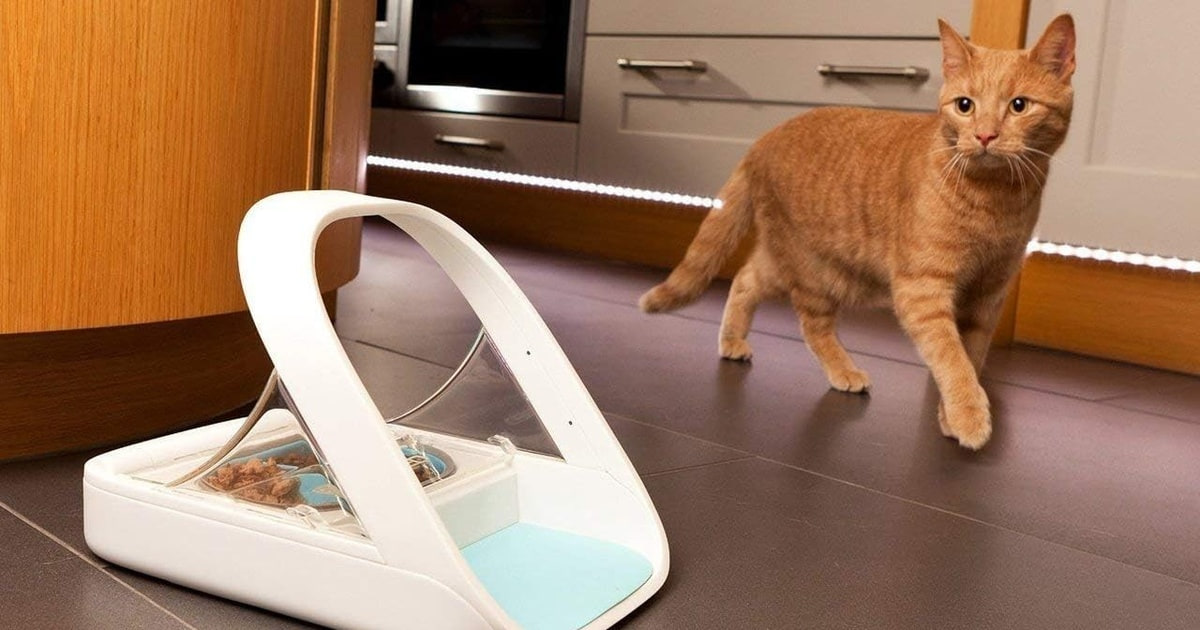
Feeding a pet on a schedule sounds simple until your life stops cooperating. You get stuck in traffic, a meeting runs long, or you're gone for two nights. An automatic feeder takes that chore off your plate, and it does something a heaped bowl of free-fed kibble can't: it holds the portion steady. That matters more than it used to. Veterinary groups estimate that most cats and dogs in this country are now overweight, and measured meals are one of the few fixes that doesn't demand much from you.
Here's the part nobody prints on the box. These machines fail in boring, predictable ways. Wi-Fi drops and a schedule stops syncing. Kibble bridges over the auger and the bowl stays empty. A determined cat shoves the whole unit into a wall until something falls out. An analysis of thousands of owner reviews put connectivity dropouts at the top of the complaint list, and nothing here is immune. If your pet is on a medical feeding plan, you still have to look in the bowl.
So buy for the failure you'd mind least. If you want remote control and a hopper that holds a week of kibble, get a Wi-Fi model with backup power. If you'd rather have nothing to sync, a plain timer feeder still works fine. And if your pet eats wet or raw food, you need a different machine entirely — chilled trays, not a hopper. We think that the PetSafe Smart Feed Automatic Pet Feeder is the best automatic pet feeder for most people, and that the PETLIBRO Automatic Cat Feeder with Camera is the one to buy if you want to watch your pet eat.
Everything we recommend

Reliable app scheduling, a big hopper, and a slow-feed mode

A camera and two-way audio, if you want to watch meals

Simple timer feeding, with no app or Wi-Fi to drop out

Microchip access that keeps one pet out of another's bowl

Five chilled trays for pets who eat wet or raw food
Prices as of Oct 22, 7:36 AM PT · Details
At a glance
| Product | Capacity | App Control | Price | |
|---|---|---|---|---|
| PetSafe Smart Feed Automatic Pet FeederTop pick | 6L/24 Cup | App | $120.99 |
| PETLIBRO Automatic Cat Feeder with CameraRunner-up | 5L | App | $139.99 |
 | WOPET 6L Automatic Cat FeederAlso consider | 6L | App | $76.99 |
| Arf Pets Automatic Pet Feeder Food DispenserBudget pick | — | — | $82.99 |
| Automatic Pet Feeder - Sureflap - SureFeedUpgrade pick | — | WiFi | Check price |
| Cat Mate C500 5 Bowl Digital Timer-ControlledAlso great | 5 Bowl | — | Check price |
 | Xiaomi smart PET food feeder 2 EUAlso in lineup | — | — | Check price |
Prices as of Oct 22, 7:36 AM PT · Details
How we picked
Portion accuracy. We favored motor-driven auger and worm-drive designs over gravity feeders, because published testing has found gravity models can overfill by 20 to 40 percent against their target portion. Anything for a pet on a restricted diet had to dose in small, repeatable increments.
Backup power. A feeder that stops during an outage isn't a feeder. We required either battery or USB backup, and we read owner feedback specifically for reports of missed meals during blackouts.
Connection reliability. Wi-Fi dropouts are the single most common complaint across thousands of owner reviews in this category. We looked for 2.4GHz support and for schedules stored on the device, so a router blip doesn't skip dinner.
Jamming and kibble fit. Spec sheets list the kibble sizes each auger can handle, and owner feedback shows where the claims break down. We prioritized wide chutes, anti-clog alerts and hoppers that don't bridge with odd-shaped food.
Cleaning. Long-term published reviewing found fixed bowls trap moisture and residue in seams and carry far more bacteria than removable ones. We gave weight to dishwasher-safe bowls and hoppers that come apart without tools.
Top pick
Reliable app scheduling, a big hopper, and a slow-feed mode
PetSafe Smart Feed Automatic Pet Feeder
A 24-cup hopper, up to 12 meals a day, and portions adjustable in eighth-cup steps from an eighth of a cup to four cups. It's the feeder that owners keep reporting still works after several years and a couple of moves.
$120.99fromAmazonPrices as of Oct 22, 7:36 AM PT · Details
This is the feeder that keeps showing up in long-term owner reports still working. That's the whole ballgame with a machine your pet depends on. PetSafe's specs list up to 12 scheduled meals a day, with portions from an eighth of a cup up to four cups per meal in eighth-cup steps. The 24-cup hopper means a single cat can go more than a week between refills, and you're not doing math to hit a vet's target.
If your dog inhales dinner and then looks queasy, the slow-feed setting is the reason to pick this one. Any meal bigger than an eighth of a cup gets spread out over about 15 minutes instead of landing all at once. Owners of fast eaters say it's the difference between a calm dog and a dog throwing up on the rug. It's a small software trick, but it solves a real problem.
The app side is unglamorous and that's a compliment. You get push notifications when the hopper runs low or empty, and when the feeder throws an error — which is the alert you actually want, since a silent failure is the dangerous one. You can also ask an Echo speaker to drop a snack from across the house. Schedules live on the feeder, so a brief internet hiccup doesn't skip a meal.
Power outages are where cheap feeders quietly quit. This one takes batteries as a backup, and owners in storm-prone areas report it kept dispensing on schedule while the lights were out. Add the fact that it handles cats and small-to-medium dogs on the same hardware, and it covers more households than anything else in this guide.
Flaws but not dealbreakers
The bowl isn't locked down, and that's the complaint we saw most. A cat who paws at the tray can scoot it out of position, and then dinner lands on the floor. Owners with pushy eaters end up wedging the feeder into a corner or against a cabinet.
The backup batteries aren't in the box, which is an easy thing to forget until the power goes out. Kibble also rattles loudly on the plastic chute — most pets learn to love the sound, but it's not subtle at 6 a.m.
It isn't immortal. A minority of owners report the unit dying after a year or two, and some describe slow going with support when that happens. Given how many of these are in service, that's a real risk rather than a fluke.
Runner-up
A camera and two-way audio, if you want to watch meals
PETLIBRO Automatic Cat Feeder with Camera
The same scheduled dry-food feeding as our top pick, plus a 1080p camera with night vision and a speaker you can talk through. If you travel and want proof your cat actually ate, this is the one.
$139.99fromAmazonPrices as of Oct 22, 7:36 AM PT · Details
The reason to buy this instead of a plain feeder is that you can see the bowl. The camera shoots in 1080p with a wide-angle lens and infrared night vision, so a 5 a.m. breakfast isn't a black rectangle. You can also record clips to a microSD card. For anyone who has spent a weekend away wondering whether the anxious cat is eating at all, that's worth the extra hardware.
Two-way audio does more than let you eavesdrop. You can talk to your pet live, or record a ten-second meal call that plays every time food drops. Owners of skittish cats say the recorded voice pulls them out from under the bed, which is the whole point — a feeder only helps if your pet comes to it. Motion alerts tell you when something moved near the bowl.
The scheduling itself is straightforward. You set meals in the app, adjust them from anywhere, and the feeder pushes alerts for low food, blockages, motion and sound. It connects on either 2.4GHz or 5GHz, which is unusual here and helpful if your router pushes everything onto the faster band. The stainless steel tray lifts out for washing.
It's also the smaller machine on a counter than our top pick, at roughly a foot wide and under eight inches tall. If you're in an apartment and the feeder has to live somewhere visible, that matters.
Flaws but not dealbreakers
It's mostly plastic, and owners are blunt about the cleaning schedule — food residue and oils build up in the chute fast, so plan on wiping it down every day or two rather than weekly.
Getting set up annoys people. An existing account on the company's website doesn't carry over to the app, so you may need a second one. Several owners also describe steady pressure to subscribe for cloud video when they'd rather just use the SD card, and the controls take a session or two to figure out.
Portions run small per dispense. That's fine for a cat on measured meals and frustrating if you're feeding a big dog.
Budget pick
Simple timer feeding, with no app or Wi-Fi to drop out
Arf Pets Automatic Pet Feeder Food Dispenser
A programmable timer feeder with a blue LCD, a magnetic locking lid, and a ten-second voice recording. Nothing connects to anything, which is exactly why some owners have kept theirs running for five or six years.
$82.99fromAmazonPrices as of Oct 22, 7:36 AM PT · Details
Every part that can drop offline has been left out. You set up to four daily alarms on the display, choose one to ten portions per meal at about 24ml each, and walk away. There's no router, no account, no firmware update at a bad moment. Owners routinely describe five and six years of service, and a few keep buying replacements because the formula works.
It runs on three D batteries or the DC cable, so a blackout doesn't stop dinner. The magnetic lid keeps a nosy cat from lifting the hopper. And you can record a ten-second meal call — most pets end up responding to the sound of the motor anyway, but the voice helps with a new pet learning the routine.
This is the feeder to buy for a second cat, a vacation house, or a pet who eats on a simple twice-a-day rhythm. It costs a fraction of the smart models and does the one job they all share. If you don't check a feeding app more than once a month, you're paying for a screen you won't open.
Flaws but not dealbreakers
Four meals a day is the ceiling, and the portions are small units, so a large dog needs a lot of them per meal. Grazers and big breeds are better served elsewhere.
You get no remote anything. If your flight is delayed, there's no way to add a meal from the airport, and no notification if the hopper jams or empties.
Reliability is more mixed than our top pick. A meaningful group of owners report the clock resetting or the unit stopping outright after a few months, which is a bad failure mode for a machine you're trusting while you're away. It's dry food only.
Upgrade pick
Microchip access that keeps one pet out of another's bowl
Automatic Pet Feeder - Sureflap - SureFeed
A sealed bowl that opens only for the pet whose microchip or collar tag it recognizes, then closes within seconds when that pet walks away. For a house where one cat is on a prescription diet and another is a thief, nothing else solves it.
Check priceatAmazonPrices as of Oct 22, 7:36 AM PT · Details
If you have a food thief, this is the only fix that actually holds. The lid stays shut until a registered pet leans in, and it seals again within about three seconds of that pet stepping back. The system reads up to 32 individual microchips or RFID collar tags, so it scales to a whole household. Owners with a diabetic or allergy cat describe it as the thing that finally made separate diets possible.
It handles wet and dry food, with a split bowl if you want to serve both. That's rarer than it sounds — most feeders in this guide are dry-kibble hoppers only. And because the bowl is sealed between visits, wet food dries out much more slowly than it does in an open dish.
There's a second benefit that surprises people: you finally know who ate. When only one cat can reach a bowl, an untouched portion means something specific instead of being a mystery. For anyone tracking intake on a vet's instructions, that's the difference between guessing and knowing.
It's battery-powered and needs no outlet, so you can put it in a back bedroom, a closet, or wherever the cat who needs it will actually go. Owners report going long stretches between battery changes.
Flaws but not dealbreakers
Read the listing carefully, because it oversells. This model is a microchip bowl, not a dispenser — you portion the food in yourself, and there's no hopper, no schedule and no app. Owners have been caught out by the connectivity language on the page; the app-connected version is a different, pricier product.
A determined bully can still work around it. The sides and back are open, so a second cat who's willing to reach in from an angle sometimes gets a mouthful. Owners solve this by putting the feeder in a corner, but the shielding could be better.
Some pets need a week or two of coaxing before they'll put their head into a bowl that moves. Most get there. A few skittish cats never do.
Also great
Five chilled trays for pets who eat wet or raw food
Cat Mate C500 5 Bowl Digital Timer-Controlled
Five lidded stainless steel bowls, each holding up to 330g, on a digital timer with two freezer ice packs underneath. It's one of the few automatic feeders built for wet, raw or air-dried food instead of kibble.
Check priceatAmazonPrices as of Oct 22, 7:36 AM PT · Details
A hopper feeder cannot handle wet food, and pretending otherwise is how people end up with spoiled meat in a plastic chute. This takes the other approach: five sealed trays on a rotating timer, with twin ice packs sitting underneath. Testing published by Tom's Guide found the trays plus ice pack held wet food below 50°F for about five hours in a room-temperature house.
The stainless inserts are the underrated part. They lift out and go in the dishwasher, which matters more than it sounds — long-term reviewing by Wirecutter found that removable, dishwasher-safe bowls carried far less bacteria than fixed bowls, where residue sits in seams you can't reach. With wet food, that gap gets ugly quickly.
Five meals of up to 330g each covers a full day and then some. Owners use it for the two things a kibble feeder can't do: a midnight and pre-dawn split for a cat who otherwise wakes them at 4 a.m., and lunch for a pet at home alone. It also swallows air-dried and freeze-dried food with pieces too big for an auger.
The lids are tamper-resistant, so a cat can't nose ahead to tomorrow's tray. Some owners freeze the food in the trays directly for longer trips, which buys extra hours.
Flaws but not dealbreakers
The ice packs are good for hours, not days. If your house runs warm, treat five hours as the honest ceiling for wet food, and don't load a full day of meat on a summer afternoon.
When the five trays are gone, it's done until you wash and reload it. There's no app, no notification and no remote meal, so a delayed return means your pet waits.
It's a wide, flat disc that takes up real counter or floor space for the amount of food it holds. Compared with a hopper feeder, you refill it constantly.
Who this is for
Buy an automatic feeder if your schedule is unpredictable, if you travel for a night or two at a time, or if your vet has put your pet on measured meals. It's also the standard fix for a cat who wakes you before dawn — the feeder becomes the thing that produces breakfast, not you. Owner surveys suggest about a third of pet owners have used one while traveling, and most say it took the edge off leaving a pet home alone.
It's not a pet sitter. Nothing here refills itself, notices a sick animal, or replaces a several-day absence. This guide covers scheduled dry-food dispensers, microchip-controlled bowls and chilled tray feeders for wet food; it doesn't cover gravity feeders, which can't portion accurately, or water fountains. If you free-feed a healthy pet who self-regulates, you may not need one of these at all.
How we picked
We weighed five things. Portion accuracy: motor-driven dispensing beat gravity designs, which published testing has shown can overfill by 20 to 40 percent against their programmed portion. Backup power: battery or USB backup was non-negotiable, since most feeders stop dispensing entirely when the lights go out. Connection reliability: dropouts dominate owner complaints in this category, so we looked for 2.4GHz support and schedules stored on the feeder itself. Jamming and kibble fit: we cross-checked spec sheets on kibble size against owner reports of bridging and clogs. Cleaning: removable, dishwasher-safe bowls carry far less bacteria than fixed ones, which trap residue in seams you can't reach.
Other automatic pet feeders worth considering
If you want app control with a real battery backup: The WOPET 6L Automatic Cat Feeder — The WOPET does most of what our top pick does — 2.4GHz app scheduling, up to 15 meals a day, a low-food sensor, a ten-second meal call and safety locks on the lid and hopper — and it runs on three D batteries if the power dies. Owners with multi-year units are enthusiastic, and a few describe it feeding reliably through both power and Wi-Fi outages. What you give up is the slow-feed mode and the more predictable support experience. Failures after a few months come up more often here than we'd like, and one owner's cat chewed straight through the cord, so route the cable somewhere safe.
The competition
This is what our research surfaced, not a census of the category. New feeders launch constantly, and plenty of solid ones never cross our desk. Here's the remaining model we looked at and why it didn't make the cut.
The Xiaomi smart PET food feeder 2 EU — The Xiaomi Smart Pet Food Feeder 2 is the European version of a feeder that plugs into the Mi Home ecosystem, and the listing tells you almost nothing else — two bullets, one of which is the three-year warranty against manufacturing defects. That warranty is the longest here by a wide margin. But we won't write specs we can't confirm, the regional model raises obvious plug and app questions for a U.S. buyer, and owner sentiment is the least consistent of anything in this guide. If you're already deep in Xiaomi's smart home and you're shopping in Europe, it's worth a look. Otherwise our picks are better documented.
Care and cleaning
Kibble leaves oils behind, and those oils go rancid in the chute long before you'd notice by eye. Long-term published reviewing found that removable, dishwasher-safe bowls carried far fewer bacteria than fixed designs, where residue sits in seams you can't reach with a sponge. So pull the bowl and wash it weekly, and take the hopper apart for a full wash roughly once a month — sooner if you live somewhere humid or you're feeding a rich, greasy food. Wet-food trays need washing after every use, no exceptions. Dry every part completely before reloading, because a damp hopper cakes food into the auger and causes the jams people blame on the motor. Wipe the camera lens while you're in there.
Questions we get
Can automatic pet feeders dispense wet food?
Not the hopper kind. An auger designed for kibble will smear wet food into a mess and leave it sitting at room temperature. You need a tray-style feeder like the Cat Mate C500, which uses individual lidded bowls and a freezer ice pack. Published testing found that setup keeps wet food below 50°F for roughly five hours in a normal room.
What happens during a power outage?
Most feeders simply stop, which is why backup power was a requirement for every pick here. Models with batteries or a USB backup keep running their stored schedule in the dark. Note that Wi-Fi and app control usually need mains power, so on batteries you get scheduled meals but no remote control. Keep fresh batteries in the unit rather than in a drawer.
How accurate are these for portion control?
Motor-driven feeders are genuinely good. PETKIT rates its worm-drive dispensing to within about two grams per portion, and PetSafe portions in eighth-cup increments. Gravity feeders are a different story — published testing found they can overfill by 20 to 40 percent against the target portion, so skip them if your pet is on a calorie-restricted or vet-supervised diet.
Can you use one feeder for multiple cats?
Only if both cats eat the same food and neither one bullies the other. Otherwise the fast eater takes both portions. A microchip feeder like the SureFeed is the real solution: it opens only for the registered pet and seals within about three seconds when that pet steps away. It reads up to 32 individual chips or collar tags, so it scales to a full household.
How do I stop my cat from breaking into or tipping over the feeder?
Start with placement — wedge the unit into a corner or against a wall so there's nothing to shove against. Choose a model with a locking or magnetic lid, which the Arf Pets and WOPET both have. Loose bowls are the weak point on several feeders, so if your cat paws at the tray, look for a design that holds the bowl in place or set the feeder on a non-slip mat.
Is a Wi-Fi feeder worth it over a basic timer?
It depends on how unpredictable your life is. Wi-Fi buys you remote schedule changes, low-food alerts and error notifications — genuinely useful when a flight slips or a meeting runs long. But connectivity dropouts are the number one complaint owners raise about these feeders. If you're home on a steady schedule, a timer model has fewer ways to fail.
Why you should trust us
For this guide:
- We read the manufacturer spec sheets for every feeder here — hopper capacity, meals per day, portion increments, kibble size limits and backup power — and checked them against the current Amazon listings.
- We reviewed published testing and reporting from The Spruce Pets, Tom's Guide and Wirecutter on the things owners can't easily judge themselves, including gravity-feeder overfill, wet-food tray temperatures and bacterial buildup in bowls.
- We read through owner feedback for each model looking for repeated themes rather than one-off complaints, which is where the jamming, bowl-tipping, app-setup and long-term reliability notes in this guide come from.
- We read owner reviews on every listing, weighted toward the critical ones, because that is where the recurring failures show up.
- We have a systematic way of automatically fetching the latest prices, so the numbers on this page stay current.
- This is a research-focused guide, so the team may not own every product listed — though we often do own the top winners, which gives us extra context for the recommendations.
- We don't accept free products, and the retailer commission never changes which product we recommend.
Sources
Best Automatic Pet Feeders — Wirecutter / The New York Times, Wirecutter
Best Automatic Pet Feeders of 2026 — CNET, CNET
Best Automatic Cat Feeders — Forbes Vetted, Forbes Vetted
Best Automatic Pet Feeders — The Spruce Pets, The Spruce Pets
Best Automatic Pet Feeders — Good Housekeeping, Good Housekeeping
Best Automatic Pet Feeders — Tom's Guide, Tom's Guide
Best Automatic Dog Feeders — American Kennel Club, American Kennel Club
Pet Obesity Prevalence Survey 2024 — Association for Pet Obesity Prevention, Association for Pet Obesity Prevention
Automatic Pet Feeder Market Size & Forecast 2024–2030 — Grand View Research, Grand View Research
APPA National Pet Owners Survey — American Pet Products Association, American Pet Products Association
Amazon product listings and owner reviews for all 7 products
Manufacturer specification pages for each product
Some passages in this guide may be paraphrased with AI help.
Product prices and availability are accurate as of the date/time indicated and are subject to change. Any price and availability information displayed on Amazon.com at the time of purchase will apply to the purchase of this product.
More like this.
Continue exploring pet reviews and recommendations.

The Best Automatic Pet Feeders
An automatic feeder earns its spot on the kitchen floor the first morning you don't get woken at 5 a.m. It also helps if you work long shifts, your cat's…

The Best Automatic Pet Feeders
Feeding on a schedule sounds like a small thing until you're the one doing it. A cat who wakes you at five. A dog who needs a midday meal you're never…

The Best Automatic Dog Feeders
Your dog knows when dinner is late. A feeder that runs on a schedule takes that pressure off you - the meeting that runs long, the flight that boards at…

The Best Automatic Cat Feeders
An automatic feeder solves a small problem you deal with every single day. Your cat wants breakfast at 5 a.m. You want to sleep. A feeder handles the…

The Best Automatic Chicken Coop Doors
The riskiest twenty minutes of your chickens' day happen right at dusk. That's the gap between when your hens have settled onto the roost and when you…

The Best Automatic Water Shutoff Valves
A burst supply line doesn't wait for you to get home. Water runs at whatever pressure your main delivers, and it keeps running until somebody turns it off…