The Best Automatic Water Shutoff Valves
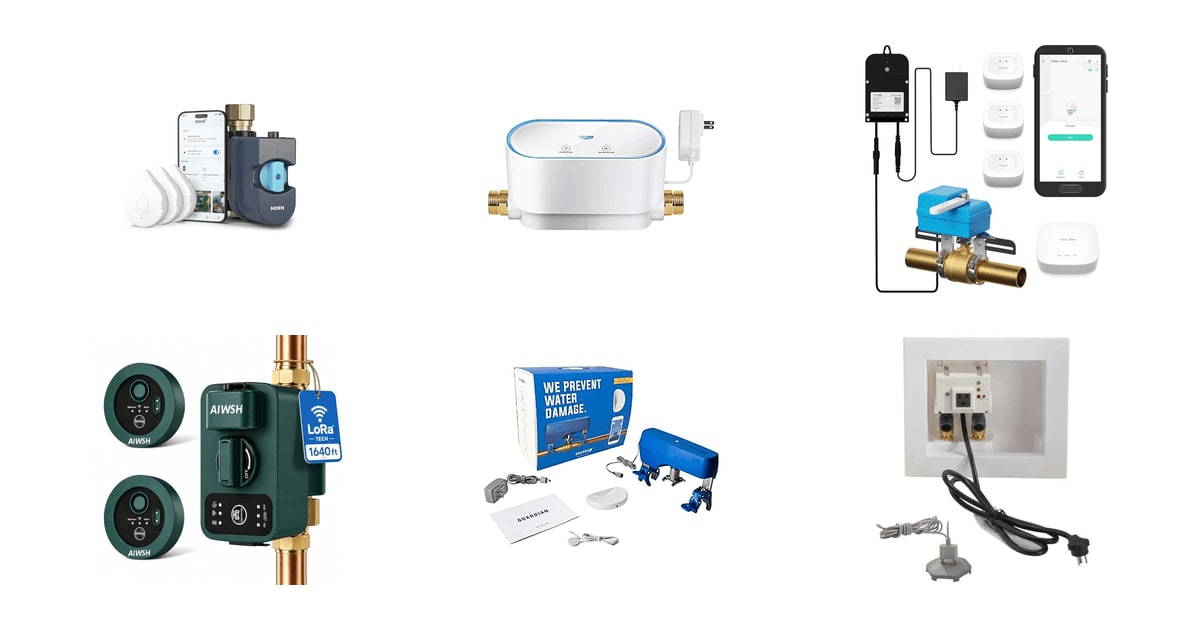
A burst supply line doesn't wait for you to get home. Water runs at whatever pressure your main delivers, and it keeps running until somebody turns it off — which, if you're at work or on vacation, could be hours. An automatic shutoff valve closes the main for you. Some do it when a puck-shaped sensor on the laundry room floor gets wet. Others watch the flow through your main line all day and shut things down when the pattern looks wrong. Either way, the point is the same: stop the water before the drywall soaks through.
Here's the honest part. No valve in this category is set-and-forget. Flow-monitoring units need weeks to learn your household's habits, and until they do, a long shower or a filling pool can trip a shutoff you didn't want. Sensor-based kits only catch water where you've physically placed a sensor — a pinhole leak inside a wall cavity will drip for months without triggering anything. App reliability is the other soft spot across every brand here. Firmware updates go sideways, apps get redesigned badly, and support quality varies a lot.
We think that the YoLink DIY Automatic Water Leak Detection & Shut-Off Starter Kit is the best automatic water shutoff valve for most people, and that the Flo by Moen 1-Inch Smart Water Shutoff bundle is the one to buy if you want whole-home flow monitoring that catches hidden leaks you'd otherwise never find.
Everything we recommend

Closes the main without cutting a single pipe

Finds the slow leaks nothing else here will catch

Whole-home shutoff without a hub or a subscription

Sharp hardware and multi-property support, shaky app
At a glance
| Product | Pipe Size | Connectivity | Price | |
|---|---|---|---|---|
| Moen 900-006 Flo by Moen 1-Inch SmartUpgrade pick | 1 Inch | — | $747.98 |
| Grohe 22503LN0 Sense Guard Smart Water ControllerAlso great | 1 Inch Max | Wireless LAN | $415 |
| YoLink DIY Automatic Water Leak Detection &Top pick | — | LoRa | $269.99On sale |
| Smart Automatic Water Shutoff Valve & LeakBudget pick | 3/4 & 1 In | LoRa | $199.87On sale |
 | New Guardian by Elexa Leak Detection andAlso in lineup | 1/2-1 1/4 In | Wi-Fi | $499.99 |
 | Watts IntelliFlow 1/2" Smart Washing Machine WaterAlso consider | 1/2 Inch | Wi-Fi | $332.53 |
How we picked
Detection method. We separated sensor-based kits from flow and pressure monitors, because they catch completely different failures. Any system we recommend has to be clear about which one it does.
Works when things break. We prioritized valves that close during a power or internet outage, since storms cause both outages and burst pipes. Specs and owner reports both had to support offline operation.
Installation reality. We compared what each valve actually demands — clamp-on, push-fit, inline cut, or soldered joints — and weighted clamp-on and DIY-friendly designs higher for most readers. Sweated copper means hiring a plumber.
Response time. Published specifications range from under five seconds for motorized ball valves to 20 seconds or more for cloud-dependent Wi-Fi units. We treated anything under 15 seconds as acceptable and faster as better.
Ongoing costs. We favored systems that alert and shut off without a subscription, and we noted where SMS alerts or cloud features are metered.
Top pickOn sale
Closes the main without cutting a single pipe
YoLink DIY Automatic Water Leak Detection &
The YoLink kit clamps an electric operator onto the ball valve you already have, so there's no soldering and no plumber. Its sensors talk straight to the valve over long-range radio, which means it still shuts your water off when the Wi-Fi and the power are both down.
$269.99fromAmazonList priceThe installation is the whole argument. Every other whole-home approach here asks you to cut into your main line or hire someone who will. This one doesn't. The EVO operator mounts over your existing quarter-turn ball valve and physically twists the handle. If you can tighten a couple of clamps, you can install it in an afternoon — and if you move, you can take it with you.
The part that matters most is what YoLink calls device-to-device control. Once you pair a sensor to the valve controller, they communicate directly, without routing through the hub, your router, or a cloud server. So when a storm knocks out power and a pipe lets go in the same hour, the sensor still tells the valve to close. That's the exact scenario most Wi-Fi-dependent gear fails in.
The radio range is genuinely useful, not a spec-sheet flourish. LoRa reaches up to a quarter mile between devices and the hub, which in practice means a sensor in a detached garage or a far basement corner stays connected through several walls. You get three sensors in the box and can add more. Battery life on the sensors runs up to five years; the valve controller runs two years on batteries alone, or you can plug it in and keep the batteries as backup.
Owner feedback skews strongly positive and unusually specific — people describe the valve clamp as more secure than competing designs, and repeat buyers keep adding sensors to the same system. Complaints about false shutoffs, which dog the flow-monitoring category, barely come up here. That makes sense: a sensor either sits in water or it doesn't. There's no algorithm to second-guess.
It works with Alexa, Google Assistant, IFTTT and Home Assistant, so it drops into whatever you're already running. Alerts come by app, email or SMS, and iOS gets critical alerts that break through Do Not Disturb — which is the notification you actually want at 3 a.m.
Flaws but not dealbreakers
This is point-of-failure protection, not whole-home monitoring. It catches water on the floor. It will not catch a pinhole leak weeping inside a wall or under a slab, because nothing ever gets wet where you put a sensor. If your worry is slow hidden damage rather than a burst hose, you want a flow monitor instead — or in addition.
You need an existing quarter-turn ball valve on your main for the operator to grab. Older homes with a gate valve or a stuck multi-turn valve will need that swapped first, which does mean a plumber. Check what's on your main before you order.
SMS alerts are metered. Each account includes a small number of free texts per month, and heavy alerting past that costs extra. App and email alerts stay free, so this is a minor annoyance rather than a real limit.
Upgrade pick
Finds the slow leaks nothing else here will catch
Moen 900-006 Flo by Moen 1-Inch Smart
Flo by Moen plumbs into your main line and watches flow, pressure and temperature continuously, running a daily test that can spot a leak as small as a drop per minute. This bundle adds three floor sensors, so you get both hidden-leak detection and fast response to obvious spills.
$747.98fromAmazonA drip a minute doesn't sound like much. Behind a wall, over three months, it's a mold problem and a torn-out bathroom. Flo's MicroLeak test runs daily, pressurizes your system and watches for the tiny pressure decay that means water is escaping somewhere you can't see. That's the capability the sensor-based kits fundamentally can't offer, and it's the reason to pay more here.
The AI layer is real, but treat it as a work in progress. Moen's FloSense engine tracks flow rate, pressure and temperature together and compares the pattern against a large library of known leak and anomaly signatures. In practice, it takes days to weeks of learning your household before it settles down. Owners describe exactly that arc — a training period, occasional nuisance shutoffs afterward, then long stretches of quiet reliability.
Timing is the whole game with water damage. Mold growth starts within 24 to 48 hours of intrusion, and restoration industry guidance holds that damage left undetected past 72 hours drives remediation costs up dramatically. A daily automated leak test is aimed squarely at that window. So is the phone alert you get for an unusual flow event, which several owners say arrived before they had any idea anything was wrong.
The bundle pairing matters. Three Smart Water Detectors go where you know trouble starts — under the water heater, behind the washer, near the sump — and any of them can trigger the main valve to close. You end up covering both failure modes: the slow hidden leak the flow monitor catches, and the sudden burst the floor sensor catches first.
The app dashboard shows daily consumption and lets you set conservation goals. That sounds like a throwaway feature until you see the numbers: the EPA estimates household plumbing leaks waste close to 10,000 gallons a year on average, and one home in ten wastes 90 gallons a day or more. Seeing your own usage plotted daily is how you notice the running toilet you'd stopped hearing.
Flaws but not dealbreakers
You will probably need a plumber. This model fits 1-inch to 1-1/4-inch pipe and installs inline on the main, which means cutting. Owner accounts include install headaches — one describes a leak at the built-in O-ring that took a second plumber visit to sort out. Budget for professional installation and add it to your mental price for this thing.
False shutoffs are a genuine annoyance during the learning period and sometimes after. A shower that runs past 30 minutes, a long irrigation cycle, filling a tub for a kid — any of these can read as anomalous. You can override from the app, but you have to have your phone handy, which is a different kind of set-and-forget than the sensor kits offer.
Support experiences are mixed. Among the harsher owner accounts are a unit that quit within days of installation and frustration with how Moen handled it. Most people report years of solid service, but the downside case here is expensive to be on the wrong end of.
Budget pickOn sale
Whole-home shutoff without a hub or a subscription
Smart Automatic Water Shutoff Valve & Leak
The AIWSH valve installs inline on a 3/4-inch or 1-inch main and closes within about 15 seconds of a sensor tripping. It runs on long-range LoRa radio instead of Wi-Fi, and it self-tests every couple of weeks so the valve doesn't seize in place.
$199.87fromAmazonList priceSkipping Wi-Fi entirely is the smart move at this price. The valve and sensors talk over LoRa with roughly 1,640 feet of coverage, which punches through basement walls and mechanical room framing where Wi-Fi drops out. There's no hub to buy, no account to maintain, and no cloud server sitting between a wet sensor and a closed valve. Fewer links in the chain means fewer things that can fail at the worst moment.
The self-test is the feature nobody advertises well and everybody should want. A motorized valve that sits untouched for two years can corrode or stick, and then it doesn't close when you need it. This one cycles itself every 15 days to keep the mechanism free. That's the difference between protection you have and protection you think you have.
You're trading detection sophistication for coverage, and for most homes that's a fair trade. There's no flow monitoring and no pressure analysis here — it responds to sensors getting wet, full stop. But you get both wired and wireless sensors in the box, room for up to eight wireless units, and an audible alarm at the valve so someone home hears it even if nobody checks a phone.
Installation is DIY-friendly on standard 3/4-inch and 1-inch plumbing with basic tools, though this one does go inline — you're cutting pipe, unlike the YoLink. One owner notes that the adapter fitting their setup needed wasn't stocked at the big-box store, so measure your run and buy fittings before you start.
Flaws but not dealbreakers
The track record is thin. This is a newer listing with a small pool of owner feedback, and none of it stretches back far enough to tell you how the valve holds up after five years on a wet basement wall. The specs and the early reports look good. Long-term durability is an open question, and that's a real risk to weigh against the lower price.
About 15 seconds to full closure is fine, but it's slower than the motorized ball valves in dedicated sensor kits, which can close in under five. At typical residential pressure, a burst line moves several gallons in the first minute. The difference isn't dramatic, but it isn't nothing either.
No flow monitoring means the same blind spot as any sensor-based system: hidden leaks inside walls stay hidden.
Also great
Sharp hardware and multi-property support, shaky app
Grohe 22503LN0 Sense Guard Smart Water Controller
The Grohe Sense Guard monitors flow, pressure and temperature on your cold main and flags abnormal flow down to half a liter per hour. It's the pick for design-conscious homeowners or anyone managing several properties from one app.
$415fromAmazonHalf a liter an hour is a sensitivity threshold worth understanding. That's slow enough to flag a hairline crack in copper before you'd ever see a stain on the ceiling. Pair the Sense Guard with Grohe's satellite Sense sensors and you cover both the invisible seep and the puddle on the floor. The controller carries an IP44 splash rating, so mounting it near fixtures isn't a problem.
Owners consistently praise the hardware and consistently complain about the software. That split runs through nearly every account. People describe the valve itself as solidly engineered — several have installed multiple units across homes and rentals. The ONDUS app is where frustration lives: a redesign that lost functionality, settings that reset themselves, and no way to force a manual pressure test.
The multi-property angle is a real differentiator. If you own a rental, a lake house or a place you visit a few weekends a year, managing them all from one app is genuinely useful. Second-home owners are the readers who get the most from any of these valves — an unattended house is where a slow leak turns into a five-figure claim.
Installation is more approachable than the spec sheet suggests. It's a cold-water-only device, maximum 1-inch pipe, and it ships with 3/4-inch NPT male adapters. One owner cut into 3/4-inch copper after the meter and had the whole thing done in about an hour. You'll need a standard outlet nearby and Wi-Fi to reach the app.
Flaws but not dealbreakers
Reliability reports are genuinely split, and the negative accounts are serious. Some owners report internal diaphragm failures on multiple units, and several describe support as unresponsive when things went wrong. Once this is plumbed in, you're committed — that's a bigger gamble than with a clamp-on valve you can remove.
Unexplained shutoffs come up in owner feedback, along with a physical power button that reportedly doesn't reliably reopen the valve, forcing people back into the app. If the app is also being difficult that day, you're standing in a basement with no water.
It's cold-water only and capped at 1-inch pipe. Larger mains are out, and the 1-inch adapter bracket is sold separately.
Who this is for
Buy one of these if you own a home with plumbing you don't fully trust — pre-1980 copper, galvanized supply, or anything that's had a leak before. Travelers and second-home owners get the most out of them, because an empty house is where a small leak becomes a gut renovation. So do condo and townhome owners, who can be on the hook for a neighbor's ceiling. And there's a financial angle: water damage and freezing account for roughly 24% of all U.S. homeowners insurance claims, and insurers including Liberty Mutual, Travelers and Chubb offer premium discounts in the 5–15% range for certified automatic shutoff systems. Ask your carrier what it certifies before you buy.
Skip these if you rent and can't touch the main — though a plug-in appliance valve or a standalone sensor still makes sense for you. This guide covers valves that shut water off automatically, plus the sensors and hubs bundled with them. It doesn't cover leak detectors that only alert you, water heater pans, whole-house filtration, or freeze-prevention gear. If your main uses a gate valve or a stuck multi-turn valve, get that replaced with a quarter-turn ball valve first, since most of these designs assume one.
How we picked
We ranked these on the things that decide whether a valve actually saves you. Detection method: whether it catches water on the floor, abnormal flow through the main, or both — and whether the maker is honest about the difference. Offline operation: the valve has to close during a power or internet outage, because storms take out both and burst pipes at the same time. Installation: clamp-on and push-fit designs you can handle yourself beat inline cuts, and soldered joints mean hiring a licensed plumber. Response time: published specs run from under five seconds to 35 seconds, and the first minute of a burst line can release several gallons at typical household pressure. Ongoing cost: alerts and automatic shutoff should work without a subscription. Real-world reliability: we weighed owner feedback themes around app stability, firmware updates and support responsiveness, which is where several otherwise capable products fall apart.
Other automatic water shutoff valves worth considering
If you just want to protect the washing machine: The Watts IntelliFlow 1/2" Smart Washing Machine Water ($332.53) — Washing machines are the single leading source of appliance-related water damage in homes, responsible for an estimated 6–8% of all water damage claims. The Watts IntelliFlow addresses that one risk directly. It opens the hot and cold inlets only when it senses the washer drawing current, so the hoses aren't sitting pressurized 24/7 — which is when they burst. A floor sensor closes both valves if water shows up, and it sends text and email alerts once you've connected it to Wi-Fi. What you give up is everything else: this protects one appliance and nothing more. Build quality is also the recurring complaint, with several owners reporting units that quit after a handful of years, and the fitting threads can require sweating on adapters. Worth it as an add-on to a whole-home valve, not as a replacement for one.
The competition
This is what our research surfaced, not a survey of everything for sale. Plenty of capable valves — Phyn Plus, LeakSmart, WaterCop, Dome — weren't part of the lineup we could confirm and write about here. The product below is one we looked at closely and didn't recommend.
The New Guardian by Elexa Leak Detection and ($499.99) — The Guardian by Elexa kit has a design we like a lot on paper. The controller clamps to both sides of an existing quarter-turn ball valve, needs no tools or pipe cutting, and works on anything from 1/2-inch to 1-1/4-inch — which makes it one of the few options that plays nicely with PEX mains. It needs no hub, charges no monthly fee, and keeps shutting off automatically even when the internet is down. The problem is that owner feedback is dominated by connectivity and firmware failures. The recurring theme is a valve that worked, then stopped after a firmware update, with sensors that wouldn't reconnect and updates that ran for hours without completing. Several people describe support as helpful but ultimately unable to fix it. If you're technical and want the clamp-on approach on PEX, this may still be worth a look — but the YoLink kit does the same clamp-on trick with a far better reliability record.
Installation notes
Before you buy anything, go look at your water main. What you want to find is a quarter-turn ball valve — a lever handle that rotates 90 degrees. Clamp-on controllers like the YoLink and Guardian need one to grab, and inline units are easier to splice near one. If you've got an old gate valve with a round wheel, have a plumber swap it first; you'll want that anyway, since seized gate valves are a classic reason people can't shut water off in an emergency. Measure your pipe diameter too, and buy adapter fittings ahead of time — mismatched NPT sizes are the most common reason an install stalls halfway. Push-fit and compression connections are fine for a confident DIYer. Soldered copper joints are not; that's a licensed plumber's job. Once installed, test the valve every few months by triggering a sensor on purpose.
Questions we get
Do I need a plumber, or can I install one of these myself?
It depends entirely on the design. Clamp-on valve controllers like the YoLink attach to your existing ball valve with no cutting, and most people manage them in an afternoon. Inline valves — Flo, Grohe, AIWSH — require cutting into your main, which is doable with push-fit or compression fittings if you're comfortable, and a plumber's job if the connection needs soldering.
Will the valve still shut off during a power outage?
Only if it's designed to. The YoLink kit uses direct device-to-device radio between sensor and valve, so it closes even with power and internet down, and its valve controller runs on batteries. The Guardian keeps working offline once configured, with an optional battery backup sold separately. Cloud-dependent valves without battery backup give you nothing during an outage — which is precisely when storm-related pipe damage happens.
Can these detect slow leaks hidden inside walls or under a slab?
Only the flow and pressure monitors can. Flo by Moen runs a daily MicroLeak test that catches leaks as small as a drop per minute anywhere in your system, and the Grohe Sense Guard flags abnormal flow down to half a liter per hour. Sensor-based kits can't do this at all — they only know about water that touches a sensor. If hidden leaks are your main worry, you need a monitor, not a sensor kit.
Do insurance companies give discounts for these?
Many do. Liberty Mutual, Travelers and Chubb each offer homeowner premium discounts in the range of 5–15% for certified automatic shutoff systems. The catch is the word certified — carriers maintain their own lists of qualifying products. Call yours before you buy and ask which systems qualify, because the discount can meaningfully offset what you spend.
How fast do these actually close?
Published specs vary more than you'd expect. Motorized ball valves in dedicated sensor kits can hit full closure in under five seconds. The AIWSH valve is rated at about 15 seconds. Cloud-dependent Wi-Fi valves that route the command through a server average 20 to 35 seconds. Locally processed systems land in the 6–10 second range. Since a burst line can release several gallons in the first minute, faster is genuinely better.
What's the best option for a condo where I can't touch the main?
If you don't control the main line, an appliance-level valve is your realistic option. The Watts IntelliFlow protects the washing machine, which is the leading source of appliance water damage in homes. Standalone leak sensors placed under the sink, near the water heater and behind the dishwasher will at least alert you fast. Check with your HOA before assuming the main is off-limits — some allow a clamp-on controller on the unit's own shutoff.
Why you should trust us
For this guide:
- We compared manufacturer specifications for every valve here on detection method, pipe compatibility, closure speed and offline behavior.
- We read published technical documentation from Moen, Grohe and the Z-Wave Alliance alongside water damage claim data from the Insurance Information Institute, the IBHS and EPA WaterSense.
- We read through owner feedback for each product and weighted the recurring themes — app stability, firmware updates, false shutoffs and support responsiveness — rather than isolated complaints.
- We read owner reviews on every listing, weighted toward the critical ones, because that is where the recurring failures show up.
- We have a systematic way of automatically fetching the latest prices, so the numbers on this page stay current.
- This is a research-focused guide, so the team may not own every product listed — though we often do own the top winners, which gives us extra context for the recommendations.
- We don't accept free products, and the retailer commission never changes which product we recommend.
Sources
Best Water Leak Detectors of 2026 — Wirecutter (New York Times), Wirecutter
Best Smart Water Leak Detectors Tested 2026 — Forbes Home, Forbes Home
Best Water Leak Detectors and Automatic Shutoff Valves — This Old House, This Old House
Flo by Moen Smart Water Shutoff Review — Bob Vila, Bob Vila
Best Water Leak Detectors for 2026 — CNET, CNET
Phyn Plus Smart Water Assistant Review — Tom's Guide, Tom's Guide
Facts & Statistics: Homeowners and Renters Insurance — Insurance Information Institute, Insurance Information Institute (III)
Fix a Leak Week — Water Loss Statistics — U.S. EPA WaterSense, U.S. Environmental Protection Agency
Mold: What Is It and How Do I Prevent It? — EPA Mold Course, U.S. Environmental Protection Agency
Do Water Leak Detectors Lower Home Insurance Premiums? — Forbes Advisor, Forbes Advisor
Best Water Leak Detectors 2026 — The Spruce, The Spruce
Smart Home Water Shutoffs and Insurance Claims Reduction — Verisk Analytics, Verisk Analytics
Amazon product listings and owner reviews for all 6 products
Manufacturer specification pages for each product
Some passages in this guide may be paraphrased with AI help. Prices are refreshed automatically.
More like this.
Continue exploring home reviews and recommendations.

The Best Automatic Pet Feeders
Feeding on a schedule sounds like a small thing until you're the one doing it. A cat who wakes you at five. A dog who needs a midday meal you're never…

The Best Automatic Dog Feeders
Your dog knows when dinner is late. A feeder that runs on a schedule takes that pressure off you - the meeting that runs long, the flight that boards at…

The Best Automatic Cat Feeders
An automatic feeder solves a small problem you deal with every single day. Your cat wants breakfast at 5 a.m. You want to sleep. A feeder handles the…

The Best Automatic Pet Feeders
An automatic feeder earns its spot on the kitchen floor the first morning you don't get woken at 5 a.m. It also helps if you work long shifts, your cat's…

The Best Automatic Pet Feeders
Feeding a pet on a schedule sounds simple until your life stops cooperating. You get stuck in traffic, a meeting runs long, or you're gone for two nights.…

The Best Automatic Chicken Coop Doors
The riskiest twenty minutes of your chickens' day happen right at dusk. That's the gap between when your hens have settled onto the roost and when you…