The Best Chicken Coop Heaters and Heated Waterers
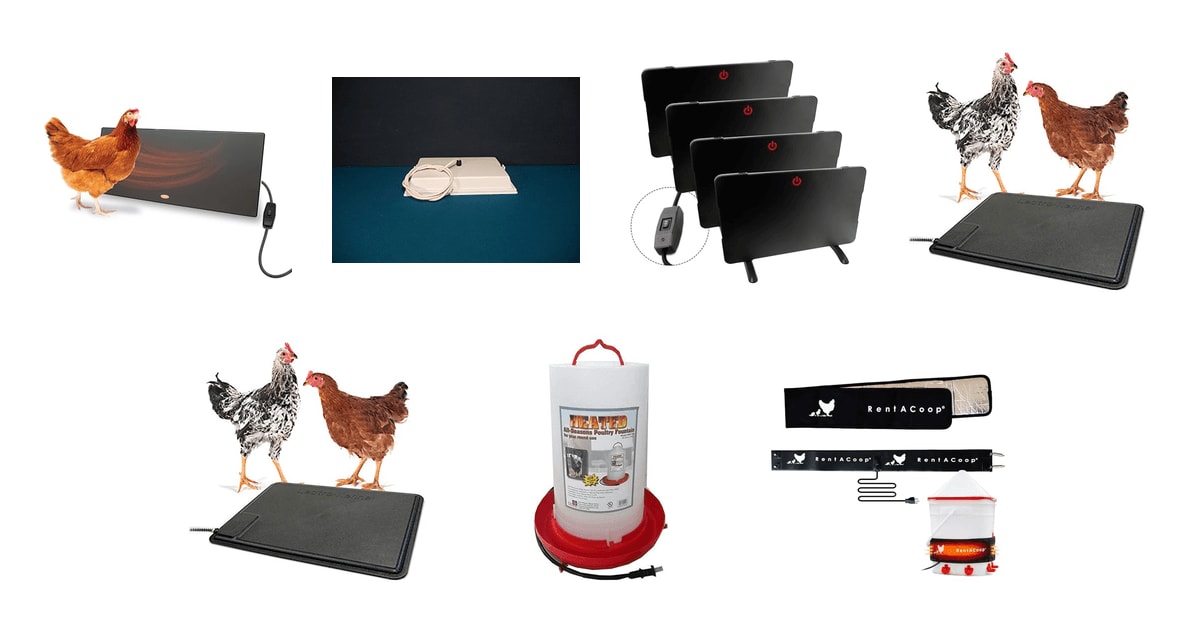
Winter in a backyard coop isn't really about temperature. It's about water. A laying hen drinks close to a pint a day, and when her waterer turns into a block of ice by 3 a.m., she stops drinking, and then she stops laying. Cold air alone rarely does that to a healthy, well-feathered bird. So the first thing most keepers should solve is frozen water, and the second is whether the coop needs any supplemental heat at all. For a lot of flocks, the honest answer to that second question is no.
Here's the caveat nobody selling these things leads with: none of them will heat your coop the way a furnace heats your house. Flat panels and infrared units warm the birds in front of them, not the air around them. Pads warm whatever is touching them. Owners who expect a cozy 50°F box are always disappointed. And every one of these units adds a cord, a plug and a draw on your circuit — in a wooden building, full of dust and bedding, that's a real thing to take seriously. Heat lamps are worse, which is exactly why these exist.
We also want to be clear about scope. This guide covers electric coop heaters and freeze-prevention gear for backyard flocks, not insulation, ventilation or coop construction — and ventilation matters more than heat in almost every winter setup. We think that the Cozy Products Cozy Coop is the best coop heater for most people, and that the RentACoop Heated Chicken Waterer Belt is the one to buy if your real problem is frozen water rather than cold birds.
Everything we recommend
Safe, simple radiant warmth for a small coop

The fix for frozen water, if you already own a bucket
Contact warmth with a thermostat, for hands-off nights

Even, hot-spot-free heat from above, for small spaces
At a glance
| Product | Wattage | Capacity | Price | |
|---|---|---|---|---|
| Cozy Products Cozy CoopTop pick | 200W | — | $54.69 |
| SWEETER HEATER Infrared Heater for Chicks &Upgrade pick | 50W | — | $122 |
 | Farm Innovators 4 Pack 2-in-1 Radiant 200-WattAlso consider | 200W/50W | — | $205.32 |
| K&H Pet Products Thermo-Chicken Heated Pad BlackAlso consider | 40W | — | $69.14 |
| K&H Pet Products Thermo Heated Chicken PadRunner-up | 40W | — | $65.99On sale |
 | Farm Innovators HPF-100 Heated Poultry FountainAlso in lineup | 100W | 3 Gal | $396.41 |
| RentACoop Heated Chicken Waterer Belt for WinterAlso great | 40W | 2-5 Gal | $59.95 |
How we picked
Safety listing. We only considered heaters with a recognized third-party electrical listing, and we favored units certified for zero clearance so they can mount against wood. In a dusty wooden building full of bedding, this is the criterion that outranks everything else.
Realistic output. We compared published wattage against the coop size each manufacturer claims to serve, then checked that against what owners actually report. Units that owners describe as warming birds but not air got recommended that way, not as room heaters.
Thermostat control. Published specs told us which units regulate themselves and which run flat out until unplugged. Self-regulating gear costs meaningfully less to run over a season and is safer to leave unattended.
Cold-weather rating. For waterers we looked for a stated minimum temperature and then read owner feedback from genuinely cold regions to see whether the rating holds. A product rated near your average low rather than your record low will fail on the night it matters.
Durability with birds. Owner feedback surfaced the failure modes that specs hide: cords chewed or pecked, pads that stopped working after a month, surfaces that are miserable to clean. We weighted peck-resistant construction and steel-wrapped cords heavily.
Top pick
Safe, simple radiant warmth for a small coop
Cozy Products Cozy Coop
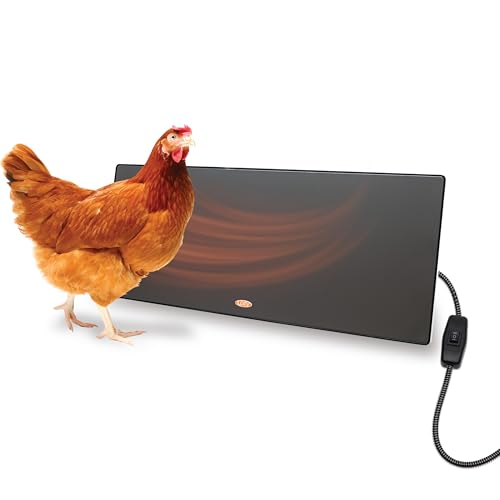
A 200-watt flat panel that bolts flat to a coop wall and radiates gentle heat toward the roost. It's ETL-listed and rated for zero clearance, so it can sit against wood without the fire risk that makes heat lamps such a bad idea.
$54.69fromAmazonThis is the one to buy if you want warmth without lying awake worrying about it. The Cozy Coop is ETL-listed and rated for zero clearance, meaning it's certified to mount flush against a wooden wall. That's the whole pitch. A heat lamp is an exposed bulb hanging over dry bedding in a dusty building, and it's the reason coop fires happen. This panel has a built-in thermal protector that cuts power before the surface gets dangerous.
Owners describe it the way you'd hope: mounted on the wall behind the roost, throwing enough radiant heat that the hens park in front of it on the worst nights. Several report it taking the edge off when outdoor temperatures dropped into the single digits. It doesn't warm the room. It warms the birds facing it, and for frostbite-prone combs on a roost, that's the part that counts.
At 200 watts it draws roughly an eighth of what a standard 1,500-watt space heater pulls, so leaving it on through a long winter won't wreck your electric bill. There's a big on/off switch and an in-cord switch, so you can kill it without climbing into the coop. Some owners note two heat settings and use the lower one indoors for pet birds, which tells you how mild the output really is.
It's also just easy to live with. No bulbs to replace, no bulb to shatter when a hen knocks it, nothing that needs a special fixture. You hang it or stand it, plug it in, and that's the season. If your coop is roughly the size most backyard flocks keep — a walk-in shed or smaller — this is the sensible default.
Flaws but not dealbreakers
There's no thermostat. Plug it in and it runs at full power until you unplug it, which is wasteful in a mild week and means you're the one deciding when winter starts. A plug-in thermostat controller from a hardware store fixes this and is the upgrade we'd recommend to anyone buying this panel.
It won't do much for a big or drafty coop. If you're in a place where nights routinely sit well below -20°F, or your coop is poorly sealed, 200 watts of radiant heat aimed at one wall isn't going to change the outcome. And a few owners have run into confusion over which version they actually received from third-party sellers, so check the listing details before you order.
The listing doesn't state a warranty term for the Cozy Coop.
Also great
The fix for frozen water, if you already own a bucket
RentACoop Heated Chicken Waterer Belt for Winter
A 40-watt silicone heating belt that wraps around any 2- to 5-gallon bucket and keeps the water liquid down to -10°F. A built-in thermostat switches it on below 38°F and off at 42°F, so it only draws power when freezing is actually a risk.
$59.95fromAmazonIf you buy only one thing for winter, make it this. Frozen water is what actually stops your hens from laying, and this belt solves it without replacing the waterer you already have. You wrap it around a standard bucket, add the included insulated wrap, and plug in the 6-foot cold-weather cord. There's no proprietary container to buy into and nothing to assemble.
Owners in Minnesota, Pennsylvania and New England report water staying liquid at -15°F, which is below the belt's own -10°F rating. That's the kind of feedback that matters more than a spec sheet. Several pair it with a 5-gallon bucket fitted with drinking nipples — a setup that also keeps bedding dramatically drier than an open trough, which is worth something in a sealed winter coop.
The thermostat is the quiet win here. At 40 watts it already draws less than most heated bases, and because it only kicks on below 38°F, it's idle through most of a shoulder-season night. Over a whole winter that difference adds up, and you never have to remember to unplug anything during a warm spell.
The fiberglass-reinforced silicone won't melt a plastic bucket and stays safe to touch, so you can use whatever container you have in the barn. It handles metal buckets too. For a small flock, one bucket refilled each morning is genuinely all the winter watering routine you need.
Flaws but not dealbreakers
The bucket is sold separately, and the belt is sized for round containers — an odd-shaped or tapered vessel won't wrap cleanly. There's no nipple fitting included either, so if you want a closed drinking system you're drilling and fitting it yourself.
Owners report a couple of consistent gotchas. Nipples and spouts can still freeze if the belt sits too far from them, so position it as close as you can. And at least one owner found the plug's internal wires loose out of the box and had to tighten them — don't yank the cord out of the socket by the cable.
Runner-upOn sale
Contact warmth with a thermostat, for hands-off nights
K&H Pet Products Thermo Heated Chicken Pad
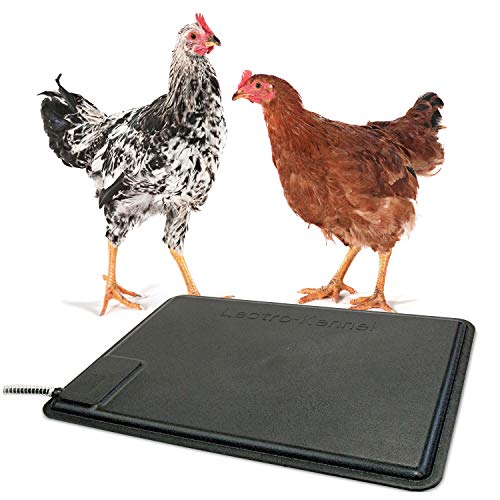
A 40-watt heated pad with automatic temperature control, safety listed as a complete product rather than just its parts. Hens press against it instead of standing near it, which makes it a good pick for a nesting box or a bird that can't roost.
$65.99fromAmazonList priceThis one heats by contact, not by radiating across a room, and that distinction decides whether you'll like it. A hen sits on it or leans against it and stays warm. It's thermostatically controlled, so it regulates its own surface temperature and won't cook a bird in a closed nesting box overnight. That's the case for it over the simpler pad: you can leave it running and stop thinking about it.
The build is genuinely made for birds, not borrowed from a dog bed. Rigid ABS plastic, a steel-wrapped cord and rounded edges mean a determined hen can peck at it without getting to anything electrical. K&H certifies the whole finished product to electrical safety standards rather than just sourcing listed components, which is a meaningful difference in a wet, dusty outbuilding.
It mounts vertically on a wall or lies flat on the floor, and owners use it both ways. One common report: an elderly hen who could no longer roost slept on it comfortably, and later a whole group of young hens crowded onto it during a cold snap. Ducks like it too. If your flock includes birds that can't get up on a roost, that's a real use case a wall panel doesn't cover.
At 40 watts it's the lowest-draw heater here alongside the RentACoop belt, and it runs year-round as a broody-hen warmer if you want. For a small coop where you mostly want to guarantee one warm spot rather than change the whole environment, this is a reasonable primary heater.
Flaws but not dealbreakers
It does not warm the air, full stop. One owner trying to keep budgies warm found the surrounding area stayed cold — the birds have to actually touch it. If you want ambient heat aimed at a roost, get the Cozy Coop instead.
The footprint fits two or three hens at most, so a larger flock will squabble over it. Owner feedback on build quality is mostly positive but not unanimous, with a few reporting it feeling flimsier than expected for what it costs.
Upgrade pick
Even, hot-spot-free heat from above, for small spaces
SWEETER HEATER Infrared Heater for Chicks &
A 50-watt infrared panel that hangs overhead on the included chain and hooks, warming 176 square inches beneath it. It produces no hot spots, which makes it the gentlest option here and a strong brooder heater as well as a coop heater.
$122fromAmazonInfrared from above works differently than a wall panel. It warms the birds directly rather than the air, and because it develops an even heat pattern with no hot spots, there's no scorching point on the surface. Owners who came to it after years of red heat lamps describe the same relief: no more burnt-out bulbs, no more worrying about the barn. Sweeter Heater has been making these since 1995, and the feedback skews unusually positive.
Where it really earns its keep is with chicks. Hang it in a brooder and the chicks move in and out from underneath, self-regulating how warm they want to be — which is closer to how a broody hen actually works than a lamp blasting one spot at 95°F. Owners running multiple brooders buy several. If you hatch or raise batches every spring, this does double duty in a way the wall panels don't.
At 50 watts it's the lightest draw of any heater in this guide, and its low-intensity output generates less of the condensation that higher-wattage units can drive in a sealed coop. Winter moisture causes more respiratory trouble than cold air does, so a heater that doesn't add to it is worth considering.
Owners in milder winter regions report switching theirs on only when the thermometer drops below about 30°F and finding it sufficient for a small coop of four to six hens. That's the honest envelope for this unit.
Flaws but not dealbreakers
Fifty watts over 176 square inches is a small heat budget. In a coop bigger than roughly 4 by 6 feet, or anywhere overnight lows run past -10°F, it won't compensate for the cold coming in. Owners who wanted more coverage bought the longer 11x30 version instead.
It's the most expensive single heater here and covers less area than the Cozy Coop, which is a hard trade to justify unless you specifically want overhead infrared or a brooder heater. It also needs somewhere to hang from, so a low or open coop ceiling complicates the install.
Who this is for
Buy something here if your winter lows regularly drop past 0°F, if your flock includes large-combed breeds like Leghorns that frostbite easily, or if you're raising young chicks through cold weather. Most of all, buy a heated waterer if your water freezes — that's the purchase that pays for itself in eggs. If you keep cold-hardy breeds like Orpingtons, Wyandottes or Australorps in a dry, draft-free, well-ventilated coop, you can very likely skip the heater entirely and spend the money on better ventilation and deeper bedding.
This guide covers electric coop heaters and freeze-prevention gear for backyard flocks. It doesn't cover coop construction, insulation, propane or combustion heaters of any kind, or commercial poultry housing. And it doesn't cover heat lamps, which we don't think belong in a coop at all.
How we picked
Safety listing: we required a recognized third-party electrical listing and preferred zero-clearance certification, because these units live against wood in a dusty building. Realistic output: we matched published wattage to the coop size each maker claims and cross-checked it against what owners describe, so nothing here is sold as a room heater when it isn't one. Thermostat control: self-regulating units cost less to run and are safer left alone overnight, so we noted which ones you'll need a plug-in controller for. Cold-weather rating: we looked for a stated minimum temperature and confirmed it against owner reports from genuinely cold regions. Durability with birds: peck-resistant shells, steel-wrapped cords and surfaces you can actually scrape clean.
Other chicken coop heaters and heated waterers worth considering
If you want the simpler K&H pad: The K&H Pet Products Thermo-Chicken Heated Pad Black ($69.14) — This is the same 18.5-by-12.5-inch heated pad in the same peck-resistant ABS shell with the same steel-wrapped cord, and it's also safety listed and thermostatically controlled at 40 watts. Owners report it lifting a small coop's temperature by six or seven degrees when mounted in the roosting area — enough to hold off frostbite. What you give up is mostly clarity: this listing doesn't spell out the automatic temperature regulation the way the newer version does, and it has no mounting holes, which several owners expected and were annoyed to find missing. It also picks up more complaints about being a pain to clean when chicks make a mess of it, and at least one owner had a unit quit after a month. If you find it and the newer pad side by side, we'd take the newer one.
If you're heating more than one coop: The Farm Innovators 4 Pack 2-in-1 Radiant 200-Watt ($205.32) — This Farm Innovators panel is sold as a four-pack, and each unit runs as a 200-watt coop heater or converts to a 50-watt horizontal brooder at three height settings. It's ETL listed with a thermal protector and certified for zero-clearance wall mounting, so the safety profile matches our top pick, and the inline switch in the 8-foot cord lets you flip between heater and brooder modes without unplugging. For a homesteader running two or three coops plus a spring brooder, buying in a pack is genuinely more sensible than buying units one at a time. For a single backyard coop it makes no sense at all — you'd be buying three spares. There's also almost no owner feedback on this listing yet, so you're leaning on the brand's track record rather than reports from the field.
The competition
This is what our research surfaced across coop heaters and heated waterers, not a census of everything sold. Coop heating is a small, seasonal category with a lot of near-identical panels and pads, and a few products here overlap heavily with our picks. What follows is the one remaining product and why it didn't make the main list.
The Farm Innovators HPF-100 Heated Poultry Fountain ($396.41) — The Farm Innovators HPF-100 is the traditional heated poultry fountain: a 3-gallon galvanized steel unit with a thermostat-controlled 100-watt base, sized to water 15 to 20 hens for a full day. It's a proven design and the galvanized body holds up to years of outdoor abuse. Two things kept it out of the picks. It's listed here as a quantity-eight pack, which is the wrong unit of purchase for anyone with a single coop. And it's an open-trough design, so it spills and adds moisture to your bedding in exactly the season when a sealed coop can least afford it — nipple and covered-bucket systems are much drier. If you run a larger operation, need self-contained fountains you can carry out and set down, and can use eight of them, it's a solid workhorse. Otherwise the RentACoop belt on a bucket does the same job with less water on the floor and a smaller electric draw.
Installation and winter setup
Mount panel heaters on a wall behind or beside the roost, not above the bedding, so the heat reaches the birds where they actually sleep. Use only outdoor-rated extension cords, keep every connection off the coop floor where spilled water pools, and check cords for peck damage each time you collect eggs. If your heater has no thermostat, add a plug-in controller set around 35°F — it'll cut your seasonal power use substantially and stop the unit running through mild nights. Clean dust and cobwebs off panel surfaces before the season starts and again mid-winter. And don't seal the coop up tight to hold heat in: ammonia and moisture do more damage to a flock than cold air, so keep the high vents open all winter.
Questions we get
What's the safest heater for a chicken coop?
Look for a flat-panel or infrared unit with a recognized electrical listing and a zero-clearance rating, which means it's certified to mount flush against wood. The Cozy Products Cozy Coop and the Sweeter Heater both fit that description. Never use a heat lamp — an exposed bulb over dry bedding is the classic cause of outbuilding fires, and every product in this guide exists as an alternative to it.
Do backyard chickens actually need a heated coop?
Usually not. Cold-hardy laying breeds like Buff Orpingtons, Plymouth Rocks, Wyandottes and Australorps handle temperatures down around 0°F in a dry, draft-free, well-ventilated coop with no supplemental heat at all. Heat becomes worth adding below about -10°F, for large-combed Mediterranean breeds like Leghorns, or when you've got young chicks. A heated waterer is the higher priority in nearly every case.
How do I keep the waterer from freezing without electricity?
You can slow it down — an insulated box, a black rubber base that soaks up sun, ping-pong balls floating on the surface to keep it moving, a south-facing spot in daylight. All of these buy you hours, not nights. Once you're into sustained sub-freezing weather, a thermostat-controlled heated waterer or a heating belt is the only thing that reliably works.
How many watts do I need for my coop?
A rough starting point is about 10 watts per cubic foot of coop space in moderate winter zones, and closer to 15 in the coldest ones. A 4-by-8 coop with a 6-foot ceiling is about 192 cubic feet, which puts the 200-watt Cozy Coop right in range. Keep in mind these are radiant heaters — they warm the birds in front of them, so aiming one at the roost matters more than the arithmetic.
Is a flat-panel heater really better than a heat lamp?
Yes, and it isn't close. Flat panels run at surface temperatures well below the ignition point of straw and framing, carry zero-clearance certification, and have thermal protectors that cut power if something goes wrong. Heat lamps use an exposed incandescent bulb that can shatter or ignite bedding and cobwebs. Panels also draw less power than a typical lamp.
Can I use a propane heater in the coop?
No. A propane heater in an enclosed coop brings carbon monoxide, an open flame near feathers and bedding, and oxygen depletion in a small space. Nothing in this guide burns fuel, and no propane heater is certified for enclosed poultry housing. Stick with listed electric panels, infrared units or pads.
Why you should trust us
For this guide:
- We read the manufacturer specifications and safety listings for every heater and waterer here, comparing wattage, clearance ratings and stated cold-temperature limits.
- We reviewed owner feedback across these listings for recurring themes — how much heat people actually get, which parts fail, and how the waterers behave well below zero.
- We compared each product against extension-service guidance on winter water requirements, coop ventilation and cold tolerance in common laying breeds.
- We read owner reviews on every listing, weighted toward the critical ones, because that is where the recurring failures show up.
- We have a systematic way of automatically fetching the latest prices, so the numbers on this page stay current.
- This is a research-focused guide, so the team may not own every product listed — though we often do own the top winners, which gives us extra context for the recommendations.
- We don't accept free products, and the retailer commission never changes which product we recommend.
Sources
Chickens in Cold Weather — University of Minnesota Extension, University of Minnesota Extension
Winter Chicken Keeping: How to Keep Chickens Warm — Purina Animal Nutrition, Purina Animal Nutrition
Fires in U.S. Farm Structures — NFPA Research, National Fire Protection Association
Poultry Drinking Systems: Water Quality and Management — Penn State Extension, Penn State Extension
Chicken Coop Heaters: The Complete Guide — The Happy Chicken Coop, The Happy Chicken Coop
Amazon product listings and owner reviews for all 7 products
Manufacturer specification pages for each product
Some passages in this guide may be paraphrased with AI help. Prices are refreshed automatically.
More like this.
Continue exploring pet reviews and recommendations.

The Best Automatic Chicken Coop Doors
The riskiest twenty minutes of your chickens' day happen right at dusk. That's the gap between when your hens have settled onto the roost and when you…

The Best Chicken Coops
A coop isn't like most pet gear. You'll open it, close it and clean it every day for years, in the rain and in the dark, so the small stuff decides how…

The Best Gifts for Backyard Chicken Keepers
Keeping chickens is a hobby made of small daily chores. Someone has to walk out at dawn to open the coop and walk back out at dusk to shut it. Water needs…

The Best Garden Hose Nozzles and Watering Systems
Watering sounds like the simplest job in the yard, and then you spend a July evening dragging a hose across the driveway for the third time. The tool you…

The Best Christmas Tree Watering Systems
A fresh-cut tree drinks more than most people expect. University of Illinois Extension recommends a quart of water per inch of trunk diameter on day one,…

The Best Heated Bird Baths
Winter birds can find seeds almost anywhere. Water is the harder problem. Once puddles, creeks and standing water lock up in ice, a chickadee burns real…