The Best Language Learning Workbooks
A language workbook has to survive your actual week, not your idealized one. That means it needs to work in twenty-minute chunks on a couch, with a pen, when you're tired. The best ones sequence material so each page builds on the last, explain things in English you can actually follow, and include an answer key so you're not left guessing whether you got the subjunctive right. The worst ones are padded with filler exercises that feel like progress but teach you nothing you'll use in a conversation.
Here's the honest part: no workbook will make you conversational on its own. Print can't talk back. You can finish a grammar book cover to cover and still freeze when a waiter asks a follow-up question, because drills build accuracy and conversation demands speed. Almost none of these include audio in the box, either, so pronunciation is on you to source elsewhere. Owners who love these books almost always mention pairing them with something else — an app, a tutor, a podcast. Treat the workbook as one leg of the stool.
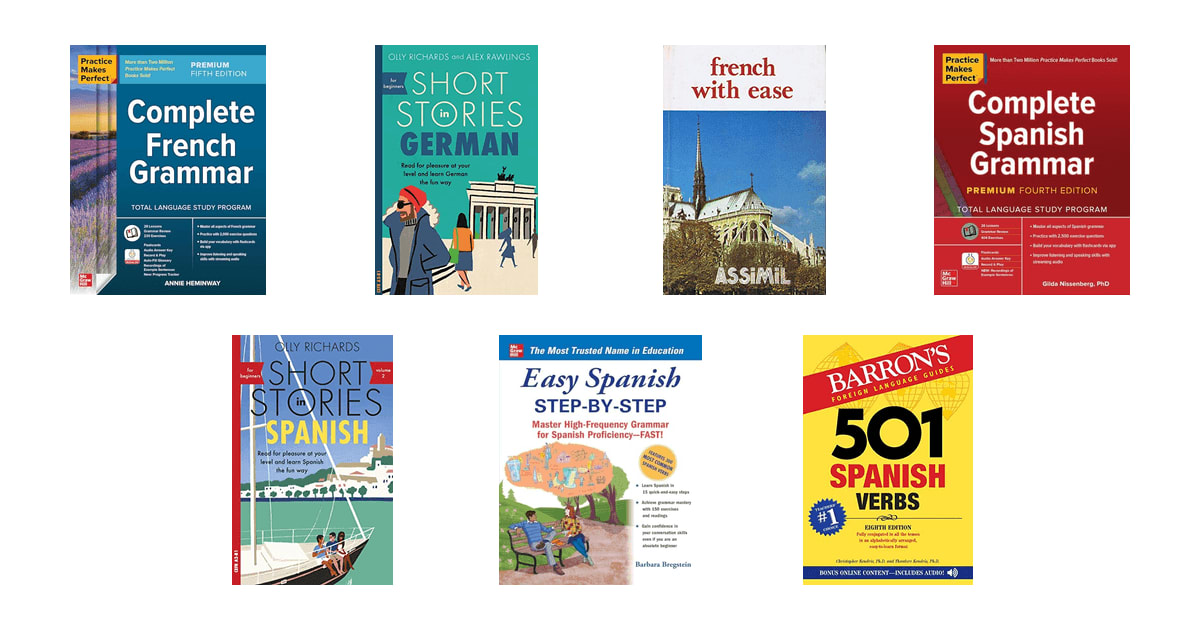
We've focused on Spanish, French and German titles aimed at self-study adults, since that's where the market is deepest and the quality gap is widest. Beginners, intermediate learners stuck at a plateau, and people who just want more reading practice all need different books, so we've sorted the picks that way. We think that Easy Spanish Step-By-Step is the best language learning workbook for most people, and that Practice Makes Perfect: Complete Spanish Grammar is the one to buy if you already have a semester or two behind you and want to close specific gaps.
Everything we recommend

The gentlest on-ramp if you're starting from nothing

For closing specific grammar gaps once you're past the basics

Reading practice that's actually fun, for very little money

Immersion-style French, if you'll actually show up daily

A conjugation reference you'll keep for years
At a glance
| Product | Language | Skill Focus | Price | |
|---|---|---|---|---|
| French With Ease: Day by Day MethodAlso great | French | Method | $78.50 |
| Practice Makes Perfect: Complete Spanish GrammarRunner-up | Spanish | Grammar | $12.49On sale |
 | Practice Makes Perfect: Complete French GrammarAlso consider | French | Grammar | $17On sale |
| Short Stories in Spanish for BeginnersBudget pick | Spanish | Short Stories | $6.99 |
 | Short Stories in German for BeginnersAlso consider | German | Short Stories | $8.28On sale |
| Easy Spanish Step-By-StepTop pick | Spanish | Grammar | $9.16On sale |
| 501 Spanish VerbsUpgrade pick | Spanish | Verbs | $21.69 |
How we picked
.
.
.
.
.
Top pickOn sale
The gentlest on-ramp if you're starting from nothing
Easy Spanish Step-By-Step
Easy Spanish Step-By-Step teaches grammar in order of how often you'll actually use it, so you can build real sentences within the first few chapters. It's the rare beginner book that doesn't dump irregular verbs on you before you can order coffee.
$9.16fromAmazonList priceIf you've never studied Spanish, start here. Barbara Bregstein sequences grammar by communicative importance rather than by textbook tradition. You get the most frequent verbs and their present-tense forms first, because those are the building blocks of every real conversation. Past and future come later, once the foundation holds. Owners who'd failed with other books repeatedly point to this ordering as the reason this one finally stuck.
The listing says more than 300 verbs and key terms are introduced by frequency, and that number matters less than the principle behind it. You're not memorizing vocabulary you won't hit for months. Each new concept arrives only after the previous one has been drilled, which keeps the overwhelm down. Readers describe it as bite-sized in the best way — you can finish a chunk in a sitting and feel like you got somewhere.
There are embedded readings, too, not just fill-in-the-blanks. That's a bigger deal than it sounds. Seeing a verb in a short passage gives your brain context to hang it on, and context is what makes vocabulary stick. Owner feedback consistently separates this from books that are pure drill: people say they came away able to read a little Spanish, not just conjugate it.
The explanations are written for adults who don't know grammar terminology. Bregstein taught Spanish in New York City colleges for decades, and it shows in how she handles the concepts English speakers trip over. Nothing assumes you remember what a direct object pronoun is from ninth grade. If a book has ever lost you in its own vocabulary, this one probably won't.
Flaws but not dealbreakers
The methodical pace is the whole point, and it's also the problem if you've studied Spanish before. Anyone who took a semester of high school Spanish will find the first several chapters redundant. Skimming works, but you'll be paying for pages you don't need.
There's no audio. For Spanish that's a real gap, since pronunciation errors fossilize fast and get hard to undo later. You'll need a podcast, an app or a tutor alongside this. One owner also noted the book reads as fairly plain and school-like — it's practical, not charming.
Runner-upOn sale
For closing specific grammar gaps once you're past the basics
Practice Makes Perfect: Complete Spanish Grammar
This is the book for the intermediate learner who keeps dodging the subjunctive and guessing between ser and estar. Hundreds of exercises organized by concept let you attack exactly the weakness you have without wading through material you already know.
$12.49fromAmazonList pricePlateaus almost always trace back to a handful of specific gaps. Preterite versus imperfect. Ser versus estar. The subjunctive you've been avoiding for a year. This book organizes its exercises by grammatical concept, so you can go straight to the chapter that fixes your problem instead of restarting from chapter one. That targeting is what makes it useful as a supplement rather than a full course.
Owners are clear about who it's for, and they're worth listening to. Several say outright that it assumes roughly a semester of Spanish behind you — start it cold and you'll struggle. Come to it with basic vocabulary and shaky grammar, though, and people describe steady, visible progress. That's a narrower audience than the marketing suggests, but a very well-served one.
The translation exercises are a quiet strength. Going English-to-Spanish forces you to produce the structure rather than just recognize it, which is closer to what conversation actually demands. Combined with the answer key, you get a real feedback loop: attempt, check, understand why. That loop is the whole reason a self-study grammar book can work without a teacher.
The Premium Fourth Edition adds digital practice on top of the printed exercises. Worth noting that not every owner has found the online extras as substantial as advertised, so buy this for the book itself and treat anything digital as a bonus.
Flaws but not dealbreakers
Grammar drills build accuracy, not fluency. Finish this cover to cover and you'll write clean Spanish while still stumbling in real conversation, because drills don't train the processing speed dialogue requires. Pair it with a reader or a conversation partner.
It's a big, heavy book — this is a desk resource, not a commute one. Some owners of the digital edition also report that example sentences are rendered as images, so you can't search or copy them. And the format gets repetitive; there's no narrative pulling you forward, just topic after topic.
Budget pick
Reading practice that's actually fun, for very little money
Short Stories in Spanish for Beginners
Short Stories in Spanish for Beginners, Volume 2 gives you graded narratives with per-chapter glossaries and comprehension questions. It's the easiest way here to get sustained reading practice, which is the thing most grammar-focused learners are missing.
$6.99fromAmazonReading in context is how vocabulary sticks. Encountering a word inside a story you care about beats meeting it in a numbered blank, and this book is built entirely around that idea. Each story sits just above your current level, with unfamiliar words glossed as you go so you're never stuck flipping to a dictionary every third line. Owners repeatedly describe the momentum this creates.
The stories are written for adults, which sounds obvious and isn't. Plenty of graded readers are condescending. Readers here say the plots stay engaging even though the language is simplified — one language instructor calls out the whole-language approach as the reason it works better than word lists. You get bolded new vocabulary in the text, a glossary block per chapter, and questions to confirm you followed the plot.
Because it's a digital edition, you can start reading in a minute and look words up on the device you're already holding. That's genuinely convenient. It also means you can bump the type size, which matters more than you'd think for a book you'll be squinting at in the evening.
Flaws but not dealbreakers
It's Volume 2, and it acts like it. Owners who came to it without Volume 1 or an equivalent A1 course describe translating heavily and struggling through later chapters. A couple of fluent readers also think the difficulty sits closer to intermediate than true beginner, so calibrate expectations.
Digital-only means no margin scribbles and no annotating in pen, which some people rely on. There's no audio, either. And a few readers find the stories a bit corny — pleasant enough, but not literature.
Also great
Immersion-style French, if you'll actually show up daily
French With Ease: Day by Day Method
Assimil's French With Ease teaches through a long sequence of native-context dialogues rather than grammar tables, so you absorb structures by repeated exposure. It rewards a consistent daily habit and punishes an inconsistent one.
$78.50fromAmazonThis is the least textbook-like book here. Instead of leading with conjugation charts, Assimil drops you into short French dialogues with facing-page English and brief notes on what's happening structurally. You read, you re-read, you gradually stop needing the translation. Later in the course an active phase kicks in and you start producing French of your own from earlier material.
The method has a long track record and a devoted following among self-taught language learners. A French tutor among the owner reviews uses it with students; another owner learned English and German with it before coming back for French. That kind of repeat use across languages is a meaningful signal for a method book.
It's small and light — under a pound, roughly paperback-novel size. You can carry it. Given that the whole approach depends on doing a short lesson every single day, portability isn't a nice-to-have here. It's the difference between finishing and quitting.
Flaws but not dealbreakers
There's no accountability built in. No streaks, no reminders, nothing to stop you skipping four days. One tutor's blunt observation is that most solo learners drop out, and the fix he suggests is finding a study buddy. If daily self-direction isn't your strength, be honest about that before you buy.
The inductive approach frustrates people who want rules stated up front. If you like knowing exactly when the subjunctive applies before you see it used, you'll find this vague. Audio is sold separately and it's close to essential for French pronunciation, so budget for it as part of the package.
Upgrade pick
A conjugation reference you'll keep for years
501 Spanish Verbs
501 Spanish Verbs doesn't teach Spanish — it answers the conjugation question that just stopped you mid-sentence. For anyone writing, reading or studying seriously, it removes a constant source of friction.
$21.69fromAmazonBuy this as a lookup tool, not a course. Every verb is laid out across the full set of tenses, including both subjunctive forms, with an index built for fast searching. When you hit a form you can't recall while writing or reading, you find it in seconds and get back to work. That's the entire job, and it does it very well.
Owners describe it as the book they've kept from high school through college and into teaching their own kids Spanish. Several say they prefer it to competing verb references specifically because the index is faster and the pages hold up. It's a thick, sturdy book that lives on a desk and gets opened constantly.
It pairs naturally with a grammar workbook. Working through the past subjunctive in Practice Makes Perfect and blanking on a form is exactly the moment this earns its place. Used together, one book teaches the pattern and the other confirms the detail.
Flaws but not dealbreakers
There are no exercises, no readings and nothing communicative. If you buy this expecting to learn from it, you'll be disappointed. It assumes you already know what you're looking for.
It's the heaviest book here at over two pounds — it does not travel. Some owners also report trouble reaching the online content the back of the book points to, so treat the printed pages as the whole product.
Who this is for
This guide is for adults teaching themselves Spanish, French or German with a book and a pen — self-study learners, students supplementing a class, and travelers with a few months before a trip. If you're a total beginner, start with a structured grammar book and add a reader once basic sentence patterns feel familiar. If you're stuck in the intermediate middle, a targeted grammar workbook plus a verb reference will do more for you than another beginner course. And if you already read comfortably, you want stories, not drills.
A few people should skip all of this. If your goal is conversational fluency on a deadline, a tutor or a language exchange beats any workbook, and no book here changes that. If you learn best by listening, note that almost none of these include audio — you'll be assembling your own listening practice regardless. We've stuck to print and digital workbooks for these three languages, so apps, full course packages with CDs, and exam-specific prep materials are out of scope.
How we picked
We weighed five things. Method and sequencing: we looked at whether concepts arrive in a defensible order and build on each other, since a book that front-loads irregular verbs loses beginners fast. Answer key and self-study fit: without a teacher, immediate feedback is non-negotiable, so we favored books whose keys explain rather than just list. Level honesty: published descriptions and owner feedback often disagree about who a book is for, and we weighted what owners actually experienced. Audio and pronunciation: we noted where audio is missing or sold separately, because unlearning a fossilized pronunciation error is much harder than learning it right. Durability of format: weight, dimensions and binding decide whether a book gets carried and used or left on a shelf.
Other language learning workbooks worth considering
If you want the same grammar drilling for French: The Practice Makes Perfect: Complete French Grammar ($17) — Practice Makes Perfect: Complete French Grammar mirrors the Spanish edition's formula — systematic exercises, English explanations, a full answer key — and owners describe the layout as logical and easy to follow. It's the right supplement if you're working through Assimil or a class and need to fill structural gaps. Two caveats worth knowing: the print runs small enough that at least one owner returned it over legibility, and the promised online extras have disappointed people expecting flashcards and drills. It's also flatly not fun. One reader called it about as dry as French grammar books get, which is a fair warning if you need a book to keep you interested.
If you're learning German rather than Spanish or French: The Short Stories in German for Beginners ($8.28) — Short Stories in German for Beginners applies the same graded-reader approach that works so well in the Spanish volumes, and German learners are unusually enthusiastic about it. The stories vary in setting and genre, they're short enough that you see progress quickly, and the per-chapter vocabulary support keeps you moving. Owners consistently pair it with Duolingo or a grammar book rather than using it alone, which is the right way to think about it — it strengthens what you know, it doesn't teach German from zero. Expect to want a dictionary nearby, and expect German's cases and genders to need a separate reference. There's no audio in the print edition.
The competition
This is what our research surfaced across three languages and three teaching approaches, not a survey of everything in print. Language workbook publishing is enormous, and plenty of good regional and exam-specific titles never make it onto a shortlist like this one. Every product here is worth someone's money — the question is whether it's worth yours, given your level and how you like to study.
How to actually use these
Pick one book as your spine and don't buy three at once. For most people that's a structured grammar book worked through in order, twenty to thirty minutes a day, with the exercises done on separate paper so you can redo a chapter later. Do the exercises before you look at the key, always — checking as you go feels productive and teaches you almost nothing. Add a reader once basic sentence patterns feel automatic, and read for pleasure rather than translating every line; getting the gist is the skill you're building. Keep a verb reference within arm's reach for lookups, not study. Twenty focused minutes daily beats a three-hour weekend session, because language retention depends on repeated exposure over time rather than total hours logged in one sitting.
Questions we get
What's the best Spanish workbook for an absolute beginner?
Easy Spanish Step-By-Step. It introduces grammar in order of how often you'll use it, so you're forming real sentences early instead of memorizing rules in the abstract. Once the foundation feels solid — for most people that's a couple of months — add Short Stories in Spanish for Beginners for reading practice. Just don't expect either to help your pronunciation.
Can I get conversational using only workbooks?
Not really, and you shouldn't try. Workbooks build reading, writing and grammatical accuracy very effectively, but conversation requires processing speed that print can't train. You'll need audio input and, eventually, someone to talk to. Use the workbook for depth and add listening practice from day one so bad pronunciation habits don't set.
Should I use an app instead of a workbook?
Use both — they're good at different things. Apps handle daily habit, vocabulary exposure and listening in short bursts, which is genuinely valuable. Workbooks give you grammar depth and sustained reading that a phone screen rarely delivers. A lot of the owners who praise these books mention finishing a Duolingo course and wanting something with more substance behind it.
How much should I do per day?
For a dialogue-based course like Assimil, one lesson a day is the design, with a light review of the previous day before you advance. For grammar workbooks, aim for one complete topic per session rather than a page count, since stopping mid-concept wastes the setup. Twenty to thirty minutes daily is the sweet spot. Consistency matters far more than volume.
Do I need separate books for grammar, verbs and vocabulary?
You don't need three, but one book won't cover everything well. A grammar workbook handles structure, a verb reference handles conjugation lookups, and a story-based reader builds vocabulary in context. For most learners a two-book combination — one grammar resource plus one reader — covers the essentials without overlap. Add the verb reference when you notice yourself getting stuck on forms.
What's the difference between a grammar workbook and an immersion workbook?
A grammar workbook like Practice Makes Perfect teaches the language explicitly, in English, through stated rules and exercises — you study about French or Spanish. An immersion book like Assimil's French With Ease teaches implicitly through dialogue, so you study in the language. Grammar books build accuracy and exam performance. Immersion builds comprehension and natural-sounding output. Most people who get far end up using both.
Why you should trust us
For this guide:
- We compared publisher descriptions, listing specifications and stated page structure across every title here, along with published write-ups of each teaching method.
- We read owner feedback for each book and looked for repeated themes — especially disagreements between how a book is marketed and what level readers say it actually suits.
- We did not use, study from or work through any of these workbooks ourselves.
- We read owner reviews on every listing, weighted toward the critical ones, because that is where the recurring failures show up.
- We have a systematic way of automatically fetching the latest prices, so the numbers on this page stay current.
- This is a research-focused guide, so the team may not own every product listed — though we often do own the top winners, which gives us extra context for the recommendations.
- We don't accept free products, and the retailer commission never changes which product we recommend.
Sources
FSI Language Difficulty Rankings for English Speakers — Spanish and French classified Category I at 600–750 hours to ILR Level 3 proficiency, U.S. Foreign Service Institute (FSI)
El español: una lengua viva — Annual demographic report citing approximately 485 million native Spanish speakers worldwide, Instituto Cervantes
La langue française dans le monde 2022 — OIF reports over 321 million French speakers globally, with projections of 700 million by 2050 driven by sub-Saharan Africa, Organisation Internationale de la Francophonie (OIF)
CEFR Level Descriptions — official six-level framework (A1–C2) used to evaluate and market language workbooks across Europe and North America, Council of Europe
Amazon product listings and owner reviews for all 7 products
Manufacturer specification pages for each product
Some passages in this guide may be paraphrased with AI help. Prices are refreshed automatically.
More like this.
Continue exploring lifestyle reviews and recommendations.

The Best Toddler Learning Companions and Interactive Books
A toddler's day is mostly repetition. The same song, the same page, the same animal noise, forty times. That's not a bug - it's how small kids learn, and…

The Best Books for Learning Python and Machine Learning
Learning to code and learning machine learning are two different projects, and most people end up doing both at once. You want something you can follow at…

The Best Ski and Snowboard Helmets
A helmet earns its keep on ordinary days, not dramatic ones. You catch an edge on a flat traverse. Someone comes over a blind rollover behind you. Head…

The Best Self-Help Books for Personal Growth
A self-help book only works if you finish it and then do something with it. That sounds obvious. It's also the step most buyers skip. You buy the title…

The Best Contemporary Poetry Collections
A poetry collection asks less of your calendar than almost anything else on your shelf. You read four pages before bed, set it down, and pick it up a week…

The Best Camping and Hiking Gear Essentials
Gear failures rarely announce themselves at home. They show up at 2 a.m. when a zipper jams, or three miles from the trailhead when your headlamp dies and…