The Best Self-Help Books for Personal Growth
A self-help book only works if you finish it and then do something with it. That sounds obvious. It's also the step most buyers skip. You buy the title everyone's talking about, read forty pages on a plane, and shelve it. The books worth your money name a problem you actually have. Then they hand you something to do about it this week. Format and length matter more than reputation here, because they decide whether you reach the end at all.
Here's the honest part: no book on this list will change your life on its own. Reading feels like progress, which is exactly the trap. A chapter about compound habits goes down easy, and nothing in your Tuesday actually changes. Workbooks push back by making you write, but they're only as good as your willingness to sit with a blank page. And most of the companion workbooks here assume you've read the original title first. Skip that step and you'll be filling in prompts about a framework you only half know.
So we sorted this lineup by the problem each book solves. Health and energy, judgment under pressure, self-sabotage, or the general sense that you've stopped growing. We leaned on published reviews, publisher descriptions and what owners keep saying about each edition, and we gave weight to books people report finishing. We think that Outlive is the best self-help book for most people, and that Same as Ever is the one to buy if you want perspective instead of a program.
Everything we recommend

Dense reading, but the most actionable plan for your next decade

Short chapters and lasting perspective, but nothing to do Monday

Gets at why you quit, if you'll do the writing

Three books at once, worth it only if you own none of them

Philosophy, not pep talk, for people who hate self-help
At a glance
| Product | Format | Author | Price | |
|---|---|---|---|---|
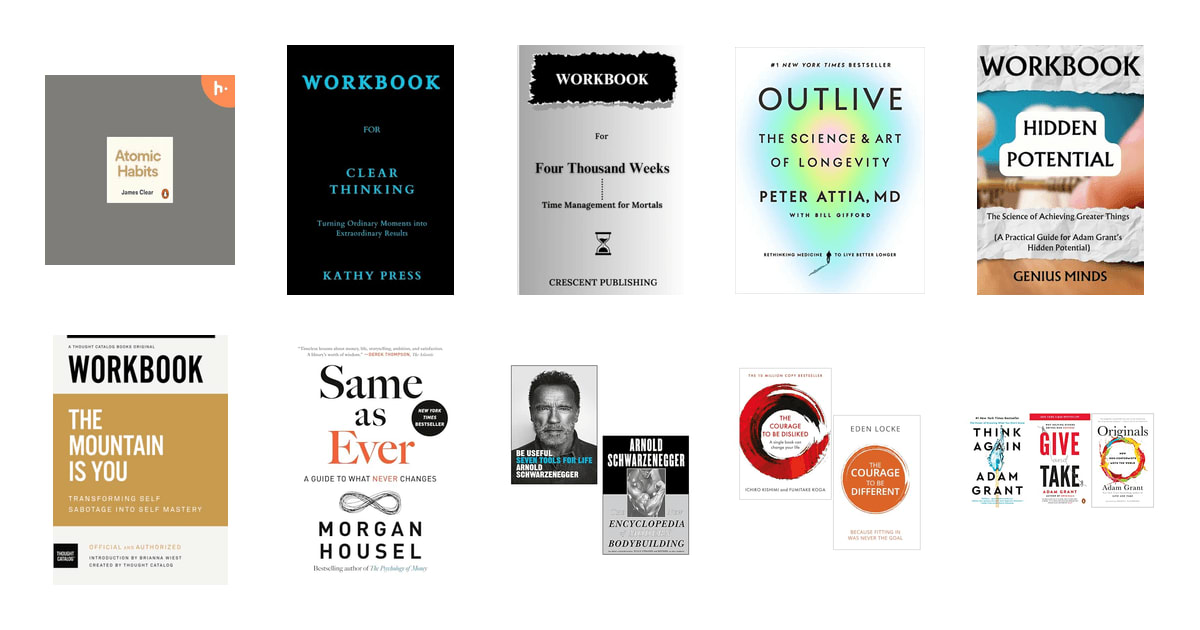
 | Atomic Habits-"James clear"Also in lineup | Audible | James Clear | Check price |
 | Workbook for Clear Thinking:Also consider | Workbook | Shane Parrish | $10.99 |
 | Workbook For Four Thousand Weeks:Also consider | Workbook | Oliver Burkeman | $8.99 |
| Outlive: The Science and Art of LongevityTop pick | Book | — | $13.33On sale |
 | Workbook: Hidden Potential: The Science of AchievingAlso consider | Workbook | Adam Grant | $12.99 |
| Workbook: The Mountain Is You: Transforming SelfBudget pick | Workbook | Brianna Wiest | $11.99 |
| Same as Ever: A Guide to WhatRunner-up | Book | — | $13.06On sale |
 | Arnold Schwarzenegger 2 Books Collection SetAlso in lineup | 2 Books Collection Set | Arnold Schwarzenegger | $83.99On sale |
| The Courage To Be Disliked by IchiroAlso great | 2 Books Collection Set | — | $28.04 |
| Adam Grant Bestselling 3 Books Collection -Upgrade pick | 3 Books Collection | Adam Grant | $57On sale |
How we picked
Something to do. We favored books and workbooks with concrete exercises, frameworks or protocols you can apply within a week of reading a chapter. Pure inspiration didn't make the picks.
Author credibility. We checked what the author actually knows — clinical practice, university research, documented track record — against the claims the book makes. A physician writing on longevity carries different weight than a blogger on the same topic.
Will you finish it. We compared page counts, chapter length and format, because completion rate is the hidden variable in this category. Short chapters and dialogue formats keep readers moving.
Honest formats. Several listings here are companion workbooks, not the original books, and we say so every time. We also checked which ones are authorized by the original author rather than third-party summaries.
What owners report. We read owner feedback for recurring themes about density, blank-page counts, edition quality and whether people actually applied the material. Consistent complaints mattered more than individual ones.
Top pickOn sale
Dense reading, but the most actionable plan for your next decade
Outlive: The Science and Art of Longevity
Outlive is a longevity book written by a practicing physician, and it's the rare self-help title that tells you exactly what to do: which markers to ask your doctor about, how to train, how to sleep. It's long and demanding, but the payoff is a plan you can follow for decades.
$13.33fromAmazonList priceMost books in this aisle want to change how you think; this one wants to change your next thirty years. Peter Attia's argument is that modern medicine waits until you're sick, then treats what's already broken. His alternative is prevention that starts decades earlier, aimed at heart disease, cancer, neurodegeneration and metabolic trouble. It's a bigger swing than any habit framework, and it's pointed at the years you'll actually feel it.
The specificity is the reason to buy it. Attia names the blood markers to ask about, explains zone-2 cardio in plain terms, and spends real pages on grip strength and balance because those are what fail first. If you've ever closed a health book with no idea what to do on Monday, this is the opposite problem. There's almost too much to act on.
It also reads more broadly than the biohacker packaging suggests. Owners well outside that crowd report getting a plan out of it — readers in their eighties, retired scientists, people with no medical background at all. Attia writes for a curious adult, not a specialist. And the section on emotional health, which he clearly cares about, catches a lot of readers off guard.
Nothing else here has this much evidence behind it. The workbooks in this guide put someone else's ideas into practice. Same as Ever gives you perspective. Outlive gives you a physician's reasoning, footnoted, with the uncertainty left in. If you're past thirty-five and starting to think seriously about how the next stretch goes, it's the one book on this list that's genuinely load-bearing.
Flaws but not dealbreakers
It's long, and it reads long. Attia goes deep into mechanism before he gets to the protocol, and owners who came for a quick health primer say they got more biochemistry than they wanted. If you want a two-hundred-page motivational nudge, this isn't it.
A few of the exercise recommendations land hard on older joints, and readers with existing knee or shoulder trouble say to treat them as a starting point rather than a prescription. Several of the biomarker suggestions need a doctor to order and interpret, so you can't act on them alone. And if you already follow this world closely, the core message — sleep, train, don't wait — will feel familiar.
Runner-upOn sale
Short chapters and lasting perspective, but nothing to do Monday
Same as Ever: A Guide to What
Morgan Housel writes about what never changes in people: fear, envy, luck, the urge to extrapolate. The chapters are short, the stories stick, and you'll likely finish it in two sittings. It won't hand you a system, and that's the trade.
$13.06fromAmazonList priceHousel's method is simple and a little sneaky. Instead of predicting what's next, he looks at what has never changed — how people handle risk, good news, bad luck — and builds a short chapter around each one. The stories do the arguing for him. You finish a chapter and realize you've absorbed a point you'd have fought about if he'd just stated it flatly.
It's the most finishable book here. Two dozen short, unnumbered chapters, roughly two hundred pages, and each one ends with a hook into the next. Owners describe reading it much faster than they meant to. That matters more than it sounds. A book you actually finish beats a better book you abandon at page eighty.
Where it pays off is in decisions with long horizons. If you're running a business, investing, or just trying not to panic when the news gets loud, Housel's frame — expect the same human behavior in new clothes — is more useful than another productivity system. Readers who work in finance tend to be the loudest about this one, and you can see why.
Flaws but not dealbreakers
It's observational, not prescriptive. There's no framework, no exercise, no checklist at the back. Readers who wanted a planning playbook come away disappointed, and a few describe the experience as pleasant but light — enjoyable in the moment, hard to say what changed afterward. If you've read The Psychology of Money, the rhythm will feel familiar and a couple of the anecdotes will too.
Budget pick
Gets at why you quit, if you'll do the writing
Workbook: The Mountain Is You: Transforming Self
This is the authorized companion to Brianna Wiest's The Mountain Is You, and it turns her argument about self-sabotage into direct, uncomfortable questions. It's a budget option that goes after the emotional reason your habit systems keep collapsing.
$11.99fromAmazonWiest's premise is that self-sabotage isn't laziness. It's protection. The part of you that abandons a goal right before it works is trying to keep you safe from something — exposure, failure, a version of yourself you don't have a plan for yet. Once you read your own behavior that way, a lot of stalled projects start making more sense than they did.
Reach for this one when habit systems keep failing you. If you've bought the productivity book, built the tracker and quit in week three, the problem probably isn't your system. The prompts here go after the belief underneath the behavior, one question at a time. Owners who stick with it describe it as therapy homework, in the good sense — slower than a tracker, and it sticks.
It's also the authorized companion, which matters more than usual in this corner of Amazon. Unofficial workbooks for popular titles are everywhere, and plenty of them are padded summaries with a few questions bolted on. This one follows the original chapter by chapter, so you can read a section and then work it while it's fresh. Get the original alongside it if you can.
Flaws but not dealbreakers
There's a lot of blank space. Every question gets generous room to write, which is the point if you journal and an irritation if you don't — some owners feel they paid mostly for paper. It also doesn't give page references back to the original book, so you'll do some flipping to line the two up.
The questions are blunt. If you're not ready to be honest on the page, you'll stall out in the first section, and no workbook can fix that for you. This is the one item here that asks something of you emotionally rather than just intellectually.
Upgrade pickOn sale
Three books at once, worth it only if you own none of them
Adam Grant Bestselling 3 Books Collection -
This set collects Think Again, Give and Take and Originals — Adam Grant's three big titles on rethinking, generosity and getting new ideas past institutions. It's a working library for anyone who wants ideas rather than routines.
$57fromAmazonList priceThink Again is the reason to buy the set. Grant's case is that noticing you're wrong and updating — thinking like a scientist rather than a preacher, prosecutor or politician — predicts how far you get better than raw intelligence does. It's a genuinely uncomfortable read if you're good at winning arguments. Most people who are will find themselves somewhere in it.
The other two round it out instead of repeating it. Give and Take looks at how generosity plays out at work, including the ways it backfires on people who can't say no. Originals is about how non-conformists actually push ideas through organizations, which turns out to be more procedural and less romantic than the framing suggests. Read together, they cover a lot of professional ground.
Buy this one only if all three are new to you. Grant's ideas recur across the books, so a partial buyer pays for material twice. If you've already read Think Again, picking up the missing volumes on their own makes more sense than starting over with a bundle.
Flaws but not dealbreakers
This is a bundle assembled by a reseller, not a publisher box set. Editions and bindings on listings like this can vary, so check what arrives against the ISBNs before you settle in with it. It's heavy, too — three trade volumes, not a commuter read.
Three books is also a real commitment. If you're the kind of reader who runs out of steam after the first one, you'll get more out of a single title you finish than a stack you admire on the shelf.
Also great
Philosophy, not pep talk, for people who hate self-help
The Courage To Be Disliked by Ichiro
The Courage to Be Disliked is a Socratic dialogue about Alfred Adler's psychology, and it argues that chasing approval is the main source of your unhappiness. This set pairs it with a lesser-known second title from Eden Locke.
$28.04fromAmazonThis is the book to hand someone who thinks the whole genre is nonsense. It's a conversation between a skeptical young man and a philosopher, and the young man pushes back hard. No morning routines, no affirmations, no promises about your best self. Just Adler's argument that most of your misery comes from trying to be liked, taken apart across five nights of debate.
The idea that does the most work is separation of tasks: figuring out whose problem something actually is. Your colleague's opinion of you is his task, not yours. Written down flat like that, it sounds cold. In practice it's the cleanest tool in this guide for people who over-function in every relationship they have and can't work out why they're so tired.
The dialogue format makes it easy to read in pieces. You can put it down mid-argument and pick it up a week later without losing the thread, which isn't true of the denser titles here. Readers who normally bounce off prescriptive self-help tend to finish this one, because it never tells you what to do. It just keeps asking whether your reasoning holds up.
Flaws but not dealbreakers
The second title in the set, Eden Locke's Courage To Be Different, is far less established than the Kishimi and Koga book. Treat it as a bonus, not a reason to buy. This is also a reseller-assembled pairing rather than a publisher edition, so the two volumes won't match on your shelf.
Adler's position that your past doesn't determine your present is a hard sell if you're carrying something serious. Some readers find it liberating; others find it dismissive of real trauma. And the philosopher in the dialogue can be smug enough to test your patience.
Who this is for
This guide is for you if you've got a specific bottleneck and want the book that targets it, not the one with the loudest marketing. If your energy and health are the problem, start with Outlive. If you keep quitting on yourself, the Mountain Is You workbook is more relevant than any productivity system. If you want to think better rather than do more, Same as Ever or the Adam Grant set will serve you.
It's not for you if you're looking for clinical treatment. None of these replaces therapy or a doctor, and several of them work best alongside one. We've also stuck to general personal-growth titles and authorized companion workbooks sold on Amazon, which means no textbooks, no memoirs and no niche business manuals. And if you already own three unread self-help books, buy nothing here until you finish one of them.
How we picked
We judged every title against the same handful of things. Something to do: does it give you exercises, protocols or a framework you can use inside a week, or does it just make you feel motivated? Author credibility: does the writer's actual record — clinical practice, research, a documented life — back the specific claims being made? Will you finish it: chapter length, page count and format decide whether a book gets read or shelved, so we treated finishability as a feature rather than a nicety. Honest formats: we flagged every companion workbook as a companion, and checked which ones are authorized rather than third-party summaries. What owners report: we looked for repeated themes in owner feedback about density, edition quality and whether people applied the material or abandoned it.
Other self-help books for personal growth worth considering
If you want sharper decisions at work: The Workbook for Clear Thinking: ($10.99) — This workbook puts Shane Parrish's Clear Thinking into practice, and its core idea earns its place here: bad decisions mostly get made in ordinary moments, not dramatic ones. The exercises make you write down your reasoning before and after you choose, which is the only reliable way to find out whether your judgment is any good. It's short and modular, so it fits around a real job. But it's a companion, and it assumes you've read Parrish first.
If productivity culture has burned you out: The Workbook For Four Thousand Weeks: ($8.99) — Oliver Burkeman's Four Thousand Weeks argues that the drive to optimize your time is the actual problem, and this workbook turns that argument into reflection prompts. For anyone who feels behind no matter how much they get done, the reframe lands hard in a good way. It's the slimmest item in this lineup and a genuine budget option. The catch is that philosophy without tactics frustrates readers who want a fix by Friday.
If you think your ceiling is already set: The Workbook: Hidden Potential: The Science of Achieving ($12.99) — Adam Grant's Hidden Potential makes the case that character skills — curiosity, asking for help, tolerating discomfort — predict long-run achievement better than raw talent, and this workbook turns that into self-assessments and practice routines. It's the right pick if you've decided you're not a creative person or not a natural leader. Owner feedback is thin because the listing is small, and readers already deep in Grant's work will find some exercises redundant.
The competition
This is what our research surfaced, not the whole shelf. Personal development is an enormous category and new titles land constantly, so treat what follows as the listing from this lineup that didn't earn a pick, along with the reason.
The Arnold Schwarzenegger 2 Books Collection Set ($83.99) — The Arnold Schwarzenegger set pairs Be Useful with The New Encyclopedia of Modern Bodybuilding. Be Useful is the draw: seven blunt tools — clear vision, think big, work hard, sell yourself, shift your mindset, shut out the negative voice, be useful — backed by a life that visibly ran on them. It's the most expensive item in this lineup by a wide margin, and half of what you're paying for is a bodybuilding reference most personal-growth readers will never open. Stock on the listing is also uncertain. Buy it if you want the training encyclopedia anyway; otherwise track down Be Useful on its own.
How to actually finish one
Pick the book that matches your bottleneck, then read it with a pen in hand. If you're buying one of the workbooks, get the original title first — the prompts assume you know the argument, and you'll write thin answers without it. Set a chapter-a-day pace instead of a book-a-week goal; the short titles here reward that and the long ones survive it. Write in the book, not in a separate notebook you'll lose by March. Then give one idea eight weeks before you move on to the next book. Readers who report real change usually made one change, not nine. If a title isn't landing by page fifty, put it down and try a different bottleneck.
Questions we get
Do self-help books actually work, or is reading them just a way to avoid the work?
Both, and which one it is depends on what you do after the last page. A meta-analysis of randomized trials published in Clinical Psychology Review found that structured bibliotherapy — books with concrete exercises attached — produced improvements comparable to brief counseling for mild-to-moderate symptoms. The operative word is structured. Passive reading is exactly where self-help turns into procrastination with a receipt.
Do I need the original book to use one of these workbooks?
Yes, in practice. The workbooks here are companions, built to follow someone else's argument chapter by chapter, and the prompts assume you know the framework already. You can technically work through one cold, but you'll be answering questions about ideas you've only half absorbed. Buy or borrow the original first, then work the companion alongside it.
What should I read if I'm in my twenties and still figuring things out?
Start with The Courage to Be Disliked and the Mountain Is You workbook. Between them they cover the two things that tend to be in the way at that stage: caring too much what other people think, and quitting on yourself right before something works. Neither one asks you to have your life sorted first. If you're heading into a high-stakes job, the Clear Thinking workbook is a good second buy.
What if my problem is procrastination?
Ask yourself first whether you've already tried systems and failed at them. If tracking and routines keep collapsing, the block is emotional, and the Mountain Is You workbook goes after the fear underneath the avoidance. If instead you freeze because you can't decide what to do, the Clear Thinking workbook is the better fit. Environment design beats willpower either way, but only after you know which problem you have.
How many self-help books should I read a year?
Four, read properly, will do more for you than a dozen skimmed. Research on bibliotherapy points the same direction: finishing one book with its companion exercises and applying them over eight to twelve weeks produces more change than racing through a stack. One title a quarter is an achievable cadence. It also leaves room to notice whether anything actually shifted.
Which one should I pick if I normally hate self-help books?
The Courage to Be Disliked, without much competition. It reads like philosophy — a real argument between two people, with no morning routines and no cheerleading — and skeptics tend to finish it. Same as Ever is the next best option, because Housel writes narrative non-fiction that happens to be useful rather than advice dressed up as stories.
Why you should trust us
For this guide:
- We read published reviews and publisher descriptions for every title in this lineup, and compared each companion workbook against the book it's built on.
- We looked for repeated themes in owner feedback — density, blank-page counts, edition quality, whether people applied the material — rather than weighing individual opinions.
- We checked the bundle listings against the individual editions they collect, so you know what's actually in the box.
- We read owner reviews on every listing, weighted toward the critical ones, because that is where the recurring failures show up.
- We have a systematic way of automatically fetching the latest prices, so the numbers on this page stay current.
- This is a research-focused guide, so the team may not own every product listed — though we often do own the top winners, which gives us extra context for the recommendations.
- We don't accept free products, and the retailer commission never changes which product we recommend.
Sources
Goodreads Choice Awards: Best Self-Help Books 2025, Goodreads
Atomic Habits — Author and Publisher Sales Data, James Clear / Penguin Random House
Bibliotherapy for Depression and Anxiety: A Meta-Analysis of 32 RCTs, Clinical Psychology Review
Four Thousand Weeks — New York Times Book Review, The New York Times
Adam Grant Faculty Profile — Wharton School of the University of Pennsylvania, University of Pennsylvania / Wharton
Amazon product listings and owner reviews for all 10 products
Manufacturer specification pages for each product
Some passages in this guide may be paraphrased with AI help. Prices are refreshed automatically.
More like this.
Continue exploring lifestyle reviews and recommendations.

The Best Self-Help Books for Mental Health
A mental health book has to work on your worst week, not your best one. That's the real test. You'll pick it up at 11 at night, read four pages, and put…

The Best Personal Finance Books for Building Wealth
Money advice fails for boring reasons. You know you should save more, you know index funds beat stock picking, and then it's Tuesday, you're tired, and…

The Best Personal Blenders
A personal blender earns its counter space by being fast. You drop in frozen berries, yogurt and a scoop of protein powder, twist on the cup, press once,…

The Best Hair Growth Serums for Thinning Hair
Hair thinning shows up in ordinary moments. You notice more strands in the shower drain, or your part looks wider under bathroom lighting. Maybe your…

The Best Hair Growth Serums For Thinning Hair
Thinning hair rarely announces itself. You notice a wider part in a bathroom mirror, or a ponytail that's gone slack, or more strands than usual circling…

The Best Hair Growth Products and Treatments
Hair loss is common enough to be unremarkable and personal enough to feel like a crisis. Roughly 50 million men and 30 million women in the United States…