The Best Self-Help Books for Mental Health
A mental health book has to work on your worst week, not your best one. That's the real test. You'll pick it up at 11 at night, read four pages, and put it down again. So what matters isn't how impressive the ideas are — it's whether the book meets you where you actually are. Short chapters help. So does a warm voice, a clear structure, and exercises you can do with a pen in ten minutes. Everything else is decoration.
Now the honest part. No book here can see you. It can't notice you've stopped sleeping, adjust when a technique isn't landing, or sit with you on a bad night. Bibliotherapy has real research behind it for mild-to-moderate depression and anxiety, but that's roughly the ceiling. If you're dealing with active trauma, psychosis, an eating disorder, or thoughts of hurting yourself, none of these are the right tool. Call or text 988 in the US and talk to a person instead. Books work alongside care, not in place of it.
The five titles here cover a lot of ground: cognitive behavioral therapy, narrative memoir, boundary-setting, habit science, and DBT skills. Which one helps depends less on which is best and more on what's actually wrong and how much energy you've got. Someone circling the idea of therapy needs a different book than someone whose therapist just assigned homework. We think that Feeling Good: The New Mood Therapy is the best self-help book for mental health for most people, and that the Lori Gottlieb 2 Books Collection Set is the one to buy if you're still deciding whether therapy is for you.
Everything we recommend

The most proven option here, if you'll do the exercises

The one that makes therapy feel less like a leap

For when the problem is everyone else's expectations
At a glance
| Product | Format | Weight | Price | |
|---|---|---|---|---|
 | Study Guide: Atomic Habits by James ClearAlso in lineup | Kindle eBook | — | $9.95On sale |
| David D.Top pick | Book | 0.75 pounds | $39.94 |
| Lori Gottlieb 2 Books Collection SetRunner-up | Book | 1.8077905484 Pounds | $32.99 |
| Study Guide: Set BoundariesAlso great | Kindle eBook | — | $9.95On sale |
 | Summary of Matthew McKayAlso consider | Kindle eBook | — | $3.99 |
How we picked
Evidence base. We favored books built on frameworks with published clinical support — CBT, DBT, ACT — over advice grounded in one author's personal story. Where a title had been studied directly as a standalone intervention, that counted heavily.
Who wrote it. We looked for licensed therapists, psychiatrists, and researchers rather than wellness personalities. Credentials aren't everything, but in this category they track closely with whether the advice holds up.
Format and effort. We compared page counts, chapter structure, and how much sustained attention each book demands. A workbook that asks for an hour a day fails a reader who can barely manage ten minutes.
Tone. We read published reviews and owner feedback for signs a book shames or pressures its reader. Anything that reads as you-should-have-tried-harder gets abandoned, and abandoned books help nobody.
Something to do. We checked whether each title leaves you with a technique, a script, or a worksheet rather than only an explanation. For readers in real distress, actionable beats interesting.
Top pick
The most proven option here, if you'll do the exercises
David D.
This is the CBT manual therapists hand out more than any other, and it's been studied in trials as a treatment on its own. You get mood logs, a list of the ten thought traps that keep low mood running, and a written method for arguing back.
$39.94fromAmazonNo other book in this guide has this kind of research behind it. Burns and his colleagues ran a randomized trial in which reading the book was the only treatment. Depressive symptoms dropped about as much as they did on antidepressants, in mild-to-moderate cases. Independent studies since have found much the same. That's an unusual claim for a paperback, and it's why therapists keep handing this one out.
It gives you names for the thoughts that keep looping. Burns walks through ten cognitive distortions — all-or-nothing thinking, mind reading, catastrophizing, and the rest. You'll probably recognize yourself in three of them in the first sitting. Naming the pattern is what makes it arguable. Once you can see that you're mind reading, you can ask what you'd tell a friend who said the same thing out loud.
The exercises need a pen and about ten minutes. The core tool is the triple column: write the thought, name the distortion, write a fairer version. There are mood logs too, and techniques attached to each chapter. Nothing here requires a therapist looking over your shoulder. And if you're already in CBT, this is the between-session homework that matches what you're doing in the room.
The tone never scolds you. That matters more than it sounds. A lot of mental health writing carries a faint whiff of you-should-have-tried-harder, and when you're depressed that's the fastest way to close a book for good. Burns writes like someone who's sat across from a few thousand people having a terrible year. He explains things. He doesn't lecture.
Flaws but not dealbreakers
It's built around depression, and it shows. If your main problem is complex trauma or PTSD, the cognitive tools here will only take you part of the way. They aren't wrong, they're just aimed somewhere else. Owners working through trauma tend to say the same thing: useful, but not the book they needed. Pair it with professional support rather than leaning on it alone.
Nothing happens unless you do the worksheets. This is the complaint readers repeat most, and it's fair. The book asks for sustained effort at exactly the point in your life when effort is hardest to find. Plenty of copies get abandoned around chapter four. If that's a risk for you, do one distortion at a time and skip around rather than reading straight through.
The writing is decades old and occasionally sounds like it. It's been revised, but some examples and cultural references land oddly now. You'll hit the odd paragraph that seems to be addressing a reader from another era. The method itself has aged fine — it's the packaging that creaks a little. Most people stop noticing after a chapter.
Runner-up
The one that makes therapy feel less like a leap
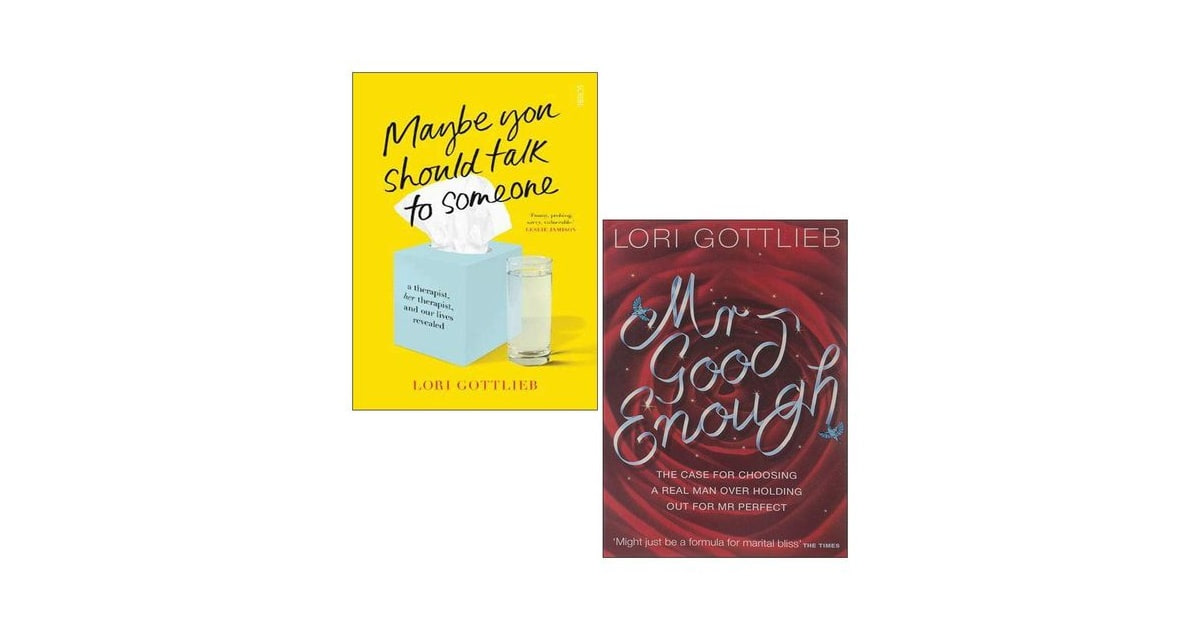
Lori Gottlieb 2 Books Collection Set
Gottlieb is a licensed therapist who writes like a novelist, and this set pairs her landmark book about the therapy room with a second title. It's the best thing here for anyone who's been thinking about getting help for a year and hasn't booked anything.
$32.99fromAmazonGottlieb shows you what actually happens in a therapy room. The book follows four of her clients while she quietly falls apart and starts seeing a therapist herself. You watch people change in slow, unflattering, recognizable ways — no breakthroughs on cue. If you've been circling the idea of therapy without doing anything about it, this is the book that tends to tip people over.
It reads like a novel, which is the whole point. Not everyone learns from worksheets. If you've bounced off clinical writing before, story does the work instead: you absorb the ideas through people rather than bullet points. The set pairs Maybe You Should Talk to Someone with a second title, so you get two books' worth of the same warm, funny, direct voice.
It's the best thing here for the shame around needing help. The two barriers people name most are stigma and not knowing what they'd be walking into. Gottlieb takes apart both, mostly by being honest about her own mess. It also works as a gift for someone you're worried about, because it doesn't read like an intervention wrapped in a dust jacket.
Flaws but not dealbreakers
You won't come away with a technique. This is memoir, not a program. No worksheets, no skills modules, nothing to practice on a Tuesday night. If you want something to do rather than something to understand, start with Feeling Good and come back to this one once you've got a routine going.
The second book isn't the reason to buy the set. Maybe You Should Talk to Someone is the draw, and it's the one people press on their friends. The companion title is a lighter, narrower read about relationships. Treat it as a bonus rather than half the value, and check the listing details before you order, since collection printings vary.
Also greatOn sale
For when the problem is everyone else's expectations
Study Guide: Set Boundaries
This condenses Nedra Glover Tawwab's boundary work for people who keep saying yes and paying for it in sleep and resentment. You get the scripts, an honest account of why saying no feels dangerous, and a format short enough to finish in an evening.
$9.95fromAmazonList priceIt targets a cause of burnout most books skip. A lot of anxiety comes from a calendar you never actually agreed to. Tawwab is a licensed clinical social worker who's spent years on exactly this — relationships, overextension, the slow leak of always being available. If you're a caregiver, a manager, or the person everyone calls first, this is your book.
You get actual words to say. The framework is unusually concrete: what to say, when to say it, and what to do when someone pushes back. That last part is what matters, because the hard bit isn't setting the boundary. It's the twenty minutes afterward when you feel like a monster. Tawwab addresses that guilt head-on instead of pretending it doesn't happen.
The short format is a feature when you're exhausted. The guide condenses the framework into something you can read in pieces on a commute. If you're already running on empty, a long book is just one more obligation you'll feel bad about. This one asks for less and still leaves you with something to try this week.
Flaws but not dealbreakers
It's a study guide, not the book. The condensed format trims case studies and nuance you'd get from Tawwab's original. If the boundary material really lands, buy the full book next. Think of this as a fast way to find out whether the framework fits your situation before you commit more reading time to it.
It only helps if your problem is relational. If your low mood has nothing to do with other people's demands, this won't touch it. And if you're working through childhood emotional neglect or complex trauma, boundary work can stir up more than you're expecting. That's work worth doing with a therapist rather than alone at the kitchen table.
Who this is for
This guide is for adults dealing with mild-to-moderate depression, anxiety, burnout, or the general sense that something needs to change — and who want reading that's grounded in clinical work rather than vibes. It's also for people already in therapy who want something to do between sessions, and for anyone supporting a partner, parent, or friend who's struggling. If you're new to all of this, start with whichever book matches how you learn, not whichever sounds most rigorous.
It isn't for everyone. If you're in crisis, newly bereaved, working through active trauma, or managing an eating disorder or psychosis, a book is the wrong first step — call 988 in the US or get to a licensed clinician. We also stuck to general-audience mental health reading. Clinical textbooks, parenting guides, addiction-specific programs, and children's books are outside what we looked at here.
How we picked
We weighed five things. Evidence base: whether the ideas come from CBT, DBT, ACT, or another framework with published clinical support, rather than from one person's story. Who wrote it: licensed therapists, psychiatrists, and researchers over wellness personalities, because in this category credentials track with whether the advice survives contact with a bad week. Format and effort: chapter length and structure, since a book that demands an hour a day fails the reader who has ten minutes. Tone: anything that shames or pressures you gets put down and never picked up again. Something to do: a script, a worksheet, or a technique you can use tonight beats an interesting explanation.
Other self-help books for mental health worth considering
If you want the DBT skills in a shorter form: The Summary of Matthew McKay ($3.99) — DBT was built by Marsha Linehan at the University of Washington for people whose emotions arrive at full volume — borderline personality disorder, self-harm urges, one crisis after another. This summary covers all four skill modules: mindfulness, distress tolerance, emotion regulation, and interpersonal effectiveness. It's the clearest map here of a framework that's usually taught only in supervised groups, and it's genuinely useful if your therapist already works this way and you want the concepts laid out plainly. What you give up is the practice. The full workbook has the worksheets, and these skills don't stick from reading about them. The writing is also dry — technical where the other books here are warm. Treat it as orientation, not treatment, and use it next to a clinician or a skills group rather than on its own.
The competition
Here's the rest of what our research surfaced. It isn't everything on the shelf — the mental health section is enormous and new titles land constantly. This is what we looked at closely enough to have an opinion about, and the reasons it didn't make the picks are worth knowing before you buy.
The Study Guide: Atomic Habits by James Clear ($9.95) — The Study Guide: Atomic Habits by James Clear (SuperSummary) condenses the enormously popular habit book into its core loop — cue, craving, response, reward — plus habit stacking and environment design. There's a real mental health case for it. Behavioral activation, meaning doing small things on a schedule whether you feel like it or not, is a first-line move for depression, and this gives you a system for making those things automatic instead of leaning on motivation you don't have. The identity idea lands too: shifting the story from I'm depressed to I'm someone who takes care of this isn't far from what CBT does with thoughts. But it's a summary of a general behavior book, with no clinical perspective and nothing specific about anxiety, grief, or trauma. The short sections do make it easy to finish if your concentration is shot. If your routines are the thing that's broken, it's a fine low-effort start — just don't ask it to do a therapy book's job.
How to actually finish one
The best book here is the one you'll finish, which usually isn't the most thorough one. If you're in a low-energy stretch, start with the Gottlieb collection or one of the study guides and work up to Feeling Good or the DBT material once you've built a little momentum. Don't read a workbook front to back either. Find the chapter that describes your exact problem, do that, then pick another. Keep a pen in it, because the exercises are the active ingredient and reading them without doing them is like reading about push-ups. And give yourself permission to stop. A book that's making you feel worse isn't one you owe anything to.
Questions we get
Do self-help books actually work, or do I need a therapist?
For mild-to-moderate depression and anxiety, the research is genuinely encouraging — CBT-based bibliotherapy has produced symptom improvements in controlled trials comparable to short-term therapy. But that's a specific claim about specific conditions. Books aren't appropriate as the only treatment for severe depression, active trauma, psychosis, eating disorders, or suicidal thinking. The strongest use is as reinforcement for work you're doing with a clinician.
Which one should I start with if I've never been to therapy?
The Lori Gottlieb 2 Books Collection Set, almost always. It shows you what a therapy room is actually like, reads like fiction, and takes the strangeness out of the idea of going. Once you're ready to work on something specific, Feeling Good is the natural next step because it hands you a method rather than a story.
Which of these do therapists hand out most?
Feeling Good is the one that shows up most on clinical reading lists, usually for clients working on depression and negative thought patterns. DBT skills material gets assigned by clinicians treating emotional dysregulation, and boundary-focused reading comes up often with clients dealing with codependency and burnout. Gottlieb's work gets recommended as a pre-therapy primer more than as a treatment.
What if I have ADHD and never finish books?
Start with a study guide. The Atomic Habits and Set Boundaries summaries are short, clearly signposted, and built for reading in fragments, which is why they work when sustained attention is the problem. For Feeling Good, don't read linearly — open to the chapter on the one cognitive distortion you recognize in yourself and do just that. Finishing one chapter beats abandoning ten.
Is a summary worth reading instead of the full book?
Sometimes, but know what you're trading. A summary gets you the framework fast, which is real value when your concentration is limited or you're not sure the approach fits you. What it can't give you is the case studies, the nuance, or the guided exercises that make a workbook work. Use one to decide whether to buy the original, not as a permanent substitute.
What should I read if I'm working through trauma?
The DBT skills summary is the most directly useful title here, because emotion regulation and distress tolerance are the skills that help when a trauma response hits. The Gottlieb collection helps with the relational side, though it won't hand you tools. This is the one area where we'd push hardest on getting professional guidance — some trauma processing techniques can make things worse without a trained clinician involved.
Why you should trust us
For this guide:
- We read the published clinical research on bibliotherapy, including the trials and meta-analyses that established CBT-based self-help as a legitimate intervention.
- We compared each title against clinical training reading lists and the recommendation lists published by mental health organizations.
- We read through owner feedback for every book here, watching for the complaints that repeat — abandoned workbooks, summaries that felt thin, formats that didn't match what the reader needed.
- We read owner reviews on every listing, weighted toward the critical ones, because that is where the recurring failures show up.
- We have a systematic way of automatically fetching the latest prices, so the numbers on this page stay current.
- This is a research-focused guide, so the team may not own every product listed — though we often do own the top winners, which gives us extra context for the recommendations.
- We don't accept free products, and the retailer commission never changes which product we recommend.
Sources
Bibliotherapy and Depression: A Meta-Analysis of Randomized Controlled Trials, PubMed Central / Journal of Consulting and Clinical Psychology
Feeling Good Bibliotherapy Trial — David Burns et al., PubMed / Journal of Affective Disorders
The Anxious Generation — Publisher Data & Academic Response, anxiousgeneration.com
American Psychological Association: Self-Help Books and Psychotherapy, APA Monitor on Psychology
Goodreads Choice Awards 2025 — Best Books in Health, Mind & Body, Goodreads
New York Times Bestseller List — Health, Mind & Body (2025–2026 archive), The New York Times
National Alliance on Mental Illness (NAMI): Recommended Reading, NAMI
Association for Contextual Behavioral Science: ACT Reading List, Association for Contextual Behavioral Science
Amazon product listings and owner reviews for all 5 products
Manufacturer specification pages for each product
Some passages in this guide may be paraphrased with AI help. Prices are refreshed automatically.
More like this.
Continue exploring lifestyle reviews and recommendations.

The Best Books for Anxiety and Mental Health
An anxiety book has one job: to give you something to do at 3 a.m. when your chest is tight and your brain won't stop looping. That's a different job than…

The Best Self-Help Books for Personal Growth
A self-help book only works if you finish it and then do something with it. That sounds obvious. It's also the step most buyers skip. You buy the title…

The Best Health and Longevity Books
Most health books tell you to eat better and move more. The useful ones tell you what to eat, how to move, and how to know it's working. That's the…

The Best Metal Detectors for Finding Gold
Gold hides in ground that fights you. The dirt in most active goldfields is loaded with iron, and that iron talks back to a detector all day long - …

The Best Children's Cookbooks for Ages 9 to 12
A kid at this age can do real cooking. Nine- to twelve-year-olds can handle a knife with supervision, read a recipe start to finish, and use a stovetop…

The Best Portable Solar Generators for Emergencies
A power outage is boring right up until it isn't. The fridge stays cold for a few hours, then it doesn't. The phones drain, the router dies, and if…