The Best Chest Freezers for the Garage in 2026
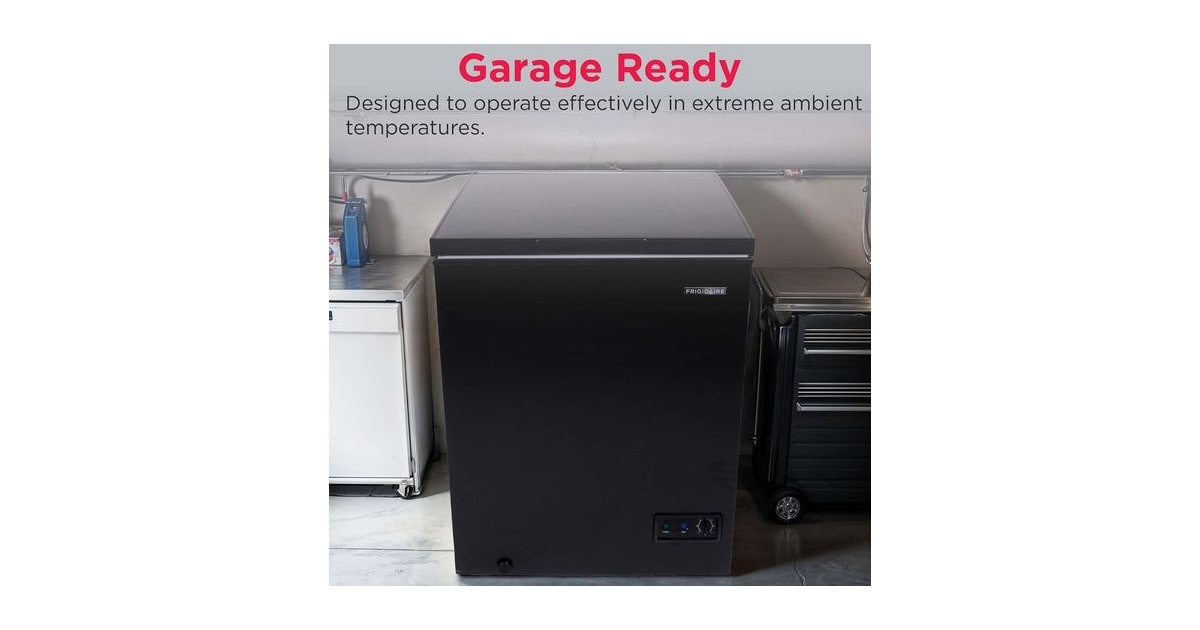
A second freezer in the garage changes how you shop. You buy the family pack, portion it out, and stop making a midweek run for chicken thighs. Garden tomatoes, a bulk box of popsicles, half a hog from a local farm — it all goes out there instead of fighting for room above the fridge. But a garage isn't a kitchen. The air can push past 100°F in the summer and drop below freezing on a cold night, and that swing is what most freezers aren't built to handle.
No chest freezer here defrosts itself, so once a year you'll unplug it, haul the food into coolers, and wait for the ice to let go. Chest designs also make you dig. Baskets help with the top few inches; everything below that is a stack you'll have to rearrange. And garage-ready is a loose term. Some brands publish an exact ambient range, others just print the words on the box, and you often can't tell the difference from a product page.
So the practical questions are how much of that ambient claim is actually documented, how much food you freeze, and how much floor you're willing to give up. Capacity is the thing people get wrong most often — a five-cubic-foot box fills faster than you'd think, and a twenty-one-cubic-foot one eats a parking spot. We think that the Frigidaire EFRF5003 is the best garage chest freezer for most people, and that the Hamilton Beach HBFRF2129 is the one to buy if you're storing a side of beef or a season of game.
Everything we recommend
Simple, compact and easy to live with, if 5 cubic feet is enough

Enough room for a side of beef, if you can spare the floor

A published temperature range and a long in-home warranty
Prices as of Oct 27, 8:28 AM PT · Details
At a glance
| Product | Capacity | Weight | Price | |
|---|---|---|---|---|
| FRIGIDAIRE EFRF5003-BLACK Chest Deep Freezer-Garage-ReadyTop pick | 5.0 cu ft | 35 lb | $278.99 |
 | Midea 12Also in lineup | — | 58.86 lb | Check price |
 | Maytag W10111620 Dryer Control Board Genuine OriginalAlso in lineup | — | — | $165.99 |
 | Whirlpool W11550898 Genuine OEM Washer Dispenser TrayAlso in lineup | — | — | $12.16On sale |
| Hamilton Beach HBFRF2129 21 cu ft DoubleUpgrade pick | 21 cu ft | 150 lb | Check price |
| Danby DCF050A5WDB 5.0 cu. ft. Square ModelAlso great | 5.0 cu ft | 55.84 lb | $349.99 |
 | Chest Freezer Deep Freezer for Garage 5.0Also in lineup | 5.0 cu ft | 45 lb | Check price |
 | Kenmore Elite 81714 Pet Friendly Ultra PlushAlso in lineup | — | 25.11 lb | $349.99On sale |
Prices as of Oct 27, 8:28 AM PT · Details
How we picked
Documented ambient range. We looked for a specific operating range on the spec sheet, not the phrase "garage ready" on its own. A unit that states 0°F to 110°F can be checked against your garage; one that says nothing can't.
Capacity and footprint. We matched capacity to household size rather than treating bigger as better, since a chest freezer takes floor space you can't get back. Roughly five cubic feet suits one or two people, and twenty-plus is for whole animals and case buying.
Defrost and drainage. Every freezer here is manual defrost, so we favored cabinets with an accessible exterior drain over ones that leave you scooping meltwater. Owner feedback across the category shows this is the chore people most often regret ignoring.
Warranty and owner history. We compared stated warranty terms and read owner feedback for repeated failure modes, giving more weight to problems that show up again and again — shipping damage, temperature drift — than to isolated complaints.
Top pick
Simple, compact and easy to live with, if 5 cubic feet is enough
FRIGIDAIRE EFRF5003-BLACK Chest Deep Freezer-Garage-Ready
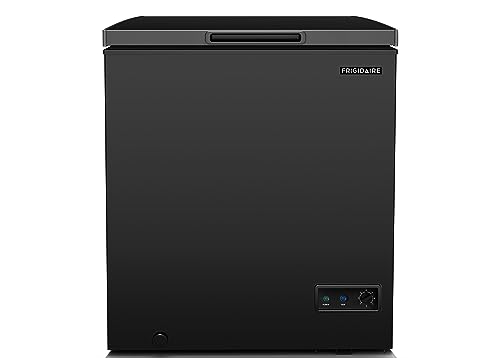
The Frigidaire EFRF5003 is a five-cubic-foot chest freezer with a seven-setting dial, one removable basket, and an outside drain for defrost day. It's the size most households actually need for overflow, and it's simple enough that there's very little on it to break.
$278.99fromAmazonPrices as of Oct 27, 8:28 AM PT · Details
Five cubic feet is the right amount of freezer for most garages. It holds a warehouse-club run, a few weeks of batch cooking, and a bag of ice without turning into an archaeological dig. It also fits in the gap beside the water heater or under a workbench, which matters when your garage still has to hold a car. Bigger is only better if you'll fill it.
The controls are a knob with seven settings, and that's the whole interface. Owners describe the same routine over and over: unbox it, plug it in, set the dial, walk away. There's a power-on light on the front, so after a breaker trip you can confirm it's running from the doorway instead of lifting the lid and letting the cold out.
Defrost day is easier here than on most bargain chest freezers. There's a drain on the outside of the cabinet, so meltwater runs into a pan instead of getting sponged out of the bottom by hand. The liner is aluminum, which wipes down fast and doesn't hold smells the way a scratched plastic tub eventually does. Small thing, once a year, but you'll be glad.
It weighs about 35 pounds empty, which sounds trivial until you're the one moving it. One person can walk it into a corner, level it, and be done. Compare that with the 150-pound Hamilton Beach, which is a two-person job and a bit of a planning exercise. If your garage layout shifts with the seasons, that difference is worth real money.
Flaws but not dealbreakers
The most common complaint has nothing to do with how it freezes. Owners repeatedly report units arriving dented, often near the thermostat housing or along a corner, and plenty of them decide the damage is cosmetic and keep it rather than fight through the return of a large appliance. Inspect the box before the driver leaves, and photograph anything you find.
The rest is the usual compact-chest compromise. There's no interior light, so a dim garage means a flashlight in your teeth. Defrost is manual, which is an annual chore you can't skip. And if you're cooking for five, you'll outgrow five cubic feet within a couple of shopping trips.
Upgrade pick
Enough room for a side of beef, if you can spare the floor
Hamilton Beach HBFRF2129 21 cu ft Double
The Hamilton Beach HBFRF2129 holds 21 cubic feet behind a split double lid, so you open half the freezer at a time and can still reach the back corners. It's the one to buy if you hunt, fish, or shop by the case.
Check priceatAmazonPrices as of Oct 27, 8:28 AM PT · Details
Reaching the bottom of a twenty-one-cubic-foot chest through a single lid means most of you goes in with the food. The split lid fixes that. You open the half you need, the other half stays sealed, and the lid holds itself up while you dig. On a freezer this size, that's not a gimmick — it's the difference between organized and chaotic.
Buy this one if your freezer is part of a food system, not just spillover. A processed deer, a quarter of beef, a season of vacuum-sealed fillets — none of that fits anywhere else in this guide. Two vinyl-coated baskets hold the things you grab weekly, and the bulk goes underneath. Owners who fill it with game and fish keep saying they underestimated how much it swallows.
It also handles heat better than a quick look at the spec sheet suggests. Owners running it in unconditioned spaces — apparatus bays, uninsulated garages, rooms that get brutally hot on a summer afternoon — report it holding temperature without drama. There's a lock built into the outside handle, too, which is worth having if your garage is detached or shared.
The small stuff is where it earns its keep. A power-on light lets you check on it from across the garage. The front-access drain saves you from bailing out meltwater. The flat back lets it sit closer to the wall than the rounded cabinets some brands still sell. None of that is exciting on day one. All of it is what you notice on year three.
Flaws but not dealbreakers
It's 150 pounds empty and wide enough to swallow a good chunk of a parking bay. Getting it into place takes two people, a clear path, and some thought about where it lives permanently, because you won't want to move it twice. Measure the spot, including the clearance the lids need to swing open.
Delivery is the other risk. Owners report units arriving standing on end rather than upright, which is exactly how you disturb a compressor, and sorting that out after the truck pulls away is slow going. Past that, it's manual defrost, and defrosting 21 cubic feet is a genuine afternoon.
Also great
A published temperature range and a long in-home warranty
Danby DCF050A5WDB 5.0 cu. ft. Square Model
The Danby DCF050A5WDB is a five-cubic-foot chest freezer rated to run in ambient temperatures from 0°F to 110°F, stated plainly rather than implied. It's Energy Star compliant and backed by an unusually long in-home warranty.
$349.99fromAmazonPrices as of Oct 27, 8:28 AM PT · Details
Danby publishes the number, and that's the whole argument for it. Most garage-ready claims are a phrase on a box. This one specifies operation from 0°F to 110°F, so you can check it against what your garage actually does instead of hoping. If you deal with real winters, or a west-facing garage that bakes all afternoon, that single spec decides whether your food stays frozen.
The warranty backs the claim up. Five years of parts and labor, in your home, is longer than most of this category offers, and in-home coverage matters for something you can't carry to a service counter. Danby also states 48 hours of holdover in an outage with the freezer three-quarters full, which is the scenario that ruins a season of meat.
Two lights sit on the front, one for power and one for the compressor. That sounds fussy until the first time you walk out and find the unit has power but isn't cooling. It's a problem you want to catch early, not the next time you lift the lid and everything's soft. The square cabinet also uses its footprint well for a five-cubic-foot box.
Flaws but not dealbreakers
You pay more per cubic foot here than for anything else in this guide, and five cubic feet is still five cubic feet. If your household is bigger than two people who freeze the occasional bulk buy, you'll be shopping for capacity again while this one is still under warranty.
The owner track record is thin. There isn't much feedback on this model yet, and what's out there is mixed, so the published range and the warranty are carrying more of the argument than a long history of happy buyers would. That's a defensible bet. It's still a bet.
Danby covers the DCF050A5WDB with a five-year in-home parts-and-labor warranty.
Who this is for
This guide is for anyone putting a freezer somewhere that isn't heated or air conditioned: an attached garage, a detached shop, a basement that swings with the weather. If you hunt, fish, buy meat in bulk, garden seriously, or batch cook for a full week, a chest freezer is the most efficient way to add a lot of frozen storage, and it holds cold better than an upright because the cold air stays put when you open the lid.
If your freezer lives in a kitchen or a conditioned utility room, you don't need any of this — a standard model will be fine, and an upright will be easier to organize. Skip a chest freezer entirely if you can't commit to defrosting it once a year, and skip the big ones if you don't already know what you'd fill them with. We're only covering chest-style freezers here; uprights, deep-freeze conversions, and portable 12-volt coolers are a different guide.
How we picked
We started with the documents, not the marketing. Ambient range: we wanted an explicit operating spec, something like 0°F to 110°F, rather than a garage-ready badge with no numbers behind it. Capacity: we matched cubic feet to real households, since an overfilled small freezer and a half-empty big one are both mistakes. Defrost: manual defrost is unavoidable in this category, so an exterior drain that lets meltwater run out instead of getting bailed out matters. Security and status: a power-on light tells you the unit survived a breaker trip, and a lid lock matters in a detached or shared garage. Warranty and owner history: we compared stated coverage and read owner feedback for the flaws that repeat.
The competition
Here's what our research turned up beyond the picks. It isn't a census of every chest freezer on the market — it's the rest of this lineup, and why each one didn't take an award.
The Chest Freezer Deep Freezer for Garage 5.0 — The WANAI 5.0 Cu.Ft chest freezer is the bare-bones option here: a seven-setting dial, one removable basket, and a compact black cabinet that tucks into a corner and stays quiet. Owners like how much it holds for its size, though a few expected something noticeably larger than what showed up. The problem for this guide is documentation. The listing specifies an internal temperature range and says nothing about the ambient conditions the compressor is rated for, so you can't tell how it behaves when the garage is below freezing or well over 90°F. In a basement, an apartment, or an attached garage that stays mild, it's a sensible second freezer. For an unconditioned garage, buy something that publishes a number.
Care and maintenance
Plan on defrosting once a year, or whenever the frost gets thicker than about a quarter inch, because ice steals capacity and makes the compressor work harder. Move the food into coolers, unplug the unit, prop the lid open, and let the ice melt into the drain instead of chipping at it — an ice pick through the liner is an expensive mistake. Leave a few inches of clearance around the cabinet so heat has somewhere to go, and level it so the lid seals evenly. Plug it straight into a grounded outlet; extension cords are a common cause of nuisance failures. A basic min/max thermometer inside tells you whether it's actually holding temperature between visits.
Questions we get
What is a garage-ready chest freezer, and why does it matter?
It's a freezer whose compressor and refrigerant circuit are calibrated to keep cycling when the surrounding air is very cold or very hot. A standard freezer leans on room-temperature air to trigger its cycle, so in a cold garage it can stop running while the food inside slowly warms. If your freezer lives outside conditioned space, look for a stated ambient range.
Will a regular chest freezer work in an unheated garage in winter?
Often not. Many standard freezers stop cycling once the surrounding air drops below roughly 50°F, and the interior drifts up above safe freezing temperatures even though the garage itself feels frigid. That's the failure that catches people off guard, because everything looks fine from the outside. Choose a model rated down to 0°F if your garage gets genuinely cold.
What size chest freezer do I need for a family of four?
Somewhere in the mid-teens of cubic feet is the usual recommendation for a family that buys in bulk or batch cooks. If you just need overflow for a kitchen freezer that's always full, five to seven cubic feet is plenty and takes far less floor space. Be honest about how much you actually freeze — a half-empty chest freezer still costs you a parking spot.
Which one should I get if my garage gets brutally hot?
Pick a model with a published upper ambient limit around 110°F. The Danby DCF050A5WDB states that range on its listing, and owners of the Hamilton Beach HBFRF2129 report running it in unconditioned spaces that get very hot without losing temperature. Avoid anything that doesn't publish an upper limit at all.
Do chest freezers use much electricity?
Not much, relatively speaking. Chest designs hold cold air in when you open the lid, and an Energy Star model like the Danby is efficient enough that it's a minor line on a power bill. A freezer sitting in a very hot garage will draw noticeably more — plan on something like 15 to 20 percent above its rated consumption — because the compressor runs longer to shed heat.
Is a lid lock worth having?
It is if your garage is detached, unlocked during the day, or shared with tenants or roommates. The Hamilton Beach HBFRF2129 has a lock on the external handle. It also keeps curious kids out of a heavy lid, which is the safety argument more than the theft one.
Why you should trust us
For this guide:
- We read the manufacturer spec sheets and listing documentation for every freezer here, paying close attention to whether an ambient operating range is actually published or merely implied.
- We compared capacity, defrost design, drain placement, warranty terms and security features across the lineup, alongside published reviews of these models and their close siblings.
- We read through owner feedback on each unit looking for failure modes that repeat — shipping damage, size surprises, missing documentation — rather than one-off complaints.
- We read owner reviews on every listing, weighted toward the critical ones, because that is where the recurring failures show up.
- We have a systematic way of automatically fetching the latest prices, so the numbers on this page stay current.
- This is a research-focused guide, so the team may not own every product listed — though we often do own the top winners, which gives us extra context for the recommendations.
- We don't accept free products, and the retailer commission never changes which product we recommend.
Sources
Best Chest Freezers — Wirecutter / New York Times, Wirecutter
Best Chest Freezers — Consumer Reports, Consumer Reports
Best Chest Freezers for the Garage — Good Housekeeping, Good Housekeeping
Best Garage Freezers — Bob Vila, Bob Vila
Best Chest Freezers — Tom's Guide, Tom's Guide
Best Chest Freezers — CNET, CNET
Best Chest Freezers — The Spruce, The Spruce
Best Garage Freezers — Popular Mechanics, Popular Mechanics
Amazon product listings and owner reviews for all 8 products
Manufacturer specification pages for each product
Some passages in this guide may be paraphrased with AI help.
Product prices and availability are accurate as of the date/time indicated and are subject to change. Any price and availability information displayed on Amazon.com at the time of purchase will apply to the purchase of this product.
More like this.
Continue exploring appliances reviews and recommendations.

The Best Rolling Tool Chests
A rolling tool chest earns its keep in the boring moments. You reach for a 10 mm socket with greasy hands, pull the drawer, and it either glides or it…

The Best Garage Door Insulation Kits
A bare steel garage door is basically a heat sink bolted to your house. In July it soaks up sun all afternoon and radiates it into the space where your…

The Best Garage Floor Containment Mats of 2026
Winter doesn't stay outside. Every time you pull into the garage, your tires and wheel wells carry in slush, road salt and grit, and it all melts into a…

The Best Electric Garage Heaters
A cold garage isn't just unpleasant. It's the reason your winter projects keep getting postponed, the reason your fingers stop working on a socket wrench…

The Best Garage Workbenches
A workbench is the thing your whole garage organizes itself around. Once you have a flat, solid surface at the right height, you stop working on the…

The Best Pegboard Organizers for Garage Walls
A garage wall is storage you already paid for, and most of us waste it. Tools end up in a drawer, a bucket, or a pile on the workbench, and you spend ten…