The Best Quiet Ceiling Fans With Remote Control
A ceiling fan is one of the few appliances that runs while you sleep, so noise is the thing that decides whether you love it or resent it. A good one disappears. You feel the air move, and that's it. A bad one hums, ticks, or develops a faint wobble that you'll hear at 2 a.m. and nowhere else. The remote matters for the same reason: if changing speed means standing on the bed and yanking a chain, you'll just leave it on whatever setting it's stuck at.
Here's the honest part. No fan is silent, and the quiet ratings you see in listings come from the companies selling them, not from any neutral referee. Most fans that whisper on low get audible on high, because moving more air always means more noise. Installation matters as much as the motor: a loose downrod, a wobbling blade, or a light box that isn't fan-rated will make an expensive fan sound cheap. And a lot of fans marketed with remotes actually ship with a wall control, with the handheld sold separately.
We looked at ten fans, from builder-grade classics to smart models with app control, and weighed motor type, blade span, what control actually comes in the box, and the flaws owners keep running into. We think that the Hunter Bennett 52-inch is the best quiet ceiling fan with remote control for most people, and that the Monte Carlo Clarity is the one to buy if your ceilings are eight feet or lower and a flush mount is your only option.
Everything we recommend

Quiet, easy to control, and sized for the rooms you use most
The one for eight-foot ceilings, with a handheld and a wall control

As close to silent as fans get, if you'll pay a lot more

For great rooms and porches a normal fan can't handle
Prices as of Oct 27, 8:28 AM PT · Details
At a glance
| Product | Blade Size | Speeds | Price | |
|---|---|---|---|---|
| Hunter Fan CompanyTop pick | 52" | 3-Speed | $349.99 |
 | Minka-Aire F519L-ORB Concept II 52 Inch CeilingAlso consider | 52" | 3-Speed | $469 |
 | Kichler 330152NI 54 Inch Sola Ceiling FanAlso consider | 54" | 3-Speed | $341.58 |
 | Westinghouse Lighting78043 Vintage Three-Light 52-Inch Five BladeAlso in lineup | 52" | 3-Speed | Check price |
 | Progress Lighting P250084-31M AirPro 52-Inch AC MotorAlso in lineup | 52" | — | $96.02 |
 | Casablanca 54 inch Indoor Ceiling Fan NoAlso in lineup | 54" | — | Check price |
| Monte Carlo 3CLYR52BSD-V1 Clarity 52" Hugger FanRunner-up | 52" | — | $479 |
| Big Ass FansUpgrade pick | 52" | 7-Speed | $899 |
| Fanimation Odyn 84 inch Indoor/Outdoor Ceiling FanAlso great | 84" | 6-Speed | $549.98 |
Prices as of Oct 27, 8:28 AM PT · Details
How we picked
Quiet on low. We prioritized fans whose motors are designed for low-noise running rather than raw output, and we leaned on owner feedback about hum, ticking, and wobble over time. A fan that's only quiet the first month doesn't count.
What's in the box. This guide is about remote control, so we checked spec sheets to see whether the handheld actually ships with the fan or is sold separately. Several well-reviewed fans lost ground here for shipping with a wall control only.
Span and room fit. We matched blade span to room size using manufacturer coverage ratings, favoring 52-inch fans for typical bedrooms and living rooms. Larger spans only made sense where a standard fan can't move enough air.
Mounting height. Flush-mount and downrod fans solve different problems, so we made sure the lineup covered both. Listed ceiling-to-blade dimensions decided which fans are safe in an eight-foot room.
Light and controls. We looked for dimmable integrated lighting, a reverse function on the remote, and enough speed steps to find a comfortable setting. Three speeds is workable; six or more is better.
Top pick
Quiet, easy to control, and sized for the rooms you use most
Hunter Fan Company
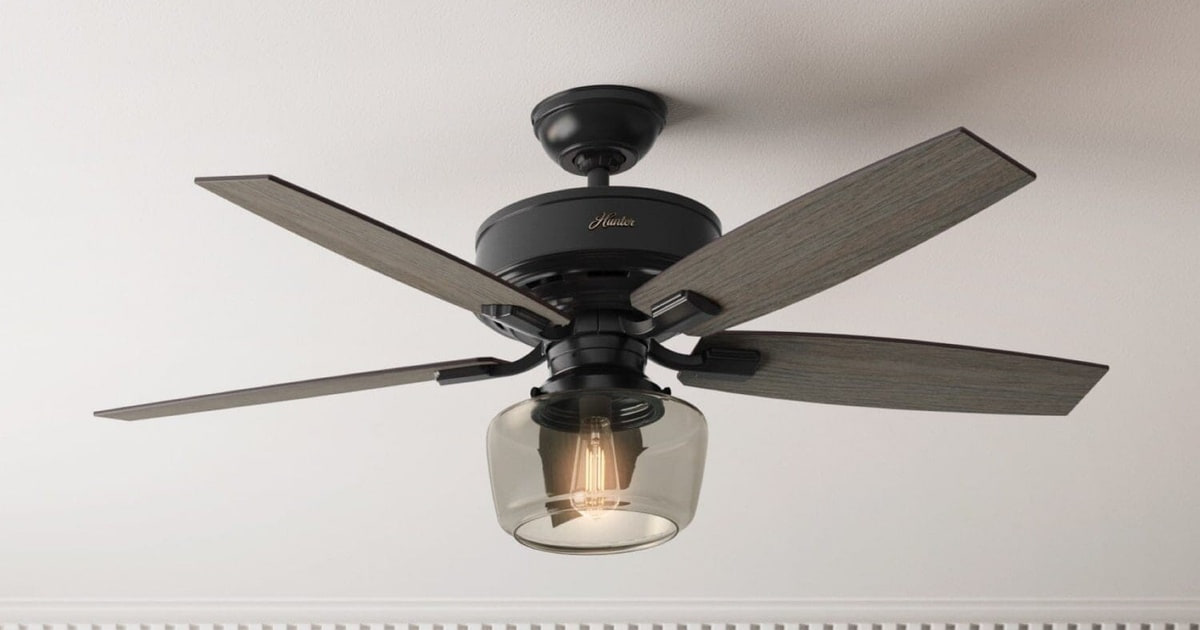
The Hunter Bennett is a 52-inch fan with a reversible WhisperWind motor, an integrated LED light, and a handheld remote in the box. It covers a large bedroom or a living room without calling attention to itself, which is exactly what you want from a fan.
$349.99fromAmazonPrices as of Oct 27, 8:28 AM PT · Details
The motor is the part you'll notice least, and that's the whole job. Hunter builds the Bennett around its three-speed WhisperWind motor, tuned for low noise rather than raw output. On low, most owners describe it as background air movement rather than a sound. That's the threshold that matters if you sleep with the fan on or work in the same room, because a faint hum you can hear is a hum you'll keep hearing.
The remote comes in the box, which is rarer than it should be. Plenty of fans in this category advertise remote control and then ship with a wall plate, leaving the handheld as a separate purchase. The Bennett doesn't play that game. You get speed and light control from the couch on day one, and you can dim the LED without wiring a dimmer switch into the wall.
Fifty-two inches is the size most rooms actually want. It's the right span for a large bedroom, a standard living room, a kitchen, or a home office, roughly the 225-to-400-square-foot range where most people are shopping. Go smaller and you'll run the fan high to feel anything, which is where noise lives. Go bigger and you're paying for air you can't use.
The reversible setting earns its keep in winter. Flip the direction and run it slow, and the fan pushes the warm air that collects at your ceiling back down to where you're sitting. In a room with high ceilings or a wood stove, that's a real difference in comfort. It costs nothing to use, and the Bennett puts the control on the remote instead of on a slide switch you'd have to reach.
Flaws but not dealbreakers
Three speeds is fewer than you'd get from a premium DC fan. Some competitors give you six or seven steps, which lets you land on exactly the airflow you want. With the Bennett you sometimes end up choosing between a little too little and a little too much. In practice most people settle on low and forget it, but if you're picky about airflow, the coarse steps will bug you.
Matte black looks great and shows every speck of dust. Blade tops collect it, and on a dark finish you'll see the film sooner than you would on brushed nickel. Plan on a wipe-down more often than you'd like. The finish is also the only one offered in this version, so if black doesn't work in your room, you're shopping elsewhere.
There's no app or voice control here. The remote does everything, but it's a remote: lose it and you're back to the wall switch. If you want the fan to turn on with a schedule, a smart speaker, or a temperature trigger, you'll need a different fan or a separate smart switch.
Runner-up
The one for eight-foot ceilings, with a handheld and a wall control
Monte Carlo 3CLYR52BSD-V1 Clarity 52" Hugger Fan
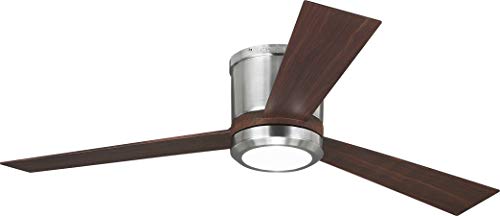
The Monte Carlo Clarity is a 52-inch hugger fan that sits close to the ceiling, so it works in rooms where a downrod fan would loom. It includes both a handheld remote and a wall control, plus a dimmable LED light kit.
$479fromAmazonPrices as of Oct 27, 8:28 AM PT · Details
If your ceiling is eight feet or lower, this is the shape you need. The Clarity mounts flush, hanging just over nine inches from ceiling to the bottom of the light. That keeps the blades safely above head height in a bungalow, an apartment, or a finished basement. A standard downrod fan in the same room feels like it's in your way, and taller people genuinely duck.
You get both control options, not one or the other. The Clarity ships with a handheld remote and a wall control, both of which handle speed, reverse, and light dimming. That's useful in practice: the wall control stays put for guests and the handheld lives on the nightstand. Fans that force you to buy the handheld separately are a recurring annoyance in this category.
Three blades at a 12-degree pitch keep it smooth and quiet. Monte Carlo pairs them with a triple-capacitor torque-induction motor built for quiet running, and the fan's rated airflow lands where you'd expect for a hugger. The three-blade layout also means less mass spinning overhead, which owners tend to notice as less start-up shudder when the fan kicks up a speed.
The brushed steel and teak look works in more rooms than you'd guess. It's clean enough for a modern condo and warm enough for a farmhouse-style living room. And the light kit is integrated and dimmable, so you don't need a separate ceiling fixture or a dimmer in the wall to get soft evening light.
Flaws but not dealbreakers
Hugger fans move less air than downrod fans, full stop. Sitting tight to the ceiling means the blades can't pull air freely from above, so you lose some efficiency compared with the same fan hung on a rod. In a warm room you'll reach for a higher speed than you would with a downrod fan, and that's where you start to hear it.
There's no Wi-Fi or voice control. Two remotes are convenient, but neither is smart. If you're building out a connected home and want the fan on a schedule, this isn't it.
The integrated LED can't be swapped. If the light module ever fails, you're dealing with the manufacturer rather than screwing in a new bulb. That's true of most fans with built-in LEDs, but it's worth knowing before you buy.
Upgrade pick
As close to silent as fans get, if you'll pay a lot more
Big Ass Fans
The Haiku L is a 52-inch smart fan with hand-balanced airfoils, seven speeds, 16 light settings, and built-in Wi-Fi. Big Ass Fans says each airfoil is balanced to prevent the wobble and squeak that make ordinary fans annoying, and it's the acoustic benchmark reviewers keep coming back to.
$899fromAmazonPrices as of Oct 27, 8:28 AM PT · Details
Nothing else here is this quiet at high speed. Most fans are pleasant on low and audible when you push them. Big Ass Fans designs the Haiku L's motor and airfoils together, and the company says the fan is validated in a sound chamber for quiet running at any speed. Published reviews across the category treat it as the fan every other fan is measured against.
Seven speeds means you can actually dial in comfort. With three speeds you pick the least-wrong option. With seven you find the setting that keeps you comfortable without a breeze in your face, and that setting is usually low enough to be inaudible. The 16 light settings work the same way, taking you from reading bright down to a soft glow for late at night.
Wi-Fi is built in, not bolted on. You control the fan from your phone, with a remote, or with Alexa or Google Assistant, without buying an adapter or a hub. If you already run a connected home, being able to schedule the fan or bundle it into a bedtime routine is the difference between using those features and ignoring them.
Hand-balanced airfoils address the flaw owners complain about most. Wobble is what turns a quiet fan into a noisy one after a year, and it usually starts with a blade that's slightly out of balance. Big Ass Fans balances each airfoil individually rather than relying on a balancing kit after installation. At under 12 pounds, the whole fan is also lighter than most competitors here, which takes stress off the mounting box.
Flaws but not dealbreakers
It costs dramatically more than everything else in this guide. That's the trade. You're paying a large premium over a fan that's already quiet on low, and if you only ever run low, you may not hear the difference you paid for.
Smart features mean setup and occasional fiddling. Wi-Fi fans need to be joined to your network, and owners of connected fans across brands report having to reconnect after a router change or firmware update. If you'd rather never think about your ceiling fan again, a plain remote is less to maintain.
Coverage tops out around a 15-by-15-foot room. That's a normal bedroom or a modest living room. In a big open-plan space, this fan will be quiet and underpowered at the same time.
Also great
For great rooms and porches a normal fan can't handle
Fanimation Odyn 84 inch Indoor/Outdoor Ceiling Fan
The Fanimation Odyn spans 84 inches across nine blades, with a DC motor, six forward and reverse speeds, and a wet rating for covered outdoor use. It's the fan for vaulted great rooms, open-plan living and dining, and big screened porches.
$549.98fromAmazonPrices as of Oct 27, 8:28 AM PT · Details
A 52-inch fan simply can't cool a great room. Past roughly 400 square feet, a standard fan moves air in a small circle and leaves the rest of the room untouched. The Odyn's 84-inch span covers open-plan spaces and vaulted ceilings in one pass. If you've been running two fans in one room and still feel stuffy, this is the fix.
Big blades mean low speed, and low speed means quiet. Nine blades at a 12-degree pitch move a lot of air per rotation, so the DC motor doesn't have to spin fast to make the room comfortable. That's the trick behind quiet operation at this scale. Fanimation also rates the DC motor for up to 70% energy savings compared with a conventional fan.
It's wet rated, so a covered patio is fair game. Blades and finish are both rated for outdoor exposure, which matters on a screened porch in a humid summer. Most indoor fans warp or corrode out there. The stem-hang mount is designed for high and vaulted ceilings, where you'd need a long downrod anyway.
The light kit and controls are more flexible than most. The integrated LED lets you choose color temperature and delivers high color accuracy, and there's a cap included if you'd rather run the fan without a light. The included remote is Bluetooth, and the fanSync app adds phone control. Six speeds in both directions give you real year-round range.
Flaws but not dealbreakers
You will probably need a professional to hang it. At roughly 34 pounds and seven feet across, this isn't a Saturday afternoon on a stepladder. You'll want a properly rated mounting box, and in a vaulted room you'll want scaffolding or a lift. Budget for the installer.
The scale is the aesthetic. Nine black blades on an 84-inch span read industrial. In a large modern great room or a barn, that's a feature. In a traditional living room with eight-foot ceilings, it would be absurd, and it wouldn't fit safely anyway.
It's expensive for what most people need. If your room is under about 400 square feet, you're paying for airflow you can't use and giving up the option of a flush mount.
Who this is for
Buy one of these if your current fan hums, clicks, or wobbles, or if you're replacing a builder-grade fan that only responds to a pull chain. This guide is aimed at bedrooms, living rooms, home offices, and covered porches, which is where noise bothers people most. If you're shopping for a specific room, start with span: 52 inches for most bedrooms and living rooms, larger only if the room is genuinely big or the ceiling is vaulted. And measure your ceiling before you fall in love with a downrod fan.
Skip these if you rent and can't touch the wiring, or if your ceiling box isn't fan-rated. Swapping a light fixture for a fan means confirming the box can carry the weight and the motion, and that's an electrician call if you're unsure. We also don't cover bladeless fans, portable and tower fans, or industrial fans for warehouses and shops. Everything here is a residential ceiling fan controlled by a handheld remote, an included wall control, or an app.
How we picked
Quiet on low: we favored motors built for low-noise running and weighed owner reports of hum and wobble that show up months later, not just out of the box. What's in the box: the handheld remote has to ship with the fan, not as a separate add-on, and it should handle speed, dimming, and reverse. Span and room fit: manufacturer coverage ratings guided how we matched blade span to room size, since running a too-small fan on high is the fastest way to make it loud. Mounting height: listed ceiling-to-blade dimensions decided which fans belong in an eight-foot room and which need a downrod. Light and controls: dimmable integrated LEDs and finer speed steps make a fan easier to live with every day.
Other quiet ceiling fans with remote control worth considering
If you want a designer flush-mount fan: The Minka-Aire F519L-ORB Concept II 52 Inch Ceiling — The Minka-Aire Concept II hangs 11.5 inches from the ceiling and comes in oil-rubbed bronze with three taupe blades, which is a more deliberate look than most fans manage. The included remote covers three speeds, full-range dimming, and forward and reverse, and the integrated LED module sits behind white opal glass. It's a favorite among designers for a reason. What you give up is smart control, speed granularity, and choice: this version is offered in one finish combination, and the 14-degree blade pitch is tuned for smooth, quiet air rather than a strong breeze.
If you want a wet-rated fan for a porch or a damp room: The Kichler 330152NI 54 Inch Sola Ceiling Fan — The Kichler Sola is 54 inches across, UL listed for wet conditions, and Energy Star certified, so it holds up on a covered patio or in a bathroom where an indoor fan would corrode. The included full-function wall control handles three forward speeds, manual reverse, and full-range dimming, and you can install it with or without the light using the included metal cap. The catch is right there in the spec sheet: it's a wall control, not a handheld. If you want bedside operation, plan on buying the compatible remote separately, and note that it's for flat ceilings only unless you add a downrod kit.
The competition
This is what our research surfaced in the quiet remote-control category, not a complete map of every fan on the market. These four are all real fans that will cool a room. Each one lost to a pick for a specific reason, usually motor type, missing controls, or a mismatch between what the marketing says and what the spec sheet says.
The Westinghouse Lighting78043 Vintage Three-Light 52-Inch Five Blade — The Westinghouse Vintage is a 52-inch, five-blade fan with a three-light polished-brass fixture, rated for rooms up to about 360 square feet. It pushes 4,815 CFM at 73 CFM per watt, which is respectable for a cold-rolled steel AC motor, and Westinghouse backs the motor with a lifetime warranty and everything else for two years. But it's a three-speed AC motor with a reversing switch on the housing, and its listed controls don't include a handheld remote, which is the whole premise of this guide. AC motors are also audibly louder on high. It's still a sensible pick for a rental, a guest room, or anywhere the traditional look fits and someone else pays the power bill.
The Progress Lighting P250084-31M AirPro 52-Inch AC Motor — The Progress Lighting AirPro is a transitional 52-inch fan with five reversible blades in black or rustic charcoal, four dimmable LED bulbs behind shatterproof shades, and mounting hardware for standard or sloped ceilings. Its captive-screw blade arms make installation less frustrating than most, and it's Title 24 JA8 rated. The research points to broad smart-platform compatibility through an optional adapter, which is genuinely useful if your household runs more than one voice assistant. Two things hold it back: it uses an AC motor, so it's louder than the DC fans here at speeds four and five, and it's listed for dry locations only. If you want voice control and you mostly run the fan on low, it's a fair choice.
The Casablanca 54 inch Indoor Ceiling Fan No — The Casablanca Panama is a 54-inch, five-blade fan in aged bronze with reversible rustic oak blades, and Casablanca's motors have a long reputation for quiet running. The larger span lets it move air at lower speed, which is the honest path to a quiet room. But this version ships with a wall control and no light, so you'd be buying both the handheld remote and a light kit separately on top of an already premium fan. Given the Bennett includes a remote and a light for less, it's hard to recommend broadly. If you already have separate ceiling lighting and want a traditional look with a proven motor, it makes sense.
Installation notes
Most fan noise starts at the ceiling, not in the motor. Confirm your electrical box is fan-rated before anything else, because a standard light box isn't built for a spinning 20-pound load and will eventually rattle. Tighten the downrod set screws and the canopy fully, and check them again after a few weeks of running, since new fans settle. If you hear a rhythmic ticking, it's usually a loose blade screw or a blade that sits slightly lower than the others. Dust the blade tops a few times a year, because uneven buildup causes wobble on its own. When you have multiple fans of the same model on one floor, set their frequency switches differently during installation so one remote doesn't control both.
Questions we get
What actually makes a ceiling fan quiet?
Motor type and blade span do most of the work. DC motors use permanent magnets instead of electromagnetic coils, so they vibrate and hum less than the AC motors in older and cheaper fans. Span matters just as much: a larger fan moves the same air at a lower speed, and lower speed always means less noise. Installation is the third factor, and a wobbling blade will out-shout any motor.
Is a ceiling fan quiet enough to sleep under?
A good one on low is, yes. Most people find a well-installed DC fan on its lowest setting reads as gentle air movement rather than a sound. The problems people report are almost never volume on low; they're a hum at higher speeds or a tick that develops over time. If you're a light sleeper, buy a fan with more speed steps so you can run it lower and still be comfortable.
Do remotes come pre-paired, or do I need to sync them?
Most fans ship with the remote already paired to the receiver, but you'll usually do a short pairing step during installation, often holding a button for a few seconds after power is restored. If it doesn't take, cut power at the breaker, wait a minute, and try again. When you install two identical fans in one house, change the frequency or DIP switch setting on one so a single remote doesn't run both.
How big should the fan be for my room?
Use span as your guide. For rooms up to about 225 square feet, 42 to 52 inches is right. From 225 to 400 square feet, go 52 to 60 inches. Above that, or in a vaulted great room, you want something much larger, which is where an 84-inch fan earns its keep. Running an undersized fan on high to compensate is the most common cause of a noisy room.
What does the reverse setting do, and should I use it?
Reverse spins the blades clockwise, pulling air up the middle of the room and pushing the warm air trapped at your ceiling back down along the walls. Run it on low in winter and you'll feel warmer without touching the thermostat. The Department of Energy estimates this can cut heating costs meaningfully in rooms with high ceilings. Switch back to counterclockwise when you want a cooling breeze.
Can I put any of these on a covered porch?
Only the ones rated for it. The Fanimation Odyn and the Kichler Sola are wet rated, and the Honeywell Belmar is rated for outdoor use, so all three tolerate humidity and spray. Indoor-only fans, including the Monte Carlo Clarity and the Progress AirPro, will corrode or warp outside even under a roof. Check the listing for a damp or wet rating before you hang anything outdoors.
Why you should trust us
For this guide:
- We read manufacturer spec sheets for all ten fans, comparing motor type, blade span, pitch, airflow ratings, mounting height, and what control ships in the box.
- We compared published reviews across the category and weighed recurring owner feedback about hum, wobble, remote pairing, and light kits that can't be replaced.
- We did not use, install, or measure any of these fans, and every claim here traces back to a listing specification, a published review, or a pattern in owner reports.
- We read owner reviews on every listing, weighted toward the critical ones, because that is where the recurring failures show up.
- We have a systematic way of automatically fetching the latest prices, so the numbers on this page stay current.
- This is a research-focused guide, so the team may not own every product listed — though we often do own the top winners, which gives us extra context for the recommendations.
- We don't accept free products, and the retailer commission never changes which product we recommend.
Sources
Best Ceiling Fans — Wirecutter / New York Times, Wirecutter / NYT
Ceiling Fans Buying Guide — Consumer Reports, Consumer Reports
Energy Star Certified Ceiling Fans — EPA, EPA Energy Star
Ceiling Fan Efficiency and Savings — U.S. Department of Energy, U.S. Department of Energy
Best Ceiling Fans of 2025 — Bob Vila, Bob Vila
Best Ceiling Fans 2025 — Forbes Home, Forbes Home
Best Ceiling Fans 2025 — This Old House, This Old House
Best Ceiling Fans — Good Housekeeping, Good Housekeeping
Amazon product listings and owner reviews for all 9 products
Manufacturer specification pages for each product
Some passages in this guide may be paraphrased with AI help.
Product prices and availability are accurate as of the date/time indicated and are subject to change. Any price and availability information displayed on Amazon.com at the time of purchase will apply to the purchase of this product.
More like this.
Continue exploring appliances reviews and recommendations.

The Best Ceiling Fans With Lights
A ceiling fan doesn't cool a room. It cools you, by moving air across your skin, and that difference is bigger than it sounds. The Department of Energy…

The Best Remote Vibration Dog Training Collars
A vibration collar is a tap on the shoulder from across the yard. You press a button, your dog feels a short buzz on the neck, and you get their attention…

The Best Quiet Aquarium Air Pumps
An air pump is one of the few pieces of aquarium gear you hear all day. It sits outside the tank, humming away in a living room or a foot from your…

The Best Window Fans
A window fan does something an air conditioner can't: it swaps the air in your house. On a summer night when it's cooler outside than in, a fan sitting in…

The Best Vacuum Sealers
A vacuum sealer earns its counter space in a fairly boring way: it stops you from throwing food out. Air is what turns a steak gray at the edges and what…

The Best Immersion Blenders
An immersion blender is the tool you reach for when you don't want to wash a countertop blender. You drop it straight into the pot, hold the button, and a…