The Best Quiet Aquarium Air Pumps
An air pump is one of the few pieces of aquarium gear you hear all day. It sits outside the tank, humming away in a living room or a foot from your pillow, and it never gets a night off. A good one disappears into the background. A bad one becomes a faint rattle you notice at 2 a.m. and then can't stop noticing. What separates them isn't power. It's how a pump handles the vibration its own motor makes, and how well its output matches your tank.
Here's the honest part: none of these pumps is silent. Every one uses a rubber diaphragm that flexes hundreds of times a minute, and that motion has to go somewhere. Brands publish decibel numbers, but they're self-reported and measured under conditions nobody explains. Placement matters at least as much as the model you pick. Set a well-engineered pump on a glass aquarium lid and it'll sound worse than a basic one on a folded towel. Budget for a rubber mat before you budget for an upgrade.
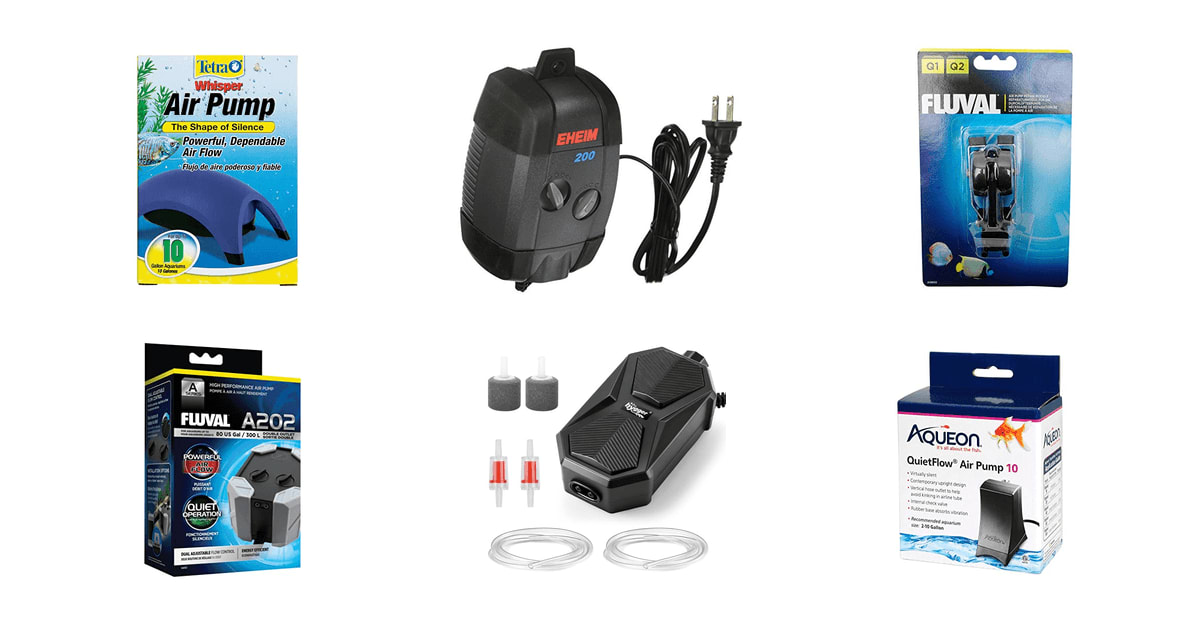
So we treated this as a matching problem instead of a horse race. Most people run one small tank with a single sponge filter or air stone, and they want the pump to be quiet and stay working. Some run a skimmer plus a bubble wall and need separate control over each line. A few just want the smallest thing that'll keep a betta comfortable. We think that the Tetra Whisper Air Pump Up To 10 Gallons is the best quiet aquarium air pump for most people, and that the hygger Aquarium Air Pump Dual Outlet is the one to buy if you need to run two accessories at once.
Everything we recommend
Near-silent air for a small tank, with no extra fuss

Two adjustable outlets and a full kit, for tanks under 40 gallons

A gentle, tidy pump for a betta or a nano tank

More output and per-outlet control, once your setup grows
At a glance
| Product | Tank Size | Wattage | Price | |
|---|---|---|---|---|
| Tetra Whisper Air Pump Up To 10Top pick | Up to 10 Gallons | — | $17.39 |
 | Aqua Tank - AIR Pump 200 W/DIFFUSERSAlso in lineup | 60 Gallons | — | $55.47 |
 | Fluval A18832 Q1Also in lineup | — | — | $13.33 |
| Fluval A202 Aquarium Air Pump 3.0WUpgrade pick | — | 3.0W | $50.67On sale |
| hygger Aquarium Air Pump Dual OutletRunner-up | 3 to 79 Gallon | 4W | $20.96 |
| Aqueon QuietFlow Aquarium Air Pump 10Budget pick | 2-10 Gallon Tanks | — | $10.08 |
How we picked
Noise by design. We looked for pumps that deal with vibration structurally, through internal baffling, a suspended motor or rubberized contact points, rather than a single pad stuck to the bottom. Rubber feet alone weren't enough to make the list.
Output for the tank. We matched each pump's rated tank size, airflow and maximum depth against the setups people actually run. A pump straining at its ceiling gets louder and wears faster, so we favored honest ratings over big numbers.
Outlets and control. Single-outlet pumps have to be quiet and correctly sized, because you can't tune them. Dual-outlet pumps had to offer independent adjustment per side, which is the whole point of paying for the second outlet.
What's included. A check valve is the one accessory that prevents a destroyed motor and water on your power strip. We noted which pumps include one, plus tubing and air stones, since that's real money and hassle for a first tank.
Parts and repairs. Diaphragms wear out under continuous use, usually within a year or two. We gave credit to pumps with available replacement diaphragms and repair kits, because a rebuild beats a landfill.
Top pick
Near-silent air for a small tank, with no extra fuss
Tetra Whisper Air Pump Up To 10
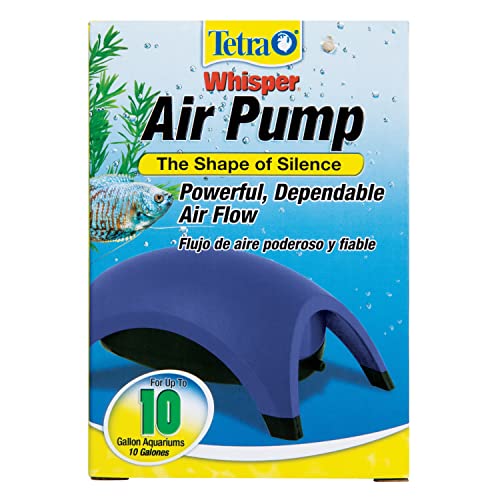
The Whisper is a single-outlet pump for tanks up to 10 gallons, and its dome-shaped housing and suspended motor keep the buzz down without any added hardware. For one air stone or one sponge filter in a bedroom, this is the pump we'd hand a friend.
$17.39fromAmazonThe noise control is built into the shape of the case, not bolted on underneath. Tetra's patented dome housing works with a suspended motor and internal sound-dampening chambers. Flat-sided rigid pumps pass motor vibration straight down into whatever shelf they sit on. The dome geometry pushes that energy inward instead, where the chambers soak it up. It's the same basic idea pricier pumps use, and it's why the Whisper stays civil even on a bare cabinet top.
It's sized honestly for the tank printed on the box. This model covers tanks up to 10 gallons, which in practice means one air stone, one sponge filter, or one air-powered ornament. That's what most people actually need. If your tank is bigger, Tetra makes 20- and 40-gallon single-outlet versions and 60- and 100-gallon dual-outlet ones, so you can size up inside the same design rather than starting over.
Owners keep buying it because it keeps running. Diaphragm pumps are simple machines, and this one has been refined for a long time. Owner feedback skews toward years of continuous use, with the usual pattern of noise creeping up slowly as the diaphragm ages rather than a sudden failure. That's the behavior you want. You get a warning, not a dead tank.
It hides easily. At roughly 5.5 by 2.75 by 3.88 inches and three-quarters of a pound, it tucks behind a stand or into a corner of an equipment shelf. Small matters more than it sounds. The farther a pump sits from a resonant surface like a lid or a hollow cabinet panel, the quieter your room gets, and a compact pump gives you more places to put it.
Flaws but not dealbreakers
It isn't UL listed, and Tetra says so plainly. That's how the price stays low. For most home aquariums it's a non-issue, but if your building, landlord or insurer requires listed appliances near water, this one won't clear that bar. Check before you buy rather than after.
There's no airflow dial. Output is fixed at the pump. For a betta or a shrimp tank where you want barely a trickle, you'll need an inline gang valve to throttle it down, which is a separate part and one more thing on the airline.
Nothing comes in the box except the pump. No tubing, no air stone, and no check valve. That last one matters: if the pump sits at or below the waterline, a power cut can siphon tank water back into the motor. Buy an inline check valve with it. Also worth knowing, a heavily planted 10-gallon with high oxygen demand can outrun this pump's output.
Runner-up
Two adjustable outlets and a full kit, for tanks under 40 gallons
hygger Aquarium Air Pump Dual Outlet
This hygger pump runs two accessories at once with a separate knob for each side, and it arrives with air stones, tubing and check valves. hygger rates it at a 35 dB maximum, for tanks up to 37 gallons and water no deeper than 3.3 feet.
$20.96fromAmazonTwo outlets you can actually dial in separately. Run a sponge filter off one side and a bubble wall off the other, then tune each with its own knob. No gang valve, no extra fittings, no fiddling with a hose clamp until the bubbles look right. If you keep two small tanks side by side, one pump can serve both, and you can set each tank's flow independently.
hygger attacks the noise at two levels. Inside, there's a double-layer structure and a thickened ABS shell meant to trap motor noise before it reaches the outside of the case. Outside, four shockproof rubber pads keep that vibration from telegraphing into your cabinet. That layered approach is why the 35 dB maximum rating is at least plausible rather than pure marketing.
The box has everything you need on day one. You get two air stones, two lengths of tubing, two check valves, a six-foot power cord and a manual. For a first tank that's genuinely useful, because the check valve is the part beginners skip and later regret. Nothing else to order, nothing to guess at.
The output suits real small-tank setups. Four watts, up to 18 GPH of airflow and max pressure around 25 kPa. That's enough to drive a couple of sponge filters or an air stone plus an ornament in a tank up to 37 gallons, freshwater or salt, without the motor screaming at full effort the whole time.
Flaws but not dealbreakers
The 35 dB number is hygger's own, not an independent measurement. Treat it as a design target rather than a promise. Owner feedback mostly describes a low hum you stop noticing, but a minority report a rattle straight out of the box. Usually that traces back to the surface it's sitting on, so try a mat before you give up on it.
Depth caps at 3.3 feet. That rules out tall display tanks, deep sumps and most protein skimmers, which need more pressure than this pump makes. Measure from the pump's outlet to the air stone before you commit.
Thirty-seven gallons is the hard ceiling. Push past it and you'll be running the pump wide open all the time, which is both louder and harder on the diaphragm. If your tank is bigger, or if you expect it to be soon, look at the Fluval A202 instead.
Budget pick
A gentle, tidy pump for a betta or a nano tank
Aqueon QuietFlow Aquarium Air Pump 10
The QuietFlow 10 is a small upright pump for 2- to 10-gallon tanks, and it's the only one here that includes a check valve, a spare diaphragm and a dust filter pad. Its low fixed output suits bettas, which don't like a strong current.
$10.08fromAmazonIt includes the parts you'd otherwise forget to order. A replaceable check valve, a diaphragm and a dust filter pad all ship in the box. The check valve is the important one, since it blocks tank water from siphoning back into the motor during an outage. The spare diaphragm means the first time this pump gets noisy, you fix it instead of replacing it.
The gentle output is a feature, not a compromise. Bettas breathe air at the surface and get pushed around by heavy current, and shrimp tanks don't want a churning surface either. A pump that can't blast your nano tank is exactly what you want here. Aqueon rates it for 2 to 10 gallons, and that range is honest.
It barely takes up any counter. The upright body is about 4 by 2 by 3.5 inches, so it stands in the gap behind a nano tank where a wide pump won't fit. The single vertical hose outlet points the tubing straight up, which keeps it from kinking against the wall. A rubberized base handles the residual buzz on glass, wood and laminate.
You can keep it going instead of tossing it. Aqueon sells repair kits for the internal components separately. Under continuous use, rubber diaphragms typically start losing performance somewhere around 12 to 24 months, showing up as more noise or weaker bubbles. Swapping the diaphragm at that point restores it, and this pump is designed for you to do exactly that.
Flaws but not dealbreakers
There's no airflow adjustment. What the pump makes is what you get. In a tank under 5 gallons you may still find it too energetic, and the fix is an inline gang valve on the airline, bought separately.
The upright shape can tip. It's light and its footprint is narrow, so a tug on stiff tubing or a bumped cord can put it on its side. Set it back from the edge of a shelf and let the tubing hang slack.
Ten gallons is a wall, not a suggestion. If you're the kind of hobbyist who goes from a 5-gallon to a 29-gallon within the year, you'll be shopping again. Buy a larger pump now and throttle it down instead.
Upgrade pickOn sale
More output and per-outlet control, once your setup grows
Fluval A202 Aquarium Air Pump 3.0W
The A202 is a 3-watt dual-outlet pump with an engineered baffle chamber inside and a control dial for each outlet. If you're feeding a skimmer, a sponge filter and an air stone from one pump, this is the one that keeps all of it quiet and adjustable.
$50.67fromAmazonList priceThe baffle chamber does the heavy lifting. It's a multi-stage internal cavity that breaks up sound waves before they leave the housing, which is a different approach than simply padding the bottom of the case. Oversized rubber feet stabilizers handle the rest. Those feet also grip, so the pump won't creep across polished wood and start the secondary rattle that ruins otherwise quiet setups.
Independent dials beat a gang valve every time. Each outlet has its own control, so you can push more air to a skimmer while keeping a decorative air stone at a slow simmer. You adjust it at the pump, in one place, instead of crawling behind the tank to pinch a valve. Fewer fittings on the airline also means fewer leaks and less back-pressure.
Fluval rates it for a good output-to-pressure ratio, and that shows up in flexibility. It'll drive one air stone or several, in freshwater or marine tanks, supporting fish, plants, corals and the biological filtration doing the quiet work in your substrate. For a mixed setup where the demands change as you add gear, that headroom is the reason to spend more.
It sips power. Three watts, running around the clock, is close to nothing on a monthly bill. That matters because you shouldn't be turning an air pump off at night anyway. Fish keep breathing after dark and plants stop making oxygen, so the hours when aeration matters most are the hours you're asleep.
Flaws but not dealbreakers
It's overkill if you only run one air stone. The second outlet is most of what you're paying for. With a single sponge filter in a 10-gallon tank, the Tetra Whisper gets you comparable quiet for far less.
It's the largest pump here. At roughly 8.75 by 3.25 by 5 inches and about 1.7 pounds, it wants real shelf space and won't hide behind a nano tank. Plan a spot for it above the waterline before it arrives.
No check valve, tubing or air stone in the box. For a pump aimed at more involved setups that's a strange omission, and it means a second order before you can run it safely.
Who this is for
This guide is for anyone whose air pump is louder than they'd like, or who's setting up a tank in a room where they sleep, work or watch TV. It covers small to mid-size home aquariums, roughly from a 2-gallon betta bowl up to about 60 gallons, running the usual air-driven gear: sponge filters, air stones, bubble walls and modest ornaments. If your pump only runs during a heat wave or a power outage, buy for the tank size and don't overthink the noise.
It isn't for large or heavily equipped systems. Deep tanks, big sumps and serious protein skimmers need more pressure than anything here delivers, and commercial or pond aeration is a different category entirely. We also don't cover battery backup pumps, which solve an outage problem rather than a noise one. And if your current pump only started buzzing recently, read the care section first. A worn diaphragm or a bad surface is a much more likely culprit than a bad pump.
How we picked
We weighed five things. Noise by design: the pump has to fight vibration structurally, with internal baffling, a suspended motor or rubberized contact surfaces, not just a pad underneath. Output for the tank: rated tank size, airflow and maximum depth have to line up with real setups, because a pump running flat out is a loud pump. Outlets and control: single-outlet models have to be sized right out of the box, and dual-outlet models have to adjust each side independently. What's included: a bundled check valve, tubing and air stones save you a second order and prevent the back-siphon that kills motors. Parts and repairs: diaphragms wear, so we favored pumps whose replacement parts you can still buy.
The competition
Here's what our research surfaced, which isn't everything sold in this category. Air pumps are a crowded, lightly documented corner of the hobby, full of near-identical listings under changing brand names. We stuck to models with enough published detail and owner history to say something useful about.
The Aqua Tank - AIR Pump 200 W/DIFFUSERS ($55.47) — The Eheim Aqua Tank AIR Pump 200 is the most solidly built pump we looked at, and on paper it's the most capable. Eheim rubberizes the corners, the feet and the diaphragm shell itself, which damps vibration at its source rather than after it reaches your cabinet. Two adjustable outlets deliver about 26 GPH each, 52 GPH combined, and it ships with two suction-cup diffusers you can stick anywhere on the glass. It's rated to 6 feet 7 inches of depth, so unlike our picks it can drive a skimmer or a sump, and a wall-mount eyelet keeps it from getting knocked over. It draws 3.5 watts. It lost on practicality: it's the most expensive pump here, it caps out at 60 gallons, and stock has been thin enough that we can't count on you finding one. If you have a deep tank on a hard cabinet and you want the sturdiest thing available, buy it when you see it.
Placement and upkeep
Where you put the pump matters as much as which one you buy. Never set it on the aquarium lid, since the glass acts like a soundboard and multiplies what you hear. A folded microfiber cloth, a rubber mat or the foam it shipped in works better than anything you can buy for it. Keep the pump above the waterline, and if it has to sit level with or below the tank, install an inline check valve so a power cut can't siphon water back into the motor. Closed cabinets make things worse, not better, because the enclosure traps and amplifies the hum. Put the pump on top of the cabinet, or leave a door ajar with a couple of inches of clearance around it. When the noise slowly climbs after a year or two, the diaphragm is worn. Replace it before it quits.
Questions we get
How quiet does an air pump need to be for a bedroom?
Aim for under 40 dB for a living room and under 35 dB for a room you sleep in. For reference, a quiet library sits around 30 dB, normal conversation is about 60 dB, and an undamped diaphragm pump typically lands in the 45 to 55 dB range. The hygger dual-outlet pump is the only model here with a published figure, a manufacturer-rated 35 dB maximum. Remember that a pump on a resonant surface can easily undo the difference between those numbers.
Do I need an air pump if my filter already agitates the surface?
Often not. A hang-on-back or canister filter return that breaks the surface handles gas exchange fine in a lightly stocked, planted freshwater tank. You do need one if you run a sponge filter, since that's air-driven by definition, or if your tank is heavily stocked, or if you use bubble walls, air-powered ornaments or a skimmer. Summer heat is the other big reason, because warm water simply holds less oxygen.
What size air pump do I need for a 10-gallon tank?
Both the Tetra Whisper Air Pump Up To 10 Gallons and the Aqueon QuietFlow 10 are built for exactly this range. A rough starting rule is about 1 GPH of airflow per gallon of water, so 10 to 15 GPH covers a single air stone or sponge filter. Going much bigger without a way to throttle it down creates surface turbulence that stresses fish and, ironically, a louder pump.
Why did my air pump suddenly start buzzing?
It's almost always one of three things. The rubber diaphragm is worn, which is the usual cause after 12 to 24 months of continuous running. The pump is vibrating against a hard surface or the tank lid. Or the airline is kinked or clogged, creating back-pressure the diaphragm has to fight. Start by moving the pump onto a rubber mat and straightening the tubing. If the noise stays, replace the diaphragm.
Do I really need a check valve?
Yes, unless the pump sits well above the waterline and always will. A check valve lets air through toward the tank but blocks water from running back toward the motor during an outage. Back-siphoning wrecks pumps and can dump tank water onto whatever electrical gear is nearby. The hygger and Aqueon pumps include one; for the Tetra and the Fluval, add an inline check valve before you plug anything in.
Can I run an air pump 24 hours a day?
You should. Every pump here is designed for continuous duty, and shutting one off overnight removes aeration at the exact hours plants stop producing oxygen and fish keep consuming it. Power draw is trivial, in the 3- to 4-watt range for these models, so running it around the clock costs almost nothing. The only reason to unplug is maintenance.
Why you should trust us
For this guide:
- We read the manufacturer spec sheets and full listing details for every pump here, comparing rated tank size, airflow, maximum depth, power draw and the specific noise-reduction design each brand claims.
- We compared published reviews and long-running hobbyist recommendations to see which pumps hold their reputation over years rather than weeks.
- We read owner feedback across these listings for recurring themes, especially rattle that appears out of the box, diaphragm wear timelines and back-siphon damage.
- We read owner reviews on every listing, weighted toward the critical ones, because that is where the recurring failures show up.
- We have a systematic way of automatically fetching the latest prices, so the numbers on this page stay current.
- This is a research-focused guide, so the team may not own every product listed — though we often do own the top winners, which gives us extra context for the recommendations.
- We don't accept free products, and the retailer commission never changes which product we recommend.
Sources
Best Aquarium Air Pumps — Wirecutter / The New York Times, Wirecutter
Best Aquarium Air Pumps Reviewed — Fishkeeping World, Fishkeeping World
Best Aquarium Air Pump Buying Guide — Aquarium Source, Aquarium Source
Best Aquarium Air Pumps — Fish Lab, Fish Lab
Best Aquarium Air Pumps — The Spruce Pets, The Spruce Pets
Amazon product listings and owner reviews for all 6 products
Manufacturer specification pages for each product
Some passages in this guide may be paraphrased with AI help. Prices are refreshed automatically.
More like this.
Continue exploring pet reviews and recommendations.

The Best Quiet Ceiling Fans With Remote Control
A ceiling fan is one of the few appliances that runs while you sleep, so noise is the thing that decides whether you love it or resent it. A good one…

The Best Smart Thermostats for Heat Pumps
A heat pump asks more of a thermostat than a furnace does. It has to know when to run the compressor, when to give up and call for backup strips, and when…

The Best Sump Pumps
A sump pump is the least interesting appliance you own and the one with the highest stakes. It sits in a hole in the floor, does nothing for months, and…

The Best Aquarium LED Lighting
The light over your tank does more work than anything else you'll buy for it. It decides whether your plants carpet the substrate or melt into brown mush,…

The Best Aquarium Heaters
A heater is the least interesting thing in your tank and the most likely to cause a disaster. Fish don't need water that's warm on average. They need it…

The Best Aquarium UV Sterilizers
A UV sterilizer is a lamp in a tube that your water flows past, and nothing else on the tank does its job. It kills the free-floating stuff: the…