The Best Sump Pumps
A sump pump is the least interesting appliance you own and the one with the highest stakes. It sits in a hole in the floor, does nothing for months, and then has to run for forty straight hours during the storm that also takes out your power. What you're really buying is margin: enough capacity to stay ahead of the water, and enough build quality to survive the cycling. Everything else — cord length, discharge size, the shape of the float — matters only because it affects those two things.
Here's the honest part. No sump pump moves what the box says it moves. Those gallon-per-hour numbers are measured at zero lift, and your pump has to push water up eight to fifteen feet of pipe before it reaches daylight. Expect something closer to half the advertised output at a realistic head height. And none of these pumps runs without electricity. The storms that overwhelm your drainage are the same storms that drop power lines, so a primary pump on its own leaves your worst case uncovered.
So buy for the water you actually get. A basement that goes damp after a hard rain needs something very different from one that pumps nonstop through a wet stretch. Sizing up isn't free either — bigger pumps cost more, run in shorter harder bursts, and need more room in the pit. Match the pump to the pit, then plan for the outage separately. We think that the Zoeller M53 Mighty-mate is the best sump pump for most people, and that the Wayne CDU980E is the one to buy if your pit refills about as fast as it empties.
Everything we recommend
The cast iron workhorse that keeps running through long storms

Far more output for high water tables, and a longer warranty

A light-duty pump for occasional water, not constant duty

A quieter pump for basements you actually live in
At a glance
| Product | Horsepower | Flow Rate (GPH) | Price | |
|---|---|---|---|---|
| Zoeller M53 Mighty-mate Submersible Sump PumpTop pick | 1/3 HP | — | $217.04 |
| WAYNE CDU980E 3/4 HP Submersible Sump PumpRunner-up | 3/4 HP | 5,490 GPH | $189On sale |
| Liberty Pumps 287 1/2-Horse Power 1-1/2-Inch DischargeUpgrade pick | 1/2 HP | — | $309.99 |
 | Wayne WSB1275 75Ah Maintenance-Free Battery Recommended ESP25Also in lineup | — | — | $276.62On sale |
 | Basement Watchdog BWSP 1730 Gallons Per HourAlso consider | — | 1,730 GPH | $583.07 |
| Superior Pump 91250 1800GPH Thermoplastic Submersible UtilityBudget pick | 1/4 HP | 1,800 GPH | $68.19 |
 | Pentair Flotec FPSE3200A Thermoplastic Sewage Pump 4/10Also in lineup | 4/10 HP | 5,250 GPH | $195.40 |
 | Zoeller 267-0006 M267-25 2-inch Sump Pump withAlso consider | 1/2 HP | — | $515.13 |
How we picked
Output at head height. We compared rated gallons per hour across the lineup, then discounted those numbers for the vertical lift a real installation demands. A pump had to have enough margin left at eight to fifteen feet of head to matter.
Housing material. Specifications told us which pumps use cast iron and which use thermoplastic, and owner feedback told us how each holds up over years of cycling. Cast iron sheds motor heat, and it's what we wanted for anything running as a primary pump.
Switch reliability. Switches fail more often than motors do, so we looked at what type each pump uses and how it fits a standard basin. Vertical floats got credit for narrow pits; tethered floats got credit for simplicity.
Noise in living space. Published reviews and owner reports both flag pumps that rattle, and a pump running at 2 a.m. under a bedroom is a real problem. Housing construction, not horsepower, is what separated the quiet ones.
Fit and installation. We checked discharge size, cord length and physical dimensions against typical residential pits and plumbing. A pump that needs new piping or a bigger basin is a bigger project than most people are signing up for.
Top pick
The cast iron workhorse that keeps running through long storms
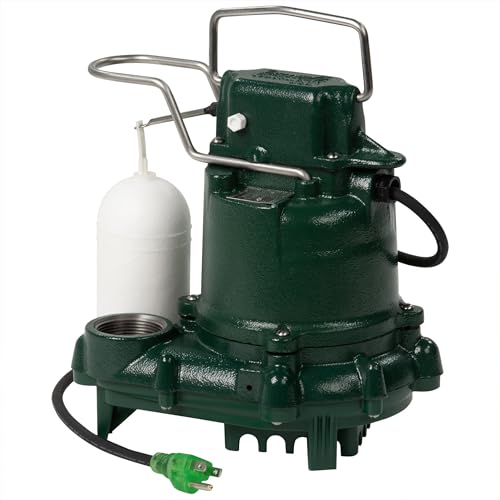
Zoeller M53 Mighty-mate Submersible Sump Pump
The Zoeller M53 is an all-cast-iron submersible that handles the ordinary job — keeping a pit down through a wet week — without drama. Owners routinely report a decade or more of service, and the vortex impeller shrugs off the grit that jams cheaper pumps.
$217.04fromAmazonCast iron is the reason this pump lasts. The switch case, motor housing and pump body are all cast iron, and metal sheds heat into the surrounding water instead of trapping it. That matters during a three-day storm, when your pump kicks on every couple of minutes for hours. Thermoplastic housings hold that heat in, and heat is what kills sump motors. You're paying for a longer life here, not a faster pump.
The vortex impeller doesn't clog easily. Sump water isn't clean. It carries sand, silt, bits of gravel and whatever else washes in through the drain tile. A vortex design spins water through the housing rather than forcing it past tight passages, so debris tends to pass instead of wedging. Owners with sandy pits keep coming back to this pump, and clogging almost never shows up in what they complain about.
The float switch is simple, and simple is what you want at 2 a.m. Water rises, the pump starts. Water drops, it stops. There's no control board to fry and no sensor to recalibrate, which removes the failure mode that takes out a lot of fancier pumps. You do need a pit wide enough for the float to swing freely, but most standard basins are.
People who wear one out buy the same pump again. That's the strongest signal in the owner feedback — repeat purchases, often a decade apart, sometimes after the old unit survived clogged discharge lines and constant cycling. For a part that only matters on the day it works, that kind of track record tells you more than any spec on the carton.
Flaws but not dealbreakers
A third of a horsepower isn't much if your water table is high. The M53 is sized for a pit that fills steadily between cycles, not one that refills the moment it empties. If your basement takes water during every serious rain, or your lot funnels runoff toward the foundation, you'll want more headroom than this has.
There's no backup and no way to know it failed. No battery, no alert, nothing. If the power drops mid-storm — which is exactly when it drops — the M53 stops, and you find out when you walk downstairs. Plan on a separate backup system, or at minimum a water alarm sitting in the pit.
A few owners get an early failure. Most units run for years, but the occasional one dies within months, usually at the switch. It's uncommon enough that we'd still buy it. Just hang onto your receipt and pour a bucket into the pit before storm season instead of assuming it's fine.
Runner-upOn sale
Far more output for high water tables, and a longer warranty
WAYNE CDU980E 3/4 HP Submersible Sump Pump
The Wayne CDU980E is a 3/4-horsepower cast iron and stainless pump rated at 5,490 gallons per hour, roughly double what a standard residential pump moves. Get it if your pit refills as fast as it empties, or if your basin is too narrow for a swinging float.
$189fromAmazonList priceThe output is the whole point. At 5,490 gallons per hour, this pump clears a pit fast enough to stay ahead of hard inflow. If you're at the bottom of a slope, sitting on a high water table, or feeding one pit from a big basement footprint, that margin is what keeps water off the floor during the worst hour of a storm. Owners in flood-prone areas describe it running continuously and keeping up.
The vertical float fits pits that tethered floats fight. A vertical switch travels straight up and down in a narrow column, so it needs no swing room and can't snag on the basin wall or the discharge pipe. If your pit is on the tight side, or your old pump kept sticking on, this is the easier one to drop in.
Cast iron and stainless steel, with a top-suction intake. The housing sheds heat the way the Zoeller does. Drawing water in from the top instead of the bottom keeps the intake above settled silt and prevents airlock, so you don't have to drill a weep hole during installation. That's one less step and one less thing to get wrong on a Saturday.
Five years of warranty coverage is the longest here. Most cast iron sump pumps carry one to three. Wayne backing this one for five says something about how it expects the motor to hold up under constant cycling. It shows up in the owner feedback too — people replacing an aging Wayne with another Wayne are a recurring theme.
Flaws but not dealbreakers
It's more pump than most homes need. A pit that cycles a few times after a hard rain gains nothing from double the output. The pump just empties faster and shuts off sooner, and short hard cycles are rougher on a motor than long steady ones. Buy this capacity because your basement demands it, not as insurance.
It's bulky, and the swap isn't always drop-in. It stands taller than a 1/3 HP pump and wants a basin with room to spare, so measure your pit depth and diameter before you order. If your discharge plumbing is original to the house, plan on replacing the check valve while you've got the pit open anyway.
The CDU980E carries a five-year warranty.
Budget pick
A light-duty pump for occasional water, not constant duty
Superior Pump 91250 1800GPH Thermoplastic Submersible Utility
The Superior Pump 91250 is a 1/4-horsepower thermoplastic utility pump that moves up to 1,800 gallons per hour and ships with a garden hose adapter. It suits a basement that gets wet a few times a year, and it doubles as the pump you grab for everything else.
$68.19fromAmazonIt costs a fraction of what the cast iron pumps here do. That's the whole argument, and it's a decent one. If you've just bought a house with an unfamiliar pit and a pump of unknown age, this gets you covered right now. Then you can watch how the basement actually behaves through a full wet stretch and upgrade once you know what you're dealing with.
It's a genuinely useful second pump to own. The 3/4-inch garden hose adapter and 10-foot cord mean you can drain a pool, empty a flooded window well, or clear a crawlspace with it. Owners lean on it hard for exactly these odd jobs. Even after you move up to cast iron for the pit, this one keeps earning its shelf space.
It's light enough to handle by yourself. Under seven pounds, so you can lift it out, rinse the screen and set it back without help or a second person on the stairs. The suction screen pulls off by hand, and the pump passes solids up to an eighth of an inch, which covers ordinary sump grit.
Simple beats clever when the pump is a stopgap. There's no controller, no electronic sensor, no diagnostics. It's a motor and an impeller in a plastic housing. Fewer parts means fewer things to fail in the first couple of years, which is exactly the window this pump is meant to cover.
Flaws but not dealbreakers
Thermoplastic doesn't handle sustained cycling. Plastic holds heat where cast iron sheds it. Run this thing hard for two days straight and you're working the motor in the worst possible way. Expect a meaningfully shorter service life than any cast iron pump here, and plan to replace it years sooner if your pit works regularly.
A quarter horsepower is a real ceiling. The 1,800 gallon-per-hour figure is before any vertical lift, and the higher your pump has to push, the less of that you'll see. It can't keep up with a high water table or a large catchment area, and it isn't meant to.
It's a utility pump first. Check that the configuration you're buying switches on by itself before you rely on it as an unattended primary. If it doesn't, it's a pump you run, not a pump that runs for you — fine for draining a pool, not fine for the storm you slept through.
Upgrade pick
A quieter pump for basements you actually live in
Liberty Pumps 287 1/2-Horse Power 1-1/2-Inch Discharge
The Liberty Pumps 287 is a 1/2-horsepower cast iron pump built around a one-piece UniBody casting, which cuts the vibration you get at bolted seams. If a bedroom or office sits near the sump pit, the quiet is worth the premium.
$309.99fromAmazonOne-piece casting is why it's quiet. Conventional pump housings bolt together, and every joint is somewhere vibration can buzz. Liberty casts the body as a single piece instead. Owners who replaced a rattling pump with this one describe the change as night and day — the difference between a pump you hear from the living room and one you forget you have.
Half a horsepower is the useful middle. It clears a pit noticeably quicker than a 1/3 HP pump, which means shorter run times and fewer minutes of noise per storm. That's the right trade for a finished basement that takes on a steady trickle rather than a flood. You get more capacity without jumping to a pump that slams on and off.
Permanently lubricated bearings and an oil-filled motor. Nothing to grease, nothing to top off. The motor is hermetically sealed with thermal overload protection, so it shuts itself down before it cooks if something binds or the discharge blocks. It's the kind of feature you never think about until it's the reason you still have a working pump.
The quick-connect cord makes servicing painless. You can disconnect at the pump instead of fishing the whole cord out of the pit or splicing it. Pull the pump, rinse the stainless bottom screen, drop it back. Small thing, but it's the difference between doing your annual check and putting it off until something goes wrong.
Flaws but not dealbreakers
You pay a lot for a modest jump in horsepower. Next to the Zoeller M53 you're getting an extra sixth of a horsepower and a quieter run, at a substantial premium. If your pit sits under an unfinished basement, a garage or a storage room, that money buys you something you'll never notice.
The VMF switch wants the right pit geometry. A vertical micro float has short travel, so it triggers on a narrow band of water level. In a shallow or oddly shaped basin it can cycle more often than a tethered float would. Check your pit depth against Liberty's specifications before you order.
It's a niche product with thinner availability. Liberty sells far fewer of these than the big-box brands, so stock comes and goes and there's less owner feedback to lean on. If your pump died this morning and you need a replacement by tonight, this probably isn't the one you can get.
Who this is for
This guide is for homeowners replacing a primary sump pump in an existing pit, or buying a spare before they need one. If your basement has a pit, a discharge line and a dedicated outlet already, any of these picks is a job you can do in an afternoon with basic tools. If you're putting in a sump system from scratch — cutting concrete, setting a liner, routing new discharge — that's contractor work in most places, and you should sort out permits before you buy anything.
You should not buy on horsepower alone. Most homes with moderate groundwater are well served by a 1/3 HP cast iron pump, and going bigger without a reason just means shorter, harder cycles. We've stuck to submersible pumps here, since they run cooler and quieter than pedestal models and belong in any finished or occupied basement. We don't cover full battery-backup systems, water-powered backups or aftermarket Wi-Fi monitors, though we think most flood-prone homes should own some form of outage protection alongside whatever they pick here.
How we picked
Output at head height: we treated advertised gallon-per-hour figures as a ceiling and asked what's left after eight to fifteen feet of vertical lift, because that's the number your basement actually gets. Housing material: cast iron sheds motor heat where thermoplastic traps it, so anything meant to run as a primary pump had to be metal. Switch reliability: switches fail before motors do, and we favored designs that suit a standard basin without snagging or sticking. Noise: a pump cycling under a bedroom is a quality-of-life problem, so one-piece castings and sealed motors earned credit. Fit and installation: discharge size, cord length and physical footprint decide whether a swap is an afternoon or a weekend, and we weighted that heavily.
Other sump pumps worth considering
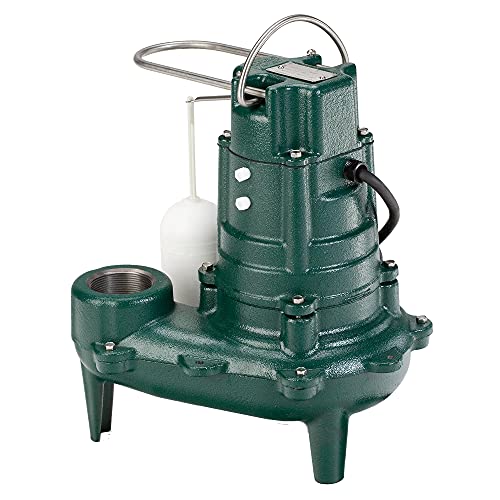
If you want commercial-grade build and a 2-inch discharge: The Zoeller 267-0006 M267-25 2-inch Sump Pump with ($515.13) — The Zoeller 267-0006 M267-25 is the heavy end of this lineup — a 1/2-horsepower cast iron pump with a 2-inch discharge port and a 25-foot cord, built for high-cycle duty in deep or awkward pits. Landlords, owners of vacation properties, and anyone who has already lived through a finished-basement flood are the people who'll find it worth the reach. It's also the pump plumbers reach for in ejector pits. What you give up is money and simplicity: it's the most expensive unit here by a wide margin, the 2-inch discharge means your existing 1-1/2-inch plumbing needs adapting, and a handful of owners report the casting degrading around the float housing well before the pump should be done. For a standard suburban basement, the M53 is the more sensible buy.
If you want a backup pump for outages: The Basement Watchdog BWSP 1730 Gallons Per Hour ($583.07) — The Basement Watchdog BWSP is a secondary pump designed to take over when your primary quits or the power goes down, rated at 1,730 gallons per hour and sold here as a pack of two. That pairing is genuinely practical if you've got more than one pit, or if you want a ready spare sitting on the shelf for the night your primary dies mid-storm. It won't match a 3/4 HP primary on output, and it isn't supposed to — its job is buying you hours, not keeping up with a flood. Two caveats: you'll need to buy a compatible battery separately for it to do anything during an outage, and there's little published detail or owner feedback on this particular listing, so confirm what's in the box before you commit.
The competition
This is what our research turned up in this lineup, not a survey of every sump pump on the market. Plenty of capable pumps from other brands aren't here. The one below is worth understanding mostly so you know why it isn't a pick.
The Pentair Flotec FPSE3200A Thermoplastic Sewage Pump 4/10 ($195.40) — The Pentair Flotec FPSE3200A is a sewage ejector pump rather than a groundwater sump pump, and that distinction is the whole story. Its 4/10-horsepower motor moves up to 5,250 gallons per hour and passes 2-inch solids, and it's certified to SSPMA standards, which is real independent verification that a lot of competitors skip. But it's thermoplastic at a price above the cast iron pumps here, and the solids-handling ability that justifies the cost does nothing for a pit that only sees groundwater. Owner feedback on this listing is thin and sharply split, which makes it hard to judge how it holds up. Choose it if you have a below-grade bathroom, a basement laundry, or a floor drain handling more than clean water — and skip it otherwise.
Installation and upkeep
Before you order, measure your pit's depth and diameter and check whether your discharge line is 1-1/2 or 2 inch. Most submersibles want at least an 11-inch basin, and a tethered float needs room to swing without hitting the wall. The pump should have its own grounded outlet on a dedicated circuit, never an extension cord and never a GFCI that nuisance-trips. Replace the check valve while the pit is open — they're cheap and they fail quietly, letting water run back down after every cycle. Once a year, pour a few buckets into the pit and confirm the pump starts, clears the water and shuts off cleanly. Rinse the intake screen while you're there. If the pump sounds different than it used to, that's your warning.
Questions we get
What size sump pump do I need?
Most homes with moderate groundwater are fine with a 1/3 HP submersible, which suits a pit that fills gradually between cycles. Step up to 1/2 HP if your basement runs over 1,500 square feet or your water table stays active. Go to 3/4 HP only for genuinely severe conditions or a basement that has flooded repeatedly. Whatever you choose, compare output at your actual discharge height rather than the free-flow rating on the box.
Submersible or pedestal?
For a primary residential pump, submersible. It sits in the water, which cools the motor and muffles the sound, so it runs cooler and much quieter through long cycles. Pedestal pumps keep the motor above the pit where it stays dry and easy to service, but they run hotter and louder. If your basement is finished or anyone sleeps near the pit, submersible isn't really a debate.
Do I really need a battery backup?
If you're in a storm-prone area, yes. The floods that do the most damage happen during the same weather that knocks out power, and a primary pump without backup is dead weight at exactly that moment. Even four to eight hours of backup runtime covers most residential storm scenarios. Compared with what a single flooded basement costs to remediate, it's the easiest call in this whole category.
How long should a sump pump last?
Cast iron submersibles commonly run a decade or more in normal residential service, and owners of the Zoeller M53 and the Wayne CDU980E frequently report exactly that. Thermoplastic pumps like the Superior Pump 91250 generally have shorter lives. Heavy cycling shortens things regardless of what the housing is made of. Test yours annually and replace it on your schedule rather than during a storm.
Can I install a sump pump myself?
Usually, if the pit, discharge pipe and dedicated outlet already exist. Swapping a submersible is a one-to-three-hour job with standard tools, and the Zoeller M53, Wayne CDU980E and Superior Pump 91250 all go in that way. Cutting a new pit into a slab is a different matter — that's excavation, a liner and new discharge routing, and most jurisdictions want it permitted and done professionally.
Why does the advertised gallons-per-hour number matter so little?
Because it's measured at zero vertical lift, and your pump has to push water up eight to fifteen feet of pipe to reach a drain or the yard. A pump rated at 5,000 gallons per hour free-flow may realistically move closer to half that at a 10-foot head. Ask the manufacturer for the performance curve and read it at your installed height. That's the number that decides whether your basement stays dry.
Why you should trust us
For this guide:
- We read the manufacturer specifications and listing documentation for every pump in this lineup, then compared horsepower, rated output, discharge size, housing material and switch type side by side.
- We worked through published recommendations from home and plumbing publications to see which models get named repeatedly and why.
- We read through owner feedback for each product, paying particular attention to recurring reports of switch failures, early motor deaths and pumps that owners replaced with the identical model.
- We read owner reviews on every listing, weighted toward the critical ones, because that is where the recurring failures show up.
- We have a systematic way of automatically fetching the latest prices, so the numbers on this page stay current.
- This is a research-focused guide, so the team may not own every product listed — though we often do own the top winners, which gives us extra context for the recommendations.
- We don't accept free products, and the retailer commission never changes which product we recommend.
Sources
Best Sump Pumps of 2026 — Wirecutter / New York Times, Wirecutter
Best Sump Pumps Tested by This Old House Reviews Team, This Old House
Best Sump Pumps — Bob Vila, Bob Vila
Best Sump Pumps Tested in 2026 — Popular Mechanics, Popular Mechanics
Best Sump Pumps — Family Handyman, Family Handyman
Amazon product listings and owner reviews for all 8 products
Manufacturer specification pages for each product
Some passages in this guide may be paraphrased with AI help. Prices are refreshed automatically.
More like this.
Continue exploring home reviews and recommendations.

The Best Quiet Aquarium Air Pumps
An air pump is one of the few pieces of aquarium gear you hear all day. It sits outside the tank, humming away in a living room or a foot from your…

The Best Smart Thermostats for Heat Pumps
A heat pump asks more of a thermostat than a furnace does. It has to know when to run the compressor, when to give up and call for backup strips, and when…

The Best Snow Melting Mats for Walkways
Shoveling a walkway at six in the morning is nobody's idea of a good time, and the ice that forms afterward is worse. A heated mat sidesteps both…

The Best Modular Closet Systems
A closet system is one of those purchases you think about for about a week and then live with for a decade. The good ones disappear into the room and just…

The Best Ergonomic Office Chairs for Back Pain
Your chair decides how your lower back feels at 4 p.m. If you sit six to ten hours a day, that's not a small thing. The spine has a natural inward curve…

The Best Anti-Fatigue Kitchen Mats
Standing on tile or concrete for an hour does something quietly awful to your body. Your heels ache first, then your knees, then your lower back around…