The Best Modular Closet Systems
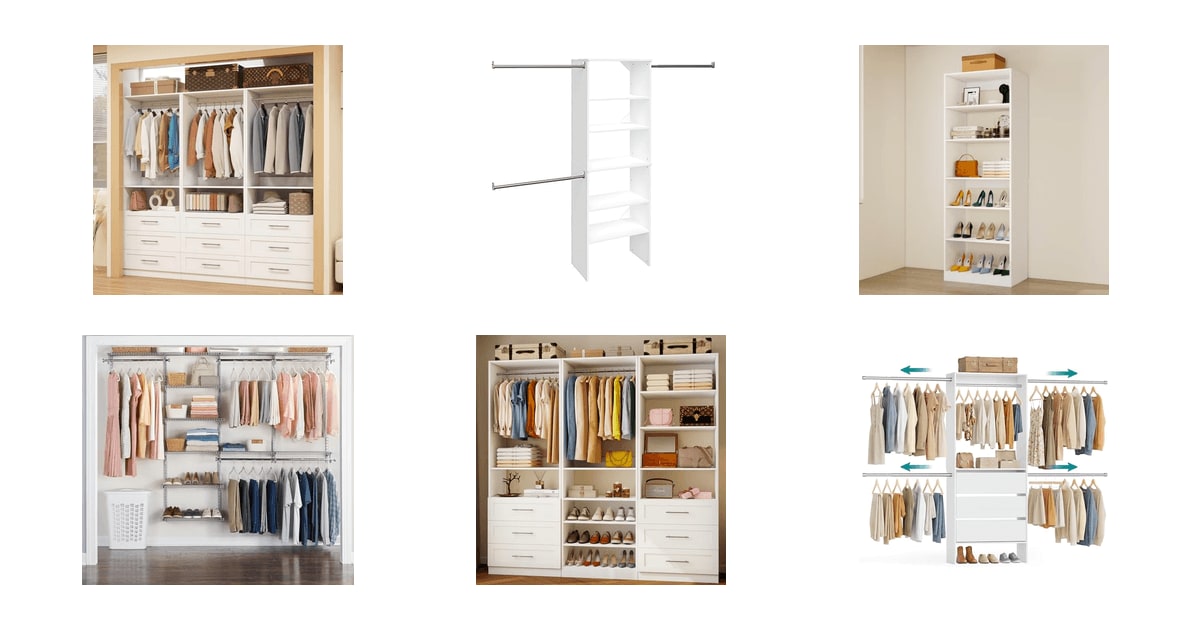
A closet system is one of those purchases you think about for about a week and then live with for a decade. The good ones disappear into the room and just work: shelves at the heights you actually need, a rod that doesn't sag under a row of winter coats, drawers you can open without shoving a sleeve out of the way. The bad ones announce themselves every morning. You'll notice the wobble, the shelf that's two inches too low for your boots, the hanging section that swallowed half your closet and gave back nothing.
Here's the part nobody puts on the box: almost every modular system in this range is engineered wood or particleboard with a laminate skin, and none of them are furniture-grade cabinetry. They're heavy to move once assembled, they don't love humidity, and the manufacturer weight ratings assume you anchored everything correctly. Wire systems dodge the moisture problem but look like wire. And every one of these takes a real afternoon to put together, usually with a second person, no matter what the listing promises.
So the question isn't which system is perfect. It's which compromise fits your closet and your patience. We think that the SONGMICS CUSTOS is the best modular closet system for most people, and that the Rubbermaid Configurations Deluxe kit is the one to buy if you're working in a humid or basement closet, or you want the fastest possible install.
Everything we recommend

Wide adjustable coverage without a custom-closet commitment

Ventilated wire that installs fast and rearranges without tools

Six drawers and 100-pound rods, if you can handle the bulk
A single tower with the deepest add-on catalog here
At a glance
| Product | Width Range | Drawers | Price | |
|---|---|---|---|---|
 | Dilando Closet System with 9 DrawersAlso consider | 6-15 FT | 9 Drawers | $566.97 |
| ClosetMaid SuiteSymphony Wood Closet Organizer SystemAlso great | 5-10 FT | — | $147.84 |
 | Modular Closet Systems with Adjustable Shelves andAlso consider | — | — | $189.99 |
| Rubbermaid Configurations Deluxe Custom Closet Kit 4-8Budget pick | 4-8 FT | — | $140.13 |
| Closet System with 3 SetsUpgrade pick | 6-15 FT | 6 Drawers | $559.99 |
| SONGMICS Closet SystemTop pick | 6.5-10.2 FT | 3 Drawers | $151.99 |
How we picked
Material and durability. We compared laminate, particleboard and epoxy-coated wire construction across every listing. Good Housekeeping Institute testing found thermally fused laminate resists scratching and delamination noticeably better than foil-wrapped particleboard, so we treated finish type as a durability signal.
Adjustability. Real Simple's closet survey found adjustable shelf height is the feature homeowners most wish they had, cited by 71 percent of respondents. We favored systems with multiple adjustable shelves and expandable rods over fixed layouts.
Weight capacity. We read published load ratings against the category benchmark — Elfa's wall brackets are rated to 100 pounds each. Any system claiming to hold a full row of winter coats needed a stated rod rating and hardware that backs it.
Install effort. EasyClosets reports that pre-cut, pre-drilled panels cut a reach-in install to four to six hours, versus eight to twelve when you're cutting on site. We prioritized kits that ship with all hardware and require no cutting.
Fit flexibility. Closets are rarely a standard width. We looked for expandable spans, trimmable rods and the ability to use one tower alone, so the system adapts to your closet instead of the other way around.
Top pick
Wide adjustable coverage without a custom-closet commitment
SONGMICS Closet System
The SONGMICS CUSTOS covers a 6.5-to-10.2-foot span with four adjustable rods, five hanging zones, three drawers and a top shelf. It's the most complete out-of-the-box layout here, and at roughly 67 pounds it's the lightest of the full-size laminate systems.
$151.99fromAmazonThis is the system that fits the widest range of closets without special-ordering anything. The rods expand from 26 to 49 inches, and the whole run stretches from 6.5 feet to just over 10. That range covers most reach-in closets and a lot of modest walk-ins. If your closet is an odd 8-foot-4 because a previous owner framed a bulkhead into the corner, you're fine.
The layout itself is the reason it wins. Five hanging zones means you can separate long dresses from folded-over pants without a single rod doing all the work. Three drawers handle socks, belts and the stuff that has no business on a shelf. A top shelf takes bins. And there's open space at the bottom for shoes, which is where most of us end up putting them anyway.
You can also just use the middle tower alone. That's a genuinely useful escape hatch. If you move to a smaller closet, or you want the tower in a bedroom corner instead of a closet, you're not stuck with a system that only works at full width. SONGMICS also says you can drill new holes for the rods if the stock heights don't suit your clothes.
It's the lightest full-size laminate system in this guide by a wide margin. At about 67 pounds shipped, it's a third of what the Westcity and Dilando systems weigh. That matters more than it sounds. You'll be carrying panels up a staircase and standing them upright in a space with no room to maneuver. Lighter panels also mean thinner material, which is the trade-off — but for a system that mostly holds clothes, it's the right one.
Flaws but not dealbreakers
It's particleboard with a white laminate finish, and that's the ceiling on how nice it can look and how long it'll last. Owners of systems in this class consistently report that the drawer boxes and the back panels are the weak points over time. Treat the shelves as clothes-and-bins storage, not book storage.
Only three drawers, and they're on basic sliding rails — no soft-close, no full extension. If you're replacing a dresser with this, three shallow drawers won't cut it. The Westcity 6-drawer system is the better answer there.
The 79.7-inch height is tall enough that in a standard eight-foot closet you lose the ability to put a shelf above it, but short enough that you're not using the last several inches of wall. It's a fine compromise, just not an efficient one if you're trying to squeeze every cubic foot out of a small space.
Budget pick
Ventilated wire that installs fast and rearranges without tools
Rubbermaid Configurations Deluxe Custom Closet Kit 4-8
The Rubbermaid Configurations Deluxe kit is epoxy-coated steel wire that spans 4 to 8 feet and ships with every piece of mounting hardware. It's the only system here that lets air move through the closet, and the only one you can reconfigure later without picking up a screwdriver.
$140.13fromAmazonWire shelving has one advantage nothing else in this guide can match: air moves through it. Bob Vila's comparison of wire and laminate systems makes the case plainly — closets without an HVAC vent trap moisture, and solid panels trap it harder. If your closet backs onto an exterior wall, sits in a basement, or lives in a place where August is a personal insult, this is the material you want.
Rearranging it is genuinely tool-free. The shelves and rods clip into the mounted rails, so if you decide the hanging section should be six inches higher, you lift and reset it. Every other system here requires you to unscrew panels, or worse, drill new holes. Real Simple's closet survey found adjustable shelf height is the single feature homeowners most wish they had. This one gives it to you without a drill.
Installation is the fastest of anything here. No cutting, no on-site measuring, all mounting hardware in the box, and the telescoping rods and expandable shelves handle the width variation instead of a saw. Compare that to systems requiring on-site cuts, where EasyClosets pegs the difference at roughly double the install time. If you've never mounted anything to a wall, start here.
The epoxy finish is the quiet upgrade over cheap chrome wire. It won't rust, and the coating reduces the snag points that catch on cashmere and shirt cuffs. It's still wire — you'll get the ridge lines on stacked sweaters — but it's the version of wire that doesn't shred your clothes.
Flaws but not dealbreakers
It looks like wire shelving. There's no getting around that. If part of why you're buying a closet system is that you want the closet to look finished when the door is open, this isn't it — the SONGMICS or the ClosetMaid tower will look considerably more like furniture.
Folded items don't sit well on wire. Sweaters get ridges, small things fall through, and you'll end up buying bins or shelf liners, which partly defeats the airflow advantage. Plan on bins for anything that isn't hanging.
This is a wall-mounted system, so it needs real anchoring into studs or proper drywall anchors. Renters who can't put a dozen holes in a closet wall should look at a freestanding system instead.
Upgrade pick
Six drawers and 100-pound rods, if you can handle the bulk
Closet System with 3 Sets
The Westcity three-unit system brings 6 drawers, 9 shelves and 5 hanging zones across a 6-to-16-foot span. It's the highest-capacity system in this guide, with rods rated to 100 pounds each and anti-tip hardware in the box.
$559.99fromAmazonIf you're outfitting a closet that has to replace a dresser as well, this is the one. Six drawers on sliding rails, nine shelves and five hanging zones is more storage than any other system here. For a shared primary closet — two people, four seasons, one room — the extra drawer capacity is the difference between a closet that works and a closet that overflows into the bedroom.
The stated capacity is the other reason to reach for it. Westcity rates the stainless rods at 100 pounds each, using 0.6mm-wall tubing rather than the thin rolled steel you find in cheaper kits. For context, The Container Store's Elfa brackets — the published benchmark in this category — are rated to 100 pounds each as well. That's a serious number for a system in this price class, and it means a full row of coats isn't a problem.
It's three independent units, each about 23.7 inches wide, and it covers 6 to 16 feet. That modularity is more useful than the raw span suggests. Put all three in a row for a walk-in, or split them: two in the closet, one in a nursery or a mudroom. Anti-tip hardware ships in the box, which is not a given at this price and matters if there are kids in the house.
The listing is honest that this is a two-person assembly, and you should believe it. The whole system weighs about 230 pounds boxed. Parts come labeled, which helps, but you're standing 81-inch panels upright in a confined space. Block out an afternoon and recruit someone.
Flaws but not dealbreakers
It's heavy and it's big. Once it's together, moving it is a project, not a chore. If you rent and expect to move within a couple of years, the sheer mass is a real cost you'll pay later.
Engineered wood with drawers means more places for the material to fail. Drawer bottoms and slide mounting points are where systems in this class tend to loosen over a few years of daily use. Owners of similar systems report that overloading drawers with folded denim is the usual culprit.
At 81 inches tall and 15.8 inches deep, it's a genuinely deep unit. In a shallow reach-in closet, you may not be able to close the door with clothes on the side rods. Measure your door swing before you order.
Also great
A single tower with the deepest add-on catalog here
ClosetMaid SuiteSymphony Wood Closet Organizer System
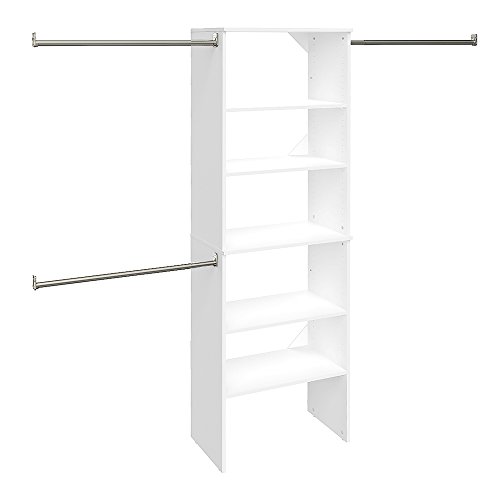
ClosetMaid's SuiteSymphony starter kit is one 25-inch tower with three expandable rods and five shelves, two of them adjustable. It fits closets from 5 to 10 feet, and it's the only system here backed by a broad catalog of matching add-on pieces you can buy later.
$147.84fromAmazonThe reason to choose SuiteSymphony over a more complete kit is what comes after. ClosetMaid sells matching drawers, doors, shoe shelves, extra rods and top shelving as separate add-ons, so you can start with one tower and build outward as your budget or your needs change. Nothing else in this lineup has that runway. ClosetMaid is also the most widely stocked closet brand in North America, carried in more than 4,500 Home Depot and Lowe's locations, so parts are easy to find.
Start small and grow is a real strategy in a closet, not just a marketing line. Buy the tower, live with it for a season, and you'll learn exactly what you're short on — shoe space, drawers, a second hanging height. Then buy that piece. Committing to a full 10-foot configuration on day one is how people end up with three feet of shelving they never fill.
The rods expand from 30 to 48 inches and can be trimmed, or mounted on one side only. That last option is what makes it work in a narrow closet where a symmetrical layout won't fit. You can also skip the rods entirely and use the tower as a shelving unit in a den or a home office, which is a fair use for a 74-pound piece of manufactured wood.
Two of the five shelves adjust. That's fewer adjustable positions than the wire systems offer, but it covers the case that matters most — boots and tall bins on the bottom, folded shirts up top.
Flaws but not dealbreakers
The starter kit is one tower and some rods. On its own, in a wide closet, it'll look sparse, and the add-ons you'll want to fix that are all sold separately. Price out the full configuration before you decide this is the affordable option, because it often isn't once you've added drawers.
It's the heaviest single tower here relative to what you get — 74 pounds for one 25-inch unit. Manufactured wood at that density is sturdy, but it also means the tower needs to be assembled close to where it's going to live.
Only two adjustable shelves in the tower limits how much you can rework the layout later without drilling. If your storage needs shift often, the Rubbermaid system is far more forgiving.
Who this is for
This guide is for anyone replacing a single wire rod and a warped shelf with something that actually organizes clothes — renters, first-time DIYers, and homeowners who want a built-in look without a designer appointment. Every system here is one you order and assemble yourself, in an afternoon, with a drill and ideally a friend. That's the whole point: a Houzz study found 62 percent of homeowners who redid a bedroom closet chose modular or semi-custom over built-in millwork, citing cost and the ability to change it later.
It's not for you if you want soft-close hardware, real wood veneer, or a designer measuring your closet. Full-service brands like California Closets run four to six weeks from consultation to install and cost several times what a DIY system does, and that's a different purchase with different expectations. We also don't cover freestanding garment racks, over-the-door organizers, or single accessories — this is about systems that structure the whole closet.
How we picked
We judged these on a handful of things that actually change how a closet works day to day. Material: laminate over foil-wrapped particleboard where we could tell, since thermally fused surfaces hold up better to scratching and delamination. Adjustability: how many shelves move and whether rods expand, because shelf height is the thing owners most often wish they could change. Weight capacity: stated rod and bracket ratings, measured against the 100-pound benchmark that the best consumer systems publish. Install effort: whether the kit ships with all hardware and skips on-site cutting, which roughly halves the time. Fit flexibility: expandable spans and the option to use one tower alone, because almost nobody has a standard-width closet.
Other modular closet systems worth considering
If you want nine drawers and a freestanding setup: The Dilando Closet System with 9 Drawers ($566.97) — The Dilando system ships as three 2-foot modules you can combine into a 4-, 6- or 8-foot run, and it packs nine drawers — more than anything else here. It's freestanding, so it's a reasonable option if you can't anchor into the walls. The catch is weight: 280 pounds boxed, the heaviest system in this guide. Each module has an inner short rod and a longer expandable side rod, which gives you flexible hanging without a lot of fiddling. But the drawer-heavy layout means less hanging space overall, and freestanding units in this weight class are a genuine ordeal to reposition. Consider it if drawers are your bottleneck and holes in the wall aren't an option.
If you only need one 2-foot tower: The Modular Closet Systems with Adjustable Shelves and ($189.99) — This Westcity tower unit is the single-module version of the larger Westcity system — adjustable shelves and an expandable side rod in a 2-foot footprint. In a small reach-in closet where a full multi-unit system won't fit, a single tower with a rod off one side is often the right shape. The listing is thin on published specs, though, which is why it isn't a pick; we can't tell you the shelf ratings or the exact dimensions with confidence. If you want a single tower and you'd rather have documented specs and a real add-on catalog, the ClosetMaid SuiteSymphony is the safer buy.
The competition
These are the systems our research surfaced on Amazon, not a complete map of the category. Notable names like IKEA PAX, Elfa and the direct-to-consumer brands aren't sold here, so they're not in this lineup even though they come up constantly in published comparisons.
Installation notes
Find your studs before you open a single box. Every wall-mounted system in this guide depends on it, and drywall anchors alone won't hold a loaded rod for long. Lay out all the panels and hardware first and check them against the parts list — finding a missing bracket three hours in is how these projects turn into two-weekend projects. Plan for a second person on anything with 80-inch panels; you can't hold a panel plumb and drive a screw at the same time. Anti-tip hardware isn't optional, especially with kids around, and it ships with several of these. For laminate and particleboard systems, wipe spills quickly and don't let anything damp sit on a shelf — moisture is what makes engineered wood swell at the edges. Wire shelving needs almost nothing beyond an occasional dusting.
Questions we get
What's the best modular closet system for a small reach-in closet?
A single tower with rods coming off one or both sides is usually the right shape for a reach-in. The ClosetMaid SuiteSymphony starter kit is built for exactly this — the rods expand from 30 to 48 inches, can be trimmed, and can mount on one side only when the closet is too narrow for a symmetrical layout. If your closet is a standard 4-to-8-foot reach-in and you want the fastest install, the Rubbermaid wire kit covers that span with no cutting at all.
Can I install a modular closet system myself, or do I need a professional?
Every system in this guide is designed for DIY installation and ships with its hardware. You'll need a drill, a stud finder, a level and usually a second person. Pre-cut, pre-drilled systems cut the job to roughly four to six hours for a reach-in closet, compared to eight to twelve when you're making cuts on site. Professional installation is worth it mainly if you're short on time or working with unusual walls.
What's the difference between wire and laminate closet shelving?
Wire lets air circulate, which matters a lot in a closet with no HVAC vent, a basement, or a humid climate — it's the main defense against musty odors and moisture buildup. Laminate looks far more like furniture and holds folded clothes without leaving ridges. Wire is also easier to reconfigure and typically less expensive. Laminate is the better choice if you want the closet to look finished.
What's the weight limit for modular closet shelving?
It varies a lot, so check the specific listing. The Westcity system rates its stainless rods at 100 pounds each, which matches the published bracket rating on The Container Store's Elfa system — a reasonable benchmark for the category. Those numbers assume correct anchoring into studs. Cheap kits that don't publish a rating are usually rated lower for a reason.
Are modular closet systems a good option for renters?
Some are. Freestanding systems like the Dilando don't need wall anchors at all, which makes them the safest bet if your lease is strict about holes. Wall-mounted systems can still work — the mounting holes are small and patchable — but check your lease first. Weight is the other renter consideration: a 280-pound system is a real problem on moving day.
Can these be reconfigured after installation?
Wire systems are the clear winner here. The Rubbermaid kit's shelves and rods clip into mounted rails, so you can change the layout without tools. Laminate systems with adjustable shelves let you move a shelf or two, but bigger changes mean unscrewing panels and sometimes drilling new holes. If your storage needs shift often, factor that in before you buy.
Why you should trust us
For this guide:
- We compared published specifications for every system here — spans, shelf counts, rod ratings, weights and materials — against the listing bullets and manufacturer documentation.
- We read published category research including Good Housekeeping Institute findings on laminate durability, Bob Vila's wire-versus-laminate comparison, and survey data from Real Simple and Houzz on what homeowners actually want from a closet.
- We reviewed recurring themes in owner feedback for systems in this class, particularly around drawer hardware, assembly difficulty and how engineered wood holds up over time.
- We read owner reviews on every listing, weighted toward the critical ones, because that is where the recurring failures show up.
- We have a systematic way of automatically fetching the latest prices, so the numbers on this page stay current.
- This is a research-focused guide, so the team may not own every product listed — though we often do own the top winners, which gives us extra context for the recommendations.
- We don't accept free products, and the retailer commission never changes which product we recommend.
Sources
Best Closet Organizer Systems — The Spruce (2026), The Spruce
Best Closet Systems — Wirecutter / The New York Times, Wirecutter
Best Closet Organizers — Good Housekeeping Institute Tested, Good Housekeeping
Best Closet Systems — Bob Vila, Bob Vila
Best Closet Organizers — Real Simple, Real Simple
IKEA PAX Wardrobe System — Full Product Specifications, IKEA
Elfa Shelving System — Product Overview & Load Specifications, The Container Store
Custom Closet Installation Cost Guide 2025 — Angi (HomeAdvisor), Angi (HomeAdvisor)
Best Closet Systems for Every Budget — House Beautiful, House Beautiful
Houzz 2025 U.S. Houzz & Home Study — Renovation Trends, Houzz
EasyClosets — How It Works / Installation Process, EasyClosets
Closet & Wardrobe Systems Market Size & Forecast 2025–2030, Grand View Research
Amazon product listings and owner reviews for all 6 products
Manufacturer specification pages for each product
Some passages in this guide may be paraphrased with AI help. Prices are refreshed automatically.
More like this.
Continue exploring home reviews and recommendations.

The Best Closet Organization Systems
You open your closet more times a day than you open the oven. Most closets ship with one rod and one shelf, which wastes the three feet of air above the…

The Best Walk-In Closet Organizer Systems
A walk-in closet is the one room in your house that nobody else sees, which is exactly why it goes bad so fast. Builder-grade setups usually give you one…

The Best Smart Garden Systems for Fresh Herbs
Fresh herbs go bad fast. You buy a clamshell of basil for one recipe, use a third of it, and find the rest slimy in the crisper a week later. A smart…

The Best DIY Smart Home Security Systems
A home security system earns its keep on the days nothing happens. You leave for a long weekend, glance at your phone in an airport line, and see every…

The Best Home Security Systems
A home security system spends almost all of its life doing nothing at all. That's the point. What you actually notice day to day is smaller stuff: whether…

The Best Under-Sink Water Filtration Systems
The water coming out of your kitchen tap is probably safe to drink. It also might taste like the shallow end of a pool, and it may be carrying lead from…