The Best Under-Sink Water Filtration Systems
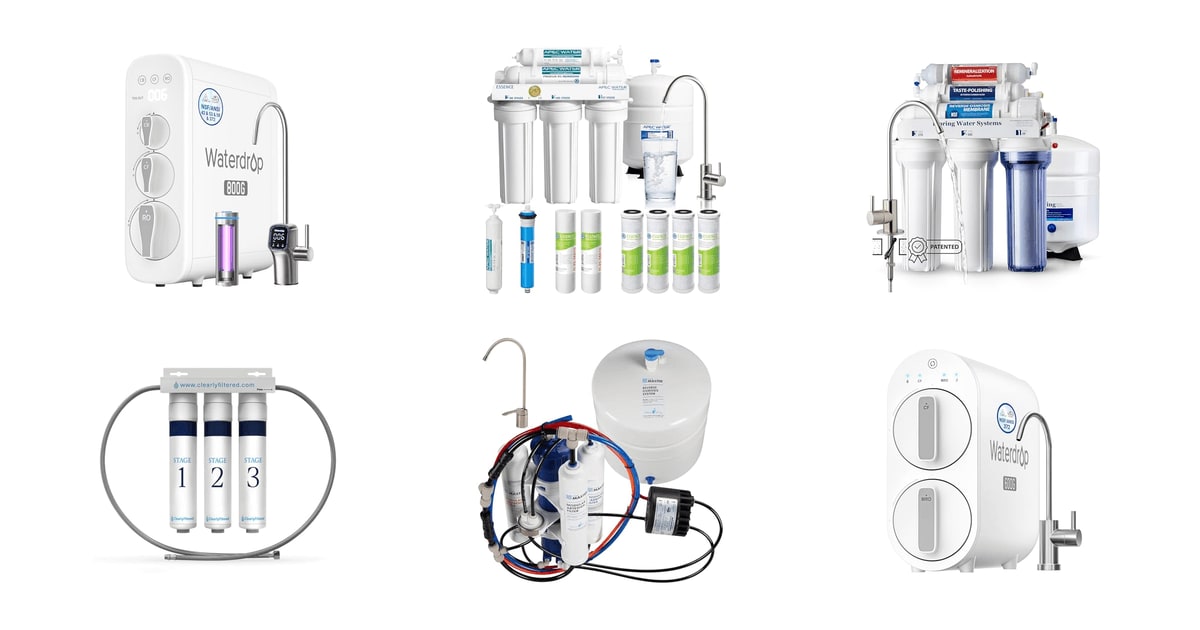
The water coming out of your kitchen tap is probably safe to drink. It also might taste like the shallow end of a pool, and it may be carrying lead from an old service line or PFAS from a plant upstream. An under-sink filter is the quiet fix for both. It lives in the cabinet, ties into the cold line, and gives you good water at the sink you already use — no pitcher to refill, no flats of plastic bottles to haul in from the car.
Here's the part nobody puts on the box: none of these systems fix everything, and none of them tell you what you actually need. Reverse osmosis pulls out the widest range of contaminants, but it sends water down the drain and slows your flow. Carbon systems keep your minerals and waste nothing, but they leave dissolved solids alone. And every one of them needs new cartridges on a schedule you will absolutely forget. Get your water tested by a certified lab first. It's the one step that keeps you from buying the wrong machine.
So match the system to your water, not to the longest contaminant list in the listing. City water with a chlorine bite needs less hardware than well water running high in dissolved solids. Cabinet clearance, whether you can drill your countertop, and what you'll spend on filters each year matter more than most people expect. We think that the Waterdrop G3P800 is the best under-sink water filtration system for most people, and that the iSpring RCC7AK-BN is the one to buy if you'd rather have remineralized water and don't mind a storage tank.
Everything we recommend
Certified filtration without a bulky tank in the cabinet

Puts the minerals back, if you have room for a tank

Long filter life and simple parts, if you skip the extras

Fast flow, low waste and minerals added back twice

Broad contaminant removal with no tank and no drilling
At a glance
| Product | Capacity (GPD) | Filter Stages | Price | |
|---|---|---|---|---|
| Waterdrop G3P800 Reverse Osmosis Water FilterTop pick | 800 GPD | 10-Stage | $849On sale |
| APEC Water Systems ROES-50 Essence Series TopBudget pick | — | 5-Stage | $232.35On sale |
| iSpring RCC7AK-BN NSF CertifiedRunner-up | 75 GPD | 6-Stage | $234.99 |
| Clearly Filtered 3 Stage Under Sink WaterAlso great | — | 3-Stage | $550 |
| Home Master TMAFC-ERP Artesian Full Contact ReverseUpgrade pick | — | 7-Stage | $383.24 |
 | Waterdrop G2P600 Under-Sink RO SystemAlso consider | 600 GPD | 7-Stage | $299On sale |
 | Express Water ROALK10DAlso in lineup | 100 GPD | 10-Stage | $253.99 |
How we picked
Certification, not claims. We gave weight to systems with documented NSF/ANSI or WQA certification — 58 for RO performance, 53 for health-effect contaminants, 473 for PFAS, 372 for lead-free materials. A published third-party lab report beat a marketing number every time.
What it actually removes. We compared published contaminant reduction data against the contaminants people are most worried about: lead, arsenic, fluoride, nitrates and PFAS. Systems that named specific percentages for specific compounds outranked ones that promised a big round number.
Waste and flow. Traditional RO can send three to five gallons to the drain per gallon purified, so we favored designs with better pure-to-drain ratios or a permeate pump. Flow rate mattered too, since a slow system is a system you stop using.
Cabinet fit and install. We read the dimensions for every system and every tank, because the most common reason one of these gets returned is that it doesn't fit. We also noted which ones need a new faucet hole drilled and which don't.
Filters and upkeep. We looked at how many cartridges each system uses, how long the manufacturer rates them, and whether changing them needs tools. Annual filter cost adds up to as much as the system itself over a few years.
Top pickOn sale
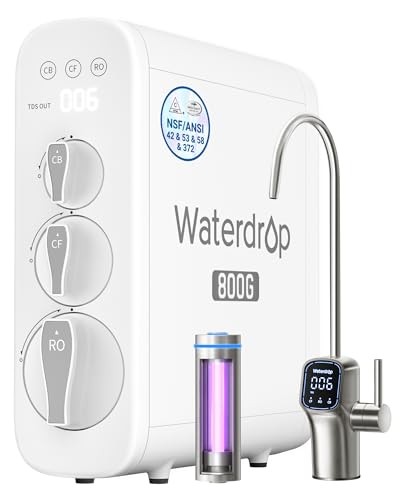
Certified filtration without a bulky tank in the cabinet
Waterdrop G3P800 Reverse Osmosis Water Filter
The G3P800 is a tankless reverse osmosis system that skips the storage tank and still puts out 800 gallons a day. It's certified against NSF/ANSI 58, 42, 53 and 372, and it sends far less water down the drain than the tank systems most people picture.
$849fromAmazonList priceLosing the storage tank is the single best thing about this system. A traditional RO setup parks a pressurized tank in your cabinet, and that tank sits full of standing water for days. The G3P800 filters on demand instead. You get a slim upright box, room left over for the dish soap and the trash pull-out, and water that was purified seconds before it hit your glass.
Certification is the part most shoppers skim, and it's the part that matters. This system is certified by IAPMO R&T against NSF/ANSI 58 for TDS reduction, and against NSF/ANSI 42 and 53 for chlorine, taste and odor. The materials are certified lead-free under NSF/ANSI 372. Waterdrop also publishes third-party SGS testing across the ten stages covering PFAS, fluoride, lead, chromium, nitrate and radioactive particles.
Flow is what you notice daily. At 800 gallons per day, the G3P800 fills a cup in about five seconds, so filling a pasta pot or a row of school water bottles doesn't turn into a wait. Tank systems drain and then refill slowly, and the last glass out of a spent tank tastes worse than the first. You won't run into that here.
The waste ratio is where tankless RO earns its keep. Older tank systems push three to five gallons to the drain for every gallon they purify, which is hard to justify if you pay by the gallon or live somewhere dry. The G3P800 runs a 3:1 pure-to-drain ratio — three cups of drinking water for one cup lost. Across a year of a family's cooking and drinking, that gap is large.
The faucet is smarter than it strictly needs to be, in a useful way. It reads out TDS, so you can watch the membrane fade instead of guessing, and the LED lights up whenever water runs. That's a small thing until the morning your water tastes off and you want to know whether the problem is your filter or the city's.
Flaws but not dealbreakers
You need a hole in the sink deck for the dedicated faucet. If your sink has an unused sprayer hole, that's a non-issue. If you have granite or a solid-surface counter with no spare opening, you're hiring someone to drill it, and that turns a Saturday project into a scheduled job with a bill attached.
Like every RO system without a remineralization stage, this one takes the calcium and magnesium out along with everything else. Some people find the result tastes flat. If that sounds like you, the iSpring or the Home Master is the better buy.
The filters are proprietary, and they cost more than the generic cartridges that fit older standard housings. Work that into your math before you commit, because it's a recurring expense, not a one-time one.
Runner-up
Puts the minerals back, if you have room for a tank
iSpring RCC7AK-BN NSF Certified
The RCC7AK-BN is a six-stage RO system that adds calcium and magnesium back after the membrane strips them out, so the water tastes like water instead of nothing. The whole system, not just the membrane, is certified to NSF/ANSI 58.
$234.99fromAmazonPlenty of people install RO, take a drink, and think something's missing. They're right. The membrane pulls out nearly everything, minerals included, and the result can taste flat and slightly hollow. The sixth stage here runs purified water through calcite and coconut-shell carbon, which lifts pH to roughly 7.5 to 8.5 and returns calcium and magnesium. It's the direct fix for the most common complaint about RO water.
Full-system certification is rarer than the marketing implies. Many brands certify a single component and let you assume the rest is covered. iSpring has the complete RCC7AK certified to NSF/ANSI 58. The published reduction figures are specific, too: 93 to 98 percent of TDS, 96 to 99 percent of PFAS, more than 98.9 percent of lead, and over 97 percent of fluoride, along with asbestos, barium, cadmium and chromium.
Installation is friendlier than most tank systems. The faucet uses a top-mounted fastener, so you tighten it from above the counter instead of lying on your back in the cabinet with a basin wrench and a flashlight in your teeth. Quick-connect fittings handle the tubing. If you can assemble flat-pack furniture without swearing, you can do this in an afternoon.
The clear first-stage housing is a small touch that pays off. You watch the sediment filter go from white to brown, so you change it because it needs changing, not because of a reminder you set eight months ago and stopped trusting. That matters most on well water, where sediment loads swing hard from season to season.
Flaws but not dealbreakers
It's a 75-gallon-per-day system with a storage tank, and that combination has consequences in a real cabinet. The tank claims a serious share of the space under your sink — plan on losing most of one side. Draw a lot of water at once and you'll empty it, then wait while it slowly refills.
Six stages means six things to replace on staggered schedules. None of it is hard, but it's more bookkeeping than a two-cartridge carbon system asks of you.
Budget pickOn sale
Long filter life and simple parts, if you skip the extras
APEC Water Systems ROES-50 Essence Series Top
The ROES-50 is a five-stage RO system with no smart faucet, no display and no remineralization — just a well-built filter stack that keeps going. It holds WQA Gold Seal certification, and the pre-filters run six to 12 months before they need your attention.
$232.35fromAmazonList priceBuy this if you want reverse osmosis and nothing else. There's no app, no LED, no mineral cartridge and no pump. You get five stages, a tank, a faucet and a company that has been building the same design for a long time. For a lot of households on city water, that's the whole job, and paying for the extras is paying for features you'll never look at twice.
Filter life is the quiet money saver. APEC sequences the stages so the three pre-filters take the abuse and protect the membrane, and those pre-filters go six to 12 months. The membrane and post-filters last 12 to 24 months, depending on how rough your incoming water is. Across three years, that's meaningfully fewer cartridges than systems that want fresh media every six months.
The certification story holds up. WQA Gold Seal certification requires weeks of testing for material and parts safety, structural integrity and contaminant rejection, and the system is built to the NSF/ANSI 58 standard. Published lab results put it at up to 99 percent reduction across more than a thousand contaminants, including lead, arsenic, fluoride, chlorine and nitrates.
It also comes apart fast, which renters should note. Close the inlet shutoff, pull the inlet tubing, and the whole assembly lifts out in about five minutes. You'll still have the faucet hole to explain to a landlord, but the system itself moves to the next apartment without a plumber or a weekend.
Flaws but not dealbreakers
There's a tank, and it isn't small — roughly 11 inches across and 15 inches tall, sitting alongside the filter rack. Measure your cabinet before you order, especially if a garbage disposal already eats half the room down there.
You get no remineralization and no TDS readout. The water comes out clean and a little flat, and tracking filter changes is entirely on you.
At 50 gallons a day, it's the slowest system in this guide to recover. Fill a couple of pitchers back to back and you'll draw the tank down, then wait a while for it to catch up.
Upgrade pick
Fast flow, low waste and minerals added back twice
Home Master TMAFC-ERP Artesian Full Contact Reverse
The TMAFC-ERP is a seven-stage RO system with a non-electric permeate pump, a 1:1 waste ratio and a two-pass remineralization design. It's the one to get for well water, a high-TDS supply, or a household that drinks and cooks through a lot of filtered water.
$383.24fromAmazonThe permeate pump is the reason to pay up. It equalizes pressure across the membrane without using electricity, and Home Master credits it with cutting water waste by up to 80 percent and raising production by up to 50 percent. It also reduces TDS creep, the slow drift in quality that happens when a tank sits partly full. On well water or a high-TDS supply, that's the difference between a system that keeps up and one that struggles.
Flow is genuinely quick for a tank system. The Fast Flo kit uses larger fittings and tubing, and Home Master rates an eight-ounce fill at about 4.5 seconds, roughly double the flow of both conventional and tankless designs. If you cook most nights or fill bottles for four people every morning, you feel that difference immediately.
Minerals go back in twice, not once. Most alkaline RO systems bolt a single remineralization cartridge onto the end of the line. The Full Contact design puts purified water back in contact with calcium and magnesium at two points in the process, and owners of these systems consistently describe the water as tasting closer to spring water than to distilled.
Maintenance is once a year or every 2,000 gallons, and it's tool-free. The modular canisters twist off by hand — no strap wrench, no wrestling a stuck housing over the trash can while water drips on your forearm. The system is modular and upgradeable, so you can add capability later instead of replacing the whole thing.
Flaws but not dealbreakers
It's the largest system here, roughly 20 inches long and 16 inches wide before you account for the tank. A crowded cabinet with a disposal in it may simply not have the room, and there's no compact version.
It's also the most expensive unit in this guide, with the most hardware — a pump, extra stages, more fittings. Every one of those is a part that can eventually leak. If your only complaint about your water is how it tastes, this is more machine than you need.
The TMAFC-ERP comes with a five-year limited parts warranty.
Also great
Broad contaminant removal with no tank and no drilling
Clearly Filtered 3 Stage Under Sink Water
The Clearly Filtered 3-Stage connects straight to your cold water line, installs in about 10 minutes with a wrench, and comes back off just as fast. It's independently lab-tested against 232-plus contaminants, including PFAS, fluoride, lead and chromium-6.
$550fromAmazonIf you rent, this is the one. There's no storage tank, no drain line, no dedicated faucet and no hole to drill in a countertop you don't own. Stainless braided lines with 3/8-inch fittings tie into the cold supply, and the whole thing unhooks and travels with you. Clearly Filtered designed it to be portable on purpose, and it's the only system here you could reasonably install in a lease apartment and forget about.
The testing record is the strongest here on emerging contaminants. Clearly Filtered publishes third-party lab results showing removal of up to 99.9 percent of more than 232 contaminants, tested to comply with NSF/ANSI standards 42, 53, 401 and 473. Standard 473 is the PFAS one and 401 covers pharmaceuticals and pesticides. If forever chemicals are what's keeping you up, that's the pair of numbers to look for.
Because it isn't reverse osmosis, nothing goes down the drain and nothing useful gets stripped out. The media targets contaminants and leaves calcium and magnesium alone, so the water tastes like good tap water rather than like nothing at all. You also skip the pressure tank, the drain saddle and the annual ritual of sanitizing a reservoir.
Flaws but not dealbreakers
Flow drops, and Clearly Filtered says so outright — the dense filtration media slows the water down. It's fine for a glass and noticeable when you're filling a stockpot.
It won't reduce total dissolved solids the way RO does, so it's the wrong tool for well water running high in TDS, hardness or iron. And if you plumb it into the main cold line, every gallon you rinse dishes with passes through the cartridges too, which burns through filter life faster than drinking water alone would.
Who this is for
Buy an under-sink system if you drink and cook with tap water every day and you've got a specific reason to filter it: a lead service line, a PFAS notice from your utility, a well, or just chlorine you can smell from the sink. These systems handle far more volume than a pitcher, they don't need refilling, and they cost less per gallon than bottled water by a wide margin. If you're a renter, look hard at the Clearly Filtered and the APEC — both come out cleanly when you move.
Skip it if you haven't tested your water yet. Contaminant profiles change block by block, and the right system for a house on a well with high iron is the wrong system for an apartment on treated city water. This guide covers point-of-use systems that sit in the cabinet and treat the water at one sink. It doesn't cover whole-house filters, water softeners for hard water, countertop units or pitchers. If your problem is scale on the fixtures and spotty glassware, you want a softener, not one of these.
How we picked
We weighed five things. Certification: documented NSF/ANSI or WQA listings — 58 for RO, 53 for health-effect contaminants, 473 for PFAS, 372 for lead-free materials — carried more weight than any claim on a box. Removal data: we compared published third-party lab figures for lead, arsenic, fluoride, nitrates and PFAS, and preferred systems that named specific compounds and percentages. Waste and flow: better pure-to-drain ratios and faster fill rates moved a system up, since traditional RO can drain several gallons for each one it purifies. Fit and install: we checked every dimension, including tanks, and noted which systems need a faucet hole drilled. Upkeep: cartridge count, rated filter life and whether a change needs tools.
Other under-sink water filtration systems worth considering
If you want tankless RO for a smaller household: The Waterdrop G2P600 Under-Sink RO System ($299) — The Waterdrop G2P600 is the G3P800's smaller sibling, and for two or three people it's plenty. You get the same slim tankless footprint, seven stages, 600 gallons a day and a 2:1 drain ratio, which still beats any tank system by a mile. Installation runs about 30 minutes, and the twist-and-pull cartridges swap in seconds without moving the unit or finding a wrench. Filter life indicators tell you when. What you give up is certification breadth — the G2P600 is listed as certified to NSF/ANSI 372 for lead-free materials, where the G3P800 adds 58, 42 and 53 — plus the TDS readout and a slightly better waste ratio.
The competition
This is what our research surfaced, not a census of the category. New under-sink systems show up constantly, and plenty of decent ones never cross a review desk. What follows is a real option that simply lost to a pick on certification clarity or documentation.
The Express Water ROALK10D ($253.99) — The Express Water ROALK10D is a 10-stage alkaline RO system rated at 100 gallons per day, with an alkaline remineralization stage, quick-connect fittings and an emergency leak detector that shuts off flow when it senses moisture. That leak sensor is a genuinely good idea if your cabinet holds anything you'd hate to lose, and the system is upgradeable later with UV or deionization stages. It lost to the APEC on certification documentation, which is more specific and easier to verify, and to the iSpring on published per-contaminant reduction figures. Express Water backs it with a one-year warranty, short next to Home Master's five years. Choose it if the leak sensor and the expansion options are what you care about most.
Installation and upkeep
Most of these go in with quick-connect fittings and an afternoon. The hard part is usually the faucet: a dedicated RO faucet needs a 1 3/8-inch hole in the sink deck or countertop, and drilling granite or solid-surface material is a job for a pro with the right bit. Check for a capped sprayer hole first — many sinks have one. Before you buy anything, measure the clear space in your cabinet with the disposal and the trap in place, then compare that to both the filter rack and the tank. After install, run the system to waste for the first tank or two to flush carbon fines. Then write the filter change dates somewhere you'll actually see them, because a spent cartridge is worse than no filter at all.
Questions we get
What is the best under-sink filter for removing PFAS?
Look for either a certified RO system or a carbon block filter certified to NSF/ANSI P473, the standard written specifically for PFOA and PFOS. The Clearly Filtered 3-Stage is tested to comply with 473 and the iSpring RCC7AK-BN publishes 96 to 99 percent PFAS reduction. The federal limit for PFOA and PFOS is 4 parts per trillion, which is low enough that certification, not a general claim, is what you should be checking.
Do I need a plumber to install one of these?
Usually not. Every system here uses quick-connect fittings and ties into the cold water line under the sink, and most people finish in under two hours. The exception is drilling a new faucet hole in granite, quartz or another solid surface — that's worth paying someone to do. The Clearly Filtered system avoids the issue entirely, since it doesn't need its own faucet.
What's the difference between reverse osmosis and a carbon block filter?
Reverse osmosis forces water through a semi-permeable membrane that blocks dissolved solids, so it removes the widest range of contaminants — including things carbon can't touch, like nitrates and arsenic. It also strips out calcium and magnesium and sends some water to the drain. Carbon block filters adsorb chlorine, chloramine, VOCs, lead and PFAS while leaving minerals alone and wasting nothing. For most city water, carbon is enough. For well water or a high-TDS supply, you want RO.
How often do the filters need replacing?
It depends on the system and your incoming water. The APEC's pre-filters run six to 12 months with the membrane and post-filters going 12 to 24; the Home Master is on a once-a-year or 2,000-gallon schedule. Sediment-heavy or hard water shortens all of those. If the flow slows noticeably or the taste comes back, change filters regardless of what the calendar says.
Does reverse osmosis strip the healthy minerals out of water?
Yes, it removes calcium and magnesium along with the contaminants, and that's why RO water can taste flat. The amounts involved are small compared to what you get from food, so it's a taste question more than a nutrition one. If it bothers you, get a system with a remineralization stage. The iSpring adds minerals back and raises pH to roughly 7.5 to 8.5, and the Home Master does it twice in the process.
Do RO systems waste a lot of water, and does that matter?
Traditional tank systems send three to five gallons to the drain for every gallon they purify, which is real but smaller in absolute terms than most people assume — you're only filtering drinking and cooking water. Newer designs cut it sharply. The Waterdrop G3P800 runs at 3:1 pure-to-drain, the G2P600 at 2:1, and the Home Master's permeate pump reduces waste by up to 80 percent. If you're on a well, a septic system or a metered supply in a dry region, pick one of those.
Why you should trust us
For this guide:
- We read the manufacturer specification sheets, certification listings and published third-party lab summaries for every system in this guide.
- We compared filtration stages, rated flow, pure-to-drain ratios, cabinet dimensions and stated filter life across all eight listings side by side.
- We also reviewed recurring themes in owner feedback, particularly around cabinet fit, flow rate and how RO water tastes without a remineralization stage.
- We read owner reviews on every listing, weighted toward the critical ones, because that is where the recurring failures show up.
- We have a systematic way of automatically fetching the latest prices, so the numbers on this page stay current.
- This is a research-focused guide, so the team may not own every product listed — though we often do own the top winners, which gives us extra context for the recommendations.
- We don't accept free products, and the retailer commission never changes which product we recommend.
Sources
Best Under-Sink Water Filters — Wirecutter (NYT), Wirecutter
Best Under-Sink Water Filters 2026 — CNET, CNET
Water Filter Ratings & Reviews — Consumer Reports, Consumer Reports
PFAS in Drinking Water: Final Rule — EPA, U.S. Environmental Protection Agency
EWG Tap Water Database, Environmental Working Group
PFAS Found in About 45% of US Tap Water — USGS, U.S. Geological Survey
Reverse Osmosis Drinking Water Systems — NSF International, NSF International
PFAS Water Filter Certification (NSF P473) — NSF International, NSF International
WQA Gold Seal Certification Program, Water Quality Association
Best Under-Sink Water Filters — Forbes Home, Forbes Home
Best Under-Sink Water Filters — Good Housekeeping Institute, Good Housekeeping Institute
Basic Information About Drinking Water — EPA, U.S. Environmental Protection Agency
Amazon product listings and owner reviews for all 7 products
Manufacturer specification pages for each product
Some passages in this guide may be paraphrased with AI help. Prices are refreshed automatically.
More like this.
Continue exploring home reviews and recommendations.

The Best Water Filtration Pitchers
Filtered water is one of those upgrades you notice for about a week and then take for granted. The chlorine smell goes away, ice stops tasting like the…

The Best Smart Water Leak Detectors
A burst washing machine hose can put hundreds of gallons on your floor before you get home from work. That's the whole problem with water damage - it's…

The Best Automatic Water Shutoff Valves
A burst supply line doesn't wait for you to get home. Water runs at whatever pressure your main delivers, and it keeps running until somebody turns it off…

The Best Whole House Water Softeners
Hard water doesn't announce itself. It shows up as a film on the shower glass you can't scrub off, spots on glasses that came out of a dishwasher you just…

The Best Water Heater Insulation Blankets
Your water heater sits there all day keeping 40 or 50 gallons hot, whether you're home or not. If the tank is old, a lot of that heat leaks straight into…

The Best Salt-Free Water Softeners
Hard water shows up in small annoyances before it shows up in your wallet. There's the white crust on the showerhead, the film on your drinking glasses,…