The Best Closet Organization Systems
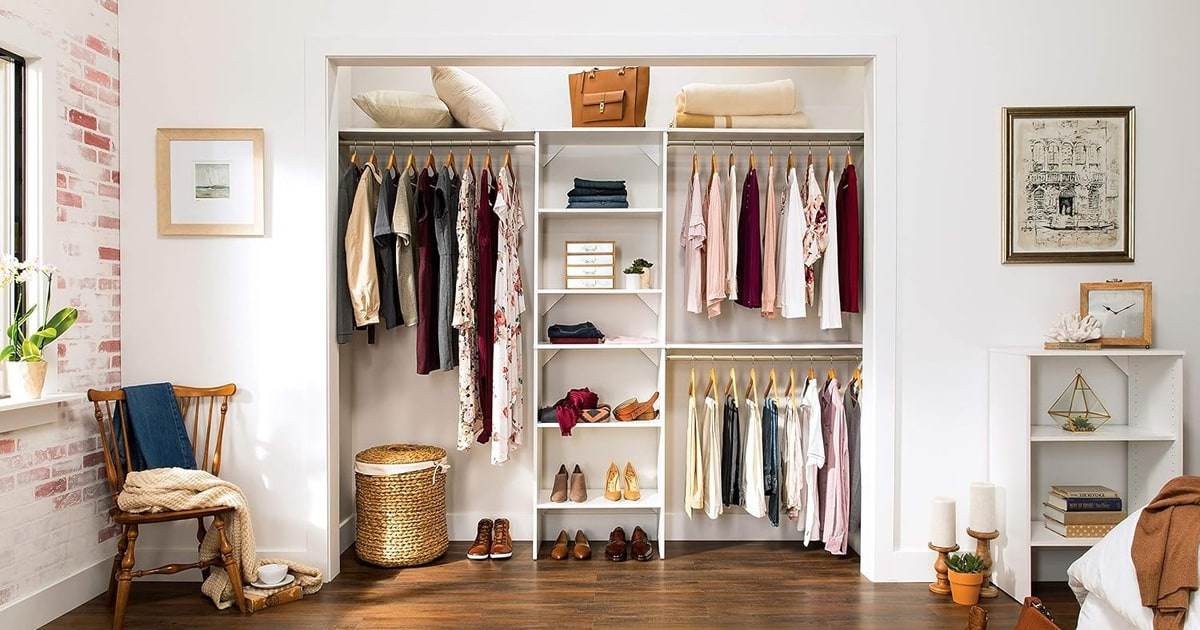
You open your closet more times a day than you open the oven. Most closets ship with one rod and one shelf, which wastes the three feet of air above the shelf and dumps everything else onto the floor. A good system splits that space into short hanging, long hanging, shelves and drawers, so a sweater stack stops sliding into your shoes. Survey work cited by Good Housekeeping found 65% of Americans call their primary bedroom closet disorganized or overcrowded. It's also one of the easier rooms in the house to fix.
No system here does everything well. Wire shelving goes up fast and costs less per linear foot, but small heels and folded stacks tip through the gaps. Laminate looks like furniture and stays put, though most laminate and MDF shelves are rated for only about 25 to 35 pounds. Solid wood holds far more, and you'll be cutting shelves to fit it. Nearly every system also advertises a width range that assumes flat walls and studs where you want them, and the drawers and shoe racks are almost always sold separately.
So start with the closet you have. Measure the wall width, the door swing and the ceiling height, then decide whether you want something bolted to studs or something that stands on the floor and moves with you. Renters and anyone who hates patching drywall should lean freestanding. Anyone with a deep walk-in should think in towers, not one long rod. We think that the ClosetMaid SuiteSymphony Wood Closet Organizer System is the best closet organization system for most people, and that the John Louis Home Solid Wood Walk-In Closet Organizer is the one to buy if you want real wood and shelves that hold heavy stacks.
Everything we recommend
A laminate tower that fits most closets and grows later

Real wood and much stronger shelves, if you can handle a saw

Wire shelving that goes up fast and moves when you do

Wall-to-wall coverage in a wide closet, drawers included
At a glance
| Product | Fits Width | Material | Price | |
|---|---|---|---|---|
| SONGMICS Closet SystemAlso great | 6.5-10.2 Ft | Particleboard | $159.99 |
| ClosetMaid SuiteSymphony Wood Closet Organizer SystemTop pick | 5-10 Ft | Manufactured Wood | $147.84 |
 | Closet System with 6 DrawersAlso in lineup | 48-126 In | Engineer Wood | $399.99 |
| John Louis Home Solid Wood Walk-In ClosetRunner-up | — | Solid Wood | $769 |
| Rubbermaid Configurations Deluxe Custom Closet Kit 3-6Budget pick | 3-6 Ft | Metal Wire | $169.29 |
How we picked
Shelf strength. We compared published weight ratings across materials, since laminate and MDF shelves typically hold 25 to 35 pounds while solid wood runs closer to 75. Sagging shelves are the single most common long-term complaint in owner feedback, so ratings carried real weight.
Fit and adjustability. We favored systems whose spec sheets cover a range of closet widths and whose shelves and rods move after installation. A kit that only works at one width is a kit you'll replace.
Install difficulty. We read assembly documentation and owner feedback for how much cutting, drilling and stud-hunting each system demands. Anything that needs a saw got flagged, not disqualified.
Room to expand. We looked at how deep each brand's accessory catalog runs — drawers, doors, shoe shelves, extra rods — because most people buy a starter kit and add to it later.
Renter-friendliness. We noted which systems stand on the floor with only an anti-tip anchor versus those that hang from studs. Freestanding towers leave far less damage behind.
Top pick
A laminate tower that fits most closets and grows later
ClosetMaid SuiteSymphony Wood Closet Organizer System
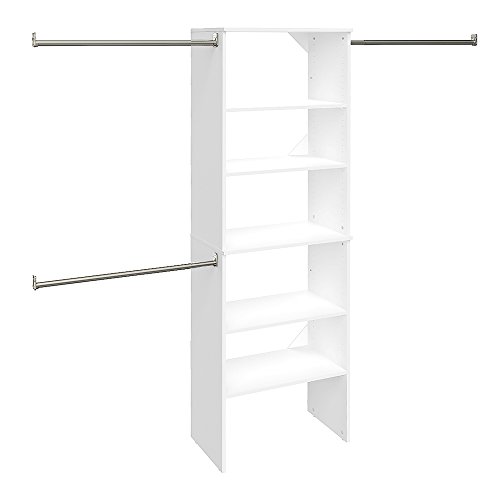
This starter kit gives you a 25-inch tower with five shelves and three expandable rods, so it covers a closet anywhere from 5 to 10 feet wide. It looks like built-in furniture, and you can bolt on drawers, doors and shoe shelves later.
$147.84fromAmazonThis is the shape most closets actually need. A center tower with hanging on both sides turns one long rod into two levels of hanging plus five shelves. Shirts and jackets go on the rods, folded stuff goes in the tower, and the floor stays clear. The rods expand from 30 to 48 inches and can be trimmed, or you can hang them on just one side if your closet is narrow.
ClosetMaid uses 3/4-inch laminate panels here, the same thickness a lot of custom closet companies install, at a small fraction of what a professional job runs. That thickness matters more than the finish does. Thinner particleboard shelves bow in the middle once you stack jeans on them, and once a laminate shelf sags it never comes back.
The add-on catalog is the real reason to start here. Drawers, doors, extra rods, shoe shelves and top shelving all bolt onto the same tower, so you can buy the kit now and add drawers when the budget allows. It's also sold at the big-box stores, which means you can see a panel in person and pick up a replacement part without waiting on a shipment.
One person can build this in an afternoon. All the hardware and instructions come in the box, nothing needs cutting, and the tower goes together on the floor before it stands up. Two shelves inside the tower are adjustable, so you can size a bay for boots or for folded sweaters after you've lived with it for a week.
Flaws but not dealbreakers
It's heavy, and awkward heavy at that. The kit weighs about 74 pounds and the tower stands nearly 7 feet, so getting it upright in a tight reach-in is a two-person job even though the assembly isn't. Plan on clearing the room first.
The starter kit is genuinely a starter. You get shelves and rods and nothing else, so drawers, doors and shoe racks are separate purchases that add up quickly. And like all laminate, the shelves are the weak point for heavy loads: think folded shirts and handbags, not stacks of hardcover books.
Runner-up
Real wood and much stronger shelves, if you can handle a saw
John Louis Home Solid Wood Walk-In Closet
This is 100% solid wood rather than laminate over particleboard, with shelves rated to about 75 pounds each. It's cut-to-fit, so you trim the components to your closet's exact dimensions and end up with something that reads as built-in.
$769fromAmazonThe weight rating is the headline. John Louis Home rates its shelving at 75 pounds per shelf, roughly double the 25-to-35-pound range typical of laminate and MDF systems. If you store folded denim, wool coats, camera gear or storage bins full of paperwork, that difference is the whole argument. Owners of laminate systems report sagging shelves more than any other single complaint.
Cut-to-fit is a feature and a chore. Because you trim the shelves and rods yourself, the finished wall looks tailored instead of a foot short with an awkward gap. But you need a saw, a straight edge and the patience to seal the cut edges. If the phrase circular saw makes you uneasy, buy the ClosetMaid kit instead.
The honey maple finish is warmer than the white melamine everything else in this guide comes in, and the sides and shelves are ventilated. That airflow is worth something in a humid climate or a basement closet, where sealed laminate boxes trap the musty smell that gets into stored linens.
Everything ships in one box with the shelves, rods, brackets and hardware, and the layout is yours to arrange. You can run double hanging on one wall and shelves floor to ceiling on the other. In a walk-in, that flexibility is the difference between a room that works and a room with a rod around three walls and nothing above eye level.
Flaws but not dealbreakers
You're doing more work here than with any other pick. Cutting, sealing and mounting to studs takes a weekend and a couple of tools most renters don't own, and mistakes are permanent in a way that a mis-drilled laminate panel isn't.
Solid wood also costs more per foot of storage than the laminate and wire options, and honey maple won't match a room full of white trim. If you want the built-in look in white, this isn't the shortcut.
Budget pick
Wire shelving that goes up fast and moves when you do
Rubbermaid Configurations Deluxe Custom Closet Kit 3-6
This expandable wire kit covers closets 3 to 6 feet wide, needs no cutting, and reconfigures without tools once it's on the wall. It's the fastest way to double the usable space in a plain reach-in closet.
$169.29fromAmazonWire is the value play, and this kit is the easy version of it. Wire systems run roughly 30 to 40% less per linear foot than comparable laminate, and this one comes with all the mounting hardware and telescoping rods, so there's no trip to the hardware store mid-project. If you're organizing a rental, a pantry or a laundry room and you want it done before lunch, start here.
The airflow is a real advantage, not marketing. Open wire shelving lets damp towels and winter coats dry out instead of sitting in still air, which matters in a basement closet or a humid summer. The epoxy finish also won't rust, so it holds up in a mudroom where boots come in wet.
You can rearrange it later without tools. Shelf heights change, the telescoping rods can be joined into one uninterrupted run or used separately, and the whole thing comes apart and reassembles in a new configuration. When your storage needs change — a kid outgrows short hanging, say — you aren't drilling a fresh set of anchors.
Flaws but not dealbreakers
It looks like wire shelving. Nothing about this reads as furniture, and if you're staging a house to sell, the laminate systems photograph much better.
Small things fall through. Folded sweaters slump into the gaps, shoes tip on the ribbed surface, and anything the size of a sock or a bracelet needs a bin. Buy a few shelf liners and a couple of baskets and plan for them from the start.
Also great
Wall-to-wall coverage in a wide closet, drawers included
SONGMICS Closet System
The SONGMICS system stretches from 6.5 to more than 10 feet wide with four adjustable rods and five hanging zones. Three drawers and a shoe bay come in the box, which is rare at this level.
$159.99fromAmazonIf your closet is wider than a standard reach-in, most starter kits leave you with a dead zone at one end. This one expands to about 10 feet and gives you four rods that adjust between 26 and 49 inches, so you can run short hanging over a shoe bay on one side and full-length dresses on the other. Nothing goes to waste.
Drawers in the box change the math. With most systems you buy the tower, live with open shelves, then spend again on drawer units. Here you get three drawers, a top shelf sized for bins and floor space for shoes as part of the kit. For a guest room or a teenager's closet where a dresser won't fit, that's the whole bedroom's storage in one wall.
You can also use less of it. Set the rods on one side only, or install just the middle tower and skip the arms entirely, which makes this workable in a small closet you plan to move out of later. If the rod heights don't suit your coats, you can drill new holes.
Flaws but not dealbreakers
It's particleboard, not the 3/4-inch laminate of our top pick or the solid wood of the runner-up. Treat the shelves accordingly: folded clothes and light bins, not book boxes or a stack of winter quilts.
It's also big and heavy, around 67 pounds, and assembly takes real time with a second pair of hands. Anchor it to the wall when you're done — a tall, top-loaded closet tower is exactly the kind of furniture that tips.
Who this is for
Buy a system now if your closet still has the builder's single rod and shelf, if you're splitting one closet between two people, or if you're about to list your house. Storage sells: the National Association of Home Builders found a walk-in closet in the primary bedroom ranks among the top three most-wanted interior storage features, and the National Association of Realtors' Remodeling Impact Report puts the cost recouped on closet and storage renovations at roughly 56%. That's high for an interior project you can do yourself.
Skip it if you're moving within a few months, unless you go freestanding and take it with you. This guide covers DIY kits you can buy and install yourself — wire, laminate and solid wood, wall-mounted and freestanding. It doesn't cover professionally designed and installed custom closets, which typically run five to ten times what a comparable DIY laminate system costs, or single accessories like hanging shoe bags and drawer dividers.
How we picked
We looked at five things. Shelf strength: published ratings by material, since laminate usually tops out around 25 to 35 pounds per shelf and solid wood runs closer to 75. Fit and adjustability: whether the spec sheet covers a range of closet widths and whether shelves and rods still move once the thing is on the wall. Install difficulty: how much cutting, stud-hunting and lifting each kit demands, and whether one person can do it. Room to expand: how deep the accessory catalog goes, because almost nobody buys the finished closet on day one. Renter-friendliness: whether the system stands on the floor or requires a row of permanent anchors.
The competition
This is what our research surfaced, not a census of every closet kit sold. Systems change configuration and packaging constantly, and plenty of good ones never turn up in a search.
The Closet System with 6 Drawers ($399.99) — The secilix closet system ships as two independent modules, each about 24 inches wide and 81 inches tall, and covers openings from 4 feet out to more than 10. Six drawers and three rods come included, and the stainless rods are rated to 100 pounds each, which is more than most. It lost to our picks on materials — this is engineered wood, and the finish and hardware aren't in the same class as the ClosetMaid panels — and it really does want two people and a couple of hours to assemble. Still, if you want two towers you can separate later and you care more about drawer count than finish, it's a sensible buy. Install the anti-tip kit.
Installation and fit
Measure twice before you order, and measure the opening at the floor, at eye level and at the ceiling — older closets are rarely square, and a half-inch of drift will eat your clearance. Find your studs before you commit to a layout, since every wall-mounted system anchors to them, and drywall anchors alone won't hold a loaded shelf. For freestanding towers, level the base with shims before you load anything, then run the anti-tip strap into a stud; a tall tower with heavy bins up top is a tipping hazard around kids. On wire shelving, add liners so socks and heels stop falling through. And wipe laminate with a barely damp cloth, not a soaked one, because water sitting on a cut edge swells the core.
Questions we get
What's the best closet system for a small reach-in closet?
A single tower with rods on both sides gets you the most out of a narrow opening, which is why we recommend the ClosetMaid SuiteSymphony for most reach-ins. Its rods can be trimmed or installed on one side only, so it still works below the 5-foot mark. If you'd rather not mount anything, the SONGMICS center tower can be used alone.
What's the difference between wire and laminate closet systems?
Wire is ventilated, lighter on your wallet — roughly 30 to 40% less per linear foot — and goes up faster, but small items fall through and it never looks like furniture. Laminate gives you solid shelves and a built-in look, at the cost of weight limits usually in the 25-to-35-pound range and a longer install. If the closet is in a damp basement or a mudroom, wire's airflow is a genuine advantage.
Is a professionally installed custom closet worth it?
It buys you design help, exact fit and someone else doing the work, and California Closets reports that more than 90% of its surveyed customers say the new system improved their morning routine. But professional installation typically costs five to ten times a comparable DIY laminate system. If you can measure a wall and drive screws into studs, the gap in finished quality is much smaller than the gap in cost.
What can I use if I rent and can't drill into the walls?
Go freestanding. The SONGMICS and secilix systems stand on the floor and hold their own weight, so the only fastener touching the wall is the anti-tip anchor — one small hole you patch on move-out. Don't skip that anchor. A loaded tower that isn't strapped can tip, and no landlord deposit is worth that risk.
Which system handles heavy sweaters and stacks of jeans?
The John Louis Home solid wood system, by a wide margin. Its shelves are rated at about 75 pounds each, roughly double what typical laminate and MDF shelving is rated for. If you routinely stack heavy folded clothes or store bins of paperwork on shelves, that rating is the spec to shop on.
How long does a DIY closet system take to install?
A wire kit like the Rubbermaid can be done in a morning, since nothing needs cutting. A laminate tower kit is usually an afternoon for one person, plus a second pair of hands to stand it up. Cut-to-fit solid wood is a weekend, because you're measuring, cutting and sealing edges before anything goes on the wall. Pre-assembled panel systems cut install time roughly in half compared with cut-and-fit kits.
Why you should trust us
For this guide:
- We read manufacturer specification sheets for every system here, comparing shelf weight ratings, panel thickness, adjustable width ranges and what actually ships in the box versus what's sold separately.
- We compared published buying guides and cost research from Bob Vila, HomeAdvisor, the National Association of Realtors and the National Association of Home Builders to understand how material choice affects cost per linear foot and resale value.
- We looked for recurring themes in owner feedback across these systems — sagging shelves, missing hardware, assembly time and how well each kit fits closets that aren't perfectly square.
- We read owner reviews on every listing, weighted toward the critical ones, because that is where the recurring failures show up.
- We have a systematic way of automatically fetching the latest prices, so the numbers on this page stay current.
- This is a research-focused guide, so the team may not own every product listed — though we often do own the top winners, which gives us extra context for the recommendations.
- We don't accept free products, and the retailer commission never changes which product we recommend.
Sources
Best Closet Organizers 2026 — Wirecutter / New York Times, Wirecutter
Best Closet Organizers Tested by Good Housekeeping, Good Housekeeping
Best Closet Organizers and Systems — The Spruce, The Spruce
Best Closet Organizers of 2026 — Bob Vila, Bob Vila
Closet Organizer Buying Guide — This Old House, This Old House
Best Closet Systems — Better Homes & Gardens, Better Homes & Gardens
Cost to Install a Closet Organizer — HomeAdvisor 2025 Cost Guide, HomeAdvisor
Remodeling Impact Report 2025 — National Association of Realtors, National Association of Realtors
What Home Buyers Really Want — National Association of Home Builders, NAHB
Elfa Shelving System Specifications — The Container Store, The Container Store
PAX Wardrobe System — IKEA US, IKEA
SuiteSymphony Closet System — ClosetMaid, ClosetMaid
Amazon product listings and owner reviews for all 5 products
Manufacturer specification pages for each product
Some passages in this guide may be paraphrased with AI help. Prices are refreshed automatically.
More like this.
Continue exploring home reviews and recommendations.

The Best Modular Closet Systems
A closet system is one of those purchases you think about for about a week and then live with for a decade. The good ones disappear into the room and just…

The Best Walk-In Closet Organizer Systems
A walk-in closet is the one room in your house that nobody else sees, which is exactly why it goes bad so fast. Builder-grade setups usually give you one…

The Best Pantry Organization Bin Sets
A pantry bin set does two jobs at once. It keeps flour and cereal from going stale, and it lets you see what you already own so you stop buying a fourth…

The Best Label Makers for Home Organization
A label maker earns its keep in the boring places. The bin of winter hats. The spice jars that all look alike. The tangle of black cords behind the TV.…

The Best Car Organization Gadgets
Cars accumulate junk. Receipts slide under the seat, a phone drops into the console gap, and grocery bags tip over the second you take a left turn. The…

The Best Home Security Systems
A home security system spends almost all of its life doing nothing at all. That's the point. What you actually notice day to day is smaller stuff: whether…