The Best Anti-Fatigue Kitchen Mats
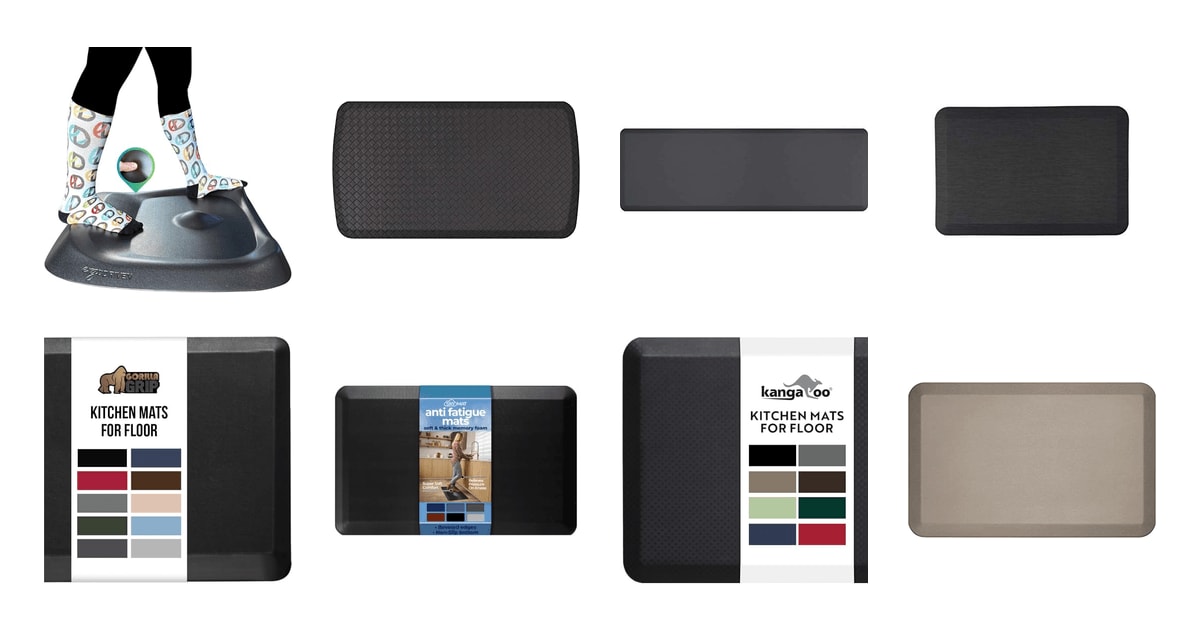
Standing on tile or concrete for an hour does something quietly awful to your body. Your heels ache first, then your knees, then your lower back around the time you're plating dinner. Research published in Occupational & Environmental Medicine links prolonged standing past two continuous hours to musculoskeletal pain in the lower back, hips, and knees. A good mat won't make you a different person, but a study in Applied Ergonomics found that people standing on anti-fatigue mats reported roughly half the discomfort of people on bare concrete. That's a real difference for something you step onto and forget about.
Here's the honest part: most mats sold as anti-fatigue don't do much. The Canadian Centre for Occupational Health and Safety says you need a minimum compressed thickness of three-quarters of an inch before matting is ergonomically useful, and plenty of thin foam mats fall well short. Even the good ones wear out. Good Housekeeping's long-term evaluation found budget PVC foam mats compressed 15 to 25 percent after a year of daily use, while polyurethane held its shape. And no mat fixes a bad pair of shoes or a counter at the wrong height.
We think that the Topo by Ergodriven is the best anti-fatigue mat for most people, and that the WellnessMats Original is the one to buy if you want a mat that outlives your current kitchen.
Everything we recommend

A bumpy surface that keeps your feet moving on their own

Buy it once and it likely outlasts everything else in the room
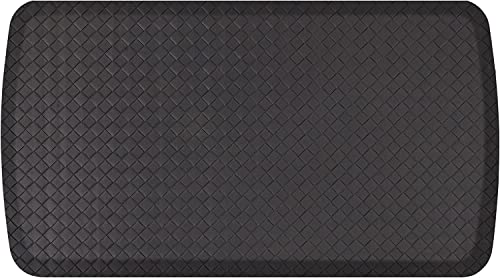
The softest surface here, and it doesn't look like a shop mat

Most of the comfort for a fraction of what the premium mats cost

Built for eight-hour days, with the safety certifications to match
At a glance
| Product | Thickness | Material | Price | |
|---|---|---|---|---|
| The Standing Desk Mat - Topo byTop pick | 2.7"Th | Comfort Foam | $109 |
| GelPro Elite Premier Gel & Foam CushionedAlso great | 0.8"Th | Gel & Foam | $159.95 |
| WellnessMats Original Anti-Fatigue Kitchen MatUpgrade pick | 0.8"Th | — | $315 |
| Imprint CumulusPRO Professional Linen Anti-Fatigue MatRunner-up | 0.8"Th | Linen | $128.40 |
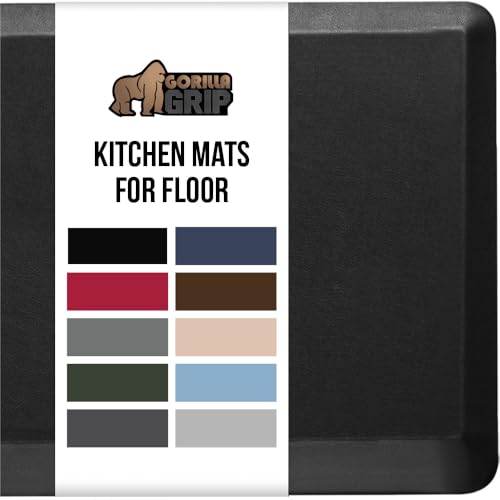 | GORILLA GRIP Cushioned Antifatigue Kitchen Mat forAlso in lineup | 3/4" | — | $42.94On sale |
| Sky Solutions Anti Fatigue Mat - 3/4"Budget pick | 3/4" | PU Foam | $49.99 |
 | KANGAROO Anti Fatigue Mats for Kitchen FloorAlso consider | 0.8" | High Density Foam | $39.94 |
 | NewLife by GelPro Professional Grade Anti-Fatigue KitchenAlso consider | 3/4" | Bio-Foam | $93.94 |
How we picked
Thickness that counts. We treated three-quarters of an inch of compressed thickness as the floor, following the CCOHS recommendation for people who stand on hard surfaces. Anything thinner got cut regardless of how it's marketed.
Material and lifespan. We compared spec sheets and published long-term evaluations, including Good Housekeeping's finding that polyurethane held its density after a year while PVC foam lost 15 to 25 percent. Warranty length told us what manufacturers themselves expect.
Edges and slip. We looked for four-sided beveled edges and non-slip backing, since CNET's walk-on comparisons found flat-edged mats caught toes more often. Any listing that warns it isn't slip-resistant got flagged.
Waterproof surface. Serious Eats found that fabric-top and non-sealed mats soak up oil and food debris within weeks. We prioritized sealed, wipe-clean surfaces over anything that needs laundering.
Sizes that fit kitchens. We favored mats available in runner and island-friendly lengths, not just one 20-by-32 rectangle. A galley kitchen and a single sink station are different problems.
Top pick
A bumpy surface that keeps your feet moving on their own
The Standing Desk Mat - Topo by
The Topo has ridges, slopes, and a raised massage bump instead of a flat surface, so your feet shift around without you deciding to. It's thick, PVC-free, and easy to nudge out of the way with one heel.
$109fromAmazonThe Topo's advantage is that it stops you from standing still. Its topographic surface — raised edges, gentle slopes, a central node — is engineered to prompt small weight shifts every couple of minutes. Ergonomics literature ties that kind of micro-movement to less lower-limb fatigue than standing frozen in one spot. Wirecutter's panel named it their top overall anti-fatigue pick for exactly this reason. You'll catch yourself stretching a calf on the ridge while you wait for water to boil.
It's also the thickest mat here by a wide margin. At 2.7 inches, the Topo's deluxe comfort foam sits far above the three-quarter-inch threshold that CCOHS treats as the minimum for meaningful relief. Owners who stand for hours describe going from sore feet within an hour to full sessions without much complaint. If you're heavier or you have plantar fasciitis, that extra depth matters more than a fraction of an inch does on a flat mat.
The one-foot repositioning trick sounds like a gimmick until your kitchen is busy. There's an indentation you can hook with a heel or toe to drag the mat out from the counter, then push it back when you're done. Flat mats make you bend over or kick at an edge. This one you move while your hands are full of a hot pan.
It's PVC-free, which matters if you're trying to keep petroleum-based plastics out of a kitchen where kids are underfoot. Owner feedback going back years describes the foam holding its shape rather than flattening into a pancake — one long-term account covers two years of near-daily use on hardwood with no meaningful loss of cushion.
Flaws but not dealbreakers
It's not a kitchen mat by design. Ergodriven built the Topo for standing desks, and the shape reflects that — it's roughly square, about 29 by 26 inches, so it covers one station and nothing more. If you want coverage along a galley run or around an island, this isn't your mat.
The terrain is polarizing. Some people love the sculpted surface underfoot; others find the slopes distracting when they just want a flat place to stand. Barefoot is where it feels best. In shoes, the contours matter less, and you're paying a premium for a feature you'd barely notice.
It's the priciest mat here relative to how much floor it covers, and several owners say so plainly even while recommending it. If you only stand at the sink for ten minutes a night, a simpler foam mat will do.
Upgrade pick
Buy it once and it likely outlasts everything else in the room
WellnessMats Original Anti-Fatigue Kitchen Mat
The WellnessMats Original is made in the USA from three-quarter-inch polyurethane and carries a 20-year manufacturer's warranty. It's antimicrobial, wipes clean with a damp cloth, and the 72-inch length covers an entire galley run.
$315fromAmazonNo other mat here comes close on lifespan. WellnessMats backs this one with a 20-year manufacturer's warranty, which is not a number companies attach to foam. Good Housekeeping's long-term evaluation found polyurethane mats kept their original thickness and density after a year of daily use while cheaper PVC foam lost 15 to 25 percent. Owner reports stretch past a decade with the mat still springy. Spread the cost over that many years and the math changes.
The 72-by-24-inch size is the reason to pick this over the smaller premium mats. If you have a galley kitchen, you can put one mat down and stop thinking about where to stand. Owners with concrete slabs and no basement describe it as the thing that made dishwashing tolerable again. Two 20-by-32 mats butted together always leave a seam to trip on. This doesn't.
It's 99.99% anti-microbial by design and puncture, tear, heat, and stain resistant, which is a useful combination in a room where you drop knives and set down hot pans. Cleaning is a damp cloth. There's no cover to wash, no fabric to absorb oil, and no seam for grime to hide in.
The edges taper gradually rather than sitting proud of the floor, and WellnessMats says they won't curl, delaminate, or compress. Curling edges are the failure mode that turns an old mat into a trip hazard — CNET's walk-on comparisons found flat-edged mats caught toes noticeably more often than ramped ones. For an older adult in the house, that's the spec that matters most.
Flaws but not dealbreakers
It costs more than any other mat here, and there's no way around that. You're paying up front for a mat you won't replace, which is a good trade if you cook daily and a bad one if you don't.
The surface picks up scuffs. Several owners note that walking on it in outdoor shoes leaves a dusty shoe-shaped outline until you wipe it down. It doesn't hurt anything, but on the grey it's visible.
The look is plainly utilitarian. If you want your mat to read as part of the decor, the patterned options elsewhere in this guide will suit you better.
The WellnessMats Original carries a 20-year manufacturer's warranty.
Also great
The softest surface here, and it doesn't look like a shop mat
GelPro Elite Premier Gel & Foam Cushioned
The GelPro Elite pairs a gel layer with energy-return foam in a three-quarter-inch core, which spreads pressure across your whole foot instead of concentrating it on the heel. The patterned top makes it the one mat here you might actually want visible.
$159.95fromAmazonGel changes how the cushioning feels, not just how much there is. GelPro's dual comfort core puts a soothing gel layer over energy-return foam, and the company's position is that the gel distributes plantar pressure across a wider contact area than uniform foam of the same thickness. In practice that means less of a hot spot under your heel after an hour of prep. GelPro points to it specifically for people dealing with plantar fasciitis, arthritis, or osteoporosis.
The basketweave top is why a lot of people choose this one. Most anti-fatigue mats look like they belong in a warehouse. This looks like a runner, which matters when your kitchen opens onto the living room and there's no hiding it. The surface is water- and stain-resistant, so a splash of olive oil wipes off instead of soaking in.
Longevity reports are strong. Owners describe mats still in service after four, five, even ten-plus years, which puts it far ahead of typical foam and within reach of polyurethane. The edges are beveled and reinforced specifically so they won't curl or wear down, which is where most cheap mats fail first.
It's heavier than the budget foam mats, and that weight works in your favor. A light mat skates when you pivot from sink to stove. This one mostly stays put — though it isn't perfectly immune, and some owners report gradual creep over weeks.
Flaws but not dealbreakers
It's expensive for the coverage you get. At 20 by 36 inches, it's a one-station mat priced near the premium tier, and more than a few owners who like it still call it overpriced.
The rating spread is wider than the others here, with a visible tail of unhappy buyers. The recurring complaints involve mats that shifted on smooth floors and, in some cases, frustrating experiences with returns and replacements.
It's not a mat for a garage or a workshop. The decorative top is built for kitchen life, and abrasive grit will show on it faster than it would on plain polyurethane.
The GelPro Elite is backed by a 5-year warranty.
Budget pick
Most of the comfort for a fraction of what the premium mats cost
Sky Solutions Anti Fatigue Mat - 3/4"
The Sky Solutions mat hits the full three-quarter-inch thickness with high-density PU foam, has a diamond-textured stain-resistant top, and works on both hard floors and carpet. It's the sensible starting point if you're not sure a mat will help you.
$49.99fromAmazonIt clears the bar that matters. Three-quarter-inch high-density polyurethane foam is exactly the compressed thickness CCOHS names as the minimum for effective anti-fatigue matting, and plenty of cheap mats don't get there. You're not buying a compromise on the one spec that determines whether standing feels better. You're skipping the gel layer and the decades-long warranty.
If you don't know whether a mat will help your back, start here. It's a fraction of the cost of the premium picks, and the feedback pattern is remarkably consistent across a very large body of owner reports — people with heel pain, arthritic knees, and long shifts on concrete describe real relief. Sky Solutions backs it with a one-year guarantee, so a bad experience isn't a sunk cost.
The padded non-slip bottom is rated for hard floors and carpet, which is unusual. Most anti-fatigue mats assume tile or hardwood and slide unhelpfully on a low pile. If your kitchen runs into a carpeted dining area, or you want to move the mat to a carpeted office, this one travels better than the rest.
The diamond-textured top resists stains rather than just repelling water. Owners mention spice and seasoning debris wiping off without leaving a mark, which is the actual failure mode for a kitchen mat — not a puddle, but the slow accumulation of turmeric and olive oil in a texture.
Flaws but not dealbreakers
Foam is foam. It will compress over years in a way polyurethane like the WellnessMats doesn't, so plan on replacing it eventually rather than treating it as a lifetime purchase.
It ships flat to avoid creases, which means a big awkward box. Some owners report dents in the foam from shipping on the larger sizes, deep enough to warrant a return.
The edges aren't as gradually ramped as the premium mats. It's fine for most households, but if trip risk is your main concern, the beveling on the WellnessMats or the Imprint is more reassuring.
Sky Solutions backs the mat with a one-year guarantee.
Runner-up
Built for eight-hour days, with the safety certifications to match
Imprint CumulusPRO Professional Linen Anti-Fatigue Mat
The Imprint CumulusPRO is one-piece polyurethane with a high-density core, certified by the National Floor Safety Institute and partnered with the American Chiropractic Association. It's guaranteed not to lose support, and the beveled no-curl edges make it a safe choice for households with seniors.
$128.40fromAmazonThis is the mat to buy if you cook for hours, not minutes. Imprint's Cushion-Core construction is a solid one-piece polyurethane build with a high-density core, guaranteed not to bottom out over time. The people who rave about it are the ones standing six or seven hours a day, and they describe the difference against a half-inch foam mat as not close. If your holiday cooking runs from morning to dinner, this is the surface you want.
The safety credentials are the strongest here. It's tested and certified by the National Floor Safety Institute, and Imprint is an American Chiropractic Association partner. The edges are beveled with no-curl construction and the bottom is non-slip. CNET's walk-on comparisons found four-sided ramped edges cut down on toe-catch incidents versus flat-edged mats — a finding that matters most for older adults and small kids.
The materials are non-toxic and phthalate-free, safe around children and pets. That puts it alongside the Topo and the NewLife as a reasonable choice if you're trying to avoid PVC in a room where a toddler sits on the floor. Cleaning is a wipe-down; there's no cover and no fabric.
It comes in a range of sizes including 30-by-30 and larger, which gives it more layout flexibility than the Topo. If you stand at a corner or need to cover the space between a sink and a dishwasher, you're more likely to find a fit.
Flaws but not dealbreakers
The stamped linen texture on top divides people. Barefoot, some owners find the pattern irritating against the sole after a while. In socks or shoes it's a non-issue, but if you cook barefoot, that's worth knowing.
It's a premium-priced mat that looks industrial. The charcoal linen finish is more workshop than kitchen, and it won't blend into a nice floor the way the GelPro does.
The rating distribution shows a slightly larger group of dissatisfied buyers than the top pick's, mostly clustered around the surface texture rather than durability.
Who this is for
Buy a mat if you're on your feet in the kitchen for half an hour or more most days and your floor is tile, hardwood, laminate, or a concrete slab. The American Podiatric Medical Association points out that hard flooring sends shock straight into your joints, and cushioned matting absorbs a meaningful share of that repetitive load on knees, hips, and lumbar spine. If you already deal with plantar fasciitis, arthritic knees, or chronic low back pain, this is one of the simplest changes you can make to your kitchen. It's also worth it if you're outfitting a kitchen for an older parent, where the edge design is as much a safety feature as a comfort one.
Skip it if your kitchen is carpeted, if you're in and out in five minutes, or if the real problem is a counter at the wrong height — no mat fixes ergonomics that force you to hunch. This guide covers mats you stand on in a kitchen. We're not covering bath mats, decorative kitchen rugs, or thin cushioned runners that don't reach the three-quarter-inch threshold, because the research is clear that thin mats don't do much. We also stuck to standard rectangular mats rather than modular tile systems.
How we picked
Thickness: We treated three-quarters of an inch of compressed thickness as a hard minimum, following CCOHS guidance for people standing on hard floors. Material: We compared polyurethane against gel-infused and standard PVC foam, weighting long-term evaluations that measured how much each compressed after a year of daily use. Edges and grip: Four-sided beveled edges and a real non-slip backing were near-requirements, since flat edges catch toes and a sliding mat is its own hazard. Cleaning: We favored sealed waterproof surfaces you can wipe down over fabric tops that absorb oil and debris. Size options: We looked for mats offered in runner and island lengths, not just one rectangle, so you can match the mat to how your kitchen actually works.
Other anti-fatigue kitchen mats worth considering
If you want less petroleum in your foam: The NewLife by GelPro Professional Grade Anti-Fatigue Kitchen ($93.94) — The NewLife by GelPro uses a plant-based bio-foam core instead of a fully synthetic one, and it's the pick if you're trying to keep petrochemicals out of a kitchen where kids play on the floor. It hits the same three-quarter-inch thickness as the picks, the bottom is certified by the National Floor Safety Institute for traction, and the edges are beveled and reinforced. GelPro backs it with a 10-year manufacturer's warranty, which is unusual at its price. Owners describe mats still going strong after five years of heavy use, including one used for marathon gaming sessions. What you give up is the gel layer of the Elite and the terrain of the Topo — this is a flat, smooth, comfortable mat with a plainer look. The stone colorway is more neutral than exciting.
If you need to cover several spots at once: The KANGAROO Anti Fatigue Mats for Kitchen Floor ($39.94) — The Kangaroo Original comes in extra-large and runner sizes and costs little enough that you can put one at the sink and another at the stove without much thought. The three-quarter-inch high-density foam is genuinely comfortable — repeat buyers describe mats lasting six years before needing replacement, and the manufacturer has offered one-time replacements when foam started cracking in year two. But read the listing carefully: Kangaroo explicitly warns that this mat is not slip-resistant and tells you to wipe up any water on or under it. That's a meaningful caveat for a kitchen, and it's why this isn't a pick. On a textured tile floor with dry conditions it's fine. On smooth hardwood near a sink, we'd choose something with a rubber backing.
The competition
Here's what our research surfaced, not a survey of everything sold. Anti-fatigue matting is a crowded category with a lot of near-identical foam rectangles, and we focused on the models that published reviews, manufacturer specs, and owner feedback gave us something substantive to compare.
The GORILLA GRIP Cushioned Antifatigue Kitchen Mat for ($42.94) — The Gorilla Grip Cushioned Antifatigue Mat is the most popular mat in this lineup by a wide margin, and it's a reasonable buy. It has the full three-quarter inch of high-density foam, a waterproof pebbled top, and an SB rubber backing that's genuinely tougher than the foam backings on most budget mats. Owners like the beveled edges and the easy wipe-down. It lost to the Sky Solutions mat on two counts: the grip reports are inconsistent, with some owners saying it stays put on tile and others saying it slides enough to need something underneath, and a few describe a musty smell from the underside when the mat is new. If you want the rubber backing specifically and your floor is textured, it's a fine alternative at a similar price.
Care and placement
Wipe your mat down with a damp cloth and mild soap when something spills, and do it before the oil sets — sealed polyurethane surfaces clean easily, but dried-on grease still takes effort. Skip harsh solvents and abrasive pads, which can dull or crack the top layer. Don't run a wipe-clean mat through a washing machine. Every few weeks, lift it and clean the floor underneath; trapped moisture is what makes a mat smell and can leave a mark on hardwood. For placement, measure the stretch where you actually stand rather than buying to a standard size. In front of a sink, most people want something in the 20-by-32 range. A galley kitchen with a sink, stove, and prep counter in a line is where a 72-inch runner earns its cost. If a mat's edges start curling, stop using it — that's the trip hazard the beveling was there to prevent.
Questions we get
Do anti-fatigue kitchen mats actually work, or is it just marketing?
They work, within limits. A peer-reviewed study in Applied Ergonomics found that people standing on anti-fatigue mats for 90-minute sessions reported roughly half the perceived discomfort of people standing on bare concrete. The catch is that thin mats don't deliver this — the effect depends on real cushioning depth. A quarter-inch decorative kitchen rug is not an anti-fatigue mat no matter what the packaging says.
How thick does a mat need to be to help my back?
Three-quarters of an inch is the number to look for. That's the minimum compressed thickness the Canadian Centre for Occupational Health and Safety recommends for people standing on hard surfaces, and thinner matting isn't considered ergonomically effective. Every pick in this guide meets or exceeds it. The Topo goes much further at 2.7 inches, which is part of why it works so well for longer sessions.
What's the difference between gel, memory foam, and polyurethane mats?
Polyurethane is the durability play — it resists compression for years, which is why WellnessMats can attach a 20-year warranty to one. Gel-infused mats like the GelPro Elite add a layer that spreads pressure across more of your foot, easing the hot spot under your heel. Standard and memory foam is the budget tier: comfortable at first, but it compresses measurably over a year of daily use.
Are anti-fatigue mats safe on hardwood floors?
Generally yes, as long as you pick one with a proper non-slip backing rather than a hard plastic underside. The bigger risk is trapped moisture rather than scratching, so lift the mat every few weeks and let the floor underneath dry. Be careful with mats that state they aren't slip-resistant — the Kangaroo listing carries that warning explicitly, and smooth hardwood near a sink is exactly where that matters.
What's the best mat for plantar fasciitis?
Look for depth and pressure distribution rather than firmness. The GelPro Elite is built around this — its gel-and-foam core is aimed specifically at plantar fasciitis, arthritis, and osteoporosis, and the gel spreads load across a wider area than uniform foam. The Topo is the other strong option, since its extra depth plus the shifting it encourages keeps you from loading the same part of your heel for an hour straight.
How long should a mat last before the cushioning gives out?
It depends entirely on material. Good Housekeeping's long-term evaluation found polyurethane mats held their original thickness after a year of daily use while lower-cost PVC foam compressed 15 to 25 percent over the same period. WellnessMats states its mats hold density for a decade or more in normal home use, against typical two-to-three-year lifespans for foam. Owner reports on the better foam mats often land in the four-to-six-year range.
Why you should trust us
For this guide:
- We read manufacturer spec sheets for every mat in this guide, comparing stated core thickness, material composition, edge construction, and warranty terms.
- We reviewed published evaluations from Wirecutter, Good Housekeeping, CNET, and Serious Eats, along with ergonomics guidance from CCOHS, the American Podiatric Medical Association, and peer-reviewed research in Applied Ergonomics and Occupational & Environmental Medicine.
- We read through owner feedback for each model, looking for recurring themes around slipping, edge curling, foam compression, and long-term durability rather than isolated complaints.
- We read owner reviews on every listing, weighted toward the critical ones, because that is where the recurring failures show up.
- We have a systematic way of automatically fetching the latest prices, so the numbers on this page stay current.
- This is a research-focused guide, so the team may not own every product listed — though we often do own the top winners, which gives us extra context for the recommendations.
- We don't accept free products, and the retailer commission never changes which product we recommend.
Sources
Best Anti-Fatigue Mats — Wirecutter (NYT), Wirecutter
Best Anti-Fatigue Kitchen Mats — Good Housekeeping, Good Housekeeping
Best Anti-Fatigue Kitchen Mats — Serious Eats, Serious Eats
Best Anti-Fatigue Kitchen Mats of 2026 — CNET Home, CNET
Best Anti-Fatigue Mats for Kitchens — Bob Vila, Bob Vila
Best Kitchen Mats — Real Simple, Real Simple
Effects of Anti-Fatigue Matting on Discomfort and Fatigue During Prolonged Standing — Applied Ergonomics, Applied Ergonomics (Elsevier)
Prolonged Standing at Work and Its Health Effects — Occupational & Environmental Medicine (BMJ), BMJ Occupational & Environmental Medicine
Ergonomics: Working in a Standing Position — Canadian Centre for Occupational Health and Safety, CCOHS
WellnessMats Original Product Specifications & Warranty, WellnessMats Official
Topo Anti-Fatigue Mat — Design & Ergonomics Specifications, Ergodriven Official
GelPro Elite Anti-Fatigue Mat — Product Overview, GelPro Official
Amazon product listings and owner reviews for all 8 products
Manufacturer specification pages for each product
Some passages in this guide may be paraphrased with AI help. Prices are refreshed automatically.
More like this.
Continue exploring home reviews and recommendations.

The Best Driveway Heating Mats
The worst part of a snowstorm isn't the snow. It's the twenty feet between your door and your car, refrozen into a gray slab by morning. A heating mat…

The Best Snow Melting Mats for Walkways
Shoveling a walkway at six in the morning is nobody's idea of a good time, and the ice that forms afterward is worse. A heated mat sidesteps both…

The Best Garage Floor Containment Mats
Winter doesn't stay outside. Every time you pull into the garage, your tires and wheel wells carry in slush, road salt and grit, and it all melts into a…

The Best Anti-Aging Face Serums
A serum is the step in a routine where the actual chemistry happens. Cleanser, moisturizer and sunscreen mostly support the work a serum does. A good one…

The Best Anti-Snoring Mouthpieces and Devices
Snoring is one of those problems you rarely notice yourself. Your partner does. And once it's a nightly thing, the fixes people reach for first - a…

The Best Anti-Aging Face Moisturizers
An anti-aging moisturizer does two jobs at once. It keeps your face comfortable all day, and it carries actives - retinol, peptides, niacinamide - that…