The Best Driveway Heating Mats

The worst part of a snowstorm isn't the snow. It's the twenty feet between your door and your car, refrozen into a gray slab by morning. A heating mat handles that stretch for you. You unroll it, plug it in, and the snow turns to water as it lands. There's no shoveling, no salt eating your concrete, and no hidden ice waiting under fresh powder. For anyone who dreads the walk out to the driveway, that's the whole appeal.
But no mat here will clear a two-car driveway. Portable mats are sized for walkways, entry pads, stairs, and maybe a single tire track. Warmzone, which sells snow-melt systems, says as much: residential mats are built for walkways and single-car-width sections, not full coverage. You can link mats to grow the area, though every chain hits an amp ceiling. And they're slow in a real blizzard. If snow falls faster than about two inches an hour, you'll still be out there with a shovel.
So buy for the spot that matters most, then expand from there. Match the wattage to your climate instead of reaching for the strongest mat you can find. This Old House makes the same point, since lighter-snow regions can run cooler, cheaper mats. Check for a UL or ETL mark and a GFCI outlet before you plug anything in outside. We think that the HeatTrak Heated Snow Melting Mat is the best driveway heating mat for most people, and that the RVSNAIL Heated Snow Melting Mat is the one to buy if you only need a doorway or a few steps clear.
Everything we recommend

A big, season-proof entry pad you can leave down all winter
Thicker rubber and a faster melt, in a doorway-sized slab

A long, low-wattage strip for a walkway on a budget
Permanent, invisible snow melting, if you're pouring concrete
Prices as of Oct 25, 6:48 AM PT · Details
At a glance
| Product | Coverage area | Surface material | Price | |
|---|---|---|---|---|
| HeatTrak Heated Snow Melting Mats for EntrancesTop pick | 40 x 60 in | Corrosion-resistant | $399.95 |
| WarmlyYours PowerMat Snow Melting MatUpgrade pick | 3 x 15 ft (45 sqft) | — | $497.40 |
 | Kurhimy Heated Snow Melting Mats for Entrances-10Also in lineup | 60 x 100 cm | — | $171.64 |
| 20x30in Heated Snow Melting MatsRunner-up | 20 x 30 in | 7mm rubber | $119.99 |
 | HeatTrak Heated Snow Melting Mats for EntrancesAlso consider | 30 x 48 in | Corrosion-resistant | $299.95 |
| Toriexon Snow Melting Mats Outdoor 20 xBudget pick | 20 x 60 in | Premium PVC | Check price |
Prices as of Oct 25, 6:48 AM PT · Details
How we picked
Melt rate and wattage. We compared published melt rates and watts per square foot against the Department of Energy's 50-to-300-watt range for radiant snow-melt systems. A mat had to clear at least two inches an hour to make the list.
Rubber over PVC. Family Handyman and Bob Vila both flag PVC as the weaker surface, slicker when meltwater refreezes and prone to cracking in deep cold. We favored rubber unless a mat's price made the compromise worth it.
Outdoor electrical safety. We looked for a UL or ETL mark and a GFCI cord or GFCI-protected outlet, since UL Solutions tests outdoor heating gear for GFCI compatibility and weatherproof enclosures. Anything without one was out.
Linking and coverage. Because a single mat rarely covers what you need, we noted the stated amp or wattage ceiling for chaining mats together. A higher ceiling means fewer outlets and more room to expand.
Warranty and support. Warranty terms here run from unstated to ten years, and owner feedback themes point to cords and elements as the parts that fail. We weighted longer coverage and reachable technical support heavily.
Top pick
A big, season-proof entry pad you can leave down all winter
HeatTrak Heated Snow Melting Mats for Entrances
At 40 by 60 inches, this mat covers a landing, a stoop, or the strip of driveway right behind your bumper. It ships with a GFCI power cord, melts about two inches of snow an hour, and is built to stay outside from the first storm to the last.
$399.95fromAmazonPrices as of Oct 25, 6:48 AM PT · Details
This is the mat we'd trust to stay out all season. HeatTrak builds it from corrosion-resistant material and says it's meant to be left in place through the winter, which matters more than it sounds. Every time you drag a mat in and out of the garage, you flex the heating element and scuff the cord. Leave this one down and it just works.
The size is the real reason it wins. Forty by sixty inches is enough for a front landing plus the first step down, or a car-door-sized patch of driveway so you're not stepping into slush. Smaller mats clear a rectangle you have to aim for. This one clears the area you actually walk on, which is what stops the shuffling and the hand on the railing.
The included power unit is the quiet advantage here. It's engineered for outdoor use, comes with a six-foot cord, and lets you chain stair and walkway mats together up to 14 amps. So you can start with the entry pad and add mats down the path later without hunting for another exterior outlet. Consumer Reports recommends pairing snow-melt gear with a dedicated GFCI outlet, and this cord already has that protection.
Two inches of snow an hour won't win a spec-sheet fight. Cheaper PVC mats claim the same rate, and one mat here claims three. But the Department of Energy puts radiant snow-melting systems anywhere from 50 to 300 watts per square foot, and the top of that range costs real money to run. A steady two inches an hour handles most storms in most places, and owner feedback on these mats leans toward longevity over raw speed.
Flaws but not dealbreakers
It's the most expensive portable mat here per square foot, and the listing doesn't publish a wattage figure, so you're taking the melt rate on faith rather than doing the math on your power bill. The two-year warranty is also shorter than what RVSNAIL puts on a much cheaper mat.
Two inches an hour is a middling melt rate. In a heavy, wet storm the mat keeps the surface passable but won't stay ahead of accumulation, and you'll still want a shovel for the edges where snow slides off and piles up.
HeatTrak covers the mat with a two-year manufacturer's warranty from the date of shipment.
Runner-up
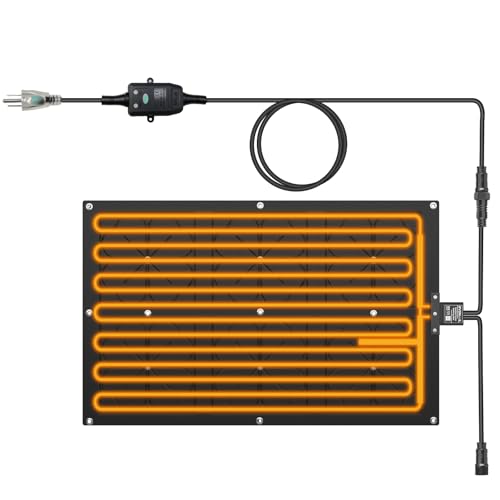
Thicker rubber and a faster melt, in a doorway-sized slab
20x30in Heated Snow Melting Mats
This 20-by-30-inch mat is built from 7mm industrial-grade rubber and claims up to three inches of snow melted per hour. It's the one to buy for a back door, a stoop, or a short set of steps, and you can add matching mats later if the path needs more.
$119.99fromAmazonPrices as of Oct 25, 6:48 AM PT · Details
Seven millimeters of rubber doesn't sound like much until you set it next to a PVC sheet. That thickness is why RVSNAIL rates the mat as pressure- and cold-resistant with a five-to-ten-year service life. Family Handyman notes rubber grips better than smooth PVC once meltwater refreezes at the edges, and this mat adds a clover-pattern tread on top and a friction strip underneath.
The temperature control is what earns it a spot here. The mat holds its surface between 88 and 122 degrees, warm enough to keep melting and cool enough that a dog can cross it. If you let a pet out the back door mid-storm, that number matters. An IP68 waterproof rating and a leak-proof plug cover the other outdoor worry.
At 260 watts it's a modest draw, and it links with other RVSNAIL sizes as long as the total on one switch stays under 1300 watts. That's a lower ceiling than HeatTrak's 14 amps, so a long walkway will need a second circuit. For a single doorway it's plenty, and the three-year warranty is the longest on any portable mat here.
Flaws but not dealbreakers
Twenty by thirty inches is small. This is a doorway mat, not a driveway mat, and covering a real walk means buying several and doing the wattage math yourself. The 1300-watt limit per switch caps you at about four of them on one connection.
RVSNAIL is also a newer name with a thin track record next to HeatTrak. The listing leans hard on claims like a five-to-ten-year lifespan that no buyer has owned the mat long enough to confirm, so treat that as a design target rather than a promise.
RVSNAIL offers a three-year manufacturer's warranty.
Budget pick
A long, low-wattage strip for a walkway on a budget
Toriexon Snow Melting Mats Outdoor 20 x
This 20-by-60-inch PVC strip runs 338 watts on a standard 120-volt outlet and melts about two inches of snow an hour. It's a budget way to cover a five-foot run of walkway, and the power components carry both UL and ETL certification.
Check priceatAmazonPrices as of Oct 25, 6:48 AM PT · Details
Five feet of coverage for a small mat's outlay is the whole pitch. A 20-by-60-inch strip fits the run from a side door to a gate, or the width of a single tire track where you park. You can chain several together, and Toriexon caps the total at 1500 watts on one connection, which works out to about four mats before you need another outlet.
The certification is worth calling out. UL Solutions tests outdoor heating products for GFCI compatibility and weatherproof enclosures before they earn a mark, and Toriexon says its power components are UL- and ETL-certified. Plenty of low-cost mats skip that step entirely. If you're plugging something into a wet outdoor outlet, this isn't the corner to cut.
The trade-off is the plastic. Bob Vila warns that budget PVC mats crack in extreme sub-zero cold where rubber commercial mats hold up, and Family Handyman notes PVC turns slick once meltwater refreezes on the surface. In a mild-winter climate you may never see either problem. In northern Minnesota, plan on replacing this sooner than a rubber mat.
Flaws but not dealbreakers
PVC is the weak point, and it shows up two ways: brittleness in deep cold, and less grip underfoot than rubber once the surface refreezes. Neither is a dealbreaker in a mild climate, but together they're the reason this is the budget pick rather than the top one.
The listing doesn't state a warranty term, either. And 338 watts spread across roughly 8 square feet is a low power density against the Department of Energy's range, so expect it to keep up with steady light snow rather than a fast-moving storm.
Upgrade pick
Permanent, invisible snow melting, if you're pouring concrete
WarmlyYours PowerMat Snow Melting Mat
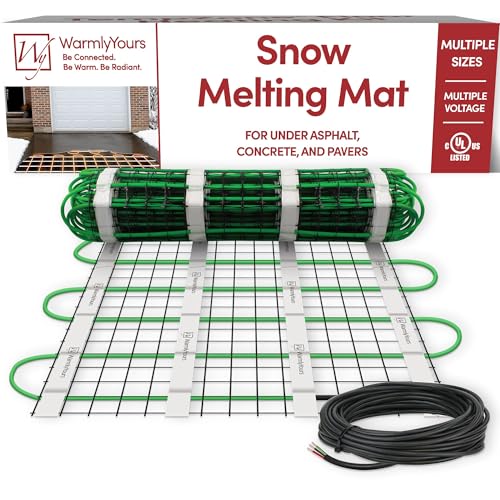
This 3-by-15-foot mat isn't portable at all. It installs under concrete, asphalt, or pavers at a depth of three to four inches, then melts snow across 45 square feet at 50 watts per square foot with nothing visible on the surface.
$497.40fromAmazonPrices as of Oct 25, 6:48 AM PT · Details
If you're already redoing the driveway, buy this instead of a portable mat. Embedding the element solves every problem a surface mat has. Nothing to unroll, nothing to trip over, no cord snaking across the walk, and nothing to haul into the garage when the snow stops. Angi puts a full embedded heated driveway at a steep cost per square foot, and one PowerMat gets you a useful slice of that for far less.
Forty-five square feet is genuinely enough to matter. Three feet by fifteen feet covers one tire track the length of a car, or a whole walkway from the sidewalk to your steps. WarmlyYours says the mats can be combined for full coverage or aimed at tire tracks specifically, and the company offers a free system design if you send in your layout.
The electrical side is serious. It pulls 18.75 amps at 120 volts for 2250 watts, so it needs its own circuit, and the Spruce notes larger units may call for 240-volt service. US code requires ground-fault protection of equipment for fixed outdoor deicing gear. That makes this licensed-electrician work, not a weekend project, and you should budget for that labor when you compare it to a mat you just plug in.
The ten-year warranty is the tell. WarmlyYours backs the mat for a decade and includes lifetime technical support from US and Canadian staff, which is exactly what you want from something buried under four inches of concrete. Fifty watts per square foot sits at the low end of the Department of Energy's range, so think steady melter rather than blast furnace.
Flaws but not dealbreakers
You can't try this one. Once it's under the slab, a failure means breaking concrete, and the installation can cost as much as the mat. Renters and anyone with a driveway they're happy with should skip it.
The 18.75-amp draw rules out sharing a circuit, and running 2250 watts across a whole winter is where electricity stops being trivial. Popular Mechanics puts a 1500-watt mat at a modest hourly rate, and this one draws half again as much.
WarmlyYours covers the mat with a ten-year limited manufacturer's warranty and lifetime technical support.
Who this is for
Buy a heating mat if you have a specific stretch of ground that scares you: the front steps, the path to the mailbox, the strip where you unload groceries. That's where these earn their keep. They're a strong fit if you're older, recovering from something, caring for a parent who shouldn't be out on ice, or renting a place where you can't tear up the concrete. Small businesses use them for the same reason, since a clear entryway is cheaper than a fall.
Don't buy one expecting a clear driveway. Covering a two-car apron with portable mats means a lot of mats, a lot of amps, and a lot of money, and you'd be better off with an embedded system. This guide covers plug-in surface mats plus one embed-under-concrete mat for people already doing the work. It doesn't cover heated cables for roof edges, snow blowers, or full driveway installations.
How we picked
We built the list around five things you'll actually notice. Melt rate: at least two inches an hour, checked against the Department of Energy's 50-to-300-watt-per-square-foot range for radiant snow melting. Surface: rubber first, since it holds traction when meltwater refreezes and survives freeze-thaw cycles better than PVC. Electrical safety: a UL or ETL mark and GFCI protection, because a wet outdoor outlet is no place to improvise. Expandability: a stated amp or wattage ceiling so you know how many mats one outlet will carry. Warranty: longer coverage and support you can reach, since cords and heating elements are what give out first.
Other driveway heating mats worth considering
If you want the same mat in a smaller footprint: The HeatTrak Heated Snow Melting Mats for Entrances — HeatTrak's 30-by-48-inch version is the identical mat scaled down, with the same corrosion-resistant build, the same GFCI power cord, the same two-inch-per-hour melt rate, and the same two-year warranty. It's the right size for a stoop, a landing, or the top of a short set of steps, and it costs meaningfully less than the 40-by-60. What you give up is the coverage that makes the bigger mat so useful: two and a half by four feet clears the door but not the step down or the patch where you park.
The competition
This is what our research turned up on Amazon for portable and embedded snow-melting mats, not a survey of everything on the market. Several established snow-melt brands sell only through electrical distributors or their own sites, and those aren't represented here.
The Kurhimy Heated Snow Melting Mats for Entrances-10 — The Kurhimy heated snow melting mat is the most interesting near-miss. It's non-slip waterproof rubber, comes with a ten-foot cord and a leak-proof plug with a status indicator, and includes an outlet timer with a digital screen and up to eight or twenty on-off programs, which is a real convenience nobody else here bundles. It links with other mats up to 1800 watts, the highest ceiling among the plug-in options. What kept it out is the thin record: the listing publishes no wattage for the mat itself, no melt rate, and no warranty term, and there's essentially no owner feedback to lean on. The 60-by-100-centimeter size is also awkward, closer to two feet by three than to a walkway. If the built-in timer is what you want most, it's worth a look.
Installation and storage
Plug the mat into a GFCI-protected outdoor outlet, not an indoor extension cord run out a window. Lay it flat on a clean surface before the storm arrives, because a mat set down on top of four inches of packed snow starts from behind and stays there. Run the cord where you won't step on it or catch it with a shovel. Rubber mats like HeatTrak's are meant to stay out all winter, so resist the urge to roll them up between storms. At the end of the season, let the mat dry completely, roll it loosely rather than folding it, and store it somewhere that doesn't freeze. Kinks in a heating element are what kill these mats.
Questions we get
How much electricity does a snow melting mat use?
It depends on wattage and how long you run it. Popular Mechanics puts a typical 1500-watt mat at a modest hourly cost at average US electricity rates, so a few hours during a storm is cheap. The smaller mats here draw far less, 260 watts for the RVSNAIL and 338 for the Toriexon. Running a mat all winter, every day, is where the bill starts to show.
Can heated driveway mats be left outside all winter?
Rubber mats generally can, and that's how they're designed to be used. HeatTrak specifically says its mats are corrosion-resistant and meant to stay out all season. Budget PVC mats are the ones to be careful with, since Bob Vila notes they crack in extreme sub-zero cold. Either way, dry the mat out and store it indoors once the season ends.
Can I link multiple snow melting mats together to cover a full driveway?
Yes, within a power limit, and that limit is the catch. HeatTrak's power unit carries stair and walkway mats up to 14 amps, RVSNAIL caps one switch at 1300 watts, and Toriexon at 1500. That's typically three or four mats per connection. Warmzone points out that residential mats are designed for walkways and single-car-width sections, so a full two-car driveway really calls for an embedded system.
Do heated driveway mats need a special electrical outlet?
They need a GFCI-protected outdoor outlet, ideally a dedicated one. Consumer Reports recommends exactly that for snow and ice removal gear to cut shock risk in wet conditions. Some mats, including HeatTrak's, include a GFCI cord so a standard outlet works. The Spruce notes most consumer mats run on 120 volts, while larger units may need 240-volt service.
Are rubber or PVC snow melting mats better?
Rubber, for most people. Family Handyman finds rubber surfaces grip better underfoot than smooth PVC once meltwater refreezes, and rubber holds up better through freeze-thaw cycles. PVC mats cost less and work fine in milder winters. If your winters go well below zero, spend the extra on rubber.
Are portable mats cheaper than an embedded heated driveway?
Much cheaper upfront. Angi estimates a permanent embedded system at a substantial cost per square foot installed, and a plug-in mat is a small fraction of that for the area it covers. The gap narrows if you buy enough mats to cover a real driveway. If you're already pouring new concrete, the WarmlyYours PowerMat splits the difference.
Why you should trust us
For this guide:
- We read the manufacturer specifications for every mat in this guide, comparing stated wattage, melt rate, surface material, cord length, and linking limits side by side.
- We drew on published guidance from the Department of Energy, UL Solutions, Consumer Reports, This Old House, Family Handyman, Bob Vila, the Spruce, Popular Mechanics, Angi, and Warmzone on snow-melt power density, outdoor electrical safety, material durability, and realistic coverage.
- We reviewed owner feedback themes for recurring complaints about cords, heating elements, and cold-weather cracking, and used them to shape the flaws sections rather than to rank the mats.
- We read owner reviews on every listing, weighted toward the critical ones, because that is where the recurring failures show up.
- We have a systematic way of automatically fetching the latest prices, so the numbers on this page stay current.
- This is a research-focused guide, so the team may not own every product listed — though we often do own the top winners, which gives us extra context for the recommendations.
- We don't accept free products, and the retailer commission never changes which product we recommend.
Sources
Radiant Heating - Energy Saver Guide, U.S. Department of Energy
How to Choose a Snow Melting System, This Old House
Best Snow Melting Mats and Systems, Bob Vila
Winter Home Maintenance and Snow Removal Tools, Family Handyman
Outdoor Electrical Safety and GFCI Requirements, UL Solutions
How Much Does a Heated Driveway Cost?, Angi
Snow Melting Mat Buying Guide, The Spruce
Heated Driveways: Pros, Cons, and Costs, Popular Mechanics
Consumer Guide to Ice and Snow Removal Products, Consumer Reports
HeatTrak Product Specifications and Warranty, HeatTrak (manufacturer)
WarmlyYours Snow Melting Systems Overview, WarmlyYours (manufacturer)
Warmzone Snow Melting Mats and Systems, Warmzone (manufacturer)
Amazon product listings and owner reviews for all 6 products
Manufacturer specification pages for each product
Some passages in this guide may be paraphrased with AI help.
Product prices and availability are accurate as of the date/time indicated and are subject to change. Any price and availability information displayed on Amazon.com at the time of purchase will apply to the purchase of this product.
More like this.
Continue exploring home reviews and recommendations.

The Best Concrete Crack Repair Kits for Driveways
A crack in your driveway isn't just ugly. It's an open door for water, and water is what turns a hairline into a trench. Rain seeps in, freezes, expands,…

The Best Asphalt Driveway Sealers
Sealing a driveway is a cosmetic job with a practical payoff. A good sealcoat blocks water and sun from working into the asphalt, and it hides the gray,…

The Best Driveway Markers for Snow Plowing
A driveway marker is a boring purchase right up until the moment it isn't. The first big storm covers your lawn edge, your sprinkler heads and that…

The Best Anti-Fatigue Kitchen Mats
Standing on tile or concrete for an hour does something quietly awful to your body. Your heels ache first, then your knees, then your lower back around…

The Best Snow Melting Mats for Walkways
Shoveling a walkway at six in the morning is nobody's idea of a good time, and the ice that forms afterward is worse. A heated mat sidesteps both…

The Best Garage Floor Containment Mats of 2026
Winter doesn't stay outside. Every time you pull into the garage, your tires and wheel wells carry in slush, road salt and grit, and it all melts into a…