The Best Portable Washing Machines for Apartments in 2026
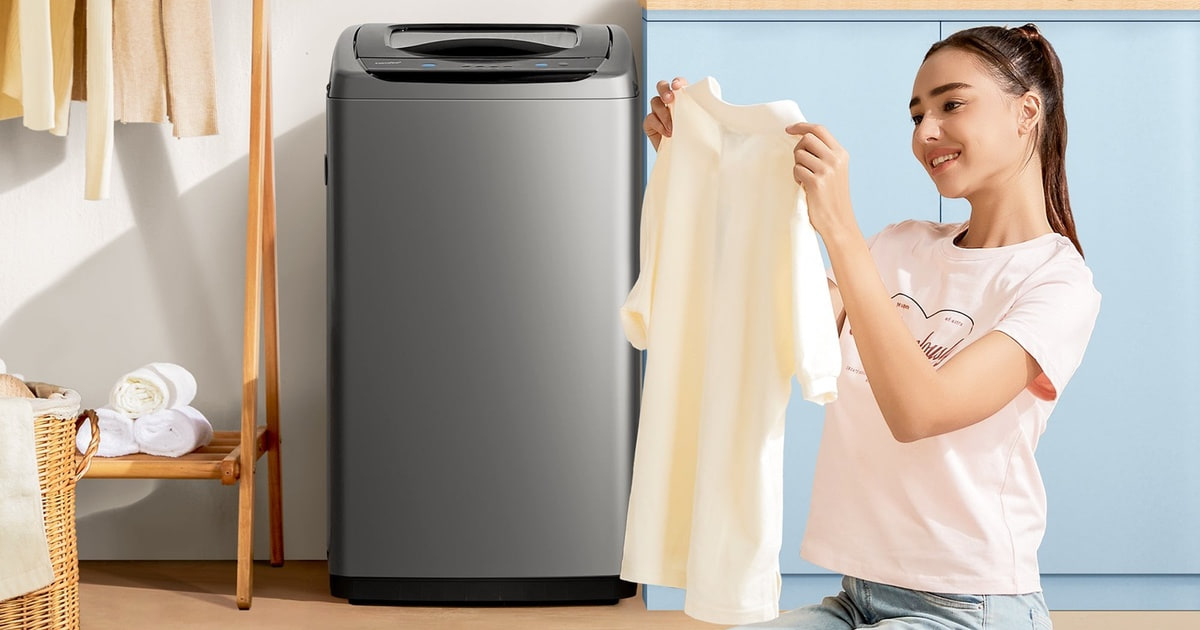
Laundry day in an apartment without hookups is a logistics problem. You haul a bag down three flights, feed quarters into a machine someone else just left wet clothes in, and lose a Saturday afternoon. A portable washer changes the math. It rolls out to the kitchen sink, hooks to the faucet, runs a load while you cook dinner, and tucks back into a closet. For a lot of renters, that's the difference between doing laundry weekly and letting it pile up for two weeks.
Here's the honest part: none of these machines will handle your whole life. Most portable washers top out around 6 to 12 pounds, so a comforter, a winter coat, or a week of towels for two people still means a trip to the laundromat. None of them dry clothes either, so you'll need a drying rack and some patience. And every one of them depends on your faucet accepting an adapter — if your kitchen tap has a pull-out sprayer or an odd thread, you may be filling buckets instead.
We spent our time reading spec sheets, published reviews and owner feedback to sort out which machines actually earn the counter space. We think that the Midea 0.9 cu. ft. Portable Washing Machine is the best portable washing machine for most people, and that the BLACK+DECKER BPWM09W is the one to buy if you want the most proven track record in a machine this size.
Everything we recommend

The most cycle options in a closet-sized automatic washer
Fewer cycles, but the longest track record of the bunch

Twice the capacity for far less, if you don't mind the extra step

No power, no plumbing, and it fits on a countertop
Prices as of Oct 27, 8:28 AM PT · Details
At a glance
| Product | Capacity | Wash style | Price | |
|---|---|---|---|---|
| Midea Portable Washing Machine 0.9 Cu.ft forTop pick | 0.9 cu. ft. | Automatic, 6 programs | $279 |
| BLACK+DECKER 0.9 Cu. Ft. Portable WasherRunner-up | 6.6 lb / 0.9 cu. ft. | Automatic, 5 cycles | $279.99 |
| COSTWAY Portable Washing MachineBudget pick | 18 lb wash / 8 lb spin | Twin tub | $149.99 |
 | Giantex Portable Mini Compact Twin Tub WashingAlso consider | 12 lb wash / 8 lb spin | Twin tub | $134.99On sale |
| WonderWash Portable Washing Machine for Apartment &Also great | — | — | $69.95 |
 | COMFEE' Portable Washing Machine 0.9 cu.ft CompactAlso consider | 0.9 cu. ft. | Automatic, 5 programs | $259 |
 | LG WM4000HBA 4.5 Cu. Ft. Smart Front-LoadAlso in lineup | 4.5 cu. ft. | — | Check price |
Prices as of Oct 27, 8:28 AM PT · Details
How we picked
Real capacity, not drum size. Cubic feet is a marketing number; pounds of laundry is what you live with. We prioritized machines where the manufacturer states a usable weight capacity and sorted them by what that means for one person versus two.
Hookup and drain reality. We read spec sheets and owner feedback for how each machine fills and drains, since a faucet adapter that won't thread onto your tap makes the rest moot. Built-in drain pumps got preference over gravity-only draining.
Noise and vibration. Apartment floors transmit everything. We favored machines with stated unbalance detection, soft-close lids and lower motor wattage, and we flagged the models where owner feedback repeatedly mentions walking or rattling.
Longevity signals. Portable washers fail more often than full-size ones. We weighted machines with long sales histories and broadly favorable owner feedback over newer listings with thin track records.
Storability. We compared published dimensions and weights, and gave credit for casters and side handles. A machine one person can't move alone ends up parked in the middle of a small apartment.
Top pick
The most cycle options in a closet-sized automatic washer
Midea Portable Washing Machine 0.9 Cu.ft for
The Midea is a fully automatic top-loader that hooks to your sink, runs a wash-rinse-spin cycle on its own, and rolls away when it's done. It packs more cycle and water-level choices than most machines this size, including a drum-clean mode that keeps the tub from going musty.
$279fromAmazonPrices as of Oct 27, 8:28 AM PT · Details
This is the machine to get if you want to press one button and walk away. Fully automatic means it fills, washes, drains and spins without you standing over it. Load your clothes, pick a cycle, connect the faucet adapter, and go do something else. Twin-tub machines are cheaper, but they ask you to move soggy laundry from one tub to another halfway through. After a few weeks, that gets old.
The cycle menu is unusually deep for a 0.9 cubic foot washer. You get presets tuned to different fabrics and soil levels, plus three water levels — large, medium and small — so a load of four T-shirts doesn't use the same water as a full basket. If you're washing a lot of small, frequent loads, which is most of why people buy these, that control matters more than it sounds.
Midea includes a dedicated Drum Clean mode, and you should use it. Small washers trap detergent residue and stay damp between loads, which is how they start smelling like a gym bag. A built-in cleaning cycle makes that maintenance a two-minute decision instead of a chore you keep postponing. The stainless steel drum has a honeycomb surface that's meant to keep fabric from snagging.
At about 44 pounds with side handles and bottom rollers, one person can move it. That sounds minor until you live it. You'll be rolling this between the kitchen and a closet a few times a week, and a machine you can't reposition alone ends up living permanently in your walkway. The soft-close glass lid is a small thing that makes the kitchen quieter at eleven at night.
There's a child lock, too, which you engage by holding two buttons for three seconds. If you've got a toddler who treats every glowing button as an invitation, that's worth knowing about before you set this up at floor level.
Flaws but not dealbreakers
The capacity is genuinely small. At 0.9 cubic feet, you're washing a few shirts, some underwear and socks, maybe a pair of jeans. Bath towels eat the drum fast, and bedding is mostly out of the question. Plan on running several loads a week rather than one big one.
Owner feedback on this model is more mixed than on the longest-running machines in this category, with a visible share of buyers reporting problems. It's also a newer listing with a shorter track record, so there's less accumulated evidence about how it holds up after two or three years than there is for the BLACK+DECKER.
Like every washer here, it won't dry anything. The spin cycle leaves clothes damp, not wearable. Budget space for a drying rack, and expect jeans to take most of a day.
Runner-up
Fewer cycles, but the longest track record of the bunch
BLACK+DECKER 0.9 Cu. Ft. Portable Washer
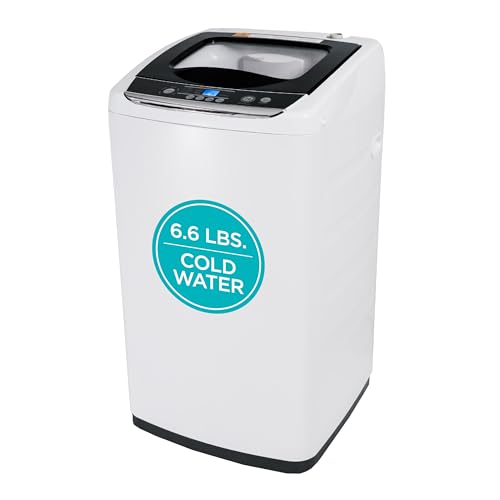
The BLACK+DECKER BPWM09W does the same job as our top pick with a simpler cycle list and a familiar name behind it. Thousands of owners have run it for years, and the feedback skews notably positive, which counts for a lot in a category full of short-lived machines.
$279.99fromAmazonPrices as of Oct 27, 8:28 AM PT · Details
Portable washers are a category where things break. Pumps fail, lids crack, control boards die after eighteen months. The BPWM09W has been sold long enough and widely enough that the owner feedback pool is deep, and it leans clearly favorable. If you want the safest bet rather than the most features, this is it.
You give up some cycle flexibility for that reliability. Five cycles — Heavy, Gentle, Normal, Rapid and Soak — cover the realistic range of apartment laundry, but there's less fine-tuning than the Midea offers. Three water levels handle load sizing. For most people washing shirts and socks, that's plenty; if you're the type who wants a preset for every fabric, you'll notice the gap.
It's cold water only, which is worth saying plainly. There's no internal heater and no hot fill, so you're washing everything cold. That's fine for most clothes and actually better for colors and shrinkage. But if you were hoping to sanitize cloth diapers or kill something living in a gym shirt with hot water, this machine won't do it.
Auto unbalance detection is the feature you'll be quietly grateful for. Small washers with light frames love to walk across a kitchen floor when the spin cycle hits a lopsided load. This one detects the imbalance and corrects for it. Combined with a child lock and auto shutoff, it's a machine you can leave running while you're in another room.
The 6.6-pound capacity is the real number to plan around, not the 0.9 cubic feet. That's roughly a day or two of clothes for one person. Two roller wheels and side handles let you move its 48 pounds to a closet without recruiting help.
Flaws but not dealbreakers
Cold water only is the limitation most people run into. Greasy kitchen towels and heavily soiled work clothes come out better with warm water, and you can't get it here without pre-soaking in the sink.
It's slightly heavier and marginally taller than our top pick, which matters if you're wedging it into a specific closet. Measure first — these machines are over 31 inches tall, and that can clash with a low shelf.
Budget pick
Twice the capacity for far less, if you don't mind the extra step
COSTWAY Portable Washing Machine
The COSTWAY twin tub washes in one chamber and spins in another, and you move the clothes between them yourself. In exchange for that hassle, you get an 18-pound wash tub and a built-in drain pump for a fraction of what an automatic costs.
$149.99fromAmazonPrices as of Oct 27, 8:28 AM PT · Details
The capacity difference here is not subtle. An 18-pound wash tub next to a 6.6-pound automatic is a different category of laundry. You can run towels. You can run a week of clothes in one go. The spin tub handles 8 pounds separately, so you can be spinning one batch while the next one washes — which, once you get the rhythm down, is faster than a single automatic cycle.
The trade is manual labor. You fill it yourself or run a hose, you move wet clothes from the wash tub to the spin tub by hand, and you set two separate timers — up to 15 minutes for washing, up to 5 for spinning. It's maybe two extra minutes of attention per load. Some people stop noticing after a week. Others find it genuinely annoying and wish they'd bought an automatic.
A built-in drain pump is the detail that makes this one easier to live with than most twin tubs. Cheaper models rely on gravity, which means the machine has to sit higher than your drain or you're hauling buckets. A pump pushes water up and out to a sink, so you can set this on the floor and still drain it.
COSTWAY is upfront in its own listing that clothes come out around 90 percent dry and need to hang. That's honest, and it's true of every machine here — but it's a useful reminder that a spin tub isn't a dryer. Expect to hang things.
At 33.5 pounds, it's lighter than the automatics even though it's wider. It's a tall, broad shape, though: roughly 32 inches high and 27.5 inches across. Check your closet width, not just the height.
Flaws but not dealbreakers
Owner feedback on COSTWAY twin tubs includes a meaningful share of unhappy buyers, with build quality and longevity the recurring themes. These are inexpensive machines made to a price, and the plastic tubs and timer knobs feel like it.
There's no automatic water fill or level sensing. You watch the tub, you shut off the tap. Walk away at the wrong moment and you'll be mopping.
Twin tubs are loud. The wash motor pulls 280 watts and the spinner 140, and neither is isolated the way a well-built automatic's drum is. On a thin apartment floor at night, your downstairs neighbor will know.
Also great
No power, no plumbing, and it fits on a countertop
WonderWash Portable Washing Machine for Apartment &
The WonderWash is a hand-cranked drum that weighs five pounds and needs nothing but water and a few minutes of turning. For dorm rooms, boats, campers and the handful of delicates you'd otherwise wash in a sink, it's the simplest option here by a wide margin.
$69.95fromAmazonPrices as of Oct 27, 8:28 AM PT · Details
This isn't competing with the electric machines, and it shouldn't be judged against them. The WonderWash is for the person whose building bans appliances, whose RV has no spare amps, or who just wants a better way to handle a few merino shirts and some hand-wash-only items. At 12 by 16 by 12 inches and five pounds, it stores in a cabinet.
You crank it, which is less of a workout than it sounds. You add water and detergent, seal the lid, and turn the handle for a few minutes. There's no motor to burn out and no pump to clog. The newer E-Z lid lever replaced an older screw-down design that owners found fussy, and the handle insert is built not to work loose over time.
Cloth diapers come up constantly in the context of this machine, and the logic holds. Parents need frequent small loads, often more than once a day, and running a whole electric cycle for six diapers is wasteful. A hand-crank drum that holds a small load and uses a few gallons fits that pattern better than anything else here.
The Laundry Alternative backs these with a three-year warranty, which is longer than what most portable washers in this guide carry. For a product with almost no electronics, that's a reasonable signal about how long the plastic and seals are expected to hold up.
Flaws but not dealbreakers
The load is tiny. Think a few shirts, some underwear, or a handful of delicates — not a basket of laundry. If this is your only washer, you'll be using it most days.
There's no spin cycle at all. Clothes come out soaking, and you wring them by hand before hanging. That's slower to dry and harder on fabric than a real extraction spin, and it's the single biggest reason this can't replace an electric machine for most people.
It's made of ABS plastic and it feels like it. Treat the lid and lever with some care; owner feedback on this machine is positive overall but noticeably more mixed than the top electric picks.
The Laundry Alternative covers the WonderWash with a three-year warranty.
Who this is for
Buy a portable washer if you rent without in-unit hookups and you're tired of the laundromat or a shared basement machine. It works best for one or two people doing small, frequent loads: work shirts, underwear, socks, gym clothes, baby things. Students, studio dwellers, RV and van owners, and parents washing diapers daily all get real value. You need a sink with a faucet that accepts an adapter, a drain within reach, somewhere to store a roughly 17-by-18-inch footprint, and room for a drying rack.
Skip it if you have hookups and space for a real washer — a full-size machine will clean better, hold more and last longer for similar money. Skip it if your household generates towels and bedding faster than a 6-pound drum can handle, or if your lease flatly bans appliances connected to plumbing. This guide covers portable and compact washers meant for apartments: faucet-connected automatics, twin tubs and non-electric hand washers. It doesn't cover dryers, spin-only extractors or full-size machines.
How we picked
We built the shortlist around what actually determines whether one of these machines earns its space. Capacity: stated pounds of laundry, not just drum volume, because that's what tells you how many loads a week you're committing to. Hookup: whether it connects to a standard faucet, how it drains, and whether a pump is included or you're relying on gravity. Noise and vibration: unbalance detection, motor wattage, lid design — the things that keep your downstairs neighbor from knocking. Longevity: how long the model has been sold and how owner feedback trends over time, since cheap washers fail in predictable ways. Storability: height, width, weight, casters and handles, because a machine you can't move alone stops being portable.
Other portable washing machines for apartments in 2026 worth considering
If you want a proven automatic with a clear display: The COMFEE' Portable Washing Machine 0.9 cu.ft Compact — The COMFEE' 0.9 cu. ft. is made by Midea and does nearly everything our top pick does — five programs, three water levels, auto unbalance detection, a rust-resistant steel tub, wheels and handles. It adds an LED display and a lint filter. Owner feedback on this one is deep and runs favorable, with apartment dwellers repeatedly describing it as the thing that ended their laundromat trips. The reason it's not the top pick is the shallower cycle list and the absence of a dedicated drum-clean mode, which matters because the most common complaint about any small washer is odor. If the Midea is out of stock or you prefer the display, buy this without hesitation.
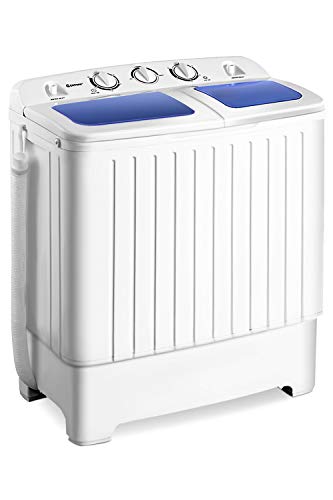
If you want twin-tub capacity in a narrower body: The Giantex Portable Mini Compact Twin Tub Washing — The Giantex twin tub does the same wash-then-spin routine as our budget pick with a 12-pound wash tub and an 8-pound spinner. Its real advantage is shape: at 15 inches wide it slots into tighter spots than the COSTWAY's 27.5-inch span, and at 28 pounds it's the lightest electric machine here. It's been sold for years and has an enormous owner-feedback pool that trends positive. What you give up is the built-in drain pump — this one relies on gravity draining, so it needs to sit above your drain or you're lifting water. The side filter net pulls out for cleaning, which is a nice touch at this price tier.
The competition
This is what our research turned up in the portable washer category, not a map of everything for sale. New models appear constantly, often as rebadged versions of the same few factory designs, and a machine's absence here usually means we didn't find enough reliable information about it rather than that it's bad.
The LG WM4000HBA 4.5 Cu. Ft. Smart Front-Load — The LG WM4000HBA is a 4.5 cubic foot front-loader with TurboWash, app control and an allergen cycle — a genuinely good washer that has nothing to do with apartment portability. It's 42 inches wide, weighs nearly 200 pounds, and needs permanent hot and cold hookups plus a dedicated drain. If you have the hookups and the floor space, it will clean better than anything else on this page and cost you less per load over its life. But you can't roll it to a sink, and you can't store it in a closet. We mention it because people shopping for compact LG washers sometimes land here, and it's worth knowing this isn't that machine.
Setup and upkeep
Before you buy, go look at your kitchen faucet. Most portable washers connect with an adapter that threads on where the aerator screws in, so unscrew yours and check that it comes off cleanly. Pull-out sprayers and some designer taps won't work at all, and you'll be filling by bucket. Set the machine on level, hard flooring — tile or vinyl beats a rug or a flexing wood floor, and it cuts vibration a lot. After every few loads, leave the lid open so the drum dries out; a closed damp tub is how these start smelling sour. Run a cleaning cycle monthly with the drum-clean mode or a cup of white vinegar, clear the lint filter if your machine has one, and disconnect the faucet adapter when you're done rather than leaving the hose pressurized.
Questions we get
Do portable washers need a drain, or can they drain into a sink?
A sink works fine for most of them. These machines come with a drain hose you hook over the lip of a kitchen or bathroom sink, or into a tub. Machines with a built-in drain pump, like the COSTWAY, can push water upward, so they can sit on the floor. Gravity-drain models need to sit higher than wherever the water is going.
How much laundry can a portable washing machine actually hold?
Less than you want. The 0.9 cubic foot automatics are rated around 6.6 pounds, which is roughly a few shirts, underwear, socks and maybe one pair of jeans. Twin tubs hold more on paper — 12 to 18 pounds in the wash tub — but the spin side is smaller, so you'll spin in batches. Either way, expect to run several loads a week rather than one big one.
Can a portable washer handle towels and bedding?
Towels, yes, in small numbers — two or three bath towels fill a 0.9 cubic foot drum. A twin tub handles more. Bedding is harder: sheets will usually fit, but comforters and duvets won't, and forcing one in makes the spin cycle go badly off balance. Plan on a laundromat trip for bulky items a few times a year.
Do portable washers work with any kitchen faucet?
No, and this is the single most common disappointment. The adapter threads onto the spot where your aerator sits, so you need a faucet with a removable aerator and a standard thread. Pull-out sprayers, hands-free faucets and some high-end fixtures won't accept one. Check yours before you order, and consider a universal adapter kit if the thread size is unusual.
Are twin tubs better than fully automatic portable washers?
They're cheaper and they hold more, but you do the work. You fill the tub, move wet clothes to the spinner, and manage two timers. Automatics cost considerably more and hold less, but you press a button and leave. If capacity per dollar is your priority, go twin tub; if you want laundry to be something you don't think about, go automatic.
Do I need a dryer if I own a portable washer?
You need somewhere to dry clothes, which usually means a rack. No portable washer dries anything — the spin cycle leaves clothes damp, and hand-crank models leave them soaked. A folding rack near a window handles most loads overnight. Some people add a small ventless dryer or a standalone spin dryer, but a rack and a day is enough for most apartment laundry.
Why you should trust us
For this guide:
- We read manufacturer spec sheets and full Amazon listing details for every machine here, comparing stated capacity, dimensions, weight, motor wattage and cycle options side by side.
- We reviewed published coverage of portable washers along with the themes that recur in owner feedback — odor, vibration, faucet-adapter fit and long-term reliability — and weighted machines with long sales histories accordingly.
- We did not use, install or operate any of these machines, and every performance statement here comes from manufacturer specifications or reported owner experience.
- We read owner reviews on every listing, weighted toward the critical ones, because that is where the recurring failures show up.
- We have a systematic way of automatically fetching the latest prices, so the numbers on this page stay current.
- This is a research-focused guide, so the team may not own every product listed — though we often do own the top winners, which gives us extra context for the recommendations.
- We don't accept free products, and the retailer commission never changes which product we recommend.
Sources
Best Portable Washing Machines - Wirecutter (verify page exists), Wirecutter
Compact Washing Machines - Consumer Reports, Consumer Reports
Washing Machine Reviews - RTINGS, RTINGS.com
ENERGY STAR Residential Clothes Washers, ENERGY STAR
Midea MAE50-S1102GW product page, Midea (manufacturer specs)
BLACK+DECKER BPWM09W specifications, BLACK+DECKER (manufacturer specs)
LG WM1455HWA specifications, LG (manufacturer specs)
Laundry Alternative Wonder Wash product page, Laundry Alternative
Clothes Washers - U.S. Department of Energy, U.S. DOE
Amazon product listings and owner reviews for all 7 products
Manufacturer specification pages for each product
Some passages in this guide may be paraphrased with AI help.
Product prices and availability are accurate as of the date/time indicated and are subject to change. Any price and availability information displayed on Amazon.com at the time of purchase will apply to the purchase of this product.
More like this.
Continue exploring appliances reviews and recommendations.

The Best Washing Machines
A washing machine is the appliance you notice least until it goes wrong. You load it, you walk away, and you want the clothes clean the first time, so you…

The Best Indoor Dog Potty Systems for Apartments
Your dog needs to go out every few hours, and in an apartment that means shoes, a leash, a hallway, an elevator and a sidewalk. An indoor potty shrinks…

The Best Ways to Display Collectibles in a Small Apartment
Collections grow faster than apartments do. The average US apartment has shrunk from 941 square feet in 2015 to about 882, and studios in big cities often…

The Best Waterless Car Wash Products
If you live in an apartment, park in a garage, or just don't want to drag out a hose, a waterless wash is how you keep a car looking clean. You spray a…

The Best Electric Pressure Washers for Driveways
A driveway is the hardest surface most homeowners will ever clean. It collects tire grit, engine drips, winter salt, and a slow green film of algae along…

The Best Pressure Washer Surface Cleaners
A surface cleaner is the attachment that makes a pressure washer worth owning. Instead of one jet carving stripes into your driveway, two nozzles spin…