The Best Hair Growth Products and Treatments
Hair loss is common enough to be unremarkable and personal enough to feel like a crisis. Roughly 50 million men and 30 million women in the United States have androgenetic alopecia, the pattern thinning that runs in families. You notice it in the shower drain, or in a photo someone else took, or in the way your part keeps widening. The good news is that a couple of treatments genuinely work and have decades of trial data behind them. The bad news is that the shelf around them is crowded with products making the same promises on much thinner evidence.
Here's the honest caveat: nothing in this category works fast, and nothing works forever on its own. Every credible treatment needs at least three months before you'll see anything, and six to twelve months before you can judge it fairly. If you stop, the gains reverse. No product regrows hair on skin that's been slick bald for years, because the follicles there are gone. And if your thinning started after a stressful stretch, a surgery, or a birth, it may resolve on its own — which means you could spend a year of money on something your body was going to fix anyway.
We've leaned on the treatments with real peer-reviewed evidence and been direct about where the evidence gets thin. Minoxidil is the only FDA-approved topical for pattern hair loss, and it's the benchmark every other product here is measured against. Supplements and peptide serums sit a tier below it, and we say so. We think that Men's Rogaine 5% Minoxidil Topical Foam is the best hair growth treatment for most people, and that Nutrafol Women's Balance is the one to buy if you're a woman past 45 whose thinning tracks with hormonal changes.
Everything we recommend

The only proven topical, with decades of trial data behind it

For women whose thinning tracks with menopause

A cheaper supplement with its own published trial data

Drug-free laser therapy, if you can't or won't take minoxidil
At a glance
| Product | Format | Time To Results | Price | |
|---|---|---|---|---|
| Men's Rogaine 5% Minoxidil Topical FoamTop pick | Topical Foam | — | $49.97 |
| Nutrafol Women's Balance Hair Growth SupplementsAlso great | Hair Growth Supplements | 3-6 Months | $88 |
| Viviscal Hair Growth Supplements for WomenBudget pick | Hair Growth Supplements | 3 Months | $39.99 |
| iRestore Essential Laser Hair Growth System +Upgrade pick | Hair Growth System | 3 to 6 months | $578 |
 | The Ordinary Multi-Peptide Serum for Hair DensityAlso consider | Multi-Peptide Serum | — | $20.40On sale |
 | Nioxin System 4Also in lineup | Leave-In Treatment | 30 Days | $27 |
How we picked
Regulatory status. We separated FDA-approved drugs from 510(k)-cleared devices from unregulated supplements, and we say which is which in every entry. The distinction changes how much weight a manufacturer's claim deserves.
Quality of evidence. We prioritized products with peer-reviewed, placebo- or sham-controlled randomized trials published in journals like Dermatology and Therapy, JAMA Dermatology, and the Journal of Drugs in Dermatology. Where trials were industry-sponsored or small, we flagged it.
Type of hair loss. We matched products to the condition they actually address — androgenetic alopecia, telogen effluvium, or hormonal thinning — because a treatment aimed at the wrong mechanism is money spent for nothing.
Honest timelines. We required published evidence over at least a three-month window and preferred six months or more, since nothing in this category shows results faster and any product promising otherwise is overselling.
Daily practicality. We read owner feedback for the reasons people quit: pill size, greasy scalp, twice-daily hassle, session length. A treatment you abandon at week six has an efficacy rate of zero.
Top pick
The only proven topical, with decades of trial data behind it
Men's Rogaine 5% Minoxidil Topical Foam
Rogaine's 5% minoxidil foam is the one over-the-counter treatment with FDA approval for pattern hair loss and a mountain of randomized trial data. You rub it into your scalp twice a day, and if you keep at it for six months, the odds are genuinely in your favor.
$49.97fromAmazonIf you buy one thing from this guide, buy this. Pooled clinical data reviewed in Dermatology and Therapy found that 5% topical minoxidil produced meaningful regrowth in about 84% of male patients, against roughly 60% on placebo. That gap is the whole reason this category exists. The 5% formula also clearly beats the older 2% version. No supplement, serum, or laser device here has evidence anywhere near that depth.
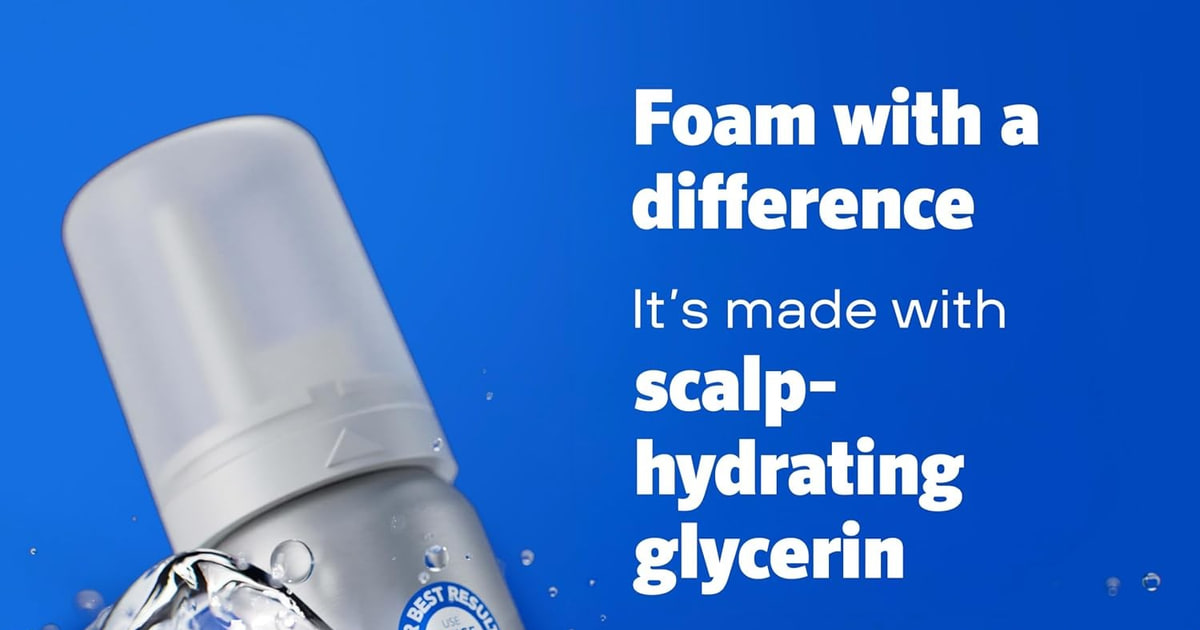
The foam matters more than it sounds like it should. The original minoxidil came as a liquid solution with propylene glycol, which a lot of people found itchy and greasy, and which ran down their forehead. This foam melts into the scalp in seconds and doesn't wreck your hair. If you've bailed on minoxidil before because it felt awful, the foam is worth another look — the drug is identical, the experience isn't.
You have to do it twice a day, every day, and that's the real hurdle. Owners who report good outcomes almost all describe the same thing: they stayed consistent for months before anything changed, and several mention buying their fourth or fifth three-month supply. Owners who report nothing usually quit at week six. Set it next to your toothbrush. This is a habit problem more than a product problem.
Expect shedding before growth, and don't panic. Minoxidil pushes resting follicles into a new growth cycle, which means some old hairs fall out first. It typically shows up around week two to eight and it's a sign the drug is doing something. Owners describe it often enough that it's worth knowing in advance. It passes. Quitting during that window is the single most common way people waste their money here.
Flaws but not dealbreakers
It's a commitment with no exit. Stop using minoxidil and you'll lose the regrown hair within a few months, back to where you would have been. That's not a defect in the product, but it does mean you're signing up for an ongoing purchase, probably for years.
Some people get an itchy, flaky, or irritated scalp, and a smaller number get unwanted facial hair growth if the foam migrates. Wash your hands after applying. A few owners have also reported canisters arriving with a thin, runny texture instead of proper foam — a manufacturing inconsistency rather than a design flaw, but annoying when you've paid for three of them.
It works best on the crown and thinning areas, not on a receded hairline, and it does nothing for skin that's been bald a long time. The earlier you start, the more it has to work with.
Also great
For women whose thinning tracks with menopause
Nutrafol Women's Balance Hair Growth Supplements
Nutrafol Women's Balance is formulated for women 45 and up, and it's the rare supplement with a published, placebo-controlled trial behind it. It targets the hormonal and stress-related drivers of thinning rather than acting on the follicle directly like minoxidil does.
$88fromAmazonNearly half of women notice hair loss by 50, and the usual trigger is the hormonal shift of perimenopause and menopause. That's a different problem from male pattern balding, and it's what this formula is built around — saw palmetto, ashwagandha, maca, plus a long list of vitamins and minerals. If your thinning arrived alongside hot flashes and disrupted sleep, this is aimed squarely at you.
The evidence is real, but it's a tier below minoxidil. A double-blind randomized trial published in the Journal of Drugs in Dermatology found statistically significant improvements in hair growth rate, thickness, and volume at six months versus placebo. That's a genuine peer-reviewed result and it puts Nutrafol ahead of nearly every supplement on the shelf. But it's a supplement, not an FDA-approved drug, and the trials behind it are smaller and industry-sponsored. We'd read it as promising, not proven.
It's the easiest thing here to actually stick with, which counts for a lot. Four capsules once a day with food, and you're done — no scalp application, no timing your hair washes around it, nothing to get on your pillowcase. Women who've been shedding on a GLP-1 medication report using it for that specifically, and the brand states it's been reviewed for use alongside those drugs.
You can stack it with minoxidil. These work through different mechanisms, and plenty of dermatologists suggest running both. If you're a woman with diffuse thinning and you want the strongest shot, the 5% foam plus this is a more serious plan than either one alone.
Flaws but not dealbreakers
Four capsules is a lot to swallow at once, and they're large. Some people can't get them down, and others report digestive upset in the first couple of months — often manageable by taking them with a full meal, but not always. Take them with dinner, not on an empty stomach.
It's the most expensive ongoing routine in this guide, and results take three to six months minimum. Owners who quit at month two learned nothing except that they spent money. If you're not prepared to give it half a year, skip it.
It won't do much for advanced pattern baldness. This is a product for diffuse thinning and shedding, not for restoring a scalp that's already visibly bare.
Budget pick
A cheaper supplement with its own published trial data
Viviscal Hair Growth Supplements for Women
Viviscal is two small tablets a day built around AminoMar, a marine collagen complex with more than 25 years of research behind it. It costs meaningfully less than Nutrafol and it's far easier to swallow, though the formula is simpler.
$39.99fromAmazonThe pills are the point. Two small tablets a day, versus four large capsules — if the size of Nutrafol's dose is what would make you quit, that difference decides it. Owners routinely describe taking Viviscal for years without much thought, which is exactly the behavior a supplement needs to produce anything.
The evidence holds up for what it is. A double-blind, placebo-controlled trial published in the Journal of Drugs in Dermatology found statistically significant increases in total hair count and terminal hair density at 180 days. Same caveats apply as with Nutrafol: smaller scale, industry involvement, and not an FDA-approved drug. But among supplements, having any real RCT at all puts it in a small club.
It's a reasonable pick if your shedding came from stress, rapid weight loss, or postpartum recovery rather than genetics. The formula is marine collagen, biotin, zinc, and vitamin C — nutritional support rather than a hormonal intervention. Owners recovering from a rough stretch describe shedding tapering off around the two to three month mark, which lines up with the trial timeline.
Being cheaper than Nutrafol also means you can afford to give it a fair run. Six months is the honest evaluation window for anything in this category, and that math is a lot friendlier here.
Flaws but not dealbreakers
The formula is simpler than Nutrafol's, without the saw palmetto and adaptogens aimed at hormonal thinning. If menopause is your trigger, Nutrafol is the better-targeted choice even at a higher cost.
New growth may come in finer than your existing hair. Owners who saw regrowth often note the new hairs are thinner, which improves density and coverage but doesn't fully restore the texture you had.
Upgrade pick
Drug-free laser therapy, if you can't or won't take minoxidil
iRestore Essential Laser Hair Growth System +
The iRestore Essential is an FDA-cleared laser helmet you wear hands-free for 25 minutes at a time. It's the drug-free route for people who react badly to minoxidil or simply don't want a daily topical, and it's the least expensive way into laser therapy.
$578fromAmazonLow-level laser therapy is the only non-drug approach here with randomized, sham-controlled evidence behind it. A trial in Lasers in Surgery and Medicine found a 39% increase in mean terminal hair density in an active LLLT group versus sham after 26 weeks. That's a real signal. It's also a different device than this one, so treat it as evidence the mechanism works, not a promise about this specific helmet.
FDA-cleared is not the same as FDA-approved, and the difference matters. LLLT devices go through the 510(k) pathway as Class II medical devices, which establishes safety and equivalence to existing products. It does not establish drug-level efficacy. Anyone selling you a laser cap as though it's been approved like minoxidil is blurring a line worth keeping straight.
The hands-free design is what makes it usable. You put it on, sit down for 25 minutes, and read or answer email. Laser combs and brushes require you to keep moving them across your scalp for the whole session, which is exactly the kind of chore people abandon by week three. The rechargeable battery pack means you're not tethered to an outlet either.
It stacks cleanly with everything else in this guide. Because it isn't a drug, there's no interaction to worry about — you can run the helmet and use minoxidil and take a supplement. For someone who's plateaued on the foam alone, adding a device is a reasonable next step rather than a replacement.
Flaws but not dealbreakers
It's the biggest single outlay in this guide by a wide margin, and it's a bet on a mechanism with less evidence than the one drug that's actually approved. If you haven't tried minoxidil yet, try that first.
Durability is a real question. Some owners report units failing inside two years, though they also describe the company replacing them without much fuss. A helmet that stops working partway through a treatment plan is a worse problem than a bottle that runs out.
It has far fewer owner reports than anything else here, so there's less accumulated feedback to draw on. And several people who bought it after everything else failed describe seeing reduced shedding but no new growth after a couple of months — which is roughly what the timeline predicts, but it's a long, expensive wait.
Who this is for
This guide is for people with early-to-moderate thinning who want to know which products have evidence behind them and which don't. If you're a man with a receding crown, a woman whose part has widened, or someone recovering from a stressful stretch or a pregnancy, there's something here for you. Start by figuring out what kind of hair loss you have, because it changes the answer completely. Pattern thinning that's been creeping along for years responds to minoxidil. Sudden diffuse shedding after childbirth, illness, or rapid weight loss is usually telogen effluvium, which resolves on its own in six to twelve months for most people — a supplement may help you feel like you're doing something, but time is doing the heavy lifting.
This guide won't help if you've been slick bald for years. Once follicles are gone, no topical, pill, or laser brings them back, and the only real options are transplant surgery or acceptance. It also doesn't cover prescription-only treatments in depth. Oral finasteride is FDA-approved for men and a 2017 JAMA Dermatology meta-analysis found that combining it with topical minoxidil beats either drug alone — worth raising with a doctor or a telehealth service, but it isn't something you buy off a shelf. If your hair is coming out in patches rather than thinning evenly, or if it's accompanied by scalp pain, see a dermatologist before you buy anything.
How we picked
Regulatory status: We drew a hard line between FDA-approved drugs, 510(k)-cleared devices, and supplements that are regulated as food, and we name the category for every product. Quality of evidence: We favored peer-reviewed randomized controlled trials with placebo or sham arms, and we flag when a trial was small or industry-sponsored. Type of hair loss: We matched each product to the mechanism it plausibly addresses, since androgenetic alopecia, telogen effluvium, and hormonal thinning don't respond to the same things. Honest timelines: We looked for evidence over three months minimum and preferred six or more, because nothing here works faster. Daily practicality: We read owner feedback for the friction points that make people quit — dose size, scalp irritation, twice-daily application, session length — because adherence is most of the outcome.
Other hair growth products and treatments worth considering
If you want a low-cost topical to layer on: The The Ordinary Multi-Peptide Serum for Hair Density ($20.40) — The Ordinary's Multi-Peptide Serum for Hair Density is a budget option, and it's the most transparent about what's in it. REDENSYL, CAPIXYL, Procapil, and caffeine have in-vitro and small-trial support for waking up follicle stem cells and reducing shedding — genuinely interesting science, but nowhere near the evidence base behind minoxidil. It's a once-daily bedtime application that's easy to add to a routine. Just don't treat it as a minoxidil substitute. Some owners also report scalp sensitivity in the first few days, and this listing draws more mixed feedback than anything else in the guide.
The competition
This is what our research surfaced in this category, not a survey of everything sold. Hair growth is a crowded, heavily marketed shelf, and plenty of products we didn't look at make the same claims as the ones we did. Here's the remaining product and where it lands.
The Nioxin System 4 ($27) — Nioxin System 4 is a leave-in scalp treatment aimed at colored or chemically damaged hair with visible thinning, and it's been a salon-counter staple for a long time. It cleans buildup and sebum off the scalp and coats strands so hair looks and feels thicker, which owners consistently notice. But that's a cosmetic and scalp-health effect, not regrowth — there's no clinical evidence that it recovers lost follicles, and the manufacturer's own numbers describe what consumers noticed rather than measured hair counts. Use it as a complement to a real treatment if you like how it feels, especially if your hair is color-treated. Just don't buy it expecting the results minoxidil delivers. Note that it contains menthol and peppermint, which some people find irritating.
How to use these and what to expect
Apply minoxidil foam to a dry scalp, not damp hair, and part it so the product reaches skin rather than sitting on strands. Rub it in, then wash your hands so it doesn't end up on your face or pillow. Give it four hours before showering. Expect a shedding phase somewhere in the first two months and keep going through it — that's the most common point where people quit and lose the chance to find out if it works. Take supplements with a full meal to blunt stomach upset. For laser sessions, run them on a clean, dry scalp and stick to the schedule rather than doubling up after a missed day. Photograph your scalp in the same spot and lighting every month; hair changes too slowly to judge in a mirror, and a photo set is the only honest way to tell whether six months of effort did anything.
Questions we get
What's the most effective hair growth treatment you can buy without a prescription?
Topical 5% minoxidil, by a wide margin. It's the only over-the-counter treatment FDA-approved for pattern hair loss, and pooled clinical data shows meaningful regrowth in about 84% of male patients versus roughly 60% on placebo. Everything else in this category — supplements, serums, laser devices — competes against that standard, and none of them match its evidence base.
How long does minoxidil take to work?
Plan on three months before you see anything and six to twelve before you can judge it. In the first two months you may actually shed more hair, because minoxidil pushes resting follicles into a new growth cycle and the old hairs fall out first. That's expected and it passes. If you quit during that window, you'll never find out whether it would have worked for you.
Can women use the 5% minoxidil foam?
Yes. The FDA approved a 5% once-daily foam specifically for women, replacing the old twice-daily 2% solution — a change that made the routine much easier to stick with. Women generally use it once a day rather than twice. Talk to a doctor first if you're pregnant, nursing, or trying to conceive.
Are Nutrafol and Viviscal worth the monthly cost?
They're the two supplements with actual published, placebo-controlled trials behind them, which puts them well ahead of most of the shelf. But they're supplements, not approved drugs, and their trials are smaller and largely industry-sponsored. If you have clear pattern hair loss, spend on minoxidil first. If your thinning is hormonal or stress-driven, or you can't tolerate a topical, they're a defensible choice — as long as you give them six months.
Do laser helmets actually work?
The evidence is real but thinner than for minoxidil. A randomized, sham-controlled trial found a 39% increase in mean terminal hair density after 26 weeks of low-level laser therapy. These devices carry FDA 510(k) clearance, which confirms safety and equivalence to existing devices — it is not the same as drug efficacy approval. Reasonable as an addition or as a drug-free option, not as your first move.
My hair started falling out after I had a baby. What should I buy?
Possibly nothing yet. Postpartum telogen effluvium affects an estimated 40 to 50% of women after childbirth and usually resolves on its own within six to twelve months. A supplement may support recovery and give you something to do while you wait, but the shedding typically stops regardless. If it's still going strong past a year, that's the point to see a dermatologist.
Can anything regrow hair on an area that's completely bald?
No. Once follicles are gone, they don't come back, and no topical, supplement, or laser device changes that. These treatments work on follicles that are still alive but shrinking — which is why starting early gives you far more to work with. For established bald areas, transplant surgery is the only option that adds hair.
Why you should trust us
For this guide:
- We read the peer-reviewed clinical literature behind each product, including randomized controlled trials published in Dermatology and Therapy, JAMA Dermatology, the Journal of Drugs in Dermatology, and Lasers in Surgery and Medicine.
- We compared manufacturer specifications and ingredient documentation against what those trials actually measured, and we checked FDA approval and 510(k) clearance status for every product that claims one.
- We read owner feedback across all six listings for recurring themes about irritation, dose tolerance, durability, and the point at which people give up.
- We read owner reviews on every listing, weighted toward the critical ones, because that is where the recurring failures show up.
- We have a systematic way of automatically fetching the latest prices, so the numbers on this page stay current.
- This is a research-focused guide, so the team may not own every product listed — though we often do own the top winners, which gives us extra context for the recommendations.
- We don't accept free products, and the retailer commission never changes which product we recommend.
Sources
Hair Loss — Diagnosis, Treatment & Medications: American Academy of Dermatology, American Academy of Dermatology
Minoxidil and its use in hair disorders: a review — Dermatology and Therapy (2020), PubMed / Dermatology and Therapy
Finasteride in the Treatment of Men with Androgenetic Alopecia — New England Journal of Medicine (1998), New England Journal of Medicine
Combination Therapy With Finasteride and Minoxidil vs. Monotherapy — JAMA Dermatology (2017 meta-analysis), JAMA Dermatology
A Randomized Double-Blind Placebo-Controlled Study of a Nutraceutical Supplement (Viviscal) — Journal of Drugs in Dermatology (2015), Journal of Drugs in Dermatology
Efficacy of a Standardized Nutraceutical Supplement (Nutrafol) for Hair Growth in Women — Journal of Drugs in Dermatology (2018), Journal of Drugs in Dermatology
Low-Level Laser Therapy for Hair Loss: Efficacy and Safety — Lasers in Surgery and Medicine (2013), PubMed / Lasers in Surgery and Medicine
Telogen Effluvium: Etiology, Diagnosis, and Treatment — Dermatology and Therapy (2019), PubMed / Dermatology and Therapy
Treating Female-Pattern Hair Loss — Harvard Health Publishing, Harvard Health Publishing
Hair Loss in Women — Cleveland Clinic, Cleveland Clinic
Global Hair Loss Treatment Market Size & Growth Forecast 2024–2030, Grand View Research
FDA 510(k) Clearances for LLLT Hair Growth Devices, U.S. FDA / CDRH 510(k) Database
Amazon product listings and owner reviews for all 6 products
Manufacturer specification pages for each product
Some passages in this guide may be paraphrased with AI help. Prices are refreshed automatically.
More like this.
Continue exploring beauty reviews and recommendations.

The Best Hair Growth Serums For Thinning Hair
Thinning hair rarely announces itself. You notice a wider part in a bathroom mirror, or a ponytail that's gone slack, or more strands than usual circling…

The Best Hair Growth Serums for Thinning Hair
Hair thinning shows up in ordinary moments. You notice more strands in the shower drain, or your part looks wider under bathroom lighting. Maybe your…

The Best Septic Tank Treatments
If you're on a septic system, the tank in your yard is doing a job the city does for everyone else. Solids settle, bacteria digest what they can, and the…

The Best Self-Help Books for Personal Growth
A self-help book only works if you finish it and then do something with it. That sounds obvious. It's also the step most buyers skip. You buy the title…

The Best Olaplex Hair Products
Bleach, box dye, a flat iron on high - they all break the same thing. The bonds inside each strand that keep hair springy instead of straw-like. Olaplex…

The Best Hair Dryers for Every Hair Type
A hair dryer is one of the few appliances you hold against your head, and you probably use it more days than not. That changes what matters. Weight,…