The Best Whole-House Humidifiers
Winter air inside a heated house gets dry fast. Once it's below about 20°F outside, indoor humidity can slide into the teens, and you feel it everywhere: bloody noses, cracked lips, a shock every time you touch the refrigerator. Hardwood floors shrink and open gaps between boards. Guitars drift out of tune. A portable humidifier can fix one bedroom, but it needs refilling daily and it never reaches the rest of the house. A whole-house unit plumbs into your heating system and handles all of it at once.
None of these is set-and-forget. Every one needs a water line, a drain, and a fresh evaporator pad at the start of each heating season. Skip that pad and mineral scale can cut moisture output roughly in half, while giving mold a damp surface to grow on. Most units use a manual dial, so you have to turn it down when a cold snap hits or you'll wake up to water running down the windows. And installation isn't trivial. Plenty of people hire it out.
So the choice isn't really about which unit makes the most moisture. It's about matching the unit to your heating system, your square footage, and how much fiddling you're willing to do. Forced-air homes get the most options and the simplest installs. Radiant heat, boilers, and heat pumps narrow things down to steam. We think that the AprilAire 700M is the best whole-house humidifier for most people, and that the AprilAire 600M is the one to buy if your furnace runs steadily all winter and you'd rather spend less.
Everything we recommend

Runs on its own fan, so it humidifies between furnace cycles

Nearly the same output for less, if your furnace runs a lot

Steam and automatic control for big or hard-to-humidify homes
At a glance
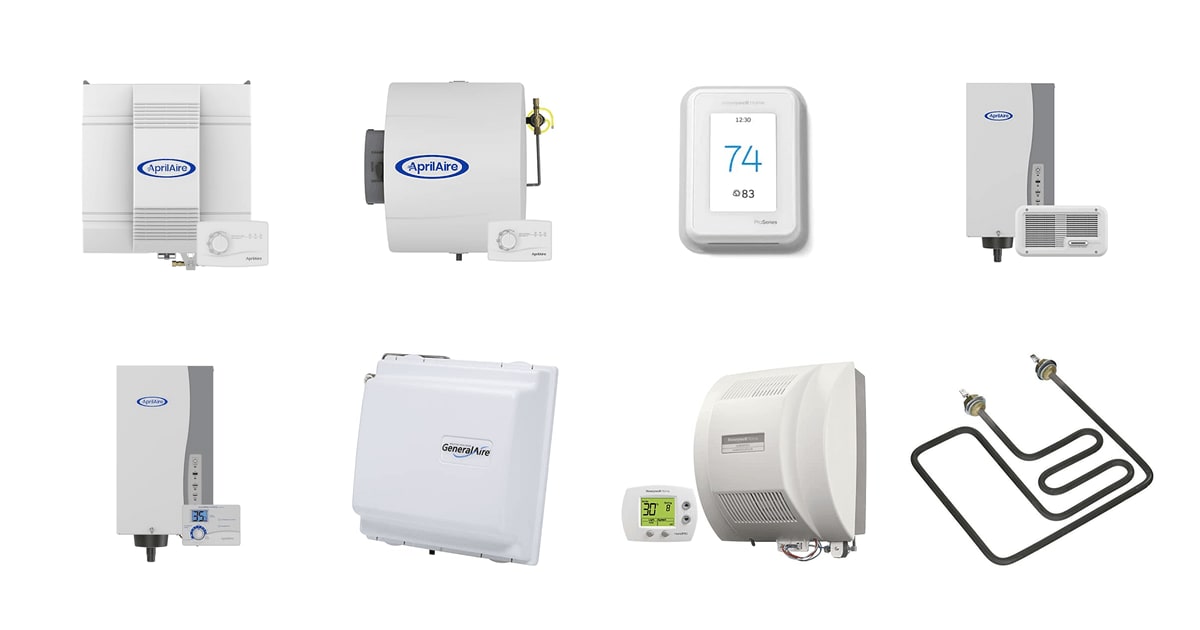
| Product | Price | |
|---|---|---|
| AprilAire 700M Whole-House Fan Powered HumidifierTop pick | $469.99 |
| AprilAire 600M Whole-House HumidifierBudget pick | $247.58On sale |
 | Honeywell Home THX321WFS2001W T10 Pro Smart ThermostatAlso in lineup | $349.99 |
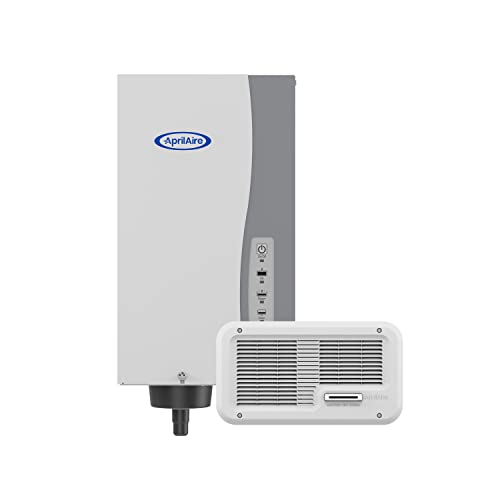 | AprilAire 865 Whole-House Steam HumidifierAlso consider | $1,489.99 |
| AprilAire 800 Whole-House Steam HumidifierUpgrade pick | $1,119.99 |
 | GeneralAire Whole House Fan-Assist Humidifier Model 4400AAlso consider | $311.99 |
 | Honeywell Home Whole Home Humidifier and HumidistatAlso in lineup | $318.88 |
 | Skuttle 000-0430-055 Replacement Heater for Model 60-1Also in lineup | $126.50 |
How we picked
Output and coverage. We compared rated gallons per day and square footage from each manufacturer's spec sheet, and treated those numbers as best-case figures for a tightly built house. Older, draftier homes should size up a tier.
Heating system fit. We checked what each unit needs from your HVAC system, because evaporative models are useless without forced-air ductwork. Radiant heat, boilers, and heat-pump-only setups rule out most of the category.
Control and condensation. We looked at whether a unit adjusts its setpoint as it gets colder outside, since owner feedback across every brand points to foggy windows as the most common complaint. Automatic outdoor sensing earned real credit here.
Maintenance burden. We favored designs where the yearly job is one pad swap you can actually do. Published guidance and owner reports agree that a scaled pad can halve output, so easy access and easy parts sourcing matter.
Parts and support. We weighed how widely each brand's replacement pads and service help are available, based on distribution and recurring owner comments. A humidifier you can't get parts for is a humidifier with a short life.
Top pick
Runs on its own fan, so it humidifies between furnace cycles
AprilAire 700M Whole-House Fan Powered Humidifier
This is the fan-powered AprilAire that HVAC pros reach for most, rated for homes up to 5,300 square feet and 18 gallons of moisture a day. Its own blower pulls warm air through the pad, so it keeps working while the furnace sits idle.
$469.99fromAmazonThe built-in fan is the whole point. A bypass humidifier only makes moisture while the furnace blower runs. If your house holds heat well, or you're in a milder stretch of winter, that blower might run a few hours a day — and the humidifier does nothing the rest of the time. The 700M has its own blower and pulls heated air through the pad on its own schedule. That's what lets it reach your target humidity and hold it.
More people install this one themselves than you'd guess. It mounts to the warm-air supply plenum and needs a drain line, a water connection, and a 120V outlet for the fan. Owners who are comfortable cutting sheet metal and running low-voltage wire describe it as an afternoon job with a good set of instructions. If that sounds like a bad afternoon, an HVAC tech will do it, and the labor is a real add-on to the unit price.
If you already run a Nest or an Ecobee, get this manual version rather than the automatic one. Owners consistently report that the thermostat's own humidity control does the work, which makes the unit's built-in dial redundant. You wire it to the humidifier terminals with standard 24V control wire and let the thermostat manage everything. One warning that comes up again and again: don't configure it as a steam humidifier in your thermostat settings. This pad needs furnace heat to evaporate anything.
Pads are easy to find, and that matters more than it sounds. AprilAire invented the whole-home evaporative humidifier and still builds this one in the USA, so its water panels sit on the shelf at basically every HVAC supply house. You'll buy one every fall for as long as you own the thing. A humidifier with a hard-to-source pad is a humidifier you quietly stop maintaining.
Flaws but not dealbreakers
The dial is manual, and remembering it is on you. When the temperature outside drops, you need to turn the setpoint down or condensation collects on the glass and eventually soaks the sills. A smart thermostat or an outdoor-temperature-sensing control solves this. The unit by itself doesn't.
It's a tight fit in a cramped mechanical room. Owners with a furnace close to a wall describe wedging it into about half an inch of clearance. Measure beside your plenum before ordering, and leave room to swing the door open for the annual pad change.
Budget pickOn sale
Nearly the same output for less, if your furnace runs a lot
AprilAire 600M Whole-House Humidifier
A bypass humidifier rated for homes up to 5,000 square feet and 17 gallons a day, with no blower of its own. It borrows airflow from the furnace to evaporate water off the pad, which keeps both the price and the installation simpler.
$247.58fromAmazonList priceOn paper the gap between this and the 700M is one gallon a day and 300 square feet. The real difference is runtime. In a cold climate where the furnace cycles all day, a bypass unit gets plenty of chances to evaporate water, and you'd have trouble telling the two apart. In a mild winter, or a tightly sealed house that rarely calls for heat, the fan-powered 700M pulls ahead.
This is the easiest unit here to put in yourself. There's no second fan to power, so you're dealing with a water line, a drain, and low-voltage wiring — that's it. It mounts on the return duct as well as the supply, which helps in awkward mechanical rooms. Owners replacing a decades-old humidifier often reuse the existing wiring, though most had to enlarge the duct opening to match the new footprint.
It's the one we'd hand a first-timer. Owner feedback skews unusually warm for an appliance that involves cutting a hole in your ductwork, and the recurring theme is simple: the static shocks and the dry-throat mornings just stop. Pad availability is the same as the 700M's, which is to say you'll never hunt for one.
Flaws but not dealbreakers
Bypass means zero output when the blower is off. If your system runs short cycles, the humidifier sits idle most of the day and you may never hit the humidity you set. Check the runtime report on your thermostat for a week before you decide.
The control is manual, same as the 700M, so the seasonal dial-down is your job. The bypass duct also eats space next to the plenum, which is worth measuring if your furnace closet is already crowded.
Upgrade pick
Steam and automatic control for big or hard-to-humidify homes
AprilAire 800 Whole-House Steam Humidifier
This steam humidifier covers up to 10,300 square feet and offers six output levels, topping out at 34.6 gallons a day. Dual sensors watch outdoor temperature and indoor humidity together, so it adjusts itself instead of waiting for you to remember.
$1,119.99fromAmazonAutomatic control is what you're really paying for. Every other humidifier here expects you to turn the setpoint down when a cold front rolls in. This one reads the outdoor temperature and handles it. You set your target once and it manages the rest of the season. If the manual dial is the part that makes you skeptical about whole-house humidification, this is the fix.
Steam also solves problems a pad can't. A two-stage heat pump moves supply air that's too cool to evaporate much water, and owners of those systems describe bypass humidifiers as close to useless. Steam doesn't care how warm the air is — it boils water and injects it. Same story in a big, leaky house where an evaporative unit never quite catches up with the dry air coming in.
The install is the serious part. Most configurations want a dedicated 240V circuit and a properly routed condensate drain, which usually means an electrician, a plumber, or both. Owners who did it themselves talk about pulling new romex from the panel and spending a few weekends on it. Assume professional labor unless that description sounds like a good time.
Electrode technology uses the minerals already in your tap water to carry current, so there's no filtration to buy or maintain. That's a genuine simplification over units that fight scale all winter. The trade-off is electricity: heating water takes real power, and you'll see it on the winter bill in a way you never would with a bypass pad.
Flaws but not dealbreakers
Operating cost is the highest here by a wide margin. You're boiling water for months. If you have working forced-air ductwork, an evaporative unit gets you most of the way there for a small fraction of the running cost, and that's the honest comparison.
The documentation draws complaints. Owners describe vague plumbing instructions, a steam hose they wish were longer, and a parts list — breaker, romex, ice-maker line — that isn't obvious from the box. Read the manual straight through before you start buying fittings.
Who this is for
Get one of these if you own your home, you're heating it through a real winter, and you're tired of shocks, split trim, and floors that gap every January. You'll need a water supply within reach of your furnace, a drain the unit can dump into, and either forced-air ductwork or the willingness to go with steam. If you rent, or you only care about one dry bedroom, a portable humidifier is the cheaper and saner answer.
This guide covers ducted whole-home units — bypass, fan-powered, and steam — plus the controls that manage them. It doesn't cover console humidifiers, tabletop models, or the replacement parts that keep an existing system alive. And it assumes you'll either hire an installer or already know your way around low-voltage wiring and a compression fitting.
How we picked
Output and coverage: we compared rated gallons per day and square footage from each spec sheet, then treated those figures as best-case numbers for a well-sealed house. Heating system fit: evaporative units need forced-air ductwork, so we checked what each model demands before anything else. Control: foggy windows are the most common owner complaint in this category, so units that adjust their setpoint as it gets colder outside earned credit. Maintenance: we favored designs where the annual job is one pad you can reach and replace without dismantling anything. Parts and support: widely stocked pads and a real service network decide whether a unit lasts a decade or gets abandoned after three seasons.
Other whole-house humidifiers worth considering
If you want whole-home humidity without any ductwork: The AprilAire 865 Whole-House Steam Humidifier ($1,489.99) — The AprilAire 865 is the only unit here that works with no furnace, air handler, or ducts at all. A wall-mount fan pushes electrode-generated steam straight into the living space, covering up to 10,300 square feet across six output levels. That makes it the answer for radiant floor heat, boilers, and heat pumps — and for anyone who needs stable humidity in the shoulder seasons when the heat isn't running. What you give up is the automatic dual-sensor control the AprilAire 800 has, so you're back to adjusting a dial by hand. It's also the priciest unit here before an electrician and a plumber ever show up, and owner feedback on it is thin and more mixed than we'd like.
If you want fan-assist output in a tight space: The GeneralAire Whole House Fan-Assist Humidifier Model 4400A ($311.99) — The GeneralAire 4400A is low-profile enough to fit spots where an AprilAire won't go, and owners with cramped furnace closets say so directly. Its flow-through pad keeps fresh water moving instead of recirculating it, which slows the scale buildup that plagues humidifiers in hard-water areas, and the stainless water tube lets you feed it hot water for more output. The included GFX4 control reads indoor humidity and runs the fan accordingly. But the flow-through design sends more water down the drain, the wiring confuses people more than the AprilAire units do, and there are owner reports of the electronics dying early and of a rattling blower. GeneralAire's parts network is also much smaller.
The competition
This is what our research turned up in a category that's mostly sold through HVAC contractors rather than on shelves, so it isn't every humidifier on the market. The unit below is a legitimate product that plenty of people install happily. It just lost to a pick on coverage, consistency, or owner experience.
The Honeywell Home Whole Home Humidifier and Humidistat ($318.88) — The Honeywell Home HE360D is the most convenient package here on paper: a whole-home humidifier that ships with a digital humidistat and outdoor sensor, so it turns itself on and off to hold your setting without the seasonal dial-twiddling most units require. It mounts on either the supply or return duct, and you can usually pick one up locally instead of ordering through a distributor. Two things kept it out of the picks. Coverage stops at 4,500 square feet, below the AprilAire 600M's rating, and owner reports include missing saddle valves and fittings, units arriving damaged, and at least one that showed up with a used pad. If you want the outdoor-sensing control built in and your house fits under that ceiling, it's still a reasonable buy — just inventory the box before you cut anything.
Installation and upkeep
Plan on one job every fall: swap the evaporator water panel before you turn the heat on. A scaled pad can cut moisture output roughly in half, and the unit will hum along looking perfectly healthy while your humidity sits in the low twenties. If your water is hard, add a mid-season replacement. Wipe out the distribution tray while you're in there and make sure the drain line runs clear, because standing water is where mold gets its start. Steam units need their own attention, since both the canister and the condensate path scale up over a winter. And check your windows on the first hard freeze — fogging means your setpoint is too high, not that something's broken.
Questions we get
What's the difference between bypass, fan-powered, and steam humidifiers?
A bypass unit uses your furnace blower to push warm air across a wet pad, so it only makes moisture while the blower runs. A fan-powered unit adds its own blower and keeps working between furnace cycles, which is worth real money if your heat runs intermittently. Steam units boil water electrically and don't need warm supply air at all, so they're the only option for radiant heat, boilers, and heat-pump-only homes. Bypass costs the least to buy and run; steam costs the most and works anywhere.
Can I install a whole-house humidifier myself?
Bypass models like the 600M are realistic DIY if you can cut a duct opening, make a compression fitting, and land low-voltage wire on the right terminals. Fan-powered units add a 120V connection, which raises the difficulty a notch. Steam is a different animal: a dedicated 240V circuit and a routed condensate drain usually mean licensed help. Owners do tackle steam installs themselves, but they describe multi-weekend projects, not afternoons.
What humidity level should I set in winter?
Aim for 35 to 45 percent when it's above 20°F outside. Below 20°F, drop to roughly 30 to 35 percent, and below zero, closer to 25 to 30 percent. The EPA recommends staying between 30 and 50 percent year-round. If you'd rather not think about it, a unit with automatic outdoor-temperature sensing makes these adjustments on its own.
Will a whole-house humidifier cause window condensation or mold?
Condensation happens when the humidity is too high for how cold your windows are, not because the unit is faulty. Turn the setpoint down as the temperature falls, or use a control that does it automatically, and the fogging stops. Mold inside the unit is a maintenance question: replace the pad every season, keep the tray and drain clean, and don't let water sit stagnant in there over the summer.
How often do I replace the water panel?
Once a heating season at minimum, before you fire the system up in the fall. In hard-water areas, a mid-season swap is worth it too. A calcified pad can cut output roughly in half, which is the single most common reason a humidifier seems to stop working. It's a five-minute job that decides whether the whole system does anything.
Do these work with a Nest or an Ecobee?
Yes. Both support a humidifier through their accessory or humidity terminals, and the AprilAire 700M and 600M wire up with standard 24V control wire. Owners with smart thermostats generally recommend the manual versions, since the thermostat takes over setpoint duty and the unit's own dial becomes redundant. One consistent caution: don't tell the thermostat it's driving a steam humidifier when it's actually driving an evaporative pad, because the pad needs furnace heat.
Why you should trust us
For this guide:
- We read manufacturer spec sheets for every unit here and compared rated coverage, gallons per day, and what each one demands from your heating system.
- We compared published reviews and installer guidance on how bypass, fan-powered, and steam designs behave in different homes and climates.
- We read owner feedback across all of these listings for recurring themes: install headaches, mineral scale, window condensation, and failures that showed up in the first season.
- We read owner reviews on every listing, weighted toward the critical ones, because that is where the recurring failures show up.
- We have a systematic way of automatically fetching the latest prices, so the numbers on this page stay current.
- This is a research-focused guide, so the team may not own every product listed — though we often do own the top winners, which gives us extra context for the recommendations.
- We don't accept free products, and the retailer commission never changes which product we recommend.
Sources
Best Whole-House Humidifiers – This Old House Reviews, This Old House
Best Whole House Humidifiers – Bob Vila, Bob Vila
Best Whole House Humidifiers of 2026 – Forbes Home, Forbes Home
Whole-House Humidifier Installation Cost Guide – Angi, Angi
Whole-House Humidifiers: Costs and Types – HomeAdvisor, HomeAdvisor
Amazon product listings and owner reviews for all 8 products
Manufacturer specification pages for each product
Some passages in this guide may be paraphrased with AI help. Prices are refreshed automatically.
More like this.
Continue exploring appliances reviews and recommendations.

The Best Whole-House Surge Protectors
Most people picture a lightning bolt when they think about surge protection. The real threat is quieter. Every time your air conditioner's compressor…

The Best Whole House Water Softeners
Hard water doesn't announce itself. It shows up as a film on the shower glass you can't scrub off, spots on glasses that came out of a dishwasher you just…

The Best Humidifiers for a Baby Nursery
Dry indoor air is one of those problems you notice through your baby, not through a gauge on the wall. The heat kicks on in November, and by December your…

The Best Humidifiers for Large Rooms and Bedrooms
Dry indoor air is a problem you feel before you name it. You wake up with a scratchy throat, your lips crack, static shocks you every time you touch a…

The Best Smart Humidifiers
Dry indoor air shows up in small ways first. Your lips crack, the hardwood gaps open, and you shock yourself on the doorknob every time you reach for it.…

The Best Noise-Reducing Garbage Disposals
A garbage disposal is one of the loudest things in your kitchen, and you run it almost every day. A cheap one turns a five-second cleanup into a jarring…