The Best Memory Foam Pillows for Neck Pain

Wake up with a stiff neck often enough and you start blaming your mattress. Usually it's the pillow. Your neck has a natural curve, and a pillow's job is to fill the gap between your head and the mattress so that curve stays neutral all night. Too flat and your head tips back. Too tall and your chin gets pushed toward your chest. The American Chiropractic Association ranks neck pain as the third most common pain complaint in the country, and sleep posture sits near the top of the list of contributors.
No pillow fixes a neck problem by itself, and any brand promising that is overselling. Height is personal. Spine-health, reviewed by board-certified orthopedic surgeons, calls pillow loft the single most important factor in preventing cervical strain — ahead of fill material, firmness and brand. So the pillow that saved your friend's neck may be the one that wrecks yours. Memory foam also asks for patience. Most pillows need a day or two to fully expand, and a molded contour can take weeks before it stops feeling strange under your head.
So we looked for pillows that let you get the height right, hold that height until morning, and don't cook you while they do it. We leaned on published lab work, manufacturer specifications for foam density and loft, and the complaints and compliments that repeat across years of owner feedback. We think that the Coop Home Goods Eden is the best memory foam pillow for neck pain for most people, and that the Elviros Cervical Memory Foam Pillow is the one to buy if you want a fixed contour that holds your neck in one place.
Everything we recommend

Adjustable fill you can dial in until your neck stops aching

A fixed contour that keeps your head where it belongs
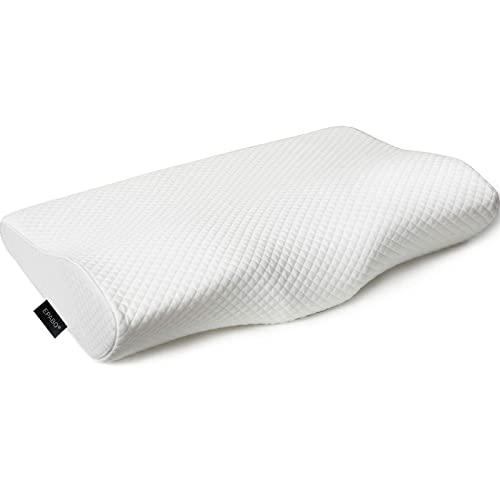
Real cervical shaping for less, if you don't mind firm

Dense foam that holds its shape all night, if you like firm

The one for hot sleepers who still need neck support
At a glance
| Product | Firmness | Fill Type | Price | |
|---|---|---|---|---|
| Coop Home Goods Eden Bed Pillow QueenTop pick | Medium Soft | — | $109 |
| TEMPUR-PedicUpgrade pick | Extra Firm | TEMPUR-Material | $149On sale |
| Purple Harmony Pillow - Medium LoftAlso great | Medium Feel | Talalay Latex | $194On sale |
| Elviros Cervical Memory Foam Pillows for NeckRunner-up | Medium Firm | Memory Foam | $37.99On sale |
| EPABO Contour Memory Foam Pillow Orthopedic SleepingBudget pick | Firm | Memory Foam | $36.99 |
 | Nest Bedding Easy Breather Memory Foam PillowAlso consider | — | — | $119 |
 | Casper Sleep Original PillowAlso in lineup | Medium-Soft | Down Alternative | $57On sale |
 | Beckham Hotel Collection Bed Pillows Standard/Queen SizeAlso in lineup | Medium-Firm | Down Alternative | $59.99 |
How we picked
Loft and adjustability. Spine-health, reviewed by orthopedic surgeons, calls pillow height the most important factor in preventing cervical strain. We favored pillows that either let you change the height or sell it in profiles matched to shoulder width.
Foam density. Published expert guidance puts 4 lb per cubic foot at the low end for real cervical support, and Verywell Health's physical therapist reviewer warns that anything under 3 collapses under an average adult head within the hour. We checked manufacturer specs where they exist and weighed owner reports of flattening where they don't.
Shape and position. Contour pillows have the better clinical record, but they only help if the mold matches you. We looked for shapes with a second height, a shoulder cutout, or enough adjustability to serve side and back sleepers alike.
Heat and airflow. CNET's lab found gel-infused foam runs a few degrees cooler than plain foam, and tossing from overheating undoes good alignment. We prioritized gel infusion, open-cell or grid structures, and covers that breathe.
Certifications and odor. CertiPUR-US caps VOC emissions below half a part per million, a limit set because of how long your face sits against the foam. We treated CertiPUR-US, OEKO-TEX or GREENGUARD Gold as a baseline rather than a bonus.
Top pick
Adjustable fill you can dial in until your neck stops aching
Coop Home Goods Eden Bed Pillow Queen
The Eden is a shredded memory foam and microfiber pillow with a zipper, so you can add or pull out fill until the height matches your shoulders. That adjustability is the closest thing to a universal answer for neck pain, and it works whether you sleep on your side, your back or both.
$109fromAmazonGetting the loft right matters more than anything else, and the Eden is the easiest way to get it right. Forbes Health cites chiropractic consensus of roughly four to six inches for side sleepers and three to four for back sleepers. Guessing at that with a sealed pillow is a gamble. Here you unzip it, pull out a handful, sleep on it, then adjust again. Coop includes a spare bag of fill if you need to go taller.
The fill is gel-infused memory foam blended with microfiber, and it behaves nothing like a solid foam block. It molds around your ear and shoulder instead of pushing back, which is usually what a side sleeper with shoulder pressure needs. Owners coming off years of down pillows tend to like it for exactly that reason. You get the moldability of down without the pillow collapsing flat by 3 a.m.
Heat is the other half of the problem. If you sleep hot you flip, and every flip undoes the alignment the pillow just gave you. The Eden's gusseted build, gel-infused foam and rayon-blend cover are all aimed at airflow, and cooling is the most repeated theme in its owner feedback. It's not refrigerated. But it doesn't turn into a warm brick under your cheek either.
It's also the safest choice if new-foam smell bothers you. The Eden is CertiPUR-US and GREENGUARD Gold certified, which means third-party limits on what it can emit — CertiPUR-US caps VOCs below half a part per million, a threshold set because your face rests on this thing for eight hours a night. You'll still notice some odor out of the bag. Air it out for a day and it fades.
Flaws but not dealbreakers
The adjustable fill is a chore before it's a feature. Landing on your right amount takes a few nights of trial and error, and once you pull foam out you need somewhere to store it. Some owners never quite find their number and give up on the process.
This is a medium-soft pillow at heart. If you want the rigid, sculpted feel of a solid cervical block that physically stops your head from rolling, look at the contour picks instead. A handful of owners also report loose stitching around the zipper on arrival.
Runner-upOn sale
A fixed contour that keeps your head where it belongs
Elviros Cervical Memory Foam Pillows for Neck
The Elviros is a solid memory foam contour with two different heights — about 3.9 inches on one side and 5.1 on the other. You flip it to match how you're sleeping, and the scooped cutouts along the edges give side sleepers somewhere to tuck an arm.
$37.99fromAmazonList priceContour shapes have the strongest evidence behind them. A randomized controlled trial in the Journal of Pain Research found people using cervical contour pillows reported a 42% drop in neck pain intensity after four weeks, against 13% in the standard pillow group. Sleep Foundation's work points the same way: 68% of side sleepers reported less morning stiffness on contour foam, compared with 41% on flat pillows.
The dual-height design is what lets one contour serve two sleep positions. Back sleepers use the taller side, where the twin ridges cradle the base of the skull. Roll onto your side and you flip to the lower side — or the reverse, if your shoulders are broad. If you change positions through the night, that's far more forgiving than a single-height cervical block.
The cover is an ice-silk fabric certified to OEKO-TEX Standard 100, and the foam core is CertiPUR-US. It comes off and goes in the wash, which matters more than it sounds. You can't launder a foam core, so a removable cover is the only real cleaning you'll ever do. The medium firmness is a revision of an earlier, harder version, and it lands closer to what most people actually want.
Flaws but not dealbreakers
The shape is the whole point, and it's also the whole risk. If your neck doesn't match the mold, there's nothing to adjust. Side sleepers with narrow frames sometimes find the neck ridge too long to sit comfortably between jaw and shoulder, and heavier sleepers occasionally sink through it.
Expect a real adjustment period. Elviros says the foam takes 48 to 72 hours to fully rebound out of the box and warns that a contour can take two to four weeks to get used to. It arrives with a noticeable foam odor, and it's a poor match if you wear a CPAP mask.
Budget pick
Real cervical shaping for less, if you don't mind firm
EPABO Contour Memory Foam Pillow Orthopedic Sleeping
The EPABO is a butterfly-contour memory foam pillow with a firm feel and a silky rayon-blend case in the box. It costs a fraction of what the premium contours do, and it gets the basic geometry right: a raised ridge under the neck, a lower hollow for the head.
$36.99fromAmazonIt's a low-risk way to find out whether contour sleeping works for you at all — and that's worth a lot. Molded shapes don't suit everyone, and spending heavily to learn that stings. This is one of the most popular orthopedic contour pillows on Amazon, and owner feedback repeats the same pattern year after year: neck pain down, shoulder pressure mixed. If the shape isn't for you, EPABO takes it back.
The queen version peaks at about 4.8 inches, which lands squarely in side-sleeper range, and the dip in the middle drops your head so your chin doesn't tilt upward. The rayon-poly cover breathes reasonably well and washes easily. For a firm sleeper who wants their head held in one spot, that covers most of what a cervical pillow needs to do.
Compared with the Tempur-Pedic, the foam here is less dense and less resilient, and that's the trade you're making. You get the shape without the staying power. How long it holds up depends a lot on your weight and how many hours a night you're on it. For a guest room, a spare bed or a first attempt at contour sleeping, that trade is easy to accept.
Flaws but not dealbreakers
Flattening is the recurring complaint. Owners report the foam losing meaningful loft within months, and for a support pillow that means the pain comes back. Verywell Health's physical therapist reviewer notes that foam below 3 lb per cubic foot bottoms out under a typical 10- to 12-pound adult head, and inexpensive pillows often sit near that line.
Broad-shouldered side sleepers frequently need more height than either side offers — the tall side feels too thick, the low side too thin, and there's nothing in between. It's also unapologetically firm, and some people never warm to that feel.
EPABO backs the pillow with a 30-day satisfaction guarantee and a full refund if it doesn't work out.
Upgrade pickOn sale
Dense foam that holds its shape all night, if you like firm
TEMPUR-Pedic
The TEMPUR-Neck is a solid, sculpted block of TEMPUR material at 5.3 lb per cubic foot, well above the density sleep researchers treat as the floor for adult cervical support. It's extra firm, it's small, and it does not budge once your head is on it.
$149fromAmazonList priceDensity is the difference between support at bedtime and support at 4 a.m. Verywell Health's physical therapist reviewer notes that foam under 3 lb per cubic foot bottoms out under an average adult head inside the first hour. Tempur-Pedic specifies 5.3. Good Housekeeping's lab measured solid memory foam holding 94% of its loft after eight hours of simulated head pressure, against 78% for polyester fill.
The shape is a fixed wave: a raised roll under the neck, a hollow for the skull. Chiropractors recommend this design often, and the owners who love it tend to be people with a pinched nerve or years of morning headaches who'd already worked through a drawer of failed pillows. When it fits your neck, it fits completely, and they don't go back.
Sizing is the step people skip. Tempur-Pedic sells this pillow in multiple profiles, and choosing by preference instead of by shoulder width is the fastest way to end up disappointed. Measure from the side of your neck to the outer edge of your shoulder and buy for that number. This particular listing is a two-pack of the medium profile, which is handy if you and your partner both need one.
Nothing here adjusts, and that's on purpose. The extra-firm formed foam is what keeps your neck muscles from doing the work overnight, and softening it would defeat the design. The cover is a hypoallergenic polyester knit that unzips and goes in the machine — the only cleaning a solid foam pillow will ever allow.
Flaws but not dealbreakers
It's small. The standard runs roughly 12.5 by 19.5 inches, so if you're used to sprawling across a queen pillow it'll feel more like a headrest. Petite sleepers say the same thing, so this isn't only a complaint from tall people.
Extra firm means extra firm. A meaningful share of owner feedback comes from people who found it unyielding and returned it, and it's the most expensive pillow here by a wide margin. If you like sinking into a pillow, skip it.
Also greatOn sale
The one for hot sleepers who still need neck support
Purple Harmony Pillow - Medium Loft
The Harmony wraps a Talalay latex core in Purple's hexagonal GelFlex Grid, so air moves through the whole pillow instead of getting trapped under your head. It's the pick if you run warm and spend half the night hunting for the cool side.
$194fromAmazonList priceHeat is a neck problem, not just a comfort problem. When you're hot you flip, and every flip resets whatever alignment you'd found. CNET's sleep lab measured gel-infused foam averaging 3.4 degrees cooler at the surface than plain memory foam after two hours of simulated body heat. The Harmony pushes further with an open grid and aerated latex, and staying cool is the single most repeated note in its owner feedback.
It doesn't feel like memory foam, which is either the appeal or the dealbreaker. Latex pushes back rather than sinking, so your head rests on the pillow instead of in it. Combo sleepers tend to like that, because you can roll over without waiting for foam to catch up. If you love the slow cradle of memory foam, you won't find it here.
Purple sells three lofts — 5.5 inches for stomach and back sleepers, 6.5 and 7.5 for side sleepers dealing with shoulder pressure. Buy by shoulder width, not by feel. Broad-shouldered side sleepers who chose the medium often say afterward that they should have gone tall, so size up if you're on the fence.
Flaws but not dealbreakers
It's costly, and the cover divides people. Some owners report the polyester-blend cover holding onto odor once it's been warmed by body heat night after night, which is a strange failing for a pillow sold on cooling.
The medium feel is the only feel. There's no adjusting it and no firmer version, so if you want a dense, propped-up surface under your neck, this one will read as too airy and too light.
Who this is for
This guide is for anyone who wakes up stiff, sore or with a headache that starts at the base of the skull, and suspects the pillow is the cause. A good test: if the pain is worst in the morning and eases as the day goes on, your sleep setup is a likely culprit. Side sleepers with broad shoulders, back sleepers with poor posture, and people whose chiropractor or physical therapist told them to fix their pillow will all find something here.
It's not for everyone. If your neck pain comes with numbness, tingling down an arm, or pain that doesn't improve during the day, see a doctor before you buy a pillow. If you've just had cervical surgery, ask your surgeon what shape you're cleared for — a contour can make recovery worse. We're covering memory foam and foam-adjacent pillows sold for neck support here, so down, feather and pure fiberfill pillows are out of scope, and so is anything marketed as a medical device.
How we picked
We built the list around five things. Loft and adjustability: height matters more than any other variable, so we favored pillows you can tune or buy in profiles matched to your shoulder width. Foam density: we looked for specs at or above the 4 lb per cubic foot threshold experts treat as the minimum for adult cervical support, and we read owner reports closely when a spec wasn't published. Shape: contour designs have the better clinical record, but only when the mold fits, so dual heights and shoulder cutouts counted for a lot. Heat: gel infusion, open structures and breathable covers, because a hot pillow makes you flip and flipping ruins alignment. Certifications: CertiPUR-US, OEKO-TEX or GREENGUARD Gold, since your face rests on this for a third of your life.
Other memory foam pillows for neck pain worth considering
If you want an adjustable pillow built for broad shoulders: The Nest Bedding Easy Breather Memory Foam Pillow ($119) — The Nest Bedding Easy Breather starts with more fill than most adjustable pillows, so it runs taller out of the bag — good news if your shoulders are wide and the Eden tops out too low for you. It's fully adjustable through a zipper, the shredded foam-and-fiber blend contours well, and the four-way stretch cover moves with your head instead of fighting it. Side sleepers are its most enthusiastic owners. What you give up is coolness: a stretch knit over a dense pile of fill traps more heat than the Eden's gusseted build, and some owners find the cover slippery under a pillowcase. It also has a strong foam smell for the first few days.
The competition
This is what our research turned up, not a census of every pillow sold for neck pain. Both of these are well-made pillows with large, loyal followings — they just aren't memory foam, which is what this guide is about.
The Casper Sleep Original Pillow ($57) — The Casper Original is a down-alternative pillow, not a foam one, built as a pillow inside a pillow: a firmer inner core wrapped in a softer outer layer, under a cotton percale cover. Back sleepers love it, and it's genuinely good at splitting the difference between plush and supportive without going flat. It's also fully machine washable, which no solid foam pillow can claim. But fiber fill doesn't hold a fixed loft the way dense foam does, and Good Housekeeping's lab work showed polyester-type fills losing far more height over eight hours than solid memory foam. If your neck pain comes from a loft that collapses overnight, that's the wrong direction. Buy it if you want a comfortable, washable everyday pillow rather than a corrective one.
The Beckham Hotel Collection Bed Pillows Standard/Queen Size ($59.99) — The Beckham Hotel Collection set is the plush hotel pillow people buy by the pair, filled with hollow-fiber down alternative under a cotton cover and certified to OEKO-TEX Standard 100. It's soft, it's tall at roughly 8 inches, and it comes two to a package. That's a lot of pillow for very little. It isn't memory foam, though, and it isn't a support pillow — even owners who love it note it's better for back sleeping than side sleeping, and side sleepers with real neck pain report sinking through it. Get it for a guest room or a partner who just wants something soft. If your neck hurts in the morning, start with one of the picks instead.
Break-in and care
Give any foam pillow a day or two out of the bag before you judge it. Compression packing leaves foam undersized and smelling faintly chemical, and both fix themselves with air — Elviros puts full rebound at 48 to 72 hours. A contour shape takes longer to get used to than that. Two to four weeks of mild strangeness is normal while your neck adapts, so don't bail after one rough night. Never put a foam core in the washer; it tears and never dries properly. Wash the cover instead, and add a protector if you sweat. Expect two to three years of useful support from memory foam before it stops springing back, per Sleep Foundation — roughly double what a down pillow gives you. When the mornings start hurting again, that's your replacement signal.
Questions we get
What kind of pillow do chiropractors recommend for neck pain?
Most point toward a cervical contour: a raised roll that fills the gap under your neck with a hollow for the back of your head. The clinical support is decent — a trial in the Journal of Pain Research found a 42% reduction in neck pain intensity after four weeks with contour pillows, versus 13% for standard ones. The shape only helps if it matches your neck, though. If a contour feels wrong after a few weeks, an adjustable shredded foam pillow is the usual fallback.
Can the wrong pillow height actually cause neck pain?
Yes, and it's the most common cause of pillow-related pain. Spine-health, reviewed by orthopedic surgeons, ranks loft above fill, firmness and brand as a predictor of cervical strain. Too flat and your head tips backward all night; too tall and your chin gets driven toward your chest. Forbes Health cites chiropractic consensus of about four to six inches for side sleepers and three to four for back sleepers.
How do I know whether my pillow is the problem?
Pay attention to when it hurts. If you're stiffest right when you wake and it loosens up over the morning, your sleep position or your pillow is the likely culprit. If the pain builds during the day or comes with numbness or tingling down an arm, it's something else and worth a doctor's visit. Also check your pillow's age — foam that no longer springs back has quietly stopped supporting you.
How long does a memory foam pillow last?
Sleep Foundation puts the useful life of memory foam at roughly two to three years before it stops holding its shape. That's better than the one to two years typical of down and feather, and much better than the six months to a year you get from polyester fiberfill. Denser foam generally lasts longer. If you press it and the dent stays, it's done.
Do memory foam pillows off-gas anything harmful?
A new foam pillow usually smells for a few days, and that smell fades with air. Look for CertiPUR-US certification, which caps VOC emissions below half a part per million — a limit set specifically because your face and airway sit against a pillow for hours every night. OEKO-TEX certification covers the cover fabric on the same principle. All of our picks carry at least one of those.
Should I buy a firm or a soft pillow for neck pain?
Firm enough to hold its height until morning, and no firmer. Foam under about 3 lb per cubic foot flattens under an average adult head within the first hour, according to Verywell Health's physical therapist reviewer, which leaves you with no support for the rest of the night. But an extra-firm block like the Tempur-Pedic is genuinely too rigid for a lot of people. If you're unsure, an adjustable pillow lets you find your own answer.
Why you should trust us
For this guide:
- We read manufacturer specifications for foam density, loft and certification on every pillow here, and noted where a brand declines to publish a density figure.
- We compared published findings from Sleep Foundation, Good Housekeeping, CNET, Tom's Guide, Forbes Health, Verywell Health and Spine-health, along with a randomized controlled trial in the Journal of Pain Research.
- We looked for patterns across owner feedback rather than individual opinions, weighing recurring complaints — flattening, sizing, odor, heat — more heavily than one-off praise.
- We read owner reviews on every listing, weighted toward the critical ones, because that is where the recurring failures show up.
- We have a systematic way of automatically fetching the latest prices, so the numbers on this page stay current.
- This is a research-focused guide, so the team may not own every product listed — though we often do own the top winners, which gives us extra context for the recommendations.
- We don't accept free products, and the retailer commission never changes which product we recommend.
Sources
Best Pillows for Neck Pain 2026 — Sleep Foundation, Sleep Foundation
The Best Pillows for Neck Pain — Wirecutter (NYT), Wirecutter
Best Pillows for Neck Pain, According to Experts — Good Housekeeping, Good Housekeeping
Best Pillows for Neck Pain 2026 — Forbes Health, Forbes Health
Best Memory Foam Pillows — Tom's Guide, Tom's Guide
Pillows for Neck Pain: What to Look For — Spine-health, Spine-health
Cervical Pillow Effectiveness Study — Journal of Pain Research, Journal of Pain Research / NIH PubMed
Best Pillows for Neck Pain, Tested by Experts — Verywell Health, Verywell Health
Best Pillows for Neck Pain — Healthline, Healthline
Best Memory Foam Pillows for 2026 — CNET, CNET
CertiPUR-US Certification Standards — CertiPUR-US, CertiPUR-US
Neck Pain: Overview and Statistics — American Chiropractic Association, American Chiropractic Association
Amazon product listings and owner reviews for all 8 products
Manufacturer specification pages for each product
Some passages in this guide may be paraphrased with AI help. Prices are refreshed automatically.
More like this.
Continue exploring home reviews and recommendations.

The Best Memory Foam and Hybrid Mattresses
You spend a third of your life on a mattress, and you notice a bad one within a week. The wrong firmness leaves your lower back sore by morning. A foam…

The Best Travel Pillows for Neck Support
A travel pillow has one job: keep your head from falling forward while you doze upright. That sounds simple, but the physics are brutal. The American…

The Best Cervical Neck Traction Pillows
Neck pain from a desk job creeps up slowly. You spend eight hours with your chin drifting toward your chest, then another two on your phone, and by…

The Best Spray Foam Insulation Cans
A can of foam is a small fix for one of the biggest problems in your house. Air leakage accounts for 25 to 40 percent of heating and cooling losses in a…

The Best Cooling Pillows for Hot Sleepers
If you wake up at 3 a.m. flipping your pillow to find the cool side, you already know the problem. Your head and neck sit against the same patch of fabric…

The Best Pillows for Side Sleepers
When you sleep on your side, your pillow has one job: fill the gap between your ear and the mattress so your neck stays level with your spine. That gap is…