The Best Travel Pillows for Neck Support
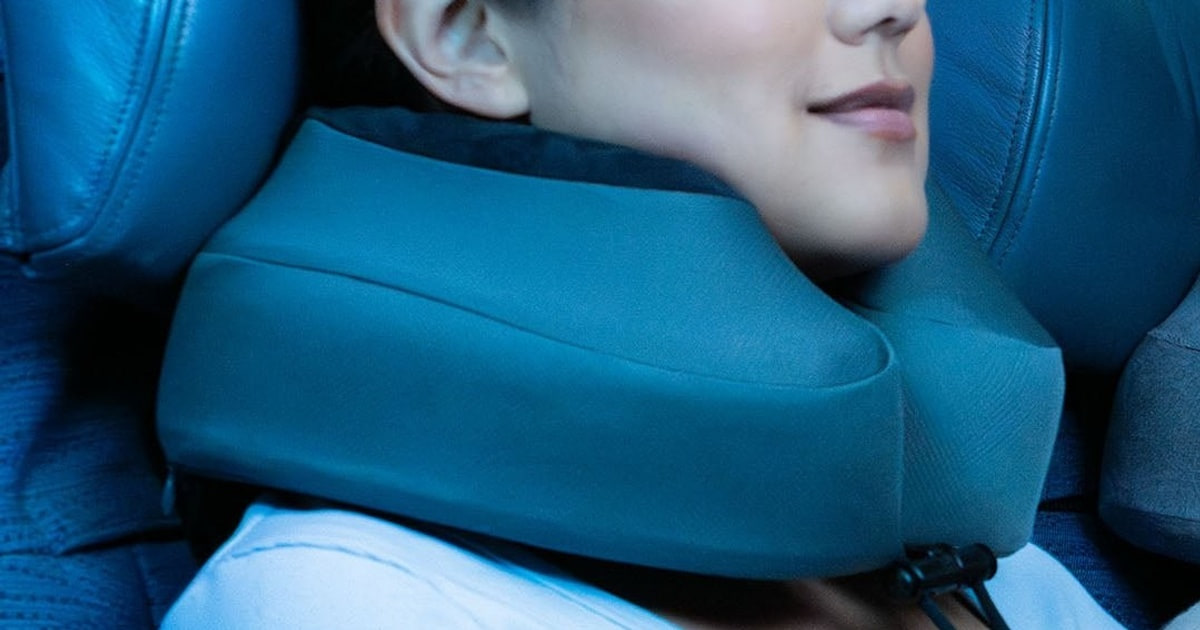
A travel pillow has one job: keep your head from falling forward while you doze upright. That sounds simple, but the physics are brutal. The American Chiropractic Association notes that a head tipped 30 degrees forward — exactly what happens when you nod off in a middle seat — loads the cervical spine with roughly 40 pounds of effective weight, versus 10 to 12 pounds when you sit upright. Spine-Health reports that holding the neck flexed past 15 degrees for half an hour or more raises your odds of waking up with a cervicogenic headache. That's the whole problem in two numbers.
Here's the honest caveat: no travel pillow makes an economy seat comfortable. They all reduce damage rather than create comfort, and every one of them is a compromise. Foam supports your neck well but eats carry-on space. Inflatables pack small but need fussing with to get the firmness right. Wrap styles look odd and run warm. And Popular Mechanics points out that airline headrests are calibrated for passengers roughly 5-foot-8 to 6-foot-0, so if you're outside that band, you're fighting the seat as much as the pillow.
Travel + Leisure's reader survey found 61% of travelers on flights over six hours said a good pillow significantly improved their sleep, but only 23% said the same about flights under three hours. So buy one if you fly long, drive long, or ride overnight trains. We think that the Cabeau Evolution S3 is the best travel pillow for most people, and that the Trtl Pillow Plus is the one to buy if you're carry-on-only and count every ounce.
Everything we recommend

Flat back, real straps, and it won't shove your head forward

Barely there in your bag, and it holds your head sideways on purpose

The one that actually stops your chin from dropping

The firmest, densest foam here, if you'll carry the weight
Light, washable, and enough support for a three-hour hop
Prices as of Oct 27, 8:28 AM PT · Details
At a glance
| Product | Fill Material | Support Style | Price | |
|---|---|---|---|---|
| Cabeau Evolution S3 Airplane Travel Pillow forTop pick | Memory Foam | 360° Support | $39.99 |
| trtl Pillow Plus and Sleep Mask BundleAlso great | Foam | — | $129.99 |
| Tempur-Pedic TEMPUR Neck PillowUpgrade pick | TEMPUR Material | — | $79 |
| BCOZZY Travel Neck Pillow for AirplaneRunner-up | Down Alternative | Double Support | $49.95 |
 | TRAVELREST All-in-One Travel Neck Support & BodyAlso consider | Memory Foam | Inflatable Support | $49.99 |
 | Huzi Infinity Pillow - Home Travel SoftAlso consider | Polyester | 360° Support | $54.50 |
| Cloudz Dual Comfort Microbead Airplane Travel NeckBudget pick | Microbeads | Snap Closure | $17.95 |
Prices as of Oct 27, 8:28 AM PT · Details
How we picked
Support architecture. We favored designs that keep the cervical spine near neutral rather than ones that just add padding. Flat-back and chin-supporting geometries got priority, since Good Housekeeping Institute lab work shows flat backs cut forward head displacement by more than two inches versus full-wrap U-pillows.
Material and firmness. Sleep Foundation's guidance puts meaningful cervical support at foam around 40 to 60 kg/m³ and 25 to 35 ILD, and that's the threshold we held products to. Manufacturer material claims and published reviews had to point to real structural resistance, not just a soft feel.
Packability. We compared listed weights and compressed dimensions against budget-carrier personal item limits. A pillow that never leaves your closet because it won't fit your bag is worth nothing, so anything over roughly a pound had to justify the weight with clearly better support.
Cleanability. We checked whether the cover removes and washes, and whether the whole pillow does. On multi-leg trips a pillow contacts seat backs, airport floors, and your own face, so full washability counted as a real advantage.
Fit across body sizes. We looked for adjustability, since Popular Mechanics notes airline headrests are calibrated for passengers roughly 5-foot-8 to 6-foot-0 and everyone else gets no support from the seat. Owner feedback themes consistently flag standard U-pillows as too tall for shorter or thicker necks.
Top pick
Flat back, real straps, and it won't shove your head forward
Cabeau Evolution S3 Airplane Travel Pillow for
The Evolution S3 uses dual-density memory foam with a deliberately flat back panel, so your head sits against the seat instead of getting pushed off it. Seat straps anchor it to the headrest, and it compresses into a stuff sack about the size of a small melon.
$39.99fromAmazonPrices as of Oct 27, 8:28 AM PT · Details
The flat back is the whole point. Most U-shaped pillows wrap all the way around, which stuffs a wedge of foam behind your skull and tips your chin toward your chest. Good Housekeeping Institute lab work found flat-back designs cut forward head displacement by more than two inches versus full-circumference U-pillows in an economy seat mock-up. Two inches doesn't sound like much until you remember what 30 degrees of forward flexion does to your neck.
The seat straps solve head bobbing better than foam alone can. Cabeau's patented strap system clips the pillow to an airplane, car, or office seat back, so when you go slack in deep sleep the pillow stays put instead of sliding down with you. That matters most in the second and third hours of a nap, when your muscles finally let go. No amount of foam density does this job — you need an anchor point.
The raised side wings actually catch your head. The foam is taller at the sides than at the back, so if you lean left or right — which is what most people do — there's something structural there to stop you. Cabeau also includes an adjustable chin clasp that cinches the front closed. Between the wings and the clasp, you get support in the positions you'll actually sleep in, not just the textbook upright one.
It's the pillow with the deepest published track record. Wirecutter's panel logged more than 200 collective flight hours across a dozen travel pillows and ranked the Evolution S3 first for neck support, comfort on waking, and whether testers would buy it again. Cabeau also says the S3's compression sack packs 30% smaller than the older Evolution Classic — useful now that budget carriers keep shrinking personal item limits.
The cover comes off and goes in the wash. The outer fabric is a moisture-wicking performance knit, which helps on a warm cabin or a long drive, and it's removable and machine washable. If you're doing a multi-leg trip and the pillow has been on a seatback, an airport floor, and your lap, that's not a luxury feature.
Flaws but not dealbreakers
It's the bulkiest pick here. Even compressed, this is a real object in your bag — around three quarters of a pound, and the stuff sack still takes up meaningful space in a personal item. There's a luggage clip so you can hang it outside your bag, which works, but you'll be that person walking through the terminal with a pillow swinging off their backpack.
Memory foam runs warm. The wicking cover helps, but foam holds heat against your neck in a way microbeads and fabric wraps don't. On a hot cabin or a summer road trip, you may end up taking it off for a while.
The foam itself isn't machine washable. Only the cover is. If something spills into the core, you're spot-cleaning and hoping.
Also great
Barely there in your bag, and it holds your head sideways on purpose
trtl Pillow Plus and Sleep Mask Bundle
The Trtl Pillow Plus skips the U-shape entirely. An adjustable internal rib structure wrapped in fleece props your head at a fixed lateral angle, like a soft scarf with a hidden brace. It weighs about 3.4 ounces and packs flat.
$129.99fromAmazonPrices as of Oct 27, 8:28 AM PT · Details
It's the lightest real support you can buy. Trtl lists the Plus at 3.4 ounces — roughly 65% lighter than a typical memory foam travel pillow, which runs 9 to 12 ounces. If you're carry-on-only and negotiating with a Ryanair sizer, that difference is the whole argument. It also packs flat rather than compressing into a lump, so it slides down the side of a bag.
The support comes from structure, not cushioning. Instead of surrounding your neck with foam, the internal ribbed spine holds your head at one angle and keeps it there. You twist toggles on the ribs to extend or shorten the support until it matches your neck height. For a side-leaner, this is more decisive than a soft U-pillow that lets your head keep traveling.
Adjustability makes it work across body sizes. Standard U-pillows are sized for an average neck, which is why people with short or thick necks so often find them too tall and end up with their chin jammed upward. The Trtl's toggle system lets you dial the height in, and Trtl markets it specifically as fitting travelers of all heights. If off-the-shelf pillows have never fit you, start here.
The fleece wrap is quieter and cooler than it looks. It's soft fabric against your skin rather than foam, and it wraps rather than clamps, so it draws less attention on a train or a bus than a bright U-pillow does. This version ships bundled with a sleep mask that blacks out fully or flips the front panel up if you want to keep an eye on the cabin.
Flaws but not dealbreakers
It commits you to one direction. The rib structure supports your head to one side. If you want to switch sides mid-flight, you have to unwrap and rewrap it, which is a small production in a cramped seat.
It looks unusual and it can get warm. You're wearing what appears to be a thick scarf, indoors, on a plane. And fleece around your neck for eight hours is fleece around your neck for eight hours.
There's no chin support. If your head tends to fall straight forward rather than to the side, the Trtl isn't the right tool — a chin-supporting design will serve you better.
Runner-up
The one that actually stops your chin from dropping
BCOZZY Travel Neck Pillow for Airplane
The BCOZZY's overlapping double-loop arms tuck under your chin and form a physical stop, so your head can't nod forward. It has a flat back like our top pick, adjusts to three configurations, and the entire pillow goes in the washing machine.
$49.95fromAmazonPrices as of Oct 27, 8:28 AM PT · Details
Chin support is the most underrated feature in this category, and BCOZZY builds it in. Forbes Vetted's reviewer noted the BCOZZY double-loop is the only widely available mass-market pillow that treats chin support as a structural, load-bearing element rather than a passive foam bump. If you're the person who wakes up with your chin on your sternum and a headache behind your eyes, this is the design aimed squarely at you.
You get a flat back too. BCOZZY calls this out explicitly — the rear of the pillow is deliberately thin so it doesn't wedge behind your skull and push your head off the headrest. Combined with the chin loop, you're braced at both ends of the failure mode: no forward push from behind, no forward droop from the front.
Three configurations cover most seats. Overlap the arms under your chin for full front support, fold it in half against one side for side-sleeping, or reverse it for a different angle. That flexibility matters because a window seat, a middle seat, and a car passenger seat all ask different things of your neck.
The whole thing washes. It's filled with a bounce-back down-alternative fiber rather than foam, so you toss it in the washer and air dry it. On a three-week trip with a dozen seat backs and airport floors, that's a genuine advantage over any memory foam pillow, all of which cap out at a washable cover.
Flaws but not dealbreakers
The fiber fill is softer than foam. It shapes nicely and it's comfortable, but it doesn't push back the way a dense memory foam core does. If you specifically want firm cervical resistance, the Tempur-Pedic or the Cabeau will feel more substantial.
It's bulky and it doesn't compress much. The arms are long and the fill is lofty. It comes with a carry case and a snap loop for clipping to luggage, which you'll use, because it isn't disappearing into a backpack.
The chin loop feels strange at first. Having something under your jaw takes a flight or two to get used to. Some people never warm to it.
Upgrade pick
The firmest, densest foam here, if you'll carry the weight
Tempur-Pedic TEMPUR Neck Pillow
Tempur-Pedic's travel-size neck pillow uses the same proprietary TEMPUR material as the company's bed pillows, in a smaller ergonomic shape. It's firmer and slower to rebound than generic travel foam, and it holds its shape over years rather than months.
$79fromAmazonPrices as of Oct 27, 8:28 AM PT · Details
Foam density is the difference between support and a soft lump. Sleep Foundation's materials guidance recommends memory foam around 40 to 60 kg/m³ with an ILD of 25 to 35 for real cervical support, and notes most budget travel pillows use foam under 25 kg/m³ that offers almost no structural resistance. TEMPUR material is specifically the high-density, slow-rebound end of that spectrum. You feel it the moment you press on it.
It keeps its shape. Cheap travel foam compresses permanently after a season of being stuffed in a bag. Tempur-Pedic says the TEMPUR material returns to shape and won't lose it, which is the practical reason to spend up here. If you fly long-haul often, a pillow that still supports your neck in year three is worth more than one that's flat by month eight.
The ergonomic contour suits back and side sleepers. This is Tempur-Pedic's original neck pillow shape scaled down for travel — a firmer profile designed to support the head, neck, and shoulders across different body types. For upright dozing, that firmness is what keeps your head from settling too far in any direction.
The cover is removable and washable. The knit polyester cover is hypoallergenic, comes off, and goes in the machine, which is the standard hygiene arrangement for any foam pillow and the one you want on a multi-leg trip.
Flaws but not dealbreakers
It's heavy for a travel pillow — over two pounds by the listed spec. That's several times what the Trtl weighs and roughly triple our top pick. If you're optimizing for a carry-on-only trip, this is the wrong pillow.
It doesn't compress into a stuff sack. Dense foam by definition doesn't squash down, and there's no compression case in the box. Plan on strapping it to the outside of your bag.
There's no strap or chin clasp. Unlike the Cabeau, nothing anchors it to the seat, so a deep sleeper can still slide out from under it.
Budget pick
Light, washable, and enough support for a three-hour hop
Cloudz Dual Comfort Microbead Airplane Travel Neck
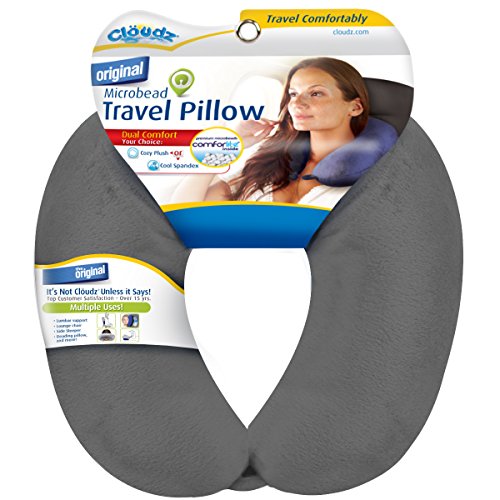
The Cloudz microbead pillow is filled with small polystyrene beads that shift to match your neck instead of pressing back against it. It weighs about a third of a pound, snaps closed at the front, and clips to a luggage handle.
$17.95fromAmazonPrices as of Oct 27, 8:28 AM PT · Details
Microbeads conform instead of resisting, which is fine for shorter trips. The beads move under your neck and settle into whatever position you're in. That's genuinely comfortable for a two- or three-hour flight or a car ride to the coast. Travel + Leisure's survey found only 23% of travelers on flights under three hours said a pillow significantly helped their sleep — so on those trips, comfortable and light beats structurally rigorous.
The snap closure is the feature that earns its keep. Snapping the front shut turns the U into a closed loop, which stops your head from tipping straight forward out of the opening. It's not the load-bearing chin support the BCOZZY offers, but it's meaningfully better than an open-ended U-pillow.
Two surfaces, two temperatures. One side is plush and warm, the other is cool spandex. Flip it depending on whether the cabin is freezing or the car is baking. It's a small thing that you'll use constantly.
It doubles as lumbar support. Snap it closed and put it behind your lower back on a long drive, or rest your face into it on a tray table. For a pillow this light, getting a second and third use out of it is a real argument for packing it.
Flaws but not dealbreakers
Bead fill doesn't hold your head up. Beads displace under sustained load, so on a long-haul flight the support gradually gives way and your head keeps traveling. This is a short-trip pillow, and we'd steer long-haul flyers to the Cabeau or the BCOZZY.
Bead pillows are audible. There's a faint crunching as the beads shift when you move. In a quiet cabin at 2 a.m., you'll notice it.
The fill can settle unevenly over time. You'll find yourself shaking and redistributing the beads before each use.
Who this is for
Buy a travel pillow if you regularly fly long-haul, drive several hours at a stretch, or ride overnight trains and buses. The benefit scales hard with duration — Travel + Leisure found 61% of travelers on flights over six hours said a quality pillow significantly improved their sleep, against 23% on flights under three hours. If you have existing cervical spine issues or chronic neck pain, the case is stronger still, because the failure mode a pillow prevents is exactly the one that aggravates your neck. And if standard pillows have never fit your frame, look for an adjustable design rather than assuming the category doesn't work for you.
Skip it if your trips are mostly short domestic hops. The bulk in your bag usually outweighs the payoff. This guide covers wearable neck-support pillows for upright sleeping in seats — planes, cars, trains, buses. It doesn't cover bed pillows, full-length body pillows for lying down, seat cushions, lumbar-only supports, or the inflatable footrests and tray-table props that show up in the same searches. We also don't cover children's sizes.
How we picked
We built the shortlist around five things. Support architecture: we favored flat-back and chin-supporting geometries over full-wrap U-shapes, since Good Housekeeping Institute lab work shows flat backs cut forward head displacement by more than two inches in an economy seat mock-up. Material and firmness: Sleep Foundation puts useful cervical support at roughly 40 to 60 kg/m³ foam and 25 to 35 ILD, and we weighted manufacturer material claims against that. Packability: we compared listed weights and compressed sizes against budget-carrier personal item limits, and anything heavy had to earn it. Cleanability: removable covers were the minimum, and fully washable pillows scored higher for multi-leg trips. Fit: adjustable designs mattered most, because Popular Mechanics notes airline headrests only suit passengers around 5-foot-8 to 6-foot-0.
Other travel pillows for neck support worth considering
If you always take the window seat: The TRAVELREST All-in-One Travel Neck Support & Body — The Travelrest All-in-One is a long inflatable that runs down your side rather than around your neck, so you lean into it against the cabin wall instead of letting your head hang laterally. That's a genuinely different solution to a genuinely different problem — if window-seat leaning is how you sleep, this supports your whole upper body rather than one joint. It inflates by mouth and rolls up tiny, and it comes with a velour cover. What you give up is convenience and discretion. You have to inflate and deflate it every time, it's conspicuous, and it does nothing for you in a middle seat or on a train where you can't lean. Condé Nast Traveler's pressure-mapping found well-made air pillows can reach firmness comparable to 30 to 40 ILD foam when fully inflated, so the support is real — you just have to be in the right seat.
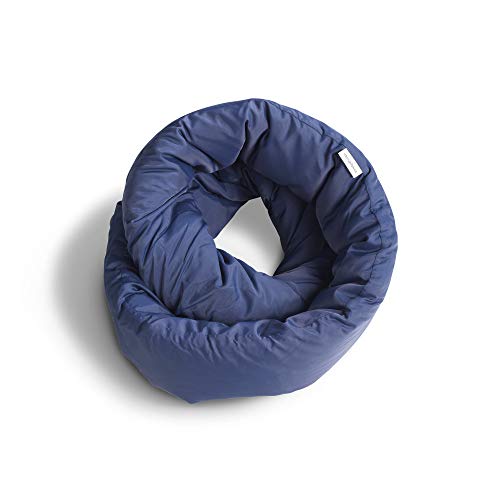
If you want one thing that does several jobs: The Huzi Infinity Pillow - Home Travel Soft — The Huzi Infinity Pillow is a figure-eight fabric loop you configure however you need — twist it into a neck support, fold it behind your lower back, wrap it over your eyes, or bundle it on a desk for a nap. The fabric is a nylon and bamboo-rayon blend that Huzi says breathes about three times better than cotton, which makes it the coolest option here against your skin. It's also machine washable, all of it. The tradeoff is structure: there's no internal support, so what you get is soft padding you arrange yourself, not a brace that holds your head. For a long-haul flight where you'll genuinely fall asleep, we'd take the Cabeau or the BCOZZY. For a commute, a train, or a hotel bed with terrible pillows, the Huzi earns its space.
The competition
This is what our research surfaced, not a census of the category. Travel pillows turn over constantly, and there are dozens of near-identical U-shapes we didn't look at. Everything that made our shortlist ended up as a pick or an also-consider above.
Care and cleaning
Treat the cover and the core as two separate problems. On any memory foam pillow — the Cabeau and the Tempur-Pedic here — unzip the cover, wash it cold on a gentle cycle, and let it air dry; heat from a dryer breaks down the knit and can shrink it onto the foam. Never put the foam core itself in a washing machine. Water tears the cell structure apart and it won't recover. Spot-clean it with a barely damp cloth and mild soap, press out the moisture with a towel, and let it dry completely before it goes back in the cover, because trapped damp foam smells within a day. Fully washable pillows like the BCOZZY and the Cloudz are simpler: machine wash and air dry, no dryer. Between trips, store foam uncompressed. Leaving it crushed in a stuff sack for months is how it ends up permanently flat.
Questions we get
Why does my neck still hurt after using a travel pillow?
Usually because the pillow is pushing your head forward instead of holding it up. Most U-shaped pillows have a thick rear cushion that wedges behind your skull and tips your chin down — the exact posture you're trying to avoid. Good Housekeeping Institute lab work found flat-back designs reduce forward head displacement by more than two inches versus full-wrap U-pillows. The other common cause is height: if the pillow is too tall for your neck, it forces your chin up and strains the other direction.
What travel pillow doesn't push your head forward in airplane seats?
Look for a flat-back design, which deliberately leaves the area behind your skull unsupported so your head can rest against the seat. Our top pick, the Cabeau Evolution S3, is built this way, and the BCOZZY uses the same principle. Both trade rear padding for better spinal alignment, which is the right trade for sleeping upright.
Are inflatable travel pillows as supportive as memory foam?
A good one can be. Condé Nast Traveler's gear lab pressure-mapping found fully inflated high-quality air pillows reach firmness comparable to 30 to 40 ILD foam — that's mid-grade memory foam territory — while deflating to under two ounces. The catch is that geometry and inflation level matter enormously. A cheap inflatable U-pillow at the wrong pressure supports nothing, and you have to re-inflate every trip.
What travel pillow works for people with short necks or small frames?
Adjustable designs, not standard U-pillows. Off-the-shelf U-shapes are sized for an average neck, so if yours is shorter or thicker the pillow rides up and shoves your chin skyward. The Trtl Pillow Plus lets you twist toggles on its internal ribs to set the support height, which is the most direct fix. Popular Mechanics notes airline headrests themselves only fit passengers around 5-foot-8 to 6-foot-0, so if you're outside that range you're already fighting the seat.
What's the lightest travel pillow that still gives real support?
The Trtl Pillow Plus, at a listed 3.4 ounces — roughly 65% lighter than a typical memory foam pillow at 9 to 12 ounces. It gets away with it by using an internal rib structure instead of a mass of foam. Deflated inflatables can go lighter still, but they need setup each time and the support depends entirely on getting the pressure right.
Are travel pillows worth it for flights under three hours?
Usually not. Travel + Leisure's reader survey found 61% of travelers on flights over six hours said a pillow significantly improved their sleep, but only 23% said so on flights under three hours. On a short hop, the bag space costs you more than the pillow gives back. If you fly a mix of short and long, buy for the long flights and accept carrying it on the short ones.
Why you should trust us
For this guide:
- We read published findings from Wirecutter, Good Housekeeping Institute, Condé Nast Traveler, Forbes Vetted, Sleep Foundation, Spine-Health, and the American Chiropractic Association on cervical loading, foam density, and pillow geometry.
- We compared manufacturer specifications for every pillow here — listed weights, dimensions, fill materials, and washability claims — against the buying criteria above.
- We reviewed recurring themes in owner feedback, particularly complaints about height fit, forward head push, and how well each design holds up after repeated packing.
- We read owner reviews on every listing, weighted toward the critical ones, because that is where the recurring failures show up.
- We have a systematic way of automatically fetching the latest prices, so the numbers on this page stay current.
- This is a research-focused guide, so the team may not own every product listed — though we often do own the top winners, which gives us extra context for the recommendations.
- We don't accept free products, and the retailer commission never changes which product we recommend.
Sources
Best Travel Pillows — Wirecutter (NYT), Wirecutter
Best Travel Pillows Tested — Sleep Foundation, Sleep Foundation
Best Travel Pillows 2026 — Travel + Leisure, Travel + Leisure
Best Travel Pillows — Condé Nast Traveler, Condé Nast Traveler
Best Travel Pillows Tested — Good Housekeeping Institute, Good Housekeeping
Best Travel Pillows — Forbes Vetted, Forbes Vetted
Best Travel Pillows — Popular Mechanics, Popular Mechanics
Neck Pain and Air Travel — Spine-Health, Spine-Health
Neck Pain Patient Guide — American Chiropractic Association, American Chiropractic Association
Travel Accessories Market Report 2024–2029, MarketsandMarkets
Amazon product listings and owner reviews for all 7 products
Manufacturer specification pages for each product
Some passages in this guide may be paraphrased with AI help.
Product prices and availability are accurate as of the date/time indicated and are subject to change. Any price and availability information displayed on Amazon.com at the time of purchase will apply to the purchase of this product.
More like this.
Continue exploring lifestyle reviews and recommendations.

The Best Memory Foam Pillows for Neck Pain
Wake up with a stiff neck often enough and you start blaming your mattress. Usually it's the pillow. Your neck has a natural curve, and a pillow's job is…

The Best Cervical Neck Traction Pillows
Neck pain from a desk job creeps up slowly. You spend eight hours with your chin drifting toward your chest, then another two on your phone, and by…

The Best Pickleball Shoes for Court Support
Pickleball looks gentle until you're three steps into a crosscourt dink rally and your foot slides out from under you. The sport is mostly short, sharp…

The Best Lumbar Support Cushions
Your chair's backrest is flat. Your lower back isn't. A lumbar cushion fills that hollow just above your beltline so your spine keeps its natural inward…

The Best Cooling Pillows for Hot Sleepers
If you wake up at 3 a.m. flipping your pillow to find the cool side, you already know the problem. Your head and neck sit against the same patch of fabric…

The Best Pillows for Side Sleepers
When you sleep on your side, your pillow has one job: fill the gap between your ear and the mattress so your neck stays level with your spine. That gap is…