The Best Cervical Neck Traction Pillows
Neck pain from a desk job creeps up slowly. You spend eight hours with your chin drifting toward your chest, then another two on your phone, and by Thursday your shoulders feel like they're bolted on. Cervical traction devices try to undo some of that by pulling gently on the head to open up space between the vertebrae. Some do it while you sleep, some in a ten-minute session on the floor, and one hangs from your door. They all chase the same goal: less compression, more of the natural curve your neck is supposed to have.
Here's the honest part. No pillow or foam wedge fixes a herniated disc, and none of these can tell you how much force you're actually getting. Passive devices apply whatever your head weighs and nothing more. Physical therapists prescribe traction at roughly 10 to 15 percent of body weight in short sessions, and only calibrated equipment can hit that number reliably. If you have diagnosed nerve compression, tingling arms, or any spinal instability, you need a clinician before you need a purchase. Traction is also flat-out contraindicated for fractures, advanced osteoporosis, and rheumatoid arthritis in the neck.
So think about what you're actually treating. Stiffness from posture is a different problem than radiculopathy, and the right device is the one that matches the condition rather than the one with the most features. We looked at sleep pillows, foam wedges, a door-anchor hammock, a mechanical supine unit, and an inflatable collar. We think that the Arc4life Traction Neck Pillow is the best cervical neck traction pillow for most people, and that the ComforTrac Deluxe Home Cervical Traction Kit 2.0 is the one to buy if a physical therapist has told you that you need measured traction at home.
Everything we recommend

Gentle decompression all night, with nothing to set up

Measured, adjustable traction when a clinician has asked for it
The easiest way to find out if traction helps you at all

Adjustable pull you can pack, if you have a standard door

A cooler, softer cervical pillow that side sleepers settle into
At a glance
| Product | Traction Type | Adjustable Height | Price | |
|---|---|---|---|---|
| Arc4life Traction Neck Pillow for Cervical SupportTop pick | Contour Orthopedic | — | $135 |
 | OrthoTrust Cervical Traction Wedge Pillow - NeckAlso consider | Wedge Foam | — | $23.95 |
| ComforTrac Deluxe Home Cervical Traction Kit 2.0Upgrade pick | Hand Pump | — | $389 |
| Cervical Neck Traction Device for Home UseAlso great | Hammock Over Door | — | $29.99 |
| RESTCLOUD Neck and Shoulder RelaxerBudget pick | Dense Foam | — | $19.99 |
| Elviros Cervical Memory Foam Pillows for NeckRunner-up | Memory Foam | Dual-Height Design | $35.99On sale |
 | Therapeutica Ergonomic Cervical Pillow for Neck PainAlso consider | Molded Foam | — | $98.44 |
 | Bargain Crusader Inflatable Cervical Neck Traction AirAlso in lineup | Air Inflatable | — | $9.49On sale |
How we picked
Traction type and force. We separated devices that apply measurable, adjustable force from those that rely on body weight alone. Anything recommended for diagnosed disc or nerve conditions had to offer a way to set and repeat a specific load.
Match to condition. We compared each product's stated use against published guidance on when cervical traction helps and when it doesn't. Devices aimed at postural stiffness were judged differently from those aimed at radiculopathy.
Comfort over a full session. Traction only works if you finish the session or the night. We weighed headrest padding, harness material, foam density and reported adjustment periods from owner feedback.
Fit and sizing. Cervical pillows fail more often from wrong sizing than bad design. We favored products with clear measuring guidance or a shape forgiving enough to suit a range of shoulder widths.
Setup and portability. We looked at what each device demands before you can use it: floor space, a suitable door, assembly, or nothing at all. Lower friction won ties.
Top pick
Gentle decompression all night, with nothing to set up
Arc4life Traction Neck Pillow for Cervical Support
The Arc4life replaces your regular pillow and does its work while you sleep, so there's no session to schedule and nothing to remember. Its center channel holds your neck in a mild stretch for six to eight hours a night, which adds up faster than a ten-minute floor session.
$135fromAmazonThe best traction device is the one you'll actually use, and this one asks nothing of you. Every other approach here needs you to stop what you're doing, lie on the floor or hang from a door, and stay put. This one just goes on your bed. You sleep on it. If your track record with stretching routines is anything like most people's, that difference matters more than any spec.
The linear center channel is what separates this from an ordinary contour pillow. Most orthopedic pillows just cradle your head in neutral. The Arc4life's channel holds a mild posterior stretch, which over weeks encourages your neck back toward its natural forward curve. Back sleepers get the most out of it, since the channel lines up directly under the cervical spine.
Side sleepers aren't an afterthought. Raised lateral wings keep your head from tipping toward the mattress, which is what causes that one-sided morning ache. You get the same pillow either way, so you don't have to commit to a sleeping position when you buy. If you switch sides through the night, it still works.
At 28 by 15 inches, it's a full-size replacement, not an add-on. You aren't stacking it on top of what you already own or finding somewhere to store it during the day. It's the pillow. That also means one purchase covers your whole setup, which softens the sting of a price well above a standard bed pillow.
The force is low enough to be safe every night. This isn't a device that can pull too hard, because the only thing pulling is the weight of your own head against foam. For postural stiffness and tech neck, that's the right dose. You get months of gentle input instead of a few intense minutes.
Flaws but not dealbreakers
You can't measure or adjust anything. The force is whatever your head weighs on the contour, which means it's neither reproducible nor tunable. If a doctor has told you that you need a specific amount of decompression, this pillow can't deliver it. That's the ComforTrac's job.
Expect a rough week or two. Contoured pillows feel wrong at first, and this one is no exception. Owners who stick with it usually report stiffness easing within the first couple of weeks, but plenty of people bail before that. If you're a devoted soft-pillow sleeper, go in knowing you'll be uncomfortable for a while.
It costs a lot for something that looks like a pillow. Compared with the foam wedges here it's a serious outlay, and the benefit is gradual rather than dramatic. If you just want to see whether traction does anything for you, start cheaper.
Upgrade pick
Measured, adjustable traction when a clinician has asked for it
ComforTrac Deluxe Home Cervical Traction Kit 2.0
The ComforTrac Deluxe 2.0 is the closest thing to clinic traction you can put in a spare room. It pulls you supine at a set angle with a hand pump, so sessions are consistent and repeatable in a way that no foam wedge can match.
$389fromAmazonThis is the only device here that gives you a number you can repeat. A patented hand pump raises the force and a quick-release button drops it with one hand. That means session two matches session one, and you can follow a protocol instead of guessing. For diagnosed disc problems, reproducibility is the whole point.
Supine traction is the position clinicians prefer. Lying down takes your postural muscles out of the equation, so they aren't fighting the pull. Upright methods like the door hammock have to overcome that guarding. If you've had traction in a physical therapy office, this is the setup you'll recognize.
The adjustable incline lets you aim. It sets to ten, fifteen, and twenty degrees without ordering extra parts, and each angle changes where the force lands along the cervical spine. That's how a therapist targets a specific level rather than pulling on the whole neck evenly. The neck wedges adjust independently for fit.
Sessions are actually tolerable. The memory foam headrest is the reason people finish a ten- to twenty-minute session instead of quitting at six. Comfort sounds like a soft benefit until you're the one lying there. The bundle also includes the Wave neck support and a stretcher, so you get a complete home routine rather than one machine.
It covers the conditions the foam options can't. The listing points at degenerative disc disease, herniated and bulging discs, cervicalgia, and radiculopathy. Those are the situations where measured mechanical traction has real clinical backing, and where a passive wedge is simply the wrong tool.
Flaws but not dealbreakers
It's the most expensive thing in this guide by a wide margin. For general stiffness, that money buys you nothing a foam stretcher wouldn't. Buy it because a clinician told you to, not because it's the most capable option on the page.
It takes up real space and real time. You need floor room to lay it out, and each session means setting up, lying down, pumping, and putting it away. It doesn't travel. If you move around a lot or live in a small apartment, that friction is going to win eventually.
You need a diagnosis to use it well. Without a prescribed angle and force, you're improvising with a device designed for protocols. Improvising with mechanical traction on an unstable neck is exactly what the contraindication warnings are about.
Budget pick
The easiest way to find out if traction helps you at all
RESTCLOUD Neck and Shoulder Relaxer
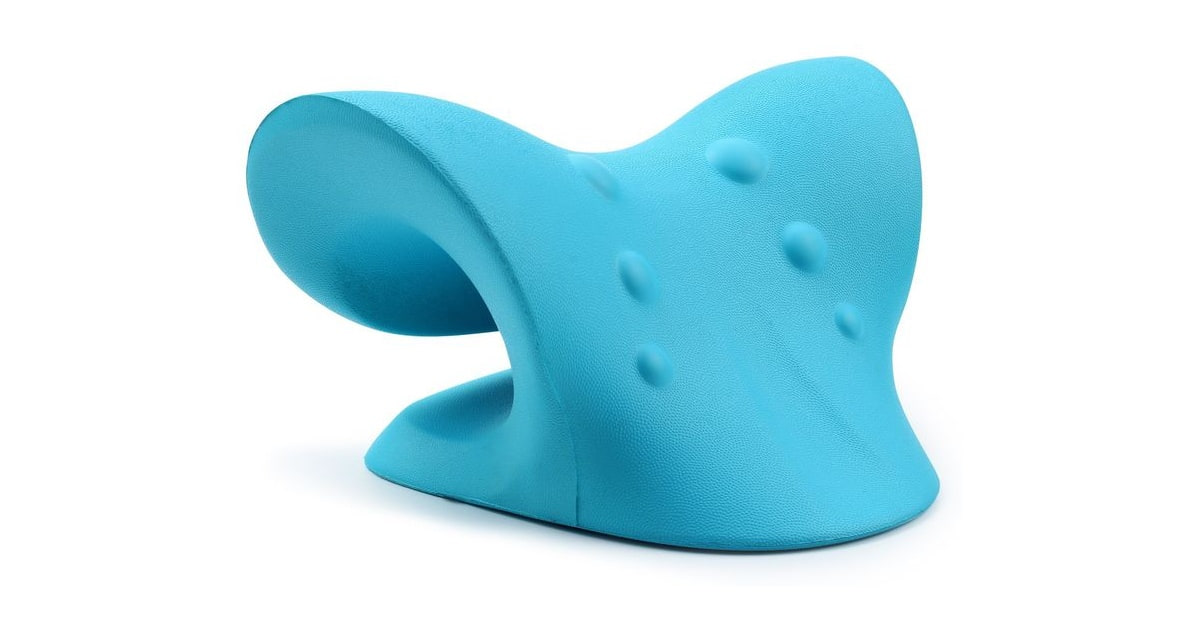
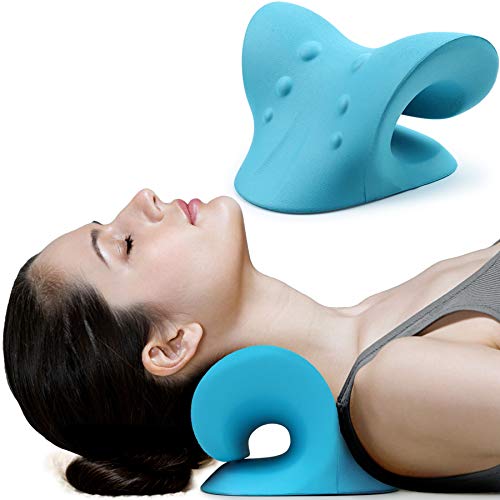
The RESTCLOUD is a dense foam curve you lie on for about ten minutes a day, on the floor or a yoga mat. It costs so little that trying it is basically free, and for desk-related stiffness that's often all the decompression you need.
$19.99fromAmazonTen minutes a day is a commitment you can keep. The curve matches the shape of the cervical spine, so when you lie back your head drops slightly and your neck opens up. That's the whole routine. You can do it while a podcast plays, and you're done before you've thought about quitting.
It works anywhere there's a hard flat surface. Home floor, office carpet, hotel room, yoga mat, outdoors. It weighs about two-thirds of a pound and takes up less room than a paperback, so it lives in a backpack without you noticing. That's a real advantage over anything door-mounted.
For tech neck, this is the right amount of intervention. If your problem is eight hours of forward head posture and not a nerve root, you don't need calibrated force. You need consistent, low-grade input in the opposite direction. This does that, and the listing is explicit that it's aimed at people who spend all day with their head bowed.
Nothing about it can go badly wrong. There's no inflation to overdo and no pump to crank. Force comes from your own head resting on foam, which caps the risk. If you're new to traction and nervous about it, this is where to start.
Flaws but not dealbreakers
The foam is genuinely hard at first. Owners routinely describe the first few uses as uncomfortable, and the maker says to expect one to three days of adjustment. Some people never warm to it. Sensitive necks in particular may find the pressure sharper than expected.
Don't sleep on it. The instructions say so directly, and the shape backs that up. This is a session device, not a pillow. If you want overnight traction, look at the Arc4life instead.
It's not treatment for anything serious. Passive body-weight force can't touch a diagnosed disc or nerve problem, and using it as your only intervention for one just delays the care you need.
Also great
Adjustable pull you can pack, if you have a standard door
Cervical Neck Traction Device for Home Use
This over-door hammock uses a spring scale to set traction anywhere from zero to about 40 pounds, so you can dial in a specific load and repeat it. It's the only portable option here that gives you a measurable number instead of whatever gravity provides.
$29.99fromAmazonThe spring scale is the reason to pick this over foam. A ratcheting mechanism and calibrated spring let you set force in increments and see what you're applying. Home traction guidance lands around 10 to 15 percent of body weight, so a 160-pound person is looking at roughly 16 to 24 pounds. This device can land there on purpose. A wedge can only hope.
It packs down to under a pound. Everything comes pre-assembled, and a door stopper anchors it without chewing up the frame. You can throw it in a suitcase and run the same routine in a hotel that you run at home, which is more than the ComforTrac can say.
The velvet harness is more comfortable than it sounds. Head slings are where cheap traction devices fail, usually with a strap digging into the jaw. The fabric cradle spreads the load across the occiput and chin without hard pressure points, which makes a full session bearable.
Chiropractors point people toward this style of device for a reason. Over-door traction has been the standard home stopgap for radiculopathy and disc symptoms for decades, largely because it's cheap and it applies real, measurable force. If your therapist wants you doing traction between appointments and a mechanical unit isn't in the budget, this fills the gap.
Flaws but not dealbreakers
Upright traction is the less-preferred position. Sitting or standing means your neck muscles are working, and they resist the pull. Supine devices sidestep that entirely, which is why clinics use them. You may need more force here to achieve the same effect.
Your door has to cooperate. It needs to be a standard height in the 74- to 82-inch range, hinged so it stays shut, and in a spot where nobody opens it mid-session. Odd door frames, sliding doors, and short basement doors are all dealbreakers.
It demands a real session. Ten to twenty minutes, seated, doing nothing else. That's the same ask as the ComforTrac without the comfort, and it's the reason many people drift back to a pillow-based approach.
Runner-upOn sale
A cooler, softer cervical pillow that side sleepers settle into
Elviros Cervical Memory Foam Pillows for Neck
The Elviros is a dual-height memory foam pillow with a shoulder cutout and an ice-silk cover, aimed at side sleepers who run warm. It supports your neck through the night at a medium-firm feel, and it costs well under what the molded-foam pillows here do.
$35.99fromAmazonList priceThe shoulder cutout is what makes side sleeping work. It gives your shoulder somewhere to go, so your head stays level with your spine instead of tipping down. That's the alignment problem side sleepers actually have, and a flat pillow can't solve it no matter how thick it is.
Two heights mean one pillow covers both positions. The higher 5.1-inch side suits back sleepers with cervical issues, and dual horns support the head and neck there. The lower side works when you're on your side. If you switch through the night, you have options without buying a second pillow.
The cooling cover is a real difference, not marketing. Memory foam traps heat, and a warm pillow wakes you up. The ice-silk fabric is Oeko-Tex certified, breathes better than standard cotton ticking, and comes off for the wash. If you've abandoned a memory foam pillow because it got hot, this addresses the reason.
Medium-firm is the setting most people want. This is the upgraded firmness version, tuned to sit between the soft pillows that give you nothing and the molded foam options that feel like a brick. The foam core is CertiPUR-US certified, with a slow 48- to 72-hour rebound that holds shape overnight.
Flaws but not dealbreakers
It smells for the first few days. New memory foam off-gasses, and the maker acknowledges the odor up front. Airing it out for three to five days before you sleep on it solves the problem, but you can't unbox it at bedtime and use it that night.
One size doesn't fit every frame. Broad-shouldered side sleepers may find the loft too low to keep the neck level, and there's no taller version to move to. Measure the gap between your ear and the mattress edge of your shoulder before you order.
It supports more than it corrects. This is an alignment pillow, not a traction device. If you want the mild sustained stretch that the Arc4life provides, the Elviros isn't going to get you there.
Who this is for
This guide is for people whose necks hurt from how they live: hours at a monitor, a phone held at chest height, a pillow that's been wrong for years. If that's you, a passive device is a reasonable thing to try, and the cheap ones cost little enough that the experiment is low-stakes. It's also for people whose physical therapist has recommended home traction and who want to know which device actually replicates what happens in the clinic.
It's not for self-treating a diagnosed problem. If you have arm numbness, tingling, or weakness, get a diagnosis first, because those symptoms have causes outside the neck entirely. Cervical traction is contraindicated for spinal instability, fractures, advanced osteoporosis, rheumatoid arthritis affecting the cervical spine, and some vascular conditions. Stop using any of these if pain, headaches, or neurological symptoms start or get worse. We cover home devices only, not clinic equipment, collars for injury immobilization, or anything requiring supervision.
How we picked
Traction type and force: We split the field between devices that let you set and repeat a specific load and those that apply only what your head weighs, and we held the clinical picks to the measurable standard. Match to condition: We checked each product's claims against published guidance on where traction helps, so a wedge for tech neck isn't judged against a unit for radiculopathy. Comfort over a full session: Padding, harness material and foam density decide whether you finish, so owner reports of sharp foam or a digging strap counted against a product. Fit and sizing: Cervical pillows go wrong at checkout more than in use, and we preferred clear measuring guidance or a forgiving shape. Setup and portability: Floor space, a suitable door and assembly time are all reasons a device ends up in a closet, so the less a product asks of you, the better it did.
Other cervical neck traction pillows worth considering
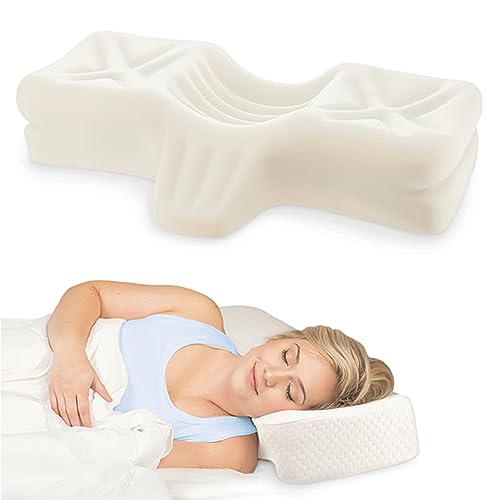
If you want a sleep pillow that holds its shape all night: The Therapeutica Ergonomic Cervical Pillow for Neck Pain ($98.44) — The Therapeutica is molded foam rather than viscoelastic, which means it doesn't slowly compress under your head over eight hours. A chiropractor designed the patented wedge-and-cradle shape: back sleepers settle into the occiput cradle, side sleepers get held by the raised side section. That consistency is the argument for it, and people managing whiplash recovery or cervical arthritis often prefer it to anything softer. Two catches, though. It's firm in a way that divides people sharply, and it comes in five sizes that you have to choose by measuring from the base of your neck to the bony tip of your shoulder. Order the wrong one and you'll be worse off than with your old pillow. It also costs about twice what the Elviros does.
If you want to target forward head posture specifically: The OrthoTrust Cervical Traction Wedge Pillow - Neck ($23.95) — The OrthoTrust is a dense foam wedge pitched squarely at cervical curvature — military neck, straight neck, forward head tilt — rather than general decompression. It's the same basic idea as the RESTCLOUD at a similar low price, with a removable 100% felt cover that machine-washes and breathable, hypoallergenic foam. Owners also use it for occiput release and the headache and jaw tension that travel with a stiff neck. The trade-offs are the same as any passive wedge: no measurable force, nothing to adjust, and wrong for a herniated disc that needs clinical traction. The firm foam can feel sharp on a sensitive neck for the first several uses, so ease into it rather than starting with a long session.
The competition
This is what our research surfaced across the main delivery methods, not a survey of everything sold. Cervical traction is a crowded category with a lot of near-identical foam wedges and door kits, and we focused on the products with the clearest documentation and the most owner feedback to draw on.
The Bargain Crusader Inflatable Cervical Neck Traction Air ($9.49) — The Bargain Crusader Inflatable Cervical Neck Traction collar is the simplest way into the category and the least capable thing here. You wrap it around your neck, squeeze the bulb, and the collar expands to push your head up off your shoulders. It's light enough to forget in a bag and sized to fit most adults, which makes it genuinely handy for a long flight or a stiff afternoon at a desk. But the inflation isn't calibrated, so the force is different every time and you have no idea what it is. Over-inflate and you can strain the muscles you were trying to loosen. Evidence for inflatable collars is also the thinnest in this guide compared with supine mechanical traction. Buy it for travel convenience, not for a disc problem.
How to use these safely
Start shorter than you think you need to. Active devices — the door hammock and the ComforTrac — are meant for ten- to twenty-minute sessions, and longer isn't better; tissue doesn't need more time, it needs consistency. If you're setting force yourself, work up gradually toward the 10 to 15 percent of body weight range that therapists use, and stop well below it if anything pinches. Foam wedges like the RESTCLOUD and OrthoTrust take a few days to feel normal, so give them short daily sessions rather than one long one. Sleep pillows need a week or two of adjustment, and alternating with your old pillow makes that easier. Wash removable covers regularly. And stop immediately, every time, if you get new headaches, tingling, or arm weakness.
Questions we get
Do cervical traction pillows actually work for chronic neck pain?
For the right problems, yes. Published guidance points to traction being most useful for radiculopathy from disc herniation or a narrowed nerve opening, and foam wedges and contoured pillows can meaningfully help with posture-related tightness. They do nothing for fractures, instability, or advanced joint disease. Think of them as a supplement to exercise and better desk setup, not a replacement for care you've been prescribed.
What's the difference between a traction device and an orthopedic cervical pillow?
A traction device applies a sustained separating force to open space between vertebrae — mechanically, by body weight, or by hanging from a door. An orthopedic pillow like the Elviros or Therapeutica just holds your neck in good alignment while you sleep without pulling on it. The Arc4life sits in between: its center channel creates a mild passive stretch that goes beyond ordinary contouring.
How much force do these actually apply?
Calibrated mechanical units land in the range therapists prescribe, and the door hammock's spring scale goes up to about 40 pounds. Passive foam wedges and sleep pillows apply only a fraction of your head's weight, with no way to adjust it. Home traction guidance is roughly 10 to 15 percent of body weight, which for most adults means somewhere between 8 and 20 pounds. Only the mechanical options can reliably hit that.
How long should a session last?
Ten to twenty minutes is the standard window for active devices, and going longer risks irritating tissue rather than helping it. The RESTCLOUD is built around a ten-minute daily routine. Sleep pillows are the exception — they work overnight at very low force, so six to eight hours is fine.
Can I use a traction pillow every night?
Passive sleep pillows are generally safe nightly if you don't have a contraindicated condition, since the force is low and self-limiting. Active mechanical devices shouldn't exceed about twenty minutes a day without guidance from your therapist. Stop with any device if you develop new pain, headaches, tingling, or arm weakness. Instability, fractures, advanced osteoporosis, and rheumatoid arthritis in the neck rule out traction entirely.
Which one is best for side sleepers?
The Elviros, mostly because of the shoulder cutout and the dual-height contour that keep your head level with your spine. The Therapeutica is the firmer, pricier alternative, with a raised side section that holds alignment without settling — just measure carefully, since it comes in five sizes. Side sleepers generally need more loft than back sleepers to avoid the neck bending sideways all night.
Why you should trust us
For this guide:
- We read manufacturer specifications and listing documentation for all eight products, comparing stated traction method, adjustability, materials and sizing.
- We reviewed published guidance from spine and physical therapy sources on cervical traction protocols, force ranges and contraindications.
- We looked at owner feedback themes across the lineup, particularly reports of adjustment periods, foam firmness, off-gassing and sizing problems.
- We read owner reviews on every listing, weighted toward the critical ones, because that is where the recurring failures show up.
- We have a systematic way of automatically fetching the latest prices, so the numbers on this page stay current.
- This is a research-focused guide, so the team may not own every product listed — though we often do own the top winners, which gives us extra context for the recommendations.
- We don't accept free products, and the retailer commission never changes which product we recommend.
Sources
Cervical Traction for Neck Pain, Spine-Health
Cervical Traction: How It Works and What to Expect, Verywell Health
Cervical Traction: Benefits, Risks, and How It's Done, Healthline
Traction for Low-Back Pain with or without Sciatica — Cochrane Review, Cochrane/PubMed
Assessment of Stresses in the Cervical Spine Caused by Posture and Position of the Head, Surgical Technology International
Amazon product listings and owner reviews for all 8 products
Manufacturer specification pages for each product
Some passages in this guide may be paraphrased with AI help. Prices are refreshed automatically.
More like this.
Continue exploring health reviews and recommendations.

The Best Memory Foam Pillows for Neck Pain
Wake up with a stiff neck often enough and you start blaming your mattress. Usually it's the pillow. Your neck has a natural curve, and a pillow's job is…

The Best Travel Pillows for Neck Support
A travel pillow has one job: keep your head from falling forward while you doze upright. That sounds simple, but the physics are brutal. The American…

The Best Tire Chains and Snow Traction Cables
Chains live in your trunk for years and matter for about twenty minutes. But those twenty minutes tend to happen on a dark shoulder, in falling snow, with…

The Best Bed Wedge Pillows for Acid Reflux
If you wake up at 2 a.m. with a burning throat, gravity is the simplest fix available to you. Lying flat lets stomach acid drift back into your esophagus,…

The Best Cooling Pillows for Hot Sleepers
If you wake up at 3 a.m. flipping your pillow to find the cool side, you already know the problem. Your head and neck sit against the same patch of fabric…

The Best Pillows for Side Sleepers
When you sleep on your side, your pillow has one job: fill the gap between your ear and the mattress so your neck stays level with your spine. That gap is…