The Best Hair Dryers for Fine Hair
Fine hair dries fast, which sounds like good news until you're standing in front of the mirror with a flat, staticky crown. The tricky part isn't power. It's control. Too much heat on thin strands and you get frizz, breakage and hair that won't hold a shape by lunchtime. Too little airflow and you're standing there for twenty minutes, which is its own kind of damage. What you want is a dryer that moves a lot of air without cooking anything.
Here's the honest part: no dryer repairs fine hair, and every one of them still puts heat on your head. Ionic, tourmaline, nano titanium, mineral complex — brands love these words, and the claims behind them are mostly unverifiable from a spec sheet. Weight figures on listings aren't reliable either. And the biggest variable isn't the machine at all. It's whether you keep the nozzle moving, use a heat protectant, and stop at damp instead of bone dry.
So we read manufacturer specs, published reviews and owner feedback across this lineup, looking for dryers that dry quickly at moderate heat and stay comfortable to hold. Automatic heat regulation matters most, because it takes your judgment out of the equation on a rushed morning. After that it comes down to airflow, adjustability and balance. We think that the Dyson Supersonic r™ is the best hair dryer for fine hair for most people, and that the ghd Helios is the one to buy if you want salon-style speed and shine for a lot less.
Everything we recommend

Heat control that doesn't rely on you remembering to dial it down

Salon-fast airflow and real shine, minus the smart heat cap

Pro power for less, if you keep the heat dialed down
Light, quick, and it saves the settings you like
At a glance
| Product | Wattage | Ionic Tech | Price | |
|---|---|---|---|---|
| Dyson Supersonic r™ Hair Dryer in CeramicTop pick | — | — | $467.99On sale |
| ghd Helios Professional Hair Dryer - AdvancedRunner-up | 1875W | Ionic Technology | $329 |
 | T3 - Cura Diffuser for Cura andAlso in lineup | — | — | $30 |
| BaBylissPRO Hair DryerBudget pick | 2000-Watt | Nano Titanium Ionic | $104.99On sale |
| Bio Ionic 10X Ultralight Speed Hair DryerAlso great | — | Ionic Technology | $270.75On sale |
How we picked
Heat management. We prioritized dryers that either regulate temperature automatically or give you enough discrete settings to lock in a moderate one. Anything with only two vague heat options was out.
Airflow over wattage. Spec sheets and published reviews consistently show that a fast, well-shaped airstream dries fine hair quicker than a hotter, sloppier one. We favored dryers that publish real airflow figures.
Weight and balance. We looked for dryers that stay comfortable through a full blowout, since owner feedback repeatedly links arm fatigue to holding the nozzle in one place for too long.
Controls and attachments. A cool shot, a concentrator and ideally a diffuser should come in the box. We checked what each listing actually includes versus what it expects you to buy separately.
Motor and longevity. Brushless and professional AC motors hold their airflow as they age, while cheap DC motors fade. We treated motor type as a proxy for how the dryer will behave in year three.
Top pickOn sale
Heat control that doesn't rely on you remembering to dial it down
Dyson Supersonic r™ Hair Dryer in Ceramic
This is Dyson's smaller, lighter Supersonic, with the motor moved into the handle so it sits in your palm instead of hanging off the end. It checks the airflow more than 20 times a second and adjusts to keep heat off your strands, which is exactly what fine hair needs.
$467.99fromAmazonList priceThe automatic heat control is the whole reason to buy this one. Dyson says its intelligent heat control measures airflow more than 20 times a second and adjusts to prevent heat damage. You don't set anything, and you can't forget. That matters on fine hair, because most damage happens on the mornings you're late and reach straight for the hottest setting. It's the rare feature that protects you from your own habits.
The shape genuinely changes how it feels to use. With the motor in your palm, the weight sits in your hand instead of dangling at the end of a handle. You can get the nozzle into the awkward spots — the nape, the back of the crown, the sections behind your ears — without twisting your wrist. Fine hair shows every missed section, so being able to reach everything easily is worth more than it sounds.
It dries fast without leaning on heat. The flow heater is built to warm the airstream evenly, and Dyson rates this as its fastest-drying dryer, with smoother results and less frizz. On fine hair, high-velocity air does most of the work anyway. Less time under the nozzle means less total heat exposure, which is the only kind of protection that actually compounds over months.
The attachments come set up for you. It ships as a six-piece set, and the attachments carry expert-set temperature and airflow presets, then remember the preferences you use most. That means you're not guessing which combination is safe for a rough-dry versus a finishing pass. For fine hair, the wider, gentler airflow options are the ones you'll reach for, and they're in the box rather than sold separately.
Flaws but not dealbreakers
It costs far more than anything else here. There's no way around that, and for someone who blow-dries once a week, the math is hard to justify. The case gets stronger if you style daily, color your hair, or have already done damage you're trying to stop. If none of that describes you, one of the other picks will get you most of the way.
The magnetic attachments are convenient right up until they aren't. Owners report them working loose or popping off mid-styling at full airflow, usually when the nozzle catches on hair. It's a small annoyance rather than a fault, but it's the kind of thing that interrupts a blowout at the worst moment.
Smart heat control isn't a substitute for a heat protectant. The dryer manages its own output; it can't do anything about friction, tension from a round brush, or the state your hair is already in. If your strands are color-treated or chemically processed, you still need prep products.
Runner-up
Salon-fast airflow and real shine, minus the smart heat cap
ghd Helios Professional Hair Dryer - Advanced
The Helios is an 1875W brushless dryer built around a fast, tightly focused stream of air that ghd rates at 75 mph. You get variable heat and speed, a cool shot and a nine-foot cord, in a body that stays light and unusually quiet for something this powerful.
$329fromAmazonAirflow does the drying here, and that's the point. The Aeroprecis system pushes a concentrated 75 mph stream through a contoured nozzle, so you can dry a section with air pressure rather than cranking the temperature. That's the technique every stylist recommends for fine hair. It also means you're finished sooner, which is the simplest way to cut total heat exposure.
It's noticeably quiet for a professional dryer. ghd built a bespoke acoustic system into the housing, and low noise is one of the things published reviews single out. If you dry your hair early while someone else is asleep, or you just hate the jet-engine racket, this is the pick that makes the routine bearable.
You keep full manual control. Variable temperature and power settings let you land on the medium-heat, high-speed combination that suits fine hair, and the cool shot locks the shape in at the end. Fine hair loses its set quickly as it cools on its own, so finishing with cold air is what makes a blowout hold past mid-morning.
The shine is the reason people rave about it. Ionic output is aimed at frizz and flyaways, and ghd claims 30% more shine. Fine hair reflects light well when the cuticle lies flat, and that's what this dryer is tuned to do. Owners consistently describe the finish as glossier than what they got from their previous dryer.
Flaws but not dealbreakers
There's no diffuser in the box. If your fine hair has any wave or curl, you'll want one, and it's a separate purchase. That's a real gap on a dryer at this level, and it changes the calculation if you're not styling straight.
Nothing stops you from overdoing the heat. Unlike the Dyson, the Helios trusts you. The settings are there to be used sensibly, and on fine hair that means resisting the top of the dial even when you're in a hurry.
It isn't dual voltage. Pack it for a trip abroad and it stays in the suitcase. If you travel internationally more than occasionally, that's a genuine limitation.
Budget pickOn sale
Pro power for less, if you keep the heat dialed down
BaBylissPRO Hair Dryer
This is the salon-counter staple: an Italian AC motor, six heat and speed combinations, a nano titanium ionic generator and a cold shot. It's built to run all day, and if you keep it off the hottest setting, it gives fine hair a proper blowout for a fraction of the Dyson's cost.
$104.99fromAmazonList priceThe motor is the reason this one keeps going. BaBylissPRO uses a long-life Italian AC motor, the same kind of part that stands up to back-to-back clients in a working salon. AC motors hold their output as they age instead of gradually weakening, which matters more than it seems — a dryer that loses airflow over time quietly pushes you toward higher heat to compensate.
Six heat and speed combinations let you find the setting fine hair actually wants. That's medium heat with high speed, and you need enough granularity to hit it rather than jumping between extremes. Cheaper dryers give you two vague options. Here you can dial in one combination, learn it, and use it every time.
The nano titanium ionic system is aimed squarely at static and flyaways. The titanium grill and true ionic generator work to close the cuticle as the hair dries, and fine hair is the texture that shows static worst — the halo of loose strands after a winter blowout. Owners routinely mention smoother, shinier results as the thing that keeps them using it.
A removable filter keeps it running properly. Fine hair sheds, and shed hair migrates straight to the intake. Being able to pop the filter off and clear it in a few seconds means the airflow stays where it should be, and a dryer with a clogged filter runs hotter and works harder.
Flaws but not dealbreakers
It's the heaviest pick here, and you'll feel it. A long blowout on shoulder-length hair turns into a forearm workout. Tired arms lead to holding the nozzle still in one spot, and that's exactly the habit that scorches fine strands.
Nothing protects you from the top setting. At full power this is a 2000-watt dryer, and the air coming out of the nozzle is far hotter than fine hair should ever meet. The fix is simple discipline: medium heat, high speed, keep it moving. But it's on you every single time.
It looks and sounds like the tool it is. The build is industrial rather than pretty, and it's loud next to the ghd. Nobody buys this one for the bathroom shelf.
Also greatOn sale
Light, quick, and it saves the settings you like
Bio Ionic 10X Ultralight Speed Hair Dryer
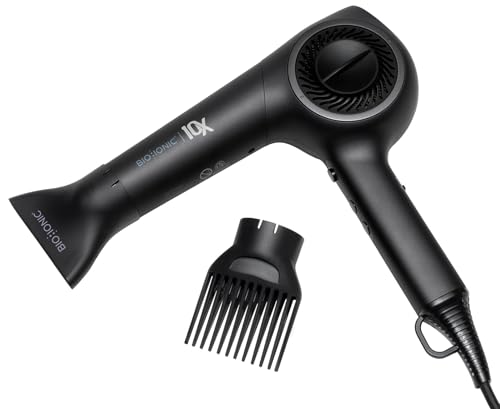
The 10X Ultralight pairs a brushless motor with three heat and three speed settings, plus a memory function that saves your combination for next time. It weighs about a pound, so it's easy to keep moving — and keeping the nozzle moving is the habit that spares fine hair.
$270.75fromAmazonList priceThe memory function is smarter than it sounds. It saves your preferred heat and speed so you're not starting from scratch, or from the highest setting, every morning. Fine hair does best on one narrow combination, and this is the only pick here that remembers it for you. Set it once at medium heat and high speed and stop thinking about it.
It's light enough to keep in constant motion. At roughly a pound, it doesn't fight you through a long blowout. That's not a spec-sheet nicety — a heavy dryer makes your arm drop and hover, and hovering is what concentrates heat on one patch of fine hair until it turns brittle.
Bio Ionic claims a full blowout in under ten minutes. The brushless motor is built for steady airflow and even heat rather than raw wattage, which is the right priority for thin strands. The mineral ion complex is aimed at holding moisture in the hair and cutting flyaways, and owners tend to describe the finish as soft rather than crispy.
The attachments cover the basics well. You get a concentrator for precision work near the roots and a comb attachment for detangling and stretching out curls, plus a built-in cool shot to set the style. For fine hair, that comb attachment is a quiet win — it lets you elongate texture without dragging a brush through fragile strands.
Flaws but not dealbreakers
There's no diffuser. If you're drying fine waves or curls, the concentrator and comb won't give you the soft, scrunched finish you're after, and you'll be hunting for a compatible attachment.
It's the least established name in this group. Availability comes and goes across major retailers, and there's less long-term owner feedback to lean on than there is for the salon workhorses here.
The memory feature cuts both ways. Save a setting that's too hot and the dryer will faithfully return to it every day. It's worth deliberately setting it low the first time and leaving it alone.
Who this is for
This guide is for anyone with fine, thin, color-treated or heat-stressed hair who blow-dries at home and wants to stop making things worse. If you style several times a week, automatic heat control is worth paying for, because it removes the one decision people get wrong when they're rushing. If you dry your hair occasionally and mostly air-dry the rest of the time, the mid-range picks here will serve you just as well, and you can put the difference toward a decent heat protectant and a soft microfiber towel.
We've stuck to full dryers you can buy and use on their own. Attachments that only fit one brand's platform aren't in scope, and neither are hot brushes, multi-stylers or hooded dryers — they solve different problems and deserve their own comparison. This also isn't a guide to fixing damage already done. A dryer can slow the cycle; it can't reverse it. If your hair is breaking mid-shaft, a conversation with a stylist will do more than a new appliance.
How we picked
We built the shortlist around five things. Heat management: either the dryer regulates its own temperature or it gives you enough settings to hold a safe one, because fine strands suffer most at the top of the dial. Airflow: we favored dryers that publish real velocity figures and use air pressure rather than heat to get the job done. Weight and balance: anything that tires your arm mid-blowout leads to holding the nozzle still, and that's where localized damage starts. Controls and attachments: a cool shot and a concentrator are non-negotiable, and a diffuser in the box counts in a dryer's favor. Motor: brushless and professional AC motors keep their airflow as they age, while budget DC motors quietly weaken and push you toward more heat.
The competition
This is what our research surfaced for fine hair, not a census of everything on the market. We looked at a small, deliberately chosen group of dryers that come up repeatedly in published reviews and owner discussion, and all four of the full-size dryers we examined earned a spot above — there wasn't a clear loser among them. The fifth listing in this group turned out to be an attachment rather than a dryer, so we've set it aside below.
Care and maintenance
Fine hair sheds, and every strand you lose heads for the air intake. Check the filter weekly and clear the lint — a clogged intake makes any dryer run hotter and work harder, which is the opposite of what you want. Wipe the housing when it's cool rather than spraying anything at it. Don't wrap the cord tightly around the body between uses; that's how the wire near the handle eventually frays, and it's the most common way a good dryer dies early. Store it somewhere dry rather than on a damp bathroom counter. And use a heat protectant every single time, even on a quick rough-dry — it's the easiest protection in this whole routine.
Questions we get
What heat setting should I use on fine hair?
Medium heat with the highest speed setting is the combination to aim for. High airflow dries fine hair with air pressure instead of thermal intensity, so you finish sooner and your strands take less punishment. Finish with a burst of cool air for about thirty seconds to set the shape. If your dryer regulates heat automatically, leave it alone rather than overriding it upward.
Is the Dyson really worth it for fine, thin hair?
If you blow-dry most days and your hair is fine, colored or already stressed, we think so. The automatic heat control is the only feature in this group that protects your hair on the mornings you're not paying attention, and that consistency is what adds up over months. If you dry your hair once a week, it's hard to justify, and the BaBylissPRO on medium heat will get you a very similar blowout.
Does blow-drying every day damage fine hair?
It can, but it doesn't have to. Some published research suggests that air drying isn't automatically gentler, particularly when it's paired with rough towel drying and long periods of wet hair being handled. Daily drying with an ionic dryer on moderate heat, a heat protectant and a nozzle you keep moving falls well within safe territory. The damage comes from maximum heat, skipped protectant, and holding the dryer still against your scalp.
Do ionic dryers actually help fine hair?
Yes, mainly by shortening the job. Negative ions help water leave the hair shaft faster, so you spend less time under heat, and they help the cuticle lie flat, which is what kills static and flyaways. Fine hair shows both effects more than thick hair does. Higher-output systems like the nano titanium generator in the BaBylissPRO tend to make a more obvious difference than a basic ionic coating.
What's the difference between ionic, tourmaline and ceramic?
They describe different parts of the same machine and are often combined. Ionic just means the dryer generates negative ions, with no promise about how many. Tourmaline is a mineral that throws off dense negative ions when heated, so it usually signals stronger ionic output. Ceramic refers to the heating element and means heat spreads evenly instead of forming hot spots — which is the part fine hair cares about most.
How light should a hair dryer be?
Light enough that your arm doesn't give out before your hair is dry. The listed weights on retail pages are unreliable, so treat them as rough guidance and pay more attention to where the weight sits. A dryer with the mass in your palm feels far better than a heavier-headed one on paper. If you find yourself resting the nozzle against a section to give your arm a break, the dryer is too heavy for you.
Why you should trust us
For this guide:
- We read the manufacturer spec sheets and full listing details for every dryer in this guide, and compared what each brand claims about airflow, heat regulation and ionic output.
- We reviewed published write-ups from beauty and consumer publications alongside guidance on how heat affects fine strands.
- We looked for recurring themes in owner feedback — attachments coming loose, arm fatigue, filters clogging — and let those patterns shape the flaws we call out.
- We read owner reviews on every listing, weighted toward the critical ones, because that is where the recurring failures show up.
- We have a systematic way of automatically fetching the latest prices, so the numbers on this page stay current.
- This is a research-focused guide, so the team may not own every product listed — though we often do own the top winners, which gives us extra context for the recommendations.
- We don't accept free products, and the retailer commission never changes which product we recommend.
Sources
Best Hair Dryers 2026 — Allure, Allure
Best Hair Dryers for Fine Hair — Byrdie, Byrdie
Best Hair Dryers — Good Housekeeping Institute, Good Housekeeping
Best Hair Dryers — Wirecutter (NYTimes), Wirecutter / The New York Times
Best Hair Dryers for Fine Hair — InStyle, InStyle
Best Hair Dryers — Cosmopolitan, Cosmopolitan
Hair Dryer Heat Damage Research — Healthline / Journal of Cosmetic Science, Healthline
Best Professional Hair Dryers — Glamour, Glamour
Amazon product listings and owner reviews for all 5 products
Manufacturer specification pages for each product
Some passages in this guide may be paraphrased with AI help. Prices are refreshed automatically.
More like this.
Continue exploring beauty reviews and recommendations.

The Best Travel Hair Dryers
Hotel hair dryers are a gamble. Some are bolted to the wall and push lukewarm air through a hose. Others don't exist at all, which you discover at the…

The Best Dry Shampoo for Oily Hair
Oily roots don't wait for wash day. If your scalp turns your hair flat and separated by lunchtime, you already know the routine: a topknot, a headband, or…

The Best Hair Dryers
A hair dryer is one of the few beauty tools you might reach for every single day, so small differences add up fast. Ten minutes saved on a weekday morning…

The Best Professional Hair Dryers for Home Use
A hair dryer is one of the few tools you might hold in your hand for 20 minutes a day, several days a week, for years. That changes what matters. Weight…

The Best Ionic Ceramic Hair Dryers
Most of us dry our hair on autopilot: head down, dryer on high, out the door. But the tool you grab every morning does more to your hair over a year than…

The Best Hair Dryers for Every Hair Type
A hair dryer is one of the few appliances you hold against your head, and you probably use it more days than not. That changes what matters. Weight,…