The Best Hair Straightening Brushes
A straightening brush is the tool you reach for when you want smooth hair in ten minutes instead of thirty. You brush, the heated teeth press each section flat, and you're done. There's no clamping, no section-by-section geometry, no scorched fingertips. That's why these have taken over so many bathroom drawers. Good Housekeeping's Beauty Lab testers rated straightening brushes highest for ease of use compared with traditional flat irons, especially for people styling at home. If flat irons intimidate you, this is the gentler way in.
No brush here gets you glass-straight hair on thick, coarse texture as quickly as a flat iron does. InStyle makes the same point. On dense or coarse hair, brushes need more passes and more minutes. Allure's stylists go further and say a brush shouldn't be your primary tool on tightly coiled hair, which does better with narrow adjustable plates. Ionic coatings genuinely help with frizz, but they don't rewrite your texture. And every one of these gets hot enough to damage hair if you're careless with it.
So think of a straightening brush as a smoothing tool with limits. It's very good at softening waves, calming frizz, reviving second-day hair, and getting a sleek finish without a learning curve. To sort the lineup, we read manufacturer specifications and feature listings, published reviews and roundups, and recurring themes in owner feedback. We think that the TYMO Ring is the best hair straightening brush for most people, and that the L'ANGE Le Vite is the one to buy if you have thicker hair or you travel abroad.
Everything we recommend

Fast, frizz-free everyday smoothing at a modest top temperature

More heat and a digital dial, plus a plug that travels

One fixed temperature, better heat control, higher cost

Digital heat for hair that is fine, fragile, or curly
Prices as of Oct 25, 6:48 AM PT · Details
At a glance
| Product | Max temperature | Auto shut-off | Price | |
|---|---|---|---|---|
| TYMO Ring Hair Straightener BrushTop pick | 350°F | 30 minutes | $49.99 |
| L'ANGE HAIR Le Vite Straightening BrushRunner-up | 450°F | — | $39 |
 | 2026 Upgraded Cordless Straightening BrushAlso in lineup | 392°F (200°C) | 20 minutes | Check price |
| Drybar The Brush Crush Heated Straightening BrushAlso great | 450°F / 230°C | 60 minutes | Check price |
| ghd Glide Smoothing Hot Air BrushUpgrade pick | 365°F | 60 minutes | $239 |
Prices as of Oct 25, 6:48 AM PT · Details
How we picked
Heat-up and range. We compared manufacturer heat-up claims and temperature ranges across every listing, favoring brushes ready in about a minute. We also wanted a top end matched to the hair type each brush targets, not just a big number.
Plates and bristles. We looked for ceramic or titanium heating surfaces rather than bare coated metal, since Cosmopolitan's coverage ties even heating to fewer hot spots. Tooth spacing mattered too, because denser teeth hold a section flat.
Frizz control. Ionic or negative-ion technology is close to standard now, and Byrdie's editors found it made a visible difference to flyaways in humid conditions. We treated its absence as a strike.
Safety design. The Strategist notes that a 30 to 60 minute auto shut-off is a category baseline, so we checked every listing for one. Anti-scald framing and cool-touch housing broke ties.
Fit for hair type. We weighed published reviews and owner feedback about how each brush behaves on fine, thick, and curly hair. Allure's stylist sources also shaped what we say about tightly coiled textures.
Top pick
Fast, frizz-free everyday smoothing at a modest top temperature
TYMO Ring Hair Straightener Brush
This is the brush most people should start with. TYMO says it reaches 350°F in about 20 seconds, the dense 3D teeth catch hair right at the root, and an ionic coating keeps flyaways down without pushing heat into damage territory.
$49.99fromAmazonPrices as of Oct 25, 6:48 AM PT · Details
A brush you don't have to plan around is a brush you'll actually use. TYMO says the Ring hits 350°F in roughly 20 seconds using PTC heating. That's fast enough to plug it in, clip your hair up, and start on the first section before the mirror fogs. Plenty of competing brushes take a minute or more to get there. On a rushed morning, that gap decides whether you style your hair or skip it.
The teeth are the other reason it works. TYMO uses a 3D tooth layout with about 0.09 inches of spacing, tighter than a typical bristle brush. Denser teeth hold more of each section, so hair lies flat against the heated surface instead of slipping between rows. The design also reaches closer to the root, which is exactly where most brushes give up and leave you with a soft bend.
The 350°F ceiling is a feature for most hair, not a shortfall. Dermatologists interviewed by Healthline recommend staying under 365°F to limit protein damage to the hair shaft. The Ring sits just below that line, so you can't accidentally cook fine or color-treated strands. The ionic coating helps on the other end, laying down a smoother finish and cutting the static that shows up the second you step outside in August.
Safety is handled sensibly here. A V-shaped flame-retardant frame runs along the outside of the teeth, so the parts your scalp and fingers brush against stay cooler than the heated surface. The brush shuts itself off after 30 minutes of sitting idle. That's shorter than the 60 minutes several brands use, which is either reassuring or mildly annoying, depending on how long you take to get dressed.
Flaws but not dealbreakers
The ceiling that protects fine hair works against coarse hair. If yours is thick, dense, or wiry, 350°F means more passes and more minutes, and you may still land on smooth rather than pin-straight. InStyle makes this point about brushes in general, and the Ring's modest top temperature makes it truer here than for the 450°F models further down.
You also don't get a dial. TYMO's listing describes a single heat level rather than a range, so there's no dropping down for a bleached front section or nudging up for the back of your head. And that 30-minute auto-off can catch you mid-style if you set the brush down to answer the door.
Runner-up
More heat and a digital dial, plus a plug that travels
L'ANGE HAIR Le Vite Straightening Brush
The Le Vite gives you an LCD screen, temperature control up to 450°F, and dual voltage for overseas outlets. It's the pick if your hair is thick enough to need real heat, or if your styling tools spend a lot of time in a suitcase.
$39fromAmazonPrices as of Oct 25, 6:48 AM PT · Details
The Le Vite gives you the actual number. An LCD interface lets you set a precise temperature up to 450°F, and that matters more than it sounds. Fine or color-treated hair can sit low, around the 300°F to 350°F range the research keeps pointing back to. Thick, coarse hair can go higher without any guessing. One brush can cover a household with three completely different hair types.
Dual voltage is what makes this the brush to pack. L'ANGE builds the Le Vite to run on overseas current, so it needs a plug adapter and not a converter. If you've ever killed a styling tool in a hotel room in Lisbon, you already know why that's worth the extra money. It's also a ceramic brush rather than a bare metal one, which spreads heat more evenly across each pass.
L'ANGE pairs that with double negative ion technology, which the brand says traps moisture and seals the cuticle. That lines up with what Byrdie's editors found more broadly, where ionic straightening brushes cut visible frizz and flyaways noticeably better than non-ionic models in humid conditions. On dry hair, L'ANGE says one slow pass from root to tip does the job. In practice you'll want a second pass near the crown.
This is one of the most widely bought brushes in the lineup, and owner feedback skews positive overall. L'ANGE doesn't publish a stated warranty term, but it does sell the Le Vite with a money-back guarantee, so there's a route out if your unit arrives underwhelming. That's worth knowing, because a heated tool either works well for years or fails early, and the first month tells you a lot.
Flaws but not dealbreakers
450°F is more heat than most hair ever needs, and the dial makes it easy to reach for. If your hair is fine, bleached, or already fragile, stay near the bottom of the range and treat the top end as something you'll never use. A high ceiling is only useful if you have the discipline to ignore it.
L'ANGE's listing doesn't state an auto shut-off, which stands out because The Strategist notes that a 30 to 60 minute shut-off is standard across the category. Assume you're responsible for unplugging it. The Le Vite is also a longer, chunkier brush than the TYMO, so short arms and small bathrooms will notice.
Upgrade pick
One fixed temperature, better heat control, higher cost
ghd Glide Smoothing Hot Air Brush
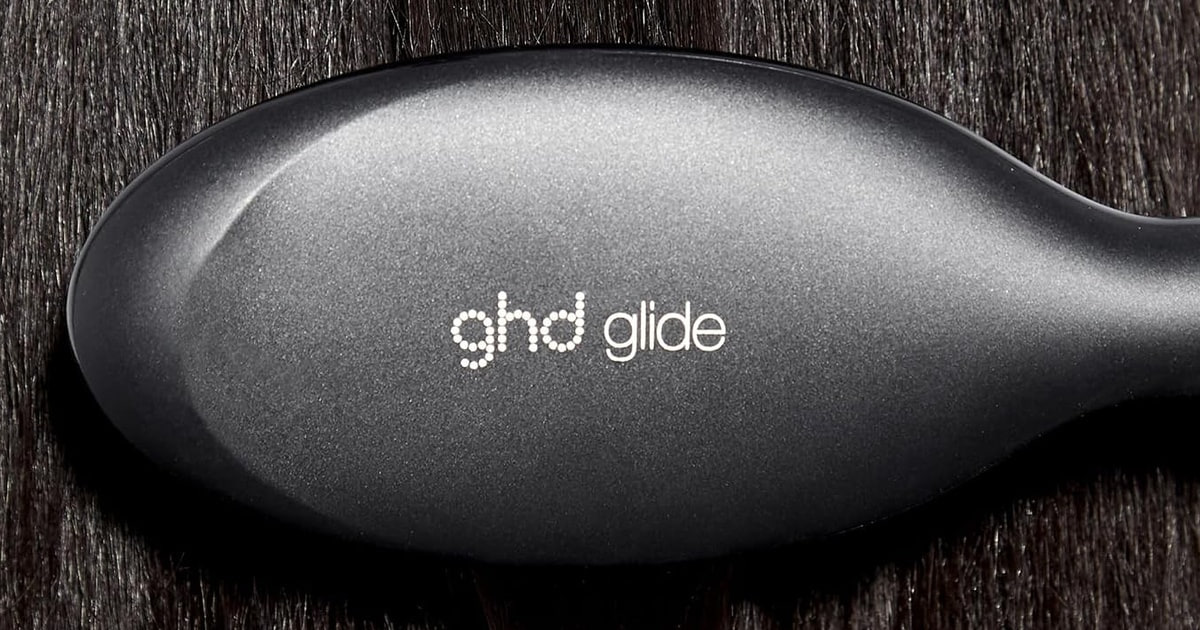
The ghd Glide holds a single 365°F setting and does not let you change it. That sounds restrictive until you notice it's the exact ceiling dermatologists recommend, and that ghd's ceramic heater is built to hold that number across the whole plate.
$239fromAmazonPrices as of Oct 25, 6:48 AM PT · Details
ghd made the temperature decision so you don't have to. The Glide holds 365°F and offers no other option. Healthline's dermatologist sources recommend keeping styling heat below 365°F to protect the protein structure of the hair shaft, so ghd has essentially designed to that limit. If you've ever cranked a tool higher out of impatience and regretted it a month later, a locked setting is a quiet kind of protection.
The heater is the part you're paying for. ghd uses its own ceramic heater technology, which the brand states holds a more consistent temperature across the plate than standard heating elements. Consistency is the thing cheap brushes get wrong. A hot spot in the middle of a plate means one part of a section takes more heat than the rest, and you only find out later when that stretch of hair looks dull.
The bristle layout is unusual and it earns its keep. ghd mixes high-density short and long bristles, so the brush grips a wide section and smooths it in one motion instead of nibbling at it. Combined with the ionizer and pearl ceramic coating, that makes it a strong second-day tool. You can knock down frizz and reshape yesterday's blowout without washing your hair again.
The details around the edges are salon details. There's a 9-foot swivel cord, which is longer than what most of these brushes give you and means you're not tethered to one spot at the mirror. The housing is cool-touch. It drops into a sleep mode after 60 minutes of inactivity. None of that changes how your hair looks, but it's the stuff you notice every single morning.
Flaws but not dealbreakers
One temperature is genuinely limiting for some people. If your hair is coarse or very dense, 365°F may mean several more passes than a 450°F brush needs, and repeated passes carry their own cost. There's no way to borrow more heat for the stubborn section at the back.
This is the most expensive brush in the guide by a wide margin, and the research is fairly consistent about what that buys. Premium tools tend to justify themselves through longevity and steadier heat rather than a dramatically different result on day one. If you straighten your hair twice a month, you probably won't feel the difference.
It's also a big head. At roughly 3.9 by 3.7 inches across the brush end, it doesn't tuck neatly into a carry-on, and it's a slightly awkward tool for short hair or fine detail work near the hairline.
Also great
Digital heat for hair that is fine, fragile, or curly
Drybar The Brush Crush Heated Straightening Brush
Drybar built The Brush Crush for the whole spread of hair types that walks into a salon, from curly to fragile. Digital control up to 450°F and a generous 60-minute shut-off make it a flexible pick if one brush has to serve everyone in the house.
Check priceatAmazonPrices as of Oct 25, 6:48 AM PT · Details
Drybar's whole business is smoothing other people's hair, and The Brush Crush reflects that. The company says it works across hair types from curly to fragile, which is a wider claim than most brushes make. The practical version of that claim is the temperature range. You can run it cool for someone with fine, color-treated hair and hot for someone with thick waves, using the same tool on the same morning.
The digital control is what makes it worth the money over a basic brush. You set a number on the display, up to 450°F or 230°C, instead of choosing between vague low and high buttons. Cosmopolitan's beauty tool coverage keeps returning to even heating as the thing that separates good brushes from cheap ones, and a readable target temperature is the first step toward that.
Ionic technology handles the finish. Drybar says it seals the cuticle to cut frizz and add shine, which matches Byrdie's broader finding that ionic brushes visibly outperform non-ionic ones once humidity gets involved. The safety side is the most forgiving here too. Auto shut-off kicks in after 60 minutes rather than 20 or 30, so the brush won't quit on you while you're still working through the back.
Flaws but not dealbreakers
It costs considerably more than the TYMO without giving you a fundamentally different result on hair that isn't especially difficult. Real Simple's panel found budget brushes matched premium ones for day-to-day results, with durability as the real long-term separator. Buy this for the flexibility and the brand's track record, not for a dramatic upgrade in smoothness.
Drybar's listing doesn't mention dual voltage, so treat it as a domestic tool and leave it home for international trips. And as with any 450°F brush, the top of the range is a trap for fine or bleached hair. Set it once, low, and resist the dial.
Who this is for
Buy a straightening brush if flat irons feel fiddly, if you want your morning routine shorter, or if your goal is smooth and polished rather than sheet-of-glass straight. They're forgiving. You hold a brush the way you already hold a brush, and there's no clamp to leave a crease. They're also good at partial jobs, like calming frizz around your face or reshaping second-day hair without a full wash and style.
Skip one if your hair is tightly coiled and you want a lasting straight result, since Allure's stylist sources point that texture toward flat irons with narrow adjustable plates. Skip it too if your hair is very coarse and you're in a hurry, because InStyle is right that brushes take longer there. This guide covers heated straightening brushes only. Blow-dryer brushes, flat irons, and curling tools are different categories with different trade-offs, and we've kept them out.
How we picked
Heat-up time: we favored brushes that manufacturers rate at roughly a minute or less, because a slow tool is a tool you skip. Temperature range: we wanted settings that suit the hair type each brush targets, with a low end near 300°F for fine or color-treated hair and a high end reserved for genuinely coarse texture. Plates and bristles: ceramic or titanium surfaces and denser tooth spacing beat bare coated metal, since even heat means fewer hot spots. Frizz control: ionic technology is standard now and it earns its place, especially in humid weather. Safety: an auto shut-off between 30 and 60 minutes, plus anti-scald framing, was close to a requirement. Hair type fit: we read published reviews and owner feedback for how each brush behaves on fine, thick, and curly hair rather than trusting the marketing copy.
The competition
This is what our research turned up, not everything on the market. Heated brushes launch constantly, plenty of them are the same factory design under a different name, and a good one can go years without appearing in an editorial roundup. Here's the brush we looked at that didn't make the cut.
The 2026 Upgraded Cordless Straightening Brush — The Notegala Go Brush Pro is the cordless option, and it's a genuinely interesting one. A 4000mAh battery charges over USB-C from a power bank or a car charger, MCH heating gets it warm quickly, and you get three settings at 320°F, 356°F, and 392°F. Notegala calls it TSA-friendly and it's slim enough for a backpack. What holds it back is evidence. Almost no owner feedback exists yet, and cordless heated tools historically trade sustained heat for portability, which shows up as fading performance halfway through a head of thick hair. The 20-minute auto shut-off is also the shortest here. If you touch up your hair in a car, a dorm, or a locker room, it's worth a look. For your main brush at home, a corded model is the safer bet.
Care and heat safety
Use a heat protectant every time, and use these brushes on dry hair only. None of them are wet-to-dry tools, and running a 400°F plate over damp hair boils water inside the strand. Start lower than you think you need. If fine or color-treated hair looks smooth at 320°F, there's no reason to climb higher. Let the brush cool completely before you clean it, then wipe the teeth and plate with a barely damp cloth to lift product buildup, which is what makes a brush drag and snag. Don't wrap the cord tightly around the handle, since that's how the wire fails at the base. And don't count on auto shut-off as your safety net. Unplug it.
Questions we get
Are hair straightening brushes actually good for your hair?
They're heat tools, so they carry the same risk any heat tool does. The upside is that most brushes make a single pass at a moderate temperature, rather than clamping a section repeatedly the way a flat iron can tempt you to. Dermatologists interviewed by Healthline suggest staying below 365°F to limit protein damage, which several brushes here respect by design. Use a heat protectant and the lowest setting that works.
How is a straightening brush different from a flat iron?
A flat iron clamps hair between two hot plates, which is how it gets hair pin-straight. A brush presses hair against a single heated surface as you comb through, so it smooths and softens instead. Good Housekeeping's testers rated brushes as much easier to use, especially for beginners. The trade-off is that brushes rarely match a flat iron's sleekness on coarse hair.
Can you use a straightening brush on curly or coily hair?
On loose to medium curls, yes, and a brush is often kinder than a flat iron because you're not clamping. On tightly coiled hair, Allure's stylist sources recommend against making a brush your primary tool, since narrow adjustable flat iron plates give better control at the root. A brush can still work well for stretching curls or smoothing a blowout on textured hair.
What temperature should I use on color-treated hair?
Stay in the 300°F to 350°F range and work slowly rather than hot. Color-treated and bleached hair has already had its cuticle opened, so it takes damage faster than virgin hair does. That's a good argument for a brush with a readable digital display, so you know your exact setting instead of guessing between low and high.
How long does it take to straighten hair with a heated brush?
For fine to medium hair at shoulder length, plan on roughly five to ten minutes once the brush is hot. Thick or coarse hair takes longer, and InStyle notes that brushes generally need more time than flat irons on those textures. Most of these brushes are ready to use in under a minute, so heat-up time barely factors in.
Can I bring a straightening brush on a plane?
Corded straightening brushes are fine in carry-on or checked bags. Cordless models with built-in lithium batteries need to go in your carry-on, not checked luggage, and airline battery limits apply. If you're traveling internationally, check whether your brush is dual voltage before you plug it in, because a single-voltage tool on 220V current usually ends badly.
Why you should trust us
For this guide:
- We read the manufacturer specifications and full feature listings for every brush in this guide, including heating technology, temperature ranges, bristle design, and auto shut-off behavior.
- We compared published reviews and category roundups from Good Housekeeping, Byrdie, InStyle, Allure, Cosmopolitan, Real Simple, Women's Health, Healthline, and The Strategist.
- We read recurring themes in owner feedback for each product to identify durability complaints and hair-type mismatches that specifications never mention.
- We read owner reviews on every listing, weighted toward the critical ones, because that is where the recurring failures show up.
- We have a systematic way of automatically fetching the latest prices, so the numbers on this page stay current.
- This is a research-focused guide, so the team may not own every product listed — though we often do own the top winners, which gives us extra context for the recommendations.
- We don't accept free products, and the retailer commission never changes which product we recommend.
Sources
Best Hair Straightening Brushes - Good Housekeeping Institute Beauty Lab, Good Housekeeping
The Best Hair Straightening Brushes, According to Stylists, Allure
The Strategist: Best Hair Straightening Brushes, New York Magazine - The Strategist
We Tested the Best Hair Straightening Brushes of the Year, Byrdie
Best Straightening Brushes, Tested by Editors, Real Simple
Straightening Brush vs. Flat Iron: What's the Difference?, InStyle
The Best Hot Brushes for Every Hair Type, Women's Health
TYMO Ring Straightening Brush Review, TYMO (manufacturer)
L'ANGE Hair Le Vite Straightening Brush Product Specs, L'ANGE Hair (manufacturer)
ghd Glide Hot Brush Official Specifications, ghd (manufacturer)
Is a Straightening Brush Bad for Your Hair? Dermatologists Weigh In, Healthline
Best Beauty Tools 2026: Hair Straightening Brushes Tested, Cosmopolitan
Amazon product listings and owner reviews for all 5 products
Manufacturer specification pages for each product
Some passages in this guide may be paraphrased with AI help.
Product prices and availability are accurate as of the date/time indicated and are subject to change. Any price and availability information displayed on Amazon.com at the time of purchase will apply to the purchase of this product.
More like this.
Continue exploring beauty reviews and recommendations.

The Best Hair Straighteners and Flat Irons
A flat iron is one of the few beauty tools you press directly against your hair, at temperature, over and over. So the things that matter are boring ones.…

The Best Hot Air Brushes
A hot air brush does two jobs in one pass. It dries your hair and shapes it at the same time, which is why a blowout that used to need a dryer, a round…

The Best Makeup Brush Sets
A good brush does the boring work for you. It picks up the right amount of foundation, spreads it evenly, and doesn't leave a streak along your jaw. A bad…

The Best Professional Makeup Brush Sets
Good brushes are the difference between makeup that looks applied and makeup that looks like skin. A dense, well-shaped foundation brush pushes product…

The Best Facial Cleansing Brushes
A facial cleansing brush does one small job, and it does it better than your hands. It moves cleanser around your face with a steady, even motion,…

The Best Car Interior Detailing Brushes
Dust settles in places a towel can't reach. It packs into vent fins, collects along the seam where your seat cushion meets the bolster, and builds up in…