The Best Heavy-Duty Toilet Plungers
Nobody shops for a plunger on a good day. You're buying one because something went wrong, or because you finally looked at the sad rubber dome under the sink and realized it has never actually worked. The tool matters more than people think. A toilet drain curves, so a plunger has to seat inside that opening and push water — not air — into the clog. Get the seal right and most household blockages clear in a few strokes. Get it wrong and you'll just splash.
Here's the honest part: no plunger clears everything. A compacted plug of wipes, a toy somebody flushed, or a blockage past the trap will resist all of these, and that's when you need a toilet auger. Rubber hardens as it ages, so every plunger here gets worse at sealing over the years. Every caddy eventually needs a rinse, too. A plunger buys you the easy wins, which is most of them. It doesn't replace a plumber.
So the choice comes down to seal, force, and where you're willing to keep the thing. Most people want something that works on the first try and doesn't leave a wet ring on the tile. Some of you want raw pushing power and don't care how it looks. We think that the OXO Good Grips Toilet Plunger with Holder and Drip Tray is the best heavy-duty toilet plunger for most people, and that the Korky BeehiveMAX is the one to buy if you'd rather put your money into clearing power than into a caddy.
Everything we recommend

Hygienic storage and a solid seal for everyday clogs

Strong clearing on any bowl shape, if you skip the caddy

A plunger that hides in plain sight, at a real premium

The one to grab when a normal plunger hasn't budged it
At a glance
| Product | Plunger Head Type | Includes Holder/Caddy | Price | |
|---|---|---|---|---|
| OXO Good Grips Toilet Plunger with HolderTop pick | — | — | $29.99 |
| Korky BeehiveMAX Heavy Duty Toilet Plunger -Budget pick | Beehive Shape | — | $15.98 |
| simplehuman Toilet Plunger with Holder SetUpgrade pick | Narrow Flange | Holder Set | $39.99 |
| NEIKO 60166A Toilet Plunger with Patented All-AngleAlso great | 4-Step Suction Cup | — | $10.69On sale |
 | MR.SIGA Toilet Plunger and Bowl Brush ComboAlso consider | Suction Cup | 2-Compartment Holder | $23.99 |
 | G.T. Water ProductsAlso in lineup | 4-Cup Design | — | $37.44 |
 | LOVLOY Toilet Plunger with HolderAlso consider | Double-Layer Design | — | $15.99 |
 | Casabella Bowl Brush & Plunger Combo -Also in lineup | Extended Flange Cup | Included Caddy | $18.99On sale |
How we picked
Seal quality. We compared cup and flange geometry across every listing, since a partial seal wastes almost all the force you put in. Designs that manufacturers and reviewers describe as seating inside the trapway on both round and elongated bowls moved to the top.
Force per stroke. Published comparisons consistently rank multi-cup and accordion designs well above simple domes for compacted clogs. That gap is what separates the everyday picks here from the ones worth keeping for emergencies.
Handle and leverage. Reviews tie T-bar and flat-top grips to better downward control and less splashback than straight rods. We also looked at handle length, because a short handle puts your hands uncomfortably close to the water.
Storage and hygiene. We favored caddies that vent or drain over sealed ones, since owner feedback about odor almost always traces back to trapped water. Auto-closing and magnetic covers earned extra credit for keeping drips off the floor.
Build and longevity. Rubber hardens and stops sealing, so we weighed material quality and looked for repeated owner complaints about cracking cups, loose handle joints, or flimsy caddies. Metal and reinforced shafts were a plus.
Top pick
Hygienic storage and a solid seal for everyday clogs
OXO Good Grips Toilet Plunger with Holder
The OXO seals well in round and elongated bowls, and its canister pops open when you lift the handle, so you never touch the wet cup or rest it on the floor. The vented tray lets drips dry out instead of turning into a smell.
$29.99fromAmazonThe canister handles the part everyone hates. Plunging takes ten seconds. The awkward part is the thirty seconds after, when you're holding a dripping rubber cup and looking for somewhere to put it. OXO's canister opens on its own when you lift the plunger and shuts when you drop it back in. You don't touch the cup, and the mess stays inside.
The flat-top handle gives you a place to push from. A round rod makes you grip and shove at the same time, which is where a lot of splashback starts. With a flat top you plant your palm and drive straight down. That's more control with less wobble, and published reviews keep calling out handle shape as one of the biggest differences between plungers that feel effective and ones that don't.
The flange seals both common bowl shapes. OXO's specs say it works on all toilets, including low-flush models, and reviewers describe a clean seat in round and elongated bowls without hunting for the right angle. For the clogs most homes actually get — too much paper, slow buildup, a partial blockage — that seal is all you need. Owners report a few firm strokes usually does it.
The vented drip tray is a small thing you'll appreciate for years. Sealed caddies trap water, and trapped water smells. The slots in OXO's tray let residue evaporate instead of pooling under the cup. If you've ever opened a plunger holder and immediately regretted it, this is the detail worth paying for.
Flaws but not dealbreakers
It's a flange plunger, so it has a ceiling. Multi-cup and accordion designs move far more water per stroke, and published comparisons put that gap at several times over. If your toilet clogs hard and often, the OXO will make you work for it. Keep something like the NEIKO around for the bad days.
The canister eats floor space. Its base is wider than a slim caddy, which matters in a small bathroom where the gap between the toilet and the vanity is measured in inches. Owners also mention the canister needs an occasional rinse — it hides the mess, it doesn't erase it.
You're paying for the storage, not the power. Strip away the canister and tray and this is a good flange plunger, not an extraordinary one. Cheaper picks here clear the same everyday clogs. If your plunger lives in a closet or a garage anyway, spend less.
Budget pick
Strong clearing on any bowl shape, if you skip the caddy
Korky BeehiveMAX Heavy Duty Toilet Plunger -
The BeehiveMAX's stacked cup squeezes down in stages, so it seals in old round bowls and modern low-flow ones without you repositioning. The telescoping handle collapses to fit under a vanity, which makes it a smart choice for renters and cramped bathrooms.
$15.98fromAmazonThe beehive shape fits bowls that fight other plungers. Older toilets and newer high-efficiency ones have different drain openings, and a standard oblong flange tends to favor one or the other. Korky stacks the rubber into tapered rings, so something in that stack seats no matter what your bowl looks like. You don't spend the first minute wiggling around for a seal.
It builds pressure in stages instead of all at once. Each ring compresses in turn, so force ramps up as you push rather than firing off in one burst. Owners describe less effort per stroke and less water leaping back at them. Korky also says the rubber won't mark up the bowl, which matters on lighter porcelain.
The collapsing handle solves the real storage problem. Most plungers are a stick you can't hide. This one telescopes down short enough to slide under a sink or into a vanity cabinet, then extends when you need the leverage. If you move often, or your bathroom has no spare corner, that beats a fancy caddy.
The T-handle keeps your grip honest. You wrap both hands over the bar and push down through your shoulders instead of your wrists. It's a more natural motion than choking up on a straight rod, and it keeps your hands higher above the water than the short-handled options here.
Flaws but not dealbreakers
There's no caddy at all. You get a plunger and nothing to put it in. That means a bucket, a bag, or a holder you buy separately, and in the meantime a wet cup sitting somewhere on your floor. For some people that alone rules it out.
The telescoping joint is the part that ages. Owners report the handle working loose over time under hard, repeated use, and a handle that slips mid-stroke is both annoying and messy. Check the joint now and then and snug it back up. That's upkeep the fixed-handle picks don't ask for.
Upgrade pick
A plunger that hides in plain sight, at a real premium
simplehuman Toilet Plunger with Holder Set
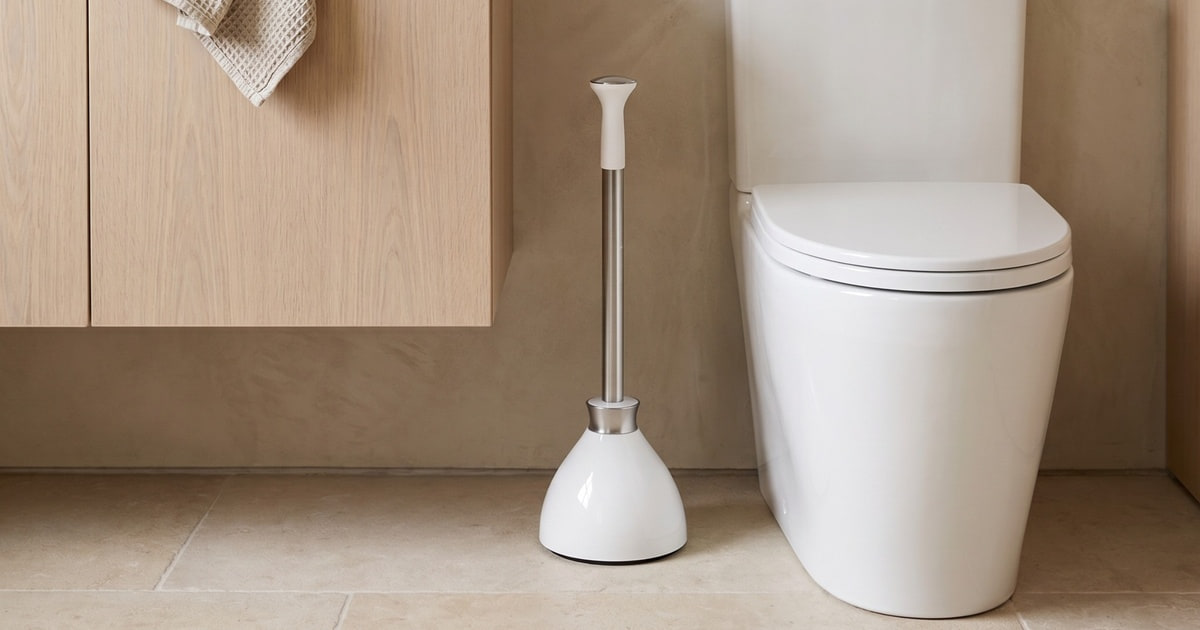
The simplehuman disappears into a low dome, and a magnetic collar locks the cover to the steel rod so it travels to the bowl with you. Its narrow flange is built for the tighter drain openings on modern low-flow toilets.
$39.99fromAmazonThe magnetic collar stops drips where they actually happen. Most holders catch drips while the plunger sits still. The mess usually happens in the three steps between the toilet and the caddy. simplehuman's cover clamps to the stainless rod and rides along with the plunger, so whatever's dripping lands inside the cover instead of on your tile.
It's the only one here that doesn't read as a plunger. The dome sits low and hides the head completely, with a large rear opening you reach into to pull the tool out. In a guest bathroom or a fresh renovation, that's the whole point. Nobody notices it, which is exactly what you want.
The narrow flange is aimed at modern low-flow bowls. Newer toilets tend to have tighter drain openings, and a slim flange seats deeper in them than a wide one does. If your toilet is recent, this is a good match. The stainless rod also won't rust where the water hits it.
The build quality shows in the details you touch. The rod is steel rather than coated plastic, the cover detaches without a fight, and the finish is meant to sit next to nicer fixtures. Owners who buy simplehuman's other bathroom pieces like that this one matches instead of clashing.
Flaws but not dealbreakers
It's the most expensive plunger here, and the money buys looks. Clearing power is fine, not exceptional. On any reasonably modern toilet, the Korky matches it for a fraction of the outlay. You're paying for the dome, the finish, and the magnet.
That narrow flange struggles on older toilets. Wide-opening bowls from before the low-flow era give the slim profile nothing to grip, and the seal turns sloppy. If your house still has its original fixtures, buy the Korky or the NEIKO instead.
Also greatOn sale
The one to grab when a normal plunger hasn't budged it
NEIKO 60166A Toilet Plunger with Patented All-Angle
The NEIKO's cup steps down in four stages, so it wedges into almost any drain opening and drives water straight at the blockage. The aluminum handle doesn't flex when you lean on it, which is what you want after a standard flange has already failed.
$10.69fromAmazonList priceThe stepped cup seats deeper than a standard flange. Each ring is narrower than the one above it, so the cup keeps going until something matches your drain. Less pressure leaks out around a partial seal and more of it goes where the clog is. Reviews note the seal holds even when you come at the bowl off-center.
It won't flip inside out. Cheap flange plungers invert under hard pushing, and once that happens you're fighting the tool instead of the clog. NEIKO's cup geometry resists it, and owners who plunge often tend to mention exactly that. It's a big part of why this one survives aggressive use.
The aluminum handle stays rigid and stays clean. It's light, so fifteen strokes won't wear out your arms, but it doesn't bend when you throw your weight into it. The cup has a smooth interior with no ridges to trap residue, and there's a peg hole in the handle if you'd rather hang it in a closet.
It's the closest thing here to what a plumber carries. Published reviews and plumbing pros both point to multi-cup and accordion designs for compacted blockages, because they shove much more water per stroke than a simple dome. When paper and waste have packed into a solid plug, that extra force is the difference.
Flaws but not dealbreakers
There's no caddy and no attempt at one. It's a bare tool with a hanging hole. If you want it out of sight, you're finding your own bucket or hook. In a small bathroom with nowhere to hang anything, that's a real problem.
It looks like what it is. Black rubber on a bare metal stick, standing next to your toilet. Nobody's putting this in a guest bathroom. It's also more plunger than routine clogs need — for everyday paper blockages, the OXO or Korky is faster and less dramatic.
Who this is for
Buy one of these if the plunger in your bathroom is a plain red dome with no flange, or if you don't own one at all. That dome is a sink tool. On a toilet it slides off the curved drain opening and barely builds pressure, so you end up pushing water around the bowl and getting nowhere. Anyone with an older toilet, small kids, or a house that clogs more than it should will also feel the difference from a properly shaped flange or multi-cup design.
This guide covers toilet plungers, including two sets that pair a plunger with a bowl brush. It doesn't cover toilet augers or drain snakes, which are what you reach for after a plunger has failed, and it doesn't cover chemical drain cleaners — those do little against a solid clog and can chew on rubber toilet parts. If your plunger still seals cleanly and clears a clog in a handful of strokes, keep it. Replace it when the rubber goes stiff.
How we picked
We judged every plunger here on five things. Seal: the cup has to seat inside the trapway opening, because a partial seal turns your effort into splashing. Force: multi-cup and accordion designs push far more water per stroke than a plain dome, which is what a compacted clog needs. Handle: T-bar and flat-top grips give you controlled downward force and keep your hands well above the water, while short rods do neither. Storage: a vented tray or a drip-free cover keeps water off your floor and odor out of the caddy. Durability: rubber hardens with age, so material quality and a shaft that won't flex or work loose decide how many years you get.
Other heavy-duty toilet plungers worth considering
If you want a plunger and a bowl brush in one buy: The MR.SIGA Toilet Plunger and Bowl Brush Combo ($23.99) — The MR.SIGA combo pairs a commercial-grade rubber cup with a dense-bristle brush in a two-compartment caddy, so you get both bathroom tools and one floor footprint instead of two. The cup pulls strong suction on round and elongated bowls, and owners say the nylon bristles keep their shape and reach under the rim rather than splaying on the first scrub. The trade-off is width: that shared caddy is bulkier than any single-tool holder here, which is a problem in a narrow bathroom. And if you already own a brush you like, you're buying half a product you don't need.
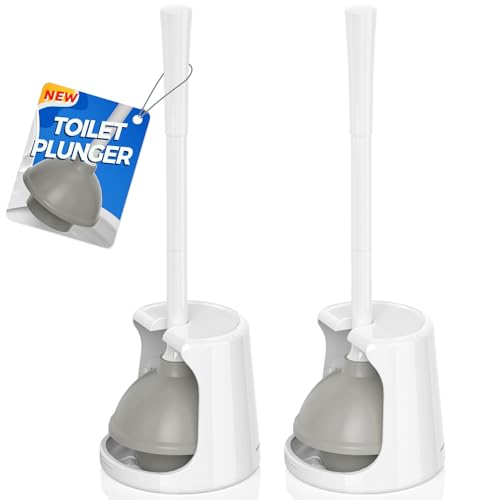
If you want a plunger in every bathroom: The LOVLOY Toilet Plunger with Holder ($15.99) — The LOVLOY set comes as two full-size plungers with two vented holders, which is the easy answer for a two-bath house or anyone who wants a spare stashed away. Its double-layer rubber gives you a second sealing surface if the outer one doesn't sit flush, and the long handle keeps your hands well clear of splashback. The base flips over for a lower profile. What you give up is heft — the plastic and rubber feel lighter than the OXO or the NEIKO, and the cup is sized around a standard drain opening, so an unusual bowl may not seal cleanly. Fine for occasional clogs, less so for weekly ones.
The competition
These are the other plungers our research turned up, not a survey of everything sold. Each one lost to a pick for a specific reason, but a couple of them make sense if your situation matches.
The Casabella Bowl Brush & Plunger Combo - ($18.99) — The Casabella combo is the budget answer to the MR.SIGA set: an extended-flange plunger and a silicone bowl brush sharing one discreet caddy. The long flange reaches further into the trapway than a short one, and the silicone brush is gentler on porcelain than stiff nylon, which is worth something on an older or refinished bowl. It lost on two counts. The handles are shorter than our picks', so hard plunging puts your grip closer to the water, and the overall construction is lighter than the MR.SIGA's. Choose it if you want a complete set cheaply and your clogs are the routine kind.
The G.T. Water Products ($37.44) — The G.T. Water Master Plunger Shorty uses a four-cup displacement design that pushes roughly double the water of a standard rubber dome, and it ships as a pair, so you can stock a bathroom and a kitchen at once. It's made in the USA and small enough for an RV or a packed utility closet. The short handle is what kept it out of the picks: plunging a toilet hard with a compact shaft puts your hands unpleasantly close to the bowl, and there's no caddy to store it in. It's a good go-bag tool for a contractor or landlord, and a mediocre one for a family bathroom.
Plunging technique and upkeep
Fill the bowl until the cup is submerged before you start — a dry plunger pushes air, and air doesn't move clogs. Seat the flange slowly and press down gently on the first stroke to burp out the trapped air. Then go short, firm, and controlled, and pull up sharply on the last one. Give it fifteen strokes before you decide it isn't working. Afterward, rinse the cup, wipe it down, and let it dry before it goes back in a holder; sealed caddies that stay wet are where the smell comes from. Replace a rubber cup once it hardens or cracks. If a clog that used to take five strokes now takes twenty, the rubber's done.
Questions we get
Can I use a regular cup plunger on a toilet?
Technically yes, practically no. A cup plunger is shaped for flat drains like sinks and tubs, so on a toilet it slides off the curved trapway entrance and builds almost no pressure. Testing from major home publications consistently puts flange plungers ahead of cup plungers on toilets for exactly that reason. In a pinch you can fold the dome inside out to fake a flange, but replace it with a proper toilet plunger.
What's the difference between a flange plunger and an accordion plunger?
A flange plunger is a rubber dome with a soft extension that seats inside the drain opening, and it's what most people own. An accordion plunger uses ribbed bellows that compress like a spring and shove far more water per stroke. Published comparisons put multi-cup and accordion designs several times ahead of a plain cup on force. Use a flange for everyday clogs and reach for a multi-cup design like the NEIKO when the flange has already failed.
What's the best plunger for an elongated bowl?
The Korky BeehiveMAX, because its stacked rings adapt to round, elongated, and high-efficiency drain openings without you repositioning. The OXO and the NEIKO both seal well on elongated bowls too. The simplehuman's narrow flange is aimed specifically at modern low-flow toilets, which are often elongated. Skip a generic cup plunger here — a circular dome over an elongated opening wastes most of your effort.
How often should I replace a toilet plunger?
Every year or two for a rubber cup, or sooner if it hardens, cracks, or stops seating fully in the drain. Stiff rubber can't form an airtight seal, and effectiveness drops off fast once it does. The clearest signal is stroke count: if a clog that used to take five strokes now takes twenty, the cup is finished. Aluminum-handled tools like the NEIKO last longer overall, but the rubber still ages.
What do I do if the plunger doesn't clear it?
After fifteen or twenty firm strokes, stop and get a toilet auger — a flexible cable that reaches further down the trapway to break up or hook out whatever's stuck. Skip chemical drain cleaners; they do little against a solid clog and can damage rubber toilet components and the wax ring. If the auger also fails, the blockage is probably in the main line, and that's a plumber's job.
Can plunging damage the toilet or the wax ring?
Normal plunging won't. The wax ring seals the base of the toilet to the floor flange, well outside the path of any pressure you generate inside the trapway. Very aggressive plunging on an old, already-cracked bowl could in rare cases widen a hairline crack near the drain throat. The bigger practical risk is yanking hard on a loose or aging bowl, which is another argument for the right plunger and controlled strokes.
Why you should trust us
For this guide:
- We read published reviews from major home and cleaning publications alongside each manufacturer's own specifications for cup shape, handle length, and bowl compatibility.
- We compared owner feedback across all eight listings, looking for repeated reports of seal failure, handle joints working loose, and odor building up in sealed caddies.
- We weighed each design against the two clog types households actually face: soft paper blockages and compacted plugs that need real hydraulic force.
- We read owner reviews on every listing, weighted toward the critical ones, because that is where the recurring failures show up.
- We have a systematic way of automatically fetching the latest prices, so the numbers on this page stay current.
- This is a research-focused guide, so the team may not own every product listed — though we often do own the top winners, which gives us extra context for the recommendations.
- We don't accept free products, and the retailer commission never changes which product we recommend.
Sources
The Best Toilet Plunger — Wirecutter (New York Times), Wirecutter
Best Toilet Plungers of 2025 — Good Housekeeping Institute Testing, Good Housekeeping
Best Toilet Plungers — Bob Vila, Bob Vila
Best Toilet Plungers of 2025 — This Old House Expert Review, This Old House
Best Toilet Plungers — The Spruce Testing Panel, The Spruce
Amazon product listings and owner reviews for all 8 products
Manufacturer specification pages for each product
Some passages in this guide may be paraphrased with AI help. Prices are refreshed automatically.
More like this.
Continue exploring home reviews and recommendations.

The Best Heavy-Duty Garage Shelving
Garage shelving lives a harder life than any other furniture you own. It sits on a slab that isn't level, in air that swings from freezing to broiling,…

The Best Heavy Duty Jumper Cables
A dead battery almost never picks a good moment. It's the grocery store lot at closing time, or your driveway on the coldest morning of the winter. Jumper…

The Best Heavy-Duty Dog Crates for Large Breeds
A crate for a 90-pound dog has a different job than one built for a beagle. It has to hold when your dog throws a shoulder into the door at six in the…

The Best Toilet Flapper Replacement Kits
A running toilet is easy to ignore. It's a hiss behind a closed door, a refill that kicks on at 2 a.m., a water bill that creeps up without explanation.…

The Best Toilet Safety Rails and Grab Bars
Getting on and off the toilet is one of the most repeated movements in anyone's day, and it's also one of the riskiest. AARP identifies the toilet…

The Best Toilet Seat Risers With Handles
A few extra inches of toilet height changes an ordinary bathroom trip from a struggle into something you barely think about. If you're recovering from a…