The Best Heavy Duty Jumper Cables
A dead battery almost never picks a good moment. It's the grocery store lot at closing time, or your driveway on the coldest morning of the winter. Jumper cables are cheap insurance against that, but the two specs that actually matter get buried under marketing words like "heavy duty." Those specs are wire gauge and length. A lower gauge number means a thicker wire and more current, and cables that can't physically reach the other car are useless no matter how thick they are.
Here's the honest catch: almost every set sold today, including expensive ones, uses copper-clad aluminum rather than pure copper. CCA conducts less efficiently than solid copper of the same size, so a cable labeled 1-gauge behaves more like a 2- or 3-gauge copper cable under load. For the short burst a jump start needs, that's usually fine. But it means the amp ratings printed on the box are optimistic, and you should buy more headroom than the math suggests.
You also can't have everything in one set. Thick cables are heavy and eat trunk space. Long cables cost more and coil into a bigger bundle. Cheap insulation stiffens into a garden hose when it's below zero. We think that the Energizer 1-Gauge 800A 25 Ft cables are the best heavy duty jumper cables for most people, and that the TOPDC 0-Gauge 1000A 20 Ft set is the one to buy if you're jumping commercial diesels or 24V equipment.
Everything we recommend
Enough gauge and enough reach to cover almost any vehicle

More current and a real cold rating, if you can live with 20 feet

Truck-capable gauge without the truck-capable bulk
The right amount of cable for a compact car, and no more
At a glance
| Product | Gauge | Length | Price | |
|---|---|---|---|---|
| Energizer 1-Gauge 800A Heavy Duty Jumper BatteryTop pick | 1 Gauge | 25 Ft | $54.97 |
| TOPDC 0 Gauge 20 Feet 1000 AmpUpgrade pick | 0 Gauge | 20 Ft | $66.99 |
 | Cartman 1 Gauge 25 ft Heavy DutyAlso consider | 1 Gauge | 25 Ft | $55.99 |
 | Energizer Jumper Cables for Car BatteryAlso in lineup | 6 Gauge | 16 Ft | $19.96 |
| EPAuto 4 Gauge x 20 Ft HeavyBudget pick | 4 Gauge | 20 Ft | $25.97 |
| Voilamart Heavy Duty Battery Jumper Cable 2Also great | 2 Gauge | 20 Ft | $23.99 |
 | NOCO Boost GB70: 2000A UltraSafe Jump StarterAlso consider | — | — | $189.95 |
How we picked
Wire gauge. We treated gauge as the primary spec, cross-checking each listing's stated AWG against its weight and conductor description. For trucks and diesels we set a floor of 2-gauge; for passenger cars, 4-gauge.
Cable length. We compared published lengths against the 25-foot figure that automotive sources widely recommend for trucks and SUVs. Anything under 20 feet we treated as compact-car-only.
Conductor honesty. We looked for listings that disclose copper-clad aluminum rather than implying solid copper. Nearly every set here is CCA, so we favored brands that say so plainly.
Clamp and cold rating. We read spec sheets for published temperature ranges and clamp construction, and weighed owner feedback about springs going soft and jackets stiffening in winter.
Storage and warranty. We noted whether a case was included and what warranty term the manufacturer publishes, since UV and heat kill more cables than actual use does.
Top pick
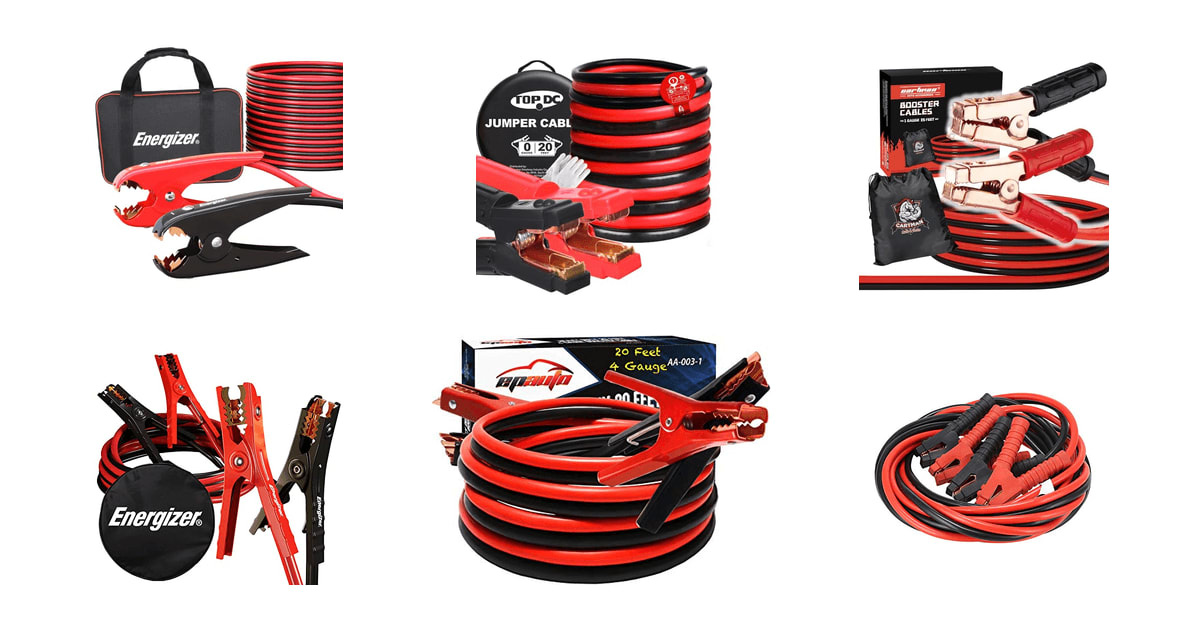
Enough gauge and enough reach to cover almost any vehicle
Energizer 1-Gauge 800A Heavy Duty Jumper Battery
The Energizer 1-Gauge 800A set pairs thick 1-gauge conductors with a 25-foot run, which covers everything from a Civic to a diesel pickup. That length is what separates a successful jump from a tow truck call when the two cars can't line up nose to nose.
$54.97fromAmazonThe 25-foot length is the reason to buy these. Parking lots don't cooperate. The dead car is wedged between two others, or it's backed into a spot, or the battery sits under the rear seat or in the bed. Twenty feet works when everything lines up perfectly. Twenty-five feet works when it doesn't. Energizer even makes the point in the product name: you can boost a battery from behind a vehicle.
One-gauge conductors give you real headroom. These are rated for 800 amps, which covers V8 gas engines and most light diesels with room to spare. A four-cylinder sedan pulls maybe 150 to 250 amps to crank. A big diesel in cold weather can want 600 to 1,000. Buying the thicker cable once means you're never the person whose cables couldn't do the job.
The insulation is rated to stay flexible at -40°C. That matters more than it sounds. Cheap jacketing turns rigid in deep cold, and a stiff cable fights you when you're already miserable and trying to get a clamp onto a terminal with gloves on. Energizer also specs a thick vinyl coating over the conductors and clamps to keep rust and corrosion from creeping in at the connection points.
You get a carry bag, and you should use it. Loose cables rattling around a trunk get chewed up by heat, UV and whatever else lives back there. The included travel bag keeps the set coiled and out of the sun, which is the single biggest factor in whether a set lasts five years or fifteen. It's a small thing that meaningfully extends the life of the cables.
Energizer backs these with a two-year warranty. That's longer than most cable sets in this price class carry, and it signals the company expects the clamps and springs to survive normal use. Owners generally report the clamp springs stay firm rather than going soft after a season, which is where budget sets tend to fail first.
Flaws but not dealbreakers
These are copper-clad aluminum, not pure copper. Energizer says so in the listing, which is more honest than a lot of competitors. But it means the 800-amp figure is a rating, not a guarantee under sustained load. In practice, 1-gauge CCA still moves more current than 4-gauge pure copper, so the everyday impact is small. If you want solid copper, you'll pay considerably more and get a heavier cable.
They're bulky and they're heavy. Twenty-five feet of 1-gauge cable makes a substantial coil, and it will take up real room in a small trunk. If you drive a compact and only ever jump other compacts, you're carrying weight you don't need. That's the trade-off for coverage you'll probably only use once every few years.
Energizer covers these cables with a two-year warranty.
Upgrade pick
More current and a real cold rating, if you can live with 20 feet
TOPDC 0 Gauge 20 Feet 1000 Amp
The TOPDC set uses a 2/0-gauge core rated for 1,000 amps, and it's UL-listed with a certified -40°F to 140°F operating range. It's the one to buy for commercial diesels, 24V equipment, or if you live somewhere winter is genuinely brutal.
$66.99fromAmazonThis is the thickest cable here by a wide margin. The 2/0-gauge core is rated for 1,000 amps and it weighs nine pounds, which is a good sign — copper content shows up on the scale. TOPDC calls it 0-gauge, but the listing specifies 2/0 AWG ultra-thick core. If you're cranking a big diesel on a cold morning, this is the set with the most margin.
The UL listing is a genuine differentiator. Most jumper cables on Amazon carry no third-party certification at all, and the category has a real problem with inflated gauge claims. TOPDC says each clamp has passed UL certification. That doesn't make the cable magic, but it does mean an outside party checked the clamps rather than taking the manufacturer's word for it.
It's the only set here with an explicit extreme-cold rating. TOPDC specs -40°F to 140°F. If you park outside in Minnesota or Alberta, that's the number you care about. Cheap vinyl-jacketed cables crack and stiffen well before that, and a cracked jacket on a live cable isn't just annoying, it's a hazard. The PVC here is specified to resist freezing, cracking and folding.
It handles 24V systems, which most consumer cables don't. Freight trucks, some agricultural equipment and a lot of commercial diesels run 24V. TOPDC lists 12V and 24V compatibility explicitly. If you manage a fleet or run a tow rig, that alone narrows the field. The set also includes a permanent installation kit for shop or service-vehicle setups.
TOPDC offers a five-year quality assurance. That's the longest coverage in this lineup, and it fits the commercial positioning. It's also a reasonable hedge on a set you might use dozens of times a year rather than once a decade.
Flaws but not dealbreakers
Twenty feet is the real limitation. It's fine for two passenger cars parked head-on. It gets tight the moment you're jumping a long-wheelbase truck, or the donor vehicle can't pull straight in. For a set aimed at commercial diesels, that's a strange gap — those are exactly the vehicles that need the extra reach. Measure your typical scenario before you commit.
It's still copper-clad aluminum despite the price. TOPDC discloses high-density CCA in the listing. Given the commercial framing and the premium over everything else here, solid copper would be a fair expectation. The 2/0 core is thick enough that this matters less than it would on a thinner cable, but you're not getting pure copper.
Nine pounds and a big coil. This is a shop tool, not something you tuck into a hatchback's spare-tire well. If your trunk is already full, plan around it.
Also great
Truck-capable gauge without the truck-capable bulk
Voilamart Heavy Duty Battery Jumper Cable 2
Voilamart's 2-gauge set uses 12mm-thick conductors rated for 1,200 amps, which is more than enough for large gas engines and most diesels. It gives up five feet of reach compared with our top pick, but it's easier to store and handle.
$23.99fromAmazonTwo-gauge is the sweet spot for most trucks and SUVs. You get most of the current capacity of a 1-gauge cable in a bundle that's noticeably easier to coil and stow. Voilamart rates these at 1,200 amps through 12mm-thick conductors. That's ample for a V8, and the listing covers petrol and diesel engines up to 9500cc.
The insulation is built for what's actually under a hood. PVC that resists heat, oil and acid matters because cables get dragged across engine bays and set down on whatever's nearby. All-insulated clamp handles are the other detail worth having, especially if you jump-start rarely and aren't confident about where your hands are going.
It covers 6V, 12V and 24V systems. That's unusual at this level and it means the set works on older equipment, tractors and commercial vehicles as well as your daily driver. If you've got a mixed garage — a truck, a boat trailer, an old tractor — one set covers all of it.
The zipped case with a handle is one of the better ones here. Small thing, but a bag you can actually grab and carry means the cables stay in the bag. Cables that stay in the bag stay flexible and uncracked. The 20-foot run is also specified as tangle-free, so it uncoils rather than fighting you.
Flaws but not dealbreakers
Twenty feet, again. Same constraint as the TOPDC set. Fine for two cars head-on in a lot, tight for a full-size truck or an awkward angle. If you drive anything long, the top pick's extra five feet is the better buy.
The 1,200-amp figure deserves skepticism. It's higher than the TOPDC rating despite thinner wire, which tells you these numbers aren't measured the same way across brands. Treat it as a marketing figure and judge the cable on its 2-gauge conductor size instead, which is genuinely capable.
PVC isn't TPR. It handles moderate winters fine, but it stiffens in serious cold in a way that rubber-jacketed cable doesn't. If you're regularly below -20°F, look at the TOPDC set instead.
Budget pick
The right amount of cable for a compact car, and no more
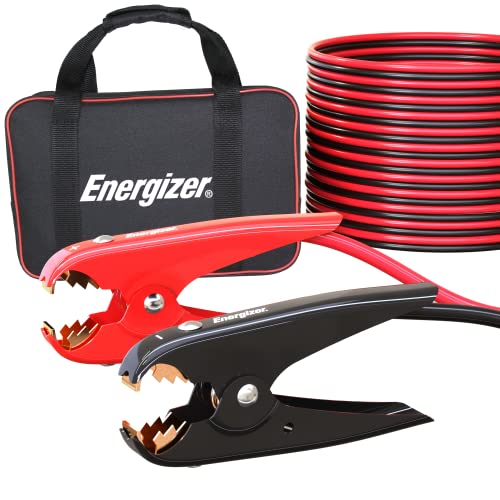
EPAuto 4 Gauge x 20 Ft Heavy
EPAuto's 4-gauge set is sized for four-cylinder and small V6 engines, which is most of what's parked on your street. The tangle-free jacket and copper-plated clamps punch above what you'd expect from an inexpensive kit.
$25.97fromAmazonFour-gauge is genuinely enough for a passenger car. A four-cylinder needs somewhere around 150 to 250 amps to crank, and a small V6 maybe 250 to 400. This cable handles that. Skipping up to 1-gauge buys headroom you'll never use if you drive a Corolla and jump other Corollas. Buy the gauge your actual car needs.
The tangle-free jacket isn't just a marketing line. These uncoil cleanly instead of springing back into a knot, which is exactly what cheap vinyl cables do the moment it gets cold. The specialized insulation stays pliable enough to work with, and it packs back into the bag without a fight.
Copper-plated clamps with firm springs hold their grip. The plating conducts better than bare steel at the contact point, and the tension springs keep the jaws on the terminal instead of sliding off when someone bumps the hood. That connection point is where cheap sets waste current and generate heat.
It's light enough that you'll actually keep it in the car. The best jumper cables are the ones in your trunk, not the ones in your garage because they were too bulky to bother with. This kit tucks into a spare-tire well. EPAuto also throws in a pair of work gloves, which is a nicer touch than it sounds when you're handling a grimy battery terminal.
Flaws but not dealbreakers
Don't use these on a diesel or a big V8. Four-gauge isn't rated for that kind of sustained draw. Trying it risks a failed start and a hot cable. If there's a truck in your household, buy the top pick instead and keep this set as the second car's kit.
Twenty feet means you need to park close. For two compacts in a normal lot that's fine. For anything else you'll be doing geometry. The clamps are copper-plated rather than solid copper, too, which is the expected corner-cut at this level but worth knowing.
Who this is for
Buy a set if you own a car, full stop. A dead battery is one of the most common reasons drivers end up stranded, and cables are about the simplest fix there is. Match the gauge to your heaviest vehicle, not your lightest: if there's a truck in the driveway, buy truck cables and use them on the sedan too. If you only ever drive a compact and can't spare the trunk space, a 4-gauge set is a legitimate choice rather than a compromise.
This guide covers traditional vehicle-to-vehicle jumper cables plus one lithium jump starter, since that's the honest alternative for anyone who drives alone. It doesn't cover permanently mounted battery cables, trickle chargers, or 24V-only commercial harnesses. And no cable helps a battery that's genuinely dead rather than discharged — if yours needs a jump twice in a month, you need a new battery, not longer cables.
How we picked
Wire gauge: we treated AWG as the primary spec, checking stated gauge against listed weight and conductor description, with 2-gauge as the floor for trucks and 4-gauge for passenger cars. Length: we compared every set against the 25-foot figure automotive sources recommend for large vehicles, and treated anything under 20 feet as compact-car-only. Conductor honesty: nearly everything here is copper-clad aluminum, so we favored listings that disclose it rather than implying solid copper. Clamps and cold: we read published temperature ranges and clamp construction, and weighed owner reports about soft springs and jackets that stiffen in winter. Storage and warranty: we noted included cases and published warranty terms, since heat and UV finish off more cables than actual use.
Other heavy duty jumper cables worth considering
If you drive alone and can't count on a donor car: The NOCO Boost GB70: 2000A UltraSafe Jump Starter ($189.95) — The NOCO Boost GB70 solves the problem cables can't: an empty lot with nobody to help. It's a 2,000-amp lithium pack rated for engines up to 8.0L gas and 6.0L diesel, with up to 40 starts per charge, and it fits in a glove box at five pounds. The spark-proof clamps and reverse-polarity protection make it hard to connect wrong, which is a real advantage if you've never done this before. There's a 400-lumen light and a USB power bank built in. The catch is discipline: it only works if it's charged, and a jump starter you forgot about for two years is a brick. It recharges in six hours, and it won't work on 24V systems. It also costs several times what any cable set here does.
If you want 1-gauge and 25 feet from a different brand: The Cartman 1 Gauge 25 ft Heavy Duty ($55.99) — The Cartman set matches our top pick on the two specs that matter most — 1-gauge conductors rated for 800 amps, and a 25-foot run — and it's honest about the CCA construction. The patented anti-rust clamps are rubber-insulated and fit both top-post and side-post batteries without adapters, which is genuinely useful on older cars. Cartman also publishes a TPR cold rating down to -13°F. Where it slips is clamp feel: owners describe the spring tension as lighter than the Energizer's, which shows up on corroded or oxidized terminals where you want the jaws to bite hard. The cable itself is flexible and the bag is compact. It's a fair alternative, not an upgrade.
The competition
This is what our research surfaced in the heavy-duty category, not a survey of everything sold. The jumper cable market is enormous and largely undifferentiated, with dozens of near-identical CCA sets sold under brands that appear and vanish. We focused on sets with published specs we could check and enough owner history to spot patterns. One set here didn't make the cut.
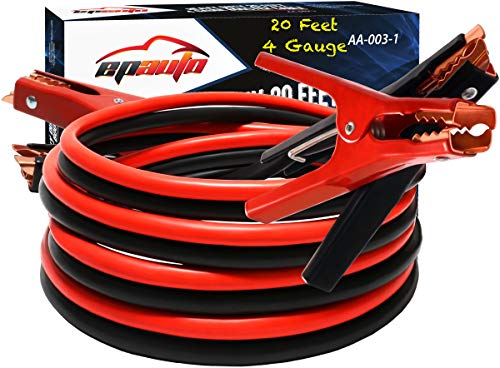
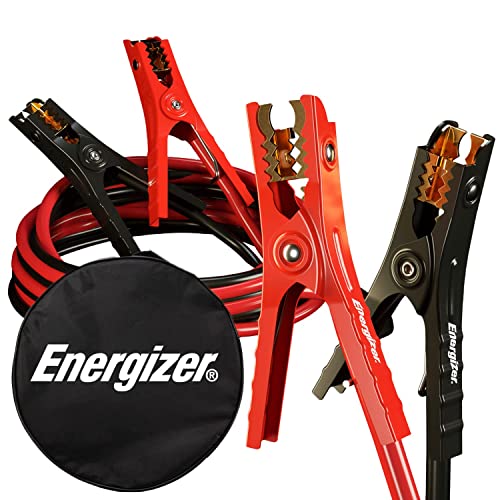
The Energizer Jumper Cables for Car Battery ($19.96) — The Energizer 6-Gauge 16 Ft set is the entry-level version of our top pick, and it carries the same brand's clamp construction, vinyl coating and carrying bag. The problem is both specs at once: 6-gauge is the thinnest wire we'd accept for any car, and 16 feet means you have to park practically bumper to bumper. Either one alone would be a limitation; together they narrow this to one job, which is jumping a compact car from another compact car parked right next to it. Owners who use it that way are generally satisfied, and the build quality is better than no-name sets at similar cost. But the EPAuto budget pick gives you a thicker conductor and four more feet for very little more, and that's the better buy for nearly everyone. Consider this one only if you drive a four-cylinder sedan, park in a wide-open lot, and want the absolute smallest bundle you can keep in the trunk.
Care and storage
Cables die from neglect, not use. Keep them in the bag they came with and out of direct sun — UV and trunk heat crack insulation far faster than jump-starting ever will. Once a year, pull them out and check three things: flex the jacket along its length looking for splits, squeeze each clamp to see whether the spring still snaps back, and look for green or white crust where the cable meets the clamp. That corrosion is the most common failure point, and it chokes current right where you need it. Coil loosely in wide loops rather than tight ones; sharp bends fatigue the strands inside. Stored properly, a good 1- or 2-gauge set should be fine for a decade or more.
Questions we get
What gauge jumper cables do I need for a diesel truck?
Go with 1-gauge or 2-gauge rated at 600 amps minimum, and 800 or higher if you can. Diesels have much higher compression than gas engines, so they pull far more cranking current — especially when it's cold and the oil is thick. If your truck runs a 24V system, you need cables rated for it, like the TOPDC 0-gauge set.
What's the real difference between 1-gauge and 4-gauge?
Lower number, thicker wire. One-gauge has roughly four times the cross-sectional area of 4-gauge and carries three to four times the current. Practically, 1-gauge starts trucks, diesels and big V8s; 4-gauge is for passenger cars and compact SUVs. Don't put 4-gauge on a diesel — you risk a failed start and a cable that gets uncomfortably hot.
Is copper-clad aluminum as good as pure copper?
For the short burst a jump start needs, CCA at a decent gauge works fine. Pure copper conducts roughly 35% better per unit of cross-section, so it's the better choice for repeated or sustained current. The real issue isn't CCA itself, it's mislabeling — a thin cable sold as 1-gauge performs nowhere near the label. A field check: pure copper weighs about 30% more per foot than CCA at the same stated gauge.
Should I buy 20-foot or 25-foot cables?
Buy 25 feet if you drive a truck, SUV, minivan or anything bigger than a compact sedan. Cars in real parking lots rarely line up the way the instructions assume, and a cable that's two feet short is as useless as no cable at all. Twenty feet is fine for compacts and mid-size cars in normal urban parking. For fleet or commercial use, don't go under 25.
Are portable jump starters better than cables?
They solve a different problem. A pack like the NOCO GB70 works when there's no second car, and its spark-proof, reverse-polarity design is safer for someone who's never done this. Cables never need charging and never go flat in a trunk, but they're useless without a donor vehicle. If you commute alone a lot, the pack is worth it — just keep it charged.
Can jumper cables damage my car's electronics?
It's possible with undersized cables. A cable that overheats mid-jump can cause voltage instability, and modern cars are full of control modules that don't like that. In rare cases it triggers fault codes or damages a module. Using properly rated cables — 1- or 2-gauge for trucks, at least 4-gauge for cars — keeps current delivery stable and removes the risk.
Can I jump-start a hybrid or EV?
You can jump the 12V auxiliary battery in most hybrids and EVs the normal way — never touch the high-voltage traction pack. What you shouldn't do is use a hybrid or EV as the donor car, since supplying boost current can stress its power electronics. Check the owner's manual first, because terminal locations vary a lot on these vehicles.
Why you should trust us
For this guide:
- We compared published gauge, length, amperage and temperature specifications across every set in this lineup, and cross-checked stated gauge against listed cable weight where the manufacturer published it.
- We read owner feedback for recurring patterns — clamp springs losing tension, jackets stiffening in deep cold, corrosion at the clamp junction — and used those themes to shape the flaws in each pick.
- We carried forward the buying criteria and gauge guidance from the earlier version of this guide and checked each claim against current manufacturer listings.
- We read owner reviews on every listing, weighted toward the critical ones, because that is where the recurring failures show up.
- We have a systematic way of automatically fetching the latest prices, so the numbers on this page stay current.
- This is a research-focused guide, so the team may not own every product listed — though we often do own the top winners, which gives us extra context for the recommendations.
- We don't accept free products, and the retailer commission never changes which product we recommend.
Sources
Best Jumper Cables of 2026 — Popular Mechanics, Popular Mechanics
Best Jumper Cables — Wirecutter / The New York Times, Wirecutter
Best Jumper Cables Tested and Reviewed — Car and Driver, Car and Driver
Best Jumper Cables for 2026 — CNET, CNET
Best Jumper Cables — The Drive, The Drive
Amazon product listings and owner reviews for all 7 products
Manufacturer specification pages for each product
Some passages in this guide may be paraphrased with AI help. Prices are refreshed automatically.
More like this.
Continue exploring electronics reviews and recommendations.

The Best Heavy-Duty Toilet Plungers
Nobody shops for a plunger on a good day. You're buying one because something went wrong, or because you finally looked at the sad rubber dome under the…

The Best Heavy-Duty Garage Shelving
Garage shelving lives a harder life than any other furniture you own. It sits on a slab that isn't level, in air that swings from freezing to broiling,…

The Best Heavy-Duty Dog Crates for Large Breeds
A crate for a 90-pound dog has a different job than one built for a beagle. It has to hold when your dog throws a shoulder into the door at six in the…

The Best Tire Chains and Snow Traction Cables
Chains live in your trunk for years and matter for about twenty minutes. But those twenty minutes tend to happen on a dark shoulder, in falling snow, with…

The Best Car Battery Jump Starters
A dead battery almost never happens at a convenient time. It's the school run, the grocery-store parking lot at dusk, or a driveway on the first genuinely…

The Best Lithium Jump Starter Power Banks
A dead battery almost never happens at a convenient moment. It happens in a parking garage at 11 p.m., or on the first genuinely cold morning of the year,…