The Best Knee Scooters for Foot Injuries
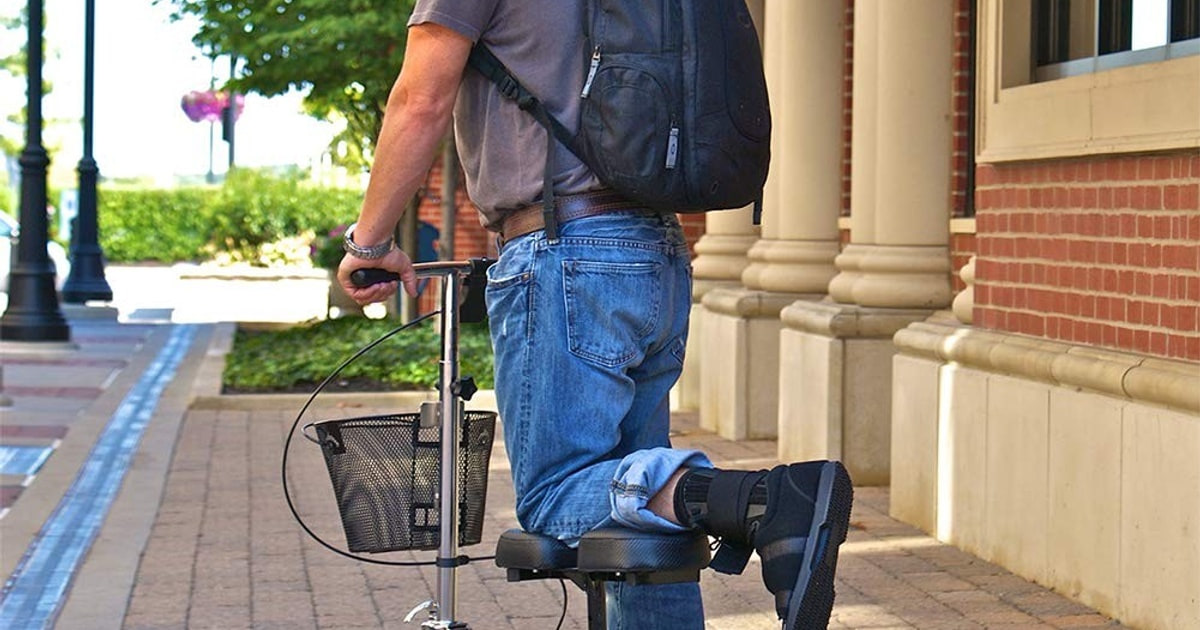
A broken foot changes your whole day. Crutches sound simple until you've used them for a week, and then your armpits ache, your wrists throb, and you can't carry a cup of coffee from the kitchen to the couch. A knee scooter fixes most of that. You rest your bad leg on a padded platform, push with the good one, and steer with your hands. Orthopedic guidance from the American Academy of Orthopaedic Surgeons favors scooters over crutches for non-weight-bearing stretches longer than two or three weeks, mostly because your upper body stops doing all the work.
No scooter solves stairs. That's the honest limit here, and it applies to every wheeled model in this guide. You'll need a railing, a helper, or a second scooter parked upstairs. Thresholds, thick carpet, and gravel driveways all fight you too, and even 12-inch pneumatic tires just make the fight shorter. Folding claims deserve a squint as well. Most of these fold, but they're still 20 to 35 pounds of steel, and lifting one into a trunk one-legged is its own small project. Plan on help for the first week.
We looked at what published reviews, manufacturer spec sheets, and owner feedback say about braking, wheel size, weight capacity, and how these things behave in a narrow hallway. Fit matters more than features. A scooter rated for your height and weight will do more for your recovery than a cup holder ever will. We think that the KneeRover Steerable Knee Scooter is the best knee scooter for most people, and that the Vive Mobility All Terrain Knee Scooter is the one to buy if your recovery involves grass, gravel, or a long driveway.
Everything we recommend

Steers tight, brakes twice, and fits most adult bodies

Big air-filled tires for grass, gravel, and rough pavement

Folds down small enough for a cab, a bus, or a desk

Dual knee pads and a 350-pound rating for less money
Prices as of Oct 24, 6:27 AM PT · Details
At a glance
| Product | Wheel size | Weight capacity | Price | |
|---|---|---|---|---|
| KneeRover Steerable Knee ScooterTop pick | 7.5 inch | 300 lbs | Check price |
| KneeRover GO Hybrid Knee Scooter for AdultsUpgrade pick | 9 inch front, air | 300 lbs | $259.99 |
| Vive Mobility All Terrain Knee Scooter WalkerAlso great | 12 inch pneumatic | 350 lbs | $219.99 |
 | iWALK3.0 Original Hands Free Knee Crutch-Replaces KneeAlso consider | — | — | $179 |
 | BodyMed All-Terrain Knee WalkerAlso consider | 12 inch, air-filled | 350 lbs | $206.39 |
| Roscoe Medical Knee Scooter for Adults forBudget pick | 8 inch | 350 lbs | $199.99 |
 | Medline Manual Seated Mobility Scooter Knee WalkerAlso in lineup | 8 inch | 300 lbs | Check price |
Prices as of Oct 24, 6:27 AM PT · Details
How we picked
Braking and control. We favored scooters with a locking brake you can set while transferring to a chair or bed, since that's when falls happen. Dual-brake designs got extra credit.
Wheel size and terrain. Published guidance from SpinLife puts 8-inch wheels indoors and 10-inch or larger outdoors, so we made sure the lineup covered both ends. Anything that couldn't clear a normal sidewalk crack didn't make a pick.
Fit range. Manufacturer height ranges and weight capacities decided a lot of this. We looked for scooters that fit a broad span of adult heights and rated at least 300 pounds, because a scooter that doesn't fit you is worse than crutches.
Turning in tight rooms. Steerable four-wheel designs turn far tighter than fixed-wheel ones, which WebMD flags for home doorways and bathrooms. We only considered steerable models for the main picks.
Transport and storage. We compared folded dimensions, folding mechanisms, and shipping weights from spec sheets, since somebody has to lift this into a car. Tool-free folding mattered most.
Top pick
Steers tight, brakes twice, and fits most adult bodies
KneeRover Steerable Knee Scooter
The KneeRover Steerable Knee Scooter pairs a locking handbrake with a rear drum brake, which is a rare combination at this size. Its 7.5-inch wheels handle hardwood, tile, and smooth sidewalks well, and the frame is rated to 300 pounds for users between 5'3" and 6'5".
Check priceatAmazonPrices as of Oct 24, 6:27 AM PT · Details
Two brakes beat one, especially on a ramp. Most scooters in this range give you a friction brake and call it done. This one has an adjustable locking handbrake plus a rear drum brake, so you can slow yourself on a driveway slope and then lock the whole thing in place while you transfer to a chair. If you live anywhere with a pitched garage floor or a sloped walkway, that lock is the difference between a parked scooter and a runaway one.
The steering is where you'll notice the difference day one. Four wheels with a steerable front end turn far tighter than the fixed-wheel designs, and WebMD flags that turning radius for home doorways and bathrooms. You'll swing this through a 30-inch door without a three-point turn. Bathrooms are still tight, because bathrooms are always tight, but you won't be reversing out of one.
At 22.3 pounds it's not the lightest thing here, though it's lighter than the all-terrain models by a wide margin. It folds without tools and KneeRover says it fits in compact cars. Owners buying for a parent or spouse consistently flag that as the thing they cared about, since somebody else usually does the lifting.
The height range is unusually generous. KneeRover rates it for 5'3" to 6'5", which covers most adults without the knee pad bottoming out or the handlebars sitting at your chin. Both the pad and the bars adjust. Get the pad height right first, so your hip stays level when the injured knee rests on it, then set the bars where your elbows sit slightly bent. Skipping that setup is the most common source of the back pain owners complain about.
Flaws but not dealbreakers
The 7.5-inch wheels are the smallest in this guide, and they show it. Gravel, thick lawn, and broken sidewalk slabs all stop this scooter cold, and cracks that a 12-inch pneumatic tire rolls over will catch these. If your recovery involves a long unpaved driveway, buy something else.
Assembly is straightforward but not instant, and the drum brake usually needs a cable adjustment out of the box to feel right. Do that before your first outing rather than discovering the slack halfway down a slope.
Also great
Big air-filled tires for grass, gravel, and rough pavement
Vive Mobility All Terrain Knee Scooter Walker
The Vive Mobility All Terrain Knee Scooter rides on 12-inch pneumatic wheels, which is the largest set here. It supports up to 350 pounds, adjusts from 20 to 26 inches at the knee platform, and suits users from 5'4" to 6'6".
$219.99fromAmazonPrices as of Oct 24, 6:27 AM PT · Details
If your front walk is gravel, this is the scooter. Guidance from SpinLife puts 10-inch and larger wheels in the outdoor category and 8-inch wheels indoors, and Vive's 12-inch pneumatic tires sit comfortably past that line. Grass, dirt, packed gravel, and the kind of buckled sidewalk that tree roots create all become passable. You'll still feel the bumps. You just won't stop dead at them.
The knee pad is contoured rather than flat, which matters more than it sounds like it should. A flat pad puts all the pressure on your shin's edge, and after three weeks that's where the soreness lives. The contoured foam cradles the lower leg and spreads the load, and Vive designed the platform to be height-adjustable across a six-inch range so you can dial out hip tilt.
It carries 350 pounds, 50 more than our top pick. That's a real gap if you're near the limit, and weight ratings aren't a place to round up. Verywell Health notes that most scooters top out around 300 pounds, so this one buys you margin without jumping to a reinforced steel frame.
Vive covers it with a lifetime guarantee and the purchase is HSA and FSA eligible. If you have a health spending account sitting unused, that's worth knowing before you pay out of pocket.
Flaws but not dealbreakers
Pneumatic tires need air. You'll want a pump, you'll want to check pressure before longer outings, and a flat is a real possibility over a long recovery. Solid rubber never does that.
It's a big machine. The listing puts it at 45.5 inches tall and 36 inches long, which makes indoor use in a small apartment genuinely awkward. Doorways are fine. Turning around in a galley kitchen is not.
The all-terrain frame is heavier and bulkier to load into a car than the folding compacts here, so plan on a second pair of hands for transport.
Vive backs the All Terrain Knee Scooter with a lifetime guarantee.
Upgrade pick
Folds down small enough for a cab, a bus, or a desk
KneeRover GO Hybrid Knee Scooter for Adults
The KneeRover GO Hybrid folds in seconds and packs down to roughly 19 inches long, so it slides under a desk or into a trunk without a wrestling match. Its 9-inch air-filled front tires handle more terrain than the compact size suggests.
$259.99fromAmazonPrices as of Oct 24, 6:27 AM PT · Details
You bought a scooter because you still have a life. If that life includes a commute, a rideshare, or an office, the GO Hybrid is built around exactly that problem. It folds in seconds without tools and collapses to about 19 inches long, small enough to stash under a desk or in an overhead-height car trunk. Nothing else here disappears that completely.
The 9-inch front tires are the compromise that makes it work. Air-filled and larger than our top pick's wheels, they'll take you over cracked pavement and short stretches of packed dirt without the bulk of a full all-terrain frame. It's a hybrid in the honest sense: better outdoors than an indoor scooter, less capable than the 12-inch machines, and far easier to carry than either.
The knee platform is 3 inches thick, 7 inches wide, and 12.5 inches long, and it works for a left or right leg injury. The height range runs 4'9" to 6'6", the widest here, which makes it one of the few models that fits a shorter adult properly. At 300 pounds capacity it matches the top pick.
It costs more than the standard KneeRover, and that premium is buying you the folding mechanism and the tires, not extra comfort. If your scooter is going to live in one house for six weeks, skip it. If it's going in and out of a car several times a week, the money comes back fast in shoulder strain you don't have.
Flaws but not dealbreakers
The compact wheelbase trades some stability for portability. Owner feedback points at a tippier feel when leaning into fast turns, so take corners slower than you would on a longer frame.
Air tires mean a pump and occasional pressure checks, same as the Vive.
KneeRover lists both 20.9 pounds and 22.5 pounds for this model across its specs and bullets, so treat it as low-20s rather than a precise figure when you're judging whether you can lift it.
Budget pick
Dual knee pads and a 350-pound rating for less money
Roscoe Medical Knee Scooter for Adults for
The Roscoe Medical Knee Scooter carries 350 pounds on 8-inch wheels and uses a dual-pad knee platform for extra stability. It folds for storage and comes with a detachable basket, which covers the practical basics without extras.
$199.99fromAmazonPrices as of Oct 24, 6:27 AM PT · Details
The dual-pad platform is the standout here. Two pads spread your shin's weight across a wider base than a single narrow cushion, and that's a stability advantage you feel most when you're pushing off or coming to a stop. It also gives you more surface to shift on during a long day, which helps with the pressure-point soreness that builds up over weeks.
The 8-inch wheels put it right at the line SpinLife draws for indoor use, so hardwood, tile, low carpet, and smooth sidewalks are comfortable territory. Grass and gravel aren't. Know which one describes your recovery before you commit, because this is the trade-off you're making to save money.
It handles 350 pounds, the same as the far more expensive Vive, and Roscoe says it works for adults, teens, and some children. That's a wider range than most, though as always the height and pad adjustment is what actually determines fit. The steerable front end turns tightly enough for home doorways.
The basket detaches, which sounds minor until you're trying to fit the scooter into a trunk. Roscoe includes it rather than selling it as an add-on, and it holds enough for a grocery run or a laptop.
Flaws but not dealbreakers
You get the basics and not much else. There's no drum brake here, no cup holder, and the finish is plainer than the KneeRover models.
Owner feedback on budget scooters in general points to assembly quality as the variable that swings most, so check every bolt for tightness before your first ride and again after a week of use.
Who this is for
Buy a knee scooter if a doctor has told you to stay off one foot for more than two or three weeks. That's the point where crutches stop being an inconvenience and start causing their own problems. Healthline notes that prolonged crutch use puts pressure on the underarm and wrist, and nerve compression injuries are a documented consequence. If your non-weight-bearing period is a few days, crutches or a walker will do. If it's six weeks after ankle surgery, a scooter will make those weeks livable, and you'll be able to carry things again.
Skip a scooter if your injury is above the knee, if you can't bend the injured knee to 90 degrees, or if you have balance problems serious enough that a physical therapist has flagged them. Renting is often the smarter move for shorter recoveries. Medicare Part B typically covers 80% of the approved rental cost for durable medical equipment when a physician prescribes it, and many DME suppliers rent by the month. This guide covers wheeled knee scooters and one hands-free crutch alternative sold direct to consumers. It doesn't cover wheelchairs, standard walkers, or medical-grade rental fleets.
How we picked
Braking: We wanted a brake you can lock, not just squeeze, because the risky moment is the transfer to a chair. Wheels: Published guidance puts 8-inch wheels indoors and 10-inch or larger on gravel and grass, so we covered both and matched each pick to a terrain. Fit: Manufacturer height ranges and weight ratings did most of the sorting, and we set a 300-pound floor. Maneuvering: Only steerable four-wheel designs made the picks, since fixed-wheel models can't turn inside a normal bathroom. Transport: We compared folded size, folding mechanism, and shipping weight, because a caregiver usually does the lifting.
Other knee scooters for foot injuries worth considering
If you want the toughest all-terrain frame: The BodyMed All-Terrain Knee Walker — The BodyMed All-Terrain Knee Walker rides on four 12-inch air-filled tires and carries 350 pounds, and its front axle bolt comes out so you can turn the wheels sideways for travel. It's rated for users from 5'0" to 6'4" and uses a dual rear hand brake. The catch is heft. At 35 pounds it's the heaviest scooter here by a wide margin, and the tires ship deflated with no pump included, so budget for one and check pressure at 30 to 35 PSI before the first ride. If you're choosing between this and the Vive, it comes down to whether you value the removable-axle travel trick more than Vive's lifetime guarantee.
If you need your hands free and can do stairs: The iWALK3.0 Original Hands Free Knee Crutch-Replaces Knee — The iWALK3.0 straps to your lower leg and turns your knee into the foot, so you walk upright with both hands free and can manage stairs. At 5.2 pounds it's a fraction of any scooter's weight. But the qualifications are strict and iWALKFree publishes them plainly: below-knee injuries only, height between 5'2" and 6'2", age 55 or younger, average balance or better, and not significantly overweight. It's explicitly not recommended for elderly users or anyone with balance or strength limits. There's a one-to-three-day learning curve and early discomfort is normal. Confirm with your surgeon that you're a candidate before you buy.
The competition
Here's what our research surfaced, not a census of every knee scooter sold. Plenty of capable models come and go from availability, and rental fleets from DME suppliers carry brands you'll never see on a retail shelf. The model below is worth understanding because it solves a different problem than the rest, and some people are shopping for that problem without knowing the name for it.
The Medline Manual Seated Mobility Scooter Knee Walker — The Medline Manual Seated Mobility Scooter is a seated device, not a kneeling one. You sit on a padded seat, rest your injured foot on one of two front platforms, and push yourself along with your good leg. It holds 300 pounds, rolls on 8-inch wheels, and includes a basket. It lost to the picks because it only handles flat surfaces and, at 29.5 pounds, it's heavier than most of the folding scooters here while doing less outdoors. Still, if you can't kneel comfortably or you fatigue quickly standing, sitting through your recovery is a genuine advantage, and this is the model in our lineup that lets you do it.
Setup and safe use
Set the knee pad first. With your good foot flat on the floor, the pad should sit high enough that your hips stay level when the injured leg rests on it. If one hip drops, your back will tell you about it by day three. Then set the handlebars so your elbows bend slightly. Check every bolt before the first ride and again after a week, because vibration loosens them. If your scooter has pneumatic tires, keep a pump nearby and check pressure before longer outings. Take corners slowly and lean into the turn rather than steering sharply. Always set the parking brake before you get on or off, and never take a scooter on stairs or an escalator. On thresholds, approach straight on and slow down.
Questions we get
Are knee scooters better than crutches for foot injuries?
For anything longer than two or three weeks, usually yes. Orthopedic guidance from the American Academy of Orthopaedic Surgeons favors scooters for non-weight-bearing recovery of that length, mainly because they cut upper-body fatigue. Healthline also notes that prolonged crutch use presses on the underarm and wrist, which can lead to nerve compression. Crutches still win on stairs and in very tight spaces.
How much weight can a knee scooter hold?
Most support up to 300 pounds, and reinforced models go to 400 or more, per Verywell Health. In our lineup the Vive, BodyMed, and Roscoe all carry 350 pounds. Check the rating against your actual weight rather than assuming, and don't treat it as a soft limit.
Does insurance or Medicare cover knee scooters?
Often, if a physician prescribes one. Medicare Part B typically covers 80% of the approved rental cost for durable medical equipment like a knee walker. Coverage usually applies to rentals through a DME supplier rather than retail purchases, so ask your doctor's office to route the order that way. Many of these are also HSA and FSA eligible.
Is it better to rent or buy a knee scooter?
Rent if your recovery is expected to run under about two months, since monthly rental typically costs less than a purchase over that span. Buy if you're looking at a longer haul, if you want a specific model, or if you expect a second surgery. Rentals also skip the assembly and the storage problem afterward.
Can you use a knee scooter outdoors on grass or gravel?
Only with the right wheels. SpinLife recommends 10-inch or larger pneumatic or solid rubber tires for gravel, grass, and uneven pavement, and reserves 8-inch wheels for smooth indoor floors. The Vive's 12-inch tires and BodyMed's 12-inch tires handle rough ground. The smaller-wheeled models will stop at a lawn edge.
How do you use a knee scooter on stairs?
You don't. No knee scooter is safe on stairs, and trying it is how people turn one injury into two. Use a railing and hop on your good leg with a helper spotting you, or keep a second mobility aid on the upper floor. The iWALK3.0 is the only device here designed to handle stairs, and it has strict eligibility requirements.
Why you should trust us
For this guide:
- We compared manufacturer spec sheets for every scooter in this guide, focusing on weight capacity, wheel size, height range, folded dimensions, and braking hardware.
- We read published guidance from the American Academy of Orthopaedic Surgeons, Healthline, WebMD, Verywell Health, and SpinLife on when a scooter beats crutches and what wheel size suits which terrain.
- We reviewed owner feedback themes around assembly quality, knee-pad comfort over multi-week recoveries, and how these scooters behave in tight indoor spaces.
- We read owner reviews on every listing, weighted toward the critical ones, because that is where the recurring failures show up.
- We have a systematic way of automatically fetching the latest prices, so the numbers on this page stay current.
- This is a research-focused guide, so the team may not own every product listed — though we often do own the top winners, which gives us extra context for the recommendations.
- We don't accept free products, and the retailer commission never changes which product we recommend.
Sources
Knee Scooters: What They Are and How to Use Them Safely, Verywell Health
Recovering From Foot and Ankle Surgery: Mobility Aid Options, American Academy of Orthopaedic Surgeons (OrthoInfo)
Crutches vs. Knee Scooters: Which Is Right for You?, Healthline
KneeRover Steerable Knee Walker Product Specifications, KneeRover (Manufacturer)
KneeRover GO Knee Scooter Product Specifications, KneeRover (Manufacturer)
iWALK2.0 Hands Free Crutch Candidacy and Fit Guide, iWALK (Manufacturer)
Vive Health Knee Walker Product Page, Vive Health (Manufacturer)
Drive Medical Steerable Knee Walker Product Specifications, Drive Medical (Manufacturer)
OasisSpace Heavy Duty Knee Scooter Specifications, OasisSpace (Manufacturer)
Medicare Coverage for Durable Medical Equipment (DME), Medicare.gov
Choosing Mobility Equipment After Foot Surgery, WebMD
SpinLife Knee Scooter Buying Guide, SpinLife (DME Retailer)
Amazon product listings and owner reviews for all 7 products
Manufacturer specification pages for each product
Some passages in this guide may be paraphrased with AI help.
Product prices and availability are accurate as of the date/time indicated and are subject to change. Any price and availability information displayed on Amazon.com at the time of purchase will apply to the purchase of this product.
More like this.
Continue exploring health reviews and recommendations.

The Best Shiatsu Foot Massagers
Your feet take a beating. Standing all day at work, walking on concrete, cramming into shoes that were never quite right - by evening the arch aches and…

The Best Mobility Scooters for Seniors
A mobility scooter earns its keep in small moments. You get to the far end of the grocery store without hunting for a bench. You join the family walk…

The Best Foot Massagers for Plantar Fasciitis
If you have plantar fasciitis, you know the worst moment of the day comes before you're fully awake. You swing your feet to the floor, stand up, and a…

The Best Knee Braces for Arthritis
Arthritic knees don't hurt on a schedule. They hurt on the third flight of stairs, an hour into a grocery run, or the morning after a weekend in the…

The Best Heated Compression Knee Massagers
Knee pain rarely shows up at a convenient moment. It's the first ten minutes after you get out of bed, or the ache that settles in after a long drive, a…

The Best Knee Braces for Running
Most running knee pain doesn't announce itself. It starts as a dull ache in the last mile, then shows up earlier each week, until stairs and long drives…