The Best Space Heaters for Large Rooms
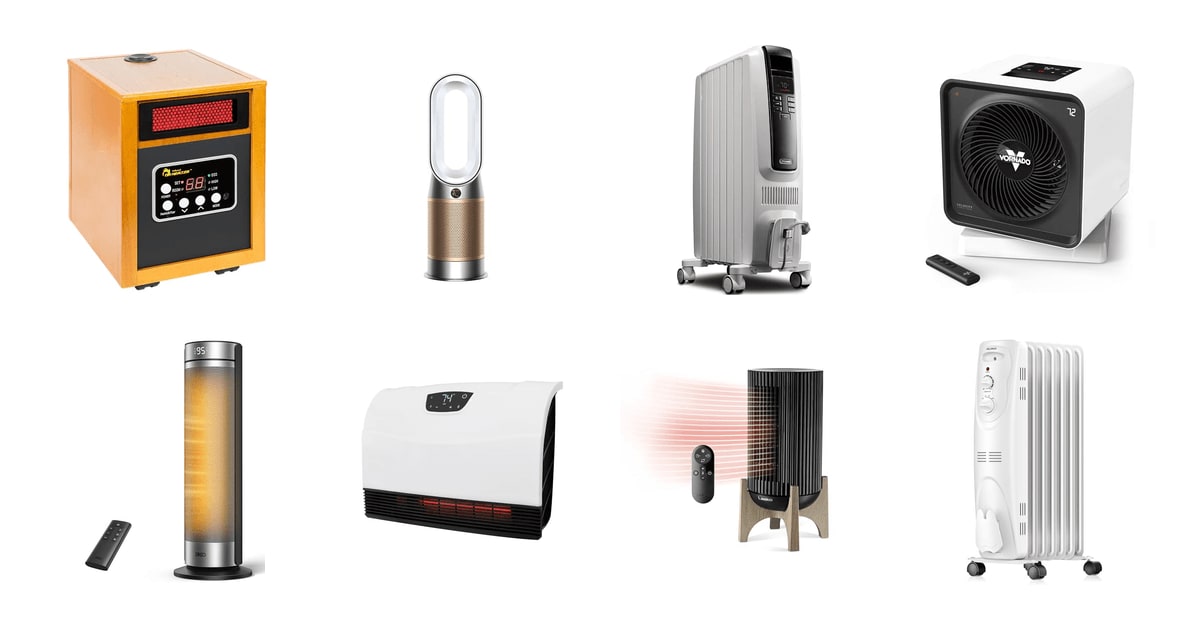
A space heater earns its keep when it lets you leave the rest of the house cold. You warm the room you're actually sitting in, drop the central thermostat, and stop paying to heat empty bedrooms. That only works if the heater can keep up with the room. Coverage ratings are the thing to watch, and they're the thing most shoppers skip. A heater rated for 250 square feet will run flat out in a 500-square-foot living room and never quite get there, which defeats the whole point.
Here's the part nobody markets: every one of these heaters is a 1500-watt appliance, and every watt becomes heat. None of them is secretly more efficient than another at full power. What differs is how the heat gets distributed, how quickly the thermostat backs off, and whether the room feels warm before you give up waiting. Marketing language about energy savings almost always means temperature-maintenance cycling, not some breakthrough in physics. Judge these on distribution, controls and noise instead.
Room size and insulation matter more than any spec on the box. A drafty great room with nine-foot ceilings will humble a heater that handles a snug bedroom just fine. So think about the actual space first, then pick the technology that suits it. We think that the Dr. Infrared Heater DR-968H is the best space heater for large rooms for most people, and that the De'Longhi Dragon Digital TRD40615E is the one to buy if you want silent heat that runs for hours.
Everything we recommend

The most heat you can get from a standard wall outlet

Silent, steady heat that keeps working after it shuts off

Precise thermostat, near-silent, and rated for smaller rooms

Buy it for the air, not the heat

Dead-silent overnight warmth with simple knobs
At a glance
| Product | Wattage | Heat Type | Price | |
|---|---|---|---|---|
| Dr. Infrared Heater DR-968H Indoor Portable SpaceTop pick | 1500W | Quartz Tube + PTC | $134.86On sale |
| Dyson Purifier Hot+Cool Formaldehyde™ HP09Upgrade pick | — | Hot+Cool | $829 |
| De'Longhi Dragon Digital Oil Filled Radiator HeaterRunner-up | 1500W | Oil Filled Radiator | $189.95 |
 | Vornado Velocity CUBE 5 OSC Whole RoomAlso consider | — | Velocity Tuned Heat | $102 |
| DREO Space Heater for Large RoomBudget pick | — | Dual DC Motors | $89.98On sale |
 | Heat Storm HS-1500-PHX-WIFI Infrared HeaterAlso consider | 1500W | Infrared | $149.99 |
 | Lasko Artisan Series Ceramic Space Heater -Also in lineup | 1500W | Ceramic | $69.99 |
| PELONIS Radiator Heater for Large SpaceAlso great | 1500W | Oil Filled Radiator | $56.67 |
How we picked
Real coverage area. We compared each manufacturer's stated square-footage rating against what owners describe heating in practice, and we weighted rooms above 400 square feet heavily. Listings that call a 250-square-foot heater a large-room model got flagged.
Heat distribution. Published reviews consistently find that oscillation and vortex-style circulation matter more than raw wattage for eliminating cold corners. We looked for oscillation, radiant surface area, or a dual-technology approach.
Controls and scheduling. We favored heaters with programmable timers, precise thermostats or app control, since cycling down to hold a temperature is where real savings come from. Fixed-wattage models with a single dial ranked lower.
Noise. We separated fan-driven ceramic heaters from silent oil-filled radiators and checked manufacturer decibel claims against owner comments about bedroom use. Anything owners called intrusive at night was disqualified from the overnight recommendations.
Safety features. Every heater here has tip-over shutoff and overheat protection, per its listing. We gave extra weight to cool-touch housings and lockable controls for homes with kids or pets.
Top pickOn sale
The most heat you can get from a standard wall outlet
Dr. Infrared Heater DR-968H Indoor Portable Space
The DR-968H pairs infrared quartz tubes with a ceramic element, so it warms you directly while it also warms the air. It's rated at 5,200 BTU and up to 1,000 square feet, and it throws in a cool-mist humidifier that no other heater here has.
$134.86fromAmazonList priceNo other 1500-watt heater here claims this much output. The DR-968H runs infrared quartz tubes and a PTC ceramic element together, which is why the spec sheet lists 5,200 BTU. Infrared warms your body and the furniture directly. The ceramic side heats the air moving through it. In a big open room, that combination gets you comfortable sooner than either approach on its own, and it keeps the room from feeling like a warm draft in a cold shell.
Owners who run it in real winters tend to describe the same thing: a 500-square-foot room held at a steady temperature through single-digit outdoor cold, used as a supplement to central heat rather than a replacement. That's the honest framing. It's the heater you put in the room you live in while the furnace coasts. Several owners have kept theirs running for years, which is not something you hear about every heater in this category.
The 72-inch cord matters more than it sounds. Large rooms rarely have an outlet where you want the heater, and the extra reach means you can set it near a cold window instead of on the far wall. Skip the extension cord — heaters and extension cords are a bad pairing. There's also a 12-hour auto shutoff and both tip-over and overheat protection, so it isn't dependent on you remembering.
The humidifier is a genuine extra, not a gimmick. Winter heating dries out a room fast, and dry air is why your throat feels rough in January. The built-in cool-mist tank adds moisture as the heater runs, so you don't need a second appliance and a second outlet. It's a small thing. But it's the kind of small thing you notice at 3 a.m.
Flaws but not dealbreakers
The cherry wood cabinet is the obvious problem. It looks like a piece of entertainment furniture from twenty years ago, and in a room with clean modern lines it sticks out. If your living room is white and minimal, this will bother you every day.
There's a fan, and you can hear it. It's not loud, but in a quiet bedroom it registers. Owners who want true silence go to an oil-filled radiator instead. There's also no app and no WiFi, so scheduling means buying a smart plug or using the built-in timer.
The 1,000-square-foot coverage claim deserves a raised eyebrow. Some owners report it feels like a heater for a smaller space than advertised, and that tracks — coverage ratings assume good insulation and mild outdoor temperatures. Treat it as a strong large-room heater, not a furnace replacement.
The DR-968H includes a 12-hour automatic shut-off timer along with tip-over and overheat protection, though the listing doesn't state a warranty term.
Runner-up
Silent, steady heat that keeps working after it shuts off
De'Longhi Dragon Digital Oil Filled Radiator Heater
The De'Longhi Dragon Digital has no fan at all, so it makes no noise whatsoever. Its oil-filled fins hold warmth after the element cycles off, and a 24-hour digital timer lets you schedule heat around when you're actually in the room.
$189.95fromAmazonIf you work from home or sleep light, silence is the feature that matters. This radiator has no fan and no moving parts, so there's nothing to hum through a phone call or wake you at two in the morning. It also doesn't blow air around, which means it doesn't stir up dust, pollen or pet dander the way a ceramic heater does. Allergy sufferers notice that difference within a day.
The heat retention is the efficiency story here. Oil-filled fins stay warm after the element stops drawing power, so the room coasts instead of cooling immediately. Over an eight-hour stretch in a home office, that cycling adds up. De'Longhi also claims 75% more radiant surface area than its RadiaS line, and more surface means more heat handed off to the room per watt spent.
The 24-hour digital timer is the most useful control on any non-WiFi heater here. Set it to start twenty minutes before you get to your desk and the room is ready when you are. Three wattage settings and the ECO Plus mode let you dial the draw down once the room is warm, rather than running full tilt and letting the thermostat slam on and off.
Owners lean on this one hard. It shows up in stories about furnaces failing in November, unheated sunrooms in Ohio winters, drafty master bedrooms in a nineties build. People buy a second one. That kind of repeat purchase is a better signal than any spec.
Flaws but not dealbreakers
It's slow. From a cold start in a big room, plan on fifteen to twenty minutes before you feel anything meaningful, and longer before the room is genuinely comfortable. First-time radiator owners consistently underestimate this. Use the timer and let it get a head start.
At more than 26 pounds it's heavy. There are casters, so you can roll it across a room, but carrying it up stairs is a two-hand job you'll do once. Think of it as furniture for one room, not a heater you shuttle around.
A handful of owners report a burning or electrical smell on first use after a long idle period. Some of that is dust burning off the fins, which is normal and fades. If it persists past the first hour or so, that's a return, not a break-in period.
Budget pickOn sale
Precise thermostat, near-silent, and rated for smaller rooms
DREO Space Heater for Large Room
The DREO ECO gives you 1-degree temperature control from 41 to 95 degrees, oscillation, a 12-hour timer and an ECO mode, for far less than the top pick. Its 250-square-foot rating is the catch, so match it to an office or bedroom.
$89.98fromAmazonList priceThe thermostat is the reason to buy this one. Most inexpensive heaters give you high, low and a vague dial. The DREO adjusts in single degrees across a 41-to-95-degree range, so you can find the setting where the room stays comfortable without swinging between stuffy and chilly. ECO mode then cycles the unit to hold that number instead of running at fixed wattage, which is where the claimed savings come from.
It's quiet — rated at 34 decibels, quieter than most rooms are at night. Owners use it in bedrooms without complaint, and the 70-degree oscillation spreads heat instead of aiming a hot column at one chair. For a desk-adjacent office heater, that combination of quiet and even coverage is more useful than raw output.
Here's the honest scope: DREO rates this for 250 square feet, and the listing calls it a large-room heater anyway. Those two things don't agree. In a bedroom or a home office it's excellent and it'll warm up fast. In a 500-square-foot living room it will run continuously and you'll be disappointed. Buy it for the room it actually fits.
Safety is well covered for the price. It's ETL-listed with a child lock, overheat cutoff, tip-over shutoff and cool-touch housing, so it's a reasonable choice in a house with a toddler or a curious cat. At 5 pounds you can also move it between rooms without thinking about it.
Flaws but not dealbreakers
Some owners report odd grinding or clicking noises developing after a few months of use — a fan bearing complaint, not a safety one, but worth knowing on a heater this new to market. The failure shows up early enough that you'd likely catch it in the first season.
There's no WiFi and no voice control. If you want to turn it on from bed or from the car, you'll need a smart plug, and a smart plug can't change the temperature setting.
It's tall and narrow at 23 inches, which is fine against a wall but tippy-looking next to a busy hallway. The tip-over cutoff handles the actual risk; the visual is just something to place thoughtfully.
Upgrade pick
Buy it for the air, not the heat
Dyson Purifier Hot+Cool Formaldehyde™ HP09
The Dyson HP09 heats, cools and purifies to HEPA standards, and it breaks down formaldehyde with a catalytic filter that never needs replacing. As a pure heater it's outclassed here, but nothing else runs year-round the way it does.
$829fromAmazonJudged only on heating, this is not the best heater in this guide. Judged as an appliance you run in every season, it's the only one that qualifies. It's a fan in July, a purifier all year, and a heater in January, which means it earns floor space twelve months instead of four. That's the actual argument for it.
The formaldehyde destruction is a real technical difference, not a marketing line. A catalytic filter breaks the VOC down into water and carbon dioxide continuously, and that element doesn't get replaced. If you've just had cabinets, flooring or new furniture installed, that's the off-gassing it targets. The HEPA side catches the ordinary stuff — dust, dander, smoke.
The bladeless design has no exposed element anywhere on it, which makes it the safest thing here around a crawling baby or a dog that leans on warm objects. Owners with multiple kids and multiple pets are the most consistently happy group. The app reports what's actually in your air, which is either reassuring or alarming depending on the day.
Heat output is modest and directional. Owners describe it warming a sunroom or taking the edge off a bedroom rather than heating a great room. If you point it at yourself it works well; if you want the whole space warm, the DR-968H does more with the same wall outlet.
Flaws but not dealbreakers
It costs several times what an effective heater costs, and most of that money buys purification. If you're zone heating strictly to cut your bill, this is the wrong tool and the math never catches up.
Replacement HEPA filters are an ongoing expense that no other heater here has. Budget for them.
Reliability is the real worry. A meaningful share of owners report the air-quality sensor going dead or the app losing connection, sometimes just after the return window closes. On an appliance this expensive, that's a harder pill than it would be on a cheap ceramic tower.
Airflow is gentler than the marketing implies. Several owners note you need to be fairly close to feel it, especially in cooling mode.
Also great
Dead-silent overnight warmth with simple knobs
PELONIS Radiator Heater for Large Space
The PELONIS oil-filled radiator has no fan, no display and no timer — just two knobs and three wattage modes. For a bedroom or nursery where any noise is a problem, that simplicity is the point rather than a compromise.
$56.67fromAmazonSilence is the whole reason this one exists. No fan, no moving parts, nothing to click or whir. In a nursery or a bedroom where a ceramic heater's fan wakes somebody up, this is the answer, and it's the least expensive way to get there. Owners describe it holding a room warm overnight without any of the dryness a blowing heater creates.
The three wattage modes — 600, 900 and 1500 watts — are more useful than they look. Bring the room up on high, then drop to 600 watts to hold it. Running at 600 watts through the night draws far less than a ceramic heater cycling between full power and off, and the oil keeps radiating during the gaps.
It's the most portable radiator here. Four casters and a front handle mean you can wheel it from the bedroom to the office without much thought, and at under 17 pounds it's noticeably lighter than the De'Longhi. Owners with old, uninsulated houses report it holding a 255-square-foot room with ten-foot ceilings, which is a real test.
Controls are two knobs and an indicator light. There's no menu to learn and nothing to reprogram after a power blip. If you've ever fought with a touchscreen heater at midnight, that's a feature.
Flaws but not dealbreakers
No timer and no digital thermostat means you can't pre-heat a room on a schedule. If you want the bedroom warm at 7 a.m. without getting up, the De'Longhi's 24-hour timer is worth the difference.
Like every oil-filled radiator, it's slow from cold. This isn't the heater you switch on when you walk into a freezing room and expect results.
Longevity is a recurring theme in owner feedback: a couple of years of good service, then the indicator light dies and the heat follows. People keep rebuying it anyway, which tells you something about both the price and the expectations.
Who this is for
This guide is for anyone heating one large room — a living room, a great room, a big bedroom, a finished garage — while keeping the rest of the house cooler. If your room is under about 250 square feet, you have more options than these and you can spend less. If you need to heat two or more large rooms at the same time, stop here and turn up the central heat instead; running multiple 1500-watt heaters concurrently costs more than it saves.
We only cover plug-in, 120-volt heaters you can buy and set up yourself, including one wall-mounted unit that needs a drill and an afternoon. Hardwired 240-volt units, gas and propane heaters, ductless mini-splits and whole-house systems are out of scope — those are electrician and HVAC territory. We also assume you'll use these as supplements to central heating, not as the only heat source in a freezing house.
How we picked
Coverage: We checked each manufacturer's square-footage rating against what owners actually report heating, and we weighted large rooms most heavily. Distribution: Oscillation, radiant surface area and dual heating technologies matter more than wattage for killing cold corners, since every unit here draws the same 1500 watts. Controls: Programmable timers, precise thermostats and app scheduling let a heater cycle down to hold a temperature instead of running flat out, which is where savings actually come from. Noise: We separated fan-driven ceramic models from silent oil-filled radiators and read owner comments about bedroom use. Safety: Tip-over shutoff and overheat protection are the floor; cool-touch housings and child locks earned extra credit.
Other space heaters for large rooms worth considering
If you want your floor space back: The Heat Storm HS-1500-PHX-WIFI Infrared Heater ($149.99) — The Heat Storm HS-1500-PHX-WIFI mounts on the wall, so it takes up nothing at all. Owners use it in garages, bathrooms and furniture-crowded living rooms where there's simply nowhere good to put a floor heater. The glass front stays cool to the touch, and WiFi control means you can warm a garage gym from inside the house ninety minutes before you use it. The catch is that it's permanent — you drill it into a wall and it lives there. Infrared also works best in well-sealed rooms; in a drafty old space with high ceilings, warm air escapes faster than the radiant heat can compensate. Some owners report the LCD display failing after a year or so.
If your problem is cold corners rather than not enough heat: The Vornado Velocity CUBE 5 OSC Whole Room ($102) — The Vornado Velocity CUBE 5 OSC combines 70-degree oscillation with the vortex circulation Vornado is known for, and published lab testing supports the idea that vortex heaters warm a room more evenly than a plain tower. It's small, it has a remote and a 1-to-12-hour timer, and the controls lock so a kid can't change them. But owner feedback splits sharply on output. Several describe it as a good small-space heater whose warm air cools off before it crosses a big room, and one of the more useful reviews calls the whole-room label a stretch. Consider it for a bedroom or a bathroom, or as a second unit alongside a higher-output heater in an open-plan space.
The competition
This is what our research surfaced in this category, not a census of every space heater sold. We worked from manufacturer specifications, published reviews and owner feedback for the models below. A heater landing here isn't necessarily bad — in most cases it's aimed at a smaller room than this guide covers, or it gives up a feature that one of the picks includes.
The Lasko Artisan Series Ceramic Space Heater - ($69.99) — The Lasko Artisan Series CX16550 is a genuinely nice-looking ceramic tower with an Auto Eco thermostat, a 12-hour timer and a remote that runs every function. Owners like it a lot — it heats a kitchen or a bedroom quickly, it's light enough to carry, and the elevated design and triple overheat protection reassure people who've had a scare with a cheap heater before. It lost to the DREO on control precision: two heat settings versus single-degree adjustment. And despite the full-room-coverage language in its listing, it's really a heater for spaces around 300 square feet. In a great room it'll run continuously and never catch up. If your room is medium-sized and you care how the heater looks, it's an easy recommendation.
Placement and safety
Give any heater three feet of clearance in every direction, and plug it straight into a wall outlet — never an extension cord or a power strip, which aren't built for a sustained 12.5-amp draw. Put it on a hard, level surface rather than carpet or a rug pile, where the tip-over switch is less reliable. In a large room, a spot near the coldest wall or under a drafty window works better than the middle of the floor, since you're intercepting the cold rather than chasing it. For wall-mounted infrared, five to six feet up gives the best spread. Vacuum the intake grille a few times a season; dust buildup is what makes a heater smell hot. And make sure the smoke detector in that room actually works before you run anything overnight.
Questions we get
How many square feet can a 1500-watt space heater really heat?
Figure 150 to 300 square feet in a well-insulated room at typical winter temperatures. The DR-968H claims up to 1,000 square feet thanks to its dual infrared and ceramic system, which is unusual for a plug-in unit, but that assumes good insulation and moderate outdoor cold. In a drafty room or one with high ceilings, knock 30 to 40% off whatever the box says.
Are infrared heaters more efficient than ceramic ones?
Not in the way the word suggests. Both draw 1500 watts at full power and convert essentially all of it to heat, so neither is cheaper to run at the same setting. Infrared warms you and the objects around you directly, which feels faster and holds up better in a drafty room where heated air leaks away. In a tight, well-insulated space, a ceramic heater with a good thermostat does just as well.
Oil-filled radiator or ceramic heater — which should I get?
Get an oil-filled radiator if you're heating a room for six to eight hours straight and you want silence, like a bedroom or a home office. The oil keeps radiating after the element cuts out, so the room coasts instead of cooling. Get a ceramic heater if you want warmth within minutes and you move the unit between rooms. Ceramic wins on speed and portability; oil wins on quiet and staying power.
Is zone heating actually cheaper than turning up the furnace?
It is when you're occupying one room. Dropping your central thermostat and running a single heater where you're sitting means you stop paying to warm empty bedrooms, and the Department of Energy has long recommended the approach for exactly that reason. The advantage disappears once you're running two or three heaters at once — at that point central heating is the more economical choice.
Can I safely leave a space heater running overnight?
An ETL- or UL-listed heater with tip-over and overheat protection is designed for it, provided you follow the basics: hard surface, three feet of clearance, straight into a wall outlet. Oil-filled radiators like the PELONIS and the De'Longhi are the most sensible overnight choice because they have no exposed element and make no noise. Make sure the room has a working smoke detector regardless. The CPSC advises caution with unattended heaters, and that's worth respecting.
What's the best heater for an old, poorly insulated room?
Infrared, because it warms your body and the furniture directly instead of heating air that's about to escape through gaps. The DR-968H is our pick here since its quartz tubes handle the radiant side while the ceramic element takes over once the room stabilizes. Seal the visible drafts first, though. No heater compensates efficiently for a leaky room.
Why you should trust us
For this guide:
- We read manufacturer specifications and listing details for all eight heaters, comparing stated coverage areas, wattage modes, thermostat ranges and safety certifications side by side.
- We reviewed published testing from independent review outlets on heat distribution, noise levels and oil-filled heat retention to sanity-check the manufacturers' claims.
- We read through owner feedback for each model to find the failure modes and coverage shortfalls that spec sheets don't mention.
- We read owner reviews on every listing, weighted toward the critical ones, because that is where the recurring failures show up.
- We have a systematic way of automatically fetching the latest prices, so the numbers on this page stay current.
- This is a research-focused guide, so the team may not own every product listed — though we often do own the top winners, which gives us extra context for the recommendations.
- We don't accept free products, and the retailer commission never changes which product we recommend.
Sources
Best Space Heaters — Wirecutter / The New York Times, Wirecutter
Best Space Heaters of the Year — Consumer Reports, Consumer Reports
Space Heater Ratings and Reviews — RTINGS.com, RTINGS.com
Space Heaters — U.S. Department of Energy Energy Saver, U.S. Department of Energy
Space Heater Safety Education — U.S. Consumer Product Safety Commission, CPSC
Amazon product listings and owner reviews for all 8 products
Manufacturer specification pages for each product
Some passages in this guide may be paraphrased with AI help. Prices are refreshed automatically.
More like this.
Continue exploring home reviews and recommendations.

The Best Humidifiers for Large Rooms and Bedrooms
Dry indoor air is a problem you feel before you name it. You wake up with a scratchy throat, your lips crack, static shocks you every time you touch a…

The Best Crawl Space Vapor Barriers
A crawl space is the part of your house you never look at, and it's where moisture problems start. Damp soil gives off water vapor around the clock, and…

The Best Throw Blankets for Your Couch and Living Room
A throw blanket is one of the few things in your living room that you touch every single day. It's the thing you pull over your legs during a movie, the…

The Best Washable Area Rugs for Living Rooms
A living room rug takes more abuse than any other textile in your home. Muddy paws track across it, a toddler drops a full sippy cup on it, someone eats…

The Best Dorm Room Mini Fridges
A mini fridge is the one appliance in a dorm room that runs all day, every day, right next to where you sleep. That changes what matters. Capacity gets…

The Best Orthopedic Dog Beds for Large Breeds
A big dog spends most of the day lying down. Senior large breeds sleep 16 to 18 hours a day, which means the surface under them is doing more work than…