The Best Adjustable Dumbbells
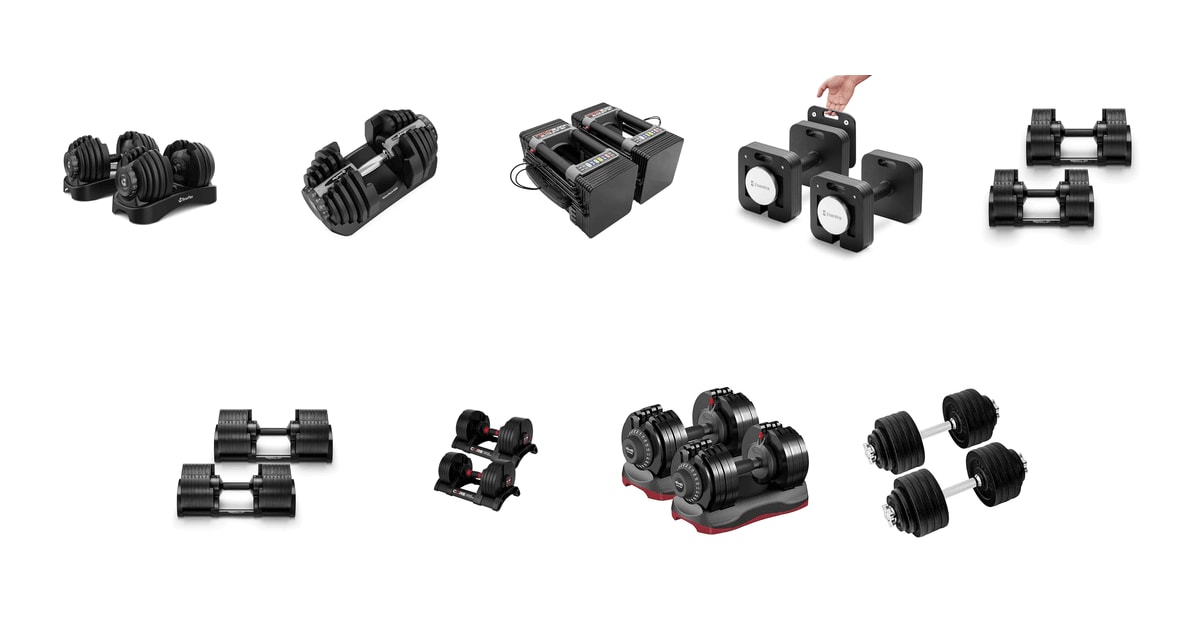
A rack of fixed dumbbells eats a whole wall and costs more than most people want to spend. One adjustable pair does the same job in about the space of a laundry basket. You spin a dial, twist a handle, or pull a pin, and the weight you don't need stays behind in the cradle. That's the whole pitch, and for a spare bedroom or a corner of the garage it's a good one. What separates a set you'll use for years from one that gathers dust is how little you have to think about it between sets.
Here's the honest part: nothing in this category feels quite like a real dumbbell. Every adjustable design trades away something — handle length grows at heavy weights, the plates sit wider than you expect, or the mechanism adds bulk right where your forearm wants to be. Most of them also can't be dropped. The plastic selectors and locking collars that make fast changes possible are the same parts that crack on impact. You lower these to the floor with control, every rep, forever.
We looked at nine sets across dial-select, twist-lock, pin-select and old-fashioned plate-and-collar designs, weighing published reviews, manufacturer specs and what owners report after months of use. We think that the BowFlex Results Series 552 SelectTech Dumbbells are the best adjustable dumbbells for most people, and that the PowerBlock Elite EXP is the one to buy if you expect to keep getting stronger and want a set that grows with you.
Everything we recommend

Fast dial changes and a range that covers most training

Buy once, then bolt on more weight as you get stronger

All metal, no electronics to break, slower to change

Feels closest to a real dumbbell, at a real premium

The same natural shape, carried up to heavy loads
At a glance
| Product | Weight Range | Increment | Price | |
|---|---|---|---|---|
| BowFlex Results Series 552 SelectTech DumbbellsTop pick | 5–52.5 lbs | 2.5 lb | $399 |
 | BowFlex Results Series 1090 SelectTech Single DumbbellAlso in lineup | 10–90 lbs | 5 lb | $399.99 |
| PowerBlock Elite EXP Adjustable DumbbellsRunner-up | 5–50 lb | 2.5 lb | $399.99 |
| Eisenlink Adjustable DumbbellsBudget pick | 5–50 lbs | 5 lb | $359 |
| NÜOBELL® Adjustable Dumbbell Set for HomeUpgrade pick | 5–50 LB | 5 lb | $599 |
| NÜOBELL® Adjustable Dumbbell Set for HomeAlso great | 5–80 LB | 5 lb | $769 |
 | Core Fitness® Adjustable Dumbbell Weight Set ByAlso consider | 5–50 lbs | — | $389.99 |
 | ATIVAFIT Adjustable Dumbbell Set 66 LB PairAlso consider | 11–66 LB | — | $399.99On sale |
 | Yes4All 105 LB Adjustable Dumbbell SetAlso in lineup | 40–200 lb | 1.25 lb | $170.94 |
How we picked
Adjustment speed. We compared documented mechanisms — dial, pin, twist-lock and threaded collar — and how long owners say a full change actually takes. Anything slower than about a minute per pair, we treated as unsuitable for circuit work.
Handle and shape. We read published reviews and owner feedback for complaints about handle length, plate width and wrist position. Sets whose handle geometry stays constant across weights scored higher.
Increment size. We looked at each manufacturer's published weight steps. Sets offering 2.5-pound jumps at the low end got credit, since that's where small increases matter most for isolation and rehab work.
Durability signals. We weighted owner reports of mechanisms jamming, collars loosening and plates cracking over months of use, along with each brand's stated warranty terms.
Room to grow. We favored systems with a documented expansion path or a high enough ceiling that most lifters won't outgrow them within a few years.
Top pick
Fast dial changes and a range that covers most training
BowFlex Results Series 552 SelectTech Dumbbells
A pair of dial-select dumbbells covering 5 to 52.5 pounds in 15 steps, with 2.5-pound jumps at the light end. It swaps weight in a couple of seconds, which is what you want when you're moving between sets and don't feel like doing math.
$399fromAmazonThe dial is the whole reason to buy these. You set the dumbbell in its tray, turn a dial at each end, and lift out the weight you picked. It takes seconds. If you superset curls and presses, or run circuits where standing around kills the point, that speed changes how you train. Slower designs quietly push you toward doing fewer weight changes than your program calls for.
The 5-to-52.5-pound range covers more than people expect. Most home lifters never press or row above 60 pounds per hand, and the 2.5-pound steps at the bottom matter more than the ceiling does — they're what let you add load on lateral raises or rehab work without a 5-pound cliff. One tray replaces fifteen pairs.
Owners who've had these for years keep coming back to the same point: the plates stay locked no matter which setting you're on, and the handles feel solid under load. Published reviews from the major fitness outlets have ranked this model at or near the top for a long time, which means the failure modes are well documented rather than unknown.
These are also the easiest set to live with if you're new to lifting. The dial is self-explanatory, the trays keep everything off your floor, and the ergonomic handle doesn't require a grip you have to learn. You won't spend your first month fighting the equipment instead of training.
Flaws but not dealbreakers
The slab shape is the real compromise. Weight sits out along the handle in a long rectangle, so floor presses, neutral-grip work and anything where the dumbbell needs to sit close to your body feels awkward. At light settings the bells are still physically large, which surprises people who bought them to start out at 10 or 15 pounds.
Drop one and you may crack the dial housing. This isn't a set you can bail out of a hard set with — lower them under control every time. There's also a recall in this model line's history around the adjustment system, which is worth knowing about even though the current version addresses it; buy from a source you trust and check that the plates seat fully before your first lift.
Each tray takes up more floor area than a block-style set at the same weight, so measure your corner before you commit.
Runner-up
Buy once, then bolt on more weight as you get stronger
PowerBlock Elite EXP Adjustable Dumbbells
A pin-select block that starts at 5 to 50 pounds per hand and accepts expansion kits to reach 70 or 90. The cage keeps the handle the same length at every setting, so a 45-pound dumbbell handles like a 15-pound one.
$399.99fromAmazonThe block design solves a problem the dial sets don't. Because the weight nests around a fixed handle instead of extending outward, the dumbbell never gets longer as it gets heavier. Your bench press setup at 20 pounds is the same setup at 50. For anyone training in tight space, that consistency is worth more than it sounds.
This is the only set here designed to grow with you. Stage 2 and Stage 3 kits take the same block from 50 to 70 to 90 pounds per hand. If you're two years into lifting and still adding weight, you buy expansion plates instead of buying a whole new pair. That math gets better the longer you train.
The magnetic pin is the mechanism, and it's about as simple as strength equipment gets — no springs, no plastic selector rods carrying load. Owners who've run these hard for years report they hold up, and the steel build is rated for high-frequency use rather than occasional home sessions. Weight changes take a second or two longer than a dial, which most people stop noticing.
Increments run 2.5, 5, 7.5, 10 and upward, so you get finer steps than a flat 5-pound ladder at the low end. It's not perfectly even — some half-steps exist and some don't — but you're rarely stuck.
Flaws but not dealbreakers
The cage sits around your hand, and that limits wrist rotation. Hammer curls and lateral raises are where people notice it most; the side bars are close enough that your natural hand path has to adjust. Most owners adapt within a few weeks, but if you do a lot of rotational or overhead work, try the movement pattern in your head before you buy.
Expansion kits cost extra and go out of stock. Planning to reach 90 pounds eventually means budgeting for parts you can't always get on demand.
Certain 2.5-pound targets simply aren't available — 12.5, 22.5, 32.5 and 42.5 don't exist in this system, which is a real annoyance if you like small, even jumps.
The Elite EXP comes with a five-year residential warranty.
Budget pick
All metal, no electronics to break, slower to change
Eisenlink Adjustable Dumbbells
A cast-iron pair covering 5 to 50 pounds with a quick-lock bolt at each end. You loosen a screw, pull or add plates, and tighten back down — no plastic selector to fail, and no cradle required to store them.
$359fromAmazonThe appeal here is that there's nothing to break. No dial, no spring-loaded selector, no plastic housing carrying the load. It's cast iron and a threaded bolt. Owners describe these as buy-once dumbbells, and several report loading them well past the stock weight with longer screws, which tells you something about the tolerances.
Because the plates are square, the tray footprint stays small — and you don't need a tray at all. Set them anywhere. That's genuinely useful in an apartment where the dumbbells have to live behind a couch instead of on a stand.
The trade you're making is time. Changing weight means loosening a bolt on each end, moving plates, and tightening back down. Owners consistently say it takes practice to get quick at it — you don't need to unscrew all the way, just enough to clear the plate — and that once you know the trick, a full change lands in under a minute rather than a few seconds.
There's less independent long-term review coverage on this brand than on BowFlex or PowerBlock. What owner feedback there is skews strongly positive on plate retention and build quality, but you're buying on less published testing history.
Flaws but not dealbreakers
Five pounds is the smallest jump, which is coarse if you're doing isolation work or coming back from an injury. Two 2.5-pound plates come in the box, but they're not a full micro-increment system across the range.
This is the wrong set for circuits, HIIT, or anything with short rest. If your program has you changing weight every ninety seconds, the bolt-and-plate routine will wear on you fast.
Support and replacement parts are less established than what the big brands offer, so factor that into a long-term purchase.
Eisenlink covers these with a one-year quality assurance and after-sales program.
Upgrade pick
Feels closest to a real dumbbell, at a real premium
NÜOBELL® Adjustable Dumbbell Set for Home
A twist-lock pair reaching 50 pounds per hand with round plates instead of a slab profile. You turn the handle in the cradle to pick your weight, and the shape stays close to a traditional dumbbell at every setting.
$599fromAmazonThe round plates are the point. Most adjustable dumbbells feel like bricks with a bar through them; this one feels roughly like the dumbbells at a commercial gym. That matters most on floor work, overhead presses and lateral raises — the movements where a long slab bangs into your ribs or forces your wrist somewhere it doesn't want to go.
Changing weight is one motion with one hand. Set it in the cradle, twist the handle, lift it out. There's no adjusting each end separately, which owners upgrading from dial-select sets call out as the single biggest improvement. Five-pound steps across the range, no exceptions.
It's also quiet. Powder-coated iron plates, an anodized aluminum handle, and nylon components mean you get a soft click rather than the clank and rattle of loose plates. If you train early in an apartment with someone sleeping on the other side of a wall, that's not a small thing.
The storage cradle has the smallest footprint of any 50-pound set here, and the handle geometry doesn't change with load. What you learn at 20 pounds still applies at 50.
Flaws but not dealbreakers
It costs a lot more than slab-style sets that reach the same 50 pounds. You're paying for shape and feel, not capacity, and whether that's worth it depends on how often you train and how much the ergonomics bother you.
There's no expansion path. Fifty pounds is the ceiling, and getting past it means buying the separate 80-pound set rather than adding plates.
The twist collar needs to be fully engaged before you lift. Owners report it can feel slightly loose if you rush the twist, and a couple note the handle knurling is smoother than they'd like once your hands get sweaty. Also, counterfeits circulate — check that you're buying from the official store.
NÜOBELL offers a two-year warranty through its store.
Also great
The same natural shape, carried up to heavy loads
NÜOBELL® Adjustable Dumbbell Set for Home
The 80-pound version of the NÜOBELL twist-lock design. It keeps the round-plate profile and one-handed adjustment while adding the range you need for heavy rows, split squats and incline pressing.
$769fromAmazonHandle geometry matters most exactly where slab designs get worst. Above 60 pounds, a rectangular dumbbell gets long enough that heavy rows and incline presses start fighting your setup. This one stays compact and round, so a heavy row feels like a heavy row instead of a balancing exercise.
If you've already outgrown a 50-pound ceiling, this is the shortest path to more weight without changing how you train. Same twist-lock, same cradle motion, same five-pound ladder from 5 to 80. Nothing to relearn.
It's the most expensive set in this guide, and that's the whole conversation. You're paying for shape at heavy loads, which is a narrow benefit — real, but only if you actually train up there. Most home lifters don't.
The cradle is larger and heavier than the 50-pound version's, and the overall unit is longer. Check your floor space, especially if the plan is to slide these under a bench between sessions.
Flaws but not dealbreakers
Five-pound increments are the only option, which is coarse at the light end. Starting a beginner on this set means jumping from 5 to 10 pounds on movements where that's a big relative leap.
The smooth handle finish that some owners flag on the 50-pound version carries over here, and it matters more when you're holding 80 pounds. Chalk or lifting gloves help.
At this weight, dropping one is both more likely and more costly. The twist-lock mechanism isn't built for impact.
NÜOBELL offers a two-year warranty through its store.
Who this is for
Buy an adjustable set if you train at home two or more times a week and you're tired of either driving to a gym or owning three pairs of dumbbells that are all the wrong weight. They make the most sense for general strength work, hypertrophy, and anything built around presses, rows, curls and lunges. If you're rowing close to 60 pounds per hand already, shop the heavier sets here rather than assuming you'll grow into a 50-pound ceiling.
Skip them if your training involves dropping weight — Olympic-style work, heavy failure sets without a spotter, anything where you might need to bail. Almost every set here has parts that crack on impact. This guide covers adjustable dumbbells for home use, not fixed dumbbell racks, kettlebells, or barbell systems, and it doesn't cover the benches, racks or stands you might pair with them.
How we picked
We built the list around five things. Adjustment speed: how fast you can actually change weight between sets, judged from documented mechanisms and what owners report in practice, not marketing claims. Handle and shape: whether the dumbbell stays a manageable length at heavy settings, since that's what determines if floor presses and rows feel natural or awkward. Increment size: 2.5-pound jumps at the low end for isolation and rehab work, 5-pound steps as the acceptable minimum higher up. Durability signals: owner reports of jammed selectors, loosening collars and cracked housings over months of use, plus each brand's published warranty. Room to grow: an expansion path or a ceiling high enough that you won't be shopping again in two years.
Other adjustable dumbbells worth considering
If you want fine weight jumps at a mid-range price: The Core Fitness® Adjustable Dumbbell Weight Set By ($389.99) — The Core Fitness set uses a one-handed twist mechanism and offers 2.5-pound increments across a wider stretch of its range than most sets in its class, which most competitors reserve for the light end and then abandon. That precision is genuinely useful for isolation work, physique training and coming back from an injury, where a 5-pound jump can be a 20 percent increase. It's slab-shaped, so it inherits the same floor-press and neutral-grip awkwardness as the BowFlex 552, and owners note the heads are wide enough to notice on single-dumbbell overhead work. There's also less long-term independent review coverage than the top brands have.
If you want 65-plus pounds per hand without paying premium prices: The ATIVAFIT Adjustable Dumbbell Set 66 LB Pair ($399.99) — The ATIVAFIT reaches roughly 66 pounds per hand through a twelve-position dial, and it comes with a storage box that protects the mechanism — a nice touch most sets at this level skip. Owners upgrading from dial-select competitors like that you adjust one end instead of two. The catches are real, though: at maximum load the slab profile gets long and unwieldy, the increments work out to about 5.5 pounds rather than clean 5-pound steps, which fouls up standard programming, and a meaningful minority of owners report locks jamming with slow warranty response afterward. Owner satisfaction here sits noticeably below the other picks.
The competition
These are the sets our research surfaced alongside the picks, not a complete map of what's on the market. Each one lost on a specific point rather than being bad, and a couple of them are the right answer for a narrow set of people.
The BowFlex Results Series 1090 SelectTech Single Dumbbell ($399.99) — The BowFlex Results Series 1090 extends the familiar dial-select platform to 90 pounds in 5-pound steps, sold as a single dumbbell. On paper that's the natural upgrade from the 552, and for heavy rows and Romanian deadlifts the capacity is welcome. Two things kept it out of the picks. The handle grows very long at the top of its range, which makes pressing movements awkward exactly where you need control most. And owner feedback on this listing is thin and unusually mixed, with reports of the mechanism jamming and requiring a reset, plus complaints that a pair from the manufacturer can cost about what a single unit runs here. If you already own and like 552s and want a heavier match, it's a reasonable choice — but check what a pair costs elsewhere first.
The Yes4All 105 LB Adjustable Dumbbell Set ($170.94) — The Yes4All 105 LB set is a different animal: cast-iron plates, threaded handles and spin-lock collars, with no integrated mechanism at all. It offers the highest raw capacity here and the most loading flexibility, since you can build any combination the plates allow, and it's the one set in this guide that shrugs off rough handling. But changing weight takes a minute or more, the loose plates need dedicated floor or shelf space, and the collars work loose over time and need checking. If you do heavy, low-rep compound sets with long rests and you don't mind the routine, it's a lot of iron for the money. For anyone doing circuits or supersets, it's the wrong tool.
Care and setup
Give every set a floor plan before it arrives. Most of these need a cradle or tray, and the trays run larger than the dumbbells themselves — measure the corner you're planning to use, plus the space you need to stand and press. Once they're in, the maintenance is mostly habit. Seat the dumbbell fully in its cradle before you turn the dial or twist the handle, and confirm the setting engaged before you lift, since a partially locked collar is how plates come loose. Lower them to the floor under control every single rep; the mechanisms that make fast changes possible are the ones that crack on impact. On threaded and spin-lock designs, check the collars before each session, because they back off over time. Wipe sweat off the handles so the knurling doesn't corrode, and store everything somewhere dry.
Questions we get
Are adjustable dumbbells worth it for a home gym?
For most people, yes. One quality pair replaces ten to fifteen pairs of fixed dumbbells and takes up roughly the footprint of a laundry basket, which is the difference between having a home gym and not having room for one. The catch is that they cost more per pound than fixed weights and they're less durable. If space isn't tight and you only need two or three weights, fixed dumbbells are cheaper and tougher.
Can you drop adjustable dumbbells?
No, with one exception. Nearly all integrated-mechanism sets use plastic housings, selector rods or locking collars that crack or jam on impact, and dropping one is the single most common way people break them. Lower them to the floor with control every rep. Traditional plate-and-collar sets like the Yes4All handle rough treatment fine, since there's nothing in them but iron and threads.
How long do adjustable dumbbells last?
Good sets from the established brands generally last many years of regular home use, and owners routinely report multi-year ownership without problems. What kills them is impact and neglected collars, not wear from lifting. Warranty terms vary a lot — PowerBlock covers the Elite EXP for five years residential, NÜOBELL offers two years, and Core Fitness covers parts for two.
What increment size do I actually need?
For compound lifts like presses, rows and lunges, 5-pound jumps are fine — you'll progress past them quickly enough. For isolation work like lateral raises and curls, or for rehab, 2.5-pound steps matter a lot, because a 5-pound jump on a 15-pound raise is a 33 percent increase you probably can't make. If most of your training is small-muscle or physique work, prioritize a set with fine increments.
What's the difference between dial-select, pin-select and twist-lock?
Dial-select uses a rotating dial at each end to pick up plates; it's fast and common on slab-shaped sets. Pin-select drops a pin into a stack inside a block cage, which is simple and durable but restricts wrist rotation slightly. Twist-lock has you turn the handle itself while the dumbbell sits in its cradle, usually with one hand, and it pairs with round-plate designs that feel closest to traditional dumbbells. All three are fast enough for normal training.
How much maximum weight should I buy?
Less than you think. Most home lifters never exceed 60 pounds per hand in practice, and buying for a ceiling you might reach in five years usually means paying more for a longer, bulkier dumbbell you'll fight every session. Unless you're already rowing or pressing near 50 pounds per hand, a 50-pound set covers years of training. If you want insurance, buy an expandable system rather than an oversized one.
Why you should trust us
For this guide:
- We compared manufacturer specifications for every set here — weight ranges, increment tables, dimensions, materials and stated warranty terms.
- We read published reviews from independent fitness outlets alongside owner feedback, looking for failure modes that show up repeatedly rather than one-off complaints.
- We did not use, install or handle any of these dumbbells, so every claim here traces back to published specs, published reviews, or what owners consistently report.
- We read owner reviews on every listing, weighted toward the critical ones, because that is where the recurring failures show up.
- We have a systematic way of automatically fetching the latest prices, so the numbers on this page stay current.
- This is a research-focused guide, so the team may not own every product listed — though we often do own the top winners, which gives us extra context for the recommendations.
- We don't accept free products, and the retailer commission never changes which product we recommend.
Sources
Best Adjustable Dumbbells – BarBend, BarBend
Best Adjustable Dumbbells – Garage Gym Reviews, Garage Gym Reviews
Best Adjustable Dumbbells – Men's Health, Men's Health
Best Adjustable Dumbbells – Tom's Guide, Tom's Guide
Best Adjustable Dumbbells – Wirecutter (NYT), Wirecutter (NYT)
Best Adjustable Dumbbells – Healthline, Healthline
Best Adjustable Dumbbells – Women's Health, Women's Health
Best Adjustable Dumbbells – Shape, Shape
Amazon product listings and owner reviews for all 9 products
Manufacturer specification pages for each product
Some passages in this guide may be paraphrased with AI help. Prices are refreshed automatically.
More like this.
Continue exploring health reviews and recommendations.

The Best Adjustable Dumbbells
A pair of adjustable dumbbells replaces a rack you don't have room for. Instead of ten or fifteen pairs of fixed weights eating a wall of your garage, you…

The Best Adjustable Weight Benches
A bench doesn't look like much. It's a padded slab on a steel frame. But it's where most of your upper-body work happens - flat presses, incline dumbbell…

The Best Adjustable Weight Benches
A bench is the piece of gear that turns a pile of dumbbells into an actual gym. Flat, incline, decline - change the angle and you change which part of…

The Best Adjustable Carbon SUP Paddles
A paddle is the piece of gear you actually hold for the entire session, and its weight is the thing you feel first. Every stroke means lifting the blade…

The Best Height-Adjustable Standing Desks
A standing desk earns its keep in the small moments. It's the mid-afternoon slump when your lower back starts complaining and you'd rather not sit through…

The Best Adjustable Bed Bases
An adjustable base changes how you use your bed the rest of the day. You raise the head to read without stacking four pillows. You lift your feet after a…