The Best Christmas Tree Stands
A tree stand does one job, and you notice it only when it fails. It has to hold a top-heavy tree upright on a floor that's never quite level, through six weeks of ornaments, gift piles and one curious cat. If your tree is real, it also has to hold water. A fresh-cut tree can drink close to a gallon in its first day, and about a quart a day after that. Run the bowl dry once and the needles start dropping.
No stand solves everything. The sturdy ones are heavy, rust-prone and ugly enough that you'll want a skirt over them. The light ones flex under a nine-foot tree. Almost every real-tree stand still asks somebody to lie on the floor and tighten bolts while a second person holds the trunk straight. And no bowl is big enough to skip the daily water check, no matter what the box says. Expect a chore, and pick the stand that makes it the smallest chore.
This guide covers stands you buy on their own, for both cut trees and artificial ones. Those are two different products. A cut tree needs a water bowl and bolts that bite into bark. An artificial tree needs a base that grips a metal pole and, ideally, folds flat when the season's over. We think that the Jack-Post Basix Christmas Tree Stand is the best Christmas tree stand for most people, and that the Casafield 360-Degree Rotating Christmas Tree Stand is the one to buy if your tree is artificial and you want it to turn slowly under the lights.
Everything we recommend

Welded steel and a wide leg span for a real tree up to 8 feet

A slow spin and three outlets, for an artificial tree

Folds flat for storage and rolls out from the wall
Prices as of Oct 25, 6:48 AM PT · Details
At a glance
| Product | Max tree height | Base width | Price | |
|---|---|---|---|---|
 | Rolling Christmas Tree Stand Base with WheelsAlso in lineup | 7.5 ft | — | $36.99 |
| Jack-Post Basix Christmas Tree StandTop pick | 8 ft | 24.25 in | $70.60 |
| National Tree Company Christmas Tree StandAlso great | 7.5 to 8 ft | 28 in | $50.99 |
| Casafield 360-Degree Rotating Christmas Tree Stand -Upgrade pick | 7.5 ft | 26 in | $49.99 |
Prices as of Oct 25, 6:48 AM PT · Details
How we picked
Base width. We compared leg spans and outer dimensions on every spec sheet, because published stability comparisons put base width ahead of stand weight for tip-resistance. Anything narrower than about 16 inches got a hard look.
Water capacity. For cut trees we wanted a bowl holding at least a gallon, since a fresh tree can drink close to that on its first day. Fire-safety guidance is stricter still, suggesting about a gallon of capacity per inch of trunk diameter.
Setup without help. We favored mechanisms one person can work. Reviewers who compare stand types consistently find that eye-bolt and thumbscrew designs go much better with a second pair of hands.
Materials and build. Welded steel and cast iron hold trees over 7 feet steadier than stamped metal or molded plastic in published comparisons. So we read construction details on spec sheets, not just shipping weight.
Storage and moving. We noted which stands fold and which roll. Owner feedback keeps circling the same two chores: getting the stand into a closet, and getting a decorated tree away from the wall.
Top pick
Welded steel and a wide leg span for a real tree up to 8 feet
Jack-Post Basix Christmas Tree Stand
The Jack-Post Basix is a welded steel stand with four eye bolts, legs that span about two feet, and a 1.1-gallon bowl for trees up to 8 feet tall. It's the plainest thing here, and for a cut tree in a normal living room that's exactly the point.
$70.60fromAmazonPrices as of Oct 25, 6:48 AM PT · Details
Welded steel is what keeps a real tree standing. Published comparisons of tree stands land in the same place: cast iron and welded steel hold trees over 7 feet steady, while stamped metal and molded plastic start to wobble. This one is welded tubular steel with four T-nut-tipped eye bolts, so the bolts bite the trunk instead of flexing the frame. That's the difference you feel when someone bumps the tree on the way past.
The leg span is about 24 inches, which matters more than the stand's weight. Stability work published on tree stands points to base width as the main defense against tipping, with anything under about 16 inches across giving up ground to wider bases. Twenty-four inches puts the outer legs well past the branch line of a 7-foot tree, so a shove from a dog or a toddler gets absorbed by the floor, not the trunk.
The bowl holds 1.1 gallons, which is generous for a stand this size. That matters most on the first day, since a fresh-cut tree can take close to a gallon within 24 hours of going in. You'll still top it off daily, but you're less likely to come downstairs to a dry bowl the morning after setup, which is exactly when a tree dries out fastest.
It should outlast a decade of trees. There's nothing here to break. No motor, no plastic hinges, no gears. Welded legs and threaded bolts are the same parts tree stands used forty years ago, and owners of this style tend to keep them until the bowl finally rusts through. Rinse it and dry it before it goes back in the box and you'll put that off for years.
Flaws but not dealbreakers
It's an eye-bolt stand, which means two people. One holds the trunk plumb, the other lies on the floor tightening bolts in a cross pattern, and you'll probably repeat that once the tree settles. If you always decorate alone, or your back objects to floor work, a pedal-operated stand is worth paying more for.
The 1.1-gallon bowl asks for daily attention. Fire-safety guidance suggests roughly a gallon of capacity for every inch of trunk diameter, and a 4-inch trunk blows past what this bowl holds. In practice that means a check every morning, plus a funnel or a long-spout can if the lower branches are dense.
The fit is specific: trees up to 8 feet, a trunk of about 4.25 inches, and about 5 inches of bare trunk below the lowest branches. Lot attendants will cut that for you if you ask. A 10-foot tree or a fat, gnarly trunk needs a bigger stand than this one.
Upgrade pick
A slow spin and three outlets, for an artificial tree
Casafield 360-Degree Rotating Christmas Tree Stand -
The Casafield is a motorized base that turns an artificial tree a full circle every 70 seconds, with three outlets in the base so your light cords stop tangling. It fits artificial trees up to 7.5 feet, and it's the most expensive stand here.
$49.99fromAmazonPrices as of Oct 25, 6:48 AM PT · Details
A rotating base changes what a tree in a corner looks like. Most people push the tree against a wall and decorate the front third. This one turns the whole tree past you every 70 seconds, so the ornaments on the back get their turn and the lights sweep across the room instead of sitting still. Kids notice it immediately. So do guests, which is either the appeal or the reason to skip it.
The three outlets in the base solve a real annoyance. A rotating tree can't have a cord running straight to the wall, so the base carries the power instead. You plug your light strands into the base, run the base's 55-inch cord to the outlet, and the switch on the housing gives you lights alone or lights plus rotation. That's one switch instead of crawling behind the tree twice a night.
It's a wide base for what it does. The housing measures 26 inches across, which is broader than most artificial-tree bases and gives the motor something to work against once the tree is loaded with ornaments. Assembly is five pieces, the motor housing plus four legs, and the dark green finish disappears under the lowest branches without a skirt.
Flaws but not dealbreakers
It's for artificial trees only. There's no water bowl, no bolts to bite bark, and a sawn trunk won't seat in the pole fittings. If you buy a fresh tree, this isn't your stand.
The 7.5-foot ceiling is a hard limit rather than a soft one, because a taller tree puts far more leverage on a base that moves. A motor is also a part that can fail, unlike the welded steel of our top pick. Keep it dry, keep the ornament load reasonable, and switch the rotation off overnight.
Also great
Folds flat for storage and rolls out from the wall
National Tree Company Christmas Tree Stand
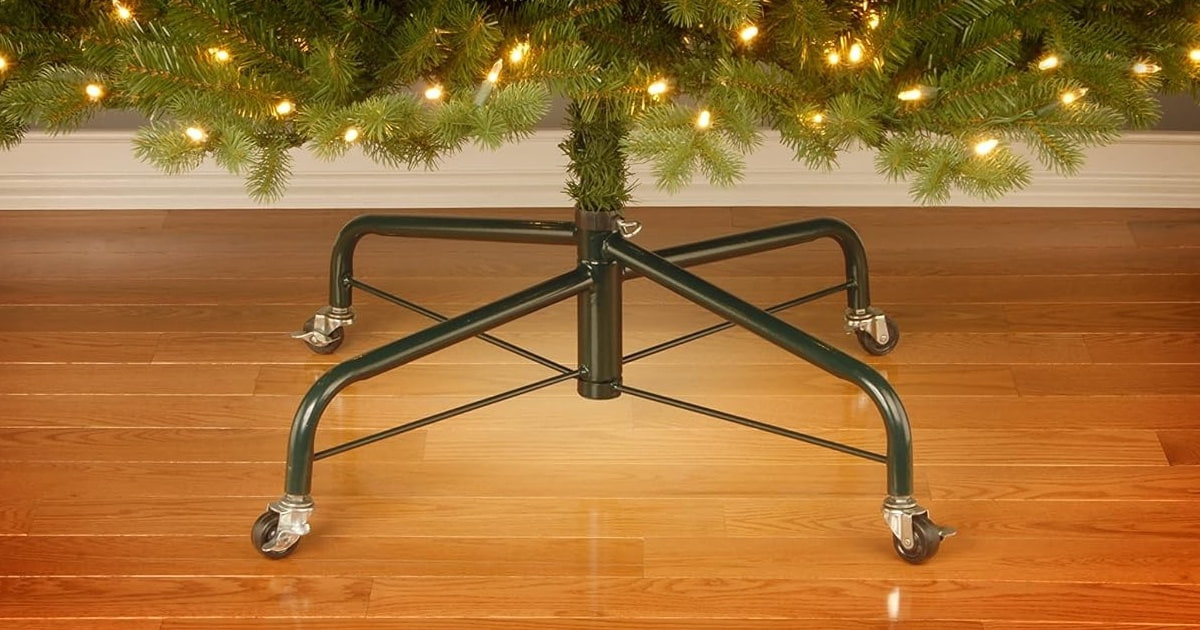
This 28-inch steel base folds flat, locks onto a pole up to 1.25 inches, and rides on four lockable wheels. It fits artificial trees from 7.5 to 8 feet, and it's the stand to get if closet space matters as much as stability.
$50.99fromAmazonPrices as of Oct 25, 6:48 AM PT · Details
Twenty-eight inches across is wide for a folding stand. That's the number that matters most for tipping, and published stability comparisons put wide bases ahead of heavy ones. The four legs open well past the lowest branches of a 7.5-foot tree, and the steel construction means they don't spring back the way thin stamped brackets do when the tree leans toward the window.
The wheels are the part you'll thank later. Once a tree is decorated and pushed into a corner, moving it usually means dragging the base and listening to ornaments swing. Here you unlock four casters, pivot the tree out, do what you need to, and lock them again. Shoppers with back or mobility concerns ask for this feature more than any other, and it costs you nothing in stability once the locks are on.
It collapses to something you can slide behind a coat. Folding stands take up roughly a quarter of their assembled footprint once the legs come in, and at a bit over two pounds this one is easy to lift onto a shelf. If you live in an apartment with one closet and no attic, that's the whole argument.
Flaws but not dealbreakers
The pole has to fit. This base is built for a center pole up to 1.25 inches, and plenty of larger artificial trees use a thicker pole or a shaped foot that won't seat properly. Measure with a tape first, and don't assume the tree you already own matches.
It's light, and light has limits. At just over two pounds, the stand adds almost nothing to the tree's own ballast, so a heavily decorated 8-foot tree with a tall topper still needs a spot away from traffic. It holds no water either, so a cut tree is out.
Who this is for
Buy a stand of your own if your tree is taller than about 6 feet, if the one in the garage is rusted or bent, or if your artificial tree came with a flimsy base that has always made you nervous. If you have a cut tree, you want welded steel and a real bowl. If you have an artificial tree, you want a base that grips the pole and stores flat, and you can skip the water hardware entirely.
This guide covers standalone stands for trees roughly 7 to 8 feet, which is where most living rooms land. It doesn't cover 10- and 12-foot commercial stands, the flimsy base that shipped in the box with your artificial tree, or skirts, collars and watering funnels. And if you need a stand a single person can set up without kneeling on the floor, look at pedal-operated designs, which none of these stands use.
How we picked
Base width: we compared leg spans and outer dimensions first, since wide bases resist tipping better than heavy ones do. Water: for cut trees we wanted at least a gallon in the bowl, because a fresh tree drinks close to that on day one. Setup: we preferred mechanisms one person can manage, and we say plainly which stands want a helper. Build: welded steel and cast iron beat stamped metal and plastic under trees over 7 feet, so we read construction details rather than shipping weight. Storage: we noted which stands fold flat and which roll, because both chores come around every season.
The competition
Here's what our research surfaced beyond the picks, which isn't everything sold. Tree stands are a seasonal, regional business, and plenty of good hardware never shows up in a search. What follows is the one remaining stand we looked at, and why it didn't beat a pick.
The Rolling Christmas Tree Stand Base with Wheels — The Hammrit rolling stand is a wheeled base for artificial trees up to 7.5 feet, and it comes with three PVC sleeves so it can grip poles of 3/4, 7/8 or 1.25 inches. That sleeve set is genuinely handy if you don't know your pole size, and the four casters lock the way the National Tree Company stand's do. It loses on the things that matter most. The listing never states a base width, and at under 4 pounds with plastic sleeves doing the gripping, it leans harder on the tree's own balance than a steel base does. It also doesn't fold. Choose it if your pole is an odd size and your tree gets moved a lot.
Setup and watering
Get the trunk plumb before you tighten anything, and have someone sight it from two directions across the room. On an eye-bolt stand, tighten opposite bolts a little at a time, the way you'd put a wheel back on a car, then check again after an hour once the tree settles. For a cut tree, saw a fresh half inch off the base right before it goes in, and fill the bowl as soon as it's upright. Check the water every morning. Never let the cut end go dry, because sap seals it over and the tree stops drinking. Rinse and dry the bowl before it goes into storage so it doesn't rust.
Questions we get
How much water does a fresh-cut tree need?
More than you'd expect on the first day. A fresh-cut tree can absorb close to a gallon within 24 hours of going into the stand, then roughly a quart a day after that. Fire-safety guidance goes further, suggesting about a gallon of stand capacity per inch of trunk diameter. Whatever the bowl holds, check it every morning.
Can I use a real-tree stand for an artificial tree, or the other way around?
Usually not, and it's the most common mistake here. A cut-tree stand grips bark with bolts and needs several inches of bare trunk, which an artificial tree's thin metal pole can't give it. An artificial-tree base grips that pole and has no water bowl, so a wet sawn trunk has nowhere to sit. Buy for the tree you actually own.
How do I keep a heavy tree from tipping over?
Start with base width. Published stability comparisons find that stands measuring 18 inches or more across resist tipping better than narrower ones, and that matters more than how much the stand itself weighs. Get the trunk vertical, then keep the heaviest ornaments low and close to the trunk. Put the tree in a corner rather than a walkway if you have pets or small kids.
Are rolling tree stands worth it?
If you water a real tree, or you push your tree against a wall, yes. Shoppers with back and mobility concerns ask for wheels more than any other feature, because the alternative is reaching under a decorated tree twice a day. Just make sure the casters lock. An unlocked wheeled base under a loaded tree is worse than no wheels at all.
What trunk or pole diameter will fit?
Most cut-tree stands top out around a 6-inch trunk, and our top pick is rated for about 4.25 inches, which covers a typical 7- to 8-foot tree. Artificial-tree bases have the opposite problem. They're sized for one specific pole, often up to 1.25 inches, so measure yours with a tape before you order.
Why you should trust us
For this guide:
- We read the manufacturer spec sheets for every stand here, comparing leg span, stated tree height, trunk or pole diameter and water capacity side by side.
- We also went through published stand comparisons and fire-safety guidance on water capacity and base width, and we read owner feedback for the complaints that repeat: wobble, rust, and bolts that loosen after a week.
- We read owner reviews on every listing, weighted toward the critical ones, because that is where the recurring failures show up.
- We have a systematic way of automatically fetching the latest prices, so the numbers on this page stay current.
- This is a research-focused guide, so the team may not own every product listed — though we often do own the top winners, which gives us extra context for the recommendations.
- We don't accept free products, and the retailer commission never changes which product we recommend.
Sources
The Best Christmas Tree Stands, Tested by Editors, Bob Vila
We Tested 10 Christmas Tree Stands to Find the Sturdiest Options, Good Housekeeping Institute
How to Choose a Christmas Tree Stand That Won't Tip Over, The Spruce
The Best Christmas Tree Stands for Real and Artificial Trees, Family Handyman
How Much Water Does a Christmas Tree Really Need?, National Christmas Tree Association
Best Christmas Tree Stands of 2025, Reviewed, Real Simple
Christmas Tree Fire Safety and Stand Stability Guidance, National Fire Protection Association (NFPA)
This Old House Tests Tree Stands for Easiest Setup, This Old House
Krinner Tree Genie XXL Product Specifications, Krinner USA (Manufacturer)
Best Christmas Tree Stands, According to Testing, Martha Stewart
Consumer Reports Holiday Decor Buying Guide, Consumer Reports
Tips for Preventing Your Christmas Tree From Tipping Over, wikiHow (Home Safety)
Amazon product listings and owner reviews for all 4 products
Manufacturer specification pages for each product
Some passages in this guide may be paraphrased with AI help.
Product prices and availability are accurate as of the date/time indicated and are subject to change. Any price and availability information displayed on Amazon.com at the time of purchase will apply to the purchase of this product.
More like this.
Continue exploring home reviews and recommendations.

The Best Christmas Tree Watering Systems
A fresh-cut tree drinks more than most people expect. University of Illinois Extension recommends a quart of water per inch of trunk diameter on day one,…

The Best Artificial Christmas Trees
An artificial tree is something you own for a decade and use for six weeks a year. So the things that matter aren't the ones printed on the box. You care…

The Best Christmas Ornament Storage Boxes
Ornaments spend eleven months of the year in a box and one month on a tree. That ratio explains why storage matters more than most people expect. A good…

The Best Animated Christmas Yard Decorations
A yard decoration works about forty nights a year, and it works hard. It sits out in wind, rain and road salt. It plugs into an outdoor outlet and stays…

The Best Outdoor Smart Plugs for Christmas Lights
Stringing lights is the fun part. Remembering to unplug them at 11 p.m. in the freezing cold, night after night, is not. An outdoor smart plug fixes that:…

The Best Cookbook Stands
A cookbook stand does one job: it holds your book open, at an angle you can read, somewhere the sauce can't reach it. That sounds trivial until you're…